Another United States Army officer was killed today as the Việt Cộng guerrillas retreated from a three‐day battle at An Lão and carried out raids and ambushes at a dozen other places in Central Vietnam. The officer was the sixth American killed in three days of fighting in Vietnam. A United States spokesman said an American enlisted man and an Australian warrant officer were wounded in the same attack a charge to retake a hill 347 miles northeast of Saigon. Early this morning a United States infantry officer was killed in a Communist ambush on Highway No. 1 in Phú Yên Province, on the South China Sea 230 miles northeast of Saigon. America’s dead in South Vietnam now total 232 in combat since December, 1961. Typical of the smaller actions was the Communist penetration of a garrisoned hamlet in Đắk Lắk Province, plateau country 150 miles north of Saigon. The raiders captured 32 weapons and 10 of the defenders. In Quảng Tín Province a Việt Cộng band seized two 105mm. guns, but a United States spokesman said Government planes later destroyed them.
They rash of minor attacks came after Government reinforcements poured in by helicopters helped a beleaguered garrison turn back several hundred guerrillas at the district headquarters at An Lão, in a mountain valley of Bình Định Province, 300 miles northeast of Saigon. The reinforcements totaled three battalions — perhaps 1,000 men. A Vietnamese division commander said United States air power saved the day. Intensive air attacks softened up Việt Cộng forces bombarding An Lão from a hill overlooking the town. Then Vietnamese troops, snaking their way under heavy fire, recaptured the hill. Pfc. Arthur A. Shelton of Loyalton, California, a helicopter gunner, was killed in the battle. The Vietnamese dead, still uncounted, were. believed to total more than 50. Another American, Specialist. 5 William R. Hamlin of Seattle, was reported missing.
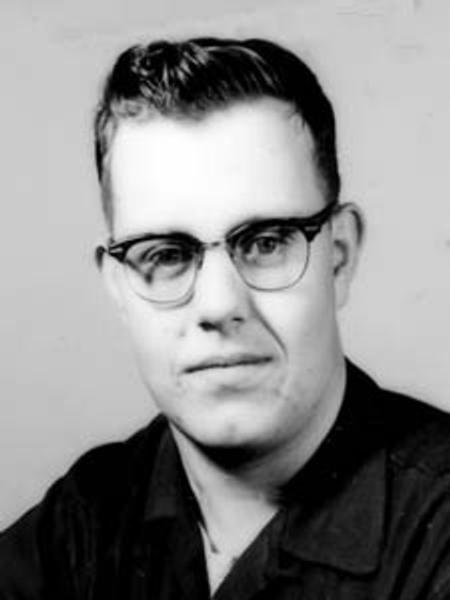
The Army identified today two officers killed in action in Vietnam. Major John F. Stonebrunner of Sandia Base, New Mexico, was killed today in an ambush. First Lieutenant Brian K. Skinner of Denver was killed when Việt Cộng troops attacked Vietnamese forces to which he was adviser.
Senator J. W. Fulbright said yesterday that stepping up the war in Vietnam would be senseless and indicated that United States involvement was a mistake in the first place. The Arkansas Democrat, who is chairman of the Senate Foreign Relations Committee, addressed 2,000 students at Southern Methodist University and then said at a news conference that he agreed with the late Gen. Douglas MacArthur that the United States should not get into a land war in Asia. “I do not advocate getting out, however,” Mr. Fulbright said. “On the other hand, I would not advocate escalating the war.” He said throwing hundreds of thousands of Americans into the war would be a “senseless effort.” Mr. Fulbright said American involvement in South Vietnam began in 1954 with an aid program “we should never have undertaken.’’
The Laotian Government made public today a white paper on “North Vietnamese interference” in Laos. The paper included details of prisoners in Laotian hands and the results of investigations by the International Control Commission, which supervises the truce in Laos. The Premier, Prince Souvanna Phouma, in a foreward, noted that though Laos had complained of North Vietnamese interference for a long time, public opinion as well as some governments had received these complaints with “skepticism.” “Nevertheless, it is true North Vietnamese troops have played a leading part in fighting” between government forces and those of the pro-Communist Pathet Lao, he asserted.
Misinterpretation of a Communist Việt Cộng broadcast led to an erroneous report that Captain Richard L. Whiteside has been captured but is well, the office of Representative John J. McFall, Democrat of California, said today. Captain Whiteside a United States pilot in Vietnam, has been missing since last March. An aide said that an account of the broadcast given Mr. McFall’s office December 2, indicated that it referred to Captain Whitehead. A recheck showed, the aide said, that the broadcast actually referred to Captain Floyd James Thompson of the Army Special Forces, who was a passenger in the Army observation plane piloted by Captain Whiteside that crashed in the jungle area near Saigon. The actual transcript of the broadcast, the aide said, indicates that Captain Thompson is a prisoner of the Việt Cộng but contained no information about Captain Whiteside’s whereabouts. The transcript was sent to Captain Whiteside’s father and wife in Stockton, California.
United States and Cambodian diplomats met again today to try to improve the strained relations between the two countries, but they disclosed no details of their talks.
Foreign Minister Thanat Khoman of Thailand charged today that Cambodia had connived “with certain aggressive forces” in Southeast Asia. He said this had effectively endangered the peace, security and freedom of the area. Mr. Thanat made his statement in the General Assembly. He did not name the forces, but his remarks appeared to be aimed at the Việt Cộng rebels in South Vietnam. South Vietnam has charged that Cambodia has given sanctuary to the Communist forces and that she has allowed the transport of military supplies to the guerrillas through her territory. Cambodia has denied the charges. Mr. Thanat also said relations between Thailand and Cambodia continued to be strained because of Cambodia’s repeated failure to honor agreements reached after mediation by a United Nations mission. He said Cambodia was continuing “violent and unjustified attacks” on Thailand on the radio and in the press. These attacks, he said, accuse Thailand of threatening Cambodian’s existence. Mr. Thanat described them as “fabricated to mislead the uninformed public.”
President Johnson and Foreign Minister Andrei A. Gromyko conferred today at the White House on a wide range of East-West problems but made little progress toward resolving specific issues. The late‐afternoon talks in the President’s office were described by officials as a general restatement of views by the United States and the Soviet Union. The exchange did not result in any change of position, according to the officials, nor did either side offer any new initiative to reduce East-West tensions. After the meeting, which lasted an hour and 20 minutes, a smiling Mr. Gromyko told White House reporters that the conversation had been “useful” and the atmosphere “friendly.” The White House had no comment.
At a meeting earlier in the day, Secretary of State Dean Rusk suggested again to the Soviet Union that it use its influence to stop the Communist insurgency in South Vietnam. Mr. Gromyko was reported to have reiterated the Soviet position that the difficulties in South Vietnam stemmed from American military intervention. The Gromyko visit was described by officials as primarily a courtesy call by the Soviet Foreign Minister, who had come to the United States to attend the United Nations General Assembly session in New York. He and Mr. Rusk conferred there last week. The President used the occasion for a general discussion of long-standing problems. From the description by American sources, it was apparent that he and his visitor had trod over familiar ground without reaching any new basis for agreement.
Mr. Gromyko was said to have restated familiar Soviet views on East‐West relations, and Mr. Johnson was said to have re‐emphasized the United States’ intention to maintain its military strength while seeking some accommodation with the Soviet. Union as a means of reducing tensions and cutting back armaments. Mr. Gromyko and his party met with Mr. Johnson in his office after posing for photographs outside the White House. The Soviet official was accompanied by Ambassador Anatoly F. Dobrynin; Mikhail N. Smirnovsky, chief of the American section of the Soviet Foreign Ministry, and Vladimir S. Semyonov, deputy Soviet representative at the United Nations. With the President were Secretary Rusk; Foy D. Kohler, United States Ambassador to the Soviet Union, and Llewellyn E. Thompson, Deputy Under Secretary of State and former Ambassador to Moscow.
Former Secretary of State Dean Acheson criticized tonight the use of what he called, “moralistic maxims” in the conduct of the United States’ foreign relations. Examples of this, he said, are the long‐held concept that the United States should deny itself the use of force in all circumstances, the principle of self-determination as applied to all situations, and the idea that foreign aid may be considered in terms of “sharing brotherly love.” In foreign affairs, Mr. Acheson said, “only the end can justify the means.” But, he warned, “this is not to say that the end justifies any means, or that some ends can justify anything.”
“What passes for ethical standards for governmental policies in foreign affairs,” he said, “is a collection of moralisms, maxims and slogans, which neither help nor guide, but only confuse decision on such complicated matters as the multilateral nuclear force, a common grain price in Europe, policy in Southeast Asia, or exceptions and disparities under the Kennedy round of tariff negotiations.” Mr. Acheson’s detailed criticism of what have been the publicly accepted and cherished tenets of United States policy under most postwar Administrations was set forth in a speech at Amherst College.
Calling for a foreign policy that is honest but hard‐headed, Mr. Acheson urged that the United States avoid “moralistic maxims” and pursue the “strategic approach” instead. Under this approach; the test of policy would be whether it contributes or detractsfrom the central goal of creating and preserving the “environment in which free societies may exist and flourish.” Mr. Acheson, who is 71 years old, served as Secretary of State under President Truman between 1949 and 1953. He stilll often acts as a Presidential adviser in foreign affairs, and his counsel is considered influential in Washington.
The Soviet Government announced today that its military budget would be 500 million rubles ($555 million) less in 1965 than this year. Expenditures for the armed forces next year will total 12.8 billion rubles ($14.2 billion), or 12.9 percent of the over‐all national budget. In 1964 they were 14.5 percent. Premier Aleksei N. Kosygin, in announcing the reduction, declared that the Soviet Government had acted after being informed by. American officials that the United States planned to reduce its military budget in the coming year. A spokesman for the United States Embassy said later that the embassy had no knowledge that such information had been given to the Soviet Government.
[Ed: These numbers given by the Soviets are, of course, fanciful. Actual military spending by the Soviets is a secret and much higher.]
Premier Kosygin reiterated in somewhat stronger and more specific terms the Soviet Union’s opposition to Western plans for creating a mixedmanned nuclear fleet in the North Atlantic Treaty Organization. “In view of the situation that has been created,” he said, the Soviet Union now “shares the opinion of other Socialist countries that the members of the Warsaw Pact should hold consultations on this issue.” The phrase “in view of the situation” was believed to be an allusion to recent United States‐West German talks about the nuclear fleet. Opposition to this force has been a prominent feature of Soviet foreign policy over the last several months. Tass, the Soviet press agency, has warned in an “authorized statement” that the Soviet Union might be compelled to take “counter measures” if the Western efforts continued. It was widely assumed at that time that these unspecified measures might in volve the Warsaw Pact, the Bast European counterpart of NATO.
The Soviet leadership elaborated today on plans for a major shift in national goals in favor of the consumer. Premier Aleksei N. Kosygin, speaking at the opening session of the Supreme Soviet (parliament), promised higher wages, lower prices and more goods in the stores for next year and a further narrowing of the growth gap between heavy industry and consumer‐oriented production. He said the people’s welfare would be a matter of “paramount importance” in the Soviet Union’s next five-year development plan scheduled to run from 1966 to 1970.
[Ed: Heh. In Gorby’s time, they’ll still be making promises they cannot keep. And the stores will still be mostly empty.]
In one of Moscow’s strongest bids for more trade with the West, Mr. Kosygin said that the Soviet Union would be prepared to link its longterm economic planning with foreign trade prospects to expand the Soviet market for Western goods and the production of,Soviet goods for export. “This would place commercial relations between the Soviet Union and the Western countries on a firm basis,” the Premier said.
The Soviet Union used the opening of debate on the Congo today for a bitter attack on the United States and specifically its support of the “puppet regime” of Premier Moïse Tshombe. But the Security Council rebuffed a drive, led by the Soviet Union, to silence debate on charges that Communist military aid was being rushed to the Congolese rebels with the help of Algeria, Ghana, the Sudan and the United Arab Republic. The charges were made in a complaint from the Leopoldville Government. The Council voted, 7 to 4, to discuss them, but only after a 90-minute wrangle marked by angry words between the United States and Soviet delegates.
The clash nearly obscured the initial reason for the Council meeting — a December 1 complaint that the Belgian‐American air rescue of hostages from the Congolese rebels constituted interference in African affairs and threatened peace. That complaint has been endorsed by 22 countries. Belgium and the United States have upheld the mission, which was completed 10 days ago, as a purely humanitarian undertaking. The United States representative, Adlai E. Stevenson, underscored this today and declared that the real threat in the Congo came from aid to the rebels, which was continuing day by day.
In his attack, Dr. Nikolai T. Fedorenko of the Soviet Union used for the Congolese Government the scornful terms that his country applies to Chiang Kai‐shek of Nationalist China. He declared that Mr. Tshombe’s Government did not deserve to be recognized as spokesman for the Congo. Dr. Fedorenko termed the Tshombe Government “a puppet of the colonialists, whose servile will it carries out.” He pictured the rebels as waging a “holy struggle” for liberation from colonialists bent on dismembering the Congo. The vehemence of his speech led some listeners to predict that Communist support for the rebels would be increased and would become more open.
The dispute between Israel and Syria over their most recent border clash became deadlocked today as members of the Security Council tried in vain to reach a consensus acceptable to both sides. Key members of the Council bargained for two and a half hours this morning while the rest of the 11-member body waited for the meeting to be called to order. At 12:24 PM the President, Fernando Ortiz Sanz of Bolivia, banged his gavel and announced that he was forced to cancel the proceedings. The meeting adjourned at 12:25. The basic hope of the negotiators was to agree on a statement that the Council condemned all use of violence along the armistice line, that it asked both sides to refrain from using force and that it hoped both sides would agree to a United Nations demarcation of the border to avoid clashes caused by misunderstanding. A reliable diplomatic source said the problem that prevented agreement was Syria’s insistence that Israel be condemned for using aircraft in the November 13 clash.
The French Government has given sympathetic consideration but no purposeful support to West Germany’s plea to reopen the issue of German unity in talks with the Soviet Union. Foreign Ministers Gerhard Schröder and Maurice Couve de Murville had lunch together today and then conferred for 2 hours and 45 minutes. This was their first meeting since relations between their Governments cooled because of Bonn’s willingness to participate in an Atlantic nuclear fleet as proposed by Washington and opposed by Paris. French and German sources agreed that although a great deal of ground had been covered in the ministers’ discussion, the basic difference had prevented any decisions likely to bring a rapid improvement in relations.
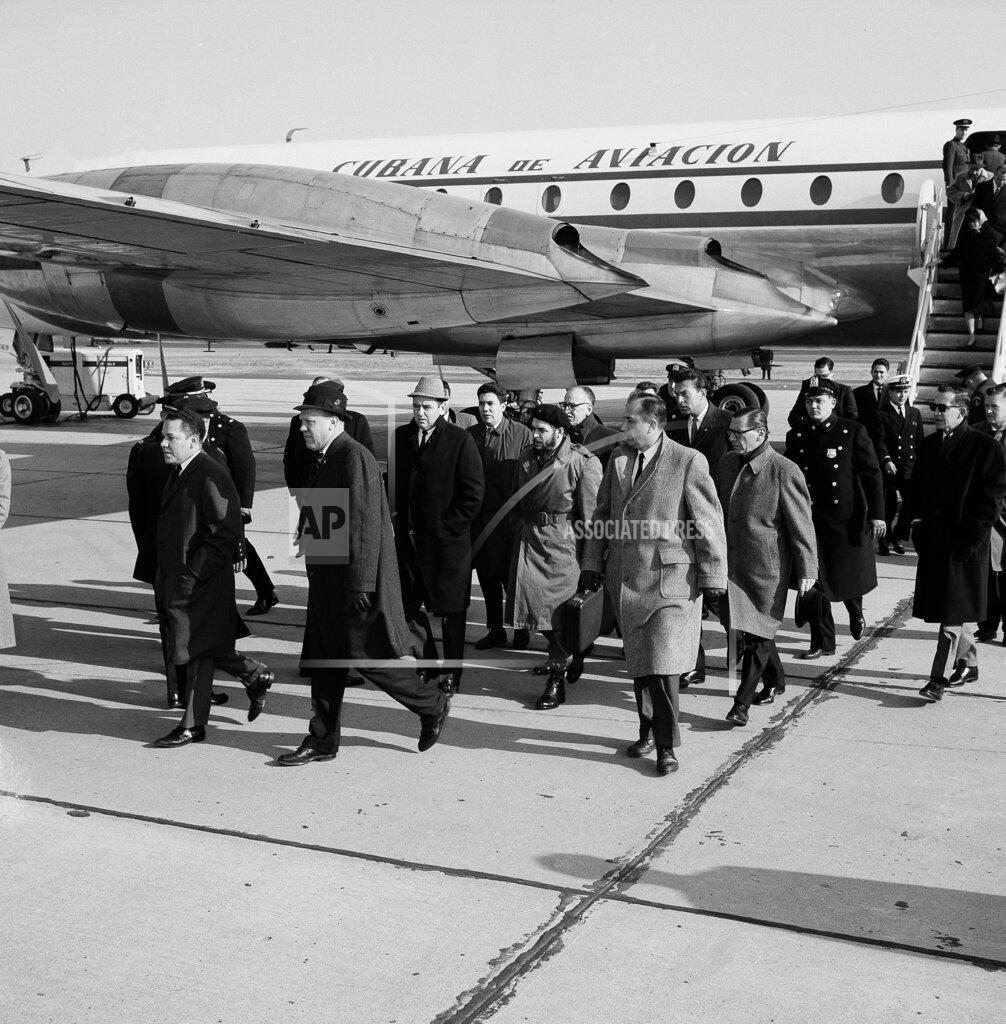
Major Ernesto Che Guevara, Cuban Minister of Industry, arrived in New York from Havana yesterday to take over, temporarily, the leadership of the Cuban mission to the United Nations and to address the United Nations General Assembly Friday. A heavy security guard of airport and city policemen was waiting when Major Guevara’s plane, a Cubana Airlines Britannia, on a special flight, landed and taxied to a cargo area more than two miles from the International Arrivals Building at Kennedy International Airport. Fifty policemen stood guard as the party was cleared by customs, immigration and health inspectors. After 10 minutes, Major Guevara appeared, clad in an olive drab military fatigue uniform with beret, a long trench coat and highly polished black boots. Walking with military bearing, he raised his right arm in greeting to a party of newsmen held behind police barricades and then entered a black limousine. His car drove immediately to the headquarters of the Cuban mission, 6 East 67th Street, where he began a round of conferences.
A strike by 330,000 Ruhr coal miners in West Germany was averted today when industry and union representatives agreed on a settlement raising wages and benefits by 10.5 percent. The agreement came a day before a scheduled strike vote. The package settlement includes a 7.5 percent raise for the miners and a doubling of their housing allowances. The agreement was reached at a two‐hour negotiating session in Essen.
Rampaging Pakistani university students posed a grave threat today to the Government of President Mohammad Ayub Khan. Clashes between youths and policemen were reported from nearly every big city in West Pakistan as a strike by Karachi University students passed its ninth day. Tension and fear gripped Karachi when new violence broke out this afternoon as students attempted to mourn publicly for a 21-year‐old student rioter who was killed by gunfire yesterday. Four students were wounded of whom two are in critical condition. Officials reported violence in Lahore, Rawalpindi. Hyderabad. Nawabshah and Sukkur during demonstrations in sympathy with the Karachi students. The Ayub Government appeared to be working desperately to cope with student demonstrators in a way that would not work to the advantage of Miss Fatima Jinnah, President Ayub’s opponent in the elections under way in Pakistan.
The Convention on Consent to Marriage, Minimum Age for Marriage and Registration of Marriages entered into force after being signed on November 7, 1962; 55 nations are currently parties to the Convention, which provides for marriages to be registered in order to be binding, and for marriage to require the consent of both parties. The international convention does not set a uniform minimum age for parties to be wed; among participating nations, the age for marriage for consenting partners ranges from 15 (for males and females in Yemen) to 21.
Nineteen of the 21 men arrested in the Mississippi civil rights slayings will have a preliminary hearing before United States Commissioner Esther Carter here tomorrow. The federal government must show “probable cause” why the charges against the men should be continued. The men are accused of violating the civil rights of the three rights workers slain last summer. Of the two other men in the group of 21, one was arrested in Biloxi, Mississippi. His preliminary hearing comes up there Friday. Another man was arrested at Shreveport, Louisiana, and his hearing will be held there.
The federal charges singled out 10 of the men as having actually plotted to intercept the three civil rights workers and “assault, shoot and kill them.” The victims were Michael Schwerner, 24 years old, and Andrew Goodman, 20, both white New Yorkers, and James Chaney, a 21-year‐old Meridian Black. The Federal Bureau of Investigation said they were executed when they went into Neshoba County from Meridian to investigate the burning of a Black church and the beating of the church elders. Any murder charges in the case must come from the state, which so far has made no more.
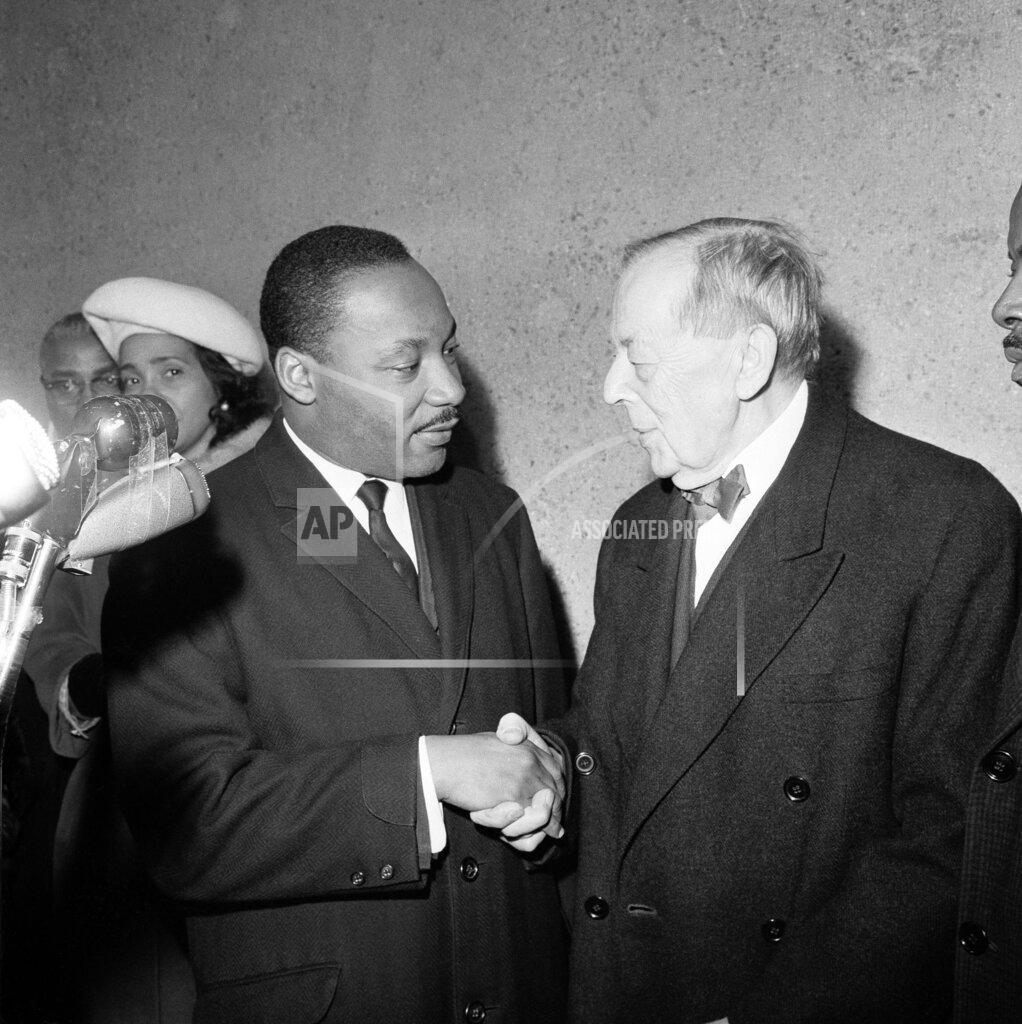
The Rev. Dr. Martin Luther King Jr. called today for a “grand alliance” of American intellectuals, liberals, and labor and religious leaders to fight the final battles in the civil rights struggle. Dr. King, who is here to receive the 1964 Nobel Peace Prize tomorrow for his nonviolent campaign in the causs of civil rights, said: “We are not finished. The struggle will take on a new dimension. It will not be a battle to integrate lunch counters but a problem of dealing with de facto segregation in schools, jobs, housing and other such areas.” He said that American Blacks, by themselves, did not have sufficient power to take the struggle beyond the lunch counters, “and so the movement will have to depend on a constructive alliance.”
Dr. King, a Baptist, minister, expressed his views at a news conference that amused Scandinavian journalists with its atmosphere of a family gathering. Many of the 30 family members and civil rights leaders who had accompanied Dr. King to Oslo were in the room and were introduced to the newsmen. Among the civil rights leaders were the Rev. Ralph Abernathy, described as “Dr. King’s perennial jailmate, having been in jail with him 30 times in the past nine years,” and Bayard Rustin, who organized the civil rights March on Washington in August, 1963.
Former President Dwight D. Eisenhower, former Vice President Richard M. Nixon, and Senator Barry Goldwater agreed yesterday that in this period of crisis for the Republican party its national chairman must have a broad base of support from all elements that make up the party. At a private one‐hour conference in General Eisenhower’s suite in the Waldorf Towers, the three men also agreed, in essence, that if Dean Burch could not achieve that widespread support before the Republican National Committee meeting of January 22-23, he should step aside as national chairman. Mr. Goldwater made it clear that he would do what he could to help rally the necessary backing for the 38-year‐old Mr. Burch, who became the party’s chairman last July at the Arizona conservative’s behest.
The defeated Presidential candidate indicated that he would seek to persuade many of the 132 members of the national committee to support Mr. Burch and would also consult with individual Governors and Congressional leaders. In a brief public statement following the meeting, Mr. Goldwater called for an end to “further dissension” among Republicans and said both sides — the conservatives and moderates — should “give a bit.” “We feel that possibly some time before the committee meeting we can resolve the differences that are in the party,” he said. At the moment, Mr. Goldwater’s lieutenants and those urging Mr. Burch’s replacement disagree on whether the chairman would carry a vote of confidence at the committee meeting. At their private session, General Eisenhower and Mr. Nixon told the Senator they thought Mr. Burch had done a good job as chairman during the campaign, and they indicated they had no one in mind as a replacement for Mr. Burch.
The Senate Rules Committee decided today to call Walter W. Jenkins, former special assistant to President Johnson, for personal testimony in the Robert G. Baker investigation. The committee also decided to suspend further hearings until after Congress convenes in January. The decision on Mr. Jenkins, who resigned from the White House staff last October after his arrest on morals charges, resolves one of the most intense partisan disputes the committee has faced. Republicans have insisted, over Democratic objections, that Mr. Jenkins be questioned under oath about charges that he extracted a kickback in the form of an advertising contract for the Johnson family’s television station in Austin, Texas, from Don B. Reynolds, an insurance man.
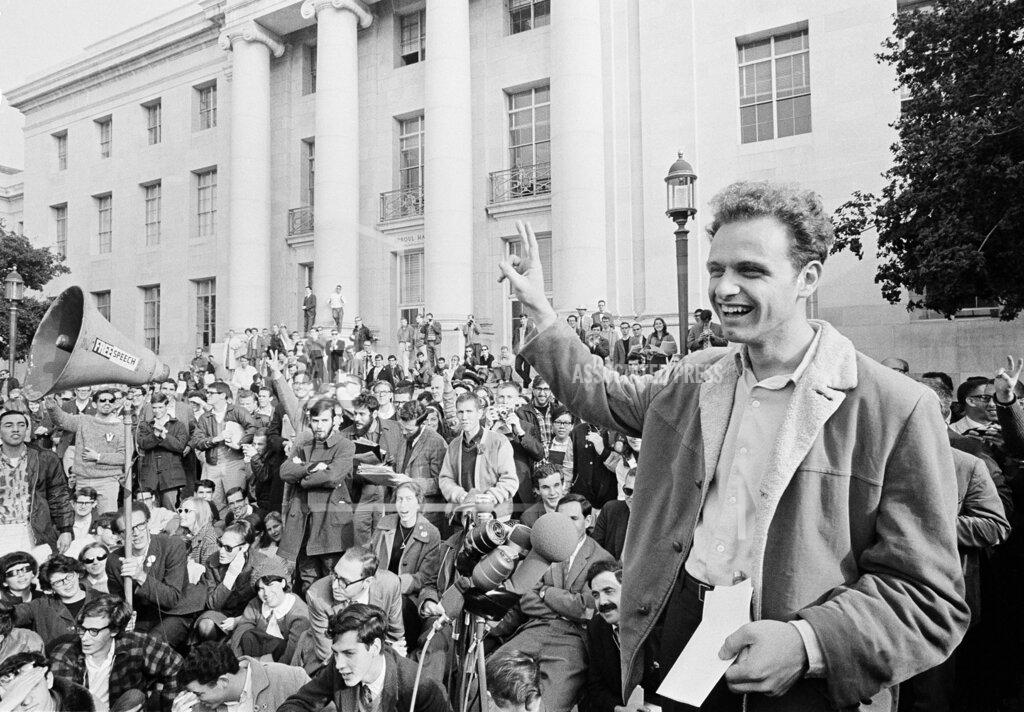
Calm, broken only by a noon victory rally of the Free Speech Movement, returned to the University of California campus here today. The movement is the student group that for months has resisted the imposition of rules changes limiting student participation in politcal and civil rights activities. The calm came after yesterday’s action by the Academic Senate, a faculty group, which proposed that the university permit the students unlimited freedom in political activity. The students accepted the proposal, but the university administration has not.
At their rally, in the plaza in front of Sproul Hall — where a week ago today 814 sit‐in demonstrators were arrested by about 500 policemen — the leaders of the Free Speech Movement spoke in terms indicating that the adoption of the Academic Senate’s proposal regents was a certainty. The proposals adopted by the Academic Senate would give students freedom to espouse any cause on campus, whether legal or not, and would not have students liable to university discipline for off‐campus political activity. There are 1,500 professors, assistant professors, associate professors and instructors in the Academic Senate, which acts as an advisory body to the regents.
Project Gemini, the program to put two‐man crews in orbit for up to 14 days, ran into serious technical troubles today. This will mean another setback of at least four weeks in a schedule that already has slipped several months. The troubles developed as an attempt was being made to send an unmanned version of the Gemini capsule on a 2,150-mile flight down the Caribbean test range. Less than two seconds after ignition of the Titan II launching rocket, a failure in a hydraulic line caused an automatic shutdown of both engines. The shutdown left the rocket sitting safely on the launching pad. And officials said that, if there had been two astronauts in the capsule atop the ninestory rocket, they would not have been in any danger. Project Gemini is an intermediate step between Project Marcury one‐man earth‐orbit flights and Project Apollo, a series of three‐man flights that are to culminate in a manned landing on the moon.
President Johnson challenged new Democratic members of Congress tonight to join him in blazing new trails leading toward the year 2000. “We shall not always be able to walk along marked trails or follow guideposts others have put in place for us,” he said. The President spoke at a White House reception after the newly elected Democrats had spent the day at an orientation session sponsored by the Democratic National Committee.
Predicting that the next Congress would be one of the most historic ever, the President noted: “On Jan. 20, when I shall be privileged to take the oath of this office, we will be closer to the year 2000 than to the year 1929. Through most of my career — and through most of your adult lives—the thrust of our public policies and attitudes has been dominated by memory of the stock market crash, the great depression and the events of the nineteen‐thirties that led back to recovery. In the next session of the next Congress, I believe our thrust and emphasis must change—and will change. We must begin to think about the future—about the year 2000 —about the foundations we must put in place for a larger, more complex, more challenging America for our children and our children’s children.”
Former President Dwight D. Eisenhower, speaking with the vigor of a campaigning politician, lashed out forcefully yesterday against what he called a movement “toward federal domination over almost every phase of our economy.” He said that the problem of poverty, for example, “can be cured only by going to its roots, by helping people and the communities” with their development, but not by “federal subsidies and doles.” “Doles have never made a people self‐supporting; they can only carry them through emergencies,” General Eisenhower and Education, training and guidance, “not merely dollars,” he declared, are the “ingredients for success.”
The United Mine Workers said today that W. A. Boyle had apparently been elected president by the membership. A statement by the union said unofficial returns from 2,000 locals in 28 states showed that Mr. Boyle had received 90 percent of the votes cast by union members in the United States and Canada yesterday. About 300,000 members of the independent union were eligible to vote; 200,000 members in related industries could not vote.
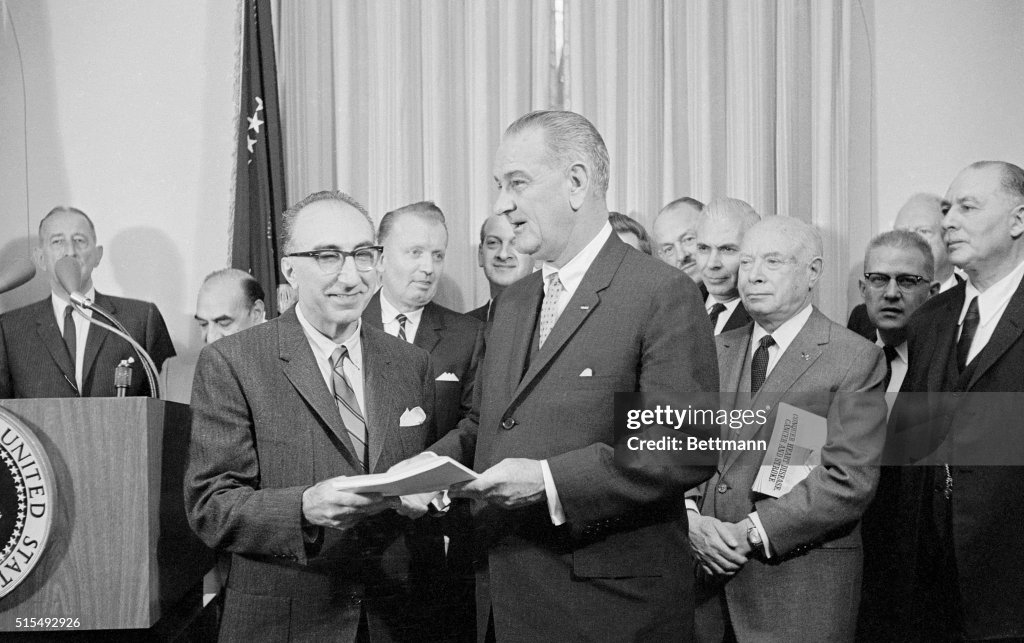
A Presidential commission urged today a $10 million program featuring a national network of anti-smoking clinics to help the United States rid itself of the cigarette habit. The recommendation was part of the report by the President’s Commission on Heart Disease, Cancer and Stroke. The commission said it “strongly endorses” the Surgeon General’s report, which concluded that smoking was linked with cancer and was a serious health hazard.
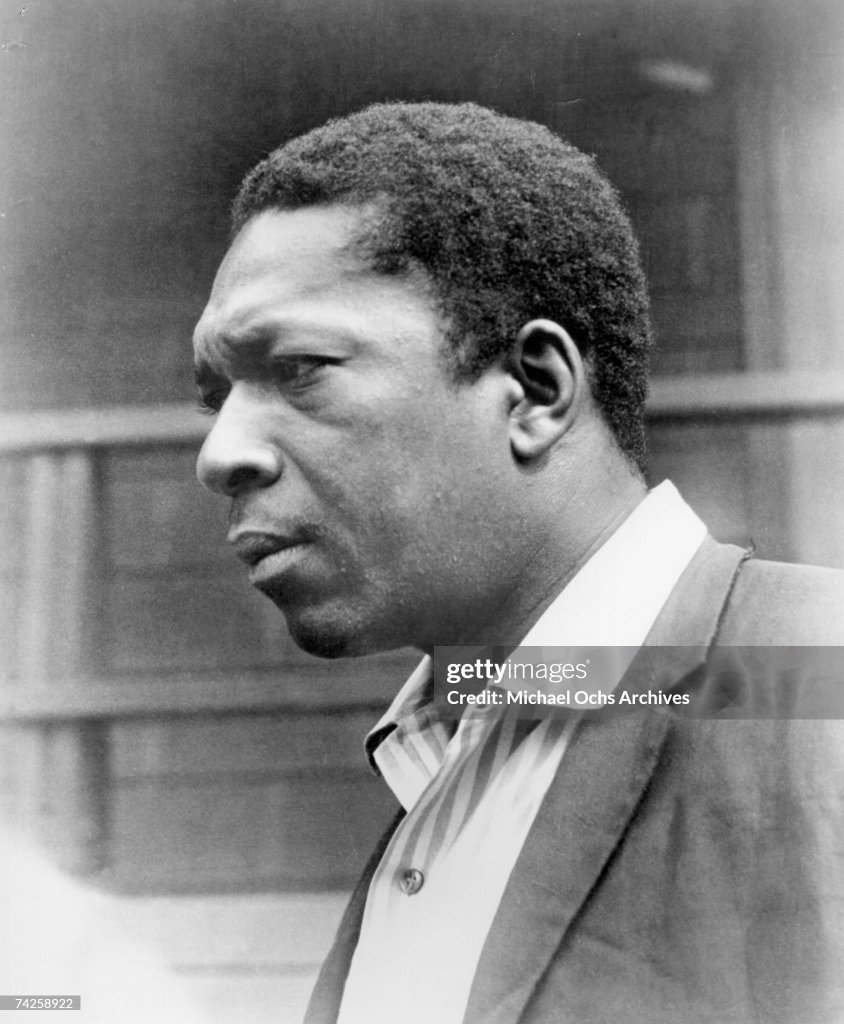
John Coltrane’s seminal album “A Love Supreme” was recorded at Van Gelder Studio in Englewood Cliffs, New Jersey.
Dow Jones Industrial Average: 863.81 (-6.88)
Born:
Petr Bříza, Czech hockey National Team goaltender (Olympics, bronze medal, 1992, Team Czech Rep), in Prague, Czechoslovakia.
Nevin Markwart, Canadian NHL left wing (Boston Bruins, Calgary Flames), in Toronto, Ontario, Canada.
John Bruhin, NFL guard (Tampa Bay Buccaneers), in Knoxville, Tennessee (d. 2022).
Dave Walter, NFL quarterback (Cincinnati Bengals), in West Branch, Michigan.
Gerald White, NFL running back (Dallas Cowboys), in Titusville, Florida.
Charles Wiley, NFL nose tackle (Seattle Seahawks), in San Diego, California.
Larry Emdur, Australian game show host; in Melbourne, Victoria, Australia.
Hape Kerkeling, German comedian, as Hans Peter Kerkeling in Recklinghausen, West Germany.
Johannes B. Kerner, German sportscaster, in Bonn, West Germany.
Died:
Edith Sitwell, 77, English poet (“Wheels”).


 History Diaries