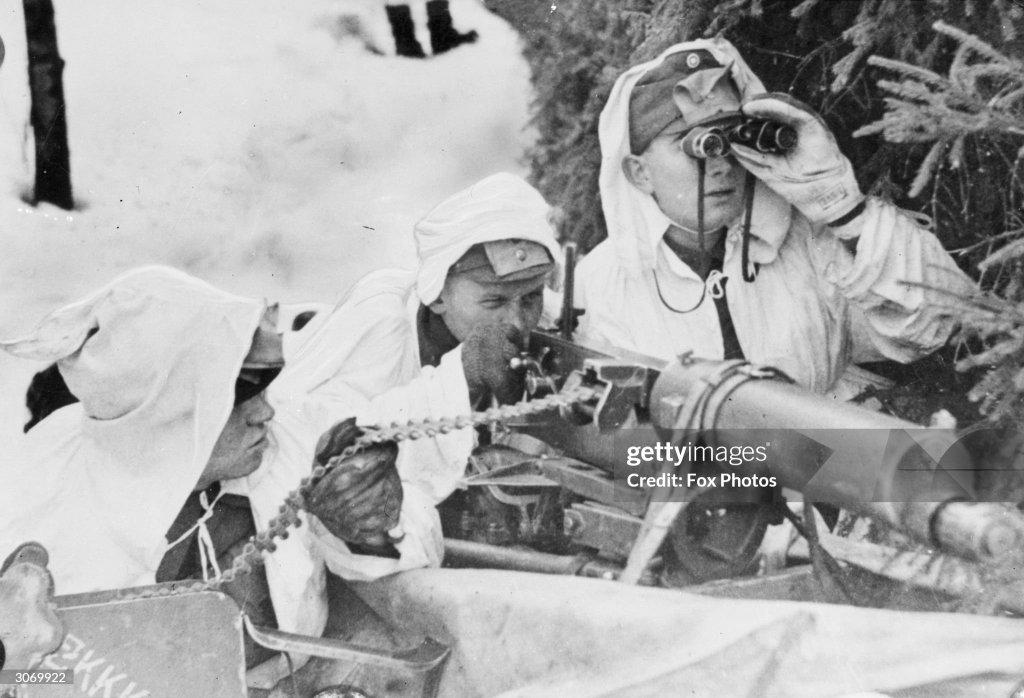
The 165th Soviet division which is advancing in the direction of Suomussalmi, join their forces in the direction of Juntusranta and Raate, at the village of Suomussalmi. During the night, Finnish troops abandon up the village of Suomussalmi, while setting it on fire.
Soviet troops of the 163rd Division of the 9th Army (Duhanov) take Suomussalmi without a fight after dark at 9 pm on 8 December 1939. They quickly attack across the frozen lakes to the west with two companies. The objective is Hyrysalmi and then, ultimately, Oulu on the Gulf of Bothnia, which would split Finland in two and effectively end the war. However, there is a very rough country in between which might not be so obvious from maps.
The Finns who had abandoned Suomussalmi, the 15th and 16th Detached Battalions of the Finnish Army, also know the stakes and are waiting. With a clear field of fire across the frozen surface, they beat back the Soviets and inflict massive casualties. The Soviets regroup and try to outflank the Finns to the northwest, at Puolnaka. The 16th detached battalion is there waiting for them and stops the Soviets cold.
Elsewhere on the front, the Soviet forces also are mostly stopped. The Finns are holding against the 8th Army at the River Kollaa. Only the Soviet 14th Army in the far north takes some tundra near Petsamo against three Finnish companies led by Captain Antti Pennanen.
The Red Army has been stopped in its tracks by the Finns at the Mannerheim Line.
The Soviet artillery at Taipale launches a week-long barrage in an attempt to destroy the Finnish positions.
The Finnish defense brings the attacks of the Soviet 9th Army, near Kuhmo, to a halt.
Northern Finland: the Finns are caught completely off guard by the Red Army’s offensive through the wilderness between Lake Ladoga and the Arctic Ocean with as many divisions as it deployed on the Karelian Isthmus.Finnish troops successfully repulse an attempted Russian breakthrough launched at 7.20 at Haukiperä in Suomussalmi.The Finns then take the initiative.
Ladoga Karelia: Soviet troops overcome the Finns at Tolvajärvi and almost capture Tolvajärvi village and the vital crossroads.During the night, Lieutenant-Colonel Pajari turns the tables with a decisive flanking attack on an encamped Russian battalion.
North of Lake Ladoga, 136th Rifle Division of Soviet 8th Army withdraws and digs in after its attack is repulsed.
The Soviet Navy minesweeper Moskva ran aground in Saunaniemi Bay whilst avoiding Finnish artillery fire.
The Soviet Navy minesweeper M-30 ran aground in Saunaniemi Bay whilst avoiding Finnish artillery fire and was holed. An attempt was made to beach her, but she rammed the minesweeper M-416, which sank.
The Soviet Navy minesweeper M-416 was rammed and sunk in Saunaniemi Bay by the minesweeper M-30 ( Soviet Navy). Her crew were rescued by the minesweepers M-412 and M-422.
The Soviet force attacking Finland is placed under the direct command of the General Staff of the Red Army.
Commander of the Army, 2nd Class K.A. Meretskov is placed in command of the Soviet 7th Army on the Isthmus.
The Finnish Consulate in Gothenburg announces that 493 Swedish families have so far offered to take in Finnish refugees.
Nationalist Spain today aligned herself with other countries of the world, condemning the invasion of Finland by Russia.
It is the first day of the Winter War when the Finns largely hold their ground.
It will not be the last…
Italy sees danger in the Balkans as fear of Russia increases. The Fascist Grand Council in Rome confirms the Axis alliance, but votes to remain out of the conflict. Italy today was digesting the meaning of last night’s communiqué from from the Fascist Grand Council, and in general the conclusion has been reached that this country’s non-belligerency was more than ever strengthened, so far as the war between the Allies and Germany is concerned, but that grave danger lies ahead in the Balkans. Foreign Minister Count Ciano is expected to clarify and explain much that is cryptic in the communiqué when he addresses the Chamber of Fasci and Corporations next. Friday. A great deal depends on where the emphasis is going to be placed and how each passage has to be interpreted. The upshot of today’s reflections. and comment is that Italy, more than ever, is looking out for herself and her own interests. She has set her course toward non-belligerency and she will not turn aside for Germany or the Allies. She has shown that her sympathies and hopes lie with Germany and her hostility continues to be directed against Great Britain and France, but the quarrel with the Allies is not Italy’s business except in so far as it affects her maritime traffic. Aside from that, her interest is in keeping Russia out of the Balkans.
Air Marshal Italo Balbo, long-time Governor-General of Libya, visits Rome and publicly states, “You will all wind up shining the shoes of the Germans!” He is the only fascist to publicly criticize Mussolini’s obvious sympathies with Hitler and wishes that Italy would join the Allies. Balbo is such a towering figure in the military that Mussolini does nothing but inwardly seethe.
Moscow disavows a threat to Rumania. The almost unprecedented step of a disavowal of an article in a Soviet publication was taken tonight when the Soviet radio declared the article on Rumania published in this week’s issue of the Communist International, organ of the Comintern, did not represent the views of the Soviet Government.
Turkish newspapers unanimously charged Germany today with attempting to divert Soviet Russia from extending her power in the Baltic by provoking a Turkish-Russian conflict.
Spain condemns the Soviet attack on Finland in the first rift of Franco’s neutrality policy.
The Pope issues a pastoral letter to the clergy serving as military chaplains in the armed forces of the warring nations. The present war, Pius declared, should be seen as a manifestation of God’s providence, as the will of a Heavenly Father who always turns evil into good.
Admiral Raeder again talks to Hitler of invading Norway. Alfred Rosenberg, the Nazi Party’s political and racial “expert”, also introduces the head of the tiny Norwegian National Unity Party to Hitler. His name is Vidkung Quisling.
King George VI spent another busy day today inspecting the grounds, troops and establishments of the Royal Air Force in France. He is received with enthusiasm, warmth, and affection by both the British troops as well as the French people.
In London, it is decided that Polish squadrons are to be attached to the RAF.
In Egypt, General Wavell dismisses Major General Percy Hobart from his position forming Mobile Force (Egypt). Hobart has unconventional ideas about the use of tanks and other mobile forces, seeing in them the ability to project long-range power across the desert. The War Office is not a fan of these ideas, but, strangely enough, one Heinz Guderian in the Reich thinks that Hobart is brilliant and actually pays a translator so that he can read everything that Hobart writes. Hobart’s dismissal is a reflection of the tensions going on in every major army about the role of mobile forces and tanks in particular. Hobart goes home to Chipping Campden and joins his Local Defence Volunteers unit as a lance corporal, serving as its Deputy Area Organiser.
The neutral Danish steam merchant Scotia was torpedoed and sunk by the U-23, commanded by Kapitänleutnant Otto Kretschmer, in the North Sea (57° 31’N, 2° 17’E). At 00.04 hours the neutral Scotia was hit in the fore part by one torpedo from U-23 and sank slowly by the bow in 17 minutes. The ship had been missed by a first torpedo at 23.26 hours on 7 December. The survivors were picked up by the Danish steam merchant Hafnia, which had witnessed the attack. Of the ship’s complement, 19 died and 2 survivors were picked up by the Danish steam merchant Hafnia. The 2,400-ton Scotia was carrying ballast and was bound for the United Kingdom.
A straggler from Convoy OB.48, the British steam merchant Brandon was torpedoed and sunk by the U-48, commanded by Kapitänleutnant Herbert Schultze, 80 miles southwest of Fastnet, Ireland in the eastern Atlantic Ocean (50°28′N 8°28′W). At 11.55 hours the Brandon (Master Richard Black Chisholm) was torpedoed and sunk by U-48. Nine crew members were lost. The master and survivors were picked up by the Belgian trawlers Marie Jose Rosette and Tritten and landed at Milford Haven. U-48 misidentified her victim as the Navasota, but this ship had been sunk by U-47 (Prien) three days earlier. The 6,668-ton Brandon was carrying ballast and was bound for Port Everglades, Florida.
The Belgian ship Louis Scheid ran aground and broke up in front of the Thurlestone Golf Club, Warren Point, Devon, England, United Kingdom before dawn.
The British cargo ship Corea struck a mine and sank in the North Sea off Cromer, Norfolk. with the loss of eight of her 15 crew. The survivors were rescued by the H F Bailey III (Royal National Lifeboat Institution).
The French coaster Dinard collided with the British Swynfleet and sank in the North Sea off Deal, Kent.
The British cargo ship Merel struck a mine and sank in The Downs, Kent west of the Gull Lightship with the loss of 16 of her 18 crew.
The British cargo ship Middlesbro’ struck the wreck of the Goodwood and sank in the North Sea 1 nautical mile (1.9 km) off Flamborough Head, Yorkshire. The crew was rescued by the Swedish ship Runeborg.
The British cargo ship Gambhria was sunk as a block ship in Scapa Flow, Orkney Islands. She was raised in 1943 and taken to Liverpool Bay where she was used as an ASDIC target.
The Belgian cargo ship Adour ran aground on rocks at Îles de Glenan, Brest, France and sank.
U.S. Consul General in Hamburg Keblinger reports that German prize control authorities are detaining more than 125 neutral ships in German ports: at least 40 Swedish, 12 Danish, 5 Norwegian, 40 Finnish, 14 Estonian and 14 Latvian, comprising practically all neutral vessels clearing Baltic or Scandinavian ports with cargoes of goods that are on the German contraband list.
Secretary of State Hull urges U.S. Chargé d’Affaires in the United Kingdom Johnson to urge the Contraband Commission in London to release U.S. freighter Nishmaha (then at Marseilles, France), which has been held 25 days “a most unreasonable detention”.
Convoy OA.49 departs Southend.
Convoy OB.49 departs Liverpool.
Convoy HG.10 departs Gibraltar for Liverpool
The War at Sea, Friday, 8 December 1939 (naval-history.net)
Light cruiser ENTERPRISE departed Portland for Halifax, NS, arriving on the 15th.
On Northern Patrol were two cruisers and one AMC in the Denmark Strait, and seven AMCs between the Faroes and Iceland.
Light cruisers DRAGON, COLOMBO, CARDIFF, DELHI and DIOMEDE departed Loch Ewe for Northern Patrol at 1700. DRAGON and COLOMBO arrived at Scapa Flow on the 12th, CARDIFF and DELHI on the 15th via Loch Ewe, and DIOMEDE on the 16th, also via Loch Ewe.
Light cruiser NEWCASTLE departed Scapa Flow for Northern Patrol to relieve light cruiser SHEFFIELD, and arrived back on the 17th.
Armed merchant cruiser MONTCLARE arrived in the Clyde after Northern Patrol.
Destroyer ECHO arrived in the Clyde.
Destroyer INGLEFIELD arrived at Leith for docking. Repairs were completed on the 11th and she arrived at Rosyth the same day.
Submarines TRIDENT and TRIUMPH arrived at Rosyth, while STARFISH arrived at Blyth after patrols.
Patrol sloops PC.74 and KINGFISHER collided at Eglinton with slight damage to both ships.
Convoy OA.49 of 11 ships departed Southend escorted by destroyers KEITH, WHITEHALL, WREN and WITCH, although WHITEHALL was detached to convoy HX.10 on the 9th. Sloop ENCHANTRESS joined on the 8th from OA.48 and stayed until the 11th when she also detached to HX.10. WREN and WITCH detached on the 9th, followed by KEITH on the 11th.
Convoy OB.49 departed Liverpool escorted by destroyer MACKAY until the 10th and WARWICK until the 11th.
After being delayed 24 hours because of mines, convoy FN.51 departed Southend, escorted by destroyers WALLACE and WOOLSTON. They arrived in the Tyne on the 9th.
Convoy HN.4 of nine British ships departed Bergen escorted by destroyers ESKIMO, MATABELE, ICARUS and ILEX, but the convoy made slow progress in bad weather. Destroyers ELECTRA, ESCORT, NUBIAN and MAORI departed Rosyth on the 10th to relieve the escorts and on the same day, heavy weather forced ESKIMO, ILEX and three steamers to heave to. MATABELE lost touch and patrolled until daylight before attempting to rejoin the convoy. Destroyer ISIS arrived at Scapa Flow on the 9th to escort the four ships of the west coast section with one of the convoy destroyers. Then on the 11th, ELECTRA, ESCORT, NUBIAN and MAORI relieved ESKIMO, ILEX and ICARUS which went on to the Clyde, arriving on the 12th. The convoy reached Methil safely on the 12th.
Convoy HX.10 arrived at Liverpool escorted by heavy cruiser YORK, which began a refit there.
U-48 sank steamer BRANDON (6668grt), a straggler from convoy OB.48, at 1225, 80 miles SW of Fastnet in 50 28N, 08 28W. Nine crew were lost and the survivors picked up by Belgian trawler MARIE JOSE ROSETTE (139grt) and British trawler TRITTEN. A flying boat attacked U-48 at 1455 and destroyers WALKER and WHIRLWIND were detached from convoy escort, making two attacks at 1526 in 50-12N, 9-05W. Some damage was done to the submarine.
Steamer MEREL (1088grt) was sunk on a mine near Gull Light Vessel near Ramsgate.
Steamer ULSTER HERO (483grt) reported sighting a submarine 16 miles from Ramsey, Isle of Man. Escort sloop MALLARD and anti-submarine trawler KING SOL (486grt) were sent to investigate.
Destroyer WANDERER attacked a submarine contact between Land’s End and Penzance.
After British aircraft bombed a submarine contact, destroyers ESCORT and ELECTRA, detached from Force W and searched 85 miles NW of Cape Wrath. U-43 was badly damaged in the air attack, but was able to reach Wilhelmshaven on the 14th. Destroyer ISIS joined in the search.
Steamer MIDDLESBRO’ (989grt) was sunk in a collision with the wreck of steamer GOODWOOD (2796grt) one mile north of Flamborough Head. The crew were rescued by Swedish steamer RUNEBORG (472grt).
French steamer OUED TIFLET (1194grt) arrived at Cartagena after being damaged on a nearby defensive minefield.
Heavy cruiser CORNWALL and light cruiser GLOUCESTER departed Diego Suarez for Simonstown, after which CORNWALL was to transfer to the South Atlantic Command and GLOUCESTER to join Hunter Force I.
New Zealand light cruiser HMNZS ACHILLES refueled at Montevideo, left on the 9th for the Plate and joined sister ship AJAX on the 10th. The two then joined heavy cruiser EXETER on the 12th and the three took up patrol in the Plate estuary.
In air operations in the South Atlantic, a Skua of 800 Squadron, landing on aircraft carrier ARK ROYAL, missed the landing wires and crashed into the sea. Sub Lt P T Bethell was killed, but Leading Airman J B Taylor rescued.
The Roosevelt administration sent Britain a diplomatic note protesting the British policy of seizing German goods on neutral ships. The American government protests the British blockade of Germany, stating: “Whatever may be said for or against measures directed by one belligerent against another, they many not rightfully be carried to the point of enlarging the rights of a belligerent over neutral vessels and their cargoes, or otherwise penalizing neutral states or their nationals in connection with their legitimate activities.”
U.S. Ambassador to Great Britain Joseph Kennedy presents to President Roosevelt a plan for idle ships. Vessels will go in routes vacated by Britain and other belligerents. A plan for using idle American shipping on foreign routes vacated by British and other belligerent nations outside the immediate war zones was laid before President Roosevelt today by Ambassador Joseph P. Kennedy in conferences during which he submitted a first hand report on the situation in Europe. The recently returned envoy to Great Britain was closeted with the President at the Executive Mansion for two hours before the President went to the executive office. At the executive office the President, in the presence of the Ambassador, told reporters of the plan for reviving American shipping tied up by restrictions of the Neutrality Act. The conferences were resumed late in the afternoon after Mr. Kennedy had sandwiched in visits to the State Department and the Maritime Commission. Mr. Kennedy had little to say to reporters, either about the European war or prospects for peace. He did pause long enough before entering the Executive Mansion this morning to point to the problems growing out of the war as sufficient warrant to continue Mr. Roosevelt in office for another four years.
“The problems that are going to affect the people of the United States-political, social and economic-are already so great and becoming greater by the war that they should be handled by a man it won’t take two years to educate,” the Ambassador declared. “The best intellect, the most brilliant man in the world, no matter how sincere, would have difficulty in grasping the problems confronting America. It would take him at least two years to learn how to handle the affairs of this country in the best interests of all. First and foremost, we know from what we have seen and heard that President Roosevelt’s policy is to keep us out of war, and war at this time would bring to this country chaos beyond. anybody’s dream. This, in my opinion, overshadows any possible objection to a third term.”
President Roosevelt blames the governor of Ohio for the relief crisis in Cleveland. President Roosevelt laid responsibility today for Ohio’s relief crisis on Governor John W. Bricker and the State Legislature, declaring that the Federal responsibility ended with the provision of WPA jobs for those able and willing to work and unemployed through no fault of their own. Without mentioning Governor Bricker by name, the President indirectly accused him of attempting to balance the State budget at the expense of home relief clients, who were beyond the scope of WPA aid. By implication, Mr. Roosevelt also exonerated Mayor H. H. Burton of Cleveland, asserting that municipal and other local governments were only creatures of the State. Having absolved the WPA of any blame in the Ohio crisis, President Roosevelt charged that, with a population of about 6,000,000, the State was taking care of its home relief cases only about half as well as Pennsylvania, which had a population of 9,000,000. He produced a memorandum by Colonel F. C. Harrington, WPA Commissioner, showing Ohio’s average relief benefits in October as $16.65 per individual, as compared with $27 for Pennsylvania.
Later in the day Secretary Ickes described Governor Bricker’s handling of Ohio’s relief problem as “heartless.” He was told that the Governor had, in replying to the President’s remarks, characterized them as a political attack on a Republican State administration. “Why shouldn’t there be a political attack on an administration as heartless as his?” Secretary Ickes said of Governor Bricker. “We don’t claim immunity from political attack just because we’re a political administration.” “Do you mean to say that this is a political administration?” the Secretary was asked. “Any administration is political,” he replied. “Government is the art of politics. Did you ever hear of an administration that was not political-especially one in Ohio?” Someone asked Mr. Ickes whether he thought the Governor’s handling of the Ohio relief problem would hurt his political fortunes. “The American people are a humane and a just people,” the Secretary said, “and any one who doesn’t do what he can to keep people from starving isn’t going to advance his political fortunes. I think his handling of the problem has been terrible. As for Cleveland, he has shown no inclination to help Mayor Burton.”
Declaring that the “hour has come when we must stop, look and listen,” Senator Burton K. Wheeler, progressive Democrat of Montana, who is among those mentioned as a possible candidate for the Presidency, went on record last night as favoring revision of the Wagner act, balancing of the budget, elimination of waste and extravagance in government expenditures and other legislative action that would stimulate the development of private enterprise as a means to prosperity. Senator Wheeler spoke at the dinner of the Congress of American Industry at the Waldorf-Astoria, which ended its three-day session held under the auspices of the National Association of Manufacturers. His address was broadcast over a nation-wide Mutual Broadcasting network through Station WOR.
He assured the 2,500 assembled leaders of industry that “there is no disposition on the part of Congress to strangle or thwart business” and that “members of Congress are sincere and determined to aid honest business.” “If prosperity results from cooperation by business, government and labor there would be more revenue from taxes for government, more profits for business, more work and better wages for labor, more markets and better prices for the farmer and more security for the public,” Senator Wheeler declared.
Wendell L. Willkie, president of the Commonwealth and Southern Corporation, another speaker, warned against the increasing encroachment of government upon the economic life of the nation, declaring that while much that has been done by government in recent years was desirable, the time has come to reexamine the situation with the aim of curbing the dangers of excessive State control.He assailed the power vested in various government commissions, with special reference to the Securities and Exchange Commission and the National Labor Relations Board, and declared that “from now on our purpose should be not to augment the powers of the State but to increase the opportunities offered to the individual.” “If in the next few months we can restore the functioning of free enterprise, we shall find, perhaps, that life begins in ’40,” Mr. Willkie said.
Mr. Willkie “pulled few punches” as he called for a “new deal” in government as the only salvation for both business and democracy. The manufacturers gave him a rousing welcome when he rose to speak and cheered again when he prefaced his prepared speech with a challenge to Mr. Wheeler to aid industry in solving the unemployment problem. “I agree with the Senator,” he said, “that the main problem confronting us today is to put the unemployed back on the payroll. In the name of the thousands of industrialists gathered here tonight, I make him the pledge that we will do it if he will help get government off our backs.”
Auto production jumps, with last week’s figures the highest since July 1937.
Auto unions ban wildcat strikes. Temporary replacement of “outlaws” who cause walkouts is ordered. Unauthorized “wildcat” strikes must end, the executive board of the United Automobile Workers (C.I.O.), declared at a meeting here today, as it made public a letter to its local unions emphasizing “principles of responsibility.”
Former U.S. president Herbert Hoover opens a drive to aid the Finns. He issues a relief appeal to the United States.
The police yesterday began an intensive hunt for a pugilist who they thought might throw some light on the murder of Dr. Walter Engelberg, the secretary of the German Consulate who was found beaten to death in his home in a quiet section of Brooklyn on Wednesday.
Admiral James O. Richardson, now in command of the battle force of the United States Fleet, was named commander in chief of the fleet this afternoon and will raise his four-star red pennant on the flagship USS Pennsylvania on January 6.
Duties of the former Technical Division, Office of Naval Operations, concerned with matters of research and invention, is transferred to Office of the Technical Aid to the Secretary of the Navy.
The Chicago White Sox trade Gee Walker to the Washington Senators for Pete Appleton and Taffy Wright. The Sox also pick up outfielder Moose Solters from the St. Louis Browns for outfielder Ray Radcliffe, both sluggers coming of poor years. The Brooklyn Dodgers get Gus Mancuso and Newt Kimball from the Chicago Cubs for Al Todd.
The Boston Bees (Braves) trade veteran Danny MacFayden to the Pirates for Bill Swift and cash.
At the December meeting of both leagues in Cincinnati, Judge Landis votes against all amendments favorable to farm systems. The Rules committee, with an eye towards raising declining batting averages, votes to restore the sacrifice fly for 1940. Seven American League owners push through a new rule barring the American League champion from making any trades within the league. Clearly aimed at the Yankees, winners of the last 4 world series, the National League owners decline to vote it for their league.
College Football:
Georgia 13, Miami (Florida) 0
Manuel Prado y Ugarteche is inaugurated as President of Peru.
Japanese 104th Infantry Division opens attacks in Kwantung province to pin down Chinese 4th War Area (Kwangsi and Kwangtung). The Japanese spoiling attacks in Wenhsi and Hsia Hsien continue.
Dow Jones Industrial Average: 147.86 (-0.84)
Born:
Red Berenson, NHL centre and left wing (NHL Champions, Stanley Cup-Montreal, 1965; NHL All-Star, 1965, 1969-1972, 1974; Montreal Canadiens, New York Rangers, St. Louis Blues, Detroit Red Wings) and college hockey coach (U. Michigan Wolverines), in Regina, Saskatchewan, Canada.
Dick Hoak, NFL halfback and flanker (Pro Bowl, 1968; Pittsburgh Steelers), in Jeannette, Pennsylvania.
Bennie McRae, NFL cornerback (NFL Champions-Bears, 1963; Chicago Bears, New York Giants), in Pinehurst, North Carolina (d. 2012)
Leroy Jackson, NFL halfback (Washington Redskins), in Chicago Heights, Illinois.
James Galway, flautist (“The Man With the Golden Flute”), in Belfast, Northern Ireland, United Kingdom.
Jerry Butler, American soul vocalist (The Impressions; “Never Give You Up”), in Sunflower, Mississippi.
Died:
Ernest Schelling, 63, American child piano prodigy, pianist and composer, of a cerebral embolism.
Naval Construction:
The Royal Navy Dance-class ASW trawlers HMS Gavotte (T 115) and HMS Hornpipe (T 120) are laid down by Cook, Welton & Gemmill (Beverley, U.K.); completed by Holmes.
The Kriegsmarine (German Navy) Type VIIC U-boat U-373 is laid down by Howaldtswerke AG, Kiel (werk 4).
The Royal Navy Flower-class corvette HMS Daffodil (K 07), later renamed HMS Dianella (K 07), is laid down by J. Lewis & Sons Ltd. (Aberdeen, Scotland).
The U.S. Navy Gleaves-class destroyer USS Ludlow (DD-438) is laid down by the Bath Iron Works (Bath, Maine, U.S.A.).
 History Diaries