The Việt Cộng attack and capture the district headquarters of An Lão and much of the surrounding valley, some 300 miles northeast of Saigon, driving off large ARVN and paramilitary forces. ARVN troops regain control only after reinforcements are airlifted in by U.S. helicopters; one U.S. Army officer and one U.S. soldier are killed, there are some 300 South Vietnamese casualties and as many as 7,000 villagers are temporarily forced to abandon their homes.
Roman Catholic families have begun a mass exodus from the provinces of central Vietnam, where Communist insurgent gains in recent months have threatened to suppress their religion. A boatload of 1,200 refugees arrived in Saigon 10 days ago and 1,200 more refugees are scheduled to reach the capital before Christmas. About 16,000 from the countryside are camping in the central Vietnamese city of Quy Nhơn awaiting resettlement. Church officials are laving plans to cope with the uprooting of about 100,000 Catholics in ihe coming months if Việt Cộng gains are not checked. Vietnamese priests have established a reception center for the refugees in the Hạnh Thông Tây Parish, about five miles north of Saigon. Immediate relief measures are being supported almost entirely by contributions from urban Vietnamese Catholics, but the longer‐term arrangements for the refugee population remain unsettled.
Ambassador Taylor, having returned from Washington, holds a series of conferences with Premier Trần Văn Hương, General Khánh and other South Vietnamese leaders. The communiqué issued on the 11th refers to the additional aid that the United States will supply to strengthen South Vietnam’s military forces (which South Vietnam agrees to increase by 100,000 men) and to ‘further economic assistance for a variety of reforms of industrial, urban, and rural development.’ But nothing is said of the plans to start the new bombing raids; in fact, U.S. officials deny that the United States has any intention of extending the war into North Vietnam.
Lieutenant General Trần Thiện Khiêm, the new Ambassador from South Vietnam, has been at his Washington post since November 23. His formal call to present his credentials to President Johnson has apparently been delayed because of the President’s long Thanksgiving working holiday in Texas.
Philip W. Bonsal, consultant to the State Department’s Policy Planning Council, arrived today with two aides to represent the United States in talks with representatives of Cambodia, opening tomorrow. Mr. Bonsai was accompanied by Henry L. T. Koren, United States Ambassador to the Congo Republic (the former French Congo), and Thomas J. Hirschfeld, State Department desk officer for Cambodia. Mr. Koren was formerly director of the State Department’s Office of Southeast Asian Affairs. Because of bad weather, the delegation arrived later than had been expected. As a result, the opening of talks with Son Sann, head of the Cambodian delegation, was postponed until tomorrow.
The Chinese people have been told for the first time in one of their newspapers that the new Soviet leaders had been close colleagues of Nikita S. Khrushchev and still follow many policies of the former Soviet Premier. Jenmin Jih Pao, the Communist party newspaper, devoted almost two pages Saturday to part of a speech made last week in Tirana by the A1banian Communist leader, Enver Hoxha. Mr. Hoxha criticized Leonid I. Brezhnev, First Secretary of the party; President Anastas I. Mikoyan, Premier Aleksei N. Kosygin and Mikhail A. Suslov, a leading party ideologist, as well as the usual targets, Mr. Khrushchev and President Tito of Yugoslavia.
In keeping with his habit of advising Soviet leaders what to do, President Tito counseled them today that it was no use trying to compromise with Communist China. The 72-year‐old leader also made an apparent concession to the Kremlin by supporting its explanation that Premier Nikita S. Khrushchev had been removed because of “certain failures and mistakes while heading the party and Government” of the Soviet Union. Marshal Tito, making the opening speech at the eighth Congress of the Yugoslav League of Communists, did not depart from the familiar independent position of his party. He amplified his policy only in the light of recent events. Speaking as the party’s Secretary General, he charged that the Chinese Communists had “deliberately and purposefully striven to transfer the center of the international workers’ movement to China and to achieve a dominant influence in world politics, regardless of the means it may have to use to attain this end.”
In an allusion to Mr. Khrushchev’s successors, he said: “There exist illusions as to the possibility of overcoming the [Soviet‐Chinese] conflict by compromise and by an artificial reconciliation of antagonistic tendencies.” He advised Moscow to pursue an “antidogmatic” policy in relations with other Communist parties because “only in this way can a new basis for unity of action in the international workers movement be formed on lasting and realistic foundations.” While he did not slam the door on Yugoslav participation in a future world Communist conference, he said: “Real revolutionary unity and Socialist solidarity must be based on such a community of interests and views as arise from the full independence and responsibility of each party.”
Communist China charged today that a United States warship intruded into its territorial waters off Fukien Province on three occasions last weekend.
The Soviet Foreign Minister, Andrei A. Gromyko, said today that the Soviet Union wanted to establish “normal good‐neighbor relations’’ with West Germany and that no international problems, including a German peace settlement, were “insoluble.” At the same time. Mr. Gromyko, speaking in the General Assembly, launched a strong attack on the United States proposal for a nuclear-armed fleet that would involve West Germany. He said this was “incompatible” with the unification of Germany. In addition he criticized recent. United States actions regarding Cuba, the Congo and Vietnam. Mr. Gromyko included in his speech a usual Soviet attack on “revanchist”—vengeful—circles in West Germany. However, his speech was interpreted as proof that the new Soviet Government intended to continue the Khrushchev policy of improving relations with West Germany.
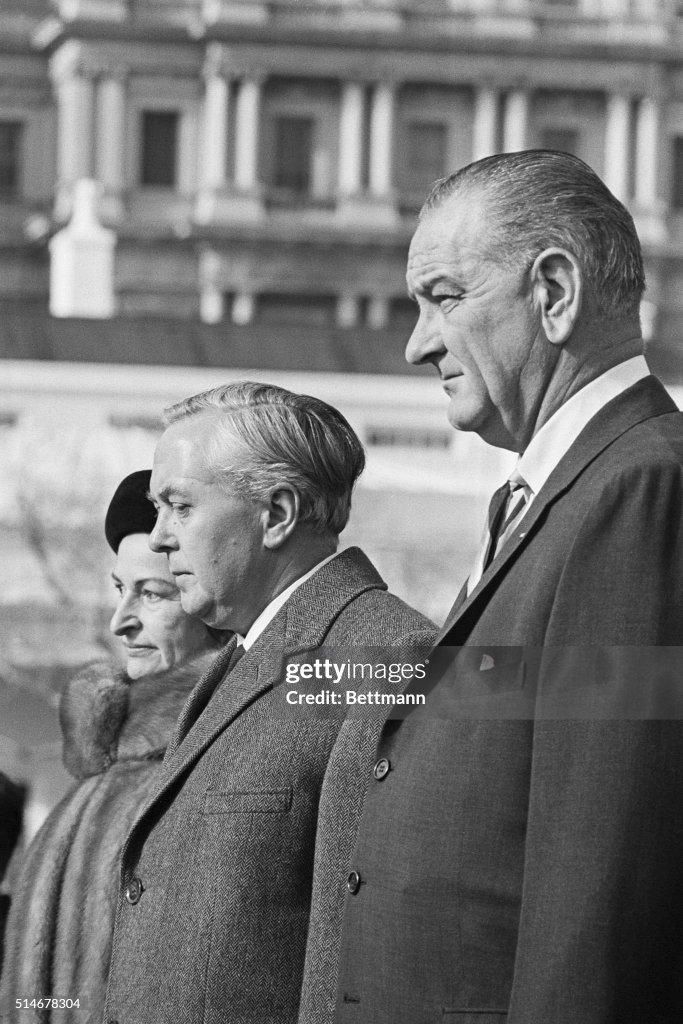
President Johnson and Prime Minister Harold Wilson conferred in private for nearly three hours today, seeking each other’s views on world problems. Neither side would give much information on the substance of the talks. British sources indicated that Mr. Wilson was pleased and encouraged by the general atmosphere of the talks, which were described as “very, very, friendly.” Both the President and the Prime Minister emphasized that their purpose was not to reach detailed decisions or ‘“blueprints,” but rather to agree on “guidelines” for future action, particularly with regard to the problems of the Atlantic alliance. Officials reported tonight that, after ranging over world problems generally, the President and Mr. Wilson began their discussion of the nuclear problems of the alliance at the afternoon session and would continue them tomorrow. But it was understood the two men were not seeking specific agreements at this stage. Mr. Johnson was described as “in no hurry.”
President Johnson and Prime Minister Harold Wilson of Britain escaped briefly tonight from such somber topics as the nuclear future of the Atlantic alliance for a festive dinner-dance at the White House. It was the 15th formal dinner given by the Johnsons in the Executive Mansion to honor a foreign chief of state or government, and their first since the Presidential election.
Three million workers in many key sectors of France’s nationalized industries and public services were called upon today to strike next Friday. The strike would be to protest a government decision under its stabilization plan to limit wage increases to 4 percent annually. Affected by the strike in varying degrees would be gas and electricity workers, miners postal employes, teachers. Parisian taxi drivers and workers in social security services, railroads and airports.
Vigorous debate marked the award by Japan today of her highest decoration for a foreigner to General Curtis E. LeMay. Chief of Staff of the United States Air Force. The presentation of the award, the First‐Class Order of Merit of the Grand Cordon of the Rising Sun, was the subject of vigorous debate because of the general’s role — a minor one — in the atomic bombing of Hiroshima and Nagasaki, almost 20 years ago. It was General LeMay who was responsible for the destructive conventional bombings of many other Japanese cities. The award to General LeMay was defended in Parliament by Premier Eisaku Sato and Junya Koizumi, director general of the Defense Agency, under questioning by a Socialist member, Hiroichi Tsujihara.
General Andrew P. O’Meara, commander of all United States armed forces in. Latin America, said today that Venezuela’s Communist guerrillas were being supported by arms, men and money from Cuba. He said Cuban assistance for the guerrillas, who call themselves the Venezuelan Armed Forces of National Liberation, was “on a small scale” but persistent. “There is obvious contact between the rebels and Havana,” the general said. “People go back and forth. There is money and I think there are arms being smuggled in.”
The Belgian Army has quietly begun training three new battalions of Congolese recruits. The move is the first step of a controversial plan to rebuild the entire Congolese Army from the bottom up. “This is an entirely new concept.” said Major Nowa Noel, the Belgian training commander. “If it doesn’t work, the Congo won’t work. It’s as simple, and as awesome, as that.” Major Noel’s opinion is shared by nearly all leading Congolese and foreign observers. The Congolese Army’s Chief of Staff, General Joseph Mobutu, has supported the plan. Ever since it mutinied against its Belgian officers after independence in 1960, the ill‐disciplined Congolese Army has provoked far more disorder than it has deterred.
Premier Moïse Tshombe has agreed not to carry out his decree canceling Belgian mining rights in the Congo pending talks in, Brussels, Foreign Minister Paul-Henri Spaak said today. These talks will be between Mr. Tshombe and Mr. Spaak. Addressing a press conference, Mr. Spaak said that such a move would be “an unfriendly’’ and “inadmissible” act that could lead to a “deterioration of Belgo‐Congolese relations.” The decision to cancel all foreign mining rights was announced by Premier Tshombe in Leopoldville Friday night. A decree signed by the Premier and countersigned by President Joseph Kasavubu put an end to the system whereby the Congo’s colonial rulers had given private companies the right to grant mining concessions.
At least 10 people were officially reported killed and 400 injured in racial rioting between Africans and Arabs in Khartoum, the capital of the Sudan, last night and today. Qualified Western sources said on the telephone from the Sudan that the authorities, who at first reacted slowly, jailed “hundreds of Sudanese” today in an effort to restore order. The Omdurman radio, the Sudan’s official government station, broadcast a statement at noon charging that a “conspiracy” was behind the racial fighting. It warned that the government would take “strict measures” to restore order. In a later broadcast monitored here, apparently after new racial fighting had broken out, the radio said the civilian Cabinet had banned street demonstrations, political gatherings and seminars. Western sources ascribed the casualty totals to a statement by Sir‐el-Khatim el‐Khaiifa.
Western sources said that seven Americans were among the injured, but that none was seriously hurt. The Omdurman broadcast also said that the American Protestant Mission Library, near the American Embassy in downtown Khartoum, had been set afire. Other reports indicated that the attacks on foreigners were accidental and that the burning of the library had occurred when a number of southerners hid there and northern mobs chased them. The rioting erupted last night when several thousand southern Sudanese went to Khartoum Airport to await the arrival of Interior Minister Clement Mboro, who is a southerner, from a tour of three southern provinces. When Mr. Mboro’s plane was delayed according to Western sources, the southern Sudanese began chanting slogans against Arabs and reasserting southern demands for secession from the Arab‐dominated Government of the Sudan.
The crowd of Africans rampaged through the airport, breaking windows and overturning furniture. Then the Africans rushed through the streets toward downtown Khartoum, smashing and burning cars and attacking Arab pedestrians. When word of the African attacks reached the city, Arab northerners were said to have organized into fighting groups and to have counterattacked. It was the third time in two months that violence had broken out in Khartoum. The first rioting, in October, overthrew the six‐year-old military regime and an outburst last month helped to force the resignation of the President, Ibrahim Abboud, the former head of the military regime.
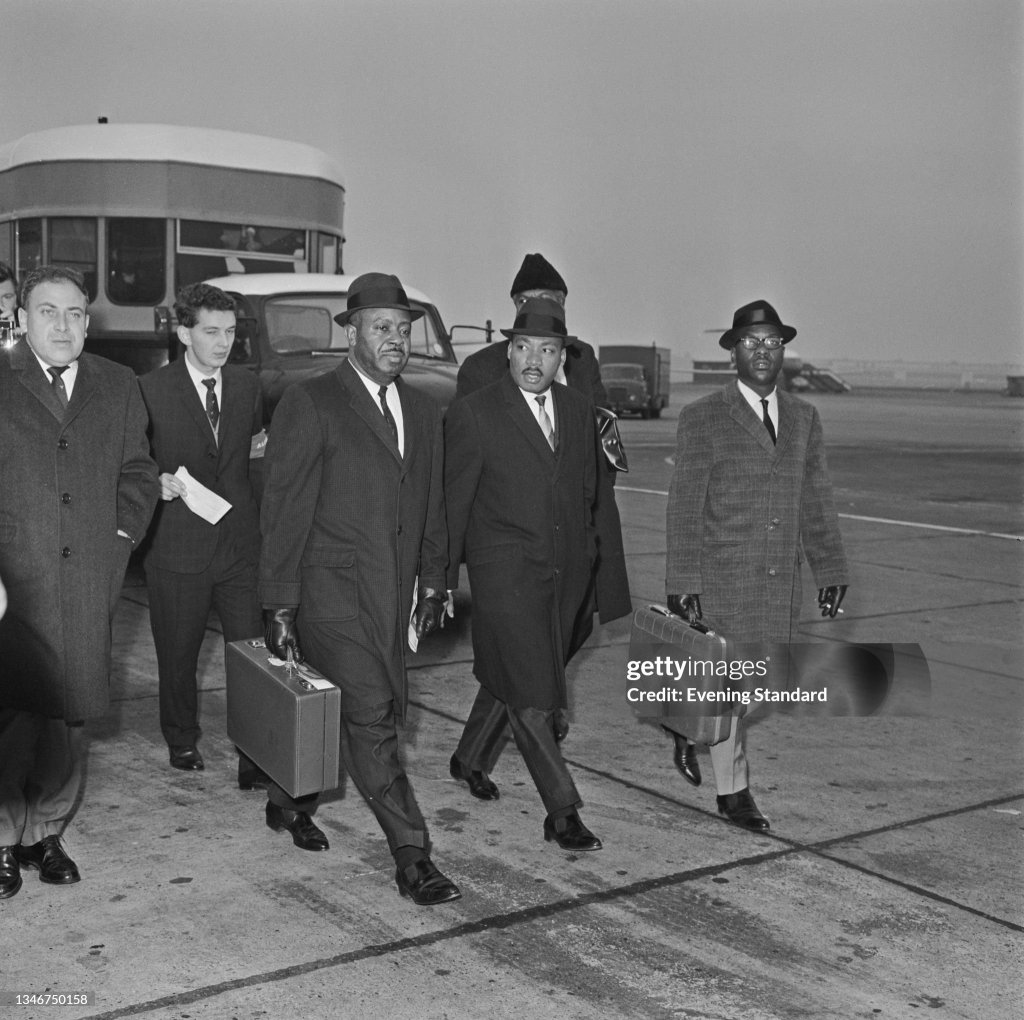
The Rev. Dr. Martin Luther King declared tonight that Britain and the United States were guilty of bolstering tyranny by refusing to impose an economic boycott against South Africa. Dr. King, this year’s winner of the Nobel Peace Prize, said “we must join in a nonviolent action to bring freedom and justice to South Africa by a massive movement for economic sanctions.” The American civil‐rights leader is on his way to Oslo to receive his $54,000 prize. He spoke before a huge audience in City Temple Hall in central London at the invitation of Canon John Collins of St. Paul’s Cathedral. Many people could not get into the packed hall. Some of the overflow moved into the crypt of St. Paul’s to hear a radio broadcast of Dr. King’s address. Still others watched the proceedings on closed‐circuit television in a church hall.
The United States Supreme Court unanimously struck down, as unconstitutional, a Florida law that prohibited cohabitation between a white man and a Black woman, or a Black man and a white woman, noting that Florida did not prohibit cohabitation between the same conduct by persons of the same race. The case of McLaughlin v. Florida arose when Dewey McLaughlin, a Black man, and Connie Hoffman, a white woman, had been sentenced to 30 days in jail after living together in Miami. The Court avoided commenting on state laws prohibiting interracial marriage.
The Court’s opinion, by Justice Byron R. White, said it was not now considering state laws against interracial marriage. Nevertheless, the decision inevitably raised doubts about the, continuing validity of such laws. “There is involved here,” Justice White said, “an exercise of the state police power which trenches upon the constitutionally protected freedom from invidious official discrimination based on race.” The language of the opinion was careful, doubtless reflecting the sensitivity of the issue of sex and race. Feelings run especially deep in the South and are often said to underlie the determination to maintain segregation.
Nineteen states still have laws against marriage between the races in 1964. They are the 11 Southern states, the border states of Delaware, Maryland, West Virginia, Kentucky, Missouri and Oklahoma, and Indiana and Wyoming. The Florida law involved in the present case is of a different character. It made it a crime for a Black man and white woman, or white man and Black woman, not married to each other, habitually to “occupy in the nighttime the same room.”
Justice Potter Stewart, joined by Justice William O. Douglas, filed a concurring opinion suggesting that the majority had not condemned strongly enough any classification based on race. “I think it is simply not possible for a state law to be valid under our Constitution,” Justice Stewart said, “which makes the criminality of the act depend upon the race of the actor.” Under that view the antimiscegenation laws would certainly be unconstitutional.
The U.S. Supreme Court agreed to review the convictions of a Connecticut doctor and a Planned Parenthood official for running a birth-control clinic in violation of that state’s law against the use contraceptives, in the case of Griswold v. Connecticut. This will become a landmark 1965 Supreme Court case that established the right of married couples to use contraception without government restriction. The Supreme Court will rule 7–2 that the law violated the right to privacy, specifically the marital right to privacy.
In Moity v. Louisiana, the court summarily reversed, on the basis of the recent holding that limited criminal prosecutions for comments on public officials, a Louisiana conviction for accusing a prosecutor of using perjured testimony.
A young minister serving his first year in this racially disturbed town challenged its civic leaders today to save it from fear and confusion. The Rev. Clay Lee, pastor of the First Methodist Church, bolted down his baked ham and potato salad at the weekly meeting of the Philadelphia Rotary Club. Then he stood and told those who run the city that they faced a choice not unlike that of Sodom, as recorded in the Bible — to find at least 10 good men or face destruction. “It has been the method and purpose of God to sustain his people when he found just 10 good men,” Mr. Lee Said.
“It is up to you to see how many good men he finds here,” Mr. Lee said. “If I had a prayer I would be able to offer in our behalf,” he continued, “it would be not that all our problems would be solved for us, but that there would be innumerable men who are just.” Mr. Lee is one of a small group of white citizens who have spoken out in an effort to prepare the community for rendering justice in the slaying of three civil rights workers last June 21. Mr. Lee said the community had been torn by “fear and confusion” in recent weeks. “You and I would be less than men if we did not face our corporate and individual responsibility,” he said. He received polite applause at the close of his speech, but many people in the community seemed to be angry at the federal government, which has accused 21 white men of involvement in the slayings.
Several leaders said they knew of no move to remove Sheriff Lawrence A. Rainey, Deputy Sheriff Cecil Price and a city policeman, O. N. Burkes, from office pending trial of the case. The three officers were among the 21 men arrested on federal charges in connection with the slaying of the three young men on a road several miles southeast of town. At the sheriff’s office, Sheriff Rainey and Deputy Price met all visitors with smiles and handshakes. Several clerks and a big, burly man stood at the counter reading “A Thunderbolt,” an anti‐Black and Anti‐Semitic newspaper published in Birmingham, Alabama, by the national States Rights party. On the bulletin board outside the sheriff’s office is a poster depicting Justice Department officials as “Jew‐Communist.”
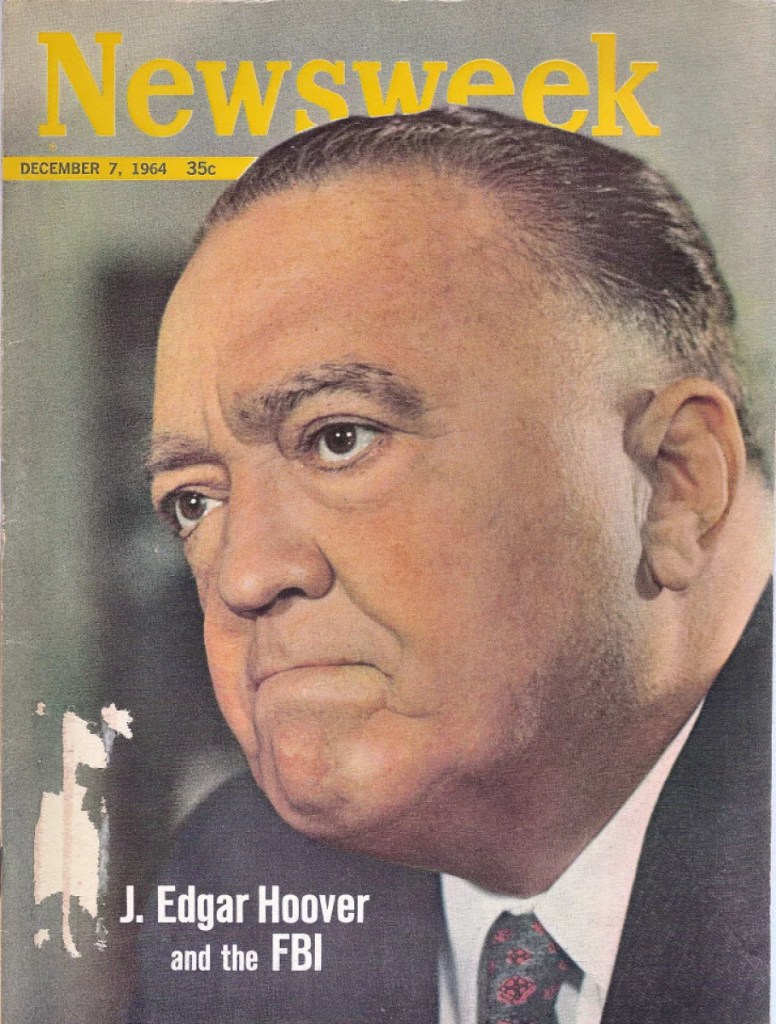
Sheriff Rainey told several persons today that the expected that the Federal Bureau of Investigation would be forced to disclose its evidence at a preliminary hearing Thursday in Meridian. The hearing for all 21 defendants is to be held before the United States Commissioner to determine whether the Government has enough evidence tn sustain the charges. Laurel G. Weir, the chief defense attorney, said the defendants would ask for a full hearing. Acting Attorney General Nicholas de B. Kalzcnbach said last night that “no pressure of any kind” had been exerted on the FBI to solve the Mississippi civil rights slayings quickly because of the visit of the Rev. Dr. Martin Luther King Jr. to Mr. Hoover. Mr. Katzenbach praised the bureau for doing a “first‐rate job in a difficult area.”
Melvin Wulf, a lawyer from New York, was criticized in the Mississippi State Supreme Court today when he warned that Mississippi would not be able to make convictions of Blacks stand up on appeal unless Blacks were freely used on juries. Mr. Wulf was arguing the appeal of Willie B. Harper, convicted of the attempted rape of a 16-year‐old white girl in Scott County two years ago. “Almost every conviction of a Negro in Mississippi is unconstitutional because of no Negro serving on juries,” Mr. Wulf said. At that point, Justice W. Ethridge Jr. interrupted and said: “I don’t think we need a moral comment from you.” Mr. Wulf then rested his case. He had appealed the conviction on the ground that Blacks had been systematically excluded from the jury. He also said there was a conflict in the evidence.
A predominantly Black political group asked a federal court here today to rule illegal a state injunction prohibiting the use of the word “Democratic” in its name. A suit filed in federal district court called the chancery court’s injunction part of a conspiracy aimed at frustrating efforts to make Blacks a “powerful political force” in Mississippi. The suit named Chancellor Stokes Robertson and the State of Mississippi as defendants. It asked the court to temporarily restrain and permanently bar enforcement of the chancery court’s injunction. Chancellor Robertson held on November 19 that the Freedom Democratic party could not function under that name because the word “Democratic” was already registered as the property of the Mississippi Democratic party.
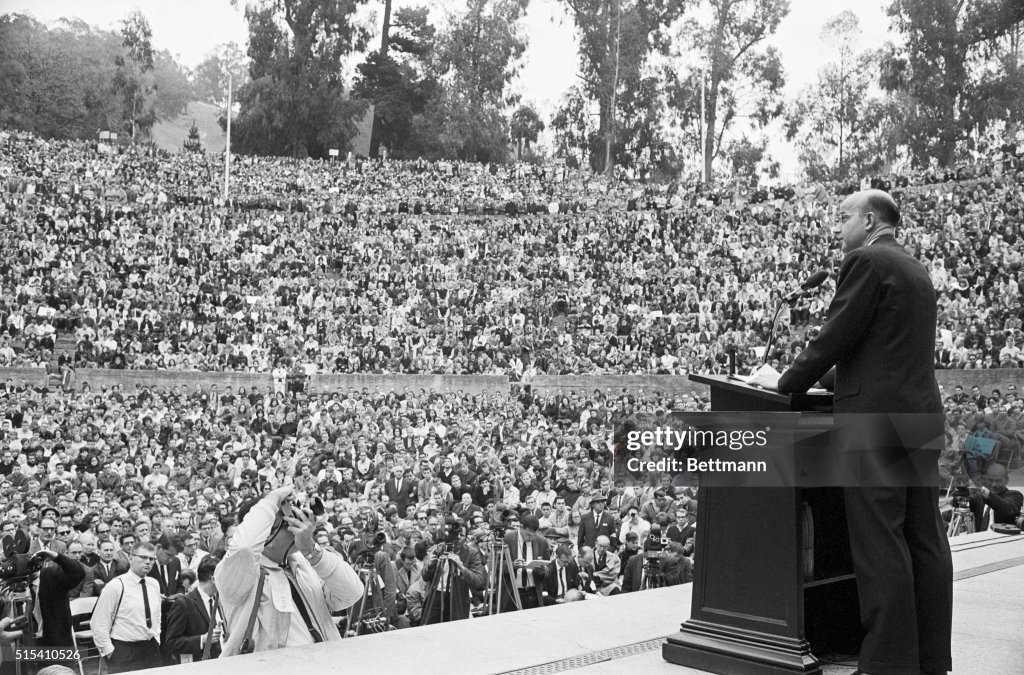
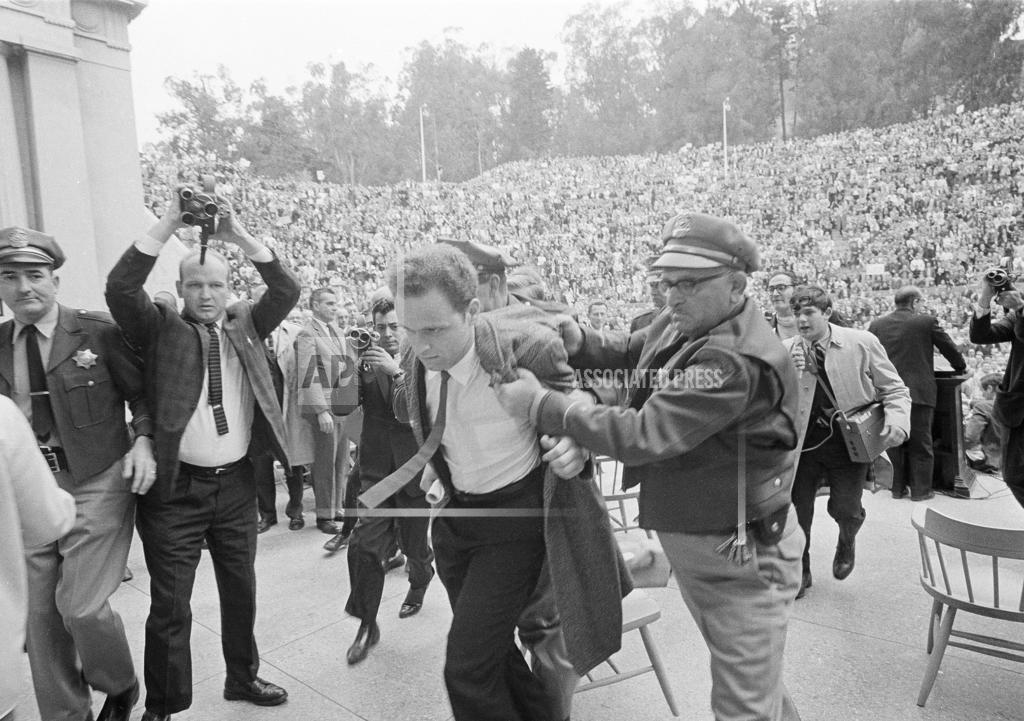
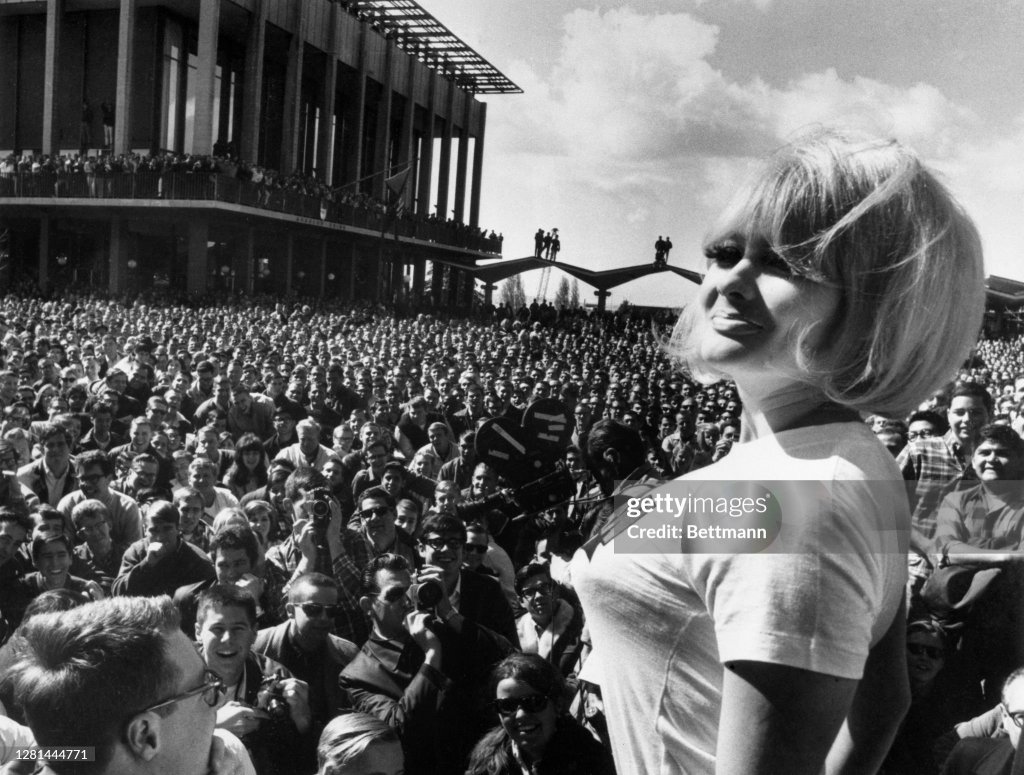
The leader of the student Free Speech Movement was dragged from a microphone today on a stage in front of 13,000 students and faculty at the University of California. Although Mario Savio, a 21year‐old philosophy student, was later permitted to return to the microphone on the stage of the Hearst Greek Amphitheater, the incident apparently cost the university administration and faculty much ground in their effort to settle a dispute that has racked the campus since September 14. The Free Speech Movement opposes university rules on political activity on campus. The incident astounded almost everyone in the amphitheater. It occurred at the end of an extraordinary convocation called by the president, Clark Kerr, and 85 chairmen and deans of university departments.
A spokesman for the Free Speech Movement said tonight that his group now looked to Che Academic Senate’s Committee on Academic Freedom for suggestions that would end the dispute. If nothing acceptable is forthcoming, he said, direct action in civil disobedience will possibly be resumed. He also said that James Farmer, the national director of the Congress of Racial Equality, would arrive here December 15 to buttress the student position. It was suggested that Mr. Savio, who earlier had said he opposed the settlement, was attempting to create an incident that would keep alive the support that his organization has built slowly over the months.
The incident occurred after Professor R. A. Scalapino of the political science department and Mr. Kerr had outlined the terms of the settlement. They would give the students most of the privileges sought by the Free Speech Movement. The proposals were not accepted with unanimity by the assembled students, but indications were that the earnestness of Professor Scalapino and Mr. Kerr had had an effect. When Mr. Kerr finished, he was applauded loudly. As he turned away, however, from the podium, where department chairmen were seated on either side, Mr, Savio entered from the left side of the stage. He walked slowly toward the microphone, brushing past the faculty members.
Mr. Savio was settling his hands on either side of the podium, taking in a breath before his remarks, when two campus policemen grabbed him. One put his arm around Mr. Savto’s throat, forcing his head back, the other grabbed him in an arm lock. They forced Mr. Savio away from the microphone and were quickly surrounded by a group of his supporters who had rushed onstage. The struggling mass moved through a door at the rear of the stage. with policemen and students in individual combat. Mr. Savio was taken out across an open terrace and into a dressing room.
Students in the audience could see the beginning of the fight. They shouted, booed, and hooted, drowning out almost all the sounds of the struggle. Those in higher seats around the rim of the bowl could see behind the partitions separating the stage from the terrace some of the rioting going on there. By the time Mr. Savio reached the door to the dressing room, he was being dragged on his back, his clothing dirty and wrinkled. The police tugged on Mr. Savio’s arms, while supporters tried to pull his legs. Other policemen forced the supporters away so Mr. Savio could be taken inside the room, where he was detained.
Eventually, it was decided to let Savio speak. Mr. Savio appeared and said; that all he wanted to do was announce a rally in the plaza at Sproul Hall for noon, a few minutes after the convocation was to have ended. After a short time at the microphone — no more than 90 seconds — Mr. Savio walked from the stage, surrounded by supporters. “They detained me,” he said. “This is a disastrous situation here.”
Dean Burch, the Republican National Chairman, offered the hand of friendship to Republican Governors today — and had it slapped by Governor Robert E. Smylie of Idaho. Mr. Burch endorsed the demand by the Republican Governors for new policy‐making machinery within the Republican party and called for unity. He indicated, however, that he would fight to hold on to his job. Governor Smylie, one of the leading critics of Mr. Burch and of his patron, Senator Barry Goldwater, responded by accusing Mr. Burch of making “hollow and shallow” promises and said he was confident the Republican National Committee would “reject” Mr. Burch when it meets in January. In another development today Mr. Burch accepted the resignation of his right‐hand man, John E. Grenier, 31 years old, a leading Goldwater conservative, from the post of executive director of the National Committee.
In Oklahoma City, a cab driver drove away. A hotel refused to lend a blanket. A crowd of onlookers did nothing. With no one to help, a 31-year‐old woman gave birth yesterday to a six‐pound baby boy on a downtown sidewalk in 30-degree weather. Mother and son were reported in good condition today at Mercy Hospital. No one in the crowd offered any help until former State Representative Robert O. Cunningham stopped his car and telephoned the Fire Department. When the rescue squad arrived, the infant was wrapped in a blanket and taken to the hospital.
Experimental usage of large doses of a 20-year‐old drug has Shown “great promise” in the treatment of addiction to heroin, a physician of the Rockefeller Institute said here yesterday. Present methods of treating narcotics addiction are inadequate since almost all addicts return to heroin after the drug has been withdrawn in a hospital. In the new study, it has been found that patients will accept an addiction to the painkilling drug methadone as a substitute for a crippling addiction to heroin. The substitute addiction allows them to maintain normal social and business life. This report was made yesterday by Dr. Vincent P. Dole, a senior physician of the Rockefeller Institute. He urged that a larger test of methadone be performed to find out if it could save the distressing economic medical, and social problem of drug addiction.
George Harrison changes his music publishing company’s name from Mornyork to Harrisongs.
Dow Jones Industrial Average: 873.99 (+3.06)
Born:
Vladimir Artemov, Russian gymnast (Olympic gold x 4, silver x 1 USSR 1988; World Championship gold x 6), in Vladimir, Russian SFSR, Soviet Union.
Peter Laviolette, American Team USA and NHL defenseman (Olympics, 1988, 1994; New York Rangers) and coach (Stanley Cup, 2006 -Hurricanes; Carolina Hurricanes, New York Islanders, Philadelphia Flyers, Nashville Predators), in Franklin, Massachusetts.
Rick Fenney, NFL running abck (Minnesota Vikings), in Everett, Washington.
Keith Paskett, NFL wide receiver (Green Bay Packers), in Nashville, Tennessee.
Patrick Fabian, American actor (“Better Call Saul”), in Pittsburgh, Pennsylvania.
Duncan Millar, English pop and jazz pianist (Blue Mercedes – Rich & Famous), in London, England, United Kingdom (d. 2022, of pneumonia).


 History Diaries