Finns held off heavy Soviet attacks on the Mannerheim Line, particularly in the Taipale sector, inflicting heavy casualties. The Battle of Taipale began. The Soviet 7th Army begins its attacks on the Mannerheim Line on the eastern end of the Karelian Isthmus. So far, the line is working exactly as planned. It is not some masterpiece of military might – more like a bunch of tank ditches – but the Soviets are up against the fixed defenses, the truly skilled and desperate Finns, and the weather. It is becoming roughly an even match. However, the Soviets do have massive numbers behind them and are thus never in any danger of losing the initiative.
The Battle of Taipale begins along the shores of Lake Ladoga on the Karelian Isthmus. The Finns have the advantage of coastal batteries there which they can use against land targets also. It is not considered the highest priority defensive sector, and the Soviets have made less progress here than elsewhere, but any breakthrough of the Mannerheim Line would undermine the truly vital components of the Finnish defenses further west. This also would forfeit the protection of natural barriers such as the Suvanto River. Minimal as the Mannerheim Line might be, it is at least something, a point of reference in the endless forests. The Soviets are taking a lot of casualties at the Taipale River near the eastern coast.
A Soviet division launches an attack across the River Taipaleenjoki. By nightfall a Russian battalion has crossed River Taipaleenjoki at Koukkuniemi.
At Kiviniemi, the last part of the covering force in front of the main defensive position on the Isthmus pulls back to the north of Vuoksi.The work of the covering force comes to an end.
Soviet amphibious operations against islands in Gulf of Finland continue. The Soviets complete their occupation of the islands off the Finnish coast. Largely undefended and small, they are of little military or economic value.
Moscow declares naval blockade of Finnish coast.
The Soviet 8th Army is advancing very slowly north of Lake Ladoga in an effort to flank the Mannerheim Line.
Some 50 aircraft arrive in Finland from Italy. Italy makes a gesture by sending 50 airplanes to Finland to aid the defense. Great Britain also sends airplanes and other armaments. Volunteers also are pouring by sea and air to Finland from other European countries.
Finns report 60 Soviet planes and scores of tanks destroyed. The Russian aim to cut Finland into two is indicated by troop moves.
A Soviet military communiqué early today claimed that the Red Army had broken through Finland’s main line of fortifications on the Karelian Isthmus and was closing in from three sides on Viborg, second largest city of Finland. This is, of course, as typical with the Soviets, a complete lie. The Soviets are flailing about ineffectually before the Mannerheim Line, for the time being going nowhere.
President Kallio receives a message of sympathy from American President Roosevelt.
Britain answered Russia’s invasion of Finland tonight by agreeing to send “a considerable quantity of war material to the Finns.”
Foreign Minister Väinö Tanner hosts an Independence Day reception for the diplomatic corps in the banqueting hall of the Kämp Hotel.
In Sweden, 80 leading public figures call on the country to help Finland.
The Swedish and Danish Parliaments today expressed pointedly the repugnance for communism and the fear of Soviet invasion that have spread throughout Scandinavia. When a Communist member of the Swedish lower house rose to speak on the question of political refugees in Sweden, 160 Deputies left the hall. Only fifty remained. Most of them were Communists and the remainder Social Democrats. In Copenhagen, when Aksel Larsen, Danish Communist leader, rose in the Chamber of Deputies to put a routine question to the Minister of Commerce, every member of the chamber except two other Communists and the Minister addressed walked out. After the walkout Dr. Fritz Clausen, National Socialist member, demanded that Denmark sever relations with Soviet Russia.
The Soviet Navy ShChuka-class submarine ShCh-311 ran aground in the Baltic Sea. She was on a voyage from Cronstadt to Tallinn. She was refloated with assistance from the destroyer Karl Marx ( Soviet Navy) and put back to Cronstadt.
Italy’s unceasing anxiety about the Balkans became more acute today when news arrived from Moscow that the Comintern’s organ had published an invitation to Rumania to join the Baltic States in putting herself under Russia’s influence, but it is believed doubtful that Rome would rush to protect Rumania from Russia.
The German and Romanian governments reach an agreement for the Romanians to reserve a set fraction of their oil production for the Reich. Oil is always one of Hitler’s top concerns, and for good reason.
King Carol presses London to decide if the West will guarantee Rumania against Soviet aggression.
Allies are silent on League of Nations plans. Argentina’s proposal to oust Russia will have a big majority, it is asserted.
The Reich admits the force of the Allied blockade. An economist says Britain has brought overseas trade to a complete standstill.
A note is issued to the Foreign Press of Berlin in which neutral countries, especially Holland, are condemned for a lack of resistance to the British blockade.
SS forces kill the inmates of Stralsund and Chelm mental asylums.
A protest against the Jewish “reservation” in the Lublin district of Poland was issued yesterday by the executive committee of the World Jewish Congress, meeting in Paris.
The British Government issues a statement to the press questioning why neutral countries are not doing more to assist the Allies in their blockade of Germany.
The House of Commons meets in a secret session— the first since the last war—to debate opposition criticism.
First Lord of the Admiralty Winston Churchill honored the officers and crew of Rawalpindi, “[w]hose glorious fight against overwhelming odds deserves the respect and honour of the House [of Commons] and of the nation”.
Field Marshal Archibald Wavell, the UK’s General Officer Commanding-in-Chief of Middle East Command, arrives in London to confer with the general staff. So far, his theater of operations has been quiet.
German physicist Werner Heisenberg submitted the first part of a report to German Army Weapons Bureau, concluding that the surest way to a reactor for energy production is enrichment of U-235 in uranium, also the only method of producing explosives “several orders of magnitude more powerful than the strongest explosives yet known.”
Air activity has slackened in recent weeks due to the poor weather. Nevertheless, the Luftwaffe is still intent on overflying Great Britain for various purposes. Today, a wrecked Heinkel He 111 bomber is found on the East Anglian coast. Other aircraft are sighted over the Orkneys. The weather hampers attempts to intercept all of these flights, but it also is causing the Luftwaffe pilots problems.
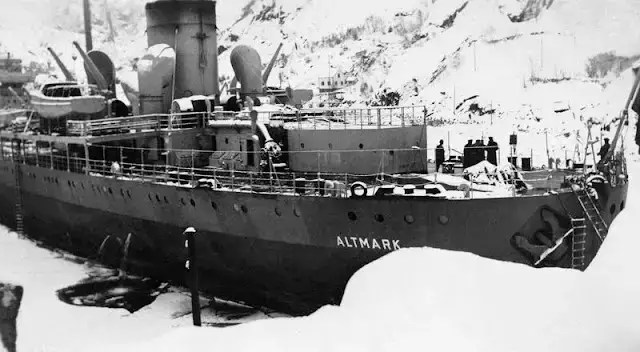
German armored ship Admiral Graf Spee refuels from tanker Altmark in South Atlantic, roughly 1,700 miles from Montevideo, Uruguay. The Admiralty has learned of the Graf Spee’s sinking of a ship off of St. Helena. Commodore Henry Harwood guesses that the German pocket battleship will head for the River Platte and has been sailing his three cruisers (HMS Exeter, Achilles, and Ajax) toward there for some days now.
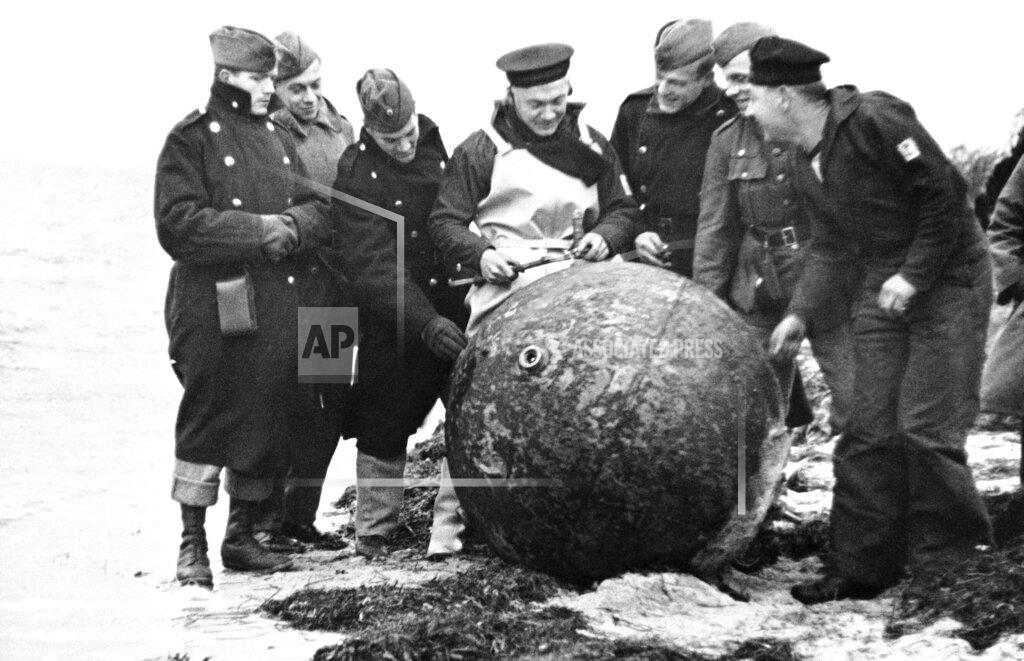
The Luftwaffe and Kriegsmarine conduct minelaying operations along British coast. During the night, German seaplanes and destroyers lay mines off the eastern coast. The British destroyer HMS Jersey will be engaged and torpedoed by German destroyers during the operations early on the 7th.
The Royal Navy minesweeping trawler HMS Washington struck a mine and sank off Caister-on-Sea near Great Yarmouth off the eastern coast of England (52° 40’N, 1° 45’E). At 10.32 hours HMS Washington (Skipper J.A. Jennison, RNR) struck a mine, laid on 5 December by U-59 and sank. The trawler was en route to be fitted out as minesweeping trawler in Great Yarmouth after being requisitioned. Of the ship’s complement only one crew member survived.
The Estonian steam merchant Agu was torpedoed and sunk by the U-31, commanded by Kapitänleutnant Johannes Habekost, in the North Sea (56° 03’N, 0° 35’E). At 07.54 hours, U-31 fired one torpedo at a small steamer and observed how the ship sank immediately after being hit amidships about 90 miles northeast of Blyth. The victim was probably Agu (Master Johannes Lamboth) which had left Tyne on 5 December and was never heard of again. All of the ship’s complement of 18 died. The 1,575-ton Agu was carrying coal and was bound for Gothenburg, Sweden.
The unescorted and neutral Swedish steam merchant Vinga was torpedoed and sunk by the U-31 approximately 100 miles east of Dundee, Scotland in the North Sea (56° 25’N, 1° 08’E). At 23.49 hours the unescorted and neutral Vinga (Master Thorsten Parrow) was hit in the foreship by one G7a torpedo from U-31 about 100 miles east of Dundee and sank slowly within 20 minutes. The enire crew of 22 survived and was picked up by the Danish steam merchant Transporter. The 1,974-ton Vinga was carrying coal and was bound for Gothenburg, Sweden.
The neutral Norwegian motor tanker Britta was torpedoed and sunk by the U-47, commanded by Kapitänleutnant Günther Prien, 45 miles southwest of Longships Lighthouse, southwestern England in the eastern Atlantic Ocean (49° 29’N, 6° 31’W). At 20.29 hours on 6 December 1939 the unescorted and neutral Britta (Master Lauritz Knutsen) was hit on port side aft by one G7a torpedo from U-47, broke in two and sank slowly about 45 miles southwest of Longships Lighthouse. The Germans had recognized the Norwegian nationality markings, but sank the ship in accordance with orders received by radio message on 23 November that authorized the U-boats to attack all tankers within a declared blockade area around Britain without warning. Of the ship’s complement, 6 died and 24 survivors were picked up by the Belgian trawler Memlinc. The 6,214-ton Britta was carrying ballast and was bound for Curaçao.
The British cargo ship Paralos struck a mine and sank in the North Sea 7 nautical miles (13 km) north east of North Foreland, Kent (51°31′N, 1°37′E) with the loss of three of her 25 crew. Survivors were rescued by the Roek.
The German passenger ship Ussukuma sinks in the South Atlantic 100 nautical miles (190 km) off the coast of Argentina after being intercepted by the Royal Navy cruiser HMS Ajax and scuttled late on the evening of the 5th. All 107 crew were rescued and interned for the duration of the war.
The administration of U.S. President Franklin D. Roosevelt sent a diplomatic note protesting the British policy of seizing German goods on neutral (especially U.S.) ships.
U.S. freighter Yaka, detained at the Downs by British authorities the previous day, is released.
Convoy OA.48 departs Southend.
Convoy OB.48 departs Liverpool.
The War at Sea, Wednesday, 6 December 1939 (naval-history.net)
Motor Torpedo Boat Flotilla 1 arrived at Portsmouth on the 6th, with base ship VULCAN (trawler, 623grt) reaching there on the 8th after coming from Gibraltar in convoy HG.9. After refitting, the Flotilla was based at Felixstowe and became operational in January 1940.
On Northern Patrol were light cruiser SHEFFIELD and seven AMCs between the Faroes and Iceland, and heavy cruiser SUFFOLK and AMC LAURENTIC in the Denmark Strait.
Heavy cruiser DEVONSHIRE arrived in the Clyde from Loch Ewe.
Light cruiser NEWCASTLE arrived at Scapa Flow from Northern Patrol.
Force W consisted of Fleet Tenders A and B (the dummy battleships) and their destroyer escorts. MASHONA and SOMALI arrived at Belfast on the 2nd from escort duty, and BEDOUIN and NUBIAN, which departed the Clyde on the 4th, were to rendezvous off Belfast Lough when Force W departed. The Force was to have departed Belfast on the 4th, but was held until the arrival of the ESCORT and ELECTRA, which left Portsmouth on the 5th. They finally departed Belfast at 0600/6th escorting Force W to Rosyth, where they arrived on the 9th.
Submarines THISTLE arrived at Rosyth and SNAPPER at Harwich after patrol.
Due to communication and administration problems while at sea, Rear Admiral Destroyers transferred to submarine depot ship TITANIA, allowing light cruiser AURORA to be released to the Clyde for refit. She departed Rosyth, arriving on the 7th for repairs that continued until the 31st. Meanwhile, destroyer depot ship WOOLWICH departed Portsmouth on the 16th, escorted by destroyer BRAZEN, but the latter developed mechanical defects and was detached at Plymouth. Destroyer BASILISK relieved her and WOOLWICH reached the Clyde on the 18th, with Rear Admiral Destroyers transferring to her on the 19th.
Destroyer IMPERIAL arrived at Rosyth from Scapa Flow.
Destroyers WARWICK and VIMY arrived at Loch Ewe with portable pumps for damaged battleship NELSON, and sailed later that day for Liverpool, arriving on the 7th.
GERMAN DESTROYER MINELAYING OFF CROMER AND HMS JERSEY TORPEDOED
German destroyers ERICH GIESE, BERND VON ARNIM and HANS LODY departed Wilhelmshaven to lay mines off Cromer. En route, ARNIM had a mechanical breakdown and returned to port, but GIESE carried out her lay during the night of the 6th/7th escorted by LODY. While the minelay was in progress, destroyers JERSEY and JUNO, patrolling in the area, were sighted four miles SE of Cromer Knoll Light. GIESE torpedoed JERSEY at 0235/7th and left her badly damaged with Lt (E) J Le C Morris, Gunner (T) G L Blowers and eight ratings killed, and Cadet A R W Archibald, Surgeon Lt H G Silverster and ten ratings injured. Sister ships JUNO, JACKAL and JANUS assisted
JERSEY was towed by JUNO, and screened by JACKAL, which departed the Humber at 0600. JANUS, also in the Humber, did not leave until later in the morning when the visibility improved. Tug YORKSHIREMAN (251grt) later took over JERSEY and took her to Immingham. JUNO and JACKAL attacked a submarine contact near the location of her torpedoing. JERSEY received temporary repairs at the Humber Graving Dock until 7 January and then proceeded to Amos Smith Dock, Hull where she was under repair until 23 September 1940.
Two British steamers were sunk and one damaged on this minefield:
On the 8th, steamer COREA (751grt) 1½ miles 65° from Cromer Coast Guard Station; eight crew lost, and seven survivors picked up by the Cromer lifeboat.
On the 12th, steamer KING EGBERT (4535grt) in convoy FS.53, four miles SW of Haisborough Light off Cromer; one member of the crew lost and 32 survivors rescued.
On the 21st, British steamer DOSINIA (8053grt) in convoy FN.57 was badly damaged ½ mile SW of Haisborough Light off Cromer. Escorting sloop WESTON detailed a trawler to stand by the damaged ship, which was taken to Hull.
Minesweeping trawler ST DONATS (349grt) was positioned 9 miles S of Cromer Knoll Light Vessel to divert southbound shipping away from the mine area, while minesweeping trawler PELTON (358grt) diverted northbound traffic.
Destroyer VANSITTART, escorting a convoy, was in a collision with a transport in the English Channel. She was repaired and refitted at Portsmouth, completing on 19 January.
Convoy OA.48 of 11 ships departed Southend escorted by destroyers ACASTA and ARDENT from the 6th to 8th, and destroyer WHITEHALL and sloop ENCHANTRESS from the 8th to 9th, when they detached to OA.49.
Convoy OB.48 departed Liverpool escorted by destroyers WALKER and WHIRLWIND until the 9th.
Anti-submarine trawler LOCH TULLA (423grt) attacked a submarine contact 14.4 miles 105° from Sule Skerry.
Destroyer GRENVILLE attacked a submarine contact 18 miles S by E of Orfordness.
Minesweeping trawler WASHINGTON (209grt, Skipper J A.Jennison RNR) was sunk off Caister near Great Yarmouth on a mine laid by U-59 on the 5th; seven crew were lost and there was only one survivor.
U-31 sank Swedish steamer VINGA (1974grt) in 56 25N, 01 08E, but all her crew were rescued by Danish steamer TRANSPORTER (1561grt).
U-31 sank Norwegian steamer FOINA (1674grt) in the North Sea NW of Rattray Head with the loss of 18 crew.
U-47 sank Norwegian tanker BRITTA (6214grt) 45 miles SW of Longships Light; six crew were lost and 25 survivors picked up by Belgian trawler MEMLINC (129grt).
Battleship BARHAM departed Alexandria on the 1st escorted by destroyers DAINTY and DEFENDER. The destroyers were relieved off Malta by sisters ships DUNCAN and DUCHESS, later departing Gibraltar on the 6th for the Clyde.
French battleship PROVENCE, escorted by three destroyers, which had departed Toulon on the 4th, arrived at Gibraltar with Vice Amiral Ollive onboard to take command of the Casablanca command. They should have sailed that evening, but a wire wrapped itself around PROVENCE’s propeller shaft preventing her leaving. Amiral Ollive embarked in submarine depot ship JULES VERNE, escorted by destroyers BORDELAIS and LA RAILLEUSE, which arrived on the 11th from Casablanca. JULES VERNE departed that day, escorted by destroyers ALBATROS and VAUBAN, while PROVENCE was able to leave Gibraltar on the 12th for Toulon with BORDELAIS and LA RAILLEUSE.
Light cruiser BIRMINGHAM departed Hong Kong on the 6th after receiving a report that German steamer BURGENLAND (7320grt) had departed Kobe on the 5th. No contact was made and she patrolled with submarine PANDORA and armed merchant cruiser MORETON BAY in the area of Kii Channel. However BIRMINGHAM did stop a Dutch freighter which was allowed to continue after inspection.
President Roosevelt, in a rare rebuke of the British during the war, sends a diplomatic note protesting the British “reprisals” for the German magnetic mines. He does not believe it is proper to seize German goods on neutral vessels. A decision has been reached to make a broad reservation of American rights in a note to Great Britain setting forth the United States’ position with regard to the seizure of German exports. The British practiced a similar policy during the First World War.
Presidential candidate Thomas Dewey urges the United States to end “defeatism” as a national enemy. He tells 12,000 in Minnesota that Roosevelt and his New Deal policies help create a spirit of despair. In his first speech since the formal announcement of his candidacy for the Republican nomination for President, the New York District Attorney charged that President Roosevelt had not only failed after seven years to reduce unemployment, but that his New Deal policies had prevented private business from putting men or capital to work.
“There is a force in America that has been held in check which once released can give us the employment that we need,” Mr. Dewey told a large and enthusiastic meeting in the Minneapolis Auditorium under the auspices of the Minnesota Republican State Central Committee. It has nothing to do with slick monetary schemes. It has nothing to do with slick economic panaceas. This force is the energy of American enterprise, great and small. Given a chance, it can produce employment, can generate new purchasing power and set in motion once more the surging flow of commercial venture. Government hostility, repressive taxation, and economic quackery have kept this force from going to work. Our firm resolve must be to give it a chance and to encourage enterprise.”
Free enterprise is vital to recovery, industry is told. The nation’s economic welfare and political liberties are linked to private business. Rededication of the nation to the “fundamental principles upon which it was founded” and the removal of obstacles to private enterprise as steps essential to wider and more sound recovery were the basic demands voiced yesterday at the opening of a three-day session of the Congress of American Industry, arranged by the National Association of Manufacturers at the Waldorf-Astoria Hotel in New York. Three thousand of America’s industrial leaders assembled for the congress to discuss the nation’s chief economic problems under the general slogan: “Forward with the Republic.”
England is somewhat puzzled by the stand of the United States in the war, according to Joseph P. Kennedy, United States Ambassador to the Court of St. James, who arrived this afternoon from Lisbon on the Dixie Clipper to consult with the President and the State Department and for the Christmas holidays. In reply to a question asking what was Great Britain’s reaction to our policy, Mr. Kennedy said England was trying to estimate “just what we mean” when we expressed great sympathy with their cause and at the same time our intentions to remain neutral. The British view of our stand was described by Mr. Kennedy as follows: “It’s like a fellow sticking out his tongue at a man and not being ready to punch him in the jaw.”
A project to have Leon Trotsky and Diego Rivera, Leftist Mexican painter, testify before the House Committee on Un-American Activities about Communist inroads in Latin America was disclosed today by Representative Martin Dies, chairman.
Dr. Walter Engelberg, the secretary of the German Consulate in New York, was found murdered yesterday in his home at 1,280 East Fifth Street, Brooklyn. A case on which a diplomatic report will be made to Berlin, the police found little to suggest either the murderer or the motive, except that the consular secretary had incurred the suspicion of his neighbors. They were seeking eight unnamed men for questioning. He was a quiet man of about 42 who lived, so the neighbors thought, strangely. Coming to New York from Chicago, where he stayed only two months following a transfer from Athens, Greece, more than a year ago, he rented the small one-family, two-storied house in a quiet neighborhood made up of such homes. Since that time, the neighbors said, at least seven men had stayed with him, one at a time, sometimes for a week and some for a month or more. No woman was ever seen to enter the house, but the police found it tastefully and completely furnished with Dr. Engelberg’s own belongings and kept in meticulous order.
[Ed: Far from being political or espionage-related, this turns out to be a sordid little murder with homosexual details.]
Pan American Airways, whose huge transatlantic clippers now leave New York twice weekly for Lisbon, Portugal, will expand this service soon to six flights a week, it was announced last night by Juan T. Trippe, president and general manager of the airline.
The proposed grid system of electric transmission lines suggested by President Roosevelt yesterday as a possible joint undertaking of the government and privately owned utilities as a measure of national defense received today the cold shoulder from Wendell L. Willkie.
Fritz Kuhn began yesterday his two and one-half to five-year sentence in Sing Sing under protective custody in a segregated cell block where are confined only prison trouble-makers and persons whose lives might be menaced by other prisoners.
Early arrivals for the meeting of the executive committee of the Republican National Committee scheduled for tomorrow indicated today that they favor holding the party’s national convention in the middle of June, irrespective of when the Democrats meet.
The stage musical “DuBarry Was a Lady” with music by Cole Porter opened at the 46th Street Theatre on Broadway.
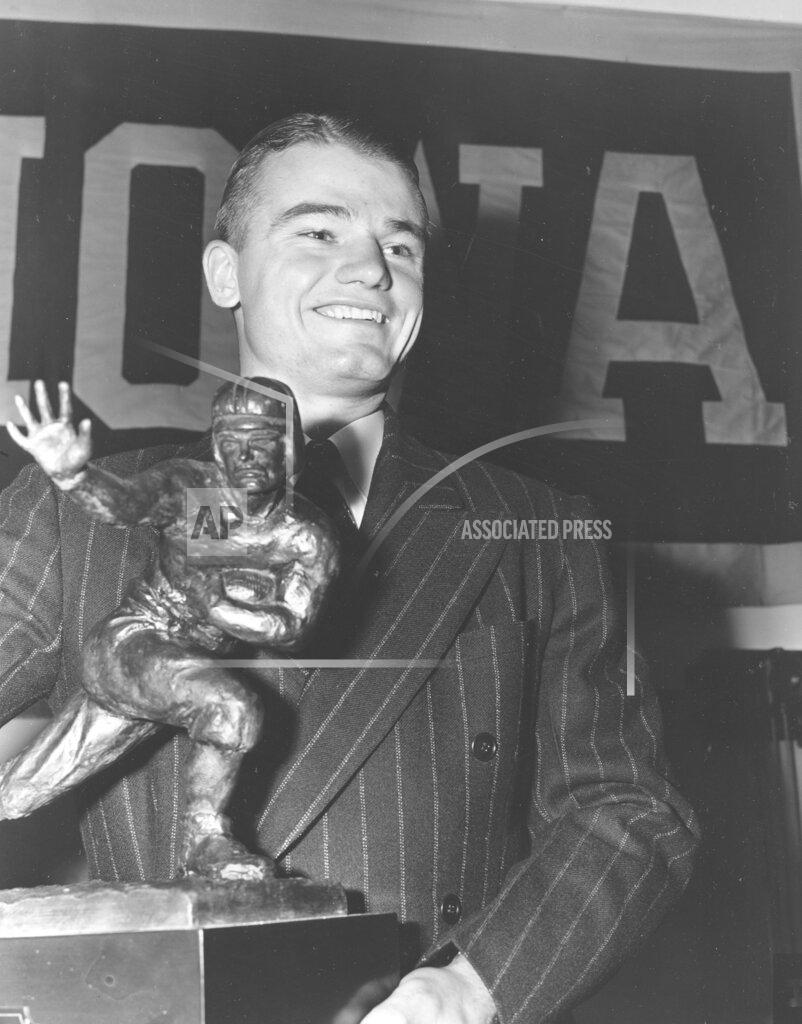
5th Heisman Trophy Award: Nile Kinnick, Iowa (halfback).
In a trade of veteran shortstops — or “worn-out shortstops,” as one newspaper described it — the Chicago Cubs acquire Billy Rogell from the Detroit Tigers for Dick Bartell. Rogell, who injured his arm playing handball the previous year, will hit just .136 before hanging up his spikes. The Tigers will release “Rowdy Richard” 5 games into the 1941 season, but he will stick with the Giants until 1946.
The Boston Bees are busy clearing their pitching staff. Jim Turner goes to the Reds for first baseman Les Scarsella and cash, while Johnny Lanning is sent to Pittsburgh for pitcher Jim Tobin and cash. On December 8th, pitcher Danny MacFaydan joins Tobin in a trade for pitcher Bill Swift.
The Chinese winter offensive gets in motion with an attack by the 1st War Area on the Japanese 1st Independent Brigade in the vicinity of Anyang. North of the Yellow River 36th Army Group attacked. Its New 5th Corps on December 6 attacked elements of the Japanese 1st Independent Mixed Brigade north and south of Anyang, succeeded in destroying bridges along the roads at Chi, Chun, Tang-yin, and Pao-lien Temple Station.
The Japanese are still launching spoiling attacks against the Chinese at Wenhsi and Hsia Hsien.
Dow Jones Industrial Average: 148.78 (+2.29)
Born:
Steve Alaimo, American pop singer (“Mashed Potatoes”; “Every Day I Have To Cry”), in Omaha, Nebraska.
Tomés Svoboda, Czech composer (Etude), in Paris, France.
Naval Construction:
The Kriegsmarine (German Navy) Type IXB U-boat U-107 is laid down by AG Weser, Bremen (werk 970).
The Nihon Kaigun (Imperial Japanese Navy) Type B (B1 sub-class) cruiser submarine I-31 is laid down by the Yokosuka Naval Yard (Yokosuka, Kanagawa Prefecture, Japan).
The Kriegsmarine (German Navy) Type IIC U-boat U-63 launched by Deutsche Werke AG, Kiel (werk 262).

 History Diaries