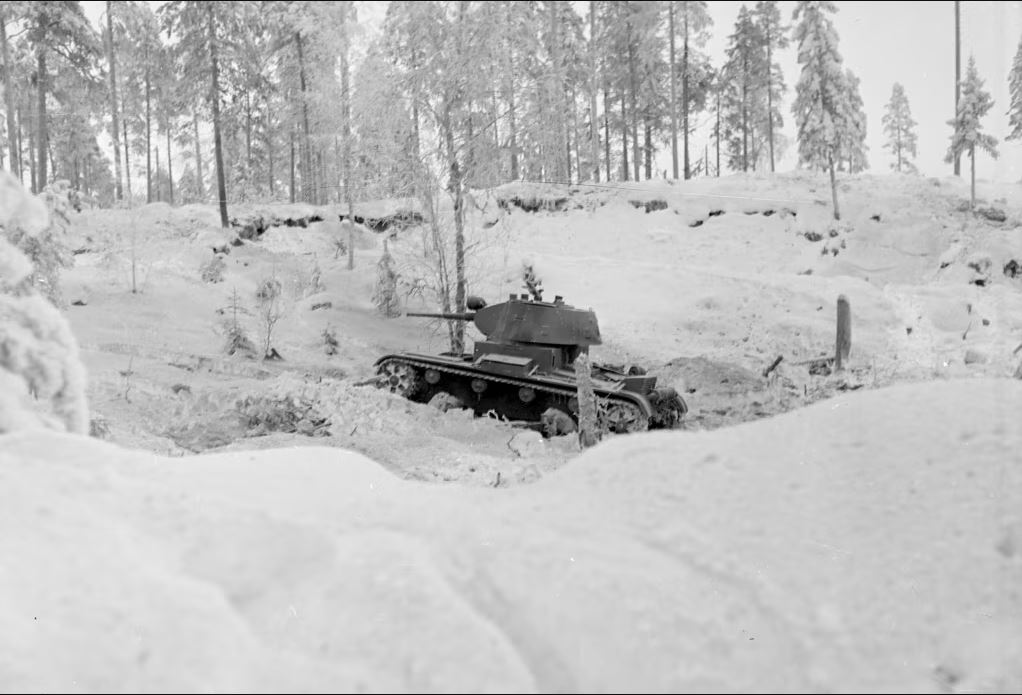
The Soviet 7th Army reached the Mannerheim Line. Forward units of the Soviet Seventh Army reach the Mannerheim Line, the main Finnish defenses, garrisoned by the Finnish 2nd Corps. There are other projected lines to the rear, but this is their best hope of stopping the Soviets. Heavy fighting takes place between Soviet Army and Finnish Army in the Karelia region in southern Finland. Marshal Mannerheim is the Finnish Commander in Chief. Already the Finns are learning to exploit poor management of the Soviet advance. They are developing tactics to master the Soviet tanks by separating them from their supporting infantry and emerging from concealed positions during the night to destroy them in close combat.
The covering force on the Isthmus launches its final counterattack at Perkjärvi, ending in a Finnish withdrawal behind the main defensive position.In places the withdrawal shows signs of panic.
Finnish Blenheim bombers raid the Soviet airbase at Murmansk with incendiary bombs.
The Finns claim to have destroyed 64 Soviet tanks and destroyed 24 planes in the previous two days. The Soviets, of course, have thousands more of each.
Soviet naval forces land troops on Suursari Island.
Russians at the front denounce the Finnish defenders for their “base and tricky cunning,” as traps and mines take a heavy toll.
The Russians are halted. Finns report taking 1,500 as a snowstorm hinders their foe.
The Soviet Navy “M” (Malyutka)-class submarine M-71 was driven ashore and severely damaged on a skerry in Finnish waters. She was refloated and taken in to Cronstadt for repairs.
The Finnish Parliament assembles for the first time in Kauhajoki.
The Finnish Broadcasting Company urges its listeners to be on their guard against Russian propaganda, and indicates it will use as many familiar announcers as possible in its own broadcasts.
Sweden strengthened her military and civilian defenses today and sped negotiations for a new government to present a united front in efforts to preserve her neutrality before the Russian-Finnish war crisis.
The Balkans draw closer; the Russian invasion of Finland unites them.
The Nazis cite Finland as an example, warning neutrals of penalties for those who take the advice of democracies.
The German Government announces that munitions output has doubled since the start of the war and is projected to double again in six months’ time.
Hungarians decide to fight the spread of Communism with their armed forces. It was understood tonight in authoritative quarters in Budapest that the Hungarian Government has decided to oppose with military force any attempt to extend communism across the Carpathian Mountains.
Italian aviators vow to aid Finland, urging Finns to resist the Soviets.
Rumania agrees to reserve a proportion of its oil production for export to Germany.
Britain urges Rumania to cut trade with the Reich. Great Britain today sent a note to the Rumanian Government asking it to stop deliveries of raw materials and goods to Germany.
Greek fear of Italian aggression recedes after the signing of the Italo-Greek pact last month. 10,000 Italians have reportedly shipped out from Durazzo in Albania to reinforce the Italian colony in Libya.
Germany has descended “to the lowest form of warfare that can be imagined”, Winston Churchill told the House of Commons today in reference to the use of the sea-mine. He claimed great success for Britain’s policy of moving ships in convoys. There were always 2,000 ships at sea, and losses in convoy were down to one in 750. Two-thirds of the ships now being sunk by the mines belonged to neutrals. As far as the war at sea was concerned, “German friendship has proved far more poisonous than German enmity,” Mr. Churchill said. He did not mention the capture off Brazil yesterday of the liner Ussukuma, which had been attempting to take supplies to German pocket battleships in the South Atlantic.
Sailing with Convoy OB.46, the British steam merchant Navasota was torpedoed and sunk by the U-47, commanded by Kapitänleutnant Günther Prien, approximately 150 miles west of Bishop Rock in the eastern Atlantic Ocean (50° 43’N, 10° 16’W). At 14.40 hours the Navasota (Master Charles Joseph Goble) in convoy OB.46 was hit by one torpedo from U-47 and sank about 150 miles west of Bishop Rock. The master and 36 crew members were lost. 37 crew members were picked up by HMS Escapade (H 17) (Cdr H.R. Graham, RN) and eight crew members by the British steam merchant Clan Farquhar and landed at Capetown. The 8,795-ton Navasota was carrying ballast and was bound for Buenos Aires, Argentina.
U-59 laid 9 mines off Cockle lightship off Lowestoft, which later resulted in the sinking of two ships.
U-28 laid 12 mines in the Bristol Channel, later resulting in the sinking of one ship.
Off the coast of Uruguay, the captain of the German passenger steamer Ussukuma decided to scuttle the ship when it was intercepted by the British cruiser Ajax. The Ajax rescued the 107 crew of the Ussukuma and interned them as enemy civilians. Towards evening, the German liner Ussukuma met the British cruiser HMS Ajax. Ajax had been looking for the Graf Spee (later meeting her in the battle of the River Plate on 13 December) and had been informed of the departure of the Ussukuma by the British naval attaché in Montevideo and by a Dutch ship which had met the Ussukuma shortly after the latter’s departure. The Ajax threatened not to rescue the German crew if they left their ship but also ordered them not to sink it. Captain Wilmsen decided to scuttle her nevertheless and the Ajax fired three rounds at her, the first across the bows, the second whilst she was lowering her lifeboats and the third when the boats were dropped into the water, 62 miles from the coast.
Destroyer HMCS Assiniboine departed Halifax for Jamaica & Caribbean patrol.
Convoy OG.9 forms at sea for Gibraltar.
German vessel Dusseldorf captured by RN cruiser Despatch off Chile.
U.S. freighter Yaka is detained at the Downs by British authorities.
Freighter Exmouth, detained at Gibraltar since 22 November, is released.
U.S. freighter Exochorda is detained at Gibraltar by British authorities, who maintain that the 45 tons of tin plate among the vessel’s cargo is contraband. The latter maintain that the cargo must be taken to Marseilles and unloaded there; the manager of the shipping firm (Export Lines) maintains that the ship cannot proceed to a belligerent port without violating the Neutrality Act. Until the impasse is resolved, the merchantman remains at Gibraltar.
The War at Sea, Tuesday, 5 December 1939 (naval-history.net)
Heavy cruiser NORFOLK departed Scapa Flow and arrived at Belfast on the 6th, where she began repairing defects, completed on the 21st.
On the Northern Patrol, seven armed merchant cruisers were on patrol between the Faroes and Iceland, with light cruiser SHEFFIELD eastward of them as close cover and battlecruiser HOOD with destroyers KINGSTON, KASHMIR and KHARTOUM north of the Faroes as distant cover. Heavy cruiser SUFFOLK was proceeding east of Iceland and AMC LAURENTIC was west of Iceland to patrol the Denmark Strait.
Anti-aircraft cruiser CAIRO departed the Thames and arrived at Loch Ewe on the 7th to provide protection for damaged battleship NELSON.
Minesweeper SHARPSHOOTER sustained minor damage in collision with a tanker.
Convoys OA.45G and OB.45G with a total of 44 ships merged as convoy OG.9. Sloop DEPTFORD escorted the convoy on the 5th and destroyers AMAZON and ANTELOPE from the 5th to 6th. French destroyers TIGRE and PANTHÈRE, which departed Brest on the 4th, joined from the 6th to 11th, and destroyer VOLUNTEER from the 5th to 9th. The convoy arrived at Gibraltar on the 11th with the French destroyers and also destroyers HAVOCK and WATCHMAN, which had joined on the 10th.
Convoy FN.50 departed Southend, escorted by sloops GRIMSBY and WESTON, and arrived in the Tyne on the 6th.
Convoy FS.50 departed the Tyne, escorted by destroyers WALLACE and WOOLSTON, arriving at Southend on the 6th.
U-47 sank steamer NAVASOTA (8795grt) from convoy OB.46 at 1425, 50 miles SW of Fastnet in 50 43N, 10 16W. Thirty-seven crew were lost, while destroyer ESCAPADE rescued 35 survivors and steamer CLAN FARQUHAR (7958grt) a further ten. Destroyer WALPOLE was ordered to search. Destroyers ESCAPADE and WINDSOR attacked U-47 at 1515, inflicting light damage, and were then ordered to meet arriving convoy SLF.10 at 0800/7th.
Anti-submarine trawler KINGSTON ANDALUSITE (415grt) attacked a submarine contact off Folkestone. Destroyer BOADICEA was ordered to investigate.
Convoy ON.4 of seven British ships departed Methil escorted by destroyers ESKIMO, MATABELE, ICARUS and ILEX. Light cruisers GLASGOW and EDINBURGH departed Rosyth on the 6th to provide close support, while battlecruiser HOOD, and destroyers KASHMIR and KHARTOUM, which departed Scapa Flow on the 6th, gave heavy support. Destroyers KANDAHAR and KINGSTON arrived at Sullom Voe to refuel on the 7th, and left on the 8th to relieve KASHMIR and KHARTOUM for refueling. The convoy safely arrived at Bergen on the 8th, while GLASGOW and EDINBURGH arrived back at Rosyth on the 11th.
Danish steamer ALEXANDRA (1463grt) was seized off Esbjerg by two German armed trawlers, and taken to Germany during the night by three German destroyers.
Belgian steamer KABINDA (5182grt) ran aground and broke in half on the English coast.
Danish steamer EGYPTIAN REEFER (3159grt) ran aground on the west coast of Scotland, but was later refloated and brought into port.
U-59 laid mines off Great Yarmouth in Cross Sands near the Cockle Light Ship, on which two steamers were lost.
U-28 laid mines in the Bristol Channel, but no shipping was sunk or damaged.
Sloop SANDWICH arrived at Port Said from the Indian Ocean en route to the UK. Reaching Malta on the 9th, she left next day for Gibraltar.
German steamer USSUKUMA (7834grt) had departed Hamburg for India before the start of the war, and took refuge at Lourenco Marques, before leaving for Bahia Blanca where she arrived on 13 October. She was ordered by the port authorities to leave within three days, but various extensions were gained and she finally left on 4 December. On the 5th, in 39-25S, 57-15W, USSUKUMA was intercepted by heavy cruiser CUMBERLAND and light cruiser AJAX, and scuttled herself rather than be captured. AJAX embarked the crew of 23 officers, some on passage returning to Germany, and 84 men.
Light cruiser DESPATCH captured German steamer DUSSELDORF (4930grt) off Punta Caldera, Chile and took her to Antofagasta, Chile, before leaving on the 14th for the Panama Canal with a prize crew for the voyage back to Britain. Despite neutralist protests, she passed through the Canal on the 25th, arrived at Bermuda on 12 January 1940 and was later renamed EMPIRE CONFIDENCE for British service.
Light cruiser DANAE was taken in hand for repairs at Hong Kong, completed on 14 February 1940.
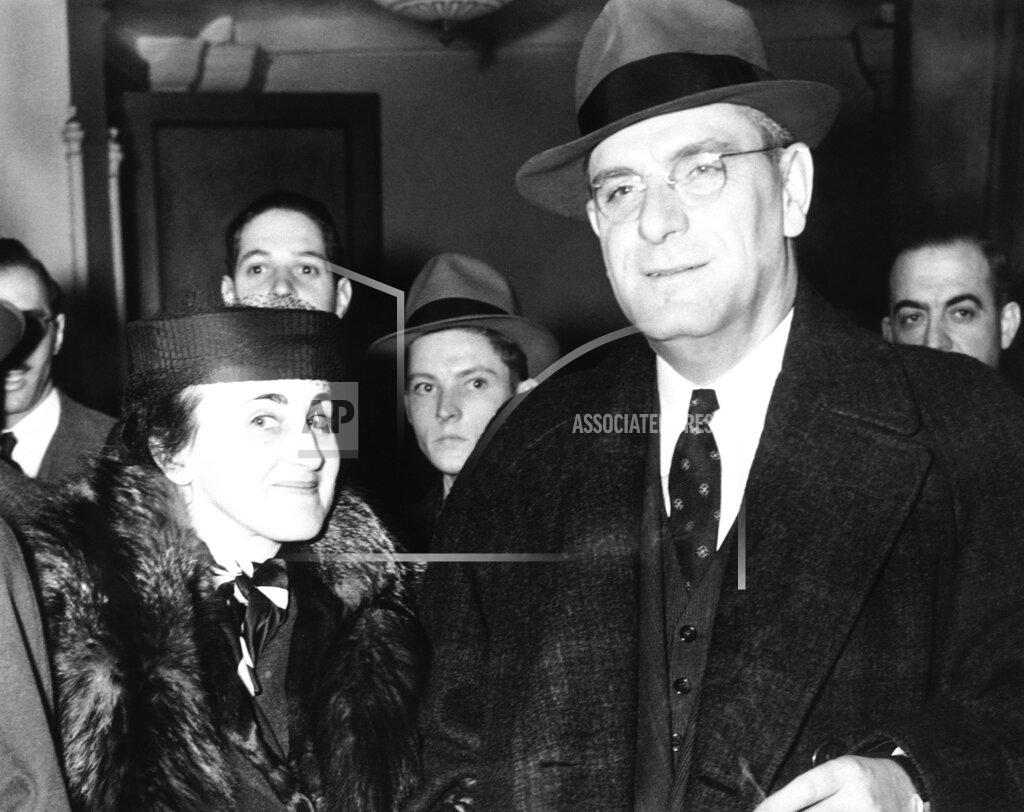
Fritz Julius Kuhn was sentenced to 2½ to 5 years in prison for larceny and forgery. Fritz Kuhn was sentenced to two and a half to five years in the penitentiary yesterday by Judge James G. Wallace in General Sessions Court. The jurist said he was not sentencing the former German-American Bund leader because he was a “hate dispenser,” and held off until next Wednesday his contemplated action against Kuhn’s counsel, Peter L. F. Sabbatino, and newspapers for contempt of court.
As a result of Judge Wallace’s dictum that Kuhn had put in a “perjurious defense,” action was expected to be taken by the District Attorney’s office against two of Kuhn’s witnesses, James Wheeler-Hill, the Bund’s national secretary, and Willy Luedtke, a Bund member. Neither of the two was in custody yesterday, and Herman J. McCarthy, assistant district attorney, who prosecuted Kuhn, and who told Judge Wallace that action “would be taken,” made it plain that further investigation would precede any charges.
Wilbur V. Keegan, associate defense counsel, it was learned last night, will seek a return of the $49,000 remaining of Kuhn’s $50,000 bail. Because Mr. Keegan had been closeted with G. Wilhelm Kunze, who was named by Kuhn as his successor, most of the afternoon, this proposed move was taken to mean that Kuhn has been eliminated from Bund consideration. The $50,000 on which Kuhn was freed pending his trial was raised among Bund members. The city levied a 2 percent tax and took $1,000 of it. Mr. Keegan seeks to regain for the Bund the remainder.
Wheeler-Hill and Luedtke were singled out by Judge Wallace as being liable for possible prosecution on perjury charges. In the trial Wheeler-Hill testified that the Bund’s constitution had been amended to legalize the “leadership principle.” It was said that before the grand jury he testified that the constitution had never been amended and was the binding document of the bund. Luedtke testified that he had delivered $500 to Daniel Kirchman, associate of James D. C. Murray, attorney, as legal fees and had received a receipt from Mr. Kirchman. Before the grand jury he testified that Kuhn told him he, personally, had paid Mr. Murray the $500. It was this $500 transaction on which all of Kuhn’s punishment was based. Around it the prosecution had made three charges, one of second-degree larceny and two of third-degree forgery.
The forgery charges were based on entries in the Bund books which reflected, in two separate instances, the payment to Murray. The jurors found that Kuhn had not paid the money and convicted him on all three counts. Two other counts on which he was convicted were one of first degree larceny and one of second degree larceny growing out of his use of $717.02 of bund funds to pay for the transportation of the furniture of Mrs. Florence Camp. Kuhn’s love letters to her were a feature of the trial.
Although the State Department’s policy is not to complicate peace efforts by precipitate action, it was represented today as prepared to join a Pan-American denunciation of the Russian invasion of Finland. Several Latin American governments have approached the department with the suggestion that some joint declaration should be made in support of principles of international law and in denunciation of the use of force as a means of settling international differences. They have been informed that, if all the other American republics consider it desirable to undertake the formulation of such a declaration, the United States will be very glad to take part. Further developments are now being awaited as a result of these discussions. In the meantime, several governments in the Western Hemisphere, such as Colombia, have made their position clear through statements or messages to President Kyosti Kallio of Finland. Argentina and Uruguay have also proposed condemnation of the invasion, but their suggestions run specifically to action by the League of Nations,. and so are not being commented on in Washington.
President Roosevelt today disclosed plans for aiding war-stricken Finland by permitting use of the December 15 payment on her war debt to this country for the benefit of the Finnish people.
President Roosevelt urges a great power grid. A system similar to that in England is advised. Under the urging of President Roosevelt a group of power company executives and governmental officials met here today to begin the study of an integrated system of private and public electric power production as part of the national defense.
Former President Herbert Hoover undertook today the establishment of an organization to raise funds for the relief of the homeless in Finland.
Secretary Hull defended his reciprocal trade agreements in an address tonight before the American Farm Bureau Federation. He addressed farmers from forty States at a banquet held in connection with the federation’s annual convention. Secretary Wallace and Edward A. O’Neal, president of the federation, were other speakers. Mr. Hull’s defense of his trade program was received for the most part in silence by the audience of about 2,000 farmer representatives, most of whom come from western areas of the country, where the severest criticism of the agreements has been expressed.
Early in his speech the Secretary of State declared that “this country should not, and must not, be drawn into war.” He held that at the end of present hostilities in Europe there would be an “even more desperate need” for vigorous action to restore mutually beneficial international trade. Mr. Hull maintained that the only alternative to the trade-agreements program which its opponents offered was a return to the “Hawley-Smoot embargo policy, or its equivalent.” He belittled the criticism that the trade agreements had increased imports competing with domestic agricultural products.
The city of Cleveland, Ohio sees some relief in sight. WPA will add 2,200 men to its rolls, food surpluses pour in, and a bond sales plan is pushed. Indications pointed today to an easing of Cleveland’s relief crisis, temporarily, although no permanent solution is seen.
A conspiracy to monopolize the tile trade of the Detroit area was charged today in an indictment handed up by a special Federal grand jury against thirty-five individuals, eight manufacturers, three contractors’ associations, some jobbers and two union locals of the American Federation of Labor. The building industry leaders are accused of trying to freeze sixty independent tile contractors out of business. Judge Edward J. Moinet received the indictment which involves the sale, shipment, and laying of tile in metropolitan Detroit.
The U.S. Army and Navy vie for defense funds. Each seeks a major part of the extra $500 million proposed by the president for defense. A friendly but strenuous tug-of-war is developing between the army and navy to get the lion’s share of the $500,000,000 that President Roosevelt has said will be added to the national defense budget for the next fiscal year. Both services feel that their defense plans will be seriously crippled if they do not get the major share of this amount. The Navy Department has reported to the White House that it needs $1,300,000,000 for proper development of the fleet, and the War Department that it requires $1,800,000,000 next year to increase the size of the army and obtain proper equipment. These make a total of $3,100,000,000, while the President’s plan calls for a total defense outlay of $2,250,000,000, so both services. I will have to modify their estimates.
Officials of both departments insist privately that they will not be able to reach a proper state of preparedness in the present troubled world situation if they do not get the major part of the extra $500,000,000, the navy contending that it is the first line of defense, and the army that it has been sadly neglected and is in greater need of immediate development. In addition to the regular budget of $750,000,000 requested for the year, the War Department has asked the White House for $850,000,000 to provide for a properly equipped regular army of 280,000 men and a National Guard of 320,000. Besides this, $200,000,000 has been requested for strategic items, largely anti-aircraft guns and secret materials.
The French Embassy in Washington announced yesterday that offices for purchases of American materials for the French and British Governments had been oponed in New York.
Chile, Bolivia, Peru and Paraguay have today protested over the Soviet Union’s attack on Finland.
Royal Navy cruiser HMS Despatch, on neutrality patrol off Chile, captures the German freighter Dusseldorf.
The Chinese retake Patang. Guerillas threaten Nanning as the Japanese extend their defense line. Despite lack of opposition, Japanese forces halt offensive operations and assume defensive positions north of Nanning. At the Battle of South Kwangsi, the Japanese realize they are simply chasing the Chinese into the endless hills without any purpose. They stop and dig in just north of Nanning.
Chinese 1st War Area attacks Japanese 1st Independent Mixed Brigade around Anyang.
Japanese continue spoiling attacks against Chinese 2nd War Area around Wenhsi and Hsia Hsien to disrupt Chinese offensive plans.
The Chinese soldier-poet Marshal Wu dies of a tooth infection at age 61. The death of Wu Pei-Fu is a blow to the Japanese. The retired warlord had been an object of steady pressure to take the puppet post. Authoritative observers in Peiping saw today in the death of Wu Pel-fu, once-powerful Chinese warlord, political complications for the Japanese plan to establish a Chinese government under Wang Ching-wei. The conviction is growing among informed persons in Peiping that the Japanese Army in North China has become decidedly cool toward Mr. Wang’s efforts, and that failure awaits them. This belief is based on reports. that Mr. Wang is demanding withdrawal of troops from China, while the North China army does not intend to withdraw under any circumstances, and that the army favors establishing a “special” administrative area north of the Yellow River. Indicating the attitude of the North China army, the Japanese press commented editorially, “Wang Ching-wei is not God.”
The army-controlled Peking Chronicle said today that Marshal Wu “was to have headed the military section of the Wang Ching-wei government,” but informed quarters believed this was without foundation.
The death yesterday of Marshal Wu Pei-fu, formerly China’s foremost warlord. was a great loss to Japan, an official Japanese spokesman said today. “He was a most impartial Chinese general and had a great influence over the Chinese people,” the spokesman said. “If he had cooperated with Japan his aid would have been invaluable, so his death is Japan’s loss.”
Posthumous honors in recognition of the patriotism of Marshal Wu Pei-fu, who died in Peiping yesterday, were being considered by the Chinese Government in Chungking today. In some Chinese quarters it was
Dow Jones Industrial Average: 146.49 (+0.15)
Born:
Bob Paremore, NFL halfback (St. Louis Cardinals), in Tallahassee, Florida (d. 2004).
Frédéric van Rossum, Belgian pianist, composer (“Waves”; “In memoriam Glenn Gould”), and pedagogue, in Ixelles, Belgium.
Horst Bastian, German writer and screenwriter, in Exin, Nazi Germany (d. 1986).
Jack Whitten, American abstract painter, in Bessemer, Alabama (d. 2018).
Naval Construction:
The Royal Navy Bar-class boom defense vessel HMS Barcliff (Z 70) is laid down by Lobnitz & Co. Ltd. (Renfrew, Scotland).
The Royal Navy Hunt-class (Type II) escort destroyer HMS Silverton (L 115) is laid down by J.S. White & Co. (Cowes, U.K.). She is transferred to the Marynarka Wojenna (Polish Navy) before completion and enters service as ORP Krakowiak (L 115).
The Вое́нно-морско́й флот СССР (ВМФ) (Soviet Navy) “K” (Katjusa)-class submarine K-52 is launched by A Marti (Leningrad, U.S.S.R.) / Yard 194.
The Koninklijke Marine (Royal Netherlands Navy) O-21-class submarine HrMs (HNMS) O-23 is launched by Rotterdamsche Droogdok Maatschappij, (Rotterdam, Holland).
The Royal Navy armed merchant cruiser HMS Esperance Bay (F 67) is commissioned. Her first commanding officer is Captain (retired) Geoffrey Shuttleworth Holden, RN
 History Diaries