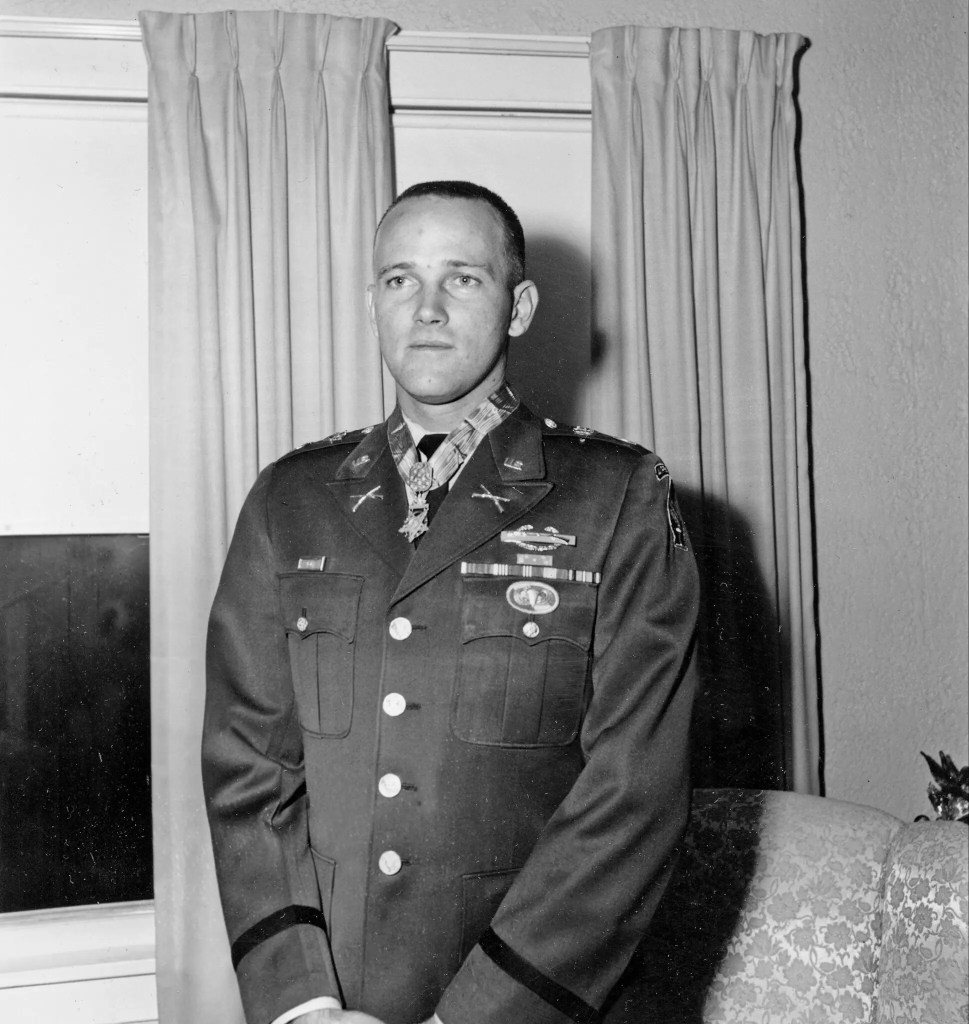
The first Congressional Medal of Honor awarded to a U.S. serviceman for action in Vietnam is presented to Captain Roger Donlon for his heroic action on 6 July 1964: although wounded four times, Donlon led his Special Forces team and the South Vietnamese in resisting a Việt Cộng attack on Camp Nam Đông.
President Johnson reaffirmed today the United States’ commitment to fight Communism in South Vietnam as he decorated this country’s first military hero of the hostilities there to receive the Medal of Honor, the nation’s highest decoration for gallantry. “This is a proud moment for all Americans,” the President said, hanging the medal around the neck of 30-year‐old Roger H. C. Donlon, a tall, lean Army captain from Saugerties, New York. “Let any who suggest we cannot honor our commitment in Vietnam find new strength and new resolution in the actions of this brave man and his comrades in arms far away,” Mr. Johnson emphasized.
Citation:
For conspicuous gallantry and intrepidity at the risk of his life above and beyond the call of duty while defending a U.S. military installation against a fierce attack by hostile forces. Capt. Donlon was serving as the commanding officer of the U.S. Army Special Forces Detachment A-726 at Camp Nam Dong when a reinforced Viet Cong battalion suddenly launched a full-scale, predawn attack on the camp. During the violent battle that ensued, lasting five hours and resulting in heavy casualties on both sides, Capt. Donlon directed the defense operations in the midst of an enemy barrage of mortar shells, falling grenades, and extremely heavy gunfire. Upon the initial onslaught, he swiftly marshaled his forces and ordered the removal of the needed ammunition from a blazing building. He then dashed through a hail of small arms and exploding hand grenades to abort a breach of the main gate. En route to this position he detected an enemy demolition team of three in the proximity of the main gate and quickly annihilated them. Although exposed to the intense grenade attack, he then succeeded in reaching a 60-mm mortar position despite sustaining a severe stomach wound as he was within five yards of the gun pit. When he discovered that most of the men in this gun pit were also wounded, he completely disregarded his own injury, directed their withdrawal to a location 30 meters away, and again risked his life by remaining behind and covering the movement with the utmost effectiveness. Noticing that his team sergeant was unable to evacuate the gun pit he crawled toward him and, while dragging the fallen soldier out of the gun pit, an enemy mortar exploded and inflicted a wound in Capt. Donlon’s left shoulder. Although suffering from multiple wounds, he carried the abandoned 60-mm mortar weapon to a new location 30 meters away where he found three wounded defenders. After administering first aid and encouragement to these men, he left the weapon with them, headed toward another position, and retrieved a 57-mm recoilless rifle. Then with great courage and coolness under fire, he returned to the abandoned gun pit, evacuated ammunition for the two weapons, and while crawling and dragging the urgently needed ammunition, received a third wound in his leg by an enemy hand grenade. Despite his critical physical condition, he again crawled 175 meters to an 81-mm mortar position and directed firing operations which protected the seriously threatened east sector of the camp. He then moved to an eastern 60-mm mortar position and upon determining that the vicious enemy assault had weakened, crawled back to the gun pit with the 60-mm mortar, set it up for defensive operations, and turned it over to two defenders with minor wounds. Without hesitation, he left this sheltered position, and moved from position to position around the beleaguered perimeter while hurling hand grenades at the enemy and inspiring his men to superhuman effort. As he bravely continued to move around the perimeter, a mortar shell exploded, wounding him in the face and body. As the long awaited daylight brought defeat to the enemy forces and their retreat back to the jungle leaving behind 54 of their dead, many weapons, and grenades, Capt. Donlon immediately reorganized his defenses and administered first aid to the wounded. His dynamic leadership, fortitude, and valiant efforts inspired not only the American personnel but the friendly Vietnamese defenders as well and resulted in the successful defense of the camp. Capt. Donlon’s extraordinary heroism, at the risk of his life above and beyond the call of duty, are in the highest traditions of the U.S. Army and reflect great credit upon himself and the Armed Forces of his country.
In the area of Tân Phú in the Mekong Delta, a major attack by the Việt Cộng leaves seven U.S. advisers wounded, 23 ARVN soldiers dead and 50 wounded, and
fifty Việt Cộng dead. One United States soldier was wounded and six helicopter crewmen were injured by Việt Cộng fire. Earlier, Saigon troops rescued Ranger units trapped by a Việt Cộng battalion at Bình Giã, 40 miles to the southeast.
Buddhist leaders have tried, and apparently failed, to enlist the support of Lieutenant General Nguyễn Khánh in their efforts to unseat the government, informed sources said today. The former Premier, now commander in chief of the armed forces, has had two private meetings with Thích Tâm Châu, rector of the Buddhist Secular Institute. General Khánh is said to have withheld support, with the explanation that the armed forces would not follow him in any defiance of the government. Much of General Khánh’s power apparently rests on backing from the country’s younger generals. These men almost solidly support the civilian Cabinet appointed last month by Premier Trần Văn Hương. Opposition to the Hương Cabinet centers on its inclusion of senior civil servants rather than politicians.
Secretary of State Dean Rusk and Foreign Minister Andrei A. Gromyko of the Soviet Union held a comprehensive review of East‐West problems for two hours today at the United States mission’s headquarters. Mr. Rusk said they did not discuss the United Nations crisis over unpaid assessments. Both said separately on leaving that the talks had been “inconclusive” and would be continued within a few days. It appeared evident that the statements were agreed upon in advance. Among those with Mr. Rusk at the talks were Adlai E. Stevenson, the United States representative; Foy D. Kohler, United States Ambassador in Moscow, and William R. Tyler, Assistant Secretary of State for European Affairs. Mr. Gromyko was accompanied by Vladimir S. Semyonov, a Deputy Foreign Minister, and Mikhail N. Smirnovsky, head of the American section of the Foreign Office.
The U.N. General Assembly narrowly averted a Soviet‐United States confrontation on the assessment question at its opening session Tuesday by agreeing to avoid any votes until the question was settled. Negotiations to settle the payments crisis so the General Assembly can operate on a normal basis were at a standstill because the Secretary General. U Thant was in the hospital for a physical examination. Both sides have passed to Mr. Thant the responsibility for current efforts to iron out their differences. A close associate of Mr. Thant said that the Secretary General was feeling relatively well and was eager to return to work. A bulletin issued by a United Nations spokesman said Mr. Thant “spent a very restful night.”
The Soviet Communist party accused China today of having advocated one‐man dictatorship for Communist countries. An editorial in Pravda, the party newspaper, contended that the Soviet Union had passed beyond the “dictatorship of the proletariat” and said of the Soviet party: “From a party of the working class, it has turned into a party of the whole people.” The accusation, made sharply and clearly without naming China, was contained in the stiffest attack on Peking yet undertaken by the men who replaced Nikita S. Khrushchev in the Soviet leadership. It was made in reply to Chinese criticism November 21 of the Soviet concept of “the state of the whole people,” the form of Government that the Kremlin claims for the Soviet Union now.
Walter Ulbricht has reasserted his leadership of the East German Communist party in the face of severe criticism of him by party members following the removal of Nikita S. Khrushchev as Soviet premier. At a three‐day Central Committee meeting, which ended in East Berlin today, the party hierarchy rallied around Mr. Ulbricht, the First Secretary, rejecting the charge that he, like Mr. Khrushchev, had built a “cult of personality.” But speakers at the meeting made it clear that the party needed to undertake an ideological drive to wipe out misgivings among the rank‐and-file throughout the country.
A Congolese Army assault force led by white mercenaries stormed across the Congo River at Stanleyville today and established a beachhead on the rebel‐held left bank, diplomatic sources reported. Algeria is reported to be sending men as well as arms to aid Congolese rebels against the Government of Premier Moïse Tshombe. Reliable diplomatic sources said today that a group of 40 Algerians, believed to be military advisers, had been seen at Khartoum airport in the Sudan two nights ago accompanying several plane loads of supplies bound for the rebels. With them were about 40 Africans, presumably Congolese returning from military training in Algeria.
The sources said that during the last week at least 14 Soviet‐built military transports from Ghana, Algeria and the United Arab Republic had flown through Khartoum bound for the southern Sudan with supplies for the rebels. According to some reports, the shipments included Soviet‐made rifles, machine guns and mortars. Rebel territory touches on Sudan.
The Belgian Government formally asked Premier Moïse Tshombe of the Congo today for an official explanation of the decree appropriating mining concessions promulgated in Leopoldville last night. Under the decree, mining companies would buy the rights to exploit land from the Government rather than from private organizations. This would in effect make the Tshombe Government the sole arbiter of future mining concessions in the Congo, whose mineral deposits are among the greatest in the world. While the action will probably be accepted by the Belgian Government without too much protest, authorities here doubt that Mr. Tshombe will move further to nationalize all present mining operations in the Congo. The conviction was spreading here that the decree marked the opening of a new drive by Mr. Tshombe to prove to black Africa that he is not “the white man’s pawn.” It was felt Mr. Tshombe had embarked on a nationalistic drive and would spare no effort to sever the official ties that have long bound the Congo to Belgium.
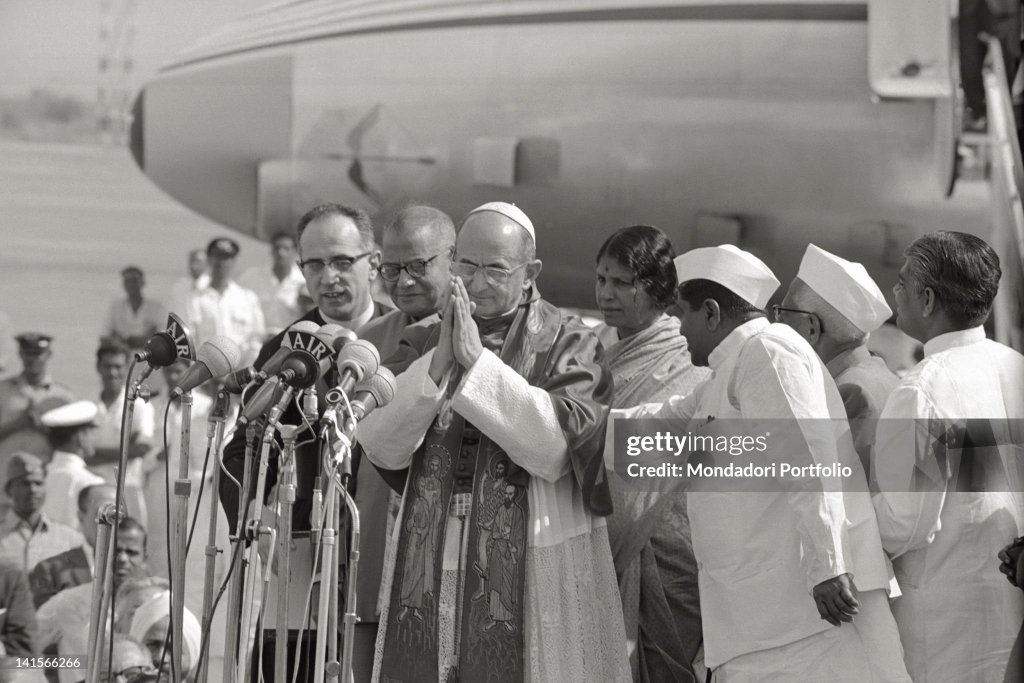
Pope Paul VI returned to Vatican City after a four-day pilgrimage to India, but not before two Turkish Air Force fighters flew dangerously close to the DC-8 airliner that was carrying him. When the Alitalia flight from Bombay to Rome crossed into the airspace of Turkey at 33,000 feet (10,000 m), an escort of four planes joined alongside for 25 minutes in what was intended as a show of respect, before responding to a request by the Alitalia pilot to move away. Two of the planes “flew less than a wing length away”, a claim confirmed by a photograph taken by one of the DC-8 passengers.
Britain’s Labor Government, shaken by the recent crisis over sterling, is expected to seek some sharing of its overseas defense burden during talks with United States officials next week. The need of holding the line on defense costs, as Labor sees it, could play a decisive part in Britain’s attitude toward whatever allied nuclear policy is discussed by President Johnson and Prime Minister Harold Wilson, reliable sources said. The two men, with their foreign and defense ministers, will meet in Washington on Monday and Tuesday. Almost all the pre‐meeting speculation has centered on nuclear policy. According to reliable informants, this is only one aspect of the global review that will be sought by Mr. Wilson, who is due in Washington tomorrow night.
The United States is prepared to discuss “some variations” of the proposal for a mixed‐nuclear fleet with Prime Minister Harold Wilson as long as they do not compromise its major objectives, an Administration spokesman said today. Under Secretary of State George W. Ball said after a two‐hour White House meeting with President Johnson at which the British leader’s visit was discussed that the United States was still basically committed to the nuclear fleet idea. One of the variations Mr. Wilson is expected to suggest during the two days of White House meetings beginning Monday is a reduction in the size of the proposed fleet from 25 surface Polaris missile ships to perhaps 8 or 10. The Prime Minister, who will arrive tomorrow, is also expected to propose an “Atlantic nuclear force” that would include Britain’s land‐based missile and bomber force, with national control presumably relinquished.
In Bonn, West Germany, more than 2,000 demonstrators carried placards today opposing the projected mixed‐manned nuclear fleet force for the Atlantic alliance.
French preparations for atomic tests in the South Pacific are forcing the Administration to walk a diplomatic tightrope in its efforts to avoid violating the test ban treaty and offending an already sensitive ally. Last August a French military transport was permitted to land in the United States for refueling. The jet tanker was en route to Tahiti, where the French are building a proving grounds for testing of atomic weapons, including thermonuclear devices. Whether the granting of landing rights to the French plane represents an infraction of the treaty for a ban on all but underground nuclear tests depends upon an interpretation of one clause in the pact and the nature of the cargo carried by the plane. The clause specifies that the signatories will “refrain from causing, encouraging or in any way participating in the carrying out of any nuclear weapon test explosion or any other nuclear explosion” in the atmosphere, underwater or in outer space.
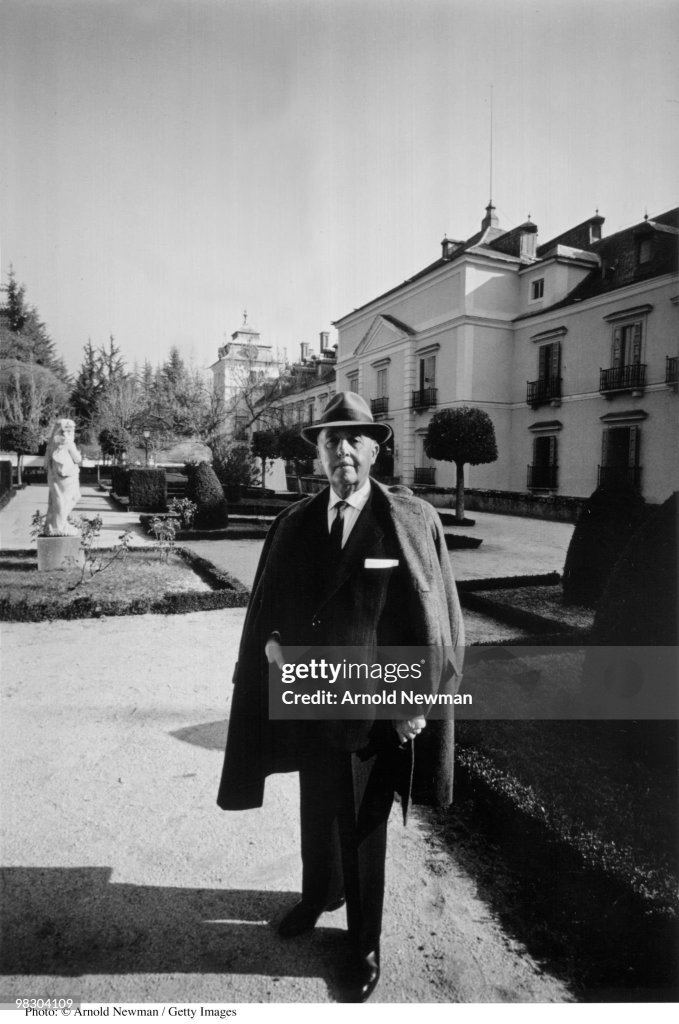
The failure of former President Juan D. Peron’s attempt to return to Argentina this week has badly shaken the Peronist movement. For the first time in years, Peronist leaders are questioning the belief that he retains a hold over the workers and the country as a whole. Stung by the indifference with which Argentines reacted to Mr. Peron’s attempt, leaders of the movement were seeking to reawaken interest by announcing that he would try again. The former dictator, who has been in exile since 1955, tried to return to Argentina from Spain Wednesday, but when his plane landed in Brazil, authorities there sent him back to Spain. He was last reported in Torremolinos, near Malaga, awaiting permission to return to Madrid.
The New York Times opines:
“After nearly a half‐year of painstaking inquiry the Federal Bureau of Investigation has now arrested a Mississippi sheriff, his deputy and nineteen other white men on charges of involvement in a Ku Klux Klan conspiracy to kill.three young civil rights workers last June. Whether any of the men will ever be tried for murder will be determined first by state authorities and then by a county grand jury. But even if their only trial is for conspiracy, the determination their guilt or innocence will have to be made by a jury of Mississippians.
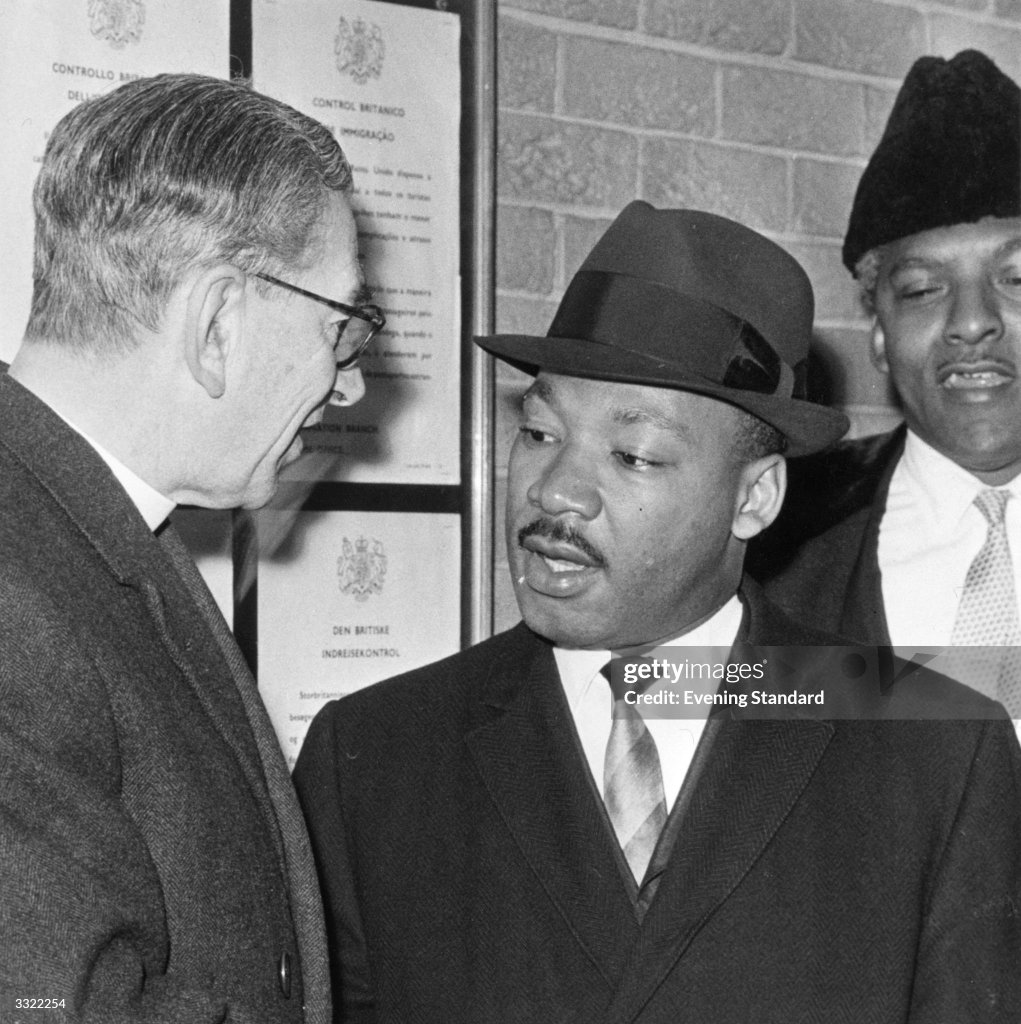
”Both the men and Mississippi will be on trial in every phase of these proceedings. The heinousness of the crime demands that there be no prejudgment of individual or collective guilt, but it also demands that no new warrant be provided for suspicion that in Mississippi murder is no crime if the victim is a battler for civil rights. Statements by local clergymen and business leaders expressing a sense both of community shame and of desire that justice prevail indicate that frozen patterns of intolerance are beginning to thaw. Yet there is little present basis for optimism that their spirit is more representative than that of those solid citizens who greeted the arrests with a complaint that ‘the whole country is taking orders from Martin Luther King.’ ”
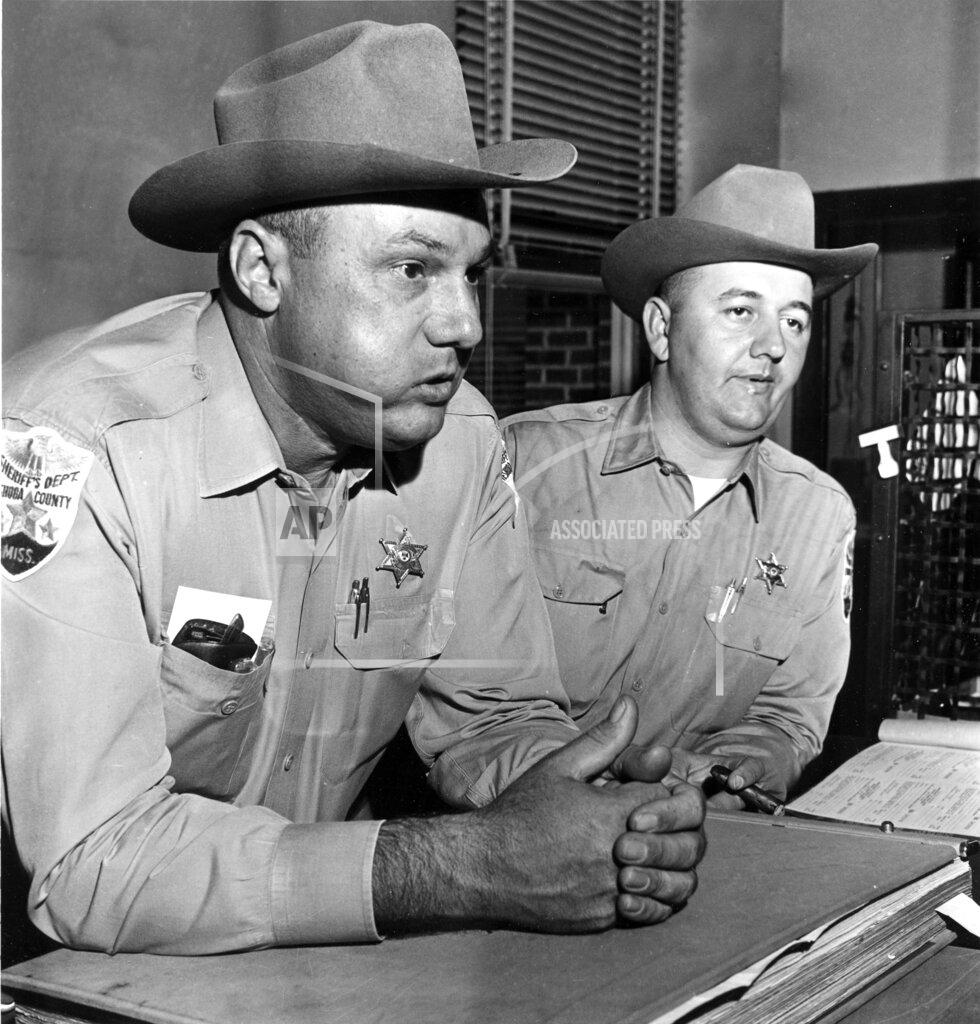
Mississippi authorities declined today to take immediate action against the men arrested by the Federal Bureau of Investigation in connection with the slaying of three civil rights workers. Sources close to the state government said it was likely that no charges would be filed pending a meeting of the Neshoba County grand jury in Philadelphia, Mississippi, next February. Yesterday the FBI arrested Sheriff Lawrence A. Rainey of Neshoba County, his chief deputy and 19 other men in connection with an assassination plot that it attributed to the Ku Klux Klan. The FBI said that Deputy Sheriff Cecil Price and nine others had been members of the lynch mob.
Nineteen defendants, including the two law‐enforcement officers, were charged with conspiracy to violate the constitutional rights of the victims. The three, Michael H. Schwerner, Andrew Goodman and James E. Chaney, were shot and killed the night of June 21 near Philadelphia. Two others were charged with refusing to give information about the slayings. Only the state can bring murder charges. The FBI said it would turn over its voluminous evidence in the case to the state authorities for whatever action they wished to take. “We will wait until it is delivered to us,” State Attorney General Joe T. Patterson said today. “So far, we have nothing.”
Before the arrests were made, however, the FBI advised Mr. Patterson and Governor Paul B. Johnson Jr. of the nature of its evidence in the hope the state would institute an immediate and independent prosecution of the case. After the state officials declined to do so, the bureau proceeded with the Federal charges. Governor Johnson refused to comment. Some state authorities were reported to believe that prosecution in Neshoba County would present certain problems because of the prominence of some of the defendants. When Circuit Judge O. H Barnett charged the grand jury to look into the case last September, he called Mr. Rainey the “bravest sheriff in America.” It would be difficult under state law for the state to obtain a change of venue, a state attorney pointed out. Without a change of venue, which transfers the trial to another district, the jury in a state trial would be drawn entirely from the county where the offense was alleged to have been committed.
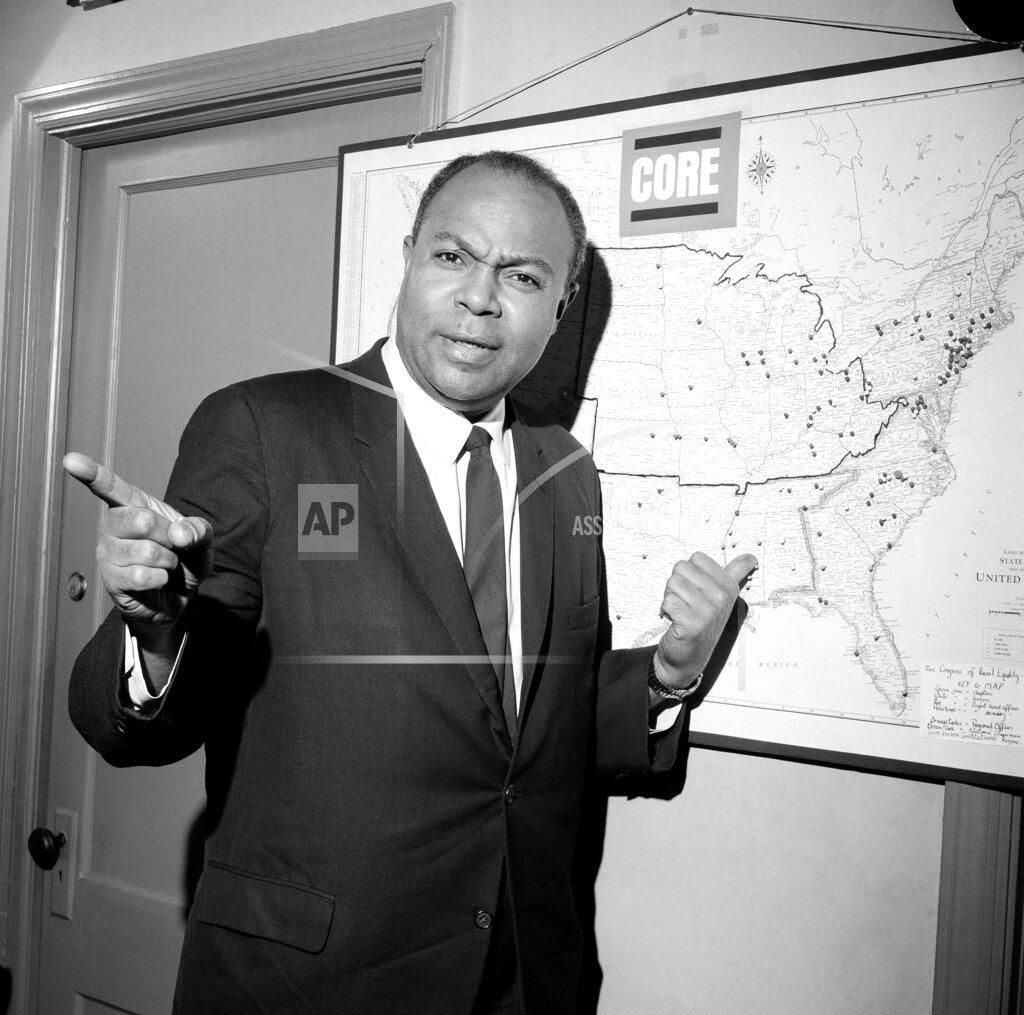
James Farmer, national director of the Congress of Racial Equality, said yesterday that the Federal Bureau of Investigation had “several eyewitnesses” to the slaying of three young civil rights workers near Philadelphia, Mississippi, last June 21. In Jackson, Mississippi, a spokesman for the FBI said, “We aren’t going to dignify that statement with a denial.” The bureau arrested 19 white men Friday on charges of violating the constitutional rights of the three victims in connection with their slaying and two others on charges of refusing to give information. Mr. Farmer declined to give the source of his information. He also said that CORE investigators who had “disappeared” into the Black population of the area had provided valuable assistance to the Federal agents.
In a news conference at his organization’s headquarters in New York, Mr. Farmer said he believed it was unlikely that any of the suspects would be convicted. But he held out the faint hope that “Mississippi will redeem itself in the eyes of the nation and the world.” He said that the arrest and trial of the 21 men would in itself “encourage the decent people of Mississippi to begin to wrest control of their communities from the racists, bigots and hatemongers.” Yet the likelihood remains, the Black leader declared, that there will be further last‐ditch violence by white supremacists in the months ahead.
LeRoy Collins asserted tonight that a number of local human relations commissions around the country had been deliberately set up as “window dressing.” These, he said, impede rather than advance progress in human rights. Mr. Collins, director of the Federal Government’s Community Relations Service, both in an address and an interview, described iocal private and public commissions as the “most important key” for combating racial tensions and discrimination. “But having a local agency with a high‐sounding name and purpose will not, in itself, assure progress,” he said. Although Mr. Collins did not name any communities, he said that some commissions served as a “buffer” rather than as a means of communication between races.
Two third graders in Mount Clemens, Michigan, near Detroit, upset because white children are calling a Black schoolmate names, appealed to President Johnson for help today. Michele Moceri, 8 years old, and Debbie Walton, who will be 9 tomorrow, wired the President at the White House that Vanessa Jackson, an 8-year‐old Black girl, was being calied “Blackjack” and “Black N****r” by some of the other children at the Herman Clix Elementary School. They told the President that Vanessa was the only Black in their class.
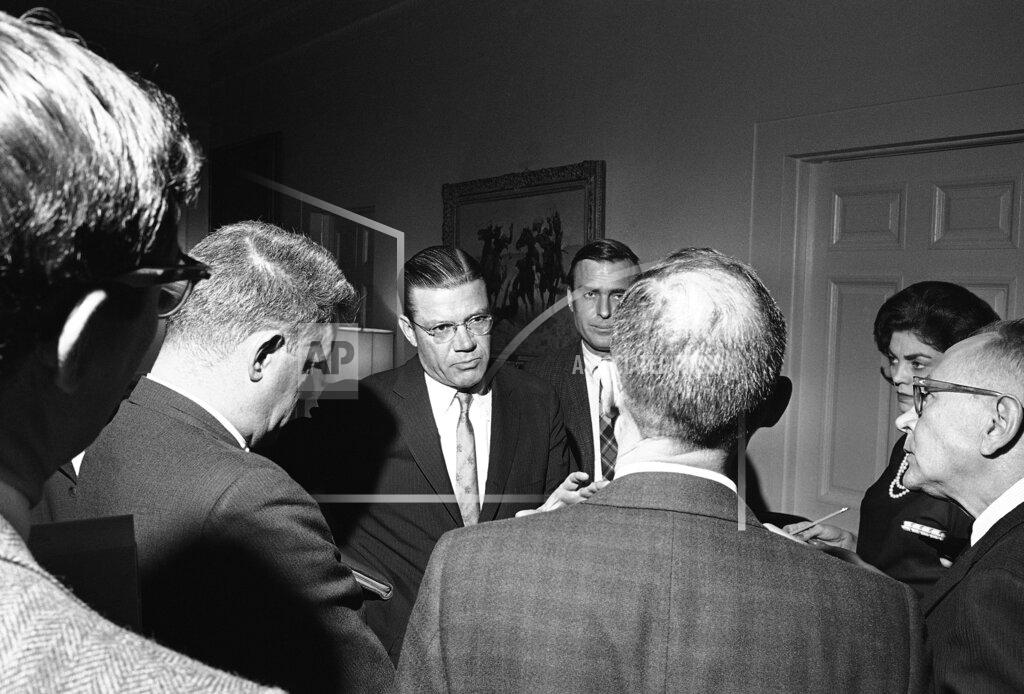
Secretary of Defense Robert S. McNamara flew up to New York Thursday to listen to political leaders there plead again for retention of the Brooklyn Navy Yard. But when the session in Governor Rockefeller’s Manhattan office was over, the Secretary’s verdict remained the same. The yard will be closed. So will Fort Jay. So will the Brooklyn Army Terminal. And so will, other politicians in other areas notwithstanding, 92 other military installations be closed in the most sweeping cutback of this kind since the end of the Korean War. Thus the Defense Secretary’s cost‐reduction program continues, a program that he has adhered to zealously from the time he submitted his first military budget in early 1961 with a consignment of the nuclearpowered‐airplane project to the scrap heap of broken military dreams.
Other Secretaries of Defense, of course, have made economy cuts and, in their time, have aroused controversy. One recalls the uproar when former Secretary of Defense Louis Johnson canceled a planned aircraft carrier in 1949 two weeks after taking office. But no Defense Secretary before Mr. McNamara ever established cost‐reduction plans on a formal basis, with management experts riding herd on military professionals and special long range targets set up for reduced spending.
Senator B. Everett Jordan said today that secret testimony given to the Senate Rules Committee by Don B. Reynolds, a witness in the Robert G. Baker investigation, had been turned over to the Federal Bureau of Investigation. “They’ve seen it,” said the North Carolina Democrat, who heads the Rules Committee. “They can check out any leads.” Mr. Reynolds testified this week about an alleged secret political contribution in 1960 to the campaign of John E. Kennedy for President and Lyndon B. Johnson for Vice President. He said that he had been the “bag man” or go‐between, for Matthew H. McCIoskey, at that time the treasurer of the Democratic National Committee, and Mr. Baker, who was secretary to the Sehate’s Democratic majority.
Mr. McCloskey, once Ambassador to Ireland, heatedly denied any knowledge of such a deal. He acknowledged that his construction company had made a $35,000 overpayment to Mr. Reynolds on a performance bond, but attributed it to a “goof,” not a political deal. Mr. Baker, who is under investigation by a Federal grand jury, resigned his Senate post when his private business dealings were questioned. The Rules Committee held hearings earlier and has now revived its inquiries.
An American LGM-30B Minuteman I missile was on strategic alert at Launch Facility (LF) L-02 at Ellsworth Air Force Base, South Dakota, when two airmen were dispatched to repair the inner zone security system. In the midst of their checkout of that system, one retrorocket in the spacer below the Reentry Vehicle fired, causing the missile to fall about 75 feet to the floor of the silo. When the missile struck bottom, the arming and fusing/altitude control subsystem containing the batteries were torn loose, thus removing all sources of power from the missile, which structure receives considerable damage. All safety devices operate properly in that they do not sense the proper sequence of events to allow arming the warhead. There was no detonation or radioactive contamination.
The Republican Governors Association called today for a complete remodeling of the party’s national organization. It also announced that Republican state executives intend to have a major part in rebuilding and leading the party from now on. In a statement at the end of a two‐day conference here, the Governors went beyond the’ question of removing Dean Burch as national chairman. They proposed that the national committee itself be totally revamped to include Governors, members of Congress, young Republicans and others representing “all the basic strength of the party.” Regarding Mr. Burch, the statement, which did not specifically mention him, was interpreted by the majority of Governors as meaning he should be removed as chairman.
Headquarters for the Administration’s antipoverty program reported today that Governors of the 21 states chosen for the first 41 Job Corps centers all have approved the selections. New York is one of the states. Sargent Shriver, director of the Office of Economic Opportunity, the new agency organizing the program, said in a statement: “All 21 Governors have acted unanimously in waiving the 30day veto period provided in the enacting legislation. This bipartisan approval indicates the nationwide acceptance of the Job Corps program, and will accelerate our recruitment and Job Corps center readiness schedule.”
Mrs. Lyndon B. Johnson traveled from New York to Washington by auto today. The First Lady canceled her plans to fly to the capital becausa of rain and fog. Mrs. Johnson and her elder daughter, Lynda Bird, went shopping in New York today before checking out of the Carlyle Hotel and heading back to Washington. The shopping tour was prompted by the social functions that will accompany the inauguration of President Johnson next month.
An American teacher has reported to the Justice Department that she furnished information to Soviet agents about Russian artists touring the United States and about Americans who might try to get them to defect. Files made available today by the Justice Department identified her as Miss Natalie Anna Bienstock, 28 years old, now a graduate student and Russian language teacher at Cornell University, Ithaca, New York. A Justice official said that no action was contemplated against Miss Bienstock because she had voluntarily told the Federal Bureau of Investigation about her activities. They began in Moscow March 9, 1962, and ended, according to her sworn statements, in February, 1963.
The National Academy of Engineering was founded in the United States by the National Academy of Sciences, with the approval by the NAS of the new academy’s Articles of Organization.
Controllers at the Jet Propulsion Laboratory in Pasadena, California successfully corrected the trajectory of Mariner 4 by the timed firing of retrorockets to send the probe toward the planet Mars. The course correction was implemented after it was calculated that the Mariner probe’s heading would have caused it to miss Mars by more than 150,000 miles (240,000 km); the new heading was calculated to bring the probe within 5,400 miles (8,700 km).
NFL Football:
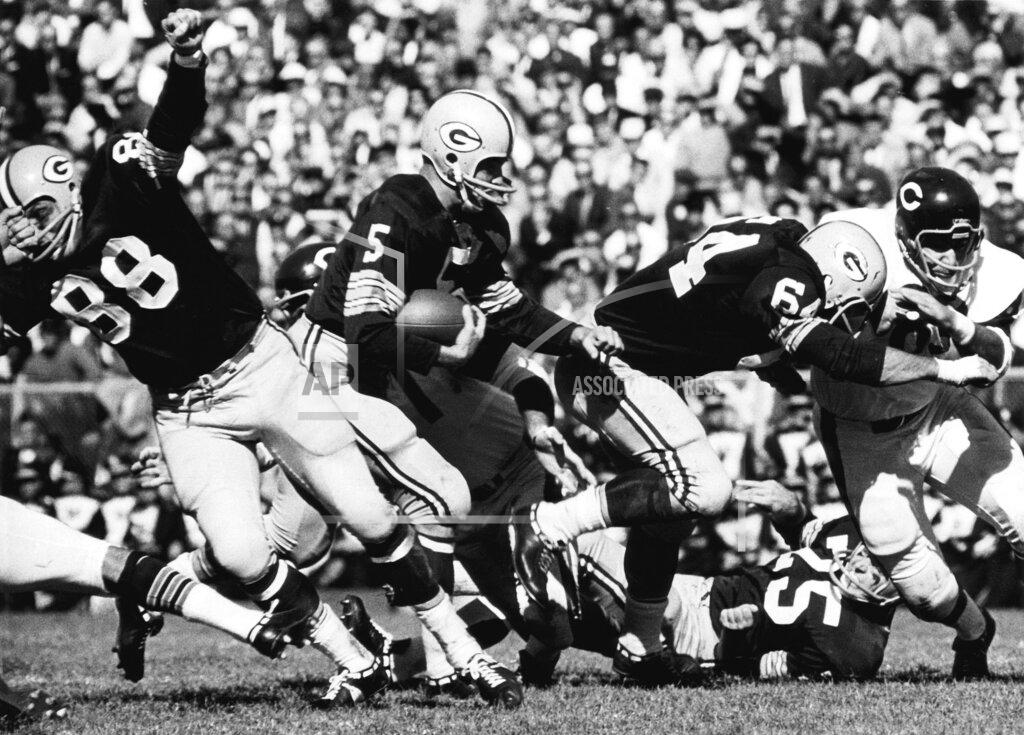
Green Bay Packers 17, Chicago Bears 3
Willie Wood’s brilliant punt returns and Jim Taylor’s battering to his fifth succesive 1.000-yard rushing season swept the Green Bay Packers to a 17–3 National Football League victory over the Chicago Bears today. Wood’s punt returns of 64 and 42 yards set up both Green Bay touchdowns in the nationally televised game before 43,646 shivering fans in snow-covered Wrigley Field. Taylor, who exploded 13 yards for the second Packer touchdown in the third period, wound up with 89 yards for the day and 1,005 yards in 13 games, the first man in N.F.L. history to rush more than 1,000 yards in five straight seasons. Wood’s first big punt return gallop, 64 yards to the Bear 16 came in the second period. Four plays later. Paul Hornung smashed 5 yards for the touchdown, which gave Green Bay a 7–0 lead. Hornung also booted a 9-yard field goal in the fourth period and kicked the points after both Packer touchdowns. The Bears, who had won three straight, never advanced beyond the Packer 15 and then had to settle for their only points on Roger Leclerc’s 31-yard field goal five seconds before halftime.
Born:
Pablo Morales, American swimmer (Olympic gold medals, 4x100m medley relay, 1984, 1992; 100m butterfly, 1992), in Chicago, Illinois.
Gene Harris, MLB pitcher (Montreal Expos, Seattle Mariners, San Diego Padres, Detroit Tigers, Philadelphia Phillies, Baltimore Orioles), in Sebring, Florida.
Perry Berezan, Canadian NHL centre (Calgary Flames, Minnesota North Stars, San Jose Sharks)


 History Diaries