Secretary of State Kissinger said today that he was surprised by the criticism voiced in Washington of the tentative agreement on arms control recently reached in Vladivostok. Speaking to newsmen after briefing the Senate Foreign Relations Committee on the accord, Mr. Kissinger said: “I believe that when the figures are correctly analyzed it will be seen that putting a ceiling on total numbers for a period of 10 years is a very significant achievement.” Under the provisional agreement, the United States and the Soviet Union set a ceiling of 2,400 long‐range nuclear bombers and missiles that each side could keep through 1985. Of that total, each country could arm up to 1,320 missiles with multiple warheads. The size of the nuclear forces that would be permitted has drawn criticism from advocates of arms control and from budget‐minded members of Congress, who have argued that it is too high and would not stop the arms race.
Asked by a reporter if he had expected the criticism, especially that of Senator Henry M. Jackson, Democrat of Washington, Mr. Kissinger said: “I am surprised.” Beginning his Capitol Hill defense of the agreement, Mr. Kissinger argued that the very existence of an agreed ceiling took the heat out of the arms race and allowed both sides to begin thinking about negotiating reductions. “For the first time in 30 years of the nuclear age, both big nuclear countries can operate in the knowledge that fixed ceilings exist and they do not live with the nightmare of either side taking off toward superiority,” Mr. Kissinger said.
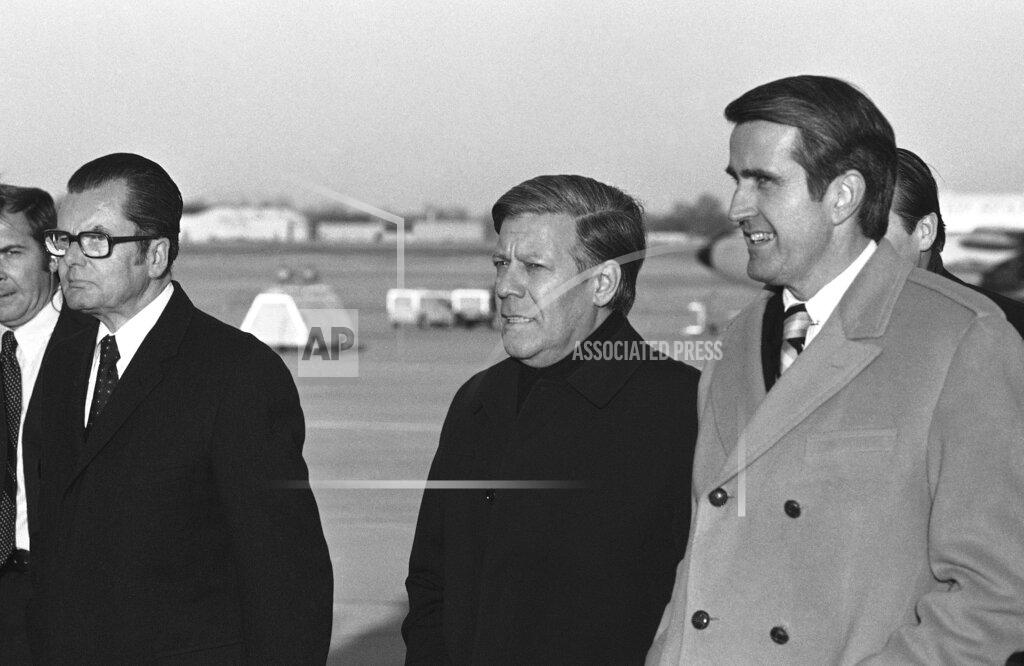
President Valéry Giscard d’Estaing is preparing for his first meeting with President Ford next week with an air of optimism, that he can ease French‐American disputes on several key issues, among them the oil crisis. The talks, to be held on the Caribbean island of Martinique December 14 through 16, are to cap a period of intense diplomatic activity for the French President. The period began today with the arrival of the Soviet leader, Leonid I. Brezhnev, for three days of talks beginning tomorrow. The sessions are to be held at the Chateau de Rambouillet, outside Paris, with, the main emphasis, French officials say, expected to be on trade. Then a two‐day meeting of the leaders of the nine Common Market countries starts here Monday, and Mr. Giscard d’Estaing is understood to hope that it will produce sufficient agreement for him to talk with Mr. Ford as Europe’s spokesman on monetary issues and possibly on the question of how to approach oil negotiations.
Greece’s Supreme Administrative Court rejected former President George Papadopoulos’ appeal of a government decision banishing him to the Aegean island of Kea. Papadopoulos, who masterminded the 1967 coup which brought the military to power, and 49 officer-members of his junta face charges of treason which could bring the death penalty.
As many as 14 million Italian workers walked off their jobs for periods ranging from a few minutes to a full day to demand raises equal to the country’s 20% inflation. It was Italy’s third nationwide strike in two months, but union officials specified that it was directed against the new government of Premier Aldo Moro and there were no demonstrations in Rome. Bus and streetcar transportation was normal throughout the country, but railroad workers held up trains for two hours.
A joint session of both houses of the Swiss parliament elected Foreign Minister Pierre Graber as president for 1975. Graber, 65, who will retain his Foreign Ministry duties, is a Socialist lawyer from the French-speaking area of western Switzerland. He was the only candidate for the office, which rotates annually among the seven ministers who make up the cabinet.
At Irkutsk in the Soviet Union, all 13 people aboard an Aeroflot An-2R airplane died in a midair collision. The plane was departing on a scheduled flight to Kazachinskoye, after being cleared for takeoff into the path of an Antonov An-12 flight cleared for landing on the same runway. The two airplanes collided at 890 feet (270 m). The crew of the An-12 were able to make an emergency landing with no fatalities.
Dissident Soviet physicist Andrei Sakharov appealed for world support for Jewish doctor Mikhail Shtern who is scheduled to go on trial next week in the Ukraine on charges of bribe-taking and swindling. Sakharov charged that the trial is an anti-Semitic provocation aimed at frightening Jews who want to leave Russia. He said that Shtern had been arrested after refusing to withdraw permission for his son’s emigration application.
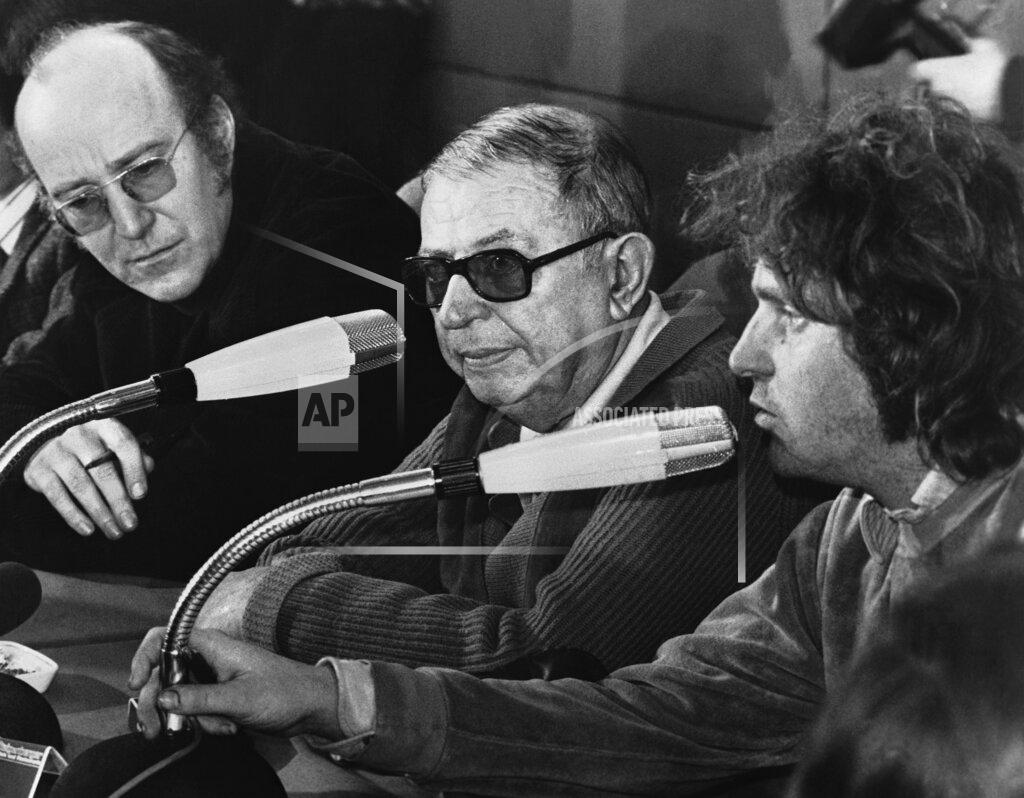
French existentialist author Jean-Paul Sartre visited the prison cell of West German terrorist Andreas Baader, of the Baader-Meinhof gang, in Stuttgart for an interview.
Premier Yitzhak Rabin has suggested that Israel may soften her demand for a formal Egyptian renunciation of belligerency as a condition for a further Israeli pullback in occupied Sinai.
France has signed a contract to sell $800 million in arms to Saudi Arabia. The Saudi Defense Minister, Prince Sultan ibn Abdel Aziz, was quoted in Lebanese newspapers as having said that France would provide anti-aircraft missiles and anti-tank weapons and would strengthen his country’s tank force. The Defense Minister was further quoted as having said his government was confident of purchasing additional weapons from the United States “with no strings attached.”
A special three‐man military tribunal in Addis Ababa, Ethiopia began trying former government officials today on charges of corruption and maladministration, a spokesman for the military government said. A radio announcement gave no indication of where the tribunal was meeting, the names of the accused or the charges against them. It was assumed that the courtroom was in the Grand Palace, headquarters of the military government, in whose prisons, it is said, 170 prisoners are held. A five‐judge supreme military tribunal, from which there is no appeal, has apparently not begun its sessions. It has the power to impose death sentences.
The United States informally offered to establish a military transport helicopter plant in Iran — the first in the Mideast — as part of a billion dollar arms deal, informed government sources said. The deal would include the sale of 200 advanced antitank-missile-firing gunships. Both helicopters are made by Bell Division of Textron, Inc., of Texas, which agreed in 1972 to deliver 490 helicopters worth $720 million to Iran.
Iran has agreed to grant a $150 million, five-year loan to Denmark, Danish finance officials announced. The loan follows reports that Iraq, another oil-producing state, had agreed to loan $1 billion to France and an Iranian agreement, announced last July, to grant $1.2 billion in credits to Great Britain.
Martinair Flight 138 crashed in Sri Lanka, killing all 191 people aboard. Carrying 182 Muslim pilgrims who were making the hajj to Mecca, the Douglas DC-8 was approaching Colombo on an intermediate stop on its flight to Jeddah in Saudi Arabia, and was cleared to descend to an altitude of 2,000 feet (610 m) after reporting its position incorrectly. The aircraft then impacted at Anjimalai Mountain, one of the peaks of the Saptha Kanya range, at 4,355 feet (1,327 m). Seven of the DC-8’s crew were Dutch and two stewardesses were from Indonesia.
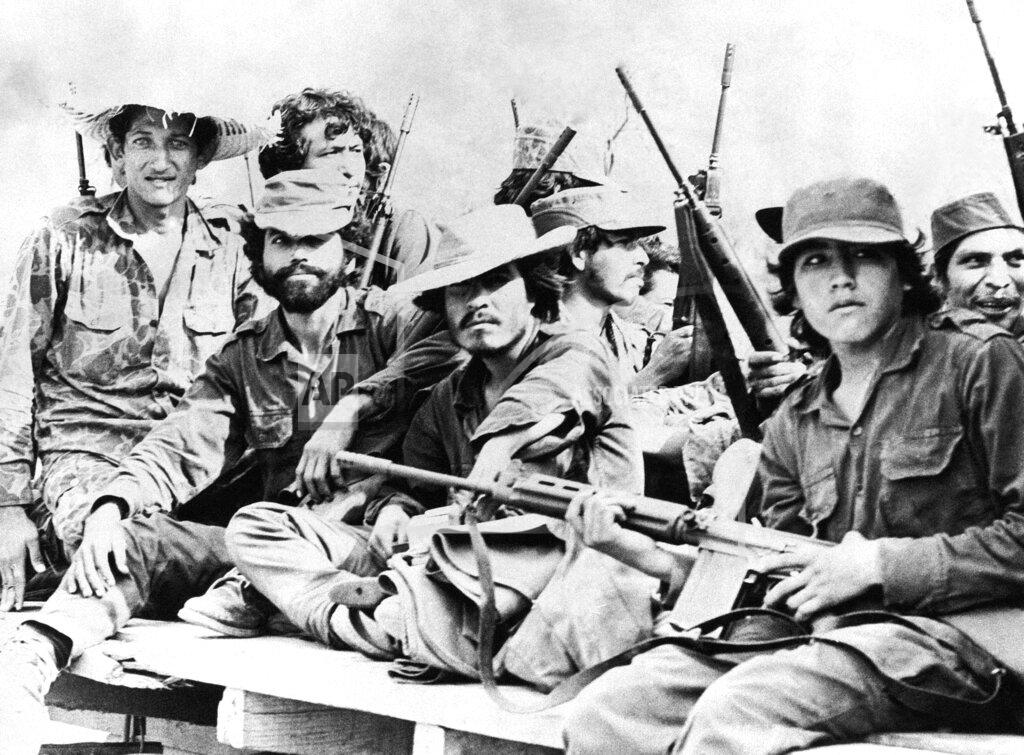
Communist‐led forces ambushed a South Vietnam Government military convoy in the Mekong Delta southwest of Saigon, killing 15 militiamen and wounding 45, military headquarters here reported today. A spokesman, Lieutenant Colonel Đỗ Việt said initial reports indicated that five Việt Cộng and North Vietnamese soldiers were also killed in the ambush yesterday along a provincial route in Vĩnh Bình Province, 75 miles southwest of the capital. He said he command had no other details.
In the Central Highlands, Saigon military official reported 30 North Vietnamese and Việt Cộng killed in a series of skirmishes around Thanh An, a district capital 220 miles northeast of Saigon. Government casualties were given as two wounded. Fighting has increased the Central Highlands city of Pleiku in the last two weeks with small skirmishes and shelling attacks.
On the central coast, 34 Việt Cộng soldiers were reported to have been killed yesterday when they assaulted a government infantry position near Hoài Nhơn, a district capital in Bình Định Province, 290 miles northeast of Saigon, the command said. It gave government casualties as three killed, seven wounded and one missing.
Japan’s Premier‐designate, Takeo Miki, said today that the governing Liberal‐Democratic party was in its “greatest crisis” and needed “drastic reform.” Mr. Miki, who was formally elected president of the Conservative party this morning, said: “I realize the need for drastic reform in our party, particularly in the election of the party president, on methods for collecting and spending political funds, and on elections.”
The Philippine Government announced today that it would soon put on trial a former Manila newspaper publisher and the son of a defeated presidential candidate who allegedly plotted to kill President Ferdinand E. Marcos. Both men have been in jail for two years. They are Eugenio Lopez Jr., who published the now‐defunct Manila Chronicle, and Sergio Osmena 3d, a son of former Senator Sergio Osmena Jr., who opposed Mr. Marcos in the 1969 presidential election. The older Osmena is in exile in the United States. Mr. Lopez, 46 years old, and Mr. Osmena, 30 went on a 10‐day hunger strike last month to protest their long detention without trial. Their wives said they had ended the strike because they believed “they have achieved their objective of focusing the attention of the Government and of the people on their plight and that of other detainees.” The two Osmenas and Mr. Lopez are among 31 persons charged in the alleged assassination plot. They include three Americans, only one of whom is in jail, and two Britons. The American under detention was identified as August McCormick Lehman, 25, of Nashville.
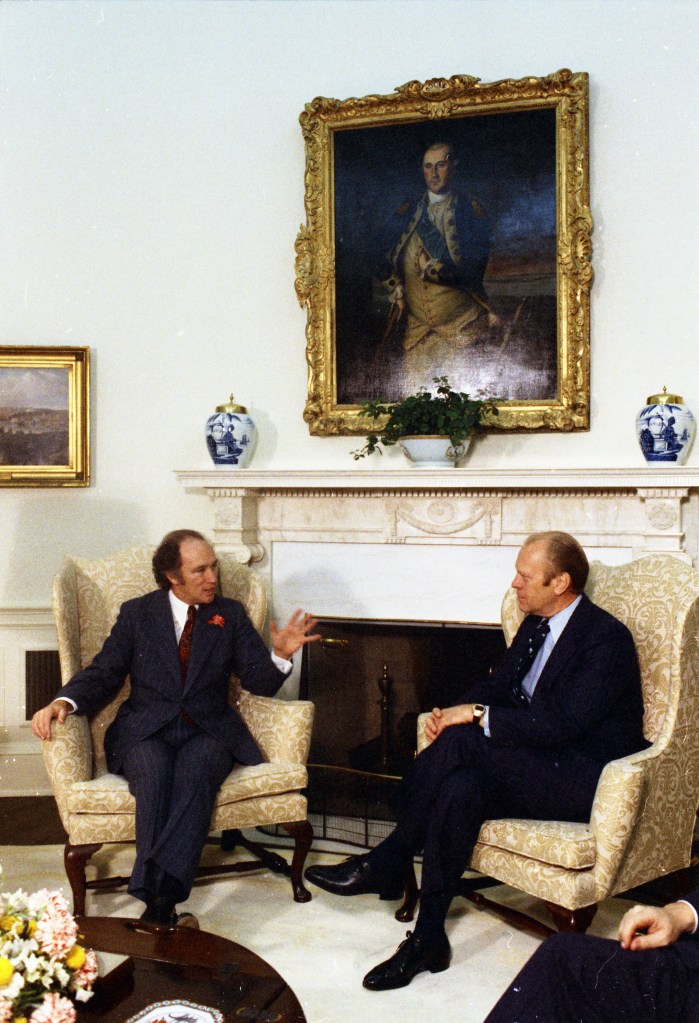
Prime Minister Pierre Elliott Trudeau told President Ford today that Canada intended to pursue a more protectiver nationalist policy on energy resources, ultimately ending the export of oil to the United States. Mr. Ford replied that while the United States appreciated Canada’s intention to develop a stronger sense of national identity, he hoped that the new policy would not assume harmful forms without at least consultation with Washington beforehand. This description of the essence of two hours of talks between the two leaders was given by Assistant Secretary of State Arthur A. Hartman in a press briefing at the White House. “All in all it was a very positive and cordial meeting,” said Mr. Hartman, who heads the State Department’s Bureau of European Affairs.
The 160-strong security forces of the eastern Caribbean island of Dominica launched a drive against the black-power terrorist movement called Dread, arresting several members and shaving off their distinguishing braids. The campaign came at the end of a 15-day amnesty period. The Dreads have been blamed for the murders last week of a retired Canadian couple who had moved to the island five months earlier. The victims were hacked to death with machetes.
Three black African Presidents were meeting in Lusaka, Zambia today amid intense speculation about moves toward a Rhodesian settlement. Radio Zambia said that Presidents Julius K. Nyerere of Tanzania and Sir Seretse Khama of Botswana would be “having routine consultations with President Kenneth Kaunda on matters of common interest.” It did not refer to the Rhodesia question specifically, or to information from informed sources here that the talks were being attended by two rival black nationalists from Rhodesia, Joshua Nkomo and the Rev. Ndabaningi Sithole.
The House, exercising its budget control authority for the first time, refused to allow President Ford to cut back spending authority for this fiscal year by $540.6 million. Mr. Ford had recommended the cuts under a new procedure enacted by Congress last summer. His recommendations must be approved by both the House and Senate to take effect. The House approved cuts totaling $116.9 million but rejected a cut of $455.6 million for rural electrification loans and $85 million for agricultural conservation programs. Mr. Ford also recommended $4.6 billion in budget cuts on November 26. Under the procedure, Congress has 45 days in which to approve them.
The prosecution at the Watergate cover-up trial read from transcripts of previously undisclosed tapes and contended that one of them showed President Nixon offering John Ehrlichman and H.R. Haldeman $200,000 to $300,000 in cash. The suggested context was that the three men understood they were protecting one another.
The United Mine Workers leadership will announce tomorrow that its members have ratified their new contract and will end their strike Friday morning. The vote for approval is estimated at about 55 percent of those taking part.
The Federal Power Commission, seeking to lift production of natural gas, raised its uniform price by 8 cents to a level of 50 cents a thousand cubic feet. It projected a price increase to residential consumers of 8 to more than 16 percent by 1978. Its chairman joined the administration in asking Congress to remove gas price controls to head off a dangerous shortage.
A federal jury in Los Angeles awarded $2,823,333.30 in damages to Robert Maheu in his defamation suit against the Summa Corporation of the billionaire Howard Hughes. The suit was based on Mr. Hughes’s assertion during an interview that he had dismissed Mr. Maheu for dishonesty and stealing from him.
The Democratic caucus in the House of Representatives continued its procedural reforms. It further undercut the seniority system by barring the chairman of a major committee from heading another full committee, select committee or joint Senate-House committee. It also bolstered the Speaker’s power. For the third straight day the mood of reform was maintained by the House Democratic Caucus, whose 291 members continued to change the procedures under which the House conducts its business, handles legislation and affects national affairs. The most important action taken today was the adoption of a proposal, offered by Representative Lloyd Meeds of Washington, that bars the chairman of a major committee from serving at the same time as chairman of another major committee — either a standing committee, a select committee or a joint SenateHouse committee.
The House Democratic leadership got wind of discussion among other members of the Ways and Means Committee following the hospitalization of its chairman, Wilbur Mills, that seemed to portend locking themselves into their strong positions. They scrapped the scheme after advice from the leadership and said they had not planned to circumvent reform. As a result, the younger, more progressive members who will be appointed to the cornmittee for the next Congress will not be frozen out of key policy‐making spots on the panel. Even as this development was being played out, the House Speaker, Carl Albert, said at a news conference that he thought Mr. Mills would not be returned as Ways and Means chairman when the new Congress convenes in January. Mr. Mills, who entered the hospital yesterday, was reported to be in satisfactory condition.
Senator William E. Brock (R-Tennessee), a member of the Senate housing sub-committee, was named as a defendant in a suit filed by buyers of recreational land in Pennsylvania. Besides Brock, four other persons, five development companies and three banks were named as defendants in the suit, filed in U.S. District Court in Philadelphia. The suit alleged that the defendants gave false and incomplete information about the property, violating federal interstate land sales regulations, full disclosure laws and the Truth-in-Lending Act. Brock could not be reached for comment. He was said to be president and sole stockholder of one of the development companies.
Lawrence M. Higby, top aide to former White House chief of staff H. R. Haldeman, will leave the government Friday to join PepsiCo., Inc., it was learned. With Higby’s departure from a $33,000-a-year post in the Office of Management and Budget he has held since June, 1973, no official linked with the inside of the Watergate affair will remain in the Executive Office structure serving President Ford. No charges were brought against Higby, who was mainly a messenger. A PepsiCo spokesman said Higby would join the company in the next few weeks in “an analytical staff capacity.” PepsiCo’s president, Donal M. Kendall, is a friend and confidant of former President Richard M. Nixon.
The House Education and Labor Committee unanimously approved an emergency $2 billion public service jobs bill to combat rising unemployment. The money, to be pumped into city, county and state governments in the worst hit areas, would be authorized for one year. The measure also contains provisions to broaden unemployment compensation benefits. President Ford has called on Congress to pass such legislation but disagreement over the total to be authorized and the distribution formula had kept the proposals in committee.
An early Gallup survey of rank‐and-file preferences for Democratic Presidential candidates in 1976 indicates that no Democrat can yet claim as much as 20 percent of the field. Governor George C. Wallace of Alabama is the leading choice with 19 percent. In a survey of Democratic voters who were asked to name their first choice from a list of 31 potential candidates, Governor Wallace was trailed by Senator Hubert H. Humphrey of Minnesota, at 11 percent; Senator Henry M. Jackson of Washington, 10 percent; Senator Edmund S. Muskie of Maine, 6 percent, and Senator George McGovern of South Dakota, 6 percent. Former Mayor John V. Lindsay of New York, with 3 percent of the responses, tied for sixth place with Senator Adlai E. Stevenson 3d of Illinois and State Senator Julian S. Bond of Georgia, the only black on the list.
[Ed: Of course, NONE of them will be the nominee.]
All privately owned handguns should be registered with authorities, a committee of the National League of Cities recommended. The action could prompt controversy today when the league, which represents 15,000 municipalities, adopts its 1975 policy program at a meeting in Houston. “This is one area that has been fought year after year,” said Mayor E. J. Garn of Salt Lake City, the committee chairman. Garn, who was elected to the U.S. Senate last month, would not predict the outcome of the vote.
The January 1 enforcement date of the Environmental Protection Agency’s controls on “indirect sources” of pollution will not be extended, EPA Administrator Russell E. Train said in Houston. Train said the agency has taken “a good hard look” at extending the date but has no present plans to change it. Starting January 1, EPA approval will be required on construction of major new shopping centers, apartment complexes and other projects with parking for more than 1,000 cars. The goal is to prevent concentrations of traffic that would violate federal limits on carbon monoxide pollution.
Hypothetical oil shale mining and refining plants in Colorado could produce semi-refined shale oil at half the price the Arab states charge for crude oil, according to a U.S. Bureau of Mines survey. The bureau said for a capital investment of $522,374,400, a 100,000-barrel-per-day operation could be built in Colorado permitting the sale of the product at $5.15 per barrel. The Arab states charge $11.65 per barrel.
A Juneau Superior Court judge has ruled unconstitutional a special legislative committee created to dispense state aid to communities affected by construction of the trans-Alaska oil pipeline. A suit filed by Alaska Governor William A. Egan, expected to reach the state Supreme Court on appeal, was upheld by Superior Judge Thomas B. Stewart. However, an injunction prohibiting the six-member legislative panel from reviewing applications for emergency grants was not issued immediately.
Skin doctors at Massachusetts General Hospital report “complete clearing” of psoriasis treated with an experimental technique combining a new ultraviolet light device and a naturally occurring drug used by Egyptians and Indians since ancient times. Similar results have been achieved in Vienna.
A fire aboard a Ringling Bros. and Barnum & Bailey Circus train in South Carolina killed 4 circus employees.
In a dismal trade for Montreal, the Expos trade outfielder Ken Singleton and pitcher Mike Torrez to the Baltimore Orioles for pitcher Dave McNally, outfielder Rich Coggins, and a minor league pitcher. Torrez was 15-8 this year for the Expos.
Dow Jones Industrial Average: 598.64 (+2.03, +0.34%).
Born:
Dan Bongino, American political commentator (“Unfiltered with Dan Bongino”), in Queens, New York, New York.
Tadahito Iguchi, Japanese baseball and MLB second baseman (World Series Champions [first Japanese position player]-White Sox], 2005, Chicago White Sox, Philadelphia Phillies, San Diego Padres; Chiba Lotte Marines), in Tanashi, Japan.
Larry Smith, NFL defensive tackle (Jacksonville Jaguars, Green Bay Packers), in Kingsland, Georgia.
Sam Sword, NFL linebacker (Oakland Raiders, Indianapolis Colts), in Saginaw, Michigan.
Ricky Parker, NFL defensive back (Jacksonville Jaguars), in Burlington, Vermont.
Anke Huber, German professional tennis player (Fed Cup 1992, Hopman Cup 1995); in Bruchsal, West Germany.
Died:
Lee Kinsolving, 36, American actor (“Explosive Generation”), of a respiratory illness.
Henry Francke Jr., 17, a linebacker on the Riverhead High School football team on Long Island, eight weeks after breaking his neck during an intrasquad scrimmage.
Leo Goossen, 82, American mechanical engineer and automobile designer, after a stroke.
Sophie-Carmen “Sonia” Eckhardt-Gramatté, 77, Russian-Canadian pianist and composer.


 History Diaries