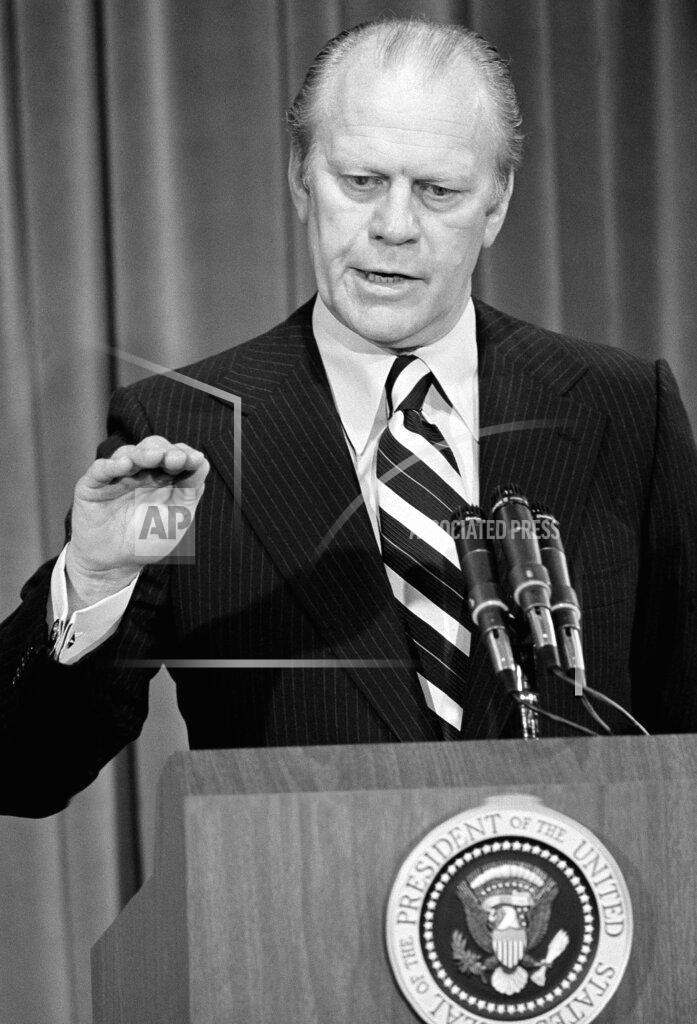
At his televised news conference, President Ford made pubic the details of a tentative agreement that he and Leonid Brezhnev had reached in Vladivostok. He said the accord put a “firm ceiling” on the arms race and created a “solid basis” for future arms reductions. “It’s a good agreement and I think the American people will buy it,” Mr. Ford said. Mr. Ford disclosed that both sides had put a ceiling of 2,400 each on the total number of long‐range offensive missiles and bombers. Of that total, each side will be able to place multiple independently targetable warheads on up to 1,320 land‐based and submarine-launched missiles.
The over‐all figure of 2,400 on strategic delivery vehicles had already become known, but the number of missiles able to receive MIRV’s was higher than previously reported. Earlier versions placed the figure an missiles that could be armed with multiple warheads at 1,200 to 1,300. The 1,320 total is sure to increase the criticism already voiced by both arms control advocates and those seeking cuts in military spending that the arms ceiling is too high. Mr. Ford acknowledged that the United States would continue to spend at about the same level or higher as this year to keep American forces up to the ceiling permitted by the accord.
He said that because of inflation, the military budget proposed for next year would increase. But he stressed, as Mr. Kissinger did at Vladivostok, that the agreement had put a “cap” on the arms race. On the Middle East, Mr. Ford indicated that while the Soviet Union and the United States had a better understanding of each other’s position, no substantial agreements were reached. He said that he and Mr. Brezhnev had discussed the Middle East at some length and that both sides agreed to “make a maximum effort to keep negotiations going.” But Mr. Ford said the United States argued that the stepby‐step approach, with Israel negotiating, with Arab nations one by one “is the right one.” The Soviet Union has for a reconvening of the Geneva conference. Mr. Ford said that “we don’t preclude a Geneva conference.”
A defense-policy specialist of the Brookings Institution has recommended that the United States reduce the number of tactical nuclear warheads it deploys in Western Europe from the present total of 7,000 to 2,000.
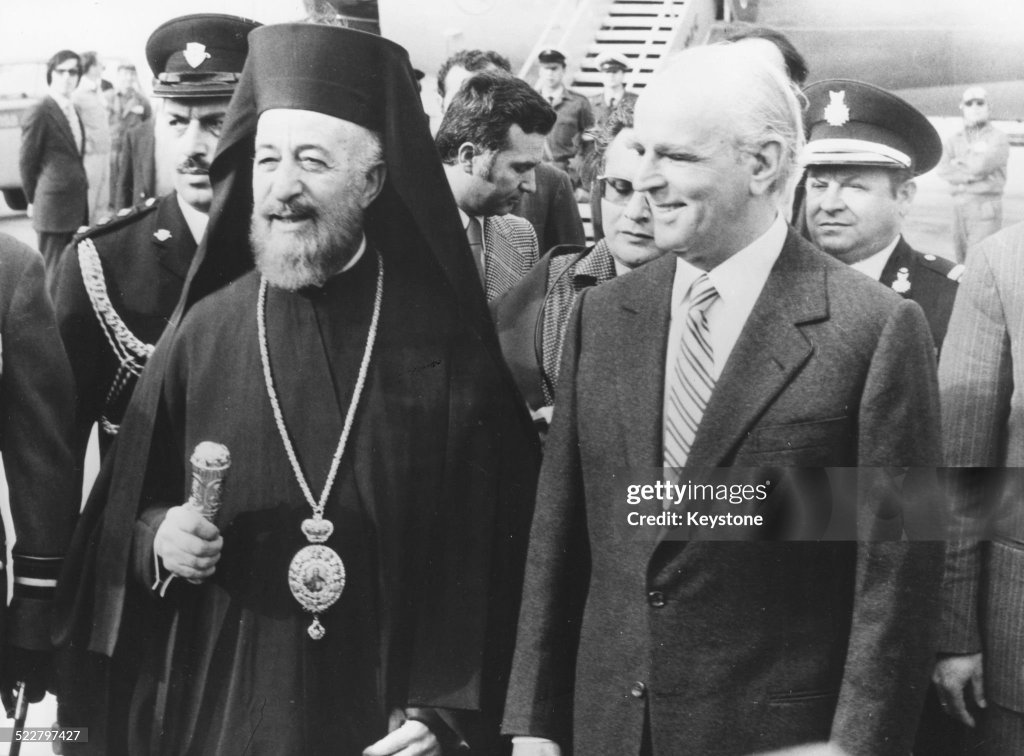
Talks between leaders of the Greek and Turkish communities in Cyprus will be halted as soon as Archbishop Makarios returns to the island, the Turkish Foreign Ministry reported in Ankara. The archbishop intends to fly to Cyprus Friday to resume the presidency. He has said that Turkey is trying to stop him from going back. The Turkish ministry said, “A man whose leadership is uncertain even among his own people will not help the situation by returning.”
The State Department confirmed that the value of U.S. arms shipments to Turkey increased sharply in the three months following the Cyprus invasion but denied that this represented an escalation of military aid. The increase, a spokesman said, resulted from shipment of four F-4 fighter planes and spare parts. The planes had been promised under an earlier agreement, he said.
An explosive charge planted in a milk churn exploded and killed a British army bomb disposal expert who was trying to defuse it in the remote Northern Ireland village of Gortmullan, only yards from the frontier with the Irish Republic. Army sources believe the bomb was detonated by remote control by Irish Republican Army guerrillas hidden across the border.
Portugal banned officials of the overthrown regime of Marcello Caetano, including the toppled president, from participating in elections scheduled for March. A decree issued as a supplement to the electoral law ruled that anybody who held specified posts during the 48 years of the right-wing regime was ineligible to vote or be a candidate in the elections for a constituent assembly.
The Chief of Staff of the French Army has warned the Minister of Defense that if he does not improve morale and living conditions among the military, a revolt may be provoked. The most respected newspaper in France, Le Monde, cornmented that a “confidential” report from General Alain de Boissieu, son‐in‐law of Charles de Gaulle, found that any serious economic and social disturbances might involve the army. In 1968 the armed forces stood aside front the student‐worker upheavals, which tore the country apart. Dissatisfaction now among conscripts, who get about $6 a month in pocket money, as well as among commissioned and noncommissioned officers, is apparently widespread. The most notable protest came in September in Draguignan in the south where young men called up for a year’s compulsory service marched in the streets to demand better conditions.
Italian Premier Aldo Moro tonight outlined a broad economic program for his new Government aimed at fighting inflation and bolstering the nation’s sagging economy. In a speech to Parliament, Mr. Moro said he realized that the program would require “many sacrifices” but pledged that the measures would last only as long as necessary for readjustment of the economy. Mr. Moro’s two‐hour speech, presented first to the Senate and then to the Chamber of Deputies, opened a parliamentary debate that will end later this week with a confidence vote in both houses. It is generally assumed that the new Government, formed by Mr. Moro after a 51‐day political crisis, will be approved.
The U.N. Educational, Scientific and Cultural Organization reported in Paris that Israel had not been excluded from the world body despite recent resolutions weakening its position in the group. The statement followed widespread protests at anti-Israeli resolutions passed by the body’s general conference last month which were interpreted as a diplomatic success for Arab nations.
In Ethiopia, Eritrean nationalists bombed the Addis Ababa city hall and the Webi Shebeli Hotel. The ruling Derg revolutionary council used the bombings as a pretext for hardened repression against former members of the regime of Emperor Haile Selassie. Bombs exploded in Addis Ababa today, damaging the City Hall and a downtown hotel and reportedly injuring 13 persons. Later, gunfire and at least two hand‐grenade blasts were heard on a road in the eastern part of the city. Ethiopia’s military rulers, who deposed Emperor Haile Selassie in September, said in a statement that the bombings were the work of “followers of the nobility and top officials of the former regime who were “executed” a week ago Saturday. More than 50 nobles, officials and generals were put to death. However, most foreign diplomats believed that the bombings, which came in the wake of the destruction of a big fuel tank at Addis Ababa’s international airport Saturay night, were the work of secessionist guerrillas from the northern province of Eritrea who have been fighting dominance from central Ethiopia for 12 years.
The United States warned today that, until suitable alternatives were devised, the arrangements that have preserved peace on the Korean peninsula for more than 20 years should not be abandoned. W. Tapley Bennett Jr., the United States delegate to the General Assembly’s political committee, said that the time had come to reconsider the role of the United Nations Command, and added: “But we are also convinced that such reconsideration cannot take place at the expense of the military stability on the Korean peninsula, which these very arrangements brought about and helped maintain.” The United States is opposing a resolution, submitted on behalf of North Korea by 38 sponsors, mainly Communist and third‐world countries, that calls for withdrawal of all foreign troops from South Korea — meaning the 38,000 American troops there. It would also dissolve the United Nations Command, created in 1950 to repel the North Korean invasion of the south.
A new Japanese Premier was picked by a consensus of party leaders in Parliament after a week of intensive political maneuvering and without a vote or any reference to the public. He is Takeo Miki, a senior member of Parliament, who will succeed the incumbent Kakuei Tanaka. Japan’s ruling Liberal Democratic Party has decided to formalize the appointment of Takeo Miki, 67, as its leader — and nominee for prime minister — in a meeting of its members in the upper and lower houses of parliament set for Wednesday. Miki would then be elected prime minister in an extraordinary session of parliament to be convened next week.
The martial-law government of Philippine President Ferdinand E. Marcos said it is holding 1,792 political prisoners. The figure was included in a letter by Defense Secretary Juan Ponce Enrile to Archbishop Jaime L. Sin. It was the first time in two years that the government had given a definite count of political prisoners.
Mexican revolutionary Lucio Cabañas was killed. Cabañas led a guerrilla group, the Party of the Poor (PDLP) and Peasants’ Brigade Against Injustice (PDLP-BCA). They numbered perhaps 300 members and lived in the Guerrero Mountains. He financed his group through kidnappings and bank robberies. The Mexican government sent 16,000 soldiers to the Sierra Madre de Atoyac Mountains to hunt him. Fifty of them died during the chase. According to the Mexican government, Cabañas and three other guerrillas were found in El Otatal, Tecpan de Galeana, and were killed in combat on December 2, 1974. Newer information contends that Cabañas killed himself to avoid capture or was executed by the Mexican military.
Peru’s Premier and two other men prominent in the military government escaped assassination last night, the Interior Ministry announced today. The announcement said that unidentified assallants fired from a vehicle that drew alongside the car carrying the three officials. Premier Edgardo Mercado Jarrín, who is also War Minister and Commander in Chief of the army, escaped injury, the statement said. But General Javier Tantaléan Vanini, the Minister of Fisheries in President Juan Velasco Alvarado’s leftist government, and General Guillermo Arbulu, General Tantaléan’s brother‐in-law, were wounded. They were taken to the military hospital in Lima, where they were reported in satisfactory condition.
The U.S. Central Intelligence Agency staged a daring jailbreak in Rhodesia to free a man that the CIA had recruited to supply information on violations of the Rhodesian trade embargo, columnist Jack Anderson reported in Washington. The man had given details to Rhodesian authorities on his spying activities after being beaten and tortured, Anderson said. A second recruited spy for the CIA had been released previously through official negotiations, the columnist added.
President Ford said in his news conference that the nation now faced the triple challenges of inflation, recession and an energy crisis. It was the first time that he had not given inflation top priority when discussing the nation’s economic problems. He called on Congress to act on his recommendations for $4.6 billion in budget cuts, urged that Congress not add more spending, and said he anticipated rising unemployment and asked Congress to pass emergency employment legislation before adjourning this year.
House Democrats voted to divest the Democrats on the Ways and Means Committee and its chairman, Representative Wilbur Mills of Arkansas, of the authority to make committee assignments for other Democrats. The assignment authority, held by the committee’s Democrats since 1911, was a major source of the vast power exercised by Mr. Mills.
Mr. Mills was the object of derision and scorn from his congressional colleagues because of his association with a strip-tease dancer. Many Democrats were openly talking of censure — even of taking away his chairmanship of the Ways and Means Committee.
Federal Judge John Sirica strongly suggested that he intended to let the Watergate cover-up case go to the jury without waiting to get testimony from former President Nixon. In a discussion about court hours, Judge Sirica said he was going to lengthen the court day to 6 PM, and added that “We’re going to try to finish this case by Christmas.” A court‐appointed panel of doctors estimated last Friday that Mr. Nikon would not be physically able to testify at the trial until February 16 at the earliest, and that he would not even be able to give testimony in the form of a deposition at his home until January 6.
The first price reduction in sugar in 20 months was announced by three of the country’s largest refiners. The wholesale price cut, effective at the start of business today, will shave consumer prices by about 5 cents a pound, but it was not certain how soon this would be reflected in grocery stores. Sugar price boosts of more than 50% in a month pushed up the family grocery bill in November, an Associated Press market-basket survey shows. But there were signs that the sugar spiral might be easing as three of the nation’s major refiners announced wholesale price cuts. The reduction at the wholesale level was the first in more than a year, but it might be some time before it reaches the retail stage. Because of sugar, the total market basket bill jumped sharply, rising an average of 6% during November. If sugar is removed from the total, however, the average increase is only seven-tenths of a percent and the bill in six of the 12 cities checked would have declined.
The winter’s first heavy snowstorm in the Appalachian coal fields forced the United. Mine Workers of America today to add two extra days far Membership balloting and to extend through Wednesday today’s scheduled rank‐and‐file voting on the coal industry’s proposed contract. The delay in completing the voting at hundreds of remote locals meant that the nationwide coal strike, now in its 21st day, could not be ended before next Thursday at the earliest, assuming a majority of the 120,000 eligible members of the U.M.W. vote to ratify. Some inconclusive voting was completed yesterday and today.
Two recording instruments that might disclose the cause of the Trans World Airlines crash that killed 92 persons were recovered from the top of a snow-covered mountain near the Virginia community of Upperville. Authorities continued to search for the bodies of the 85 passengers and seven crew members who had been aboard TWA Flight 514 when it slammed against the fog-draped peak late Sunday morning during turbulent weather. Authorities said the flight data recorder and the cockpit voice recorder had been recovered from the wreckage.
The Democratic political machine of Chicago Mayor Richard J. Daley suffered another blow when Alderman Paul Wigoda was sentenced to one year’s imprisonment for failing to report a $50,000 bribe in income tax returns. Sentencing came only a few days before Daley, 72, one of the nation’s most powerful Democrats, is expected to announce he will seek a sixth four-year term as mayor. Lawyer Wigoda was convicted of having received the money in 1969 for promising favorable treatment for a land development plan.
Former White House aide Charles W. Colson, portraying himself as a victim of the times and of misguided loyalty, has asked that his Virginia law license not be revoked. “I cannot minimize, justify or excuse my conduct. But do not forsake me from the opportunity to redeem myself,” he said in a statement to the Virginia Supreme Court. Colson, special counsel to former President Richard M. Nixon, pleading guilty in May to obstructing justice in the Ellsberg break-in case and is now serving a one-to-three-year prison term. He is scheduled to testify Wednesday in the Watergate coverup trial.
The Senate passed a bill designed to settle an old dispute by dividing 1.8 million acres of land in Arizona equally between the Navajo and Hopi Indian tribes. The bill was sent back to the House for consideration of amendments. The dispute originated in an 1882 order by President Chester A. Arthur giving the Hopis land within the sprawling Navajo reservation. The bill would require a federal court to partition the lands if the Indians themselves cannot agree on a division. The Hopis, who number about 6,000, live in an area entirely surrounded by the huge Navajo domain. The Navajos number about 130,000.
Thomas Murphy, the new chairman of the General Motors Corporation, said that G.M. would support higher federal gasoline taxes if the Ford administration decides they are necessary to reduce the nation’s petroleum imports. “If in the judgment of the Administration it looks like gasoline tax is necessary, think we ought to consider it,” he said. Later he added that “I guess we would subscribe to it if such a tax was deemed necessary.” This represented a shift from General Motors’ earlier opposition to a gasoline tax increase after it was proposed last month by Henry Ford 2d, chairman of the Ford Motor Company.
In the wake of the Watergate scandal and the resignation of former U.S. President Richard Nixon, Whittier College, Nixon’s alma mater, agreed to accept and administer the assets of the Richard M. Nixon Foundation, which would disband, with plans to build Nixon’s presidential library put on hold. Nixon would found a new Richard Nixon Foundation in 1983, and the Richard Nixon Presidential Library and Museum in Yorba Linda, California, would open in 1990.
Under an Army Corps of Engineers proposal, 1,550 residents of Baytown, Texas, would be relocated from a flood plain in the Houston suburb. Maj. Gen. John Morris, chief of civil works for the corps, told a conference in Houston that the agency was turning to alternate or “nonconcrete” solutions to flood control, an approach urged in the past by environmental groups. “I’m not saying that all concrete is bad, but there are places where we need it and places where we don’t,” General Morris said. The corps has decided that concrete is not needed in the area of Burnett, Crystal and Scotts Bays in Baytown, which has a concentration of petrochemical plants along with ground subsidence problems. Groundwater withdrawals in the area are blamed for producing the subsidence, which has resulted in increased flooding within parts of the city.
About 2,500 nonprofessional employes of three major Baltimore hospitals went on strike today after a weekend of negotiations failed to produce agreement on, a new contract. Maintenance and service workers set up, picket lines outside the Johns Hopkins Hospital, Maryland General Hospital and the Center before the start of the 7 AM shift.
The Soviet Union launched the Soyuz 16 spacecraft, carrying cosmonauts Anatoly Filipchenko and Nikolai Rukavishnikov, into orbit in order to test systems for the Apollo–Soyuz flight scheduled for July 1975.
Pioneer 11 transmitted the first pictures of Jupiter’s south polar region and then continued its journey across the solar system to Saturn. Earlier it had cut its electronic eye on Callisto, second largest of the Jovian moons, and revealed what seems to be a polar cap like that on Mars. Callisto is intermediate in size between the planets Mars and Mercury. The composition of the apparent polar cap is uncertain.
Bishop Stephen Spottswood, board chairman of the National Association for the Advancement of Colored People and a retired spiritual leader of the African Methodist Episcopal Zion Church, died of cancer Sunday night at his home in Washington at the age of 77.
At the Major League winter meetings in New Orleans, the Rules Committee institutes several changes: among the changes is one permitting the use of cowhide, rather than just horsehide, in the manufacture of baseballs.
The Boston Red Sox trade outfielder Tommy Harper to the California Angels for infielder Bob Heise.
After several rounds of bourbon are consumed by Philadelphia Phillies GM Paul Owens and Detroit Tigers GM Jim Campbell at the winter meetings, Owens agrees to trade promising catcher Bob Boone and pitcher Larry Christensen to Detroit for veterans Bill Freehan and Jim Northrup. Tomorrow morning, Owens won’t recall the trade and the deal is never made. “How do you unshake a handshake?” says the disappointed Campbell.
NFL Monday Night Football:
Cincinnati Bengals 3, Miami Dolphins 24
The game was important, so the Miami Dolphins, accustomed to success in such quantity that they need challenges to start the adrenalin moving, responded. They trounced the Cincinnati Bengals, 24–3, tonight in the Orange Bowl for their ninth victory in 12 games and remained tied with the Buffalo Bills for first place in the East Division of the American Conference. The Dolphins were methodical on offense and ‐almost perfect on defense. Bob Griese completed 11 of 13 pass attempts, two for touchdowns, and Larry Csonka smashed ahead for 123 yards rushing. All that the Bengals could achieve was one 29‐yard field goal by Horst Muhlmann, set up by a Miami fumble on the Dolphin 19‐yard line. Cincinnati lost for the fifth time against seven triumphs and its chances for a spot in the league playoffs were diminished but not extinguished. The decision in favor of Miami eliminated two A.F.C. teams from playoff contention, the Denver Broncos and the Houston Oilers. The Dolphins’ remaining opponents are Baltimore and New England. Should they conclude the season in a tie with Buffalo they would be awarded first place in the division because they beat the Bills twice. For the Bengals to reach the playoffs they are going to have to beat Detroit and Pittsburgh in their last two games. The Bengals gained only 162 yards and fumbled five times, losing the ball three times. Meanwhile, Miami gobbled up 310 yards, 196 on the ground, and as far as the defensive players were concerned, they had a shutout, almost.
Dow Jones Industrial Average: 603.02 (-15.64, -2.53%).
Born:
Duncan Pugh, Australian bobsledder (Olympics, 2010), and school teacher, in England (d. 2023).
Jason Suttle, NFL defensive back (Denver Broncos, San Francisco 49ers), in Minneapolis, Minnesota.
Grant Wahl, American sports journalist (CBS Sports, Sports Illustrated, Fox Sports), in Mission, Kansas (d. 2022).
Died:
Stephen Gill Spottswood, 77, American civil rights leader, NAACP chair and retired bishop of the African Methodist Episcopal Zion Church, died of cancer.
Lucio Cabañas, 35, Mexican schoolteacher and union and guerrilla leader, killed himself to avoid capture and likely execution by the Mexican military.
Sylvi Kekkonen, 74, First Lady of Finland and wife of President Uhro Kekkonen, died of a heart attack.
Hana Benešová (born Anna Vlčková), 89, widow of former president of Czechoslovakia Edvard Beneš, died of pneumonia. On December 7, several thousand people would attend Benešová’s funeral, although the Czechoslovak press gave no advance notice of the service.
Max Weber, 77, Swiss Federal Councilor.
Sidney Jourard, 48, Canadian psychologist, professor and writer, was crushed to death when his car fell on him while he was working on it.
Paul Coze (born Paul Jean Coze-Dabija), 71, French-American artist and writer.
Paul B. Dague, 76, former member of the United States House of Representatives from Pennsylvania.
British commercial diver David Keane, 17, drowned when his umbilical cable was cut through while he was conducting a bell dive in the Celtic Sea.




 History Diaries