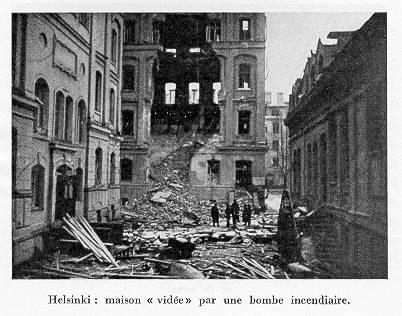
Helsinki is bombed again overnight by Soviet aircraft. Casualties amount to 80 killed. Russian aircraft bomb Helsinki and Vyborg. Telephone talks with Helsinki tonight disclosed that half the Finnish capital’s population of 300,000 was in helter-skelter flight and that nearly all those remaining in the, city were engaged in fire-fighting, first-aid work or other government service.
Soviet attacks on the Karelian Isthmus continue. On the ground, the Soviet advance is slow. The Finns may be small in numbers, but they are big in heart. The Karelian Front is the scene of savage fighting. The Finns report capturing 1200 prisoners, destroying 19 tanks and shooting down at least 16 aircraft.
Soviet 7th and 8th Armies on either side of Lake Ladoga are advancing, but slowly. They are meeting unexpected strong resistance and are behind schedule. Soviet tanks are operating independently from the infantry. These occasionally penetrate the Finnish lines but are eventually neutralized.
North of Lake Ladoga, the advance Finnish forces near the border flee back to the Mannerheim Line. The Soviets are in hot pursuit, aided by naval forces on Lake Ladoga.
Soviet 14th Army in the far north accomplishes its prime objective and captures the prime port of Petsamo.
The Soviet cruiser Kirov, and the destroyers Smetlinyi and Stremitelnyi, bombard the coast artillery battery at Russarö on the southern Finnish coast. After a brief exchange of fire, Russarö’s 234-mm guns score a hit on Kirov, and the Soviets withdraw. Kirov loses 17 KIA and some 30 WIA, while the Finns suffer no losses.
Soviet gunboat Orangenbaum runs aground on a sandbar in Lake Ladoga, a notoriously treacherous lake for ships. It is accompanying other ships trying to shell Finnish shore batteries and land troops at Taipale behind the Mannerheim Line. The overall Soviet attack is unsuccessful.
The Soviet Navy lands troops on Someri Island and Narvi Island.
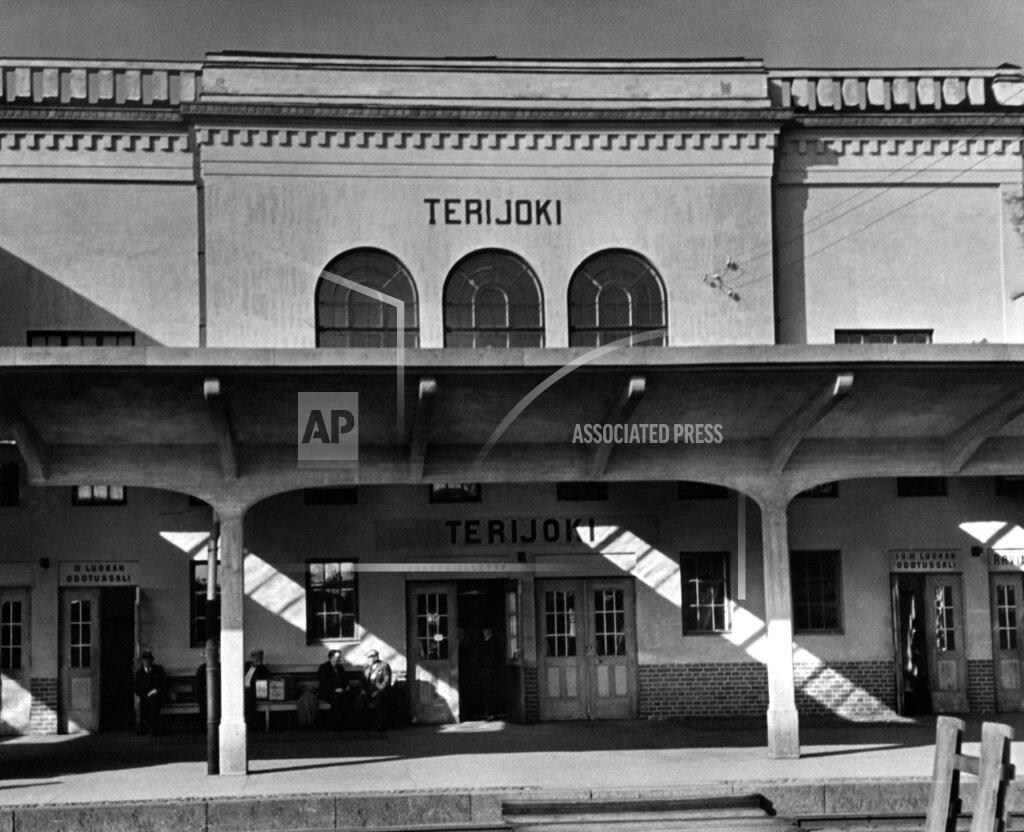
A Soviet sponsored Democratic Republic of Finland is established under Finnish Communist Otto Kuusinen at Terijoki on the Gulf of Finland. The Kuusinen government calls on all Finns to “overthrow the oppressor” (i.e., the government in Helsinki) and welcome the “liberators” (of the Red Army). A treaty is signed with the USSR giving the Soviets everything that has previously been demand, in exchange for the whole of Karelia.
The TASS news agency claims that in Finland, “the people already rose in various parts of the country and proclaimed the formation of a democratic republic. Port of the soldiers of Finland’s army already have sided with the new government, backed by the people.” In actuality, the entire Finnish Army is fighting with great skill and determination against the Soviet hordes.
The Finnish premier quits despite a vote of confidence. The Russian ultimatum is said to ask surrender or threatens pain of a worse blow
Risto Ryti replaced Aimo Cajander as Prime Minister of Finland. A new coalition government in Finland opposed to the Soviet Union was organized with Risto Ryti as Prime Minister and Väino Tanner as Foreign Minister.
Molotov rejects requests to negotiate with the new Finnish government.
There are widespread pro-Finnish demonstrations throughout the Nordic region. These nations live in perpetual fear of heavy-handed tactics such as the USSR is displaying, and now the nightmare is coming true.
A recruitment office for volunteers wishing to help the Finns opens in Stockholm.
Britain denounces Russian invaders; Prime Minister Chamberlain leads the attack on “unjustified” aggression.
President Roosevelt condemns the Soviet invasion of Finland. President Roosevelt addressed urgent appeals today to the governments of Russia and Finland to refrain from bombing civilians and unfortified cities. He requested immediate replies. U.S. Ambassador to the USSR Laurence B. Steinhardt states that in particular, the U.S. objects to “the alleged bombardment of civilians in Finland by Soviet airmen.”
Trainloads of deportees begin rolling into the newly created Government General in eastern Poland. The administration which already has 1.4 million Jews under its jurisdiction is overwhelmed by the numbers — an average of more than 3,000 per day. (These mass movements were designed to make room in the annexed area of Poland for ethnic Germans who were moving westward under special agreement with the Russians, from the Baltic States and other regions now under Soviet control.) Reichsfuhrer-SS Heinrich Himmler ordered the deportation of Polish Jews.
Colonel General Walther Von Brauchitsch, Commander in Chief of the German Army, left for the Western Front today. It is stated that he will go to the Upper Rhine for an inspection of German troops stationed there.
The quiet on the Western Front continued today. A German Army communiqué reports only slight local patrol and artillery activities. French troops, according to semi-official reports, engaged in further strengthening of their left wing entrenchments in the Rhine-Moselle sector. German patrols reconnoitered Mandem in French territory southeast of Perl and reported the town unoccupied.
Four German flying boats were forced to land on the North Sea by a heavy storm. The planes were lost, but the crews were reportedly picked up by Norwegian freighters and all are safe. The bad weather hampered aerial reconnaissance at the front, the German High Command reported, according to The Associated Press.
In Germany, Ernst Udet was appointed Director General of Air Force Equipment (Generalluftzeugmeister).
The title “Waffen-SS” became official. This organisation embraced the SS Verfugungs Division, the Liebstandarte, the SS Totenkopf Division, the SS Polizei Division, the SS Junkerschulen (training schools), together with their training and replacement units. Service in these formations would count as active military duty.
The first euthanasia centers open in Germany this month. The first victims are shot, but as the program is expanded, gassing rooms disguised as showers are used. The largest of these institutions are at Grafeneck in Wuttemberg and Hadamar in Hesse.
Premier Edouard Daladier addresses the French and British people (with simultaneous translation as usual). He states that it “has not been necessary to take an attitude of aggressive attack” due to the strength of the Maginot Line. He makes a point of blaming French communist leaders’ subversion (“treating with foreign governments”) for France’s situation, stating that it constitutes “treason.”
The unescorted Finnish steam merchant Mercator was torpedoed and sunk by the U-21, commanded by Kapitänleutnant Fritz Frauenheim, southeast of Buchan Ness, Scotland in the North Sea (57° 25’N, 1° 35’W). At 04.53 hours the unescorted and neutral Mercator (Master Gunnar Nilsson-Ollandt) was hit near the foremast by one G7a torpedo from U-21 about 12 miles southeast of Buchan Ness and sank after six minutes. One crew member was lost. The U-boat had spotted the ship with lights set only 13 minutes earlier and attacked because no national markings were visible. The RNLI lifeboat Julia Park Barry of Glasgow and the motor fishing vessel Bread Winner put out from Peterhead to rescue the survivors. 19 men in a lifeboat and a raft lashed alongside it with four others were picked up by the fishing vessel three miles east-northeast of Peterhead and brought to the port. The twelve remaining survivors in a second boat rowed towards shore and made landfall at Boddam during the morning. The 4,260-ton Mercator was carrying general cargo, including coffee, maize, wheat, linseed, casein, and groundnut meal and was bound for Helsinki, Finland.
The neutral and unescorted Norwegian steam merchant Arcturus was torpedoed and sunk by the U-31, commanded by Kapitänleutnant Johannes Habekost, east of Scotland in the North Sea. At 09.30 hours on 1 December 1939 the unescorted and neutral Arcturus (Master Nicolai Ludvik Engene) was hit on the port side underneath the fore mast by one G7e torpedo from U-31 and sank by the bow within three minutes about 80 miles east of Rattray Head. The master and eight crew members were lost. The U-boat had spotted the ship with lights set in a rain shower at 05.50 hours, but did not see the national markings, probably due to the low visibility from the periscope and missed with a first torpedo at 09.27 hours. Both lifeboats went down with the ship and the eight survivors rescued themselves on two rafts that floated free after she sank. They tied the rafts together and were spotted the next morning by a British aircraft which directed the Danish steam merchant Ivar to their location. The survivors were picked up and landed at Fredrikshavn, Denmark. The 1,277-ton Arcturus was carrying general cargo, including tea, gas stoves, steel wire, cardboard folders and diaries, boots, shoes, and machinery and was bound for Trondheim, Norway.
The British cargo ship Dalryan struck a mine and sank in the North Sea 2.5 nautical miles (4.6 km) south west of the Tongue Lightship (51°31′00″N 1°19′05″E). All 39 men aboard were rescued. The wreck was subsequently dispersed by explosives.
The French cargo ship Floride struck a mine and was damaged in the North Sea off Dunkerque, Nord. She was beached at Malo-les-Bains, Nord but broke in two and was declared a total loss. Three crewmen were killed.
The Danish schooner Grethe ran aground on the Goodwin Sands, Kent and was wrecked. The seven crew were rescued by a Royal Navy destroyer.
The Norwegian tanker Realf sinks from mine damage incurred the previous day.
The German fishing trawler Magda was lost in the North Sea north of Heligoland.
The British government advised neutral shippers to obtain a “navicert,” a certificate from British consular officials. These certificates permitted neutral cargo ships to pass through Royal Navy and allied patrols. The Italian, Dutch, Belgian, and Japanese governments issued formal protests against the British government for these blockade measures.
Convoy OA.44 departs from Southend.
The War at Sea, Friday, 1 December 1939 (naval-history.net)
The search for the German warships responsible for RAWALPINDI’s loss was discontinued at 0820/1st. Battleship RODNEY, battlecruiser HOOD, destroyers PUNJABI, GURKHA, KANDAHAR and NUBIAN arrived in the Clyde, while battleship NELSON and destroyers FAULKNOR, FURY, FIREDRAKE and FORESTER were north of the Faroes to cover AMCs returning to Northern Patrol.
Heavy cruiser DEVONSHIRE and light cruiser NEWCASTLE were patrolling 62°N between Norway and the Shetlands. Light cruisers SOUTHAMPTON, EDINBURGH and AURORA with destroyers ZULU, AFRIDI and ISIS were returning to Rosyth, with SOUTHAMPTON refueling at Scapa Flow en route and the ship arriving at Rosyth on the 2nd. Destroyer FORTUNE arrived from Scapa Flow in the Clyde for repairs.
The C and D-class light cruisers were returning to port. CARDIFF departed Scapa Flow on the 1st and arrived at Loch Ewe on the 2nd, along with DIOMEDE, DRAGON, DELHI and COLOMBO early on the 2nd. DUNEDIN and CERES reached the Clyde on the 2nd, COLOMBO and CALYPSO arrived in the Tyne for refit, and CALYPSO refitted prior to transfer to the Mediterranean, completing on the 21st.
Heavy cruiser NORFOLK and light cruiser SHEFFIELD arrived at Scapa Flow.
French battleship DUNKERQUE was joined by large destroyers MOGADOR and VOLTA, after they refueled at Belfast, and then proceeded down the west coast of Ireland. They were joined on the 2nd by destroyers GUÉPARD, VALMY, VERDUN and LE TRIOMPHANT, which departed Brest on the 1st. LE TRIOMPHANT then escorted light cruiser MONTCALM to Cherbourg for repairs, arriving on the 3rd. The rest of the force arrived at Brest on the 3rd.
Armed merchant cruisers ANDANIA, ASTURIAS, AURANIA, SCOTSTOUN and WORCESTERSHIRE arrived on their patrol lines south of Iceland, while FORFAR arrived in the Clyde from Portsmouth.
Destroyers EXMOUTH, ECHO and ECLIPSE, which had departed the Clyde on 30 November, were dispatched to investigate a possible German supply ship detected by W/T procedure in 53°N, 13°W. No ship was located and the destroyers returned to Clyde on the 4th escorting battleship WARSPITE.
Destroyer KELVIN was damaged in a collision with steamer ST HELIER (1952grt) at Portsmouth. Her repairs were completed there on the 11th.
Destroyer KHARTOUM departed Plymouth and arrived at Belfast, then continued, reaching the Clyde on the 2nd.
Destroyer IMOGEN, IMPERIAL and IMPULSIVE searched for a submarine reported in Edinburgh Channel. IMOGEN returned when her asdic was found to be faulty. Destroyers FEARLESS and later ASHANTI, which was detached from the Pentland Firth patrol, were also involved in the search. When weather conditions made asdic operations unreliable, IMPERIAL and IMPULSIVE returned to Scapa Flow and FEARLESS to Loch Ewe, all on the 2nd.
Destroyer VERITY attacked a submarine contact outside Plymouth breakwater at 1445. Destroyer VETERAN was ordered to assist at 1446.
Destroyers GLOWWORM and BOADICEA unsuccessfully searched for a U-boat near Kentish Knock and the Tongue Light Vessel.
Convoy OA.44 of 19 ships departed Southend escorted by destroyers WAKEFUL and WHITEHALL from the 1st to 2nd, and sister ships WOLVERINE and VERITY from the 2nd to 3rd. The convoy was dispersed on the 3rd, and WOLVERINE and VERITY joined HXF.10.
Convoy BC.17 of steamers ATLANTIC COAST, BARON GRAHAM, CLAN ROSS (Commodore), COXWOLD, DUNKWA and GUELMA departed Bristol Channel escorted by destroyers MONTROSE and VESPER, and arrived in the Loire on the 3rd.
Convoy FN.46 departed Southend, escorted by sloops GRIMSBY and WESTON, and arrived in the Tyne on the 2nd.
Convoy FS.46 departed the Tyne, escorted by sloops PELICAN and HASTINGS, and reached Southend on the 2nd.
U-21 sank Norwegian steamer ARCTURUS (1277grt) off the east coast of Scotland in the North Sea. Nine crew were lost and seven survivors picked up by Danish merchant ship IVAR (2145grt), guided to the position by a RAF plane. Eight more survivors were rescued by Norwegian steamer EVA (1599grt).
U-31 sank Finnish merchant ship MERCATOR (4260grt) in 57 39N, 00 36W. One crewman was lost and 18 survivors rescued by two minesweeping trawlers from Aberdeen. A further 13 survivors arrived at Boddam in the ship’s boat.
U-29 was to have mined the approaches to Milford Haven, but the lay was abandoned due to the port defences. U-29 withdrew when she was detected by anti-submarine forces.
French steamer FLORIDE (7030grt) was mined and sunk 1600 yards from Dunkirk Light House off Dunkirk, with the loss of two crew. She was beached at Malo les Bains where the hull broke in two and the ship became a total loss.
Danish sailing vessel CRETHE ran aground on South Goodwins. A destroyer rescued seven crew and landed them at Ramsgate. (The Admiralty War Diary identifies the destroyer as BULLDOG which was then in the Indian Ocean.)
German trawler MAGDA (137grt) was lost north of Heligoland.
Anti-submarine trawler PICT (462grt), escorting convoy OG.8, reported striking a submerged object in 37-29N, 11-09W. French large destroyer CHEVALIER PAUL with the convoy slowed after sighting a periscope.
Russian submarine L.1 laid mines off Nyhamn.
Allied ships in the South Atlantic were: (1) heavy cruiser EXETER and light cruiser AJAX, refitting a damaged propeller on this date, at Port Stanley in the Falklands, (2) heavy cruiser CUMBERLAND at Rio de la Plata while New Zealand light cruiser HMNZS ACHILLES was patrolling near Rio de Janiero looking for German merchant ships off Trinidada Island and on the 2nd, looking into Cabadello and on the 3rd, visiting Pernambuco, (3) light cruiser NEPTUNE, destroyers HARDY, HASTY, HERO, HOSTILE and submarine CLYDE covering the Freetown to Natal shipping route, and (4) French heavy cruisers DUPLEIX (Flagship Duplat), FOCH with large destroyers MILAN and CASSARD operating north of Dakar.
Light cruiser EFFINGHAM and Australian light cruiser HMAS PERTH arrived at Kingston.
The Russian Government was taken sternly to task by President Roosevelt today in a statement condemning severely the invasion of Finland and the bombing of civilians. Read by the President at his press conference this morning, as official reports were being received of continued Soviet bombings, the statement foreshadowed a prompt declaration of a moral embargo against the export of United States airplanes to Russia.
However, while Mr. Roosevelt in replying to questions left the door open to all possible future courses of action to mark the displeasure of the United States, it was understood that at his regular Friday Cabinet meeting this afternoon a decision was reached to reject any action so drastic as severing diplomatic relations with Russia, at least for the present.
In his statement, the President described the “profound shock to the government and the people of the United States” caused by Russia’s resort to arms, said it was tragic to realize that “wanton disregard for law is still on the march,” and declared that Russia’s action menaces the security of small nations, who “jeopardizes the rights of mankind to self-government.” He closed with a fervent expression of the warm regard of the government and the people of the United States for Finland.
[Ed: SHOCK? Only to idiots in the west who believed for a moment that Josef Stalin was EVER anything but a murderous communist pig. Roosevelt was an imbecile with regards to Stalin, right up to the end, at Yalta.]
With Mrs. Franklin D. Roosevelt again a silent and note-taking spectator, the House Committee on Un-American Activities held a second hearing today on alleged Communist influence in youth groups in which the President’s wife has shown an active interest as sponsor, guide and protagonist. The committee, minus its chairman, Representative Dies of Texas, and with Representative Starnes of Alabama presiding, questioned Joseph Lash, executive secretary of the American Student Union, at a session lasting less than two hours. Much of the interrogation was handled by J. B. Matthews, former Communist “fellow-traveler” who changed his views and eventually went to work for the Dies Committee.
In response to a series of questions Mr. Lash said that there were Communists in the union and that some of them held important posts. But that, he argued, did not indicate that the union was a Communist-dominated organization. When Mr. Matthews recalled that Earl Browder, head of the Communist party in the United States, had named the union among organizations developed as instruments of communism, Mr. Lash replied that “during the last two years Mr. Browder has claimed credit for every democratic development in the United States.” “Are you aware,” Mr. Matthews asked, “that Mr. Browder called the American Student Union one of the transmission belts of the Communist party?” Mr. Lash did not comment on this statement, except to repeat that he knew there were Communists in the union.
Mr. Lash testified that he had been a member of the Socialist party from 1929 to 1937. He resigned, he said, because of a change of beliefs crystallized, among other influences, by experience in Spain during the civil war there. He came to believe, he declared, that “the Socialist party was subordinating the national welfare to factional strife.” The hearing was adjourned suddenly and in much excitement after an outburst precipitated by Mr. Matthews. The investigator remarked that he considered “false” testimony given yesterday by three spokesmen for the American Youth Congress, who appeared jointly. They were William Hinckley, former chairman; Jack McMichael, present chairman, and Joseph Cadden, executive secretary.
With the backing of all but a few of the influential leaders of his party in his home State, District Attorney Thomas E. Dewey made the formal announcement of his candidacy for the Republican nomination for President. Mr. Dewey’s statement of his willingness to be his party’s standard bearer in 1940 came at the opening of his campaign headquarters at 100 East Forty-second Street. In the presence of party leaders from nearly every section of the State, he threw his hat into the ring before a battery of more than a score of newsreel and flashlight cameras against a background of two huge campaign posters bearing his portrait.
Cleveland’s unemployed have accepted, more or less philosophically to date, a situation in which the city’s business is humming at 1929 levels but relief allowances for the unemployed have been cut below recognized subsistence levels.
Soviet Russia has withdrawn from the 1940 New York World’s Fair, and its pavilion, which was both a magnet for visitors and a center of stormy controversy at the 1939 exposition, must be razed within ninety days, Fair officials announced yesterday.
Appointment of Harold D. Jacobs as Wage-Hour Administrator, with the idea that he will serve until Congress removes a statutory ban preventing the nomination of Lieutenant Colonel Philip B. Fleming, as army officer, was announced late today by the White House.
University of Minnesota researchers take a photo in one-hundredth-millionth of one second, a record speed.
Submarine Division 14 arrives on the Asiatic Station, the first modern reinforcements received by the Asiatic Fleet in many years. Submarines comprising the division are Pickerel (SS-177) (flag), Porpoise (SS-172), Perch (SS-176), Pike (SS-173), Tarpon (SS-175) and Permit (SS-178).
College Football:
Miami (Florida) 27, North Carolina State 7
The first Canadian troop convoy, TC.1, sails from Halifax for Britain, heavily escorted and accompanied part of the way by Canadian destroyers.
The Soviet Union has strengthened a string of air bases into China and is hinting at air attacks upon Japan proper next Spring, in an attempt to force an agreement regarding zones of influence in China upon the Japanese Government, according to diplomatic reports received in Washington.
A major Chinese winter offensive, long-planned by Chiang Kai-shek, begins. It starts in north China. The Chinese 1st War Area (Honan and northern Anhwei, with 3rd Army Group and 36th Army Group) cuts the Lunghai Railway in three places (Lowang, Neihuang, and Lanfeng) and attacked highways, both actions interrupted Japanese logistics. Meanwhile, troops of the Chinese 81st Division attacked the cities of Kaifeng and Lanfeng.
The Chinese objective in the offensive was to take the initiative by conducting multiple-front attacks to tie down the Japanese forces. They intended to use their position of exterior lines to advantage to prevent the Japanese from launching new local offensives or shifting their forces to concentrate for a large offensive. The main effort was to be by the 2nd, 3rd, 5th and 9th War Areas, which received all newly trained and reorganized units. Secondary efforts in support of the main efforts or as diversions were to be conducted by 1st, 4th, 8th, Shandong-Jiangsu and Hebei-Chahar War Areas with their existing units.
The offensive would meet with scattered limited successes, primarily the defeat of Japanese forces in Suiyuan and Henan, but be unable to achieve its ambitious goals. It did encourage the Allies to continue supporting the Chiang Kai-shek regime with loans of greater amounts of money for the Chinese war effort.
In the Battle of Kwangsi, the Japanese, pursuing the fleeing Chinese, capture Kaofengyi north of Nanning.
While the Japaness press sympathizes with Finland, the Foreign Office spokesman, Yakichiro Suma, today firmly refused to say a word that might have indicated the Japanese Government’s view.
Japanese Lieutenant General Mitsuru Ushijima was named the commanding officer of the Taiwan Army.
Six U.S. Navy submarines arrive to join the Asiatic Fleet in Manila, Philippine Islands.
Dow Jones Industrial Average: 146.54 (+0.85)
Born:
Lee Trevino, American golfer (British Open 1971-1972; US Open 1968, 1971; US PGA 1974, 1984), in Dallas, Texas.
Walt Simon, ABA small forward (ABA All-star, 1969; New Jersey-New York Americans, Kentucky Colonels), in Delcambre, Louisiana.
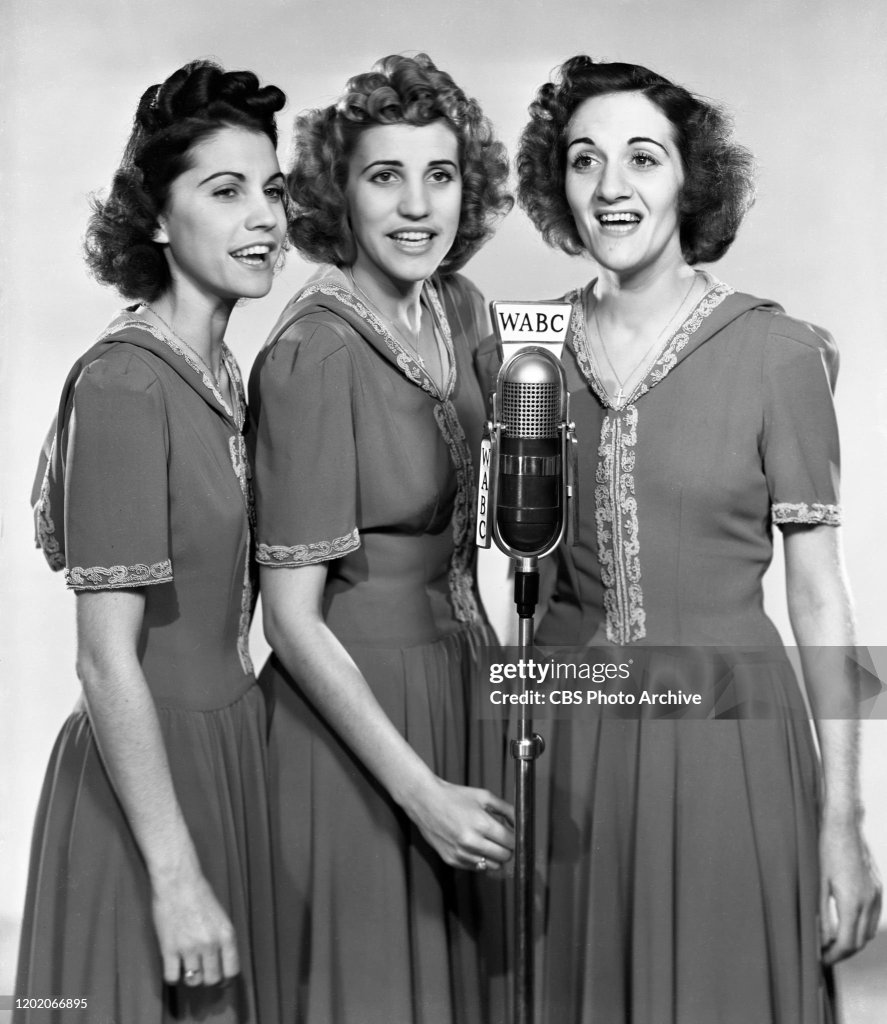
Dianne Lennon, American singer (Lennon Sisters), in Los Angeles, California.
Died:
Max Fiedler, 79, German composer.
Naval Construction:
The Royal Navy Bellona-class light cruiser HMS Black Prince (81) is laid down by Harland & Wolff (Belfast, Northern Ireland).
The Kriegsmarine (German Navy) Type VIIC U-boats U-552 and U-554 are laid down by Blohm & Voss, Hamburg (werk 528 and 530).
The U.S. Navy Cimarron-class oiler USS Platte (AO-24) is commissioned. Her first commander is Commander Pal Lamar Meadows, USN.
The Kriegsmarine (German Navy) Type 35 torpedo boat T1, lead ship of her class of 12, is commissioned.
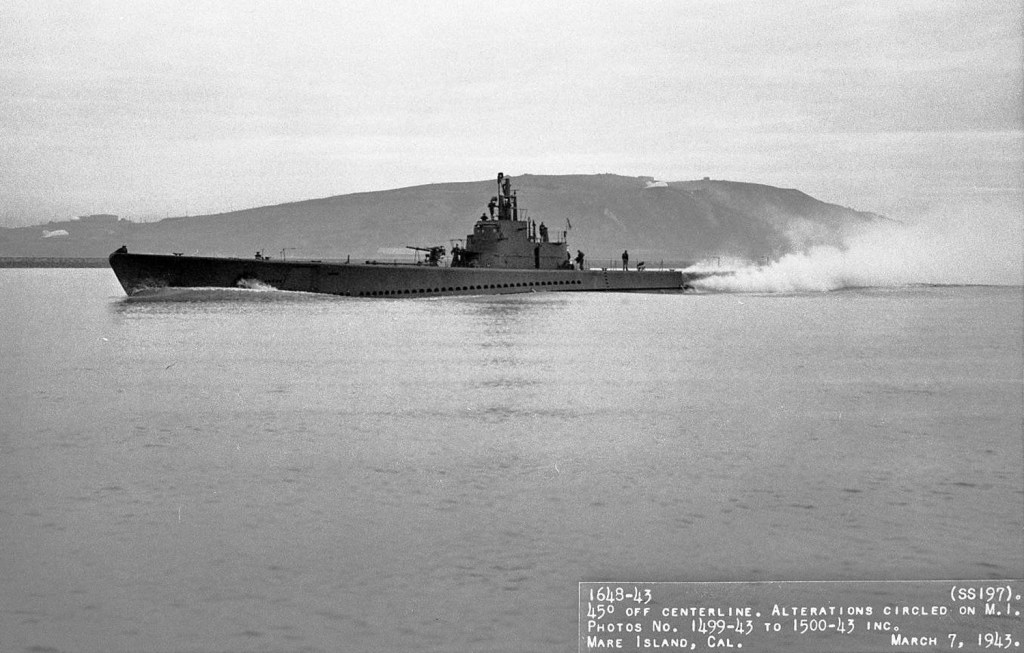
The U.S. Navy Sargo-class submarine USS Seawolf (SS-197) is commissioned. Her first commander is Frederick Burdett Warder, USN.
Asiatic-Pacific Campaign Medal with 13 battle stars for World War II service.
Seawolf ranked fourteenth in confirmed tonnage sunk (71,609 tons), the most for a Sargo-class submarine. She tied for seventh with the submarines USS Rasher (SS-269) and USS Trigger (SS-237) in confirmed ships sunk, according to the postwar accounting of the Joint Army–Navy Assessment Committee (JANAC).
Lost 3 October 1944.
USS Seawolf (Lt.Cdr.Albert Marion Bontier, USN) was most likely sunk by mistake in a safety zone for American submarines off Morotai in position 02º32’N, 129º18’E, by aircraft from the escort carrier USS Midway (CVE 63) and the destroyer escort USS Richard M. Rowell (DE 403). The American forces in the area had just been attacked by a Japanese submarine and Seawolf was apparently mistaken for it. There were no survivors.
She remains on Eternal Patrol.
https://www.hazegray.org/danfs/submar/ss197.txt
 History Diaries