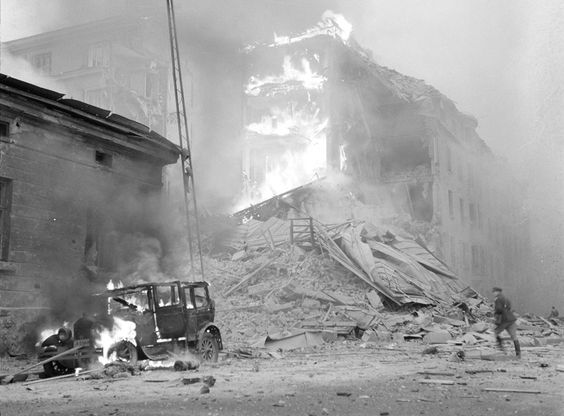
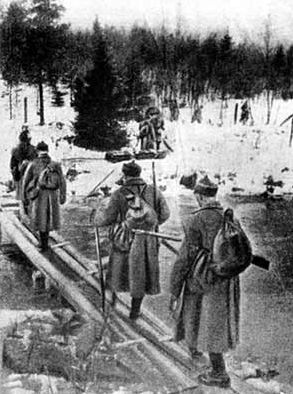
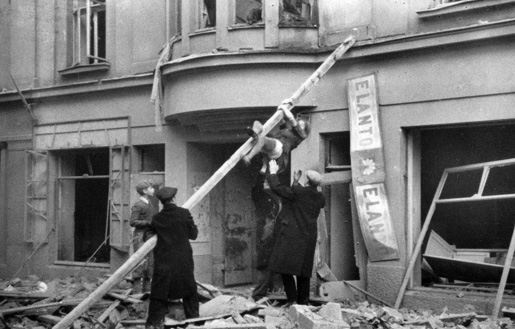
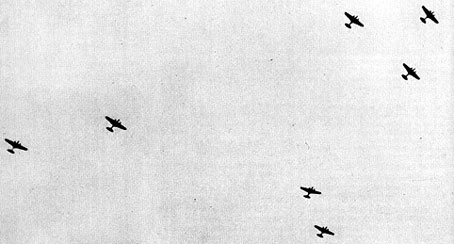
The Winter War began when the Soviet Union invaded Finland. 600,000 soldiers of the Red Army began to cross the Finnish border at 0650 hours and Soviet aircraft bombed Helsinki. Twenty-one Soviet divisions of the 7th, 8th, 9th and 14th Red Armies cross the border into Finland at 0800 hours after about one hour of artillery bombardment, starting what is to be known as the Winter War. Soviet planes are bombing Helsinki and other Finnish towns. Soviet warships are bombarding Finnish ports. Meanwhile, Soviet forces are slowly advancing into Finland, but meeting vigorous Finnish resistance. The arctic town of Petsamo in Finland is occupied by the Soviet 104th division on the first day of the war. Initially, the Red Army attacks along the 800 mile border from Ladoga to the Arctic Sea and initially is met with little resistance.
According to the terms of the Ribbentrop/Molotov Pact of 23 August 1939, Germany had given the Soviet Union carte blanche to do as it wished regarding Finland. On 30 November 1939, Stalin accordingly invades Finland following the sort of meticulous propaganda preparation, complete with manufactured “border incidents,” that most people associate only with Adolf Hitler and the Third Reich.
The attack violated several treaties between the two nations:
- The 1920 Treaty of Tartu;
- The 1932 Non-Aggression Pact, reaffirmed in 1934;
- The Covenant of the League of Nations, ratified by the Soviet Union in 1934.
Finnish forces are anchored on their main defensive line aka the Mannerheim Line, which covers the body of the country. The frontier was over 1,000 km (620 miles) in length, but chains of lakes and vast stretches of difficult terrain in the north effectively limited the axes of advance to the areas directly adjacent to Lake Ladoga. The main conflict occurs on the Karelian Isthmus to the north of St. Petersburg aka Leningrad. The conflict becomes known as the Winter War.
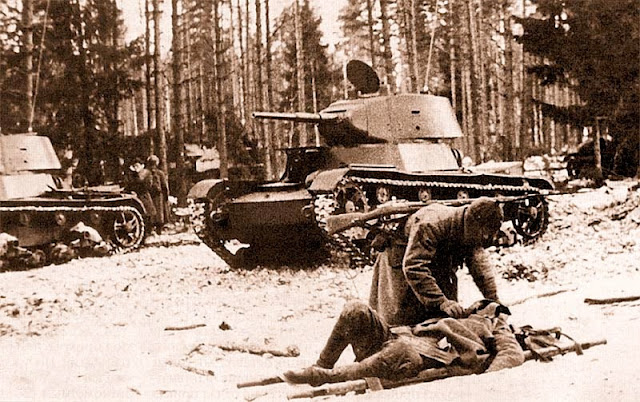
The Finnish army can only muster about 150,000 men in 9 divisions, with a tenth being formed. There are also a number of smaller independent units but their reserves of manpower are small. They have little heavy equipment and virtually no tanks. They are handicapped here in having relied on their limited domestic arms production since late 1938 in their attempt to confirm their neutrality. There is an ammunition shortage. The air force has about 100 obsolete planes. These weaknesses are partly offset by the training and moral of the Finnish troops. There are also some fairly strong fortifications in this area but the system is by no means comprehensive. Field Marshal Mannerheim (aged 72) is appointed “Defender of Finland” and Commander-in-Chief. At the start of the invasion, the Soviets employ 26 divisions (not all at full strength), in four armies. Soviet divisions are larger, with artillery components three times as strong as their Finnish equivalents and accompanied by more tanks than the entire Finnish army possesses. Independent tank and artillery units provide additional support. The Soviet 7th Army, the strongest with 12 divisions, attacks the 5 Finnish divisions defending the Karelian Isthmus. The Soviet 8th Army advances in the area immediately north of Lake Ladoga, the Soviet 9th Army attacks from Soviet Karelia in the direction of the head of the Gulf of Bothnia and the Soviet 14th Army moves out from Murmansk in the far north. The strength of the Soviet forces is greater than expected by the Finns. However, the Soviets are not well prepared for winter conditions and the coordination between their infantry and other arms is not at all good. Their preparations have been rushed. By the end of December, it will be clear that the attackers have been defeated in their initial assault.
Taken by surprise by the Soviet invasion despite the staged “provocations,” the current Finnish government resigns at midnight. Risto Ryti is named the new Prime Minister, and Väinö Tanner the new foreign minister. Marshal C.G.E. Mannerheim, a World War I hero and descendant of Germany by way of Sweden, already commander-in-chief, is given command of all Finnish Defence Forces and the honorary title “Defender of Finland.”
The Soviets announce that their action is in support of the Finnish People’s Government whose existence is now announced. This Soviet sponsored government is led by Otto Kuusinen, an exile, who has long been a member of the Comintern.
The Soviets are bombing Helsinki, as well as Petsamo, Luenhamari, and Parkina in the far north. Civilian auto and bus traffic on highways is being machine-gunned. Sixteen cities and towns are bombed during the first day of the war.
The Battle of Petsamo began. The Soviet Northern Fleet lands part of the 104th Rifle Division near Petsamo.
Soviet aircraft attack Russaro Island. Soviet cruiser Kirov and two destroyers bombard Russaro Island. Soviet naval forces land on Selskari Island.
The Finnish Coast Guard motorboat AV-45 was shelled and sunk in the Baltic off Lavansaari Island by the Soviet destroyer Gordy (Гордый). All four Coast Guardsmen on board were killed.
The Finnish coasters Jaameri and Syvri sink at Liinahamari, near Petsamo, after Soviet bombing.
The Finns begin evacuating Helsinki, Viipuri and other major cities.
In all parts of Scandinavia indignant comment in the press is denouncing the Russians’ attack on Finland. In Osio students marched in thousands under the Norwegian flag to the residence of the Finnish Minister, Vaino Vuolijoki, singing the Finnish and Norwegian national anthems.
Swedish volunteers begin signing up to help in Finland.
The Soviet invasion of Finland today met with universal condemnation in London in the press and even in the House of Commons, where before cheering members Prime Minister Chamberlain announced the government’s “deep regret” over this latest attack on a small, independent nation. Though the resentment is strong and sympathy for Finland is keen, it is generally recognized that there is little that Britain can do about it at present.
British volunteers begin signing up to help in Finland.
The Russian invasion of Finland, although it had been foreseen, has aroused the gravest misgiving and distrust and by the brutality of its methods has deeply shocked the Italian people.
German diplomatic quarters late tonight had apparently still not found a formula for making clear to the German people just why Russia was invading Finland.
On the Western Front today it was the same old story — bad weather, intermittent shelling and much patrolling. The visibility is so bad that for the first time since the war began the French air headquarters reported, “Activity: Nil.” In these conditions all reconnaissance work was left to ground patrols. On the outskirts of the Haardt forest the French ambushed an enemy patrol that lost four prisoners.
As Premier Edouard Daladier was speaking in the Chamber of Deputies today a Communist Deputy, Florimond Bonte, who had been in hiding since an order was issued for his arrest, along with other Communists, entered and took his usual seat. He was ejected and arrested.
After an all-day debate in which both sides held stubbornly to their views, the Chamber of Deputies tonight granted to Premier Edouard Daladier’s government extension of its extraorinary powers.
Statistics indicate 120,000 persons are unemployed in Germany. This compares to about 5 million unemployed in 1932, the year before Hitler took power.
Fifty Yugoslavian Communist students were arrested and Belgrade University was ordered closed for a month today after a riot between 1,000 Nationalist and Communist students. Many students were injured. The government was reported contemplating action against Communists as well as extreme Nationalists as a result of student disorders last night and today in Belgrade, Zagreb and other cities. Communist students at Belgrade University broke up a pro-French meeting last night at the university in honor of the French Admiral Guepratte, who aided the Serbian Army in North Africa, where it had retreated during the World War. Today’s riot broke out after Communist students had injured a Nationalist student severely.
Two RAF fighters chase off a Luftwaffe reconnaissance aircraft north of the Firth of Forth.
The German torpedo boat V-704 struck a mine in the Baltic Sea off Trelleborg, Skåne, Sweden and was severely damaged. She was beached but declared a total loss.
The British cargo ship Sheaf Crest struck a mine and sank in the North Sea off Margate, Kent (51°32′N 1°26′E) with the loss of one of her 30 crew. 12 survivors were rescued by the Polish destroyer ORP Błyskawica.
The Norwegian tanker Realf struck a mine and was damaged in the North Sea south east of Flamborough Head, Yorkshire (53°55′N 0°22′E) with the loss of one of the 43 people on board. Survivors were rescued by Santa Gata (Italy). Realf sank the next day.
German vessel Widder is converted into a merchant raider.
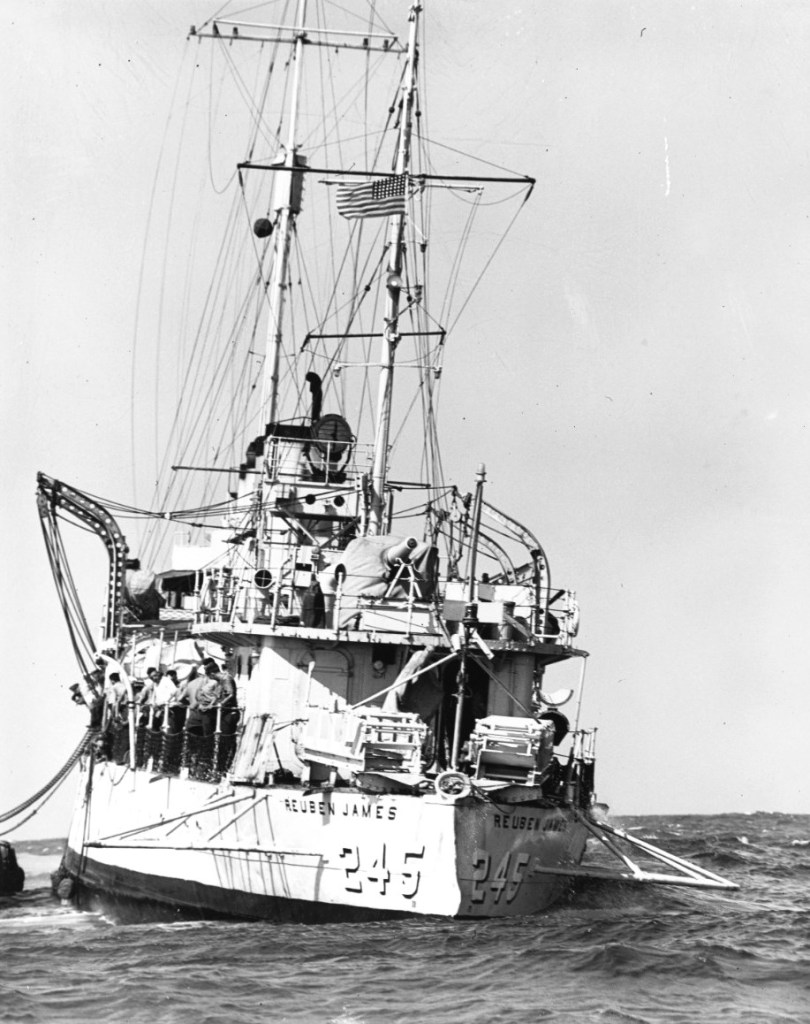
The U.S. Navy destroyer USS Reuben James (DD-245) is damaged by grounding, at Lobos Cay, Cuba.
U.S. freighter Extavia, with cargo destined for Istanbul, Turkey, and the Piraeus, Greece, is detained at Gibraltar by British authorities.
For the month of November 1939, German U-boats sank 29 Allied ships (77,799 tons) and damaged 1 ship (11,500 tons).
Total shipping losses for the month of November 1939 are given as:
- 49 Allied Ships;
- 173,563 tons;
plus 1 ship of 706 in the Indian Ocean.
One U-boat was sunk, the U-35.
The War at Sea, Thursday, 30 November 1939 (naval-history.net)
The cruiser line searching for the reported German ships off Norway, were to be in 66 10N at 0800, steer west until 1300 and then head south. During this time (1) battleship NELSON, light cruiser AURORA and nine destroyers were 100 miles to the SW of the western end of the cruiser line, (2) battleship RODNEY, and destroyers ASHANTI and GURKHA were to the west of Fair Isle Channel, (3) battleship WARSPITE to the west of the cruiser line, and (4) battlecruiser HOOD, the French DUNKERQUE and destroyers SOMALI, PUNJABI and MASHONA 100 miles west of the Faroes.
Light cruiser CALEDON departed Scapa Flow for the Tyne and arrived on 1 December for docking. After repairs, she left on the 19th and reached Plymouth on the 21st.
Armed merchant cruisers ANDANIA, AURANIA, SCOTSTOUN and WORCESTERSHIRE departed the Clyde on Northern Patrol duties.
Destroyer FORTUNE attacked a submarine contact in 59N, 4W.
Admiral Forbes turned south with his fleet on the 30th and on 1 December ordered the resumption of normal shipping movements.
Destroyer NUBIAN departed Portsmouth after repairs and following kite balloon trials, which were conducted on the 28th/29th. She rejoined the Main Fleet at Loch Ewe.
Convoy OB.44 departed Liverpool, escorted by destroyers VERSATILE and WITHERINGTON until 3 December, when they detached to convoy HXF.10.
Convoy HN.3 of 11 British ships, one Finnish, and two Estonian departed Bergen escorted by destroyers ILEX, ICARUS, ESKIMO and MATABELE. Heavy cruiser SUFFOLK, which left Scapa Flow on the 30th and light cruiser SOUTHAMPTON provided close cover. Later when SUFFOLK was relieved for refueling, light cruiser GLASGOW took her place. The convoy arrived safely at Methil on 4 December. Before then, on the 2nd, destroyers KANDAHAR and ISIS departed Scapa Flow to escort the four ships of the west coast portion of the convoy.
Convoy FN.45 departed Southend, escorted by destroyer WHITLEY and sloop STORK, and arrived at the Tyne on 1 December.
Convoy FS.45 departed the Tyne, escorted by sloops GRIMSBY and WESTON, and arrived at Southend on 1 December.
Steamer ASTRONOMER (8401grt) arrived at Rosyth from the Tyne escorted by destroyer WALLACE.
Dutch steamer BEVERWIJK (2948grt) was damaged by grounding off Terschelling in the declared mine area.
German auxiliary patrol boat Vp.704 (trawler CLAUS WISCH, 256grt) was badly damaged in a defensive minefield off Trelleborg and run aground, a total loss.
Finnish motor vessels JAAMERI (299grt) and SYVARI (237grt) were lost at Liinahamari.
Convoy HG.9, which departed Port Said on the 19th, left Gibraltar with 53 ships, escorted by destroyers VORTIGERN and WISHART, and also the French CHACAL and MISTRAL from the 30th November until they arrived at Brest on 8 December. Trawler VULCAN of the 1st Motor Torpedo Boat Flotilla proceeded to England with the convoy, which arrived at Liverpool, also on the 8th.
At the end of November, the following Royal Navy destroyers were under repair – ACHERON at Portsmouth repairing, ACTIVE at Gibraltar repairing, ARROW at Portsmouth with defects, BRAZEN at Falmouth refitting, BROKE at Plymouth refitting, COSSACK at Leith repairing, DARING at Malta refitting, DIAMOND at Singapore repairing, ENCOUNTER at Plymouth with defects, FAME at Clyde repairing, FORESIGHT at Clyde repairing, FORTUNE at Liverpool repairing, FOXHOUND at Greenock repairing, GARLAND at Malta repairing, GRENADE at Falmouth repairing, GRENVILLE at Devonport repairing, GRIFFIN at Woolwich repairing, INTREPID at Chatham refitting, IVANHOE at Chatham refitting, JAVELIN at Middlesbrough repairing, JERVIS at Grimsby refitting, KELLY at Tyne repairing, MOHAWK at Newcastle repairing, SHIKARI at Plymouth refitting, SIKH at Malta with turbine defects, VANQUISHER at Plymouth repairing, VENETIA at Liverpool repairing, VISCOUNT at Plymouth with defects, VIVACIOUS at Plymouth boiler cleaning, WALPOLE at Liverpool with defects, WESSEX at Cardiff refitting, WHIRLWIND at Liverpool with defects, WIVERN at Sheerness repairing.
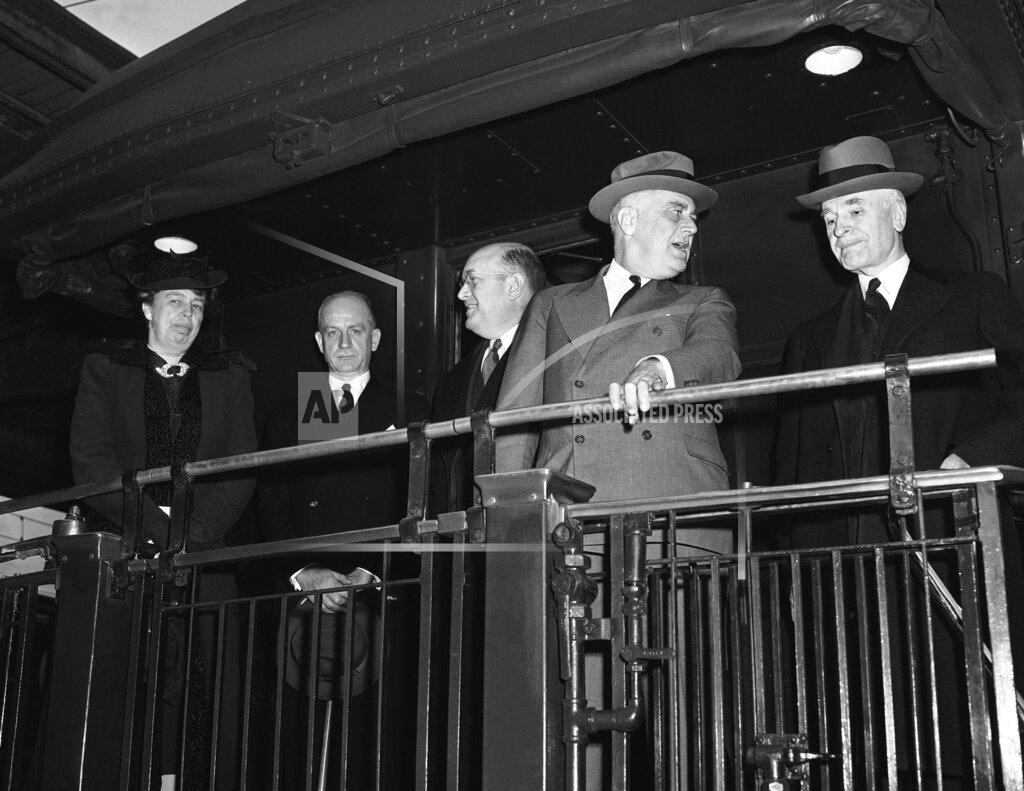
Mrs. Franklin D. Roosevelt attended today’s session of the House Committee on Un-American Activities to hear leaders of the American Youth Congress, of which she is an active sponsor, deny previous testimony that it was a Communist front, and demand that the committee be disbanded and cease using “witch-hunting methods.” She sat a silent and intent auditor during two hours of exchanges between committee members and the three young men who testified jointly as one witness. As a demonstration of her interest in the witnesses she entertained them at a luncheon at the White House. She had accompanied them on a train from New York City last night.
Mrs. Roosevelt’s action was without precedent, and it was the more pointed in view of charges by Representative Dies of Texas, chairman of the committee, that the White House has given his committee no assistance. In addition, the President’s wife declined an invitation to accept a seat of honor at the committee table. For its own part, the committee took no notice of Mrs. Roosevelt after an opening courteous gesture, and waited until 4 PM before calling the witnesses in which she was interested. It occupied the earlier hours in morning and afternoon sessions with testimony first by Leon P. Smith, assistant dean of the University of Chicago, and an exhaustive presentation by William O’Dell Nowell of Detroit, Black former Communist, who gave a long recital of Communist infiltration methods as he observed them prior to leaving the Communist party in 1936.
At the end of the morning session Mrs. Roosevelt told reporters: “I was disappointed. I thought I would hear something new.” Mrs. Roosevelt became the first wife of a President to attend a meeting of a Congressional investigating committee when she took Miss Ishbel MacDonald in 1933 to hear Secretary Perkins testify on the thirty-hour-week bill before the Senate Committee on Education and Labor. Her second attendance at a committee session came today.
Eight leaders of two union locals of the Retail Clerks International Protective Association, an A.F. of L. affiliate at 1,650 Broadway, comprising 5,000 employes of fruit and vegetable stores in the metropolitan district, were indicted yesterday by the New York County grand jury.
While thousands of employee of the Chrysler corporation returned to work today after the longest tie-up in the history of the automobile industry, the Congress of Industrial Organizations announced plans for an organization drive among aircraft workers.
A picture of Louis (Lepke) Buchalter as a cautious ‘big shot” who stayed out of narcotics smuggling until convinced it was worth while, then demanded 60 per cent of the profits and compromised on 50, was drawn in Federal Court yesterday as Assistant United States Attorney Joseph P. Martin opened the government’s case against the mobster and three other men.
Despite some change in sentiment since last June as a result of the business upturn, a large percentage of voters believe that a Republican President would bring greater prosperity to business, according to the results of a survey made public yesterday by the American Institute of Public Opinion.
Sentiment in the Republican party favors the holding of the party convention after the Democrats select their 1940 standard bearer, Senator McNary, minority Senate leader, said today.
Pennsylvania’s alien registration law was declared unconstitutional by the Federal District Court in Scranton today, less than twenty-four hours before it was to have become effective.
Federal agencies came forward today with jobs and food to ease a serious relief situation in Cuyahoga County (Cleveland), Ohio.
New Jersey will no longer recognize new common law marriages, a measure taken to curb the spread of syphilis. The state will continue to recognize the legality of those marriages that occurred before December 1, 1939.
Promising “important changes” in the exhibit it plans to sponsor in 1940, the Ford Motor Company signed yesterday at its plant in Dearborn, Michigan, a contract for participiation in the New York World’s Fair next season.
The U.S. Army limits the use of thermite bombs, as experts explain the incendiary problems. The Army Air Corps prefers to use high explosives.
Members of a Congressional committee which sought information about reported defects in the navy’s newest destroyers said today that naval experts told them remedial changes now being made would cost $600,000 to $1,000,000.
Paul Osborn’s “Mornings at 7” premieres in NYC.
College Football Scores:
Alabama 39, @ Vanderbilt 0
Arizona 6, Montana 0
Arkansas 23, @ Tulsa 0
Brown 13, Rutgers 0
Colorado 27, Denver 17
Florida 7, @ Auburn 7
New Mexico 21, Colorado State 19
(16) North Carolina 19, Virginia 0
San Jose State 12, Drake 0
Syracuse 10, @ Maryland 7
(4) Tennessee 19, @ Kentucky 0
(1) Texas A&M 20, Texas 0
Texas Tech 13, @ Loyola (LA) 0
(13) UCLA 24, Washington State 7
Virginia Military Institute 19, N Virginia Tech 7
Wake Forest 46, N Davidson 7
Wichita State 7, @ Washburn 6
The Canadian Federal Government is understood to be contemplating action against the Communist party in the country, or against some of its leaders at least.
The Royal Canadian Navy tug HMCS Bally is assigned to Halifax, Nova Scotia.
Sir Stafford Cripps leaves for an extended diplomatic tour of India, China, and the Soviet Union.
The loss of Nanning is the most serious reverse the Chinese have suffered since the fall of Hankow, as far as the immediate effects are concerned. By taking Nanning the Japanese not only placed themselves across China’s most important highway connection with the outside world, the Kwangsi-Indo-China road, but have also blocked the Yu River, another valuable route for movement of cargoes to and from Indo-China. Over the Kwangsi highway through Nanning and by the Yu River a minimum of 34 percent of China’s imports and exports have moved in recent months, transport circles here estimate.
At Nanning the Japanese also cut the line of the Kweilin-Indo China railway, upon which construction had been rushed last year with the aim of opening it to traffic in 1940. The loss of Nanning will cause an immediate critical shortage in China’s supply of gasoline. More than half of the country already has acutely inadequate stocks. Fresh supplies have been coming in by the Nanning highway and the Yu River.
Even now hundreds of trucks and cars stand idle because of lack of gasoline, especially in the vast territory north of Chungking. Increased stoppage of vehicles is certain in the next few weeks, since it is estimated the gasoline supply in the country is sufficient for only one month, even at the present restricted rate of consumption. In addition to stopping Southeast Kwangsi highway and waterway traffic through their capture of Nanning, the Japanese will be able now more effectively to interfere with the movement of cargoes on other routes in Southwest China from their air base at Nanning. Kunming, the terminus of the Indo-China Railway, will be within easy bombing range, as well as all of the Yunnan-Kweichow-Kwangsi road.
One serious result of the loss of Nanning is the interference with the export of wood oil, much of which was being trucked out of the country through Nanning. Practically the entire production of this product for the next few years must be sent to the United States to retire the $25,000,000 credit granted to China last year. Their operation directed by American experts, American trucks obtained with the credit have been transporting thousands of tons of wood oil daily to Indo-China during the last few weeks. It is believed in Chungking that the major Japanese aim in striking at Nanning at this time was to halt this transport at its height. Much of China’s 1939 production of wood oil is still within the country. Its export to the United States will now be most difficult.
However, the Chinese hope within a month or two to counteract to a large extent the difficulties created. by the loss of Nanning. A new highway, west of Kwangsi, 100 miles beyond the Nanning route, is completed to Indo-China. When the twenty-mile section within Indo-China is finished, it can take care of as much traffic as the old road, probably by next January. In addition, plans are being worked out for development of junk traffic on the Red River, which links Yunnan with IndoChina, paralleling the route of the Yunnan Railway. It is believed it will be possible also to utilize other smaller Indo-China and Yunnan streams
The manner in which the British blockade on German exports is to be applied is all important, in the view of Japanese officials, and the government intends to observe the blockade in action before deciding its next step. The governing factor in the situation will be British treatment of vital Japanese imports from Germany. Negotiations on this point are proceeding in London between Ambassador Mamoru Shigemitsu and Viscount Halifax, British Foreign Secretary.
The immediate cause of Japan’s protests against the blockade of German exports is a quantity of German patent machinery for extraction of oil from coal in Manchukuo. This has already been paid for. The Japanese Army and Navy, as well as heavy industry representatives now engaged in constructing the “new order” in Asia, are extremely interested in the safe and speedy arrival of this machinery, and Ambassador Shigemitsu had it in mind when he obtained a promise that Britain would not take action against German exports. The Japanese now complain that the promise was broken, but the British reply that it was made before Germany began the new-style mine warfare.
Sir Robert Leslie Craigie, the British Ambassador to Japan, today gave a full explanation of the British Order in Council to Foreign Minister Kichisaburo Nomura, who replied that Japan reserved all rights as a neutral. The text of the order is now being studied in connection with the British Government’s assurances that careful con) sideration will be given neutral rights.
Dow Jones Industrial Average: 145.69 (-1.20)
Born:
Chandra Bahadur Dangi, Nepali weaver and world’s shortest man (54.6 cm, 21.5 inches), in Salyan, Nepal (d. 2015).
Robyn Hilton, American film and television actress and model (“Blazing Saddles”), in Twin Falls, Idaho.
Died:
Max Skladanowsky, 76, German inventor and filmmaker.
Naval Construction:
The Royal Navy Flower-class corvette HMS Cyclamen (K 83) is laid down by J. Lewis & Sons Ltd. (Aberdeen, Scotland).
The Royal Navy Flower-class corvette HMS Arbutus (K 86) is laid down by Blyth Shipbuilding & Drydock Co. Ltd. (Blyth, U.K.); completed by Clark.
The Kriegsmarine (German Navy) Type 1936A destroyer (flotilla leader) Z28 is laid down by AG Weser (Deschimag), Bremen (werk 962).
The Royal Navy light cruiser HMS Bellona (63), lead ship of her class of 5, is laid down by the Fairfield Shipbuilding & Engineering Co. (Govan, Scotland).
The Royal Navy Fiji-class (Crown Colony-class) light cruiser HMS Bermuda (52) is laid down by the John Brown Shipbuilding & Engineering Company Ltd. (Clydebank, Scotland).
The Вое́нно-морско́й флот СССР (ВМФ) (Soviet Navy) Project 69 (Kronshtadt-class) heavy cruiser Kronshtadt (Кронштадт) is laid down by the Marti Yard (Leningrad, U.S.S.R.) / Yard 194. She is never completed.
The NYK Lines (Nippon Yusen Kaisha) ocean liner Izumo Maru (出雲丸) is laid down by Kawasaki Heavy Industries, Kobe, Japan. She is converted in 1941-42 to the Nihon Kaigun (Imperial Japanese Navy) aircraft carrier HIJMS Hiyō (飛鷹, “Flying Hawk”).
The Royal Navy Bar-class boom defense vessel HMS Barndale (Z 92) is launched by Lobnitz & Co. Ltd. (Renfrew, Scotland).
The Nihon Kaigun (Imperial Japanese Navy) seaplane tender HIJMS Nisshin (日進), sole ship of her class, is launched by the Kure Naval Arsenal, Kure, Hiroshima Prefecture, Japan.
The Marine Nationale (French Navy) Élan-class aviso dragueur de mines (minesweeping sloop) La Gracieuse is launched by Ateliers et Chantiers de Provence, Port-de-Bouc, France.
The Royal Navy armed merchant cruiser HMS Ranpura (F 93) is commissioned. Her first commanding officer is Captain (retired) Clarence Walter Eyre Trelawny, RN.
 History Diaries