South Vietnamese Government forces inflicted losses on the Việt Cộng around Saigon and far to the north in actions reported today. In fighting near the capital, Government troops also stood off a charge by seven wild buffaloes. A surprise helicopter‐borne swoop 365 miles north of Saigon resulted in 34 guerrillas killed and 30 suspected guerrillas captured. Only 18 miles from Saigon, the South Vietnamese repelled waves of yelling Việt Cộng, killing 47. Four Americans were reported wounded in this action, three of them returning to duty after treatment. A fifth American was wounded by small‐arms fire while on convoy duty northeast of Saigon. Government losses from the Việt Cộng and the buffaloes near Saigon were placed at six killed and 25 wounded, including one man gored as the buffaloes closed with scrambling infantrymen. Two bulls were killed.
The Government of South Vietnam has endured a turbulent challenge, but apparently only at the cost of prodding the opposition into new militancy. This is the conclusion the observer draws after a confused week of rioting in the streets of Saigon. Eight days of discord — while United States policymakers review the Vietnam situation in Washington — serve as a discomforting reminder that even a minimum of political stability — the immediate goal of American diplomats — is still remote. The riots, which started a week, ago yesterday and resulted in a decree of martial law, forced the Buddhists into open opposition to the Government of Premier Trần Văn Hương. Yet there is evidence that the uprisings caught the Buddhists off guard and their suppression left their highest councils confused.
A telegram went out to Buddhist representatives around the country today. “Buddhism is being slandered by the government, Buddhists repressed and the church provoked and infiltrated,” said the telegram from the senior monks. “Wait calmly for orders.”
Premier Hương seemed to realize that his days would be numbered if the Buddhists resolved their differences over how to achieve their goal — a government more amenable to their influence. “If this government has only one hour left, we will not fail to carry on our mission in that hour,’’ Premier Hương said in a radio speech last night. He defended again his. orders to prevent political demonstrations. All evidence indicates the Buddhist leaders did not instigate the demonstrations, but the police and military actions against the mobs gave militant Buddhists an opportunity to denounce the civilian regime.
In Laos, infiltration by pro‐Communist groups forced the evacuation over the weekend of the Grove Jones company’s road construction camp, according to military sources. The camp is 100 miles north of the Mekong River town of Thakhek. A Pathet Lao force of about 150 men had advanced north from the village of Khene to within 10 miles of the camp. Grove Jones is a private American company under contract to the United States Government. On the political front, the neutralist Premier, Prince Souvanna Phouma, has written his half‐brother, Prince Souphanouvong, chief of the Pathet Lao, asking him to name a meeting site in Laos for a new discussion of the country’s problems. The two leaders met unsuccessfully in Paris during the summer, along with representatives of the Laotian rightists. The neutralists and rightists have joined in a coalition regime, which until last year also ineluded the pro‐Communist faction.
About 200 miles north of Stanleyville, a column of Congolese troops, spearheaded by 30 Belgian mercenaries, captured Titule, liberating 40 Europeans, including an American family. Government forces also recaptured Bunia on the eastern frontier after heavy fighting, but found all the Europeans had been carried off as hostages. The Americans and Belgians found at Titule had been beaten and threatened with execution. Mrs. F. J. Gunningham of Yakima, Washington, and her two children, John, 3 years old, and Elizabeth, 1, were flown to Leopoldville. Mr. Gunningham, a Briton with the Heart of Africa Mission, said the beatings took place in jail and in the public square, where all the hostages were forced to remove their clothing.
Reports indicated that Kindu had almost certainly fallen back into rebel hands. Kindu was the second largest city under rebel control.
Pravda, the Communist party newspaper, asserted today that “indignant protests” throughout the world and the “firm attitude” of Communist countries had forced Belgium to withdraw her paratroopers from the Congo. The commentary came two days after African, Asian and Latin‐American students here were permitted by the Soviet police to go on a rampage during which they invaded the Congolese Embassy and stoned the United States, Belgian and British Embassies. Pravda wrote that a number of American and Belgian military personnel and “thousands, of cut‐throat mercenaries” remained in the Congo.
An emergency meeting of the Security Council was requested tonight by African states opposed to the recent intervention by Belgium and the United States to rescue hostages held by Congolese rebels. Supporters of the request said they hoped the Council would meet Wednesday. The formal request was signed by 14 African states. Conspicuously missing were the names of other African states — notably the Congo, which authorized the. intervention, and Nigeria and Liberia.
The states that did not take part in the request contended that the African group had agreed to base its action on the decisions of a nine‐member commission of the Organization of African Unity that met last week in Nairobi. This group called for a conference of African heads of government on Dec. 18, but did not recommend a United Nations meeting at this time. Both the United States and Belgium contend that the intervention was a purely humanitarian move designed to rescue innocent civilians.
The landing of Belgian paratroopers in United States planes was attacked by a number of African states. The Soviet Union called, the intervention “an act of armed aggression” with political significance. African states opposed to Premier Moïse Tshombe have charged that the intervention served to bolster his regime and to crush the rebel opposition. Their charges were directed at Britain as well as at the United States and Belgium. The Belgian paratroopers went to the Congo from Ascencion Island, a British possession.
The Administration believes that the presence in the Congo of an outside military force, preferably African troops, is urgently needed if the country is to achieve stability. This conviction, which developed some time ago, was reported tonight to have entered into discussions arising from the United States‐Belgian operation to rescue hostages from the Congolese rebels last week. The Administration is said to believe, as a consequence of the moves last week, that the Government of Premier Moïse Tshombe is not able to control rebellions, even using white mercenary troops, United States planes and Cuban exile pilots and military instructors.
The view in Washington is that the Tshombe forces can, at best, hold some key towns, but not the countryside. There are officials here who can foresee the possibility of a civil war in the Congo like that in Vietnam. Reports that the rebels may be on the verge of reconquering Stanleyville and have apparently retaken some other towns that the Tshombe forces had recently captured have strengthened the impression that there is under the present circumstances no military solujtion possible in the Congo.
The Soviet Union refused today to agree to a proposal by the Secretary General, U Thant, under which the General Assembly would postpone a confrontation between the United States and the Soviet Union over unpaid Soviet assessments. Mr. Thant was asked whether the opening of the Assembly would be postponed or whether it would meet for only a few minutes, then recess to permit further negotiations. The Secretary General replied that “anything is possible.” A statement issued by the Soviet delegation said it believed that “the General Assembly should start and continue its work in accordance with normal procedure and that all important matters on its agenda should be deliberated in the usual manner.”
Adlai E. Stevenson, the United States representative, ,told Latin‐American delegates toinight that he expected to have a talk with Andrei A. Gromyko, the Soviet Foreign Minister, before the Assembly begins its 1964 session tomorrow at 3 PM. Mr. Stevenson indicated that Mr. Gromyko’s talk late this afternoon with Mr. Thant had given some ground for encouragement. The United States representative said that if the talk with Mr. Gromyko did not produce results it might be necessary to postpone the opening of the Assembly for 24 hours. Such a decision could be made by Mr. Thant or by the current Assembly President, Dr. Carlos Sosa Rodriguez, on a member’s request. Other sources said that in his talks with Mr. Thant and with Secretary of State Dean Rusk, with whom he had lunch, Mr. Gromyko had indicated that the Soviet Union might agree without a vote to the election of Alex Quaison‐Sackey of Ghana, sole candidate for President of the Assembly.
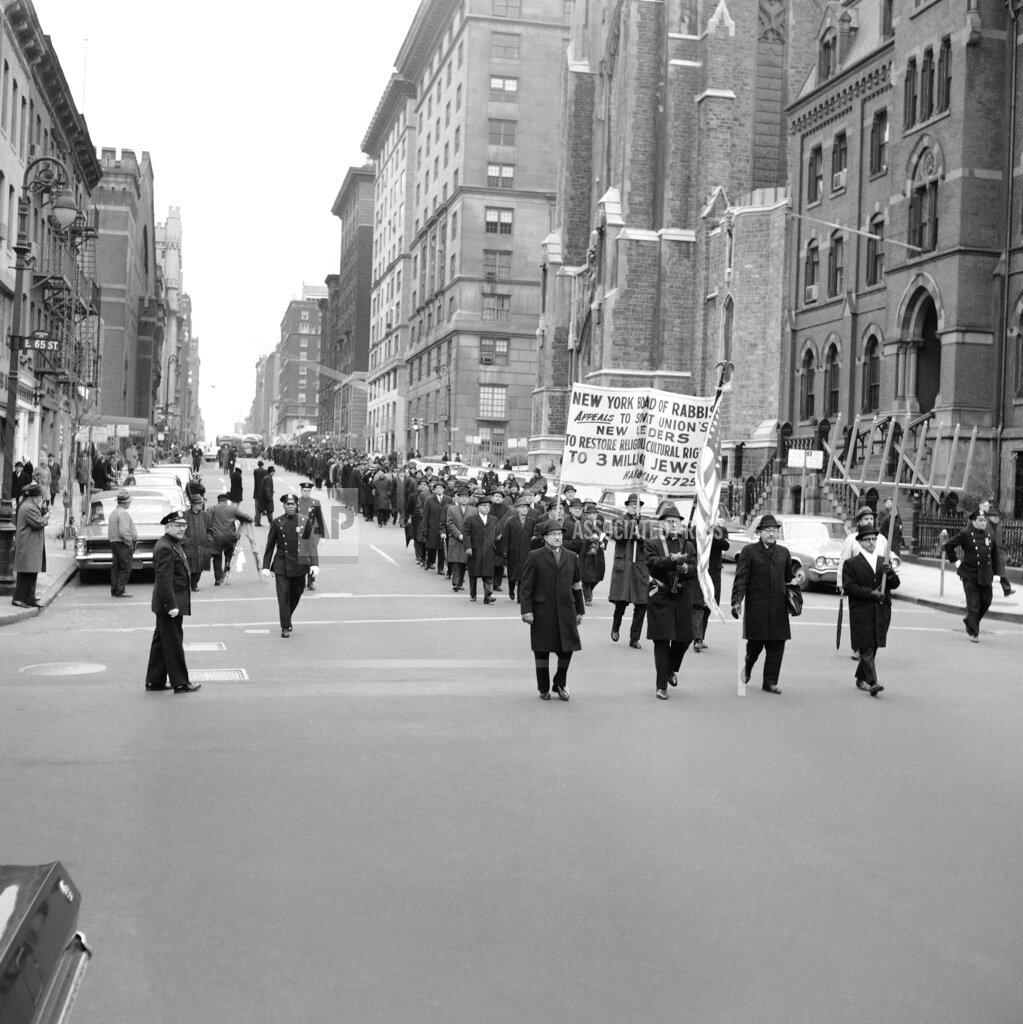
Almost 300 rabbis marched silently through mid‐Manhattan yesterday in a protest against the Soviet Union’s restrictions on Jews. Afterward they heard Governor Rockefeller, Senator-elect Robert F. Kennedy and Senator Jacob K. Javits call for continuing pressure on the Soviet Union to end such discrimination. The marchers are members of the New York Board of Rabbis, which encompasses Orthodox, Conservative and Reform rabbis. They marched from Lexington Avenue and 67th Street in a slow procession to a rally at the Carnegie Endowment for International Peace Building at 345 East 46th Street near the United Nations. Many of them wore blue armbands. A rabbi explained that blue was one of Irael’s national colors. Two banners called on the new Russians leaders to end religious and cultural discrimination against the 3,000,000 Jews in the Soviet Union.
At the Carnegie Endowment, Governor Rockefeller attacked the Soviet Union’s “heartless, godless, ruthless disregard” of the Judeo‐Ghristian heritage. He noted that the Russians had barred the use of Jewish cemeteries and had closed rabbinical seminaries. Senator‐elect Kennedy said the free world “must continue to make clear that Soviet relations with the West can never be normal as long as millions of persons are denied the right to worship their way.”
The French government carried its campaign against the proposal for the nuclear fleet into the Western European Union today. Foreign Minister Maurice Couve de Muryille told the opening session of the union’s assembly that in thinking of defense question, “it is vain to seek solutions founded on artifice and whose needless complications are not compatible with human nature.” The Foreign Minister did not mention the mixed-manned force; he warned the assembly against a “doctrinaire view” of international situations. Other French criticisms have depicted the force, as an impractical, doctrinaire proposal.
The Western European Union, which consists of Britain, Belgium, France, West Germany, Italy Luxembourg and the Netherlands, is the latest international group to hear of France’s objections to the mixed-manned force. Two weeks ago, members of the parliaments of the nations in the North Atlantic Treaty Organization were told that no power should “impose” and’ “ready-made solutions” on other members. Today, the Western European Union’s parliamentary delegates, who are celebrating the 10th anniversary of the union’s establishment, heard the French view. Some delegates were reported to feel some resentment that Mr. Couve de Murville had used the meeting to “exploit a quarrel between the French and the Americans.”
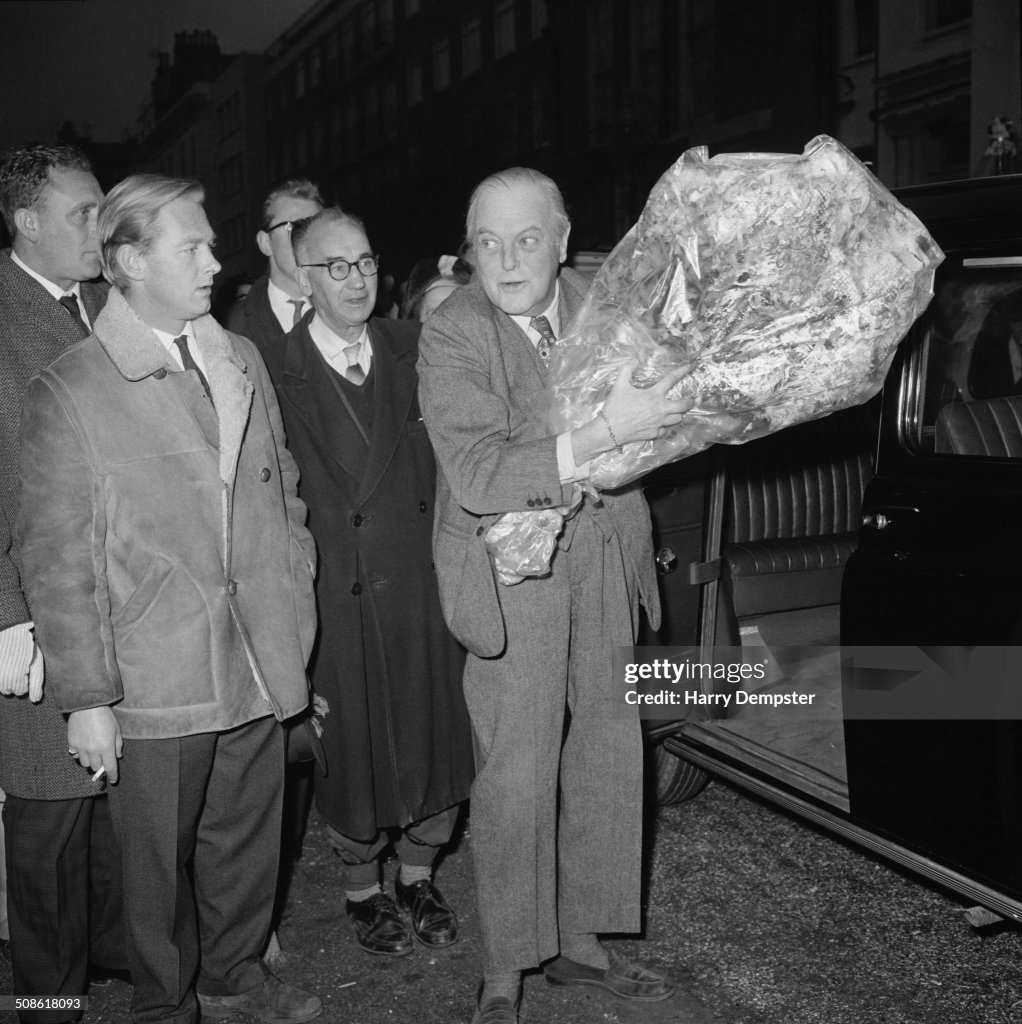
Pope Paul VI gave his gold, silver and bejeweled papal tiara to the United States for permanent display “in gratitude for all that Americans have done for the poor of the world”. Cardinal Francis Spellman, the Roman Catholic Archbishop of New York, announced the gift and displayed the crown in a meeting with fellow clergymen at a hotel in New York City.
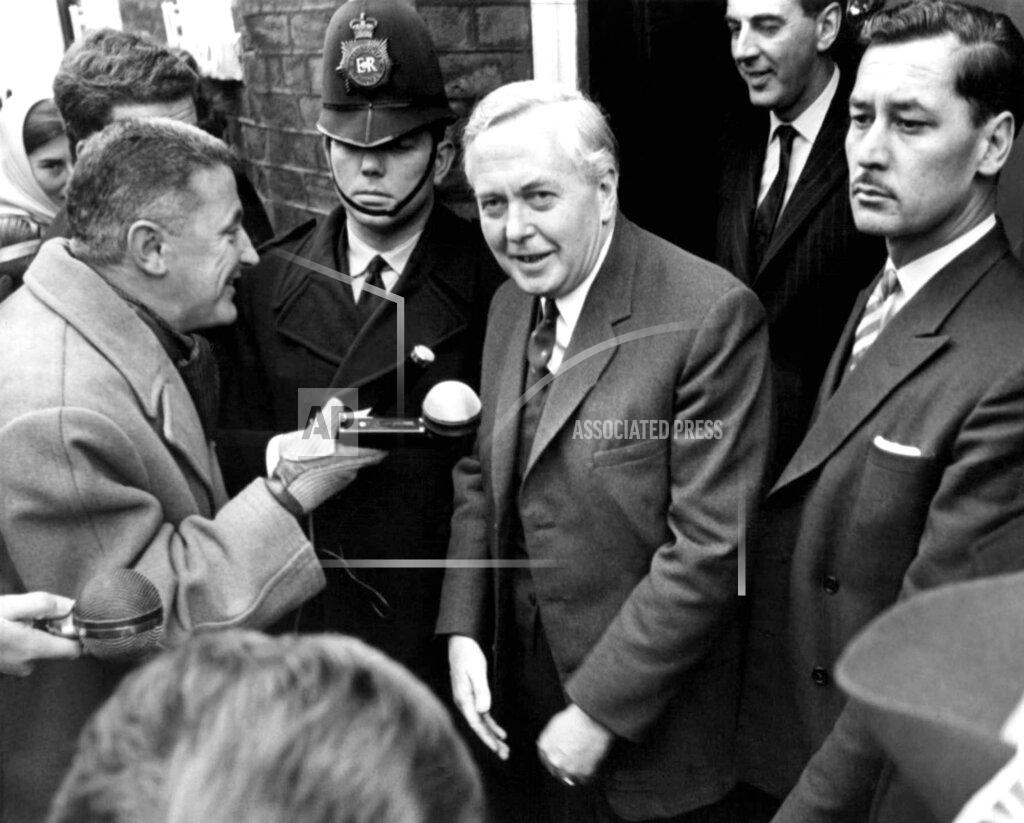
Sir Winston Churchill celebrated his 90th and last birthday. The day before the celebration, hundreds of well-wishers stood outside his Hyde Park home in London and sang “Happy Birthday to You” and “For He’s a Jolly Good Fellow”. Last year he received 30,000 letters on his birthday. The post office said that figure could be doubled this year. Sir Winston, now frail and easily tired, remained indoors. He celebrated at a dinner with members of his immediate family and some close friends. One of Sir Winston’s few visitors during the day was Prime Minister Harold Wilson, who conveyed the congratulations of the Government and the House of Commons. Mr. Wilson said the former Prime Minister “seemed very well.”
Tonight he issued a message that read: “I am most grateful to all those who have remembered me on my 90th birthday. The number of messages I have received from all over the world is, it seems, greater than ever before and I hope that those who have had the kindness to write to me will understand it is not possible for me to reply to so many. Their thoughts have given me the greatest pleasure.”
The West German Government indicated today it would yield to pressure from its Common Market partners and lower its high grain price. However, the new German grain prices probably will not be so low, as the levels sought by France and other members of the community. Following a meeting of Chancellor Ludwig Erhard with members of his Cabinet, leaders of the Government coalition and representatives of the Farmers Union, the Government issued a statement saying that a plan to bring German grain prices into equilibrium with those of the other Common Market nations would be presented to Parliament this week. It added that Chancellor Erhard would ask Parliament to compensate German farmers for any losses they might suffer.
A White House spokesman denied today a report that President Johnson was searching for a replacement for J. Edgar Hoover, Director of the Federal Bureau of Investigation. The President “never entertained any such idea,” George E. Reedy, the Presidential press secretary, said. He added that Mr. Johnson had “never heard of such a plan.” Newsweek magazine said in its current issue, dated Dec. 7, that Mr. Johnson was a “disenchanted fan” of Mr. Hoover’s and that he had decided “that he must find a new chief of the FBI.”
“The search is on,” the magazine said. Mr. Reedy said: “It’s unfortunate that this story wasn’t checked out prior to publication.” This afternoon Newsweek’s editor, Osborn Elliott, said in New York that the article “came from a most reliable source within the White House, and Newsweek stands by the statement.” At an afternoon news conference, Mr. Reedy did not clarify whether Mr. Hoover had been given an assurance that he could remain as FBI director as long as Mr. Johnson was president. Mr. Hoover made such a statement in his news conference November 18.
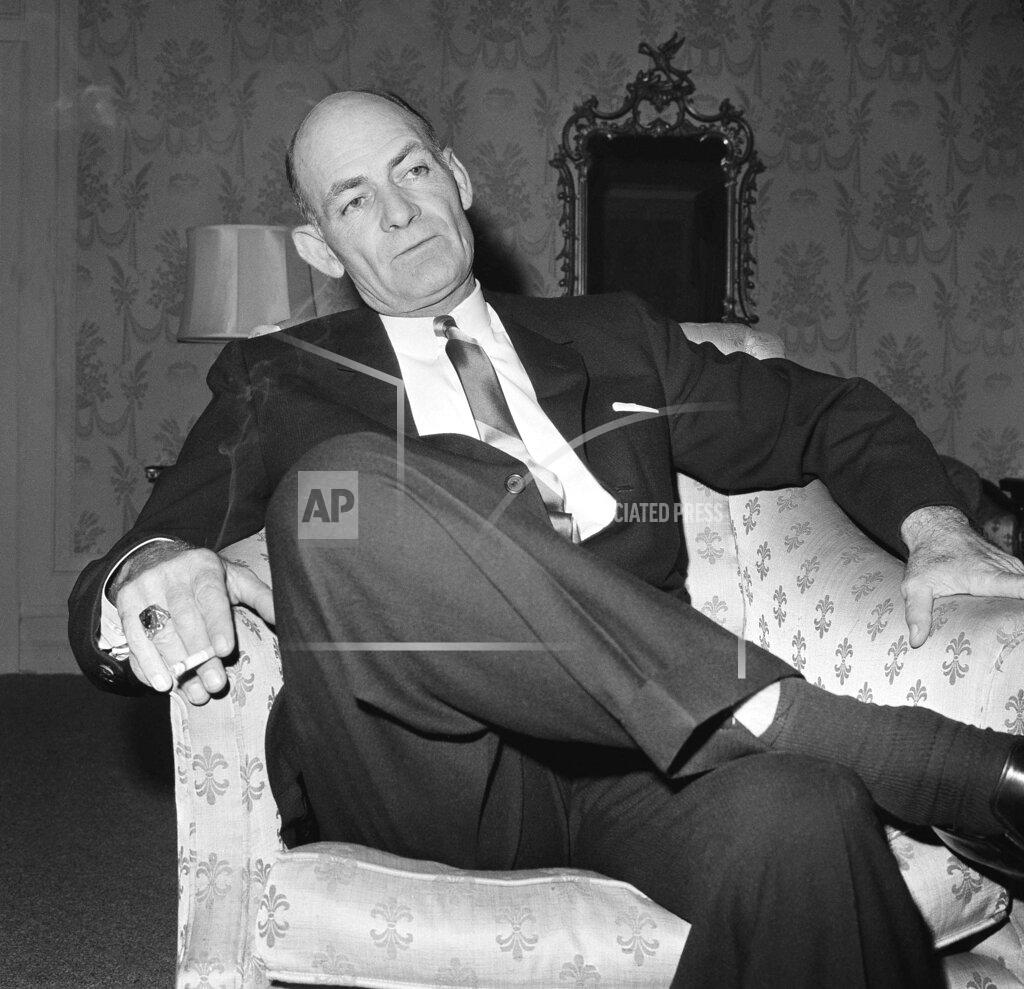
Governor Paul B. Johnson Jr. of Mississippi said tonight that the Rev. Dr. Martin Luther King Jr. had left “a trail of blood and bitterness.” Mr. Johnson was asked at a news conference to comment on a recent charge by J. Edgar Hoover, director of the Federal Bureau of Investigation, that Dr. King was a “notorious liar.” “Of course I agree with him, as do thousands of people,” Mr. Johnson replied. He said the civil rights leader and Nobel Peace Prize winner “has left a trail of blood and bitterness. Rather than a man of peace, he is a man of division and dissension.”
Mr. Johnson also attacked Charles Evers, a Mississippi Black leader, saying that “members of his own race have little confidence in him and will have even less because of his wild statements.” The Governor took issue with a proposal by Mr. Evers that the Federal Government withhold welfare funds from Mississippi because of racial segregation. “Official records show that 61 percent of these welfare funds are used in behalf of members of the colored race,” Mr. Johnson said. He‐described Mr. Evers as “a man who poses as a friend of the colored people of my state.”
Mr. Johnson came to Washington to appear on a nationwide television program this morning, the “Today” show of the National Broadcasting Company. He called the news conference after Washington’s first snowfall of the season had delayed his flight home until tomorrow. He said at the conference that the Council of Federated Organizations, a civil rights coalition in Mississippi, is collapsing because Blacks have found that “two out of every seven C.O.F.O. leaders have Marxist backgrounds.” Governor Johnson said on the “Today” show that he believed racial troubles in Mississippi were “being resolved fairly.”
He said he found Blacks in his state “are very, very happy; they are happy because of the money spent on education in Mississippi — 59 cents of every tax dollar.” The Governor said: “We have very little trouble in Mississippi in spite of what news media put out. The situation is directly opposite of what so many have painted.” Governor Johnson said he knew of few Blacks in his state who have been turned down for registration as voters and “very few instances, if any,” of Blacks being intimidated by burnings, bombings and similar acts.
A dynamite bomb wrecked the carport of a $30,000 home of a Black family in Montgomery, Alabama last night. An automobile was credited with preventing injuries by absorbing the blast. The explosion damaged the home of Charles Spears, a manufacturer’s agent. He disclaimed any connection with the civil rights movement. The local chapter of the National Association for the Advancement of Colored People demanded a full‐scale investigation, and the City Commission announced it would offer a $500 reward.
Assistant Police Chief E. P. Brown said a preliminary investigation showed that two or three sticks of dynamite had been used to bomb the brickland‐wood structure shortly before midnight. The police said they had “little to go on.” No suspects have been arrested. Mr. Spears said, his 1962 Cadillac saved his daughters, aged 17 and 9, from injury. The dynamite exploded next to the rear wheel of the car in a carport directly beneath the bedroom where the girls were asleep. Mr. Spears and his wife were also at home. All escaped injury.
The trial of six Ku Klux Klansmen charged with conspiring to shoot, beat and kill Blacks was tentatively set today for January 11 in Athens, Georgia. Federal Judge William Bootle said he would hear pretrial motions on December 28 and that the date of the trial would depend on the results of those motions. Defense attorneys have asked Judge Bootle to dismiss the federal indictments against the Klansmen, charged specifically with conspiring to deprive Blacks of their civil rights. A Madison County grand jury indicted three of the Klansmen, Myers, Sims and Lackey, last summer on charges of murdering a Negro educator, Lemuel Penn of Washington. Myers and Sims were acquitted by an allwhite jury. Lackey is still waiting trial. Also charged by the Federal grand jury are Denver Willis Phillips, George Hampton Turiner and Herbert Guest.
The National Association for the Advancement of Colored People will decide on January 4 whether to continue its affiliation with the Council of Federated Organizations, which brought hundreds of civil rights volunteers to Mississippi. The Southern Christian Leadership Conference, headed by the Rev. Dr. Martin Luther King Jr., will continue to give the council at least nominal support. Leaders of the N.A.A.C.P. and the conference, two of the more moderate and affluent civil rights organizations, issued statements after the council had denied reports that it was on the verge of disbanding. Roy Wilkins, executive director of the N.A.A.C.P., said in New York that its board of directors would decide whether to sever relations with the council, as recommended by the state conference of N.A.A.C.P. branches last November 7.
Secretary of Labor W. Willard Wirtz began today an effort to work out a settlement of a wage dispute between most of the nation’s railroads and three unions representing about 62,000 shopcraft workers. Negotiators for both sides met with the Secretary and other Government officials at the Labor Department. The indications were that little, if any, progress was made toward a settlement. The talks were expected to continue tomorrow. The dispute poses a strike threat that could tie up more than 90 percent of the nations rail traffic The unions, however, have not yet set a strike deadline. They have promised Mr. Wirtz 72 hours notice of a walkout. If the talks initiated today fail, the unions have indicated that they would set a strike date.
The main issue in the dispute is whether the unions will accept the wage recommendation made October 20 by a Presidential emergency board. It suggested pay increases totaling 27 cents an hour spread over three years. Seven other nonoperating rail unions, including three other shopcraft unions, accepted the recommendation. So did the railroads. Mr. Wirtz met with both sides for nearly two hours this afternoon, then separately with carrier negotiators for an hour. After this session, he said that the dispute remained unresolved and that it was impossible to give any indications of how the talks might turn out. Later, he met separately with the union officials.
The White House has asked Senator Kenneth B. Keating if he would be interested in a post in the Johnson Administration. Acting through two political intermediaries, President Johnson has informally invited the New York Republican to suggest any areas of government in which he might be willing to serve by appointment next year. Senator Keating was defeated in the November 3 election by Robert F. Kennedy, the former Attorney General. He is now considering several offers from law firms and business interests.
The Consumer Price Index rose one‐tenth of 1 percent in October as a result of small but widespread increases in consumer prices. The cost of nearly everything consumers buy, with the exception of food, gasoline, and household appliances, showed some rise during the month. The Department of Labor reported today that the index rose in October to 108.5 percent of its 1957-59 base. That meant that it cost the typical city family $10.85 to buy last month what could have been bought for $10 in the 1957-59 period. The index now stands 1.3 points above where it did a year ago, an increase almost identical with the one that took place during the preceding 12-month period.
The Senate Rules Committee will open the second stage of its Robert G. Baker investigation tomorrow with Don B. Reynolds as the lead‐off witness. Mr. Reynolds, a Maryland insurance man and one‐time business associate of Mr. Baker, supplied the information on which the reopening of the inquiry was ordered by the Senate late in September. He charged that Mr. Baker had received a $25,000 contribution for the 1960 Democratic Presidential campaign from Matthew H. McCloskey, builder of the $20 million D. C. Stadium in Washington, a prominent Democratic fund‐raiser. The contribution, he said, was in the form of an overpayment by the McCloskey concern for a premium on a performance bond for the stadium that Mr. Reynolds’s company had written. Mr. Reynolds said he had turned the money over to Mr. Baker on Mr. McCloskey’s instructions.
The Department of Labor was accused today of seeking to subvert the will of Congress on the touchy issue of the importation of foreign farm workers. The accusation was made at the first of a series of four public hearings being held by the department to establish criteria for the employment of foreign agricultural labor under the Immigration and Nationality Act of 1952. It came from opponents of importing foreign workers, ranging from labor unions to church groups. They contended that Congress had shown it intended to stop the importing of braceros from Mexico and other foreign workers for hand labor on such crops as vegetables and fruits, by refusing to extend Public Law 78. This act expires December 31, along with the migrant‐labor agreement of 1951 between the United States and Mexico. As a result, authority for temporary admission of foreign agricultural workers will be confined to the 1952 act, which is more restrictive than Public Law 78 or the bracero law.
Dr. Donovan F. Ward, president of the American Medical Association, set the stage today for a renewed struggle with the Johnson Administration on health care for the elderly under Social Security. “The battle must go on,” Dr. Ward, a 60-year‐old Dubuque, Iowa, surgeon, told the 228-member House of Delegates at the opening session of its convention in Miami Beach. He called on every doctor in the 204,000-member association to renew efforts to block enactment of the Administration’s so‐called medicare bill. The delegations from the District of Columbia and Michigan formally offered proposals to compromise on the issue, which has wracked the A.M.A. in various forms for 20 years. However, Dr. Ward stood fast, declaring: “We do not, by profession, compromise in matters of life and death. Nor can we compromise with honor and duty.”
Zond 2, the Soviet Union’s probe set to make a flyby of the planet Mars, was launched two days after the United States had sent Mariner 4. Although Zond 2 would pass within 1,500 kilometres (930 mi) of Mars on August 6, 1965, far closer than the Mariner 4 probe, the Zond would be unable to transmit images because of damage to one of its solar panels.
Dow Jones Industrial Average: 875.43 (-6.69)
Born:
David Wood, NBA power forward and small forward (Chicago Bulls, Houston Rockets, San Antonio Spurs, Detroit Pistons, Golden State Warriors, Phoenix Suns, Dallas Mavericks, Milwaukee Bucks), in Spokane, Washington.
Vince Jasper, NFL guard (New York Jets), in Hawarden, Iowa.
Michael Cudlitz, American actor (“Band of Brothers”, “Southland”), on Long Island, New York.
Died:
Don Redman, 64, American jazz musician and orchestra leader (Sugar Hill Times).

 History Diaries