Hitler issued Directive No. 9, Instructions for Warfare against the Economy of the Enemy. The directive focused on attacking British shipping and ports and blockading sea lanes using U-boats and naval mines:
The Supreme Commander Of The Armed Forces.
Berlin. 29th November, 1939. 11 copies
Directive No. 9 — Instructions For Warfare Against The Economy Of The Enemy
- In our fight against the western powers, England has shown herself to be the animator of the fighting spirit of the enemy and the leading enemy power. The defeat of England is essential to final victory. The most effective means of ensuring this is to cripple the English economy by attacking it at decisive points.
- The development of the general situation and of our armaments should provide within the foreseeable future favourable conditions for extensive operations against the economic foundations upon which England rests. Early preparations must therefore be made, by concentrating the appropriate weapons upon the most important objectives, to deal an annihilating blow to the English economy. Nonmilitary weapons will be employed in conjunction with the measures taken by the Armed Forces and in accordance with special orders.
- Should the Army succeed in defeating the Anglofrench Armies in the field and in seizing and holding a sector of the coast of the Continent opposite England, the task of the Navy and Air Force to carry the war to English industry becomes paramount. Efforts will be made to secure the cooperation of the Sabotage Column and Fifth Column organisations.
- The Navy and Air Force will then carry out the following tasks, given in the order of importance: (a) Attacks on the principal English ports by mining and blocking the sea lanes leading to them, and by the destruction of important port installations and locks. In this connection aircraft are extremely valuable in mine laying, particularly outside English west coast ports, in narrow waterways, and in river estuaries. (b) Attacks on English merchant shipping and on enemy warships protecting it. (c) Destruction of English depots, oil storage plants, food in cold storage, and grain stores. (d) Interruption of the transport of English troops and supplies to the French mainland. (e) The destruction of industrial plant whose loss would be of decisive significance for the military conduct of the war, in particular key points of the aircraft industry. and factories producing heavy artillery, antiaircraft guns, munitions, and explosives.
- The most important English ports, which handle 95 percent of foreign trade and which could not be adequately replaced by other harbours, are:
London } for the import of foodstuffs and
Liverpool } timber, the import and refining
Manchester } of oil.
These three ports, accounting as they do in peacetime for 58 percent of total imports, are of decisive importance.
Newcastle }
Swansea }
Blyth }
Cardiff } for the export of coal.
Sunderland }
Barry }
Hull }
Alternative ports, of limited capacity, and for certain types of cargo only, are:
Grangemouth
Holyhead
Leith
Bristol
Middlesbrough
Belfast
Grimsby
Newport
Southampton
Goole
Glasgow
Dundee
It will be necessary to keep constant watch for any possible shift in the use of these ports. We must also seek constantly to compress and shift English foreign trade into channels which are open to effective attack by our own Navy and Air Force.
French ports need only be attacked in so far as they are involved, geographically or economically, in the siege of England, or are used as harbours for troopships.
- In ports where effective minefields cannot be laid, shipping will be crippled by blocking the approaches to the ports with sunken ships and by destroying vital harbour installations. In this connection it is particularly important, in the harbours of
Leith
Sunderland
Hull
Grimsby
London
Manchester (Ship Canal)
Liverpool
Cardiff
Swansea
Bristol-Avonmouth,
to destroy the large sealocks upon which, particularly on the west coast, the regulation of the water level, and thus the effectiveness of the ports, depends.
- In preparing these operations it will be necessary: (a) To constantly check and bring up to date all facts known to us about English ports, their equipment and capacity, and about the English war industry and supply depots. (b) To develop with high priority an effective means of employing aircraft as minelayers for anchored as well as floating mines. (c) To provide a supply of mines sufficient to satisfy the very heavy demands and equal to the capacities of the Navy and Air Force. (d) To ensure that the conduct of operations be the joint responsibility of Navy and Air Force, coordinated as to time and place by both services. Preparations to this end will be undertaken as quickly as possible. I request Commanders In Chief Navy and Air Force to keep me constantly informed of their intentions. I reserve to myself the right to decide the moment at which the restrictions imposed by my previous Directives for Naval and Air Warfare shall be lifted. This will probably coincide with the opening of the great offensive.
(Signed) Adolf Hitler.
The Soviet government breaks off diplomatic relations with Finland. Molotov warns that the Red Army must be prepared for any eventuality.
Finland offered to enter into renewed discussions over the territorial dispute, suggesting conciliation or arbitration, in accord with the non-aggression treaty. The Finns also offered to withdraw their troops from the border unilaterally.
Soviet planes bomb an airfield at Helsinki, Finland. Finnish diplomats in Moscow, Russia made the final pleas to avoid war. At midnight, Soviet Foreign Minister Molotov ordered the invasion to commence.
Three Finnish border guards go missing from Puumanki border guard post. Doors and window frames show damage consistent with rifle butt strikes. Investigation concludes that they were kidnapped by Soviet soldiers.
Moscow Radio announces that Finnish soldiers had attacked across the border in the same area and that the defenders had pushed the attackers back over the border.
The rupture in Finnish-Soviet relations was regarded as ominous tonight in Scandinavian countries. It was feared that all hope of a settlement had vanished.
Armed conflict between colossal Russia and small, democratic Finland, which seems to be indicated by Moscow’s breaking off of diplomatic relations with Helsinki, would find Germany wholly sympathetic with the aims of her powerful eastern friend, according to the Berlin press tonight.
Italian sympathies are with Finland, it was clearly shown in today’s press and radio. Whatever Germany may be thinking about the Russian attitude, Italy does not like it.
A decree of the Presidium of the Supreme Soviet granted all permanent residents of Soviet-occupied Poland full citizenship of the USSR. With this came the obligation to serve in the Red Army. Residents of Soviet-occupied Poland had Soviet citizenship forced on them.
Joseph Stalin tonight declared that the Allies were responsible for the present war.
The Spanish government ratifies a friendship pact with Germany, including secret clauses allowing Germany to use Spanish ports and promising cooperation on police and propaganda.
On the Western Front, French troops perform reconnaissance in Vosges Forest areas held by German troops.
Premier Édouard Daladier will ask for renewal of powers; the French parliament is expected to vote confidence. When Parliament reassembles tomorrow for the first time since the outbreak of the war, Premier Edouard Daladier will set forth in a short statement the present situation at the end of three months of war and will give an accounting of his stewardship.
In Britain, it is reported that the Chancellor of the Exchequer has received family jewels, gold and gifts from foreigners to help finance the war effort.
The British government announces in the preceding week (ending 25 November) that it seized 21,500 tons of contraband allegedly destined for Germany.
Foreign Minister Halvdan Koht announced today that the Norwegian Government has made representations to the Allied Governments regarding their decision to seize German exports.
There is an air duel over the Northumbrian coast. Two British patrol aircraft and a Dornier seaplane are shot down over the North Sea.
Dutch swimmer Cor Kint (Cornelia Kint) swims world record women’s 200 m backstroke in 2:38.8 (stood for 11 years).
The Government of Eire commissions some motor torpedo boats and armed trawlers into its navy.
In a firm but moderate speech before the Parliamentary Committee for Foreign Affairs, Foreign Minister Grigore Gafencu today invited Hungary to abandon her present intransigent attitude so as to make possible an improvement of Rumano-Hungarian relations.
German armored ship Admiral Graf Spee re-embarks from accompanying tanker Altmark all British merchant marine officers from the six ships that the “pocket battleship” has sunk up to that point. The officers are to be taken back to Germany; the crewmen remain imprisoned on board Altmark.
The British steam merchant Ionian struck a mine and sank near Newarp Lightship along the eastern coast of England in the North Sea (52°45′15″N 1°56′15″E). At 01.30 hours on 29 Nov 1939 the Ionian (Master William Smith) in convoy FN-43 struck a mine, laid on 21 November by U-20 1.5 miles 132° from Newarp Lightship. The ship was abandoned 4 miles 340° from the lightship and sank in 52°45´15N/01°56´15E. The master and 36 crew members all survived and were picked up by the HMS Hastings (L 27) (Cdr E.H. Vincent) and landed at South Shields. The 3,114-ton Ionian was carrying general cargo, including currants and mohair and was bound for Hull, England.
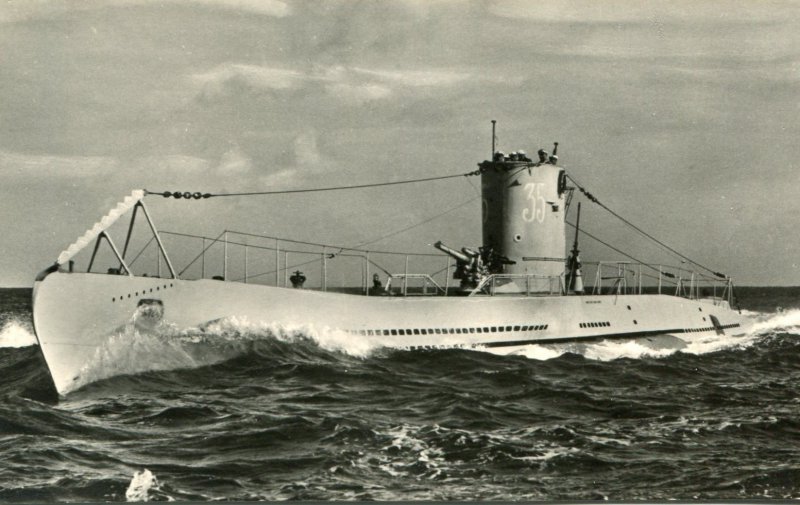
The U-35, commanded by Kapitänleutnant Werner Lott, was sunk in the North Sea, in position 60.53N, 02.47E, by depth charges from the British destroyers HMS Kingston (F 64), HMS Icarus (D 03), and HMS Kashmir (F 12). All of the crew were rescued and taken as prisoners of war. All 43 crew survive, a rarity for U-boats, because Lord Mountbatten, in command on the Kashmir, sends boats over to rescue the Germans. Indeed, every member of the U-35 crew during its short World War 2 service survived the war. The rescued U-35 crew are temporarily imprisoned in the Tower of London before being sent to POW camps.
HMS Diomede, a recently reactivated Great War cruiser, chases the German freighter Idarwald from Tampico, Mexico. The Germans scuttle the ship off Cabo Corrientes, Cuba before it can be captured. A US destroyer (either the USS Broome or USS Sturtevant) has been shadowing the freighter but does not intervene in its destruction.
U.S. freighter Nishmaha is detained by French authorities at Marseilles; her cargo (cotton, paraffin and beef casings) is held pending the decision of the Contraband Committee in London.
U.S. freighter Extavia is detained at Gibraltar by British authorities.
The Egyptian police discover an opium cache in the stomachs of camels.
The War at Sea, Wednesday, 29 November 1939 (naval-history.net)
Admiral Forbes with battleships NELSON, RODNEY, heavy cruiser DEVONSHIRE and seven destroyers was sweeping north off the Norwegian coast when RODNEY suffered a serious rudder defect. She was ordered to the Clyde, arriving on 1 December with destroyers GURKHA, PUNJABI and KANDAHAR. Escorted by destroyers IMPULSIVE, IMPERIAL and GURKHA, RODNEY left on the 6th for Liverpool to repair, and arrived on the 8th. IMPERIAL and IMPULSIVE remained at Liverpool until RODNEY was safely docked, when it was found that about one third of her rudder had been torn away. GURKHA went on to Southampton, arriving on the 10th for repairs to her turbines lasting into January 1940. IMPERIAL was to have undergone repairs at Liverpool, but returned to the Clyde on the 9th. Later, when battleship NELSON was docked for mine damage, she was found to have sustained storm damage similar to RODNEY during the sweep.
U-35 on her second war patrol, was sighted near convoy ON.3 and destroyer ICARUS delivered an unsuccessful attack. Forbes detached destroyers KINGSTON and KASHMIR and they sank U-35 northwest of Bergen in 60 53N, 02 47E. None of the crew were lost, with KINGSTON picking up the commanding officer and 11 ratings and KASHMIR three officers and 28 ratings.
Heavy cruiser SUFFOLK departed the Clyde and arrived at Scapa Flow later the same day.
Light cruiser CARDIFF, which had departed Sullom Voe on the 28th, arrived back after heavy weather carried away her main topmast and part of her main mast port antenna.
Convoy FS.44 departed the Tyne, escorted by destroyer WHITLEY and sloop STORK, and arrived at Southend on the 30th. There was no convoy FN.44.
Polish submarine ORP WILK departed Rosyth on her first war patrol from England.
Destroyer KELVIN departed the Clyde for Portsmouth, arriving on the 30th.
Armed merchant cruiser FORFAR departed Portsmouth for the Clyde, escorted by destroyer MALCOLM.
Destroyer VANESSA was sent to search in Bally Cotton Bay, 51-50N, 8-00W for a reported submarine.
Destroyers JUPITER and JAGUAR attacked a submarine contact in 55 05N, 1 33E.
Steamer IONIAN (3114grt) from convoy FS.43 was sunk 1½ miles 132° from Newarp Light Vessel on a mine laid by U-20 on the 22nd; sloop HASTINGS rescued the entire crew.
Steamer WILLOWPOOL (4815grt) was lost on 10 December, three miles east of Newarp Light Ship in the same field; her 36 survivors were rescued by lifeboat.
Light cruiser DANAE departed Singapore for Hong Kong, and arrived on 3 December for refitting, completed 14 February 1940.
U.S. Secretary of State Cordell Hull, informed the press that the United States is prepared to mediate the dispute between Finland and the USSR. The increasingly serious developments in relations between Russia and Finland led the United States today to proclaim her readiness to extend good offices for a pacific adjustment of the points at issue, if that should be agreeable to both parties. The move was made in an effort to leave no stone unturned that would prevent a spread of European hostilities. It was in the form of a statement issued by Secretary of State Cordell Hull after several telephone conversations with President Roosevelt. In particular, it represented their views of a way in which the American Government could throw its weight into the scales for peace after consideration had been given in the State Department to possible courses of action. The text of the statement follows:
“This government is following with serious concern the intensification of the Finnish-Soviet dispute. It would view with extreme regret any extension of the present area of war and the consequent further deterioration of international relations. Without in any way becoming involved in the merits of the dispute, and limiting its interest to the solution of the dispute by peaceful processes only, this government would, if agreeable to both parties, gladly extend its good offices.”
The force of a diplomatic appeal was given the statement when Secretary Hull late today cabled the text to the United States Legation in Finland and the United States Embassy in Russia with instructions that it be delivered to the Foreign Offices. The statement was issued at 3:05 P. M., one hour before word was received of Russia’s severance of diplomatic relations with Finland, and an hour and a half before the press carried reports of the speech of Vyacheslav M. Molotov, Soviet Premier and Foreign Commissar. In comment on the statement the State Department said it did not constitute intervention, nor did it necessarily mean mediation. It simply meant, it was stated, that this government is using what efforts it can to help Russia and Finland settle the dispute themselves. Although Secretary Hull merely expressed a readiness to extend good offices if Russia and Finland are agreeable, his action threw open the possibility of an adjustment that might be worked out along any one of several lines. An offer of good offices, mediation and arbitration are the three recognized methods for pacific adjustment of disputes under The Hague conventions of 1907 and have been utilized by the United States on many occasions, particularly in Latin America.
Fritz Julius Kuhn of the pro-Nazi German American Bund was found guilty on five counts of larceny and forgery in New York court. Fritz Kuhn, the leader of the German-American Bund, was convicted shortly after 10 o’clock tonight of grand larceny and forgery in General Sessions Court. He stood up, with only his forefinger on his left hand waving along the side seam of his trousers, and heard without a blink the verdict of a jury that had deliberated eight and a half hours. The maximum sentence he can receive is thirty years, and the day on which he will hear his fate was set by Judge James G. Wallace as Tuesday.
Pending the sentence Judge Wallace told Peter L. F. Sabbatino, the counsel who had defended Kuhn during his trial in General Sessions Court, that action on a promised contempt of court would be suspended until then. He gave Mr. Sabbatino leave to make any motions he desired in the intervening time. Kuhn marched off to the Tombs with the stoical attitude of a good German soldier, which he says he once was. There was no tremor on his face, and the three courtroom. bailiffs who surrounded him when Morris C. Bullock, the foreman of the jury, pronounced him guilty. had only to tug at his sleeve to lead him away to prison. There was not even an interchange of glances between him and Mr. Sabbatino or Wilbur V. Keegan, associate counsel.
Congressman Martin Dies attended a rally and warned the United States to stop its “aping” of Europe. Ten thousand cheered his plea for national unity and a fight on all alien forces. Speaking tonight in Madison Square Garden before an enthusiastic throng estimated at 10,000 to 12,000 persons, representing many patriotic and religious organizations, Representative Martin Dies of Texas denounced communism, fascism, and nazism as alien forces, tearing at American unity. He made a strong plea also for racial and religious tolerance. Asserting that there was an organized campaign to discredit the work of the Congressional Committee Investigating un-American Activities which he heads, Mr. Dies made a demand for public funds with which to continue hearings on subversive groups next year. He also called on the Administration, which he implied was opposed to the committee, to come out openly and say whether or not it favored the drive against foreign “isms.”
On this question Mr. Dies got strong support from the audience and from the other speakers, who urged those present to demand from Congress an appropriation that would preserve the committee as it is. The husky, 6-foot Representative who has achieved national prominence since he was named chairman of the committee in 1938 was escorted to the platform by a guard of American Legionnaires while the drums of the Seventh Regiment band announced him with a fanfare. Mr. Dies’s fellow-speakers were Colonel George U. Harvey, Borough President of Queens; Joseph P. Ryan, president of the International Longshoremen’s Association; Jeremiah Cross, past State commander of the American Legion; Laurens Hamilton, president of the New York State chapter, Sons of the American Revolution, and Jean Mathias, New York State commander, Jewish War Veterans of the United States. As chairman of the meeting, Merwin K. Hart, president of the New York State Economic Council, opened the meeting at 8:30 PM Frederick Jagel of the Metropolitan Opera sang the “Star-Spangled Banner,” although he advocates the adoption of a new anthem for the United States.
Senators Borah, Republican, of Idaho, and Wheeler, Democrat, of Montana, served notice today that they would oppose special taxes to pay for increased national defense costs. Both Senators said they felt that, if any such taxes were proposed, they would be bound to fall on the little fellow who could least afford to pay them. Senator Borah said he could not commit himself to any special tax until he knew who would be expected to pay it.
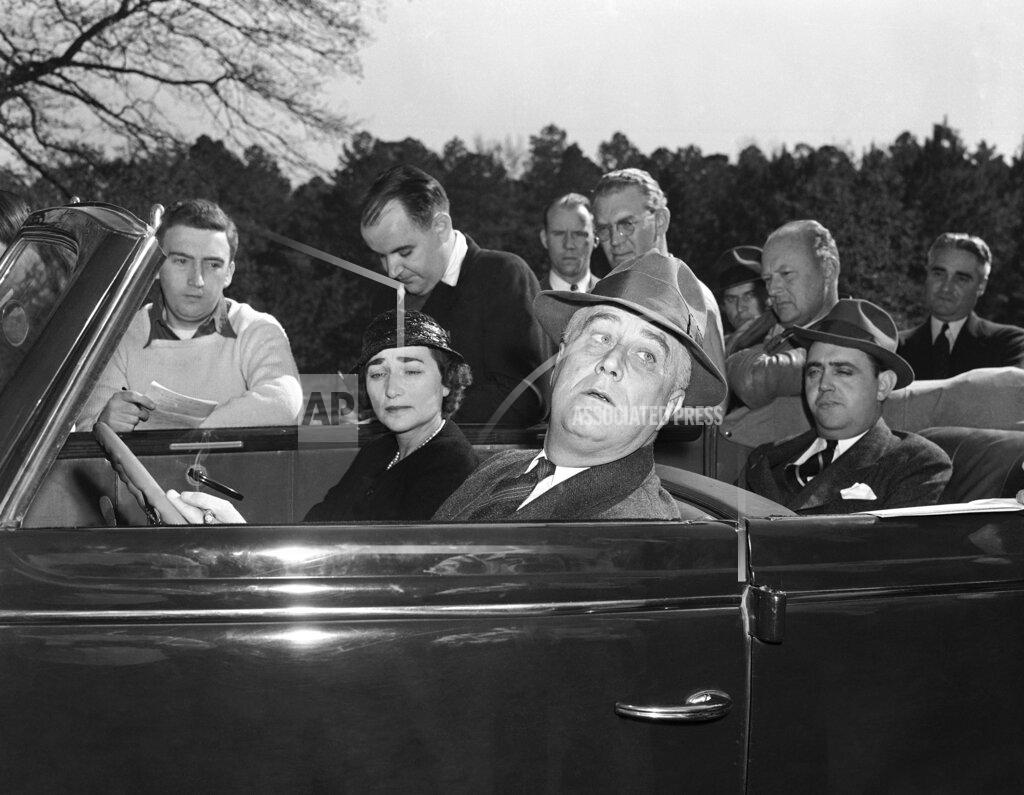
Returning to Washington from a week’s vacation at Warm Springs, President Roosevelt paused today at Asheville, North Carolina to visit with his secretary, Marvin H. McIntyre, who is convalescing from a lung lesion that has kept him from his desk in the White House since February.
Chrysler workers ratify an agreement, including a pay raise of three cents per hour for all. Five local unions of the United Automobile Workers of America (C.I.O.) voted tonight overwhelmingly to ratify the agreement ending the dispute with the Chrysler Corporation. Out of approximately 30,000 votes, only 35 disapproved the new contract.
A majority of fifty Washington correspondents, polled by News Week on the Presidential situation, expressed the view that the Democratic candidate for President would win in 1940.
Following the halting yesterday of relief aid for 16,000 adults in Cleveland, scores of persons still receiving some help from the city’s depleted funds crowded into district relief stations today with protests.
Baseball Commissioner Judge Landis fines Brooklyn, Detroit, and the St. Louis farm club, Columbus, for manipulating player contracts. He frees seven farm hands.
The Central China Daily News, organ of former Premier Wang Ching-wei, who is slated to head the new “national” government of China under the sponsorship of Japan, published another “warning” editorial to the Japanese today. Japan’s willingness to make peace with China, the newspaper said, does not signify friendliness but Japan’s inability to defeat China in the war that has been going on for two and a half years. For this reason the impending settlement of Japanese-Chinese difficulties does not involve the question of whether Japan is able to demand indemnities to cover the costs of the war, the newspaper added, asserting:
Japan has two choices: Economic cooperation with China on a basis of equality, thereby simultaneously improving Japan’s international position, or to withdraw her forces from China without even the chance of improving the Japanese economic position but at least preventing further weakening of Japan’s power.The newspaper professed to believe that Japan would choose the first alternative, since she is unable to conquer China, as proved by the long Chinese “war of resistance.”
If Japan wishes to eliminate the influence of third powers in China, the newspaper said, she must grant China sufficient freedom to remove this country’s dependence on outside interests. Earlier the newspaper had said that there must be many changes in the present administration of the so-called Japanese-occupied areas if the “new State” that Wang will head is to be strong.
The Japanese Government is considering retaliatory measures against Great Britain’s two-way blockade of Germany. These may include seizure of Anglo-French ship cargoes in Far Eastern waters. This threat appears in the newspaper Nichi Nichi this morning as part of its report of a conference held at the Foreign Office yesterday to discuss the British reply to Ambassador Mamoru Shigemitsu’s protest against the Order in Council for seizure of German exports on neutral ships.
Reports from other sources indicate that interference with Anglo-French shipping in the Far East still is a somewhat distant possibility, depending on the British response to Japan’s demand for special consideration of her German imports. Asahi says that Mr. Shigemitsu has been instructed to press the British Government to give assurances that Japanese trade will receive special consideration in enforcement of the blockade.
The Foreign Office conference in which Foreign Minister Kichisaburo Nomura, Vice Foreign Minister Masayuki Tani and several bureau chiefs participated, found the British order had been formulated in flexible terms so that its effect could not be ascertained until it has been enforced. It was decided to await the text and to continue the policy of pressing Britain to give consideration to Japan’s “important” imports from Germany. If the Japanese representations to Britain are disregarded, a further measure will be considered in the terms of Japan’s original protest, which threatened appropriate countermeasures.
Premier General Nobuyuki Abe, who at the outset of his Premiership proclaimed the efficiency of a small Cabinet and limited his administration to ten members, today brought it back to the former number, thirteen—a figure that is neither lucky nor unlucky in Japan.
The U.S. Navy submarine S-38 (SS-143) is damaged by explosion of after storage battery, Olongapo, P.I.; four sailors suffer injuries.
A motion by the leader of the Australian Labor party, John Curtin, that Parliament go on record as opposing the dispatch of an Australian Imperial Force to fight in Europe was defeated today in the House of Representatives.
Dow Jones Industrial Average: 146.89 (-1.42)
Born:
Dick McAuliffe, MLB second baseman, shortstop, and third baseman (World Series Champions-Tigers, 1968; All-Star, 1965-1967; Detroit Tigers, Boston Red Sox), in Hartford, Connecticut (d. 2016).
Jim Derrington, MLB pitcher (Chicago White Sox), in Compton, California.
Gennadi Volnov, Russian basketball player (Soviet team, Olympic gold medal, 1972), in Moscow, Russian SFSR, Soviet Union (d. 1998).
Meco, record producer and musician, in Johnsonburg, Pennsylvania (d. 2023).
Peter Bergman, American comedian, in Cleveland, Ohio (d. 2012)
Died:
Philipp Scheidemann, 74, German politician (SPD) and Mayor of Kassel.
Naval Construction:
The Royal Navy Tree-class minesweeping trawler HMS Blackthorn (T 100) is launched by Cook, Welton & Gemmill (Beverley, U.K.); completed by Holmes.
 History Diaries