Defying South Vietnamese Government orders, 2,000 Buddhists marched in a funeral procession in Saigon Sunday for a youth killed in recent rioting, The Associated Press reported. The marchers defied government orders limiting the size and route of the procession. Demonstrators and paratroopers battled today around the coffin of a Buddhist student killed in recent rioting here as a relatively small band of agitators attempted to turn a funeral procession into a new show of anti‐government defiance. The demonstration did not appear to be successful as a display of Buddhist solidarity or of popular resentment against the government’s decrees of martial law. The troops showed disgust at having to face an unruly mob in the capital only 12 hours after their return from a successful battle against Việt Cộng insurgents in the Mekong delta.
Premier Trần Văn Hương went on the radio late tonight to reassure the population. “Thanks to the determination of the government and the moderate but firm attitude of the armed forces, thanks also to the calmness of the population of the capital, the plot failed again,” he said. “The population of the capital realize those troublemakers were intentionally playing into the hands of the Communists.” A crowd of about 2,500 at the beginning of the authorized five‐mile funeral march through Saigon dwindled to no more than 300 despite efforts to get apathetic spectators to join it. A senior Buddhist monk participating at the start disappeared long before the procession turned into a battle.
After the marchers had passed the length of a residential street where many foreign diplomats live, including the United States Deputy Ambassador, U. Alexis Johnson, the trouble began. Three companies of a paratroop battalion, acting on police intelligence, intervened swiftly to cut off the last float in the procession, a wreath‐covered truck displaying anti‐government slogans that seemed out of tune with the solemnity of the procession. About 20 youths riding the truck tried to flee the sudden encirclement. They were found to have knives and iron rods hidden under their shirts. Under a false bottom on the float the police found more blunt weapons and a box of banners and leaflets denouncing Premier Hương. One young suspect had a grenade hidden in his clothing.
As the paratroopers intervened, the procession stopped. The mourners surrounding the Ihorse‐drawn hearse continued wailing near the coffin of the boy, Lê Ngọc Vǎn, who was killed Wednesday in a clash with Government forces. Some young people in the rear of the procession moved toward the soldiers, bringing out a bullhorn loudspeaker and started to insult the soldiers. This taunting went on for three hours in the hot sun while most of the people from the procession wandered off. Finally, on orders, the paratroopers moved slowly toward the demonstrators sitting in the middle of the road. In the ensuing scuffles many youths rushed to the hearse. They seemed to be trying to give the impression that they wanted to defend it, but seemed more to be defended by it, because officers commanding the troops and the police appeared to be reluctant to interfere with the dead.
Meanwhile, the paratroopers were rounding up the leading agitators. Two shots were fired into the air. There were no injuries. In all, 89 persons were herded into military trucks to be driven to headquarters for screening. Those of draft age will be inducted into the army under a recent order of Premier Hương. The paratroopers showed little of the ferocity exhibited by the police last Sunday when the week’s riots began. At least twice today officers struck a soldier seen hitting or kicking a captive. Most of the youths were led off at bayonet point, but were not mistreated.
A locomotive crashed into Saigon’s main railway station in the pre‐dawn hours today, killing at least 17 persons. There was no one at the controls when the huge diesel locomotive plowed into the building. It killed most of a group of persons waiting for an early‐morning train to the coastal provinces. There was speculation that the idling locomotive had been set in motion by a Communist saboteur. The station building was supposed to be protected from runaway trains on nearby sidings by wooden barricades placed at the end of each track. But the barricade at the end of the track on which the runaway locomotive was standing had been removed.
The agreement between the United States and Cambodia to open diplomatic talks on their differences is welcome, but there is no reason for optimism about the outcome. The differences are difficult to resolve because they are largely psychological. They originate in Prince Sihanouk’s conviction that Communist China is the wave of the future in Southeast Asia. They are complicated by the traditional animosities between Cambodia and her neighbors, South Vietnam and Thailand — which the United States has been helping to defend — and by the war in Vietnam, which at times flows across the ill‐defined border with Cambodia. In the past year Cambodia’s mercurial ruler has terminated American aid and closed his embassy in Washington while seeking increased assistance in Peking and Moscow. A year ago Albania proposed Communist China for United Nations membership. Cambodia plans to assume this role at the approaching General Assembly.
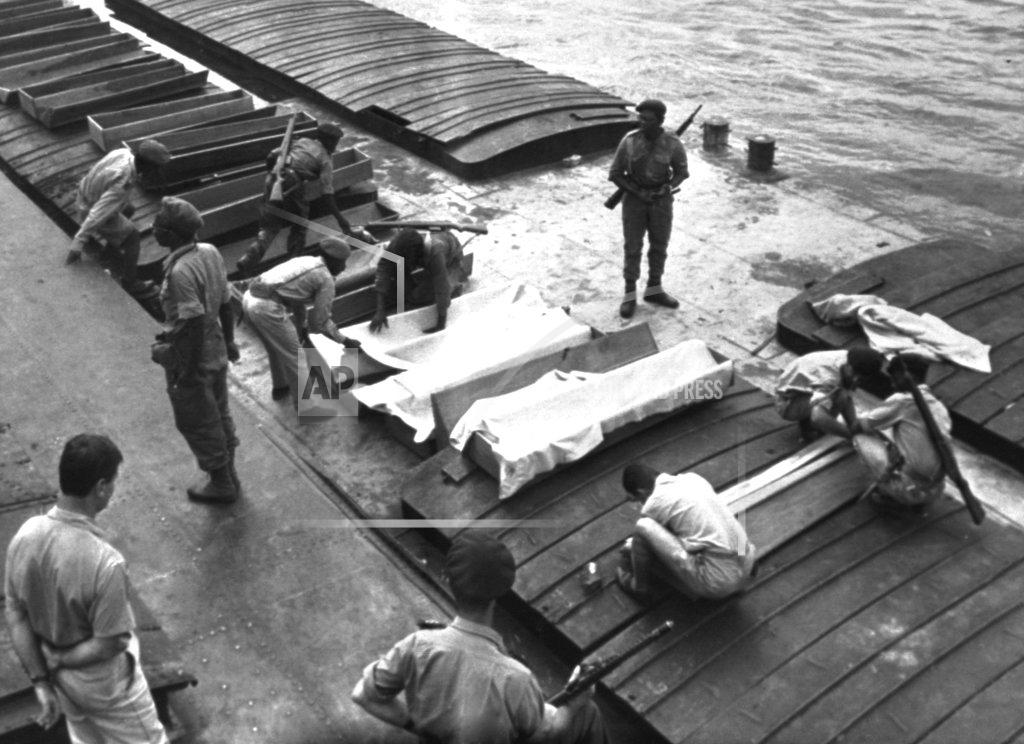
A group of Congo’s Simba rebels shot down a chartered Belgian DC-4 airplane as it was taking off from the Stanleyville airport following the recapture of the city. Of 51 people on board, most of them Congolese National Army soldiers, only seven survived.
A different group of rebels entered the village of Bafwabaka and kidnapped the 46 nuns in a Roman Catholic convent, the Sisters of the Holy Family, operated by Marie-Clémentine Anuarite Nengapeta. Nengapeta, who would be beatified in 1985, would be murdered on December 1.
White mercenaries and Congolese troops rescued more than 100 Belgian civilians after driving the Simba rebels out of the village of Dingila.
Western diplomats and military observers here are complaining that Washington and Brussels, in recalling Belgian paratroopers from the Congo, have left the rescue job only half done. Six days after the paratroop drops on Stanleyville and Paulis, well over 900 foreigners are still in the hands of the Congolese rebels and their lives appear to be in far more danger as a result of the Belgian and American military action. An American officer, asked how long it might take for Congolese ground forces to free the remaining whites, replied grimly: “Does it matter? Every one who is going to get out alive already has.”
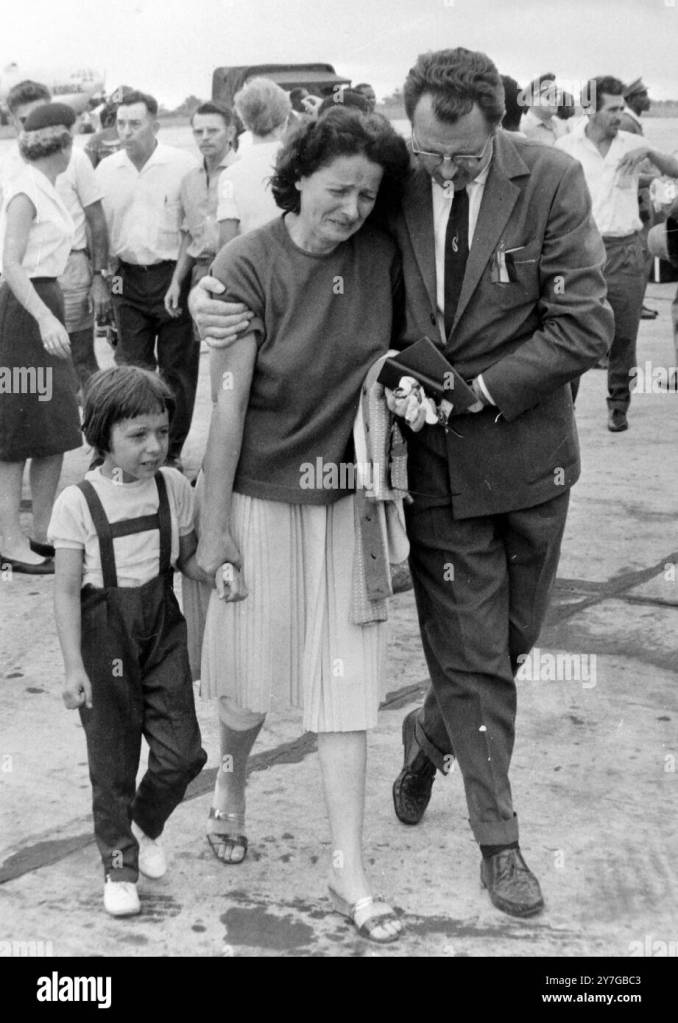
So far, more than 80 whites, including three United States missionaries, are known to have died since the rebels’ threat to massacre all foreigners under their control if Westerners intervened in the Congo. Some were shot, some hacked to death with knives, some victims of cannibalism. Moreover, missionary evacuees from Paulis report that all whites in Wamba, about 90 miles to the south, have been killed. If this report is confirmed, it will add to the death toll five Protestant missionaries, eight Roman Catholic priests and about 35 Belgian and Greek traders. The number of hostages rescued reached nearly 1,700.
Lacking solid intelligence data about the nature of the rebel movement, the Western planners of the rescue exercise concluded that, with the collapse of the rebels’ Stanleyville “government,” resistance elsewhere would probably crumble. But rebel bands — Known as Simbas, or lions — are still fighting, some harder than ever. At Beni, on the eastern frontier, Congolese troops and their white mercenary leaders are striving to reach 300 Europeans at Bunia. They report the stiffest resistance since the uprising began more than six months ago. Other Congolese Government columns, which had hoped to link up with the Belgian paratroops at Paulis, are stalled several hundred miles away. As a result, Paulis had to be abandoned to the rebels when the paratroops withdrew, leaving at least 50 whites in the surrounding bushland.
The Belgian Defense Department said today that its paratroop battalion began leaving Kamina military base in the Congo shortly after dawn. The troops are travelling by United States C‐130 transports to Ascension Island, a British dependency in the South Atlantic, for an overnight stay. They will proceed to Las Palmas in the Canary Islands tomorrow and arrive in Brussels Tuesday morning. Foreign Minister Paul‐Henri Spaak. was reported to have emphasized to the Soviet Ambassador this morning that with the withdrawal of the paratroops from the Congo, the Belgian Government had ended its Congo mission. Mr. Spaak summoned Pavel A. Gerasimov, the Ambassador to a conference that lasted for 45 minutes. He is reported to have expressed strong criticism of the Soviet Union. Mr. Spaak is also said to have emphasized that the quick withdrawal was proof of the humanitarian nature of the mission.
Premier Moise Tshombe of the Congo arrived in Paris today by air from Leopoldville. Mr. Tshombe is expected to meet President de Gaulle tomorrow. Diplomatic observers said the object of the trip, arranged several weeks ago, might be to seek long‐term technical assistance for the Congo. They said there was no question of Mr. Tshombe’s obtaining French military aid.
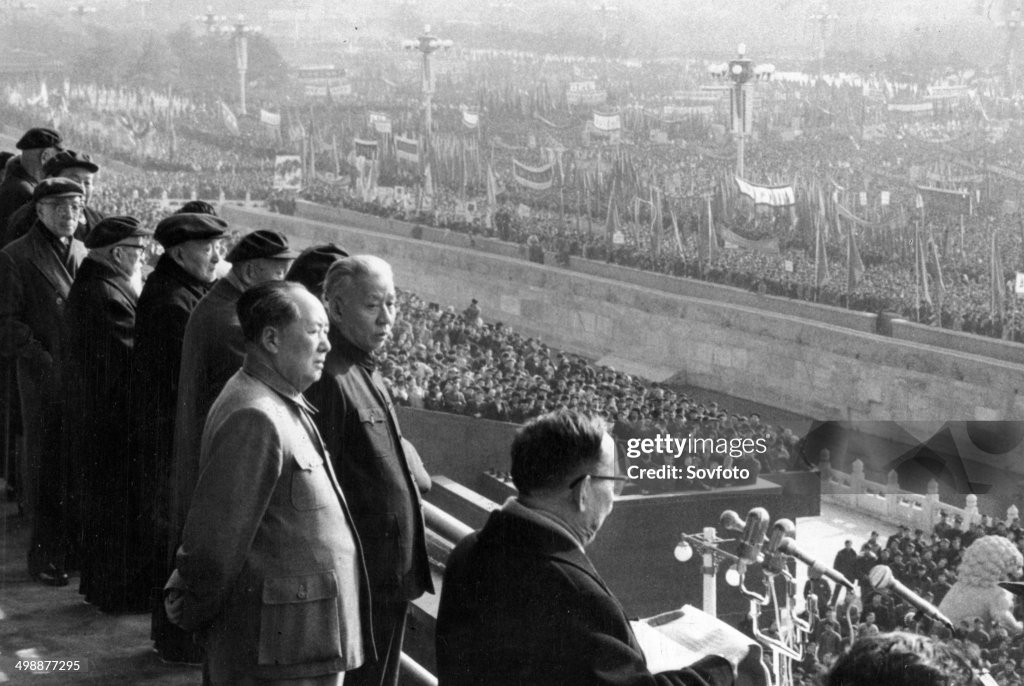
A huge rally was held in Peking today to denounce United States “aggression” in the Congo. The Chinese Communist press agency Hsinhua said the rally had been attended by 700,000 people, led by Mao Tse‐tung, chairman of the Communist party’s Central Committee, and some of his top aides. It was described as one of “the biggest anti‐imperialist demonstrations ever held in the Chinese capital.” Earlier, Mr. Mao issued a statement expressing China’s support for the “just struggle” of the Congolese people against “United States imperialism,” which he described as “the common enemy of the people of the whole world.” The Chinese leader, who does not often make public comments, asserted that the United States had “overextended its reach.”
Secretary of State Dean Rusk arrived in New York from Washington today to take over final negotiations on a plan under which the U.N. General Assembly would postpone a showdown on the question of unpaid United Nations assessments. Alex Quaison-Sackey of Ghana, the prospective President of the Assembly, predicted that Mr. Rusk would reach final agreement with Andrei A. Gromyko, the Soviet Foreign Minister, on the plan, which was. submitted by the Secretary General, U Thant. Mr. Quaison-Sackey called the plan “a whiff of fresh air.” Mr. Gromyko did not comment on the financial crisis when he arrived at Kennedy International Airport tonight. In a written statement in which he extended best wishes to the American people, he said: “We have come here to defend the peace, to defend the rights of the peoples to independent development, and to defend the United Nations itself.”
The belief that Mr. Gromyko would agree to Mr. Thant’s plan was weakened when Eastern European sources asserted tonight that any attempt to carry on the business of the Assembly in December without taking a vote would not work. These sources indicated that Mr. Gromkyo would agree to postponement of a decision, but would insist that the Assembly vote as usual pending any settlement. If Mr. Gromyko insists that votes be called in the normal way, this would be counter to the position of the United States, which insists it will not agree to any arrangement under which the Soviet Union would vote in the Assembly before the question has been settled.
The U.N. General Assembly will open its 19th annual session Tuesday with a provisional agenda of 92 items. Dr. Carlos Sosa Rodriguez of Venezuela, president of last year’s session, is scheduled to start this year’s at 3 PM. Dr Sosa has established a reputation for punctuality. that is not usual here. After a minute of silence for prayer or meditation, he will announce the appointments for the Credentials Committee. Alex Quaison‐Sackey of Ghana is assured of the presidency of the Assembly since the withdrawal of other candidates on Friday. The long agenda covers many relatively minor items of United Nations housekeeping and routine. But it also deals with topics of world importance, including disarmament and arms control, the peaceful uses of space, trade and development, and the effects of atomic radiation. Ranking high in general interest is the perennial question of the admission of Communist China. This has been regularly voted down, but since the last session Peking has made diplomatic gains, notably in receiving recognition by France in January.
The National Committee for Labor Israel calledon West Germany yesterday to forbid its scientists from working in the United Arab Republic toward the “final solution” of Israel. In a unanimous action, 1,500 delegates demanded that the Bonn Government pass legislation to deprive the scientists “in Nasser’s employ” of their citizenship if they failed to end armaments research directed at the destruction of Israel. The phrase “final solution” was frequently used by Hitler in calling for the mass destruction of Jews.
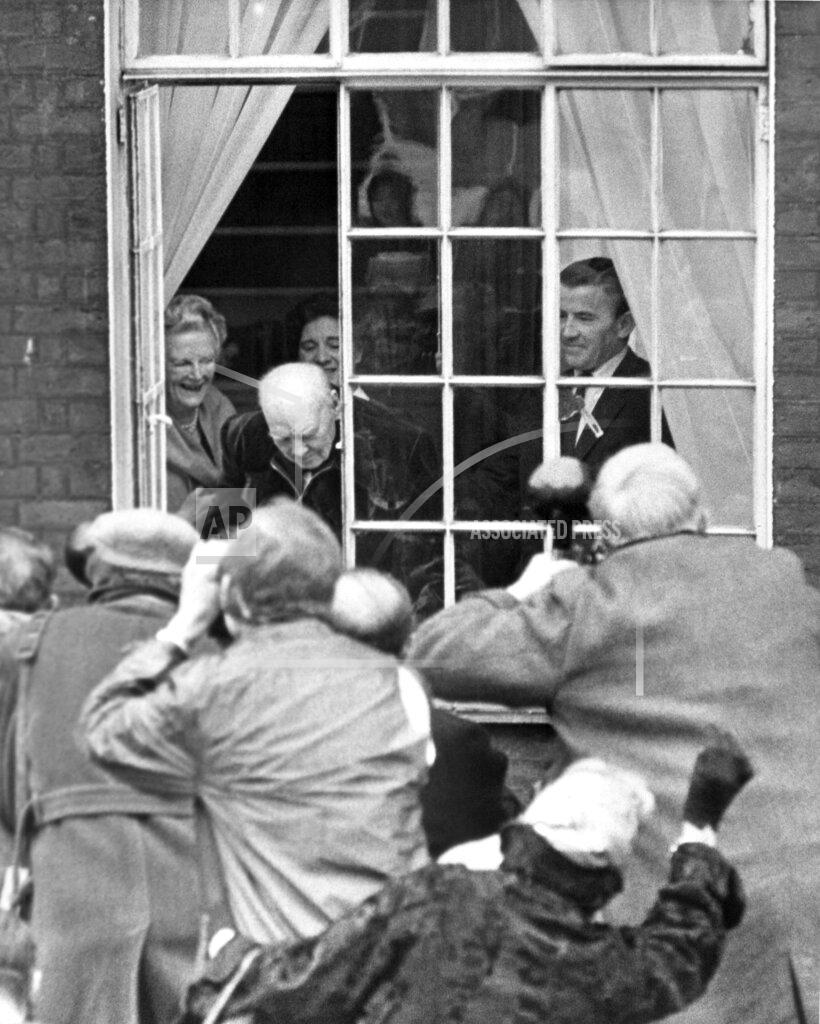
Sir Winston Churchill, who will be 90 years old tomorrow, waved his greetings to a cheering crowd of well-wishers outside his London home this afternoon. Sir Winston stood for nearly three minutes at the open window, brusquely rejecting an offer of support from his wife at one point.
On the first Sunday of Advent in the Roman Catholic Church, Catholics “walked into their parishes around the globe and, for the first time since the fall of the Roman Empire, participated in a mass that was given largely in their native tongue.” From the founding of the Catholic church up until 1964, the mass had always been conducted in Latin, until a reform by the Second Vatican Council.
Twenty-four people were trampled to death and 37 more injured in Mexico after a political rally in Jalapa, where 5,000 assembled in an arena to watch Veracruz state Governor Fernando Lopez Arias. In the excitement to attend a festival at a nearby park, the crowd proceeded down one of the stairways toward the exit when a woman fell, and those further up the stairs began falling as well.
“For Negroes, the FBI has become part of the oppression of the South,” says an editorial in Student Voice, a publication of the Student Nonviolent Coordinating Committee. Beneath the editorial is a cartoon in which “J. Edgar Standby,” a play on the name of J. Edgar Hoover, the FBI director, is asking: “Would you like to contend that the sheriff denied this Negro some civil right in killing him?” The editorial and the cartoon are examples of the distrust of the Federal Bureau of Investigation that exists among civil rights organizations. Their feeling of suspicion persists despite the bureau’s reported stepped‐up efforts against racial brutality and discrimination in the South, and despite the recognition by many civil rights leaders of the problems the FBI faces.
James Farmer, the deep‐voiced director of the Congress of Racial Equality, asks FBI agents to “make arrests on the spot” in civil rights cases. Jack Greenberg, director‐counsel of the N.A.A.C.P. Legal Defense and Educational Fund, says there has long been authority in the law to permit far more Federal criminal prosecutions in this field. William M. Kunstler, counsel to the Rev. Dr. Martin Luther King Jr., president of the Southern Christian Leadership Conference, calls for the use of a statute that requires United States attorneys, marshals and commissioners to prosecute certain civil rights violators or risk misdemeanor punishment, including a $500 fine. But there is another side — the approach of the FBI and, even more important, of its parent Department of Justice.
In a Washington office looking toward the Capitol, its spaciousness contracted by easels with maps showing levels of school desegregation and voter registration, Assistant Attorney General Budke Marshall presides over the Civil Rights divsion. “Blessed are the peace makers for they catch hell from both sides,” says the legend on a black and white sign on his window sill. “We’re doing better all the time,” Mr. Marshall said after. a two‐hour interview on the FBI’s role. “I think if we devoted all our energies to this problem for the next 10 years, that would not be enough. We’re not satisfied. But it’s hard to see what we can do except put more energy into what we’re doing.”
The department keeps strings on the FBI. In civil rights cases, the bureau can automatically investigate only certain brutality cases. Other problems must be cleared first with department lawyers. The department and the bureau uphold the value of cooperation with local authorities. They see this as the essence of the nation’s Federal system. They cite practical difficulties for any other technique. They contend that “massive compliance” has been achieved in many civil rights areas in the last decade, much of it by restraint and persuasion. They note that there has been Federal intervention with troops and marshals at times, but only in emergencies. “There is no answer which embraces both compassion and law,” Acting Attorney General Nicholas deB. Katzenbach told a University of Miami group nine days ago, “and there can be no such answer until the use of the states’ rights doctrine once more becomes a philosophy for political action, not an excuse for bigoted obstruction.”
Philadelphia, Mississippi, its reputation tarnished by the murder of three civil rights workers last summer, is trying to coax new industries to locate here. However, the city is not ready to subscribe to a statement upholding the Civil Rights Act of 1964. A three‐man committee of the Chamber of Commerce rejected last week by a 2‐to‐1 vote a proposed policy statement designed to reassure owners of factories against harassment by militant segregationists. Specifically, the statement would have pledged the support of Philadelphia’s leaders to any plant owners who might hire Negroes in compliance with Title VII of the rights act.
“It was felt that the publication of even an innocuous statement voicing disagreement with the civil rights measure but conceding that the industries might feel obliged to comply would only stir things up,” a member said. A similar problem confronts many Mississippi towns that desire industrial payrolls but refuse to do anything that might affront intransigent segregationists. Last summer, the Ku Klux Klan in Sunflower County made Mayor Charles M. Dor rough of Ruleville the target of a leaflet attack and a cross‐burning, apparently because two plants in Ruleville had started a training program for Blacks. Last week, the Citizens’ Council in the county called for resistance to the Civil Rights Act.
Some Philadelphia citizens are now convinced that a Ku Klux Klan mob murdered the three civil rights workers — Michael H. Schwerner; Andrew Goodman and James E. Chaney — in a mass conspiracy, and that as many as 100 men were involved in the killings. The Federal Bureau of Investigation says it knows the identity of the murderers. Arrests are believed imminent.
In McComb, which has been called the toughest anti‐civil rights community in the state, a petition signed by 650 of the town’s leading citizens asking equal treatment for Blacks is being countered by a segregationist petition. The latter upholds the police and the local courts and denies that “chaotic conditions prevail in our community.” “We will not pronounce our own dishonor,” said the segregationist petition, “nor furnish the conclusive evidence of our own self‐created degradation, and thereby supply our domestic and foreign news media with a Roman holiday.”
The Council of Federated Organizations, the group that has brought hundreds of civil rights workers to Mississippi, denied at a news conference today persistent reports that it was on the verge of disbanding. Dave Dennis, the assistant program director, said such reports were “absolutely and completely false.” He said the council would continue to expand its freedom schools, community‐ centers and voter‐registration drives. It is known, however, that the loosely knit organization has been beset by problems. The spokesman said a reorganization was planned at a staff meeting in Hattiesburg next weekend.
A report in The New Orleans Times‐Picayune today said that the council was having trouble in getting financial support and that many Blacks were disillusioned with the organization because it did not screen out persons with Communist ties. The report said the Federal Bureau of Investigation had kept a check on persons involved in the council’s project. “It found that two of every seven volunteers who came into the project had references to organizations on the bureau’s subversive list,” the report added. “Some were well‐known figures in the Communist party.”
Six Ku Klux Klansmen charged with having conspired to deprive Blacks of their civil rights will be arraigned tomorrow in Federal District Court. Floyd Buford, United States; District Attorney, said a date for pretrial motions in the case will probably be set at the arraignment. The trial is not likely to begin until January, he added. The six, Klansmen, all from the Athens area, were indicted by a federal grand jury on charges of systematically intimidating and harassing Blacks. Three of the six — Cecil Myers, Joseph H. Sims and James S. Lackey — were indicted last summer on charges of having murdered Lemuel Penn, a Black educator from Washington, D.C. Myers and Sims were subsequently tried and acquitted of the murder charge. Lackey is awaiting trial. The other three Klansmen are Denver W. Phillips, George H. Turner, and Herbert Guest.
The American Civil Liberties Union has charged that some state authorities are prosecuting civil rights advocates with the aim of “imposing crushing litigation burdens” on them. It will ask the Supreme Court of the United States today to order lower courts to enforce federal rights. “If legal rights prove to be empty things, then despairing resort to extralegal measures will be the bitter alternative,” the organization says in a friend‐of‐court brief that will be submitted on behalf of three men charged with having violated Louisiana’s Communist Control Act of 1962. This group estimates that a single case carried to the Supreme Court may cost $10,000 to $50,000. It is still seeking Supreme Court action on behalf of Freedom Riders arrested in Jackson, Mississippi, three and a half years ago.
An extensive program of direct action by Black civil rights groups must be resumed soon if the Black’s cause is not to be forgotten by the white majority, the Rev. Robert F. Drinan, S. J., dean of the Boston Colliege Law School, said today. Father Drinan spoke to the Catholic Interracial Council of Milwaukee. The moratorium on demonstrations and direct action during the Presidential Campaign has made the immediate future critically important for the freedom movement, he said. “The vacuum which currently exists is a dangerous lull — a period in fact when the Northern counterpart of the Southern white Citizens Councils could be formed,” Father Drinan asserted.
The possibility of organizing Black labor unions in New York and other cities was discussed yesterday by James Farmer, National Director of the Congress of Racial Equality, on the WNBC‐TV “Searchlight” program. Mr. Farmer said that a pilot project was underway in Boston and that a decision to organize Black unions in New York would depend on the results of the Boston experiment. The national director of CORE said the question was under consideration because of the practices of certain unions in excluding Negroes from their membership and apprenticeship programs. He said that if Negro unions were organized, they would be open to whites, who he contended were also victims of discrimination by craft unions.
Newsweek magazine, in an article published this week, asserts that President Johnson “had decided by last week that he must find a new chief of the FBI.” It declares that President Kennedy had decided to replace J. Edgar Hoover as head of the Federal Bureau of Investigation after the 1964 elections. According to the magazine, great friction existed between Mr. Hoover and Senator‐elect Robert F. Kennedy when the latter was Attorney General. The reported friction was caused, the article says, by Mr. Kennedy’s “desire to be Hoover’s boss in fact as well as name.”
[Ed: Any attempt to remove Hoover is, of course, Dead On Arrival in Washington. Hoover, you see, has those wonderful files, detailing the criminality and perversion of politicians all over the country, right up to and including the president himself. Hoover could literally bring down the entire thing. There is No Possibility of the government acting against him facing that threat. Just as the Kennedys were forced to back down from firing Hoover when he alluded to the Marilyn Monroe mess, so will LBJ.]
President Johnson, reluctant to leave the Texas hill country he loves, wound up an 11‐day working vacation at his ranch by flying back to Washington tonight. He faces a busy week, including talks on Tuesday with Ambassador Maxwell D. Taylor on the course of the war in South Vietnam. The President said yesterday that he would leave for Washington this afternoon. However, he awoke early this morning, saw that the day was going to be sunny and cool, and postponed his departure until after dusk.
“It is quite pleasant out at the ranch this morning,” George E. Reedy, his press secretary, said in announcing Mr. Johnson’s decision to spend one more afternoon along the placid Pedernales River, which flows in front of the main house at the LBJ Ranch. The President’s stay here involved more work than vacation. He read voluminous reports, conferred daily by telephone with officials of the State and Defense Departments in Washington, and held long discussions at the ranch with various Cabinet members and other officials.
Secretary of Labor W. Willard Wirtz will try tomorrow to resolve the wage dispute between most of the nation’s railroads and three shop‐craft unions. The unions have promised the Secretary 72 hours’ notice if they decide to call a strike. If tomorrow’s meeting does not produce progress, the unions may fix a new strike date. Originally, they were prepared to strike November 23, but called the walkout off to allow Mr. Wirtz to try to mediate the controversy.
The Senate Rules Committee will open hearings Tuesday in the renewed investigation into the activities of Robert G. Baker. The existence of new documents affecting the case has been confirmed by Lennox P. McLendon, the counsel of the committee, which is again studying how Mr. Baker, employed at $19,600 a year as secretary for the Senate Democratic majority, had accumulated possibly $2 million in assets. Mr. Baker has resigned his post and has refused to testify about his business affairs.
The Philadelphia Phillies trade pitcher Dennis Bennett to the Boston Red Sox for first baseman Dick Stuart.
NFL Football:
Baltimore Colts 14, San Francisco 49ers 3
Green Bay Packers 45, Dallas Cowboys 21
Los Angeles Rams 13, Minnesota Vikings 34
New York Giants 21, Washington Redskins 36
Philadelphia Eagles 24, Cleveland Browns 38
St. Louis Cardinals 21, Pittsburgh Steelers 20
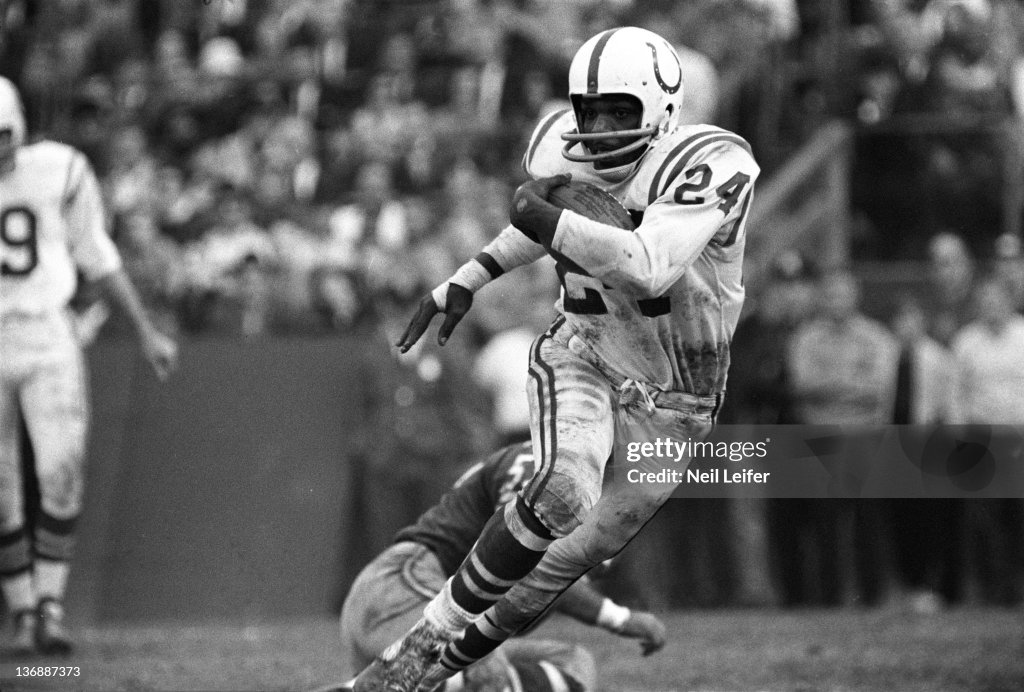
The Baltimore Colts, who have clinched the Western Conference title in the National Football League, racked up their 11th straight victory today, 14–3, over the host San Francisco 49ers. Lenny Moore scored the first Colts’ touchdown in the second period when he burst across from the 2‐yard line after John Brodie had fumbled, overcoming an early 3–0 49er lead. Then Johnny Unitas, the Colts quarterback, threw a 35yard scoring pass to Ray Berry with 2:34 left, in the game. Both conversions were kicked by Lou Michels, who also led a hot rush on Brodie. Brodie, frequently booed by a crowd of 33,642, had a rough day. He had five passes intercepted and fumbled three times. His last fumble came in the third period on the Baltimore 1‐yard line. The Colts are undefeated since dropping their season opener to the Minnesota Vikings. It was the ninth loss in 12 games for the last‐place 49ers.
The Green Bay defense picked up two fumbles for touchdowns today, one by Henry Jordan, and the other by Lionel Aldridge, as the Packers routed the Dallas Cowboys, 45–21. It was one of the worst defeats for the Cowboys in their five years in the National Football League and was viewed by the second best crowd of the season in Dallas — 44,975. Bart Starr passed for three touchdowns and ran for a fourth in leading the Green Bay attack.
The Minnesota Vikings struck for two touchdowns and a field goal in the first half today and rode the early margin to a 34–13 victory over the Los Angeles Rams. A crowd of 31,677 turned out in storm coats, sleeping bags and ski attire to watch the contest in the near‐zero cold. With the temperature hovering around the five‐degree mark frozen fingers chilled the passing attacks and neither side could establish a solid running game. The Rams fumbled the ball five times, losing it twice in the first half. Their only score in the first two periods was Bruce Gossett’s 18‐yard field goal. The Vikings were in command all the way, but the difference was not so big as the final score. Minnesota scored 10 points in the closing two minutes to make it a rout.
Christian Adolph (Sonny) Jurgensen finally beat the Giants today. The pudgy Redskin, who leads the National Football League’s quarterbacks in touchdown production and excess calories, threw four scoring passes as, Washington defeated New York, 36–21, before a capacity crowd of 49,219 in D. C. Stadium. The flaming redhead, an N.F.L. quarterback since 1957, had been in seven straight losing games against the Giants as a regular and had suffered all kinds of past indignities at the hands of the former champions. Today he served out the indignities, but was unimpressed by his achievement. The triumph, the Redskins’ sixth in their last eight games, lifted them into third place in the Eastern Conference. The Giants continued to languish in last place, losing for the eighth time in 12 starts. The Giants were crippled by injuries in their secondary. Every time Jurgensen needed yardage to sustain the Redskin offense, he threw to either AngeloCoia, the split end, or Preston Carpenter, the tight end. It was easy. Jurgensen, never under pressure from the Giant pass rush, achieved 10 of his team’s 25 first downs by throwing to these two receivers. And then there was Bobby Mitchell, the star flanker. Erich Barnes of the Giants did his usual good job covering Mitchell, but still Bobby scored twice. Sonny threw nine times to Bobby, missed five times, but hit him for a 32‐yard touchdown late in the game when Barnes had other responsibilities. On a perfect play earlier, Mitchell caught a pass on the backline of the end zone, and Barnes had no chance. Charlie Taylor caught Jurgensen’s other touchdown pass.
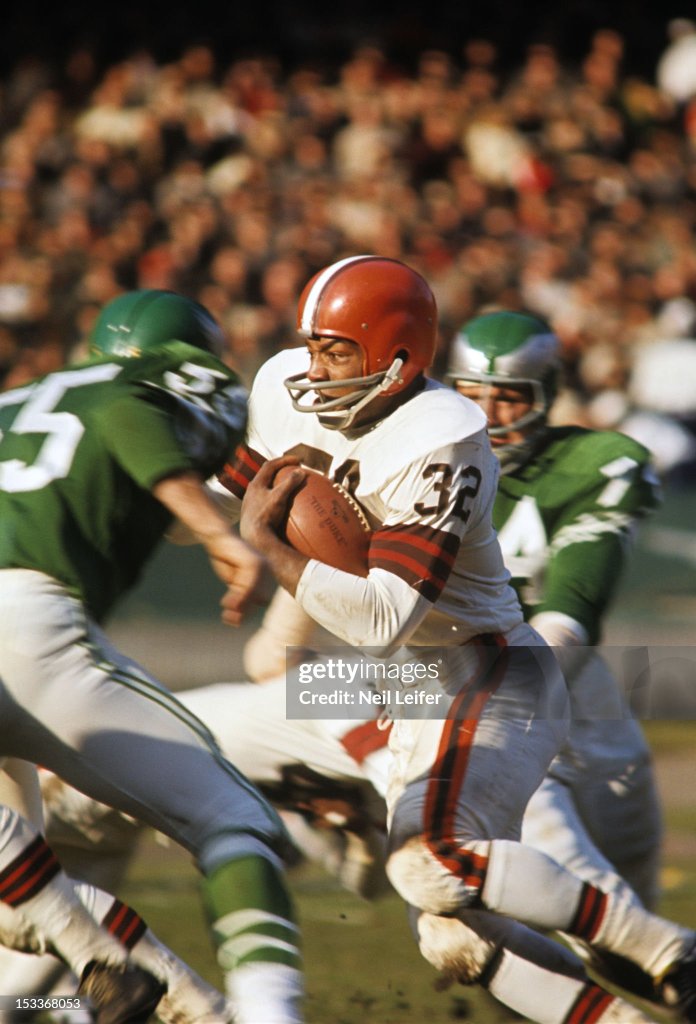
Cleveland’s alert and rugged defensive unit produced three touchdowns today as the Browns defeated the Philadelphia Eagles, 38–24, and moved to within one victory of clinching the Eastern Conference title in the National Football League. The Browns, seeking their first conference crown since 1957, scored touchdowns on a fumbled kickoff, a blocked punt and an intercepted pass to roll up a 21–3 lead at half‐time. The Cleveland defenders then turned in two more interceptions in the second half to frustrate the Eagles’ attack while Frank Ryan led the Browns offensive by throwing two touchdown passes to John Brewer. The Browns scored on the opening kickoff when Tim Brown fumbled the ball on the Philadelphia 12 and a reserve tackle, Roger Shoals, recovered in the end zone. Cleveland then added two “defensive” touchdowns within a 33‐second span, late in the second quarter. The lead was enough to offset an Eagles’ rally that produced three second‐half touchdowns.
Pat Fischer’s 49‐yard run with a fumble recovery late in the fourth quarter beat the Pittsburgh Steelers, 21–20, today and kept alive the St. Louis Cardinals’ hopes for the National Football League’s Eastern Conference title. Trailing by 20–7 in the fourth period, the Cards rallied as Charlie Johnson hit Jackie Smith with a 42‐yard touchdown toss and Fischer tallied after taking a fumble by John Henry Johnson. The Steelers had moved ahead when Jim Bradshaw took a fumble by John David Crow in the third period and ran 47 yards for a score. By winning, the Cards erased a 13‐game losing jinx at Pittsburth. They hadn’t won at Pittsburgh since 1948, when they beat the Steelers, 24–7.
AFL Football:
Oakland Raiders 20, Denver Broncos 20
Boston Patriots 34, Houston Oilers 17
Kansas City Chiefs 14, New York Jets 27
The Oakland Raiders rallied with 10 points in the fourth quarter today to tie Denver, 20–20, in a seesaw American Football League game. Mike Mercer’s 40‐yard field goal pulled Oakland into the deadlock with 3½ minutes left shortly after Tom Flores had connected on a 77‐yard pass to Art Powell on Denver’s 11. Dick Guesman of Denver tried a 45‐yard field goal in the last nine seconds, but the kick was wide to the left. Guesman’s opportunity came after a Bronco defender, Goose Gonsoulin had stolen the ball from Billy Cannon.
Babe Parilli passed for three touchdowns and Ross O’Hanley ran 47 yards with a pass interception for another today as the Boston Patriots defeated the Houston Oilers, 34–17, in an American Football League game. The Patriots’ victory — their fourth in a row — kept alive their hopes for the Eastern Division championship. The wide‐open passing game found the Oiler quarterbacks — George Blanda and Don Trull — completing 27 of 48 passes for 379 yards. Parilli hit on 20 of 36 attempts for 336 yards.
The New York Jets, often a lackadaisical football team in the later stages of games this season, exploded for 21 points in the second half at Shea Stadium yesterday and upset the Kansas City Chiefs, 27–14. Playing before 46,597 fans (8,462 of them Junior Jets), New York intercepted four passes by Len Dawson, the American Football League’s leading passer. Two of the in terceptions led to touchdowns and a third to a Jet field goal. The fourth halted a Chief drive on the New York 2. The victory was the Jets’ fifth against five losses and a tie, and halted a three‐game losing streak. All the New York triumphs have been scored at Shea Stadium. The defeat was a major blow to Kansas City’s title hopes, dropping the Chiefs deeper into second place in the Western Division with a 5–6 won‐lost record. Dick Wood, the lanky Jet quarterback, perhaps spurred by the fact that New York had drafted four quarterbacks on Saturday, fired touchdown passes to Bake Turner in the third period and to Matt Snell in the fourth.
Born:
Don Cheadle, American film actor (“Boogie Nights”, “Ocean’s Trilogy”) and producer; in Kansas City, Missouri.
Kris Kamm, American actor (Stuart Rosebrock – “Coach”), in Evanston, Illinois.
Larry Kelm, NFL linebacker (Los Angeles Rams, San Francisco 49ers), in Corpus Christi, Texas (d. 2014, in an accidental fall while deer hunting).
Cork Graham [Frederick Graham], American journalist, actor and author, in Port of Spain, Trinidad and Tobago.
Died:
Anne de Vries, 60, Dutch novelist.

 History Diaries