Finland denied shelling Mainila and suggested that the Russians had accidentally fired upon their own village in connection with training exercises. Finland sent Soviet Union a message noting that the Finnish Army had not fired any shots into Soviet territory. In response to the Soviet request on the previous day for Finnish troops to fall back 20 to 25 kilometers from the border, Finland suggested Soviet troops to do the same.
Finland quickly concludes from its investigation that it was impossible for Finnish troops to have fired upon Mainila, Russia. The reason is that Marshall Mannerheim, wise to “provocations,” previously had ordered all artillery out of range of the border. The Finnish government issues a diplomatic note to Moscow denying any involvement in the incident. The Finns suggest a mutual withdrawal of troops. The Soviets in the Kremlin, of course, know exactly what happened and are planning their next steps.
Premier Molotov’s note, the tone of which was held to be deliberately unfriendly and truculent, caused indignation all over Finland as evidencing the determination of the Soviet Government to pick a quarrel with Finland on any pretext as an aftermath of the deadlock in the negotiations in Moscow a fortnight ago, when Finland refused to cede vital territory to Russia. Since then Finland has watched with growing apprehension a campaign of abuse and threats in the Soviet press and on the radio against her neutral policy. This campaign now is culminating in resolutions adopted at mass meetings in Leningrad and Moscow, calling for drastic measures against Finland.
The Soviet charge of Finnish provocations is held here to be ludicrous, although its sinister implications are apparent. The newspapers express hope that no one abroad. will believe such nonsense as the charge that little Finland intends to provoke war with Russia’s 170,000,000 at a time when the Finnish population, after two months of severe tension, was preparing to settle down to more normal conditions. and when schools and universities were reopening and evacuees streaming back to their homes.
The British Foreign Secretary, Viscount Halifax, today informed the Soviet Ambassador, Ivan M. Maisky, of Britain’s hope that the Soviet-Finnish dispute involving warlike threats from Moscow would be settled peacefully.
Newspapers in the Baltic countries, following the lead of Soviet Russia’s press, today launched a campaign against Finland.
Germany supports an attack on Finland. A news service justifies the claim of Russia as the natural right of a big power.
German “Aryans” are given 12 months to divorce Jewish spouses. In the Reich, the marriage of “Aryans” to “Jews” is made illegal. Those so married are given one year to divorce. Just who is an Aryan and who is a Jew — always a huge issue in Germany — becomes a subject of much more deliberation.
With the proclamation of Britain’s export blockade of Germany, the Southeastern countries acquire still greater importance for the Reich not only as a source of food and materials but also as a market for German exports.
The Swedish government protests the laying of mines within Swedish territorial waters by German forces.
Local infantry and artillery action east of the Moselle River on the Western Front.
For the first time since the war began the French Parliament will meet “in extraordinary session” on Thursday. The decree fixing the day and the hour of 9:30 in the morning will be published in tomorrow’s official journal.
The British government orders the seizure of German exports on the high seas in reprisal for the magnetic mine campaign. King George signs an order in council approving reprisals against Germany for the indiscriminate mining of shipping lanes without warning.
The Luftwaffe drops more mines off the English coast.
The Nobel Committee of the Norwegian parliament announces that no Nobel peace prize is to be awarded for 1939.
The British Empire completes air training plans. Britain, Canada, New Zealand, and Australia agree on terms. 25,000 airmen are to be trained per year.
Douglas Bader made his first solo flight since his 1931 air accident that cost him both of his legs.
German armored ship Admiral Graf Spee refuels from tanker Altmark in South Atlantic.
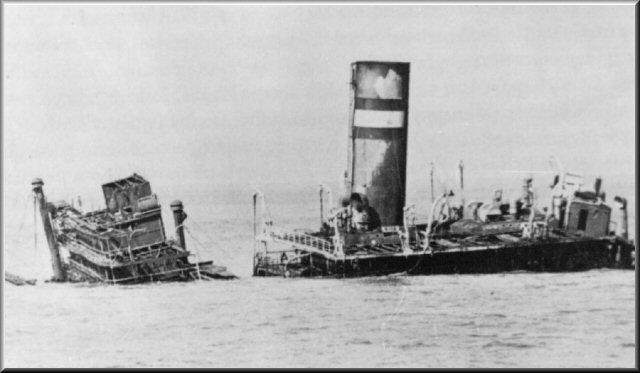
The neutral Swedish motor tanker Gustaf E. Reuter was torpedoed and sunk by the U-48, commanded by Kapitänleutnant Herbert Schultze, north of Scotland in the North Sea. At 00.30 hours on 27 Nov 1939 the unescorted and neutral Gustaf E. Reuter (Master O. Larsson) was hit in the foreship by one torpedo from U-48 14 miles west-northwest from Fair Isle. The U-boat had spotted the illuminated tanker and a destroyer four hours earlier and missed the ship with a first torpedo at 23.32 hours on 26 November. The drifting tanker was found off Sumburgh Head by HMS Kingston Beryl (4.03) that took off eight survivors and transferred them to the tug HMS St. Mellons (W 81) from Kirkwall, which then took the ship in tow by the stern. The next day a gale parted the tow and broke off the bow of Gustaf E. Reuter. The master and 18 crew members were landed at Lerwick by the tug and were joined by 14 survivors who were rescued by the Lerwick lifeboat Lady Jane and Martha Ryland. The stern section had to be scuttled by a British warship, probably HMS Kingston Beryl, on 28 November. Of the ship’s complement, 1 died and 33 survived. The 6,336-ton Gustaf E. Reuter was carrying ballast and was bound for Curaçao.
The Dutch cargo liner Spaarndam struck a mine and sank in the North Sea 2 nautical miles (3.7 km) northeast of the Tongue Lightship (United Kingdom) with the loss of seven crew. The mine had been laid during the night of 12/13 November 1939 by Kriegsmarine destroyers. There are six victims. The liner had been en route from New Orleans to Rotterdam via London.
U.S. freighter Effingham is detained at Ramsgate, England, by British authorities.
The freighter Azalea City is detained at London.
Freighter Excambion, detained at Gibraltar by the British since 20 November, is released.
The War at Sea, Monday, 27 November 1939 (naval-history.net)
A Swordfish of 818 Squadron from aircraft carrier FURIOUS failed to return from patrol, but Lt S G J Appleby and his crew were rescued and returned to the ship.
Heavy cruiser NORFOLK arrived at Scapa Flow to refuel and departed the next day to rejoin the Main Fleet at sea.
Light cruiser SHEFFIELD arrived at Scapa Flow to refuel.
Light cruiser GLASGOW departed Scapa Flow and proceeded to Rosyth to boiler clean from 28 November to 5 December.
Light cruiser COLOMBO departed Sullom Voe on Northern Patrol duties and arrived at Loch Ewe on 2 December.
Light cruiser CARDIFF departed Scapa Flow for Northern Patrol.
Light cruiser CALEDON arrived at Scapa Flow after Northern Patrol in the Faroes-Shetland passage.
Light cruiser MANCHESTER was used for degaussing tests on the 27th while at Portsmouth for refit.
Destroyers ECHO and ECLIPSE spent the day off Northern Ireland unsuccessfully searching for a U-boat.
Destroyer VIVACIOUS on patrol in the Western Approaches developed an urgent engine room defect and was forced to return to Plymouth.
Destroyer ASHANTI on Fair Isle Channel Patrol developed a leak in her reserve fuel tank which reduced her speed.
Destroyer KELVIN (Lt Cdr J L Machin) was completed and after working up, joined the 5th Destroyer Flotilla operating with the Home Fleet on 10 January 1940.
Destroyer VEGA completed conversion to a fast escort vessel. Following working up at Portland, she joined Convoy C operating from Rosyth.
Convoy SA.19 of two steamers departed Southampton, escorted by destroyers VENOMOUS and WINDSOR, and arrived at Brest on the 29th.
Starting on the 27th, the East Coast FN and FS convoys would run only between Southend and the Tyne. Ships going further north would then proceed independently the following night.
Steamer STANGATE (1289grt) was damaged in a collision in English waters.
U-58 laid mines off Lowestoft.
Battlecruiser REPULSE and aircraft carrier FURIOUS, her turbine defects corrected, departed Halifax with destroyer HYPERION to cover convoys HXF.10 and HX.10.
Sloop EGRET arrived at Port Said from the Indian Ocean and departed for Malta, en route to England.
A Swordfish of 824 Squadron from aircraft carrier EAGLE crashed into the sea on anti-submarine patrol off Colombo. The pilot Sub Lt M R Maund, Leading Airman J Manning, and Telegraphist Air Gunner J C Mardlin were picked up by Australian destroyer HMAS WATERHEN.
French large destroyer AIGLE arrived at Gibraltar and left for Oran that afternoon.
Australian boom defence vessel HMAS KOOKABURRA lost Lt N B Skottowe RAN, killed in an accident.
Tentative U.S. budget estimates for the 1941 fiscal year were laid on an “operating table” at the Little White House in Warm Springs today with President Roosevelt in the role of chief surgeon and were relieved of a few hampering growths. The operation lasted three hours, during which the President used both blue pencil and pruning shears, according to Harold D. Smith, Budget Director, who participated in the whittling process. “We continued our operations on the budget,” said Mr. Smith after his three-hour conference with the Chief Executive in the Little White House atop Pine Mountain.
The Budget Director would not disclose how much in dollars and cents was shaved from tentatively accepted estimates of the various departments which he brought with him from Washington aboard an army plane. However, he did vouch for the successful outcome of the operation, saying “we were just taking out a few appendices.” President Roosevelt let it be known recently that he was wielding the blue pencil with a heavy hand in his continuing conferences with Mr. Smith. He mentioned no figures, but elsewhere within the Administration his budgetary goal I was placed at about $9,000,000,000 with the expressed hope that the deficit for the 1941 fiscal year might be limited to $2,000,000,000 despite a $500,000,000 increase in expenditures for the national defense.
Budget estimates for the Treasury, post office, and Panama Canal were the principal items for which presidential clearance was sought by Mr. Smith at today’s conference, but he indicated that the whole question of government expenditures and revenues had been canvassed. He added that Mr. Roosevelt probably would discuss the subject at his press conference tomorrow. It was at this last press conference here that President Roosevelt. disclosed the Administration’s hopes of cutting the current fiscal year’s deficit by more than half during the period beginning July 1, 1941. He conceded, however, that its ability to do this would depend on Congressional adherence to budget estimates and a continuation of the present level of revenues which depended in turn on business activity as good or better than at present.
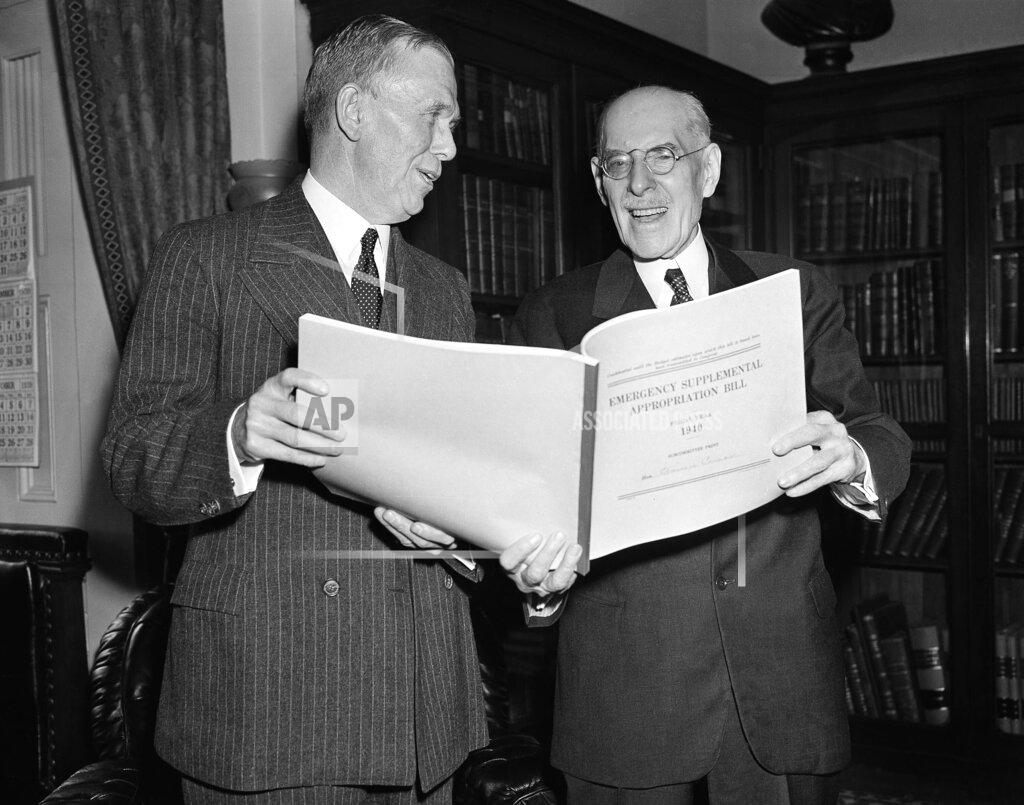
The Administration’s campaign for an immediate increase in defense funds, prompted by the European war, opened today with the appearance of General George C. Marshall, Chief of Staff, before a House Appropriations subcommittee.
U.S. Congressman Martin Dies is told that Reds run the teachers’ union. Their control is called strong; First Lady Eleanor Roosevelt is willing to testify. Charges that New York City Local No. 5 of the American Federation of Teachers was controlled by Communists, that the entire federation appeared to be likewise dominated and that the American Student Union was the vehicle used to spread Communist doctrine in many colleges of the country, were made by three witnesses today before the House committee investigating un-American activities.
The testimony was offered as Mrs. Roosevelt told her weekly press conference, in response to a question, that she would be willing to testify before the committee if asked, but was not volunteering nor seeking to be called. Her comment arose from a recent suggestion of Alfred W. Lilienthal, vice chairman of the Provisional Committee for American Youth, that Mrs. Roosevelt appear before the committee and defend her support of the American Youth Congress, which he held to be under Communist influence. Representatives Starnes, Mason and Voorhees of the committee said that they would be glad to have Mrs. Roosevelt testify if she wished, while Chairman Dies, who is ill at his home, said he would take under advisement what he, like the other committeemen, understood to be a request by Mrs. Roosevelt to be called.
The testimony on the American Federation of Teachers came from Dr. Henry R. Linville, long a New York City high school teacher, for some years head of the federation’s Local No. 5 and now active director of the unaffiliated New York Teachers Guild. He said that “liberals” in the local began in 1932 a fight against Communist elements and in 1935 withdrew, about 600 forming the Teachers Guild. At the time of the withdrawal, he testified, the Communists in the local were a minority, “but a very aggressive one,” which his group felt was sure to gain full control in another year through continuance of contentious tactics which were driving other members out. After the withdrawal of the “liberal” group, which was headed by Dr. John Dewey, the witness said, the two Communist factions, the Stalinists and Lovestoneites, obtained complete control of the local, and still retained it.
That the entire American Federation of Teachers was also Communist-controlled was indicated to his mind, Dr. Linville declared, by the position it had taken on many public issues. Although the non-Communists in the federation appeared to have won a victory recently in electing Dr. George S. Counts as president, he added, it was significant that every open opponent of the Communist faction who ran for the executive board of fifteen was defeated and that the federation rejected the appeal of the executive council of the American Federation of Labor that it revoke the charter of Local No. 5 and reorganize it to eliminate Communist domination.
In a three-hour-and-twenty-minute summing up, Peter L. F. Sabbatino, counsel for Fritz Kuhn, leader of the German-American Bund, yesterday described his client as a “strutting” little fellow who ought to be “destroyed,” but he implored a jury in General Sessions Court not to do it with a verdict of guilty on three counts of larceny and two of forgery for which Kuhn is on trial. He pleaded that Kuhn was innocent of the charges of using $717.02 of bund money for transportation of the furniture of Mrs. Florence Camp, and of the charge of misappropriating $500 that Kuhn listed as having been paid to James D. C. Murray, the lawyer, and urged that Kuhn had been made the victim of a “political persecution” intended. to destroy him and the Bund.
As for the “effectiveness” of the Bundesführer, whose aims Mr. Sabbatino said he joined in deploring, the lawyer contended that the trial and the love letters of Kuhn to Mrs. Camp had already destroyed that. He charged that the love letters had been put in evidence for the “newspaper fellows,” and although he said he did not want to “magnify the importance of my client,” he urged the jurors to consider that Kuhn was not the first man, “even though married, to fall in love with another woman.” He named Julius Caesar and Napoleon as two who had similarly sinned.
Secretary Hull expressed his gratification today at the statement of Prime Minister Chamberlain over the radio yesterday that “there can be no lasting peace unless there is a full and constant flow of trade between nations.”
Paul V. McNutt, Federal Security Administrator, will have more than 100 delegates of the 350 from the Eastern States on the first ballot at the Democratic National Convention, it was said here yesterday by Oscar R. Ewing, eastern manager of the McNutt pre-convention campaign.
The Republican national convention next year will have 999 delegates instead of 1,003, as in 1936, according to a preliminary computation. The representation in the Democratic convention will be unchanged at 1,100.
A more hopeful outlook for early settlement of the fifty-two-day dispute between the Chrysler Corporation and the C.I.O.’s United Automobile Workers was apparent today when Philip Murray, vice president of the Congress of Industrial Organizations, entered the negotiations.
California Governor Olson hinted today that the State might attempt to take over and operate San Francisco’s strike-bound waterfront.
Julian S. Huxley, noted British biologist and writer, calls for the scientific research cooperation between the United States and England to continue.
Maxwell Anderson’s play “Key Largo” premieres in NYC.
Japanese forces complete the capture of Nanning, an important rail junction in the southwest.
The evacuation of Nanning by the regular Chinese troops was fairly complete before the Japanese entered the city, according to observers in Hong Kong. The Japanese are now unable to venture far for fear of the overwhelming threat of superior Chinese forces to the north. It is unlikely that reinforcements can be spared, and so Nanning will be just another isolated Japanese garrison.
The Japanese reported today that their forces had pushed on from Nanning toward another important Chinese base. The new objective of the Japanese offensive against Chinese “lifelines” in Southwest China was not identified, however.
The last automobile caravan to use the highway from Indo-China via Nanning arrived today with nine American missionaries of the Scandinavian Alliance of Chicago. Three of the Americans, Edith Johnson, Ruth Nelson and Oscar Beckon, said they narrowly escaped death when Japanese planes bombed and machine-gunned the highway on which they left Nanning just before Japanese troops captured the city.
Dow Jones Industrial Average: 148.59 (-0.05)
Born:
Laurent-Désiré Kabila, President of the Democratic Republic of the Congo, in Baudouinville, Belgian Congo (d. 2001).
Dave Giusti, MLB pitcher (World Series Champions-Pirates, 1971; All-Star, 1973; Houston Astros, St. Louis Cardinals, Pittsburgh Pirates, Oakland A’s, Chicago Cubs), in Seneca Falls, New York.
Ann Prentiss [as Ann Elizabeth Ragusa], American actress (“The Out of Towners”), in San Antonio, Texas (d. 2010).
Ulla Strömstedt, actress, in Stockholm, Sweden (d. 1986).
Naval Construction:
The Royal Navy Bangor-class (Turbine engined) minesweepers HMS Boston (J 14) and HMS Rye (J 76) are laid down by Ailsa Shipbuilding Co. Ltd. (Troon, Scotland).
The Вое́нно-морско́й флот СССР (ВМФ) (Soviet Navy) “M” (Malyutka)-class (3rd group, Type XII) submarines M-114, M-115, and M-116 are laid down by Krasnoye Sormovo (Gorkiy, U.S.S.R) / Yard 112; completed by Dalzavod (Vladivostok, U.S.S.R.) / Yard 202.
The Royal Navy Flower-class corvette HMS Hollyhock (K 64) is laid down by John Crown & Sons Ltd. (Sunderland, U.K); completed by N.E. Marine.
The Вое́нно-морско́й флот СССР (ВМФ) (Soviet Navy) “S” (Stalinec)-class (2nd group, Type IX-modified) submarine S-55 is launched by Dalzavod (Vladivostok, U.S.S.R.) / Yard 202.
The Nihon Kaigun (Imperial Japanese Navy) Shōkaku-class aircraft carrier HIJMS Zuikaku (瑞鶴, “Auspicious Crane”) is launched by the Kawasaki Shipyards (Kobe, Japan).
The Вое́нно-морско́й флот СССР (ВМФ) (Soviet Navy) “S” (Stalinec)-class (2nd group, Type IX-modified) submarine S-4 is commissioned. Her first commanding officer is Captain-lieutenant Dmitry S. Abrosimov.
The U.S. Navy Sargo-class submarine USS Sealion (SS-195) is commissioned. Her first commanding officer is Lieutenant Julian Knox Morrison, Jr., USN.
The Royal Navy “K”-class destroyer HMS Kelvin (F 37) is commissioned. Her first commanding officer is Lieutenant Commander John Lee Machin, RN.

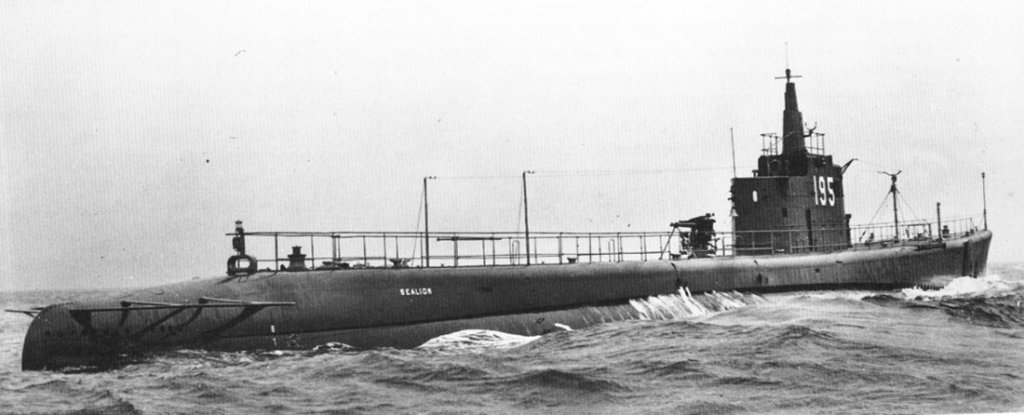
Scuttled 25 December 1941.
Following shakedown, Sealion, assigned to Submarine Division (SubDiv) 17, prepared for overseas deployment. In the spring of 1940, she sailed, with her division, for the Philippines, arriving at Cavite in the fall to commence operations as a unit of the Asiatic Fleet. Into October of 1941, she ranged from Luzon into the Sulu Archipelago; then, with another submarine of her division, now SubDiv 202, she prepared for a regular overhaul at the Cavite Navy Yard. By 8 December (7 December east of the International Date Line), her yard period had begun; and, two days later, she took two direct hits in the Japanese air raid which demolished the navy yard.
The first bomb struck the after end of her conning tower and exploded outside the hull, over the control room. The second smashed through a main ballast tank and the pressure hull to explode in the after engine room, killing the four men then working there.
Sealion flooded immediately and settled down by the stern with 40% of her main deck underwater and a 15° list to starboard. The destruction of the navy yard made repairs impossible, and she was ordered destroyed. All salvageable equipment was taken off; depth charges were placed inside; and, on 25 December, the explosives were set off to prevent her from being made useful to the enemy.

Kelvin fought in several theatres during the Second World War. In September 1940, as part of the 5th Destroyer Flotilla she scuttled HMS Ivanhoe, which had struck a mine off Texel during the Texel Disaster. In October, she was part of the escort for the battleship HMS Revenge when she shelled Cherbourg.
Under Admiral James Somerville, she was involved at the action off Cape Spartivento on 27 November 1940, and for the next two years she was busy in the Mediterranean Sea, being involved in many engagements.
In May 1941, she bombarded Benghazi in company with the destroyers HMS Jackal, HMS Kashmir, HMS Kelly and HMS Kipling before heading to Crete on 20 May 1941. She survived the withdrawal with comparatively light casualties, but required repairs and was sent to Bombay during which time her crew had sufficient time to tour India as far north as the Khyber Pass. By March 1942 she was back in the Mediterranean escorting convoy MW.10 which took part in the Second Battle of Sirte. Later in the year she was involved in diversionary attacks in support of Operation Pedestal and bombarded Rhodes.
On 16 April 1942, Kelvin landed troops from the 11th Battalion of the Royal Marines at Koufonisi near Crete to destroy a W/T station (Operation Lighter). In December, in company with HMS Janus, HMS Javelin and HMS Jervis, she sank the Italian torpedo boat Lupo off Kerkennah Bank, Tunisia.
In January 1943, she bombarded Zuwara and in company with Nubian was responsible for sinking a variety of Italian supply ships and minesweepers. Then along with HMS Javelin, Kelvin destroyed an Italian convoy on the night of 19 January 1943. Several members of her crew were decorated for their part in destroying enemy ships and aircraft in the Mediterranean.
She returned to the UK for refit in Chatham in July 1943, recommissioning in March 1944. In June 1944 she carried Winston Churchill and various other dignitaries across the English Channel during Operation Overlord. She returned to the Mediterranean and took part in operations to liberate the Dodecanese. She bombarded Tilos and landed a party of Special Boat Service troops in November 1944.
Unlike many of the other J-, K- and N-class destroyers, Kelvin survived the war and was sold for scrap on 6 April 1949 and broken up at Troon in Scotland.
Battle Honours: ATLANTIC 1940 – SPARTIVENTO 1940 – CRETE 1941 – MEDITERRANEAN 1941-43 – SIRTE 1942 MALTA CONVOYS 1942 – NORMANDY 1944 – AEGEAN 1944
 History Diaries