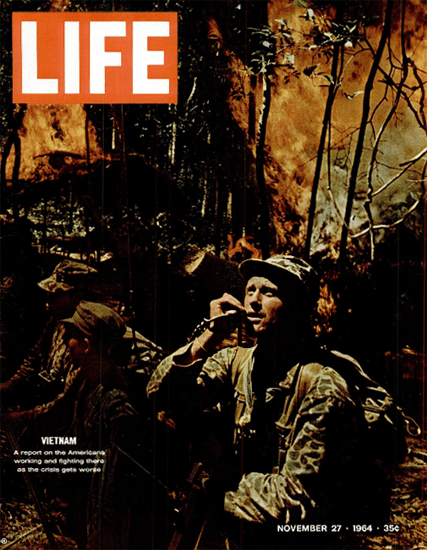
The South Vietnam Government’s strong stand against street demonstrations appeared today to have dampened the enthusiasm of opponents of Premier Trần Văn Hương. The city was quiet. Infantrymen and paratroopers patrolled the streets to maintain order under a formal decree of martial law promulgated yesterday. The capital and the surrounding province, Gia Định, are to be ruled by a military governor for the next month. The Buddhist secular and religious institutes have decided to close the Buddhist center temporarily. The center was the scene of bitter street fighting Wednesday and the point of origin of many of the anti‐Government protest marches. The latest outburst of rioting, which began Sunday, was inspired by political factions angry at their exclusion from Premier Trần Văn Hương’s Cabinet. The decision was taken, according to a Buddhist statement, “to avoid having large gatherings exploited into demonstrations to the detriment of the prestige of the Buddhist Church.”
Buddhist leaders seemed to have backed away from their stand of Tuesday when they called for the removal of the Premier and condemned police and military “repression” against demonstrators. A group of Opposition politicians headed by a former member of the country’s provisional legislature, the High National Council, held a news conference to denounce Premier Hương, both for the stern measures he ordered against rioters and for the nonpolitical character of his Cabinet ministers. The Council has found itself immobilized between the factions that wish to censure the government and those that deem it necessary to stand by the Premier they elected only a month ago. After debate yesterday that extended late into the night, the Council failed to decide whether to warn Premier Hương that he might have to reshuffle his Cabinet. Such a warning would be in response to popular demands for a motion criticizing the Premier for the press censorship imposed as part of his martial‐law policy. Vietnamese and American officials have noted the strange and apparently deliberate absence from the capital of some of the leading figures in the country.
Notable among the absentees was the commander in chief of the armed forces, Nguyễn Khánh, the former Premier who was promoted today from major general to lieutenant general. Also promoted to lieutenant general was Dương Văn Minh, who was Chief of State under General Khánh’s eight‐month rule. General Minh is now traveling abroad. General Khánh has not been in the capital during the recent troubles. Another absentee is Thích Trí Quang, one of the country’s most powerful Buddhist monks and the man credited with having inspired the August riots against General Khánh’s military rule. The Buddhist leader was in Saigon when the riots started, then departed quietly for Huế, principal city of central Vietnam, where his grass‐roots strength lies. He took no part in the Buddhist decisions first to oppose the Hương Government, later to withdraw encouragement of the demonstrations. The Buddhist leader involved in these decisions. Thích Tâm Châu, has also left the city. He was out of town when the riots started Sunday, returned Monday to analyze the situation, then left today without disclosing his destination.
South Vietnam Government forces reported a “big victory” against Communist Việt Cộng guerrillas today in the Cam Lộ district of Quảng Trị Province, the Vietnam News Agency reported. It said the guerrillas had left behind at least 100 dead.
A tour of the border between Cambodia and South Vietnam by a low‐flying helicopter today did not substantiate charges that two Cambodian border villages were providing training centers for the Vietnamese guerrillas. It had been reported in Saigon that a rifle range and a long horseshoe‐shaped trench could be seen in the Cambodian villages of Ba Thu and Tanoye. Some military quarters considered the reported existence of these installations as an indication that the guerrillas were using both villages. From an altitude that would have almost certainly guaranteed detection, neither facility could be seen. The brief tour, made by three American correspondents and one from Communist China, did point up, however, the difficulties in judging how important Cambodian border sanctuaries may be for the Việt Cộng. For three years Western newsmen have made periodic attempts to verify South Vietnamese accusations that Cambodia was actively aiding the Communist insurgents. The inspections have not turned up the kind of evidence reported by the authorities in Saigon.
However, Western observers in Pnompenh do not dismiss the accusations despite the lack of definite evidence. They point out that any house along the Cambodian border might serve, when needed, as a hospital for the Việt Cộng, and that the leaders in rice paddies by day may be smugglers by night. They say that goods, particularly chemicals for explosives, have been smuggled into South Vietnam from Cambodia. In Saigon some American officials charge that supply operations through Cambodia cannot be carried out without Cambodian Government knowledge and tacit agreement. This accusation has infuriated Prince Sihanouk, Cambodia’s chief of state, who has demanded that the United States withdraw the charge. The Westerners in Pnompenh who have made extensive investigations on foot along the border have generally sided with the Prince.
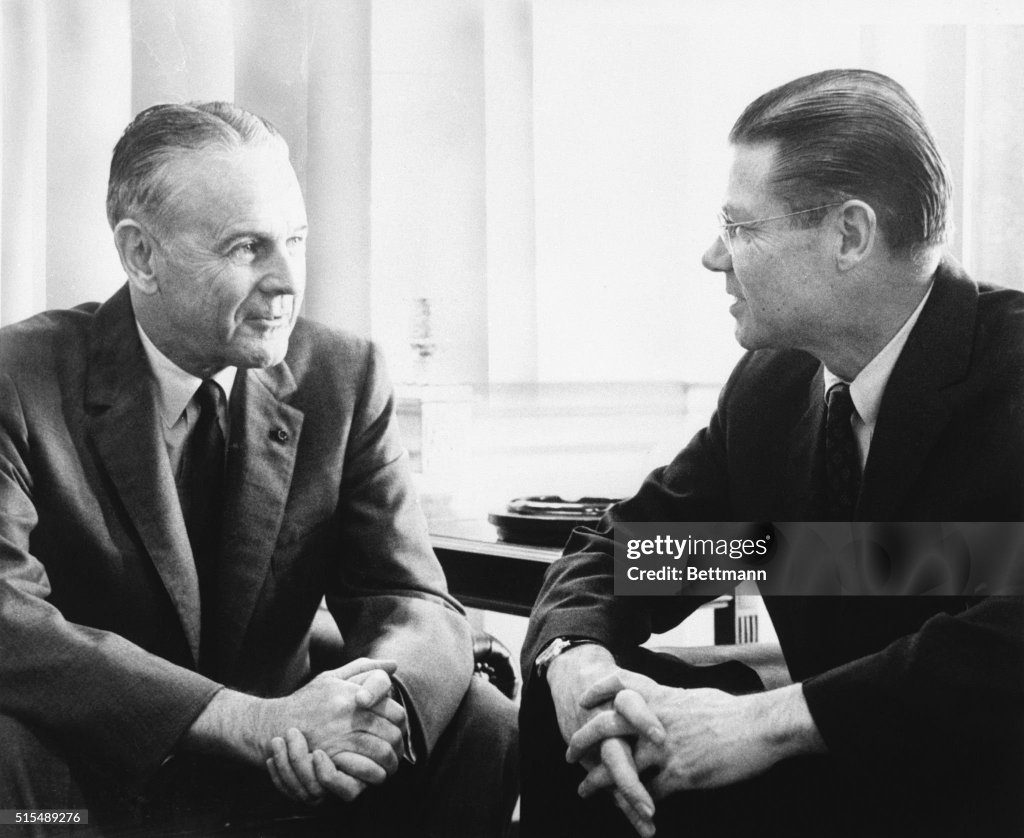
Ambassador Maxwell Taylor arrives in Washington for a meeting with the National Security Council and calls for an escalation of U.S. bombing of North Vietnam. Administration officials here and with President Johnson in Texas sought today to dampen speculation that the United States was considering a dramatic expansion of the war in South Vietnam. In Washington, where Maxwell D. Taylor, Ambassador to South Vietnam, consulted with top policy‐makers, reports that he had advocated bombing certain targets in Laos and North Vietnam were not mentioned. In Johnson City, Texas, a White House source emphasized that General Taylor’s return to the United States for the policy review did not imply that “any great, horrendous decision” would result. The President is on a working vacation at his LBJ ranch. Malcolm Kilduff, assistant White House press secretary, announced at the same time that the South Vietnam policy review would move to the White House next Tuesday. The President is expected back in the capital Sunday or Monday.
President Johnson will hear a report Tuesday by Ambassador Taylor and will be briefed on the Government discussions that began at the State Department today. The central issue in these discussions, it is understood, is a program formulated by Ambassador Taylor in the light of the growing strength of the Communist insurgents despite United States support of the regime in Saigon. According to earlier reports, which prompted warnings of intervention by the Soviet Union and Communist China, the Ambassador had suggested selective bombing of certain Việt Cộng depots and training centers that lie just outside the South Vietnamese border in Laos and North Vietnam.
Bertrand Russell, the 92‐year‐old philosopher, asked in an open letter to President Johnson today if the United States thought it worth risking nuclear war to achieve its aims in Vietnam. “The American Government is hesitating, so it appears, as to whether the war would be extended to North Vietnam and to China” Earl Russell said. “A war against China, if it is not nuclear; is likely to drag on inconclusively for years.” Contending that the South Vietnamese want only to be neutral, the philosopher suggested that the United States was pressing claims of its own that might eventually draw the Soviet Union to the side of the Chinese and North Vietnamese and raise the prospect of nuclear “extermination of the human race.”
Twenty‐eight white hostages, including four Spanish nuns, were found massacred by rebels today on the left bank of the Congo River in Stanleyville. Word of these new slayings provoked anger over the sudden withdrawal of rescue forces of Belgian paratroopers and their American aircraft, which began today on orders from Washington and Brussels. A high‐ranking Red Cross official said late tonight that the number of hostages slain in Stanleyville might exceed 45. The only survivors who were brought back across the river to the main city were a Belgian woman and four Belgian men. Their account of the murder of the nuns and an undisclosed number of Dutch priests appeared to confirm fears here that the rebels had decided to slaughter all whites still in their hands. A sixth survivor — identified as Father Schuster, a missionary from Luxembourg — was evacuated to Kamina airbase in North Katanga Province. A bullet was lodged in a lung.
Late at night, reliable but unconfirmed reports said 12 Europeans and an American missionary had been executed in Wamba, about 150 miles north of Stanleyville. A Stanleyville survivor, Camille Borry, said one victim was an unidentified planter from Argentina. “We were the only ones to get out alive,” he said at Leopoldville Airport tonight. “We paid for our lives with money and beer but the priests and nuns had nothing to give.”
Belgian paratroops are to begin leaving the Congo tomorrow for Ascension Island, a Government spokesman said tonight. They are scheduled to arrive in Belgium Tuesday, a week after they were airdropped into rebel held territory to rescue white hostages. According to estimates of Government officials, 900 Europeans and Asians will be left in rebel territory in the northwestern Congo after the paratroops depart. Most are believed to be in a triangular area stretching from Bunia to Wamba to Watsa, about 120 miles apart.
Viscount Etienne Davignon, administrative chief of the Foreign Office, said it would be impossible to carry out another airborne rescue in that area because there were no airfields. He said that the settlers lived in scattered pockets and that since they had not been rounded up by the rebels, as at Stanleyville and Paulis, it would be impossible for the paratroopers to gather for a rescue. Government officials refused to speculate on their fate. Viscount Davignon said the last planeload of paratroops left the airstrip at Paulis at 4 P. M. under rebel fire.
They were to regroup at the Kamina military base tonight. Tomorrow they are to begin leaving for Ascension, a British dependency due east of the Congo, in the south Atlantic. The troops are using United States Air Force C‐130’s, the planes that carried them from Belgium to the island on November 17. The planes are to fly Monday to Las Palmas. in the Canary Islands, where the Belgian troops and the United States Air Force crews are expected to spend a night. Viscount Davignon said 2,000 whites and Asians were rescued during the four‐day airborne operation. According to Viscount Davignon, just over 1,000 Belgians and Americans were among the 2.000 to 2,500 refugees flown out of rebel‐held territory. The rest, he said, were mostly Indians, Pakistanis and Greeks.
Viscount Davignon cast doubt on whether the Stanleyville massacre of white hostages had been premeditated. He said Belgian officials had questioned a number of survivors of the shooting that took place near the VictcTia Hotel Tuesday morning. This account has emerged as a possible explanation of the killing. Colonel Opepe, a rebel leader in charge of the white hostages imprisoned in the hotel, led 250 white men, women and children outside as the first Western planes were approaching the city. Apparently the colonel told a subordinate that he intended to march them, under the surveillance of 15 to 18 guards, to the airfield. There, he said, he would bargain with the paratroopers, exchanging the lives of the hostages for the safety of the rebel guard detachment. But as they were going through the main square, firing could be heard from the airfield. The guards became frightened and made the prisoners crouch. Just then, a Major Bubu came running into the square. “The paratroopers have come,” he cried, “Shoot the whites.” The Belgians heard him and panicked. They began to run in all directions for cover. It was then that the guards, also in panic, opened fire.
African nations appeared determined today to try to force the Congo to form a coalition government with the country’s rebel forces. Delegate after delegate supported such a course at the opening of an emergency meeting of the Organization of African Unity’s Congo Conciliation Commission. They assailed the United States, Belgium and Congolese Premier Moïse Tshombe. Kenya’s Prime Minister, Jomo Kenyatta, accused the United States of being committed to force in the Congo. Mr. Kenyatta, as chairman of the 10‐nation commission, made the opening speech.
Ethiopia condemned the American and Belgian rescue of an estimated total of 1,200 white hostages from the Congolese rebels in Stanleyville and Paulis this week as “international banditry” masquerading under the “lofty banner of humanitarianism.” The Ethiopian delegate called on the rest of the African states to consider “collective reprisals and sanctions” against the United States and Belgium as an expression of moral indignation over the airlift.
Michael P. E. Hoyt, the United States Consul rescued three days ago in Stanleyville, said tonight that the Congolese rebels were essentially a military faction out to win power rather than a pro‐Communist movement. Mr. Hoyt held a news conference at the State Department in the company of David K. Grinwis, one of the four other staff members of the consulate who were flown out of Stanleyville with hundreds of other whites following their rescue by Belgian paratroopers. In careful answers, Mr. Hoyt agreed that it would not be accurate and, indeed, would be too “simplistic” to portray the rebels’ so‐called Peoples’ Republic as a Marxist or Communist-oriented movement. “It is essentially a military movement,” he said, “with people fighting and the use of nationalistic revolutionary slogans.”
A Chinese Communist official visiting Italy urged today that a regional nuclear disarmament pact be negotiated by Peking, the United States, the Soviet Union Japan and other nations on the Pacific. The official, Liao Chen‐chin, a member of the Central Committee of the Chinese Communist party, is head of a sevenmember delegation that came here after a visit to France. In an interview with Il Paese Sera of Rome,’ a pro‐Communist newspaper, Mr. Liao said the proposed pact should ban nuclear weapons “on either side of the Pacific.”
Lhendup Dorji, who had been the acting Prime Minister of Bhutan after being appointed on July 25 (following the April 5 assassination of Jigme Palden Dorji), was dismissed by King Jigme Singye Wangchuck. No new Prime Minister was appointed for the Himalayan mountain kingdom, and the king would appoint a Royal Advisory Council to serve the function of administering the government.
The British pound appears to be out of its immediate difficulty, but Britain’s international money problems are far from ended. The money markets of Western Europe were calmer today. Wednesday’s $3 billion instant aid package staunched the speculative flight that threatened to force devaluation. But the uneasiness that caused the crisis did not develop overnight and has not been eliminated in the last two days. The uneasiness began in September, before Britain’s elections, and it has been aggravated by much that has happened since — not the least the 15 per cent British surtax on imports. Even during this week of crisis, France and Denmark have made further public protests against the tax, demanding its early repeal.
The aid package, from 11 countries and the Bank for International Settlements, is essentially a three‐month credit, as is customary for central bank deals. But some of it is repayable three months after it is borrowed, which makes it six‐month credit if it is not borrowed until three months from now. Full details of who contributed what has not been published yet and, according to some insiders, not even fully worked out. Sources here revealed that the European Common Market countries — France, Italy, West Germany, Belgium, the Netherlands and Luxembourg — are putting up a little more than the $1 billion provided by the United States.
Galo Plaza Lasso, the United Nations mediator in Cyprus, was informed by Foreign Secretary Patrick Gordon Walker today that Britain did not intend to relinquish her military bases in Cyprus to achieve a political settlement there.
In Cairo, U.S. Ambassador Lucius D. Battle delivered an emphatic protest today to the Government of the United Arab Republic over the assault by a mob on the United States Embassy last night. He demanded compensation for the heavy damage, which included the burning of both the United States Information Service library with most of its 27,000 volumes and the two‐story dormitory of the embassys’ Marine guards. The embassy compound was pillaged. Scores of windows were shattered, and a dozen embassy cars were smashed by demonstrators hurling flower pots and rocks. An embassy spokesman said the Ambassador had expressed dissatisfaction to Acting Foreign Minister Farid Abu Shadi over the authorities’ efforts to curb the mob.
Britain called in the Security Council today for practical measures to prevent a recurrence of violence along the Syrian‐Israeli border. As a “first necessity” the British delegate, Lord Caradon, urged the survey and marking of the border in the area where a military clash November 13 led to the killing of four Israelis and seven Syrians. A complete survey of‐the area was recommended by Lieutenant General Odd Bull, head of the United Nations Palestine Truce Organization, in a report Wednesday on the fighting. The truce chief also noted that past survey efforts had been obstructed by one side or the other and urged that a new attempt be made by an independent team of foreign experts whose findings would not be challenged.
The Council also heard Syrian and Israeli delegates, by turn, contend that the general’s report supported their conflicting versions of the November 13 clash, which occurred north of the Sea of Galilee. Rafik Asha of Syria, in a sweeping two‐hour attack on Israeli policies, scored Israel’s use of fighter planes as an “act of war” deserving both condemnation by the Council and even such punishment as economic sanctions and a cut‐off of diplomatic relations. Michael Comay of Israel maintained that the bombing by the planes November 13 was strictly confined to Syrian military positions directly involved in theattack on Israeli villages. He also remarked that truce officials had not been permitted to check either on Syrian allegations of civilian casualties or on villages damaged.
The collision of the Israeli luxury liner Shalom and a Norwegian tanker off the New Jersey coast early Thursday remained a mystery yesterday. Legal and insurance advisers of the owners of the 25,338‐ton Shalom and the 19,150‐ton Stolt Dagali ordered crews and operators of both ships not to discuss numerous unanswered questions about how the accident occurred. The ships collided in deep water southeast of Asbury Park in an early morning fog. Thirteen men on the tanker were known to have been killed, and at 8 AM yesterday the Coast Guard called off a search for the six members of the 43‐man crew who were still missing.
Mrs. Berglijot Haukvik, the stewardess on the Norwegian tanker Stolt Dagali, flew back to Norway last night with 15 other survivors of the Thanksgiving morning collision of the tanker and the liner Shalom. Among those missing and presumed dead was Mrs. Haukvik’s husband, Trygve, the ship’s carpenter. Mr. Haukvik, who was 60 years old, had intended this to be his farewell trip to sea. His wife, the only woman in the crew, had shipped aboard as stewardess to be with her husband. She is 51.
The Secret Service plans to begin strengthening its system of Presidential protection by adding 75 agents to its present force, Secretary of the Treasury Douglas Dillon announced today. As chairman of a special Cabinet committee studying means of tightening Presidential security, Mr. Dillon said the move would be a “first step” in a $3 million program. The program calls for 205 new agents all told, plus additional supporting personnel and use of the most modern electronic and other scientific detection equipment, he said. To finance the initial manpower increase, a supplemental appropriation of $650,000 will be asked of the new Congress in January. The full “master plan” of tighter security for the President will require 15 months to implement.
The broad outlines of the plan were sketched by Mr. Dillon for the Warren Commission, headed by Chief Justice Earl Warren, during that panel’s investigation of the assassination of President Kennedy. The special Cabinet committee was created on the recommendation of the Warren Commission. Secretary Dillon, under whose jurisdiction the Secret Service falls, said today that “the basic emphasis will be on more effective advance and preventive work by the service in connection with Presidential travel, as well as the use of more sophisticated equipment.” Presumably the new agents will be assigned to the service’s field offices rather than to the White House detail.
One purpose of today’s announcement was to serve notice that the Cabinet committee was determined to maintain the Secret Service as “an elite corps” responsible for the safety of the President and that the service’s function of preventive investigation would not be transferred to the Federal Bureau of Investigation or any other agency. The Warren Commission, in its report, took notice of a proposal that the investigative work of the Secret Service be turned over to the F.B.I. as the agency already having the skilled manpower and equipment to do the job.
The commission decided, however, that a decision on this must be left to the executive branch and to Congress. The announcement by Mr. Dillon, already approved by President Johnson, signaled a decision by the Administration to reject the proposal. The F.B.I. notified the Cabinet group that it preferred to work informally with the Secret Service rather than be required to assume the additional investigative responsibility. Only about 60 Secret Service agents are assigned to the White House detail, which has primary responsibility for Presidential security. The 355 other agents are assigned to the 65 field offices in some 60 large cities.
Heretofore, Presidential protection has been regarded by Congress as the exclusive function of the White House detail. Over the years, Congress has resisted requests for personnel increases in the field offices because it thought that such offices were responsible only for fighting counterfeiting and the forgery or theft of Federal checks. However, all agents receive intensive training in the techniques and strategy of Presidential protection and are expected to function in that capacity whenever the President travels in their area.
President Johnson will hold a news conference tomorrow, his first in nearly two months. The President last met with newsmen in the Cabinet Room at the White House October 19. However, he merely made announcements and did not submit to questioning. His last news conference in which he answered questions was held October 3, a month before the Presidential election. Since that time, there have been important developments, particularly on the international scene. The leadership in the Soviet Union and in Britain changed hands. The situation in South Vietnam appears to have worsened. American airplanes took part in a Belgian airdrop to free white hostages in the Congo.
Tomorrow’s news conference will be held on the lawn of the LBJ Ranch, where the President is spending a working vacation. He is expected to fly back to Washington on Sunday or Monday. In the last week, the President has reviewed numerous reports on matters ranging from foreign aid to the state of the nation’s economy. He has also conferred with various officials, including several Cabinet members, who flew down from Washington.
Last night and today, the President reviewed a report in which some 50 businessmen made known their views on the effect of United States aid abroad. Mr. Johnson had sought their views, a White House spokesman said, and he is not expected to make public the report. It is understood that the group of businessmen is headed by Thomas J. Watson, chairman of the board of the International Business Machines Corporation. A White House spokesman said that the report was designed to give the President an opportunity to review the attitudes and feelings of a cross‐section of the business community.
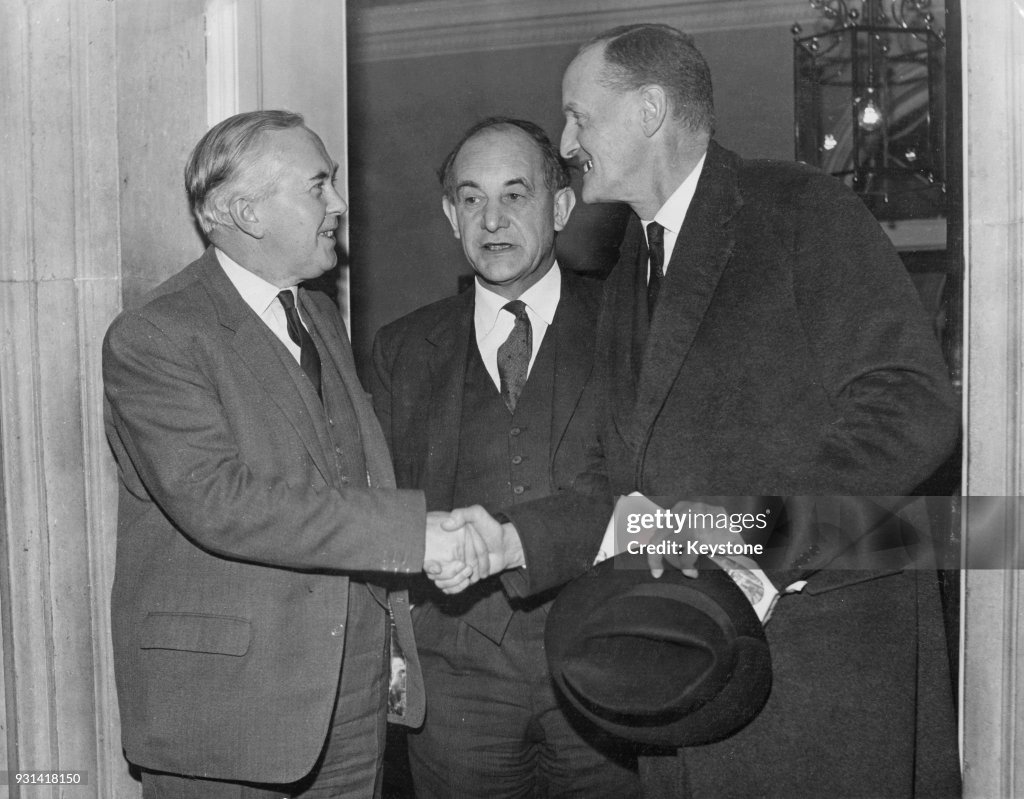
The President is also reviewing a State Department report on the projected mixed‐manned nuclear fleet that would have crews from member nations of the North Atlantic Treaty Organization. A White House spokesman said that the report was a “current over‐all study of where we stand” in regard to the proposal. There is growing French opposition to such a mixed‐manned fleet. The British Prime Minister, Harold Wilson, has also strongly criticized the proposal.
Senate staff investigators interviewed Don B. Reynolds for two‐and‐a‐half hours today in connection with the case of Robert G. (Bobby) Baker. A spokesman described it as a “quite cooperative” session. Mr. Reynolds, an insurance salesman, slipped out a back door after the interrogation in the office of the Senate Rules Committee. The meeting was a preview to the resumption of hearings next Tuesday into an alleged kickback of $25,000 on the construction contract for D. C. Stadium in Washington. Senator John F. Williams, Republican of Delaware, has charged that Mr. Baker acted as a middle man in funneling the money to the Kennedy‐Johnson campaign fund in 1960. The committee’s chief counsel, Maj. Lennox P. McClendon, said afterward that he hoped to finish this stage of the investigation into the outside business activities of Mr. Baker, one‐time secretary to Senate Democrats, “by the end of next week.”
An investigation into reports that “payola” is still widespread in the radio and television industries was announced today by the Federal Communications Commission. The inquiry, which will be conducted in secret, at least in its initial stages, will be made under the direction of the commission’s chairman, E. William Henry. The commission said that it was undertaking the investigation because it had received allegations “from many sources indicating the continued existence and spread of payola and plugola and other improper related practices.”
Payola is the secret payment of money to a broadcaster for publicity for the person making the payment. In its most common form, it involves payments to a disk jockey for playing specific records. Plugola is the secret payment of money for the mention or display of a product other than that of the sponsor of the program on which the plug is made. It can involve the display of a brand‐name product being used by a character in a dramatic show, for example. Both forms of undisclosed payments are specifically prohibited by the Communications Act and by commission rules.
If the Federal Bureau of Investigation knows who killed three civil rights workers in Philadelphia, Mississippi last June, why doesn’t it make arrests? Sheriff Lawrence Rainey asked today. The Bureau announced Wednesday that it knew the identities of the murderers but lacked sufficient evidence to obtain a conviction. “People wonder if they knew, why they haven’t done something,” the sheriff said in an interview. “About all we know is what we saw in the paper.” Relations have not been cordial between the sheriff and the bureau agents since the three civil rights workers — two whites and a Black — disappeared in this central Mississippi town last June. Their bodies were found buried in a newly made earthen dam two months later They had been shot to death with a 38 caliber weapon. A private autopsy report said the Black also had been beaten, probably fatally.
The sheriff said the agents had cooperated with him early in the investigation, then had cooled toward him. “They never have even given me the size of the bullets that were in the bodies,” the sheriff said. About all the agents do here now is watch after civil rights workers who have flocked to Philadelphia in the wake of the slayings, the sheriff said. If the sheriff was critical of the bureau, the bureau appeared to have little enthusiasm for him. “Around Philadelphia, Mississippi, law enforcement is practically nil and many times sheriffs and deputies participate in crime,” the FBI director, J. Edgar Hoover, said last week.
Dick Gregory, the comedian, and Drew Pearson, the columnist, announced today a fundraising drive to send 20,000 Christmas turkeys to Mississippi Blacks. Sammy Davis will give a benefit show here December 20 to raise funds for the drive. The announcement said the drive aimed to provide “a Christmas in Mississippi like Christmas in America.”
Four unmasked men in Ku Klux Klan robes walked out of a racially integrated Thanksgiving Day service in Wilson, North Carolina yesterday when a Black minister rose to read the Scripture. The walkout was termed “sacrilegious” today by the Rev. John Wilson, president of the Wilson Ministers Association, which sponsored the service in Mr. Wilson’s First Baptist Church. It is estimated that 250 persons, including “not more than a dozen” Blacks, attended the service, believed to have been the first racially integrated program of speakers in a white church in this tobacco community of 20,000 population. Several ministers participating in the service said that the number of Blacks attending racially integrated Easter sunrise services had been much larger. There were never any reported incidents at the Easter services.
John W. Butenko, American electronics engineer on trial in Federal Court here on charges of conspiring to give defense secrets to the Soviet Union, said today that the mysterious stranger with whom he had met to discuss relatives in Russia was in all probability Gleb A. Parlov, a member of the Soviet mission at the United Nations. The 39‐year‐old Orange, New Jersey, engineer, on the witness stand, was shown a photograph of the Soviet diplomat taken by the Federal Bureau of Investigation. He was asked if it was not that of “George Lesnikov,” whom Butenko had named in earlier testimony as the man who had approached him to discuss Butenko’s relatives. “Yes,” Butenko replied, “as far as I know there is a strong resemblance.”
Plans to move a space launching technical group from Huntsville, Alabama, to Cape Kennedy were announced today. The National Aeronautics and Space Administration said about 100 of the 140 members of the space center launching group would be moved from the Marshall Space Center at Huntsville “during the next six months.” The transfer was planned more than two years ago, the announcement said. A spokesman said the total employment at Huntsville was 7,620, including 2,728 engineers and scientists. James E. Webb, the space agency’s director, told business leaders in Montgomery and other Alabama cities early this fall that the agency was having “real difficulty” in recruiting scientists and engineers to live and work in Alabama.
An attempt to send a camera‐equipped spacecraft toward Mars was delayed for 24 hours today because of trouble in vital radio gear. A spokesman for the National Aeronautics and Space Administration said the launch, now set for about a three‐hour period starting at 9:22 AM tomorrow, hinged on tests under way to correct the problem. The trouble cropped up 60 minutes before the planned launching of the Mariner space probe. A routine test showed a temporary drop in signal strength in the radio gear that will receive crucial flight commands from ground stations.
One of U.S. President Johnson’s pet dogs, named “Her” died during surgery at the Walter Reed Army Medical Center after apparently “swallowing a stone on the White House grounds”. The pet beagle had become famous after Johnson had lifted her by her ears for photographers.
A U.S. Navy patrol plane carrying 12 men crashed into a hill four miles north of Cape Newenham in western Alaska today. A Navy spokesman said there were “apparently no survivors.” The plane, a P2V Neptune bomber, was based with Squadron VP 2 at the Whidbey Island (Washington) Naval Air Station. It was flying a routine “ice reconnaissance” mission.
Filming starts for the “Star Trek” pilot “The Cage”; cast includes Jeffrey Hunter, Susan Oliver, Leonard Nimoy, and Majel Barret; although it never airs, some footage re-used in “Menagerie” episode of the series.
Bobby Marshman of Pottstown, Pennsylvania, suffered critical burns today when his Lotus Ford crashed into a wall at Phoenix International Raceway. A spokesman at the track said the 28‐year‐old racer had just turned a lap at more than 115 miles an hour when he lost control of the car. Marshman would die of his injuries six days later.
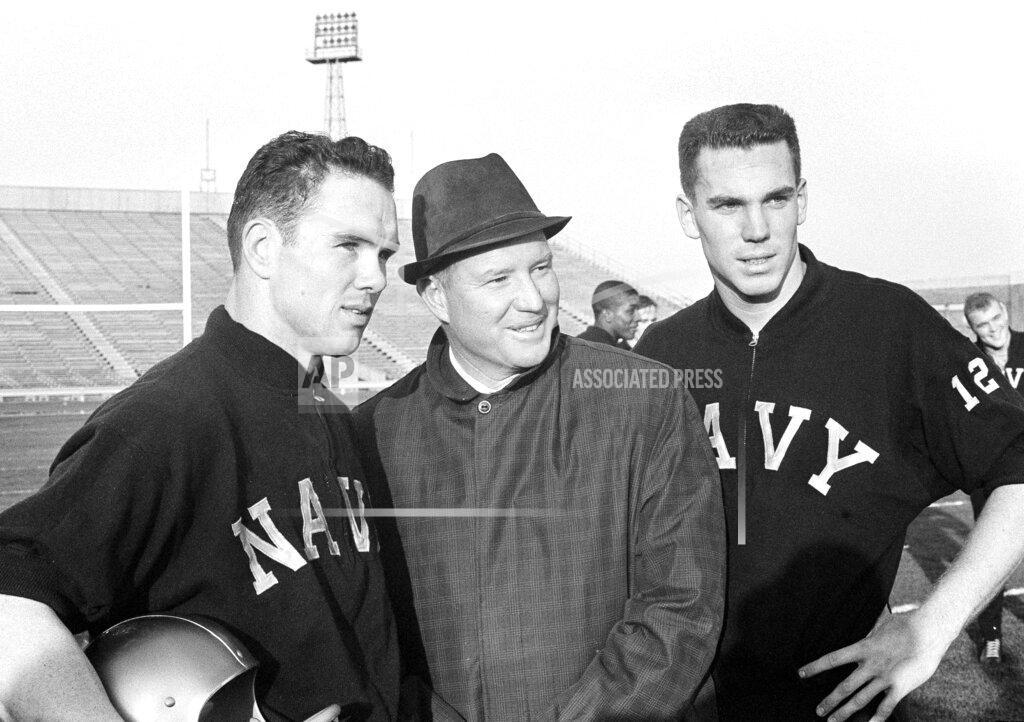
Navy is a slight favorite to score a sixth successive victory tomorrow over an Army football team that came within 2 yards of the tying touchdown and the possible winning point as time ran out in their 64th game a year ago.
Dow Jones Industrial Average: 882.12 (-0.28)
Born:
Robin Givens, American model and television actress, married and divorced Mike Tyson, in New York, New York.
Jim Warne, NFL tackle (Detroit Lions), in Phoenix, Arizona.


 History Diaries