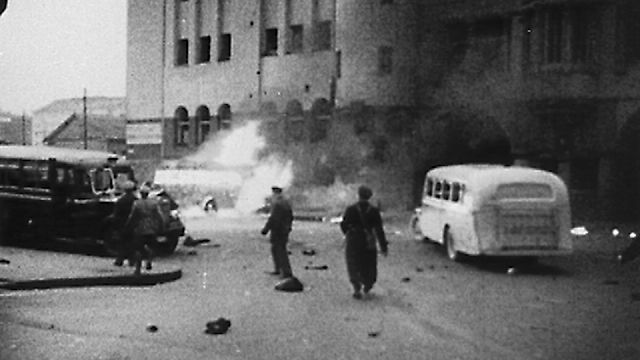
Shelling of Mainila: The Soviet Union conducted a false flag operation by shelling the Russian village of Mainila near the Finnish border and blaming the attack on Finland. Soviet troops fire seven mortar shells into a field near the village of Mainila, Russia at 1430 hours, claiming the Finnish Army is responsible for the attack. At 2100 hours, the Soviets issue the demand to Finnish ambassador Yrjo-Koskinen for the Finnish Army to move back 20 to 25 kilometers from the border. Their mere presence is a “hostile act.” The Finns are quick to deny any involvement and immediately launch an investigation.
Subsequent analysis shows that no Soviet troops or civilians are injured or killed. The shelling, as subsequently disclosed by Nikita Khrushchev, is organized by Soviet Artillery Marshal Grigory Kulik. There is, in point of fact, no Finnish artillery within range of Mainila.
The incident is eerily similar to the Gleiwitz incident on 31 August 1939, part of Operation Himmler to create a casus belli for the invasion of Poland. Mainila just so happens to be a favorite location for Red Army war games. John Colville, Prime Minister Neville Chamberlain’s private secretary, noting the similarity to the German false-flag “provocations” along the Polish border, terms the Mainila incident “a technique which does not gain in dignity for being second-hand.”
Soviet state media immediately goes into overdrive blaming the Finns as aggressors. One thing is certain: anyone who does not see the war clouds forming over the two countries is not looking.
The Finnish government rejected a series of Soviet demands, which were similar to concessions the Estonian, Latvian, and Lithuanian governments granted the Soviet Union. In response, the Soviet government demanded that the Finnish government end its troop mobilization along the Russo-Finnish frontier. The Finns, denying that Finnish artillery had opened fire on Russian troops, said early today that Finland will reject Soviet Russia’s demand that all Finnish forces withdraw twelve or fifteen miles from the frontier north of Leningrad.
The Reich grants respite to Teschen Jews, allowing two more weeks before mass transport to Poland. More than a thousand members of the Jewish community of that city, every man, woman and child of whom were to be transported to Poland yesterday to join the thousands of Jews from Austria and the Protectorate already there, have two weeks more to prepare for their departure. Neutral quarters intervened on their behalf, it is understood. When they leave they will be almost the last of 150,000 Jews who, under German deportation decrees, are being transported from the Protectorate of Bohemia-Moravia to Poland.
The Jewish population has now been evacuated from most of the towns of the Protectorate. From Moravska-Ostrava [Maehrisch-Ostrau], seat of the central bureau of the Gestapo [secret police] who are supervising the deportation from the entire Greater German Reich, virtually the entire Jewish population of some 10,000 men, women, and children of all ages has already been transported to Eastern Poland on the San River. This is believed to be the site of the projected Jewish reservation.
British Prime Minister Neville Chamberlain makes his first radio broadcast of the war, saying that the British know the secret of the German magnetic mines and denouncing the indiscriminate laying of mines by German forces. In a speech in which he declared that Britain already knows the secret of the Nazi mines that sent more than a score of ships to the bottom last week, Prime Minister Neville Chamberlain scoffed at the possibility that Germany could starve this country into submission and declared that the Allies would never sheath the sword until the German people abandoned their faith in the doctrine that might makes right.
The Prime Minister left no doubt in the minds of his listeners to a worldwide broadcast — the first that he has made since September 3 when he announced that the long-threatened war had come at last — that he had beaten his umbrella into an avenging saber. The Birmingham business man who sought to avert war by trading with Chancellor Adolf Hitler at Munich and succeeded only in postponing it a year, made a distinction between the government’s war and peace aims in one of his most forthright declarations yet regarding why Britain is fighting.
The British are still working on the German magnetic mine they captured. The mines continue wreaking havoc on shipping, which is the nation’s lifeblood.
After several quiet days, there are some German patrols in the Vosges forests on the Western Front. The communiqués issued this morning and evening give no indication of renewed activity on the Western Front. There was an attempt, however, in the region east of the Moselle River to repeat a raid which proved unsuccessful yesterday. It is understood that the same units that tried. to carry out yesterday’s raid were used in the operation, which might signify that the German command was dissatisfied with the results that were obtained and called on the same units to repeat their operation. If so, they were equally unsuccessful. Encountering severe fire from French machine guns and artillery, the German patrol was obliged to retire without capturing prisoners or penetrating the French positions.
A communiqué announcing the establishment of the British-French coordinating committee, issued jointly in Paris. and London today, indicates the Allies’ economic headquarters will function in London, where French missions attached to each ministry will collaborate in all decisions after consultations with their government. There is special satisfaction here. because of the choice of Jean Monnet, British economist of French origin, as chairman. Mr. Monnet was born in France and comes from an old French family. He has the full confidence of the French Government, with which he has had contact through League of Nations missions. He was a special representative for France in North America early this year.
Financial circles in London characterize the announcement of full cooperation of Great Britain and France in the economic field as the most encouraging news that the war so far has yielded.
The Italian High Command made known today that it had decided to grant “temporary Winter leave” beginning December 1 to the 1913 class and to reserve officers and noncommissioned officers over 29 years of age, as well as officers of older classes who had fought in either the World War, Ethiopia or Spain. The Italian measure followed by forty-eight hours France’s decision to remove all war restrictions from her territory along the Italo-French border, and it was believed likely to be the result of an understanding between the Italian and French Governments.
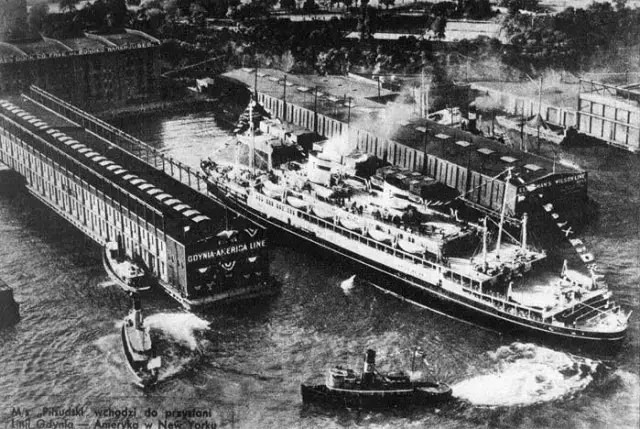
Ten die when the Polish liner Piłsudski, on charter to the Royal Navy, hit a mine and sank, 29 nm SE off Cape Flamborough. Nearly all the crew were rescued. It was thought to have been torpedoed at first, but German records do not support this.
The Belgian cargo ship Quenast foundered in the North Sea 3 nautical miles (5.6 km) north of the Noord Hinder Lightship with the loss of 3 of her five crew. Survivors were rescued by Norwegian ship Paris.
The Kriegsmarine seizes a neutral Danish steamer, the Cyril, carrying coal from Great Britain to Stockholm. This is the first German seizure of a neutral vessel going to a neutral port.
German armored ship Admiral Graf Spee and tanker Altmark rendezvous in the South Atlantic.
Convoy OA.42 departs from Southend, OB.42 departs from Liverpool, OG.8 forms at Gibraltar, and HX.10 departs from Halifax.
Sunday, 26 November
Convoy ON.3 of six British ships departed Methil escorted by destroyers ESKIMO, ICARUS and ILEX. Destroyer MATABELE departed Newcastle on the 27th and joined the convoy at sea, while anti-aircraft cruiser CAIRO provided close cover. The convoy arrived at Bergen on the 30th.
Light cruiser CARDIFF arrived at Scapa Flow.
Light cruiser DRAGON departed Loch Ewe on Northern Patrol duties, and arrived back on 2 December.
Light cruiser CERES departed Sullom Voe on Northern Patrol duties.
Anti-aircraft cruiser CAIRO departed Rosyth on escort duty and arrived in the Thames on the 28th.
During the night of the 26th/27th, submarine TRIAD was crippled off Lindesnes by a fractured hydroplane shaft. Submarine TRIUMPH soon joined to assist and submarine UNITY was ordered into the area. Destroyer MAORI also arrived on the scene and took TRIAD in tow, escorted by destroyer INGLEFIELD, but both destroyers had defective asdic installations. TRIAD arrived at Fosteroey, south of Bergen, on the 30th, but the destroyers were obliged to leave Norwegian territorial waters which they did on 1 December. Tug BANDIT was dispatched to assist TRIAD, but due to extremely heavy weather, was recalled to Scapa Flow. After emergency repairs, TRIAD was able to leave Fosteroey at 1315/2 December under her own power, escorted by Norwegian torpedo boat TRYGG and was joined outside Norwegian waters by INGLEFIELD and MAORI. All arrived safely at Rosyth at 0700/4 December. TRIAD repaired in the Tyne, completing on 12 December and returned to service.
During a gale at Ardrossan, destroyer GRIFFIN and patrol boat PC.74 moored alongside were damaged by bumping. GRIFFIN was holed and required docking, and PC.74 was later drydocked.
Convoy OA.42 of nine ships departed Southend escorted by destroyers BROKE and ANTELOPE on the 26th and 27th. Destroyer BOREAS was with the convoy on the 27th and destroyer WREN on the 28th.
Convoy OB.42 departed Liverpool escorted by destroyers WALKER and VANOC until the 29th.
Convoy FN.42 departed Southend, escorted by sloops GRIMSBY and WESTON, and arrived at the Tyne on the 28th.
U-48 sank Swedish steamer GUSTAFE REUTER (6336grt) 14 miles WNW of Fair Island. One crewman was lost and eight survivors picked up by Northern Patrol armed boarding vessel KINGSTON BERYL. The steamer was taken in tow but broke in two, the fore part sunk, while the stern was towed towards Kirkwall but scuttled by HM ships on the 28th, when it was decided salvage would be too difficult.
Steamer LOCH LOMOND (5452grt) was attacked in the Bristol Channel, 10 miles west of Lundy Island. Destroyers MONTROSE and WALPOLE were submarine hunting in the same area and WALPOLE attacked a contact in 51 08N, 4 50W.
Danish steamer CYRIL (2116grt) was seized by German warships in the Baltic for contraband violations and taken to Swinemünde.
Convoy HX.10 departed Halifax at 1000 escorted by Canadian destroyers HMCS ASSINIBOINE and HMCS SKEENA, which detached on the 28th. Ocean escort was heavy cruiser YORK which joined at 0800/28th and proceeded through with the convoy. Destroyer WAKEFUL escorted the convoy in the Western Approaches from 8 December and the convoy arrived at Liverpool on the 10th. YORK reached Liverpool on the 9th and started a refit completed on 10 February 1940. She then left on 21 February for Scapa Flow and the 1st Cruiser Squadron for duty with the Northern Patrol.
Light cruiser EMERALD departed Halifax for Bermuda, and arrived back on 7 December.
In training operations in the Mediterranean, a 770 Squadron aircraft from aircraft carrier ARGUS crashed, killing the pilot Act/Sub Lt (A) M R Pike.
Light cruiser CAPETOWN departed Malta on escort duty and arrived back on 5 December.
Australian light cruiser HMAS SYDNEY arrived at Fremantle.
President Roosevelt intervened personally today in the intra-administration fight growing out of his demand that government expenditures be cut to the bone in an effort to limit next year’s deficit to $2,000,000,000 despite sharp increases in appropriations for national defense. From Washington the President summoned Budget Director Harold D. Smith to the Little White House to report to him on progress to date in the annual budget nightmare. This year the controversy between the budget bureau and the departments is more pronounced than usual because of the President’s economy order and the fact that tentative budget estimates already had been framed by the departments when he decided partially to offset heavy military expenditures by other economies.
Storm center of the budgetary fight, Mr. Smith was ordered to fly to Warm Springs for the conferences with the President beginning after lunch tomorrow. The budget chief is expected to arrive by noon. Although the President has refused to mention figures, fiscal advisers in the Administration are hoping to limit the budget for the 1941 fiscal year to $9,000,000,000.
Whether this goal can be attained despite a $500,000,000 increase for national defense which the President indicated Friday would reach the record peacetime total of $2,250,000,000 has been a matter of conjecture. It was apparently with this in mind that Mr. Roosevelt last week mentioned the possibility of new or higher taxes to defray the cost of military and naval expenditures in the fiscal year beginning next July.
The Chief Executive had planned to return to the Capital Wednesday morning to resume the budget conferences he left off when he returned to Warm Springs for his regular Thanksgiving holiday. It was assumed that Mr. Smith’s visit was compelled by the President’s decision to extend his stay there by a day. Another caller at the Little White House tomorrow will be Governor E. D. Rivers of Georgia who will take up with the President the problems of his adopted State.
In the forenoon today the Chief Executive attended divine services in the little brick chapel on the Foundation grounds and heard a sermon by Rev. Woodfin C. Harry, minister at the Presbyterian Church at Manchester, Georgia, and Mayor of the nearby town of Warm Springs. The sermon was in the Thanksgiving spirit.
The United States fleet at the end of the fiscal year 1939 was only a little more than 85 percent manned, Rear Admiral C. W. Nimitz, Chief of the Bureau of Navigation, asserted in his annual report to the President, made public today. Although President Roosevelt, by executive order, recently authorized an increase of 35,000 enlisted men, the undermanning due to the rapidly increasing number of combatant and auxiliary ships continued to be a naval problem, Admiral Nimitz said. He asserted that in order to provide sufficient men for mobilization, all ships now in the fleet should be manned with complements at war strength.
So rigid have the requirements for service become that out of more than 159,000 young men who applied for enlistment during the fiscal year fewer than 15,000 were accepted. The situation with regard to line officer personnel, Admiral Nimitz said, was not so good as in the case of the enlisted personnel. To officer the ships now in commission and those under construction a total of 8,671 line officers were necessary and the shortage of line officers was in excess of 1,000, he added.
“In consequence of the shortage in number,” Admiral Nimitz stated, “it has not been practicable to staff vessels of the fleet with their full allowance of officers. Other methods of supplying the necessary number of officers have been under study by the Bureau of Navigation, and efforts have been made to secure funds in the budget for the employment of Naval Reserve Officer Training Corps graduates with the fleet for a period of one year. To date these efforts have been unsuccessful. The maintenance of the Naval Academy on a four-appointment basis is necessary to make up for annual losses and to provide an annual increment toward the increase of the line strength. In spite of an increase in officer strength, allowances of both the fleet and shore stations have been reduced to provide personnel for newly commissioned vessels and those about to be commissioned.”
A resolution calling on the British Government to admit 50,000 Jewish refugee families from Eastern and Central Europe into Palestine in the next twelve months was unanimously adopted yesterday afternoon by 200 delegates to the annual conference of Eastern leaders of the order Sons of Zion, a national Zionist group, at the Hotel Astor in New York.
Representative Clare E. Hoffman, Republican of Michigan, today requested Governor Luren D. Dickinson to compel local authorities in the State to protect all Chrysler Corporation employees who wish to return to work, and to proceed against any person or persons who prevented them from going to work.
“For more than forty-five days the Chrysler strike has prevented thousands of men from receiving their paychecks,” said Mr. Hoffman in his plea to the Governor. “It has compelled the taxpayers to support men who have jobs at more than average wage, but who will not earn, or are prevented from earning, their own livelihood. All this because a few communistic-minded labor organizers want to Russianize Detroit and the motor industry. The laws of Michigan punish those who by force prevent others from working. If you would enforce the laws, as it is your duty to do, by preventing pickets in Detroit from using force to keep men from their jobs the Chrysler strike would end itself.”
Six of the army’s seven B-17 “flying fortresses” completed a 12,500-mile round trip goodwill flight to Rio de Janeiro, Brazil, tonight, landing at Bolling Field near Washington, D.C. between 5 and 6:22 PM Eastern Standard Time. The seventh remained at Jacksonville, Florida, where it was forced down this afternoon. The seven 22-ton bombers, which brought back ten Brazilian Army officers, took off from Maracaibo, Venezuela, at 6:03 AM on the 2,100-mile flight to Washington on the longest single hop of the entire trip. Five of them landed here at 5 PM, averaging 196 mph to complete the non-stop flight in fewer than eleven hours.
Electrical capacity rises 3 percent in U.S. power plants. The installed capacity of all electric generating plants reporting to the Federal Power Commission was increased 3 per cent between Dec. 31, 1938, and Sept. 30, this year, to a total of 40,203,969 kilowatts, the FPC reported today.
The formation of two American organizations, both headed by Winthrop Aldrich, to provide funds for the maintenance of the American Hospital of Paris and to supply other war relief in France and England, was announced yesterday.
Japanese Premier General Nobuyuki Abe told a luncheon of commercial leaders in Osaka yesterday that a “final solution of the China problem” might take from five to ten years, the Domel news agency reported. The fact that a new “Central China” government will be launched shortly in Nanking, the Premier said, should not be taken to mean that the “China incident” — as Japan calls her undeclared war — would end at once.
Settlement of economic issues, the Premier said, still will remain after military operations have ended and pacification of the country will require great effort after the last military power of Generalissimo Chiang Kai-shek is broken. The Premier estimated that General Chiang still had about 2,000,000 soldiers in the field.
The highest officials of Generalissimo Chiang Kai-shek’s Nationalist Government in Chungking were to meet today to consider a reorganization of the government. Chungking dispatches said it was disclosed belatedly that the entire Cabinet resigned on Tuesday and that the Central Executive Committee and the Central Standing Committee of the Kuomintang (Nationalist party) had been summoned to recommend new Ministers. Persons close to the Generalissimo said that the Cabinet reorganization was decided upon to increase administrative efficiency, to unify administrative functions and to “put capable men in their proper posts.” Japanese here attached significance to the fact the Cabinet shakeup came in the face of Japan’s capture of Nanning, strategic communications center in South Kwangsi Province.
The Japanese professed to believe that there was an extensive “peace group” in the Chungking regime that was preparing to veer away from General Chiang’s leadership in advance of the new Japan-sponsored regime to be headed by forImer Chinese Premier Wang Ching-wei. The new Japanese invasion of South China and Japan’s negotiations with Russia, which has been General Chiang’s strongest supporter among foreign powers, were said to have convinced many right-wing leaders in Chungking that it was time to withdraw to the sidelines and await developments.
Chinese Nationalists in Chungking derided these reports and said that the Generalissimo’s leadership was stronger than ever and that the “war of resistance” against Japan would be continued as long as necessary. The Chinese were heartened by the firm attitude of the United States and interpreted a weekend statement by Senator Key Pittman, chairman of the Senate Foreign Relations Committee, to mean that there would be a complete economic severance between Japan and the United States when the Japanese-American commercial treaty expired on January 26.
Born:
Tina Turner, American singer (Ike & Tina – “Proud Mary”; solo -“What’s Love Got To Do With It”), in Nutbush, Tennessee (d. 2023).
David White, American singer and songwriter (Danny And The Juniors – “At The Hop”: Leslie Gore – “You Don’t Own Me”), in Philadelphia, Pennsylvania (d. 2019).
Abdullah Ahmad Badawi, Malaysian politician (5th Prime Minister of Malaysia, 2003-2009), in Bayan Lepas, Penang, Malaysia.
Jeremy Boorda, U.S. Navy admiral (25th Chief of Naval Operations), in South Bend, Indiana (d. 1996).
Mark Margolis, American stage and screen actor (Breaking Bad; The Wrestler), in Philadelphia, Pennsylvania (d. 2023).
Tom Pennington, AFL kicker (Dallas Texans), in Albany, Georgia (d. 2013).
Naval Construction:
The Kriegsmarine (German Navy) Type IXB U-boat U-106 is laid down by AG Weser, Bremen (werk 969).

 History Diaries