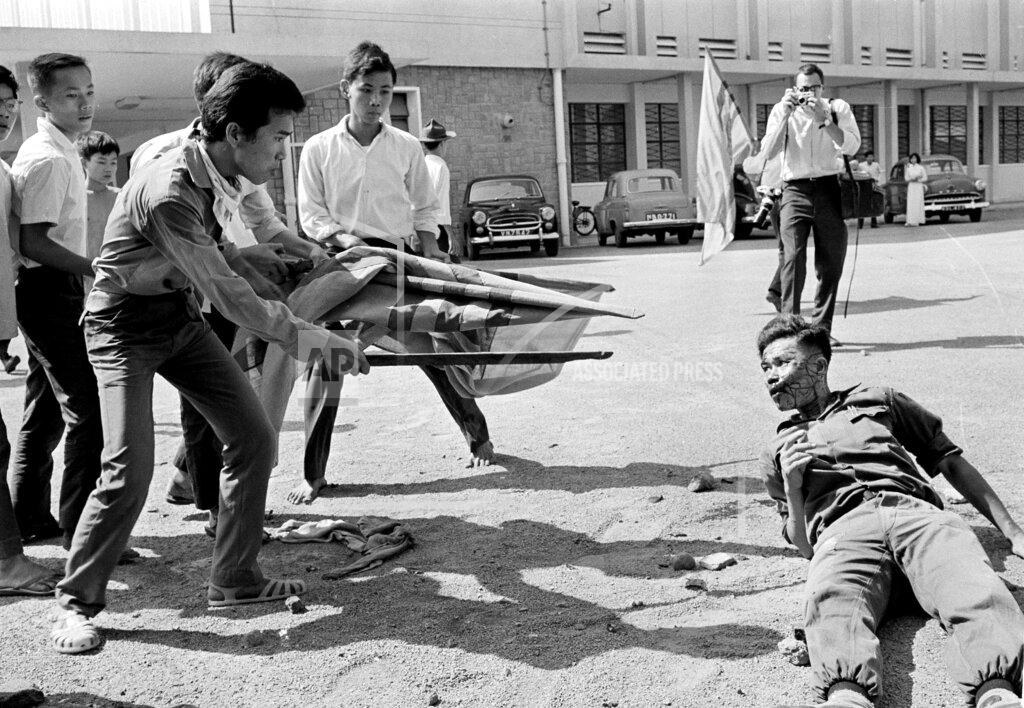
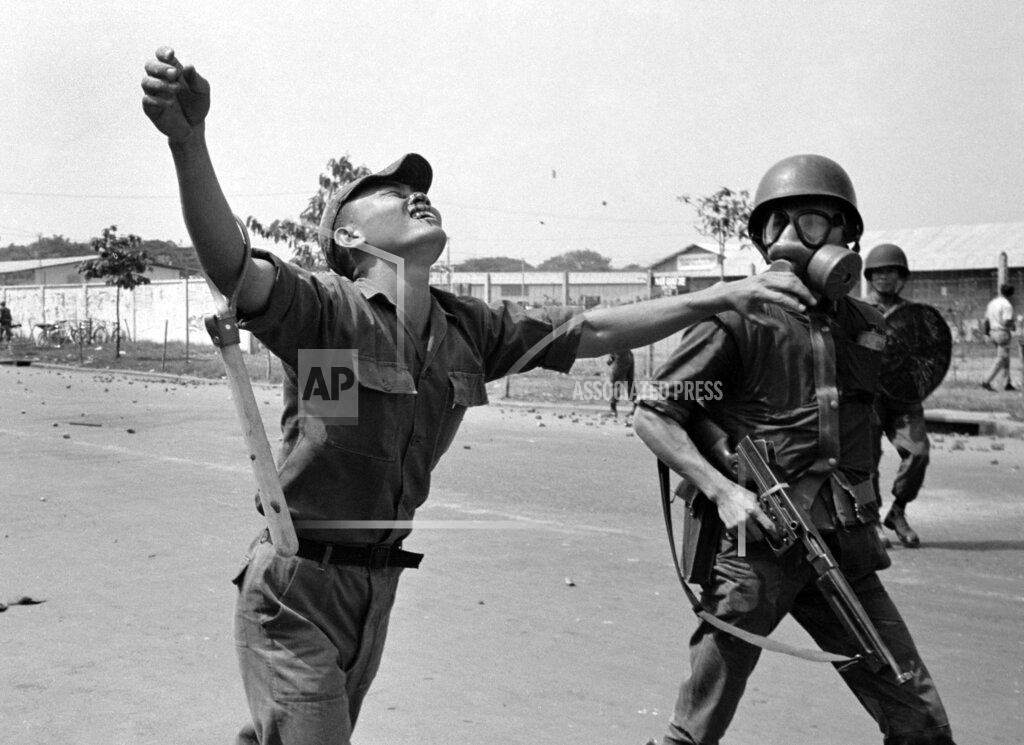
Measures based on martial law were imposed on Saigon tonight after rioting that spread across the capital. Government paratroops fired pistol shots toward bands of youths who were pelting police with bricks and stones. Late in the evening Buddhist students displayed the body of a youth who had been shot in the heart. A grenade was thrown at a police jeep, injuring three policemen and a Vietnamese reporter. Mobs overturned the vehicle and set fire to it. When the police moved to stop the march after three formal warnings, the youths spread gasoline across the road and set it afire to halt the advance. In their frustration, some paratroopers in armored jackets jumped over the flaming barriers to push back the students.
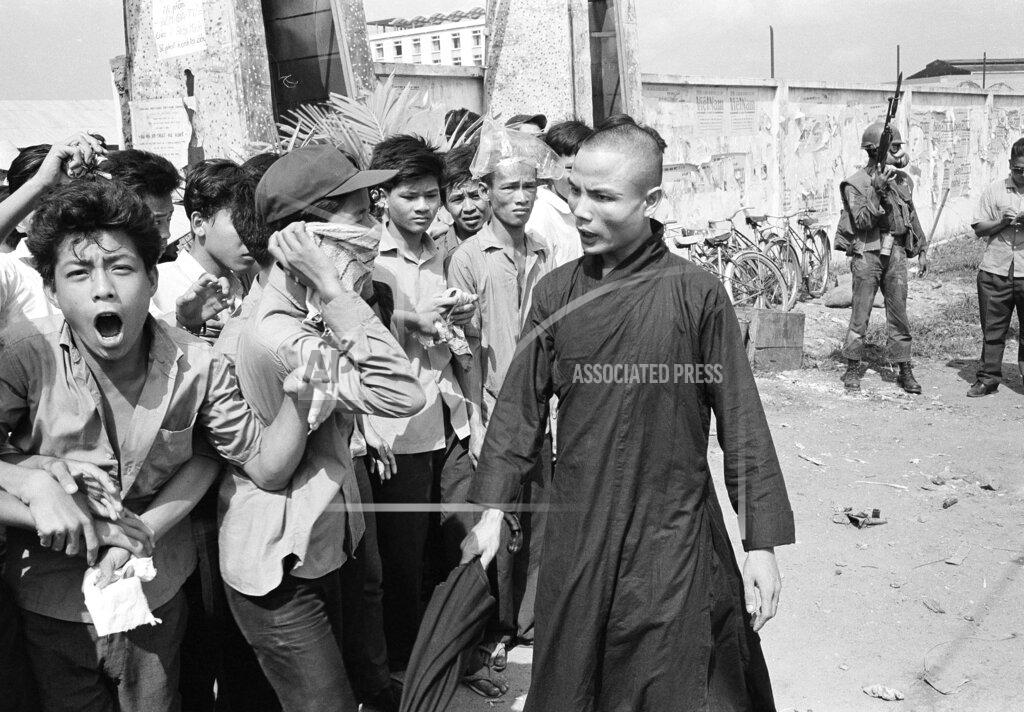
By late afternoon tentative order had been restored around Buddhist headquarters. About 1,000 young persons who had barricaded themselves inside the pagoda grounds were permitted to return to their homes unchallenged by the police. What amounted to a local cease‐fire was negotiated by leading Buddhist priests at the headquarters and by the commander of the capital military district, Brigadier General Phạm Văn Đồng. The Buddhists were warned that if any of the youths tried to linger, or start further trouble, the paratroops had orders to put down new rioting by opening fire with live ammunition.
During the disorders two grenades were tossed into the seething mobs outside the National Buddhist Center, where about 2,000 youths were pounding lines of riot police and paratroopers with bricks and heavy clubs in the most intense display of anti‐Government agitation since the demonstrations started last Sunday. The two grenades were thrown by unidentified persons on the sidelines, apparently neither by police nor demonstrators. One exploded, injuring at least four civilians and seven policemen. The police suspected the grenades were thrown by Communist agents following instructions issued by Việt Cộng commanders to have grenades ready for spreading confusion and fear whenever civil strife erupts.
Several times the police vainly threw tear gas at student gangs roaming widespread sections of the city. The crows would disperse momentarily, but reassemble and hit the police with renewed fury when the gas clouds cleared. Handicapped by unclear orders, and visibly reluctant to invite charges of repression from an angry populace, police officers held back their men until they had received specific orders to move against the mobs. For half an hour during the afternoon, three heavily armed lines paratroops and police retreated yard by yard as youths defiantly pushed their homemade barbed‐wire barricades in a widening perimeter along the main street, away from their stronghold at the Buddhist center.
Maxwell D. Taylor, United States Ambassador to South Vietnam and former Chairman of the Joint Chiefs of Staff, will arrive in Washington tomorrow for conferences on American policy in Vietnam. It has been reported that he will recommend limited expansion of the war against the Việt Cộng, by air strikes against selected sites in North Vietnam and Laos. Presumably these sites would be supply points and staging areas for the Communist guerrillas. There is no clearly defined opposition to the Taylor position. There is, however, considerable caution and doubt among high civilian officials here about the feasibility of imited expansion of the war. There is some feeling here that air strikes, while bringing pressure against Hanoi, might not solve any basic problems of the political war in the South, but that they would involve the United States even more deeply.
Those who favor expansion of the war believe the air attacks would make infiltration to the South more difficult, would serve to warn of the American intention to stay on in South Vietnam and would provide a psychological boost there. But some of the skeptics feel that if the air attacks fail, the United States will be deeply committed and further extension of the war will be made inevitable. Others fear that the raids would unify all North Vietnamese behind the government, and in the long run would aid the Việt Cộng psychologically. They also fear that if the attacks failed to have a major effect on the war, there would be a sharp drop in morale in South Vietnam.
The body of a United States sergeant was found today at the scene of a convoy ambush where he was reported missing yesterday. The ambush occurred 22 miles east of Saigon. The Việt Cộng destroyed four vehicles and killed or wounded about half the convoy’s personnel.
The Laotian Government displayed a North Vietnamese prisoner today, but he was uncooperative. The prisoner was identified as Bùi Ngọc Văn, 21 years old, from North Vietnam’s 335th Division. Under questioning with the aid of a Vietnamese interpreter, he did not once open his eyes and for a time pretended to be deaf in one ear. He said he expected to die tomorrow because the had been given poison.
He is the fourth North Vietnamese prisoner to be captured and displayed by Laos as proof of interference here. But previous prisoners had been docile, expressing wishes to remain with their captors and willing to give information. Another prisoner, Tran Van Sinh, who expressed a wish to remain in Laos or go to Saigon, answered questions willingly and gave details of the route into Laos. He was captured in September but has spent most of his captivity being cured of dysentery. Bùi Ngọc Văn was captured November 1, when he walked into a Meo village near Plaine des Jarres.
William Sullivan arrives in Laos as the new U.S. ambassador.
Communist China asserted today that any “United States effort to expand the war in Vietnam would meet with total defeat.” Peking said that the Chinese people would stand by the Vietnamese Communists in their struggle against the United States. The warning, by Premier Chou En‐lai, was in an editorial in Jenmin Jih Pao, the Communist party organ. It was couched in general terms and did not contain any specific commitment to intervene militarily if the United States struck at targets in North Vietnam and Communist-held areas of Laos.
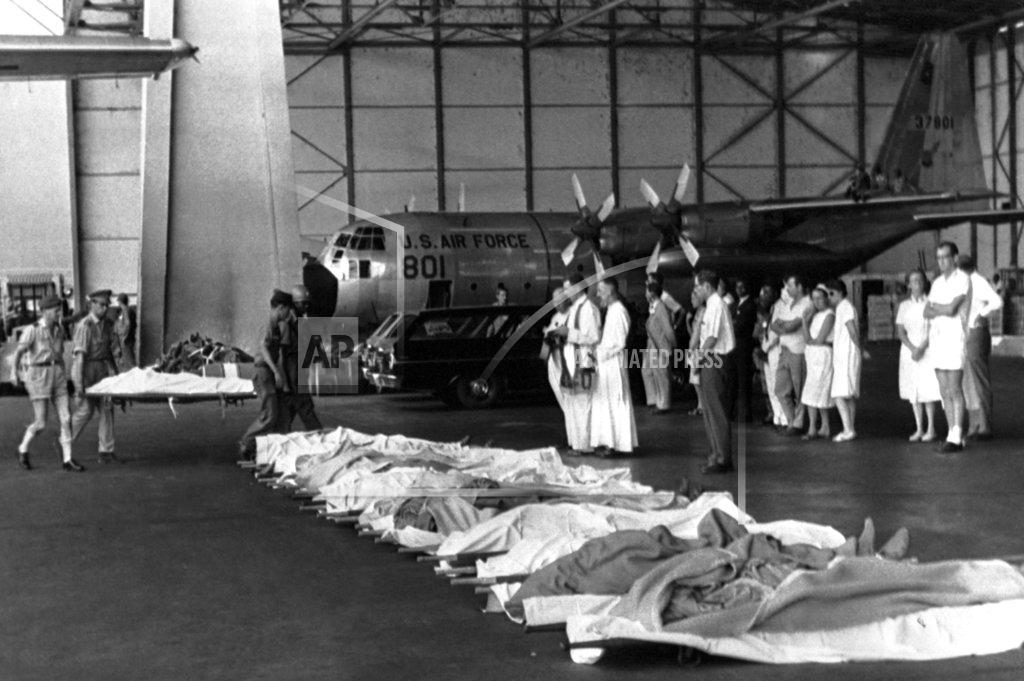
The State Department announced early today that Belgian paratroopers in the Congo had made a new landing in an effort to rescue additional whites in rebel‐held territory. The department said that about 250 men in seven United States Air Force C‐130 planes had landed at Paulis, a town 225 miles northeast of Stanleyville. The department said that “perhaps several hundred civilians,” including seven Americans, were “in imminent peril.” The rescue mission began about 48 hours after the landing at Stanleyville, the rebels’ capital. That city was secured after 29 Belgians and foreigners, including two American missionaries, had been massacred. About 200 whites were still unaccounted for in Stanleyville, The Associated Press reported. In Washington, the figure was estimated as high as 500.
Fragmentary reports shortly after the Paulis airdrop said that 62 white refugees had been evacuated. The landing began at 6 AM Thursday, Congo time (midnight Wednesday, Eastern standard time). It appeared that paratroopers were first dropped on the Paulis airfield, and that troops arrived by plane after the small strip was secured. The State Department had no early report on whether the seven Americans in Paulis were among those evacuated. The State Department was receiving its report from the United States Embassy in Leopoldville, which was receiving messages from a United States Air Force communications aircraft in the air above the drop area.
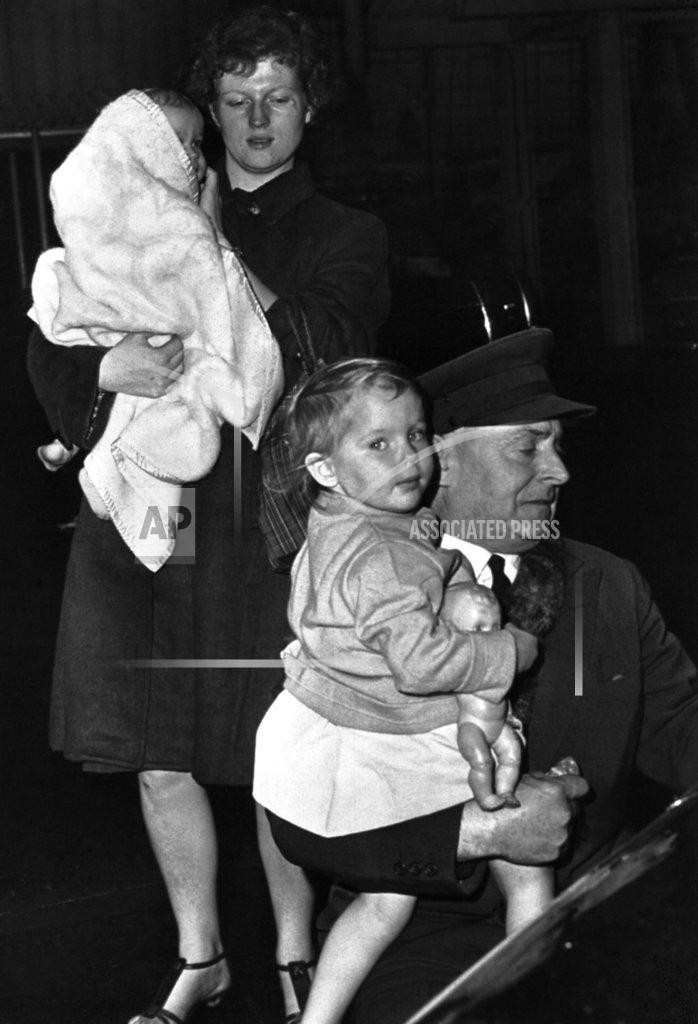
The first planeload of survivors of the Congolese rebels’ massacre arrived in Brussels from Leopoldville today. A 2‐year‐old girl carried by a young woman was among the first of the 163 former hostages to leave the plane. The woman and child were wearing the light tropical clothing they wore yesterday during the evacuation from Stanleyville to Leopoldville. A Red Cross worker put a blanket around the woman’s shoulders and said, “Let me carry your little girl.” “She is not my little girl,” the refugee replied. “We don’t know where her parents are. She can’t tell us. We fear they may have been among those killed yesterday morning in Stanleyville.”
Later Princess Paola and her husband, Prince Albert, who were among the 500 people at the airport, told a Government official to take the child to the Belvedere Chateau, where they live. Princess Paola and Prince Albert, who is the younger brother of King Baudouin, have three small children.
Former hostages reaching here declared unaimously that the arrival of the paratroops yesterday saved hundreds of captive Belgians and more than a score of Americans from certain slaughter. According to more than a dozen witnesses interviewed at the airport, at least 20 people were murdered near the Victoria Hotel in Stanleyville when rebels opened fire on 250 white captives. “They had planned to kill us all,” a refugee said. “They would have kept shooting until we were all dead if the Belgian soldiers had not arrived from the airport.” Many hostages gave gory accounts. One said he had found the bodies of a couple and their small daughter, riddled with bullets, their hands clasped.
The Soviet Union charged today that the United States‐Belgian rescue operation in the Congo yesterday was an act of “gross, active intervention.” Washington officials immediately rejected the Soviet statement as propaganda. The Soviet statement, handed in Moscow to the United States, Belgian and British Embassies, was not expected to receive a formal answer from Washington. However, the State Department’s spokesman, Robert J. McCIoskey, said that, “without reference to the note, I reject any suggestion that the mission was military intervention in the Congo.”
The United States Legation in Sofia, Bulgaria, was stoned by 400 rioters, including Africans and Chinese Communists. Denouncing the Congo intervention, they cried, “Yankee, go home!”
Jenmin Jih Pao, the Chinese Communist party newspaper,. denounced today the rescue of rebel‐held hostages by Belgian paratroops in the Congo as “a brutal crime perpetrated by United States and Belgian imperialists.” The paper called for stepping up of the armed struggle in the Congo by the rebels. “United States armed aggression in the Congo is doomed to failure, as is its armed aggression in South Vietnam,” the commentary said. “Today the people of the Congo are rich both in combat and political experience. The most, important thing is that they have discarded their illusions about United States imperialism and see it and its followers in their true light.”
President Ahmed Ben Bella said here tonight that Algeria would send “arms and volunteers” to aid her “Congolese brothers” fighting against the forces of Premier Moise Tshombe. At the end of a highly emotional speech, Mr. Ben Bella told a crowd of 10,000 people “to break up quietly and not to attack any consulate or embassy.”
The British Government said today that it was “immensely grateful” to the United States and Belgian Governments for their aerial rescue operation in Stanleyville, the Congo. George Thomson, Minister of State in the Foreign Office, expressed the dominant mood in. the House of. Commons by saying: “We are all extremely glad the operation has been as successful as it was.” Tom Driberg, a left‐wing Labor member, challenged the Belgian-American intervention amid, a chorus of jeers and shouts of “Shame!” “It is entirely a matter of speculation as to what would have happened had not the airlift taken place,” he said.
Six weeks after exploding its first nuclear weapon, the People’s Republic of China proposed a “no first use” agreement with the United States of America. At the time, the two superpowers had no diplomatic relations, so discussions took place in Warsaw between the two nations’ ambassadors to Poland, with John M. Cabot representing the U.S. and Wang Guoquan making the proposal on behalf of China.
Communist China rejected today U Thant’s recent suggestion that countries not represented in the United Nations send observers. The reply to the Secretary General came in Jemmin Jin Pao, newspaper of the Chinese Communist party. It reiterated Peking’s “unswerving and determined” stand that as long as “representatives of the Chiang Kai‐shek clique are not expelled from all U. N. organs and China’s lawful rights there are not fully recovered, China will have nothing whatsoever to do with that organization.” The statement was included in an article that accused the new Japanese Government of having committed “one bad deed after another to undermine relations between China and Japan.”
Malaysian Government forces were reported tonight to have killed three Indonesian guerrillas and seriously wounded four others in a jungle ambush in Johore state, about 175 miles south of Kula Lumpur.
Eleven nations put together a record S3 billion rescue package of currencies yesterday to help Britain defend the beleaguered pound sterling at its present official value of $2.80. At stake was not only the pound itself but also the preservation of the international financial system, which has been painstakingly developed in the last 20 years. Officials felt strongly that the size of the package and the speed with which the currencies were offered to Britain made it virtually certain that the operation would succeed. The United States is contributing $1 billion, or one‐third of the total.
The British Foreign Secretary, Patrick Gordon Walker, assured West Germany tonight that Britain had not backed away from her intention to take a constructive stand on proposals for a nuclear fleet with mixed crews.
Gaston Defferre, Socialist candidate for the Presidency, charged today that President de Gaulle’s plans for a thermonuclear striking force threatened France’s social and economic progress.
The Brazilian Army ordered today the arrest of more than 100 aides of the Governor of the State of Goias on charges of having been connected with a subversive movement. The Government was reported planning to remove Governor Mauro Borges, who is protected from arrest by a Supreme Court writ. President Humberto Castelo Branco postponed a trip to Rio de Janeiro, where the Cabinet and National Security Council were to have met tomorrow. These sessions were put off. The President conferred with the Minister of War, General Arthur Costa e Silva. Additional troops were sent to reinforce those already stationed at Anapolis, halfway between Brasilia and Goiania, the state capital.
The Niger River Commission (now called the Niger Basin Authority) was formed by an agreement signed in Niamey, the capital of Niger, and was inspired by the Tennessee Valley Authority in the United States. Parties to the agreement were the West African nations served by the Niger River and its tributaries— Guinea, Mali, the Ivory Coast (now Côte d’Ivoire), Upper Volta (now Burkina Faso), Dahomey (now Benin), Niger, Nigeria and Cameroon.
Paul Hulme, the Postmaster-General of Australia, announced anew design for the nation’s 1,500 telephone booths, which he said would be “flat-roofed, made from aluminum and glass” with “a distinctive sign on the roof so that they can be seen from a distance” and “lit continuously inside by a fluorescent strip so that people will have enough light at all times to read directories.”
The Federal Bureau of Investigation said today it knows the identities of the slayers of three civil rights workers in Mississippi last summer. Reports that the slayers’ identities were known have been published periodically since the bodies were dug from their crude grave August 4. Until today, however, official confirmation by the bureau had been lacking. There was no indication of when arrests might be made.
“The FBI launched a massive investigation following the disappearance of the three civil rights workers in the vicinity of Philadelphia, Mississippi, on June 21, 1964,” a bureau spokesman said. “The FBI located their bodies in an earthen dam and has developed information identifying those responsible. Intensive investigation is continuing to develop the case for prosecution as soon as possible.” The spokesman’s brief report on the Philadelphia case was part of a statement made in response to a request by The Washington Evening Star for comment on complaints about the bureau by the Rev. Dr. Martin Luther King Jr. of Atlanta. The statement also reviewed the agency’s actions in nine other Southern civil rights cases.
Dr. King, in a telegram last Friday to J. Edgar Hoover, director of the bureau, questioned the FBI’s effectiveness in dealing with racial incidents. He noted specifically that no arrests had been made in the Philadelphia case, in the bombing deaths of four Black children at a Birmingham, Alabama, church on Sept. 15, 1963, or in the mistreatment of demonstrators at Albany, Georgia, in the summer of 1962. The telegram was dispatched a day after Mr. Hoover, in an interview with a group of newspaperwomen here, had called Dr. King “the most notorious liar in the country” for allegedly equating the lack of arrests in Albany with the Southern background of agents stationed there.
Regarding the Birmingham church bombing, the agency’s spokesman said today that an intensive investigation was still under way. “This investigation,” he said, “was prejudiced by premature arrests made by the Alabama Highway Patrol and, consequently, it has not yet been possible to obtain evidence or confessions that would assure successful prosecution.” However, he said, “the FBI has identified a small group of Klansmen belived to be responsible.” The spokesman said agents had conducted numerous investigations of complaints in the Albany demonstrations and had submitted the results to the Justice Department.
Four civil rights leaders demanded yesterday that Mr. Hoover either resign as FBI director or reconsider his position. James Farmer, national director of the Congress of Racial Equality, called for Mr. Hoover’s resignation and charged he was conducting a “vendetta” against civil rights groups. Mr. Farmer was one of several rights leaders who reacted strongly to Mr. Hoover’s talk in Chicago last night, in which the FBI chief lashed out against “zealots or pressure groups” that he said were “spearheaded at times by Communists and moral degenerates.” Whitney M. Young Jr., executive director of the National Urban League, and Roy Wilkins, executive secretary of the National Association for the Advancement of Colored People, also were sharply critical of Mr. Hoover.
An all‐white Federal Court jury in Jacksonville, Florida, acquitted four Ku Klux Klansmen tonight of charges they conspired to violate the civil rights of a 6‐yearold Black boy whose home was bombed after he had been admitted to a white school under court order. It was the second trial for the men. A jury was unable to reach a verdict last July. The men were Barton H. Griffin, 35 years old; Willie Eugene Wilson, 39; Donald Eugene Spegal, 31, and Robert Pittman Gentry, 26. The jury brought in its verdict today 7 hours 15 minutes after receiving the case. Much of the deliberation was spent on a lengthy repeat of trial testimony at the request of the jurors.
The Klansmen were charged with conspiring to violate the rights of the boy, Donald Godfrey. All but Gentry also had been charged with conspiring to obstruct the court order integrating the Lackawanna Elementary School here, which Donald entered. They were acquitted of this charge also. J. B. Stoner, an Atlanta segregationist who was the defense attorney, called the verdict “a victory for the white race,” He referred to “the Federal Bureau of Integration” and said he was “very happy” it had “gone down to defeat again.” In his defense, the attorney had charged that the Federal Bureau of Investigation threatened some of the defendants in seeking to gain information from them about the bombing.
With some notable exceptions, racial segregation, far from disappearing, is on the increase in the United States, according to statistical studies prepared by Karl E. Taeuber, a leading population expert at the University of Wisconsin. These studies, derived from the United States Census reports of 1940, 1950 and 1960, were completed while Mr. Taeuber was research associate at the Population Research and Training Center, University of Chicago. Indexes of residential segregation were computed for 109 cities, Mr. Taeuber reported in a revision of a paper presented at the 1962 annual meeting of the American Sociological Association. The index for the 109 cities in 1940 was 85.2. Despite advances and declines between 1940 and 1960, the index in 1960 was 86.1. His segregation index ranges from 0 to 100. He explained that “if each city block contains only whites, or only nonwhites, and there are no blocks of mixed occupancy, then the distribution is as uneven as possible and the index will assume the value of 100.”
The Georgia Council of Churches, embracing nine major religious denominations, has elected a Black man as president for the first time since its establishment in 1952. He is the Rev. Dr. Harry V. Richardson, president of the predominantly Black Interdenominational Theological Center in Atlanta. Dr. Richardson was chosen unanimously at the council’s annual meeting yesterday. Members of the council, an interracial group, said his election was not a sudden effort to emphasize the council’s concern about civil rights.
Sympathy messages poured in today to the family of Dr. Paul Carlson, the 36-year-old medical missionary who was slain yesterday by the Congolese rebels. President Johnson wrote: “Mrs. Johnson and I and all Americans share your sorrow at the loss of your son Paul. His was a life of noble and unselfish service. I want to assure you that every possible effort was made to avert this tragedy.” Dr. Carlson’s 62‐year‐old mother. Mrs. Gust Carlson, was in fair condition at a hospital after being told of his death. She suffered a heart attack 11 days ago while the rebels were threatening to execute him.
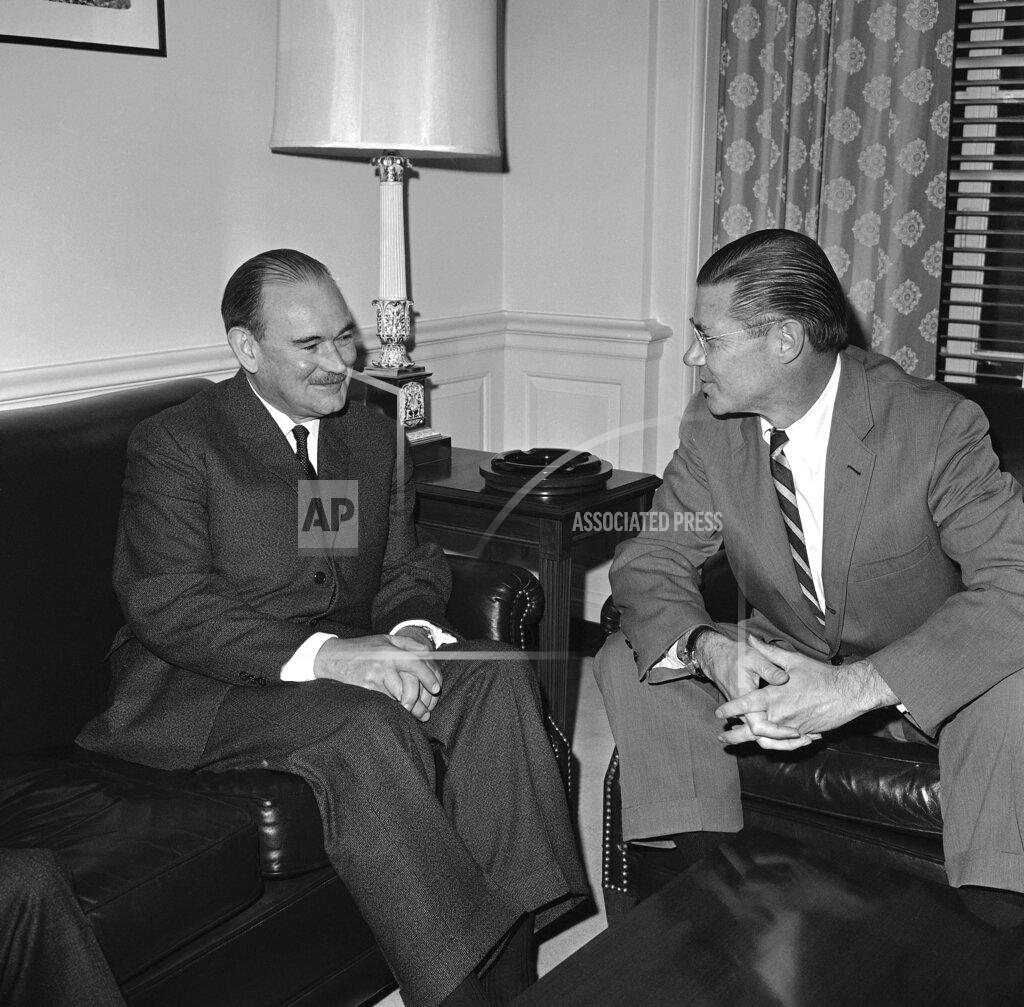
Senator Margaret Chase Smith, Republican of Maine, confronted Defense Secretary Robert S. McNamara today with what she said was a secret report that “clearly contradicts” his cost conclusions about two naval shipyards he has ordered closed. The Senator produced a report on an investigation by the Controller General, made at her request, that showed the Brooklyn Navy Yard and the Portsmouth‐Kittery Navy Yard having among the lowest operating costs of the 11 public shipyards.
The Department of Justice appeared today to be pre‐empting a major share of the Senate Rules Committee’s prolonged and inconclusive investigation of Robert G. Baker’s affairs. The Federal grand jury investigation here of certain aspects of the former Senate aide’s business dealings is going over much of the ground already covered by or being examined by the committee., Moreover, the grand jury has subpoenaed records so far ignored by the committee. The grand jury is meeting in the secrecy that usually surrounds all investigations by such panels, which have the power to indict. But it was known that a number of key figures in Mr. Baker’s recent private business ventures had been ordered to deliver today papers described in one subpoena as: “All corporate books, records, memoranda, files, bank records, bank entries and other documents which in any way relate to Robert G. Baker” and certain other residents of Washington.
Cheaper long‐distance telephone rates will go into effect next February 1 on calls made in the early evening hours and on Saturday and Sunday daytime calls. The rate reduction, ordered today by the Federal Communications Commission, will cut consumers’ telephone bills $75 million a year if the present pattern of personal longdistance telephoning continues. The potential saving to consumers will be even greater if, as expected, the rate reduction stimulates greater use of long‐distance telephoning. A further rate cut that will apply solely to business use of long‐distance telephone service will go into effect later next year. That cut, which will be tailored to bring the greatest reduction to small business and professional men, will reduce business phone bills $25 million a year.
The possibility of an increase in rates for second-class and third-class mail was raised in a conference today between President Johnson and Postmaster General John A. Gronouski. Mr. Gronouski, after conferring with the President at the LBJ Ranch for several hours, reported they had discussed possible postal rate increases. He said the President had directed him to “thoroughly investigate and report back to him” those services in which there was a net loss to the government. There was no indication that any increase would involve first-class mail, which now produces 16 percent more revenue than it costs to handle, Mr. Gronouski reported.
White House aides discounted reports today that President Johnson had had inadequate Secret Service protection on a sudden, unannounced flight to a political dinner in east Texas last night. The President flew from his ranch to Mount Pleasant, 350 miles to the northeast, aboard a private DC‐3 shortly after dusk. He was accompanied by Mrs. Johnson and Governor and Mrs. John B. Connally Jr. George E. Reedy, the President’s press secretary, who had been caught off guard by Mr. Johnson’s sudden trip, declined to say today how many Secret Service agents had been aboard the DC‐3: “I will never give the exact number of Secret Service agents,’’ Mr. Reedy said. “There was more than one Secret Service agent. The Secret Service protection was adequate.”
A Federal grand jury yesterday refused to indict Leonard E. Agnew, 62 years old, on a charge of threatening the life of President Johnson. The charge was dismissed. Mr. Agnew’s wife said that her husband, a supporter of Senator Barry Goldwater, had made the threatening remark under extreme provocation from his fellow workers at the waterfront in Seattle, Washington.
President Johnson and his family will observe Thanksgiving tomorrow with the traditional turkey dinner at the LBJ Ranch. Lynda Bird and Luci Baines, the President’s daughters, will fly home from Washington in the morning. They will attend the Texas‐Texas A. & M. football game in Austin.
Robert Lee Johnson, a former U.S. Army sergeant who had been spying for the Soviet Union since 1953, surrendered himself to the FBI at the police station in Reno, Nevada. He would confess to treason and be given a 25-year sentence in 1965, serving seven years at the Lewisburg Federal Penitentiary in Pennsylvania before being stabbed to death by his son during a visit.
Balancing his wingless, spiderlike craft precisely on jets of steam, Joe Walker, the test pilot, took the space agency’s new moon-landing training vehicle, the Lunar Landing Research Vehicle, to an altitude of 30 feet today — the highest yet in five brief flights — and landed safely.
Dow Jones Industrial Average: 882.4 (-5.21)
Born:
Dan Saleaumua, Samoan-American NFL defensive tackle (Pro Bowl, 1995; Detroit Lions; Kansas City Chiefs, Seattle Seahawks), in San Diego, California.
Ellis Dillahunt, NFL defensive back (Cincinnati Bengals), in New Bern, North Carolina.
Mark Davis, MLB rightfielder (California Angels), in San Diego, California.
Wendy Wyland, American platform diver (Olympic bronze medal, 1984), in Jackson, Michigan.
Mark Lanegan, American grunge-rock singer-songwriter (Screaming Trees; Queens of the Stone Age), in Ellensburg, Washington (d. 2022).
Died:
Clarence Kolb, 90, American vaudeville performer for the duo Kolb and Dill, who later appeared as a character actor in film and television.
Dwaram Venkataswamy Naidu, 71, Indian carnatic music violinist.

 History Diaries