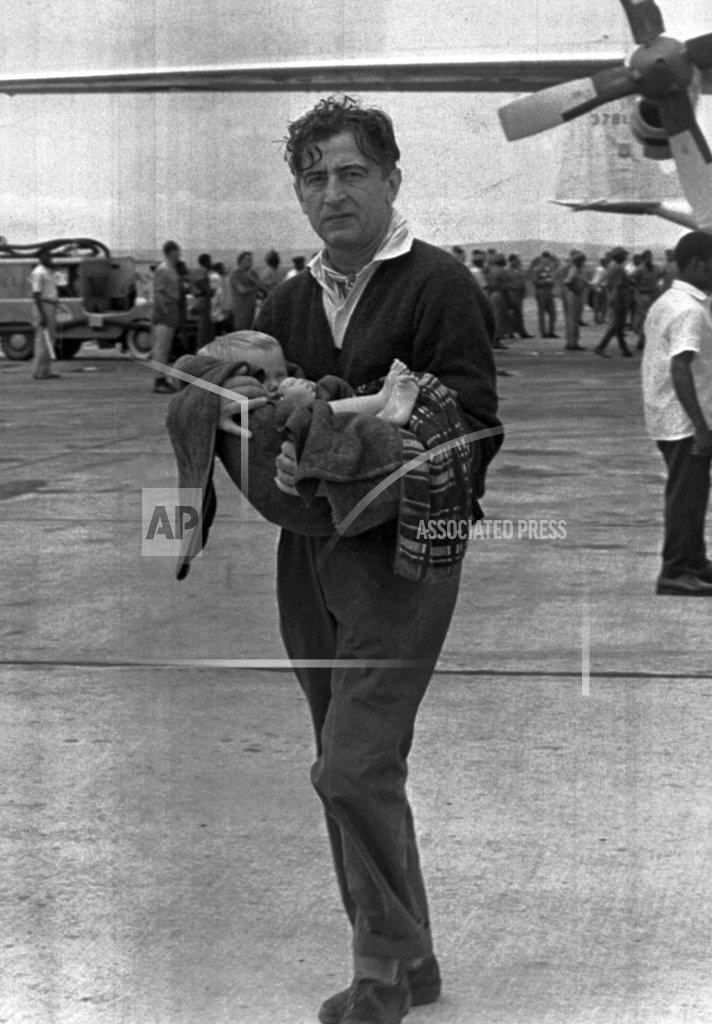
Belgian paratroopers and mercenaries captured Stanleyville in a rescue mission to liberate 3,000 foreigners who had been taken hostages by Congolese rebels. Although most were saved, at least 120 hostages “died in the period before the rescue, during the rescue itself, and in massacres in the countryside that followed” In the first week after the city was retaken, government forces would begin the process of executing 300 suspected rebels. According to witness reports released in January, suspects were led into Patrice Lumumba Stadium and displayed in front of spectators; “If the spectators cheered or clapped, the suspect was released. If they booed, he was condemned to death.” Over 500 persons condemned were killed by sub-machine guns after being driven to the countryside.
At least 18 men, women and children, including Dr. Paul E. Carlson, were executed by Congolese rebel soldiers in Stanleyville today minutes before Belgian paratroops dropped from United States planes onto the rebels’ capital. Two other whites died of wounds inflicted by the leftist-led rebels. While 18 bodies have been identified in Stanleyville, refugees arriving in Leopoldville said that as many as 30 more Europeans might have been killed. In Brussels, the Belgian Government put the toll in Stanleyville at 30 dead. A second American known to have been killed was Miss Phyllis Rine, 25 years old, of Cincinnati. Both she and Dr. Carlson were missionaries.
All of the 37 other Americans known to have been held hostage in Stanleyville are safe, including Michael P. E. Hoyt, the United States consul, and four other consular officials. They were flown to Leopoldville this afternoon with more than 800 other refugees.At least 43 men, women and children were wounded as the rebels tried to massacre more than 250 Belgians and Americans who were lined up outside the Victoria Hotel in downtown Stanleyville shortly after 7 AM. In Washington, officials said that as many as 300 Belgians and 30 to 100 Americans, mostly missionaries, might still be in rebel‐held areas.
Fifty rebels were killed in fighting that began at 6 AM when the battalion of Belgians was parachuted onto the airfield. Three paratroopers were injured during the airdrop but none were reported killed or wounded in combat. Congolese Army ground forces suffered only one casualty, a mercenary killed in an ambush. By midday the paratroops had secured the city center and had linked up with Congolese troops moving up from the south and spearheaded by 150 white mercenaries. Observers here cautioned that while Stanleyville’s recapture almost certainly marked the end of the rebel government, it did not mean the end of the protracted war in the eastern Congo, which, in informed opinion, could drag on for months. Firing could be heard throughout Stanleyville tonight and the Belgian commander of the paratroop battalion radioed that it might take “three or four days to mop up.”
Michael P. E. Hoyt the United States consul in Stanleyville, said in Leopoldville today that he and his consular aides had been severely beaten by the rebels last August and forced to eat an American flag. “We chewed on it awhile, but it was pretty durable,” the 35‐year‐old consul declared. Mr. Hoyt had on the same mud and blood‐spattered white sports shirt he had worn this morning when he and 250 other Americans and Belgians survived an attempted massacre in Stanleyville in which at least 20 persons were killed.
Chomping on a cigar and leaning back with a beer in his hand, he told of life in Stanleyville under rebel rule, which began last August 5. He said he and his staff of four consular officials had been beaten about 10 times, “mostly in the first couple of weeks.” “They beat us in a lot of ways, with rifle butts, rifle barrels, bayonets and the flat of a machete, with billy clubs, whips and the works,” he went on. He said the most serious beating had occurred about a week after the rebels had occupied Stanleyville on the day of the flag incident. “We were in jail twice, for a total of 42 or 43 days,” he said matter of factly. “You lose track after a while.” The consulate’s communications officer, Donald Parkes, sat nearby nursing a coke. His left eye was bruised and swollen. “I got the Lumumba monument treatment,” he said, referring to the scores of European and Congolese beaten at the foot of the monument to the late Congolese Premier, Patrice Lumumba, who was murdered in Katanga in 1961.
The beating took place on Saturday, when the five consular officials and four other Americans were taken to the monument and exhibited before a crowd of 5,000 rebel partisans. “It was supposed to be a trial,” Mr. Hoyt said. “The crowd kept pressing around the jeep we were in, trying to hit us. After we were taken back to jail along with Dr. Paul Carlson, we were told we had been sentenced to death.” Dr. Carlson, a medical missionary accused of having attempted to spy on the rebel regime, was one of the two Americans slain outside the Victoria Hotel this morning. ‘‘Despite what you heard on Radio Stanleyville,” Mr. Hoyt said, “Dr. Carlson was never tried in any court.” Mr. Hoyt’s first action on arriving in Leopoldville by air today and being driven to the United States Embassy was to put in a call to his wife and four children in Tucson, Arizona.
The United States and Belgium notified the United Nations today that they had taken joint military action in the Congo. They said it was the only way to save the lives of hostages held by rebels in the Stanleyville area. Britain informed the Secretary General, U Thant, that she had allowed the use of airfield facilities on Ascension Island, off West Africa, for staging the rescue force of Belgian paratroops “in the light of the humanitarian objective of this action.”
The Congolese Premier, Moise Tshombe, informed Mr. Thant in a note: “I have authorized the Belgian Government and the United States Government to render my Government the necessary assistance in organizing a humanitarian mission to make it possible for these foreign hostages to be evacuated.” Mr. Tshombe said the operation had been authorized “solely for the limited period necessary to make possible the evacuation of these persons, whose lives are in grave danger.”
African delegations took no action today toward any formal discussion of the operation, and no proposal was made for Security Council action. A prominent African delegate, Alex Quaison‐Sackey of Ghana, said he believed the paratroop landing had “precipitated” the killing of some hostages. He recalled that on Friday he said a landing might lead to a massacre. Asked whether he felt that the mission was to blame for the 20 to 30 killings reported from Stanleyville, he said, “I don’t blame anybody, but I think it precipitated things.”
The Soviet Government newspaper Izvestia condemned tonight the landing of Belgian paratroopers in Stanleyville as contrary to the United Nations Charter. In the face of this “imperialist aggression” the independent states of Africa and “all peace‐loving forces” should take urgent measures to end a “dangerous situation” in Central Africa, the newspaper said. Izvestia hinted that the threat to the white population in Stanleyville was only a pretext for the Belgian troop movement and was not real. A battalion of Belgian paratroops was landed early today at Stanleyville, with the announced mission of protecting foreign hostages held by Congolese rebels. The newspaper said that the “imperialists and their puppets” needed the pretext of protecting whites to “disguise their criminal action,” which it contended was aimed at the suppression of the rebel National Liberation Movement in the Congo.
The United Arab Republic tonight condemned the landing of Belgian paratroopers in Stanleyville and called upon African foreign ministers to hold urgent discussions on the “critical situation in the Congo.” In an official statement read over the Cairo radio by a Foreign Ministry spokesman, the Government deplored the fact that the landing had coincided “with the attempts of the African unity organization to deal with the [Congo] question” through a commission.
Ambassador Maxwell D. Taylor left for Washington today to assist President Johnson in charting United States policy aimed at reversing the Communist revolt in Southeast Asia. The former chairman of the Joint Chiefs of Staff has indicated that he hopes for a major decision on action to halt the deterioration of the war against Communist guerrillas in South Vietnam, the heart of the United States commitment in Southeast Asia. The trip is Mr. Taylor’s second since he became Ambassador in July. Officials made it clear that he was going back this time not merely to report on the situation but rather in the expectation of obtaining new policy directives. Speculation has been focused on proposals to carry the antiguerrilla war outside South Vietnam—to strike at supply routes in southern Laos and at selected targets in North Vietnam, from where the insurgents in South Vietnam are supplied and commanded. Mr. Taylor’s recommendations to the President will link this question according to qualified sources, with a condition of obtaining an effective Government in Saigon, a condition seemingly more remote now than even four days ago.
A select committee of the National Security Council meets to discuss the options prepared by the “Bundy working group.” Except for Under Secretary of State George Ball, the leaders are prepared to escalate the bombing into North Vietnam; only the timing is in question.
Anti-Government agitation continued in the streets of Saigon for the third consecutive day. No influential leaders of public opinion, except officials in the United States Embassy, have come out in support of the Saigon Government.
The leadership of the Buddhists in South Vietnam repudiated today the 20‐day‐old civilian government and called for the release of all “heroic” demonstrators who stood fast this week against what it called police “repression.” A communiqué signed by Thích Tâm Châu, the chief political spokesman for the nation’s Buddhists, called on the Vietnamese armed forces and the police to defy the Government’s orders and to let the demonstrations continue. “By the end of this week, one way or another,” one high Buddhist official said, “this government will have to go.” Rioting broke out in Saigon Wednesday for the fourth consecutive day, The Associated Press reported. Students smashed through troop lines near Buddhist headquarters and severely beat a soldier.
The new regime’s firmness in putting down street agitation in the last three days apparently tipped the balance for the Buddhists who had reserved their position about the Government of Premier Trần Văn Hương. Tear gas was used Sunday and yesterday. “This communiqué is meant to be an ultimatum,” a Buddhist spokesman said. The repudiation could be fatal to attempts by Premier Hương and his United States supporters to build a stable regime capable of pressing the war against Communist insurgents.
It was the Buddhist leadership that sponsored violent demonstrations in Saigon last August. The demonstrations resulted in the fall of the government headed by Major General Nguyễn Khánh. After those demonstrations the Buddhists demanded the release of all who had been arrested, even though some had Communist affiliations, on the ground that they had been defending the “aspirations of the people” against a dictatorial regime. The signing by Thích Tâm Châu of today’s demands was regarded as particularly ominous. He had been considered spokesman of the more moderate Buddhists — those who would be willing to give a non-Communist regime the benefit of every doubt.
“In recent days there have been regrettable incidents in Saigon causing harm to a number of compatriots, and which might bring further consequences more detrimental to all the people,” the communiqué said. “Our church believes that there can be no order in the current confused and crumbling state of the nation, when the rights of the people — the majority of them Buddhists — are being ruthlessly denied. If this situation persists, we are afraid that the country, which is already so wretched, will become all the more wretched and that the population, already unhappy, will become all the more unhappy.”
A United States Army sergeant was reported missing after Việt Cộng forces ambushed a government convoy today 22 miles east of Saigon. The guerrillas killed 15 Vietnamese soldiers and wounded nine others, hitting the convoy with intense automatic‐weapons fire. United States military spokesmen said that two United States helicopters had fired rockets and shells at gun flashes but could not see the attackers. One helicopter crewman was wounded in the wrist. The guerrillas destroyed two armored cars, a heavy truck, and a jeep.
Prince Norodom Sihanouk, the Cambodian chief of state, announced today that he would go to Peking to negotiate with North Vietnam and the political arm of the Việt Cộng insurgents of South Vietnam. The negotiations could lead to Prince Sihanouk’s long-threatened recognition of North Vietnam and of the South Vietnamese Communist “shadow government.” The Prince made his announcement in a broadcast to the nation. It was implied that if the talks in Communist China were successful he would return to Peking to sign accords with Hồ Chí Minh, the North Vietnamese leader, and Nguyễn Hữu Thọ, leader of the National Liberation Front.
Premier Chou En‐lai of Communist China said today that the Chinese would “never sit idly by when aggression is being committed against their brotherly neighbor,” North Vietnam. “Nor will they allow United States imperialism to ride roughshod in Indochina,” he said. The statement was in a message to “the International Conference for Solidarity With the Vietnamese People, Against United States Imperialist Aggression and for the Defense of Peace” opening in Hanoi, North Vietnam.
Pamphlets attacking Nikita S. Khrushchev, the ousted Soviet leader, and Moscow’s policies under his leadership have reappeared in main hotels and airport waiting rooms in Peking. The pamphlets, in English, French, Spanish and Russian, were withdrawn shortly before the departure of Premier Chou En‐lai for Moscow early this month for talks with the new Soviet leaders. The attacks consist mainly of translations of official Chinese statements, commentaries and editorials during the last two years of the Chinese‐Soviet ideological dispute.
After a close reading of the remarks yesterday by Prime Minister Harold Wilson in Parliament, State Department officials took the view today thati his criticism of the proposed mixed‐manned allied nuclear fleet did not rule out eventual British participation. Officials did not disguise their disappointment at Mr. Wilson’s blunt criticism of the plan. They agreed that bargaining when the British leader comes to Washington next month would be difficult. But there was no indication of a feeling his speech had dealt a death blow to the nuclear fleet plan. Mr. Wilson, reiterating a view taken by the Labor party before the British election in October, said the proposed fleet of Polaris armed surface vessels “adds nothing to Western strength, is likely to cause a dissipation of effort within the alliance, and may add to the difficulties of East‐West agreement.”
It was rioted that Mr. Wilson, in less widely reported remarks, had also said the nuclear‐fleet plan had “gained some momentum” and that Britain could not ignore “all that has happened” since the proposals began to be pressed after a British‐United States agreement at Nassau two years ago. Under this accord, the United States agreed to sell Britain Polaris missiles for nuclear submarines. The United States is willing to look sympathetically at a reported London proposals for turning over British Polaris submarines and nuclear bombers to a new North Atlantic Treaty Organization atomic force. But Washington regards the mixedmanned surface fleet as the keystone of that force. In addition, British participation in the fleet would give it major impetus in nations such as Italy and the Netherlands that are still not fully committed, to join.
Mayor Willy Brandt of West Berlin, bidding for the support of 35 million West German voters, promised the nation today “a humane, purposeful, richer life in peace.” The Social Democratic candidate to replace Chancellor Ludwig Erhard in next year’s national elections held up the image of a modern middle‐ofthe‐road party ready and eager to relieve Dr. Erhard’s “used-up” Christian Democratic Union of the leadership of the West German Government. Mr. Brandt’s speech on the second day of the Opposition party’s biennial congress defined the domestic platform on which the Socialists hope to be voted into power in September, 1965.
A United Nations official who surveyed the site of the Israeli‐Syria border clashes of November 13 was reported today to have agreed unofficially that an Israeli mobile patrol accused by Syria of aggression had remained at least six yards inside Israel. The Syrians have maintained that the patrol entered Syrian territory in an area north of the Sea of Galilee. Syrian positions responded with a bombardment, and an air clash ensued. Both sides called for an emergency session of the United Nations Security Council. The Council met last week and heard Israel and Syria exchange charges. It then postponed further meetings pending an on‐the‐spot report from the United Nations truce supervisory body at the border.
Israel has maintained that the Syrians were responsible at each stage of the battle for increasing the caliber of the ground weapons employed and their fire power. This position was said to have been substantiated by the United Nations field reports. The field reports were also reported to have indicated that the Syrians were not fully cooperative in permitting the United Nations to inspect the Syrian villages alleged to have been bombed by Israeli planes. The investigators were also reported to have been informed by the Syrians that they would not be permitted to inspect the Syrian casualties. Israeli military casualties from the fighting were four dead and eight wounded. Two settlers from the Dan kibbutz, or collective farm, were injured.
Prime Minister LaL Bahadur Shastri told Parliament today that he had received letters from President Johnson and Premier Aleksei N. Kosygin of the Soviet Union, approving India’s efforts “to broaden the area of peace.” Mr. Shastri was replying to members who had urged that India develop her own atomic deterrent qr that India enter a military pact with the United States to obtain an indirect deterrent against possible Chinese Communist aggression. The Prime Minister said that both President Johnson and Premier Kosygin had commended India’s policies of nonalignment and coexistence and that the letters had encouraged him “at this particular moment.”
The United National Liberation Front, a separatist group in India, was formed in the Union Territory of Manipur to carry out a war against the national government.
Australia’s parliament passed the National Service Act 1964, restoring the draft of 20-year old men into the Army, with a system of selection based on birthday.
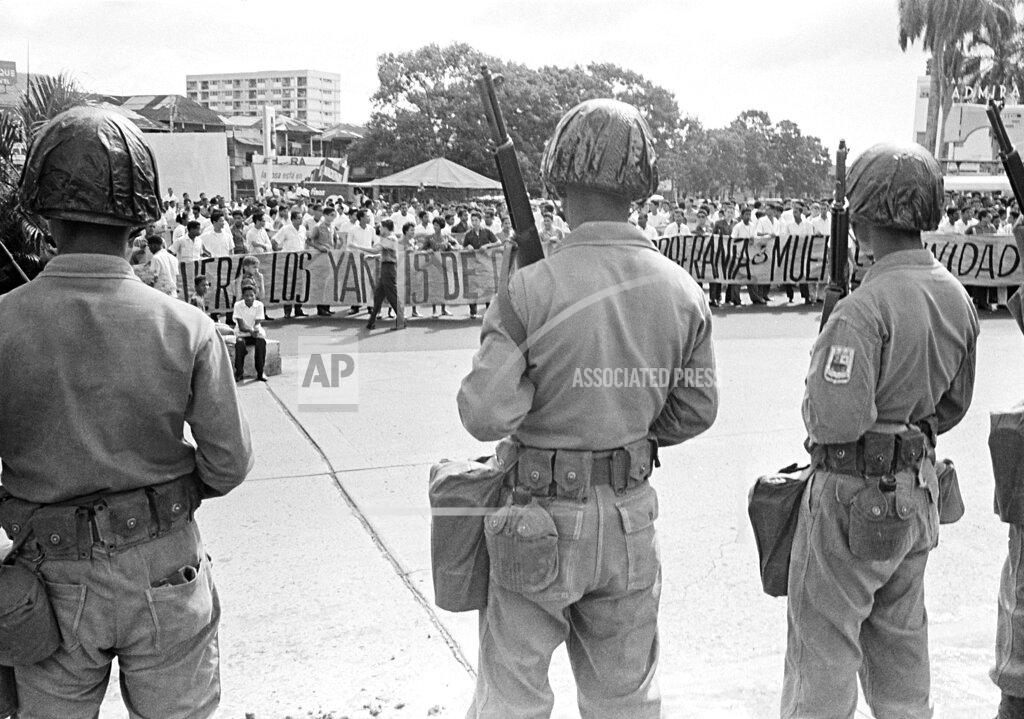
A resolution regarded as a vote of confidence in Panamanian President Marco A. Robles’s conduct of relations with the United States was adopted today by the National Assembly. The legislature had been in secret session almost 25 hours. Since the administration bloc numbers 27 and the resolution was approved 34 to 2, with 3 abstentions, it was evident that some Opposition members supported President Robles. There are 42 Deputies. The session had been called ostensibly to hear Foreign Minister Fernando Eleta and a former special envoy to the United States, Jorge Illueca, who had resigned following an argument and had then addressed a student meeting at Panama University. The Deputies took no position in the dispute between the two men. They also heard Mr. Illueca’s replacement, Diogenes de la Rosa, and Mr. de la Rosa’s colleague, Roberto Aleman.
The resolution endorsed the position Panama took after last January’s riots against United States policy in the Canal Zone. It reaffirmed the decision that was made then to seek a new treaty with Washington regarding the canal that would satisfy the “just” demands of Panama and strive for abrogation of the basic Treaty of 1903. The treaty was described today as a “cause of friction” between the two countries.
In the Canal Zone, Gov. Robert J. Fleming Jr. is going ahead with his decision to induct Panamanian citizens into the zone’s police force. The force has up until now been composed exclusively of United States citizens. Governor Fleming’s decision followed the January riots, in which about 20 Panamanians and four United States citizens were killed. Feelings in the Canal Zone are running high. Suits opposing the hiring of Panamanians for the police force have been filed in Washington. A temporary injunction has been denied; a suit for a permanent injunction is pending. Ten Panama citizens are now in the final stages of training for the zone’s police department land five others are going through a last screening before being taken on the force. According to Governor Fleming the Panamanian candidates are being subjected to a far more intensive training than American applicants have received.
President Johnson stayed up until just before dawn today, keeping, informed on rescue operations in the Congo. “He was kept informed on virtually a continuous basis from the time of the landings until about 4 o’clock in the morning, when the situation appeared reasonably well in hand,” a White House spokesman said. Asked if the President and other officials had discussed possible reprisals for the death of Dr. Paul E. Carlson, a medical missionary, George Reedy, the press secretary, replied: “I don’t want to characterize now what we are or are not going to do. Obviously, the President will keep very close to this matter, extremely close.”
Malcolm X returned to New York by plane last night from an 18-week tour of Africa and Europe and declared that the killing of white hostages in Stanleyville by Congolese rebels was the responsibility of President Johnson because of his financial support of “Moise Tshombe’s hired killers.” The Black Nationalist leader, who was met by about 30 of his followers, said that it was “probably too bad that they [white hostages] had to die, but the Congolese have been dying a long time.”
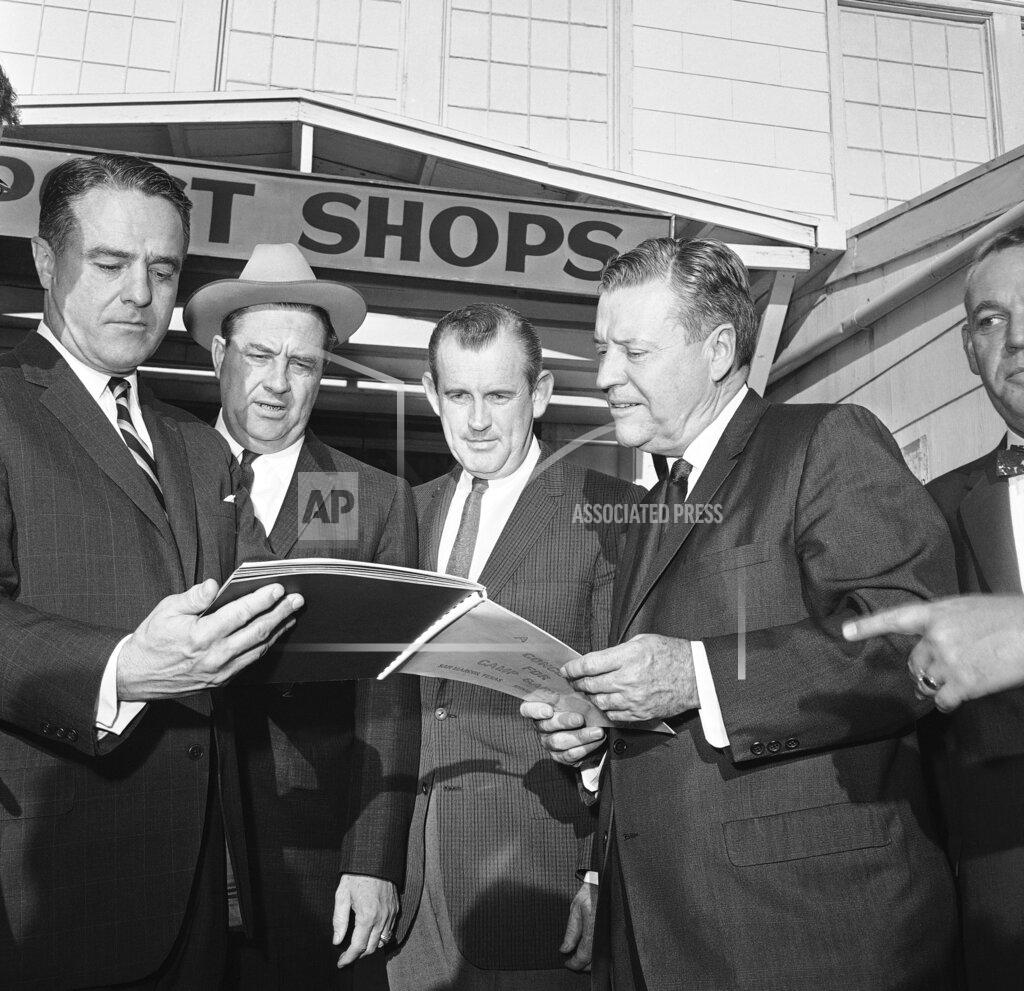
A relatively modest initial assault in what President Johnson has called a war on poverty was announced today by Sargent Shriver, director of the new Office of Economic Opportunity. Mr. Shriver said that 120 projects were involved, including 41 that were announced previously. The initial outlay was put at $35 million, most of it in federal funds but a limited amount contributed by local governments. Congress appropriated $800 million this fall to carry out the anti-poverty program, the first legislation exclusively bearing the imprint of President Johnson. The President first declared “war on poverty” in an address to Congress last January. The legislation was enacted late in the summer but the money was not made available until 50 days ago, Mr. Shriver noted. The projects announced today included 41 Job Corps conservation sites previously announced. Of the $35 million initial allocation for all the anti-poverty projects announced, $15 million will be used for building some new Job Corps camps and renovating existing facilities for other camps. The second largest sum allocated was $12,032,616 in federal funds to states and local communities to wage local attacks on poverty. The localities will contribute nearly $1 million to qualify for the funds.
Dean Burch, the Republican National Chairman, is considering calling a conference of representative Governors, Senators, House members and party leaders to review and reformulate Republican policy on major issues. The object, according to the chairman, would be to have the party’s liberals, moderates and conservatives work together on a statement of principles for the Congressional and gubernatorial elections of 1966. In a recent interview at Montego Bay, Jamaica, Mr. Burch said he was now thinking in terms of a leadership meeting somewhat like the Mackinac Island Conference of 1943. That meeting in Michigan managed to unify the Republican party on most post‐war international and domestic policies. The date and arrangements for such a conference may not be set before the Republican National Committee’s first postelection meeting in Chicago January 22 and 23, at which Mr. Burch will seek a vote of confidence.
As a consequence of President Johnson’s sweeping victory over Senator Barry Goldwater, a number of Republican leaders and moderate‐liberal groups have demanded Mr. Burch’s ouster as chairman. Several have proposed new leadership for the national organization because Mr. Burch was chosen for the post last July on Mr. Goldwater’s designation. After conferences with the chairman at Montego Bay, Mr. Goldwater and others closely associated with his campaign predicted that the national committee would uphold Mr. Burch’s stewardship in any confidence vote. The Mackinac Island Conference was called by Harrison Spangler, then national chairman, to cope with party disunity much like that now facing Republicans. At the time, one of the most divisive issues among Republicans was foreign policy, with an isolationist bloc insisting that America should eschew “foreign entanglements,” while the internationalists believed this country should assume a role of leadership in the world.
J. Edgar Hoover, director of the Federal Bureau of Investigation, pledged tonight that pressure groups would not be permitted to use the FBI to “attain their selfish aims.” Mr. Hoover’s address at the annual award dinner of the Stritch School of Medicine of Loyola University was his first public speech since a news conference last week at which he described the Rev. Dr. Martin Luther King Jr., the integration leader, as “the most notorious liar in the country.” The FBI chief made no mention tonight of civil rights or of Mr. King, who had accused the FBI of foot‐dragging in civil rights cases. But he asserted that as long as he was head of the agency it would maintain its impartiality “despite the hostile opinion of its detractors.”
“It is a great misfortune,” he said, “that the zealots or pressure groups always think with their emotions, seldom with reason. They have no compunction in carping, lying and exaggerating with the fiercest passion. They cry liberty when they really mean license. Justice has nothing to do with expediency. It has nothing to do with temporary standards. We cannot, and will not, permit the FBI to be used to superimpose the aims of those who would sacrifice the very foundations on which our government rests. The FBI will continue to be objective in its investigations and will stay within the bounds of its authorized jurisdiction regardless of pressure groups which seek to use the FBI to attain their own selfish aims to the detriment of the people as a whole.”
[Ed: Laugh. My. Ass. Off. The FBI objective? Laughs some more in Hunter Biden’s laptop. In J. Edgar’s blackmail files. In COINTELPRO. Objective, My Ass.]
A federal grand jury has been looking into the Robert G. Baker case for six to seven weeks, subpoenaing documents as part of the continuing investigation into the affairs of the former Senate aide. There was no indication that the investigation, started several weeks before the November 3 election by Acting Attorney General Nicholas deB. Katzenbach, meant the Baker case had progressed beyond the investigative stage. It was understood that the grand jury’s emphasis was on examining documents related to the case. A spokesman for the Justice Department said that the department did not confirm or deny reports of grand jury proceedings. The department previously declined to comment when asked if any specific aspects of Mr. Baker’s activities were under investigation.
President Johnson’s Maritime Advisory Committee was urged yesterday to appraise “realistically” what was termed the role seamen’s unions have played in the decline of the nation’s merchant fleet. The advice was given by the American Committee for Flags of Necessity, composed of independent ship operators and the subsidiary shipping companies of American oil and steel concerns that have vessels sailing under the flags of Panama, Liberia and Honduras. By registering their ships under these flags, the United States owners avoid the requirement of employing American seamen. The 15‐page statement submitted by the Committee for Flags of Necessity said a “careful examination” of the asserted role of maritime labor leaders and union demands in the decline of the industry was necessary for a full assessment of the merchant fleet’s decline. “Maritime unions must shoulder a much greater responsibility in overcoming the disastrous record of strikes and work stoppages which have frustrated the American maritime industry at every turn and driven countless shippers to seek other solutions to their transportation needs,” it said.
The American Federation of Labor and Congress of Industrial Organizations decided today to push for repeal of the section of the Taft‐Hartley Act under which states can enact “rightto‐work” laws. These laws, on the books of 20 states, prohibit contracts that compel workers to join or remain in unions to keep their jobs. The Taft‐Hartley Act prohibits the closed shop, which requires a worker to be a member of the union in order to get a job. Section 14‐B of the law delegates to the states the power to go further and ban lesser forms of union security, such as the union shop, under which a worker must join the union, usually within 30 days after being hired, to keep his job. Although organized labor has fussed about Section 14‐B since the law’s enactment in 1949, it has not in recent years tried to do anything to repeal it.
The role of the Department of Agriculture is being recast to gear it more closely to aiding all rural America and to increasing food production in underdeveloped nations. Even the name of the department may be changed, to something such as Department of Food, Agriculture and Rural Affairs. Secretary of Agriculture Orville L. Freeman confirmed today that this evolution of the department as a “clearing house” to get “to the people in the country” in rural towns and villages as well as on farms. As Mr. Freeman envisions it, the concept would embrace the funneling of ideas and programs to rural America and would enlist the cooperation of other Federal agencies dealing with such programs as housing, town planning, problems of the aged, medical care and community services.
Robert Moses, a leader of the Black freedom movement in Mississippi, said here last night that major challenges were to be made against that state’s political power structure. The 29‐year‐old Harlem native spoke at the 16th anniversary dinner of The National Guardian, a news weekly, attended by 1,000 at the Astor Hotel. He said that the federal government had failed so far to take the decisions needed to remedy the breakdown of law and order in Mississippi. Mr. Moses said his Mississippi Freedom Project was asking that a federal injunction be directed at all existing law enforcement groups and citizens’ councils in Mississippi in order to halt terrorism. The group is also seeking the appointment of federal commissioners in Mississippi to enforce the injunction, he said. The legal papers are now being drawn up for presentation to a federal court, he said.
British rock band “The Who” begins a 22-week Tuesday night residency at the influential Marquee Club in London, England.
30th Heisman Trophy Award: John Huarte, Notre Dame (quarterback).
Third baseman Ken Boyer of the Cardinals is voted National League MVP, with 243 votes to 187 for Philadelphia outfielder Johnny Callison.
Dow Jones Industrial Average: 887.61 (-1.68)
Born:
Garret Dillahunt, American actor (“Raising Hope”), in Castro Valley, California.
Tony Rombola, American guitarist (Godsmack), in Norwood, Massachusetts.
Alistair McGowan, British comedian and impressionist, in Evesham, England, United Kingdom.
Bob Malloy, MLB pitcher (Texas Rangers, Montreal Expos), in Arlingotn, Virginia.
Died:
Dr. Paul Carlson, 36, American physician and missionary of the Evangelical Covenant Church, was killed during the attempt to rescue him from Congolese rebels in Stanleyville.
Glen Sabre Valance, 21, the last person to be executed in South Australia, was hanged at the Adelaide Gaol at Thebarton.


 History Diaries