Several hundred South Vietnamese students barricaded themselves in a Saigon school today in protest against the draft and held several foreign teachers, including an American woman, as apparent hostages. Policemen who tried to open the main gate of the Lê Quý Đôn school were met with a barrage of rocks, tables, chairs and even blackboards from the windows of the five-story building, to which well-to-do families in Saigon send their children. The name of the American teacher was not immediately available.
About 30 American military policemen were on guard at a United States post exchange and commissary building across the street from the Lê Quý Đôn school. All had loaded weapons and one soldier said: “If they come in here, we will shoot.” Between 30 and 40 American women were inside the American building when the incident at the school started. They went out the back door to escape the periodic hail of stones from the school. Some of the women braved the stones to get their cars away from the area.
Although several hundred students were in the barricaded school, the police said that they thought the demonstration was the work of a hard-core group. Students who tried to leave the building were also targets of stones and hurled furniture. After a time violence quieted down and the police considered whether to rush the school’s main gate. The gate was wired closed and bicycles were stacked behind it. Premier Trần Văn Hương filled Saigon’s streets with armed troops and policemen last night to guard against further demonstrations against the two- and-a-half-week-old civilian government.
A State Department spokesman said today that Ambassador Maxwell D. Taylor’s statements favoring limited expansion of the war in Vietnam were “not policy.” The spokesman, Robert J. McCloskey, was commenting on an interview General Taylor gave to Life magazine in which the Ambassador said that air strikes against Communist training centers and other targets in North Vietnam and in Laos might help the South Vietnamese war against the guerrillas. A report also appeared in The New York Times saying Mr. Taylor favored limited expansion of the war. The interview, in which Ambassador Taylor said that the outcome of the war “is very much in doubt” and that air strikes would “contribute to its solution,” was made public by the United States Embassy in Saigon.
Mr. McCloskey, questioned whether this represented State Department policy, said: “It is not policy. He doesn’t say it’s policy. The question is hypothetical and he is talking about options. These possibilities do exist as options.” Mr. Taylor is due back Wednesday and is scheduled to meet with top advisers on Friday and Saturday. The White House press secretary, George Reedy, announced from Johnson City, Texas, that Mr. Taylor would see President Johnson at the beginning of next week. It was previously thought here that the Ambassador would see the President Friday.
Ambassador Taylor is reported to be planning to urge limited expansion of the war, to involve certain Communist targets in North Vietnam and Laos. He is reported to believe that the United States can strike these targets without Chinese Communist or major North Vietnamese retaliation. Reports from Saigon have indicated that Mr. Taylor now feels so strongly on the subject that unless he receives Administration backing, he will not remain Ambassador.
The. United States Ambassador, Maxwell D. Taylor, has said in an interview that if Việt Cộng supply lines in North Vietnam were attacked “I would certainly expect considerable encouragement in South Vietnam to see that at long last the enemy that had been harassing the countryside for so many years was beginning to pay. He made the statement in an interview with Ray Falk of the American Broadcasting Company. His comments were disclosed by the embassy today.
A United States military spokesman said today that South Vietnamese Government forces had killed, wounded or captured 426 Communist Vietcong guerrillas in two major operations last week. Government casualties were listed as 30 killed, 117 wounded and one missing.
TWA Flight 800 from Rome to Athens crashed as it was aborting a take off at 2:05 in the afternoon from the Leonardo Da Vinci International Airport, killing 50 of the 73 people on board in an avoidable accident. Construction was in progress on the airport’s runway 25, shortening the available length from 8,600 feet (2,600 m) to 6,500 feet (2,000 m); in addition, a steamroller was working only 100 feet (30 m) from the runway. One of the Boeing 707’s four engines failed, the jet could not be controlled and it clipped the steamroller, then burst into flame. Escape chutes were brought out after a delay and only 23 people survived after getting out; 45 passengers and five of the 11 member crew died of carbon monoxide poisoning. TWA would continue to use the “Flight 800” designation; on July 17, 1996, another TWA Flight 800 would be the call sign for a Boeing 747 that crashed into the ocean after taking off from New York for Paris.
British Prime Minister Harold Wilson sharply criticized today the project for an allied mixed-manned fleet of surface ships armed with nuclear weapons. He told the House of Commons that such a fleet, which is favored by the United States, could weaken the North Atlantic Treaty Organization and increase the difficulties of reaching East-West agreements. Allied diplomats here speculated that Mr. Wilson’s objections were restated for tactical reasons, having to do with the Labor party’s antinuclear left wing and with the desire to attain a stronger bargaining position for his talks next month with President Johnson. Mr. Wilson specifically denied a London newspaper report that his Government had agreed to a limited participation in the proposed fleet. But he said nothing to indicate that Britain would not eventually accept a scaled‐down version of the project as part of a new and much broader allied nuclear command. The new command is what Britain intends to propose to President Johnson. It would include British and possibly American Polaris‐armed submarines, British nuclear bombers and most of the nuclear weapons on the Continent now under NATO control.
The British Government took drastic action today to curb International speculation against her currency that has raised the specter of devaluation of the pound sterling. It raised from 5 percent to the “crisis” 7 percent level the key British interest rate that controls the flow of credit in the country. The decision to increase what is known here as the bank rate — made at a ministerial conference yesterday and announced at 10 AM today — will have wide repercussions in British business. The cost of borrowing money automatically goes up. Commercial banks traditionally charge 1 to 2 percentage points above the Bank of England’s bank rate for loans. This means that businessmen will pay more for the money they need to expand and modernize. It also means higher installment credit costs for consumers buying such things as cars or washing machines.
The Federal Reserve Board announced today an increase in its discount rate to 4 percent from 3½ percent as a response to a similar move by Britain earlier in the day. The increase is in the rate at which the Federal Reserve lends to its member banks. It is designed to increase short term “money market” rates in the United States to avert an outflow of dollars abroad, but not to raise the rates at which banks lend to businesses and individual borrowers. William McChesney Martin Jr., the chairman of the Reserve Board, told a news conference that “there is a sufficiency of funds so that it is not necessary or likely” that banks would raise their lending rates. He also said the Federal Reserve intended to continue pursuing an “essentially easy” monetary policy and that today’s move should have a “negligible” effect on the domestic business situation. The official announcement said the action was taken “to maintain the international strength of the dollar.”
Swiss and German authorities reach an agreement to exchange Verenahof to Switzerland for an equal amount of Swiss land, as well as settling other border disputes in the area.
Communist China has undertaken the task of transforming its militia units of more than 20 million men into an effective fighting force. Hong Kong analysts of Chinese affairs said the apparent aims of the reorganization were to tighten control of the country and to prepare for a possible military clash with the United States over Southeast Asia. Cadres of the regular armed forces are being assigned to militia units to improve their military capabilities and to heighten low morale. The backbone of the militia, which is known as Min Ping, was previously formed by the absorption each year of 500,000 to 750,000 men released from the armed forces after three years of conscript duty. Some details of the new militia program became known in connection with a conference this month of militia political officers. Instructions to the conference were given personally by Mao Tse‐tung, the party; chairman, and his top military and civilian aides.
The United States has offered Malaysia jet fighter planes to strengthen her defenses against Indonesia and to help train Malaysians. A communiqué today said the offer — the first of its kind to Malaysia — included other military equipment and training for army as well as air force personnel. An eight‐man American mission has spent two weeks surveying Malaysia’s military needs. The communiqué said the equipment would be made available on “medium‐term credit arrangements.” The offer will be presented to the Malaysian Cabinet for final approval. A Defense Ministry spokesman indicated prompt action was likely. He described the jets in the offer as “trainer-striker” aircraft. It was believed that the planes would be adaptable for use in the guerrilla warfare being fought with Indonesia, which calls Malaysia a neocolonialist plot. The American survey mission followed up a pledge of assistance made by President Johnson to the Malaysian Prime Minister, Prince Abdul Rahman, in Washington last summer.
Communist China belligerently insisted today that its nuclear tests were nobody’s business but its own. It rejected Japan criticism of Peking’s first atomic test last month as “ravings.” In blunt language rarely heard between peaceful neighboring states, the Peking People’s Daily attacked the new Japanese Premier, Eisaku Sato, who had protested the October 16 nuclear test. The paper recalled Japan’s invasion of China and warned that if war broke out again “Japan, as an American nuclear base, will bear the brunt and be inevitably involved in a nuclear holocaust.”
Panamanian National Guardsmen broke up an anti-United States demonstration by several thousand students outside the Legislative Palace today, shooting tear gas into the crowd and firing rifles over the heads of the marchers and the spectators who had joined them. The students, estimated to number 2,500, had converged on the palace in defiance of an order last Friday by Mayor Azael Vargas banning any demonstration. Mayor Vargas had insisted that a student demonstration would disrupt public order while the National Assembly was holding a secret session. The legislators were questioning participants in a dispute involving the administration’s conduct of foreign relations with the United States.
The session, which was held secretly under Panama’s Constitution, heard statements from Foreign Minister Fernando Eleta and from Forge Illueca Foer, special envoy to the United. States. They were describing difficulties between the two countries regarding the Canal Zone, and possible solutions. While the session was under way, the students marched toward the palace. They were quickly dispersed by the National Guard and left the plaza for other sections of the city The students were demanding the dismissal of Ricardo Arias Espinosa, Ambassador to the United States, and Roberto Aler man, an attorney. Both” had been appointed by President Marco A. Robles to serve with Mr. Illueca in handling Panama’s negotiations with the United States.
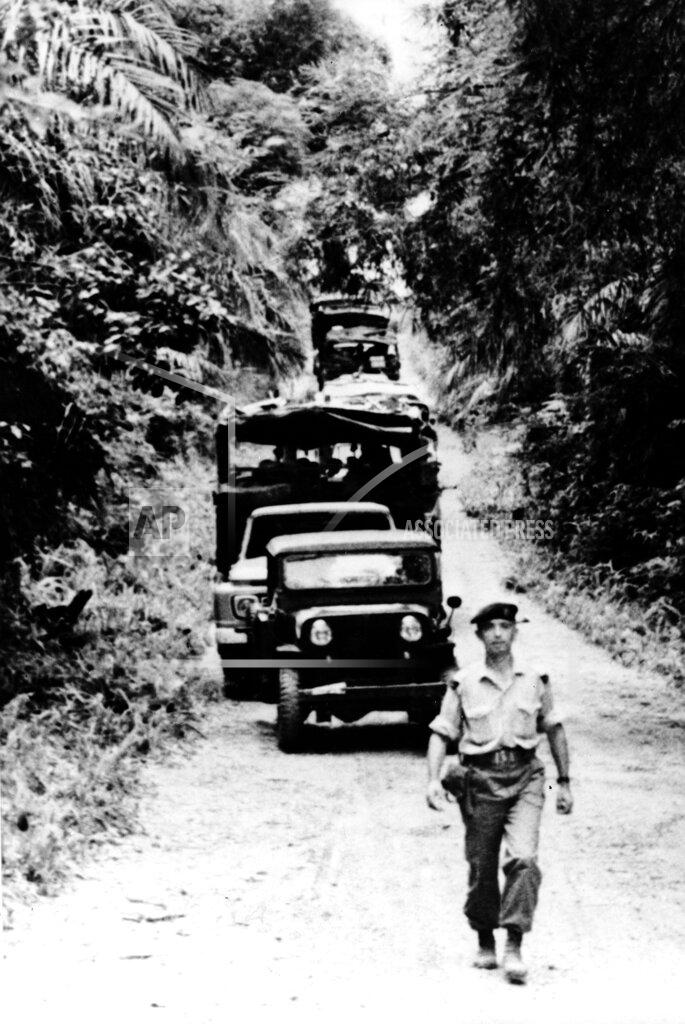
As a 600‐man battalion of Belgian paratroopers stood by today prepared to fly to Stanleyville to rescue rebel hostages, the leader of the rebel regime warned that white hostages would be slain if the landing took place. Christophe Gbenye, the rebels’ leader, warned in a communiqué broadcast in Swahili: “To all our brother nationalists and Lumumbists — if American bombardment comes to us, take your machetes and cut up the foreigners into pieces.” The broadcast was punctuated several times by shouts of “Lumumba‐water! Lumumba-water!” an evident effort to invoke magic from the late Congolese Premier, who was murdered in Katanga in 1961.
The Belgian paratroops were flown from Ascension, an island in the South Atlantic, to Kamina base in North Katanga aboard United States Air Force transports. The same planes will ferry the troops into Stanleyville if the drop is ordered. Should the paratroops go in tomorrow, they may link up with Major Michael Hoare’s Fifth Brigade of white mercenaries and Congolese troops, which is now driving on Stanleyville from the southeast. Late reports today said Major Hoare’s column had captured Lubutu against light resistance but was still more than 120 miles from Stanleyville, the rebel capital. Cuban‐piloted T‐28 and B‐26 fighter‐bombers of the Congolese Air Force are poised to support the paratroops. The planes are on small gravel strips in Lubutu and Punia, about an hour’s flying time from Stanleyville.
More than 60 Americans are believed to be in rebel‐held territory and most are thought to be in Stanleyville, with well over 500 Belgians. Hostages of 11 other nationalities are reported to be involved, including 33 Canadians and 25 Britons.
The Congolese Premier Moïse Tshombe, said tonight he expected the rebellion in the Congo to be crushed “within a few hours.” He made his statement after a column of government soldiers and white mercenaries advanced within four hours’ road travel of Stanleyville.
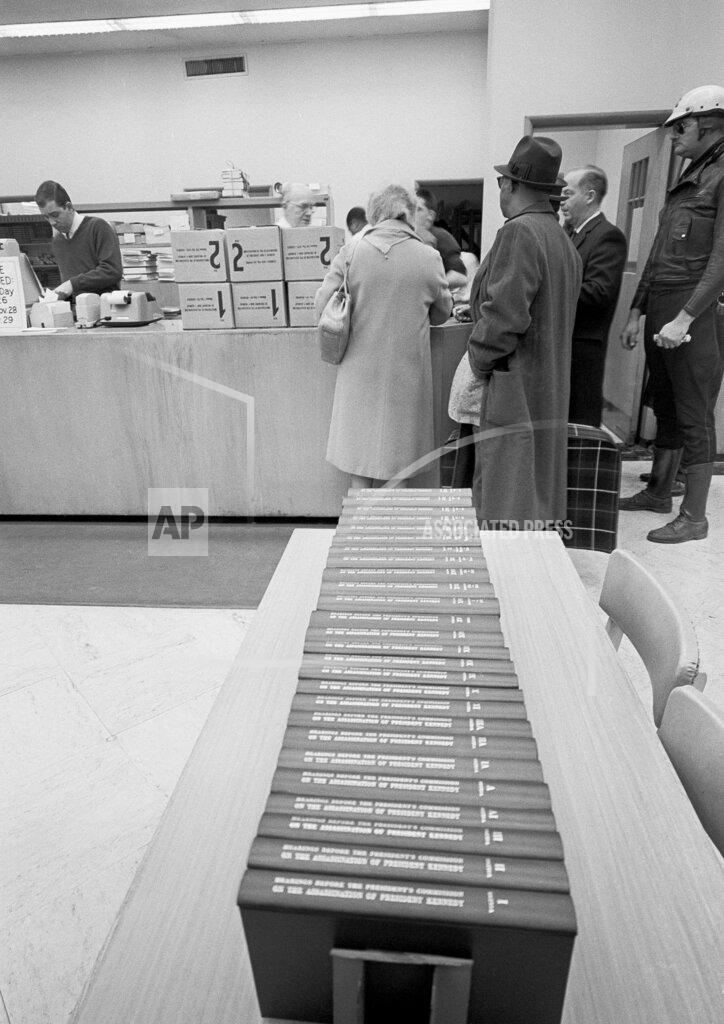
The assassination of John P. Kennedy is relived in excruciating detail in the testimony given to the Warren Commission by those closest to the horror. “My husband never made any sound,” Mrs. Kennedy told the commission. “He had this sort of quizzical look on his face . . . and then he . . . put his hand to his forehead and fell in my lap.” Mrs. Kennedy’s poignant recollections of November 22, 1963, were published today along with the testimony of the 551 other witnesses before the commission. Their words and supporting exhibits filled 26 volumes. The testimony overwhelmingly supported the conclusion of Chief Justice Earl Warren and his colleagues, as revealed in the commission’s report September 27, that the assassination was no conspiracy but the work of one unhappy man, Lee Harvey Oswald.
Senator Ralph Yarborough got the intimation of tragedy within a few seconds, as he saw another Secret Service agent, Clinton J. Hill, on the trunk of the Presidential car. “He beat the back of the car with one hand,” Senator Yarborough said, “his face contorted by grief, anguish and despair, and I knew from that instant that some terrible loss had been suffered.” Mrs. Kennedy was troubled for a time by the thought that she might have saved her husband’s life if she had been looking at him when the first bullet hit him in his back. The later, fatal shot struck his head. “I used to think,” she said, “if only I had been looking to the right I would have seen the first shot hit him, then I could have pulled him down, and then the second shot would not have hit him.”
On the day he was assassinated President Kennedy might have been shielded by a Secret Service agent standing on the right rear step of his car if he had not requested several days earlier that this position be vacated. Four agents who guarded the President at Tampa, Florida, on November 18, 1963, testified before the Warren Commission that Mr. Kennedy had ordered the two men riding on the “jump” steps on the right and left rear of the open limousine to get off and enter the follow‐up car just behind. The agents’ statements were given in response to a request from J. Lee Rankin, the commission’s general counsel. They were not asked and did not volunteer any statement as to whether the steps that flank the trunk of the limousine would have been occupied by agents except for the President’s request.
The U.S. Supreme Court declined to review, and let stand, a lower court ruling that rejected a change in the Pledge of Allegiance to the Flag of the United States, specifically taking back out the phrase “under God” from the pledge that schoolchildren were required to recite at the beginning of the day. Courts in the state of New York had rejected a suit premised on the idea that the reference to God was a violation of the First Amendment guarantees of the separation of church and state in the United States.
The Appellate Division of the New York Supreme Court, in dismissing an appeal from the lower court’s decision, cited an earlier decision by the United States Supreme Court allowing time off during the normal school day for religious instruction outside of school. In that decision, the court had said: “There cannot be the slightest doubt that the First Amendment reflects the philosophy that church and state be separated … the First Amendment, however, does not say that in every and all respects there shall be a separation of church and state. Rather, it studiously defines the manner, the specific ways, in which there shall be no concert or union or dependency one on the other. That is the common sense of the matter. Otherwise the state and religion would be aliens to each other, hostile, suspicious, and even unfriendly.”
The Supreme Court ruled today that the Internal Revenue Service need not show that probable cause existed to believe that a taxpayer was guilty of fraud before the agency could enforce a summons for records of “closed” tax years. In “closed” tax years, collection of any tax deficiency is barred by a three‐year statute of limitations, unless the returns were fraudulent. Justice John M, Harlan delivered the 8–1 decision. Justice William O. Douglas wrote a dissenting opinion.
In a similar case, the Court reversed a decision by the United States Circuit Court in Philadelphia that the Internal Revenue Service cannot enforce a summons for records of “closed” tax years unless it establishes that the agency’s suspicion of fraud is reasonable. Justice Harlan delivered the 6–3 decision in the Powell case. Justice Douglas wrote a dissenting opinion, in which Justices Potter Stewart and Arthur J. Goldberg joined.
The Supreme Court decided today that the Constitution limits state power to impose’ criminal sanctions for criticism of the official conduct of public officials. In so doing, the Court extended to criminal libel cases the rule it laid down for civil libel in a decision last March 9. In that case, it dismissed a 5500,000 Alabama libel judgment against The New York Times and four Black ministers. Today’s decision was unanimous, as was that in the Times case. It reversed the conviction of Jim Garrison, the district attorney of Orleans Parish, La., on a state charge of criminal defamation arising from his criticism of eight judges of the Criminal District Court of the parish. The so‐called “New York Times rule,” extended today to include criminal libel cases, is that the Constitution limits state power to impose sanctions for criticism of the official conduct of public officials to situations where a statement is “made with actual malice — that is, with knowledge that it was false or with reckless disregard of whether it was false or not.”
The high court also, by vote of 6 to 3, set aside an Ohio gambling conviction because the trial record did not show an adequate demonstration by the police of probable cause to arrest the defendant without a warrant and, hence, gambling convictions found on him were inadmissable in evidence
New York Governor Rockefeller told President Johnson yesterday that the scheduled closing of the New York Naval Shipyard was a matter “of sufficient urgency” to merit personal attention at the White House. The Governor accepted an offer to meet with Defense Secretary Robert S. McNamara, who announced last week that the Brooklyn yard and 94 other military installations would be closed in an economy move. But, in a strongly worded telegram to the President, Mr. Rockefeller also “respectfully” repeated a request made last Friday that the order closing the shipyard be stayed. He also scheduled for this afternoon a meeting on the problem with Mayor Wagner, Senator Jacob K. Javits, Senator‐elect Robert F. Kennedy and Representative Emanuel Celler. All four men have joined the Governor in protesting the closing order, which would mean the loss of 9,600 jobs at, the shipyard.
A special senate panel called today for countrywide curbs on discharges of air pollutants by all motors vehicles. It recommended a law requiring general installation of regulating devices adjusted to a national minimum. The group, headed by Senator Edmund S. Muskie, Democrat of Maine, also proposed Congressional action to require the Secretary of Health, Education and Welfare to establish criteria for allowable exhaust emissions from diesel-powered vehicles. Further, it urged legislation to establish a program of grants for the construction of disposal facilities for solid waste and the establishment of a Federal air control laboratory. It also proposed formation of a Government‐industry commission to effect reductions in the emissions of oxide of sulphur from certain fuels.
Conservative Republican Senators are sounding out sentiment for a possible move to oust Senator Thomas H. Kuchel of California from his post as assistant leader, or whip. There is discussion of running either Roman L. Hruska of Nebraska or Peter Dominick of Colorado against Mr. Kuchel when the Senate conference meets in January. Mr. Kuchel did not support Senator Barry Goldwater of Arizona, the Presidential nominee. More important than this in the minds of some of the conservatives was Mr. Kuchel’s failure to support actively the senatorial candidacy of George Murphy of California.
A St. Augustine, Florida, segregationist, Hoisted R. (Hoss) Manucy, refused to testify today at the federal court trial of four Ku Klux Klansmen charged in connection with the bombing of a Black family’s home. United States District Court Judge Bryant Simpson upheld Mr. Manucy’s right to claim the Fifth Amendment as protection against self‐incrimination. The defendants, Barton H. Griffin, Willie Wilson, Donald Spegal, and Robert Pittman Gentry, are charged with conspiracy in the bombing of the home of 6‐year‐old Donald Godfrey on February 16 after the Black boy had integrated the previously all‐white Lackawanna Elementary School. No one was hurt seriously in the bombing.
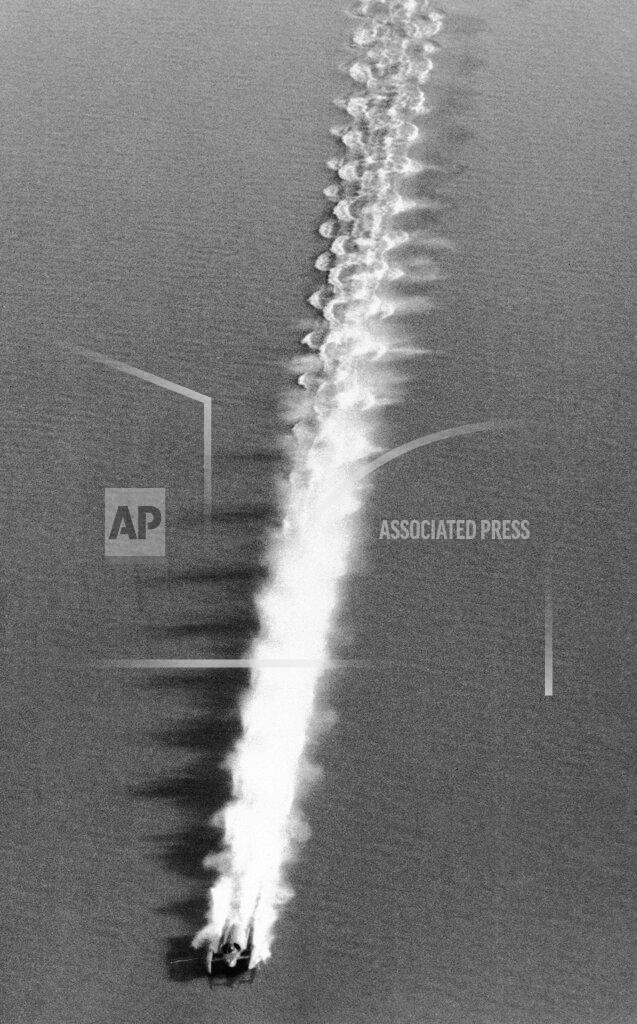
A $2.5 million yacht once used by President Franklin D. Roosevelt capsized early today and was declared a total loss. The 315‐foot Nourmahal, now owned by a Houston oilman, John Mecom, caught fire Saturday while being remodeled. Mr. Mecom bought the yacht from the Federal Government this year and had planned a conversion into a hotel and restaurant to be anchored off a new housing development near Hitchcock, Texas.
Billie Sol Estes, the convicted grain promoter, spent two hours in jail today and forfeited a $10,000 appearance bond by violating a court order restricting his travel.
“Bajour” opens at Shubert Theater NYC for 232 performances.
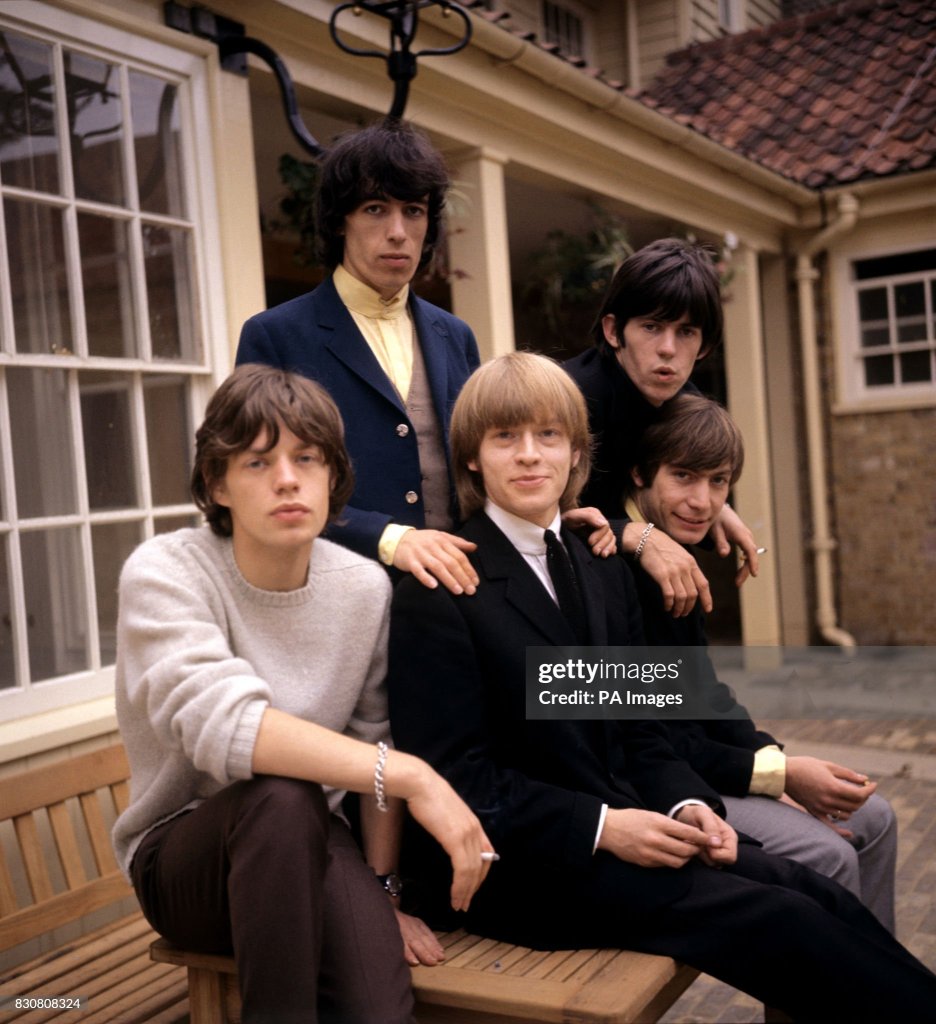
Beatles release single “I Feel Fine” & “She’s a Woman”.
The New York Mets purchase pitcher Warren Spahn from the Braves. The Future Hall of Famer, now 43, slumped to a 6–13 record in 1964, after winning 23 the year before.
Dow Jones Industrial Average: 889.29 (-1.43)
Born:
Steve Alford, Team USA and NBA point guard (Olympics, gold medal, 1984; Dallas Mavericks, Golden State Warriors) and NCAA coach, in Franklin, Indiana.
José González, Dominican MLB player (World Series Champions-Dodgers, 1988; Los Angeles Dodgers, Pittsburgh Pirates, Cleveland Indians, California Angels), in Puerto Plata, Dominican Republic.
John L. Williams, NFL fullback (Pro Bowl, 1990, 1991; Seattle Seahawks, Pittsburgh Steelers), in Palatka, Florida.
Dan Snyder, American NFL team owner (Washington Redskins), in Silver Spring, Maryland.
Boyd Kestner, American actor (“The Outsiders” (TV series); “Knot’s Landing”), in Virginia.
Died:
Edward C. Daly, 43, American cleric and Roman Catholic Bishop of Des Moines, Iowa, was among the victims of the TWA plane crash in Rome. Daly had been attending the Second Vatican Council and was returning home by way of Athens.
 History Diaries