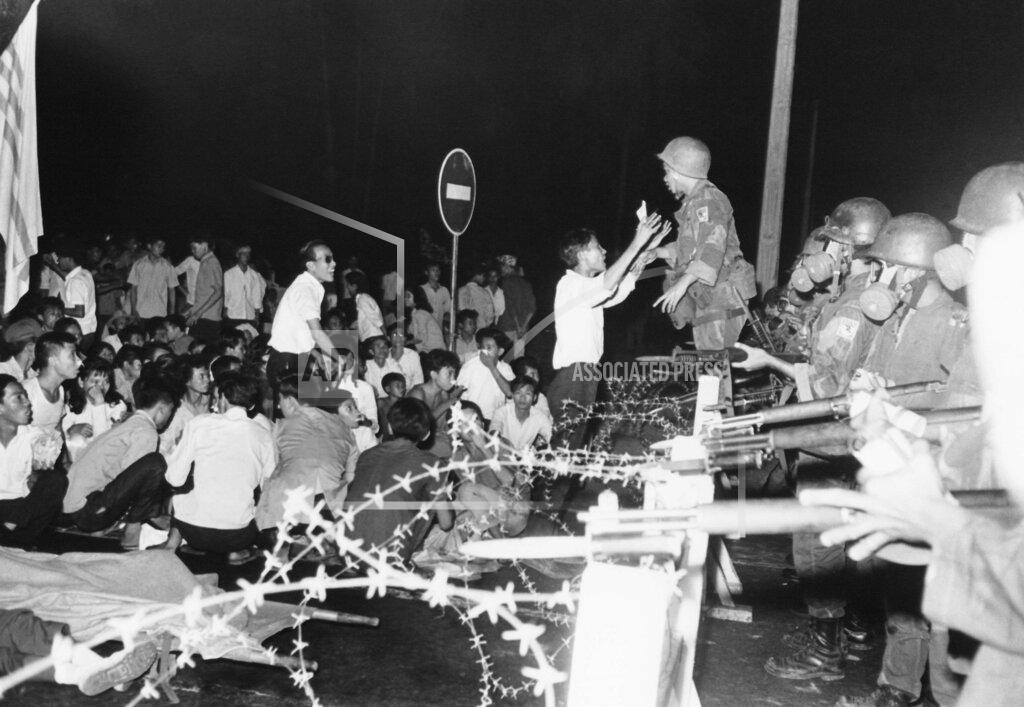
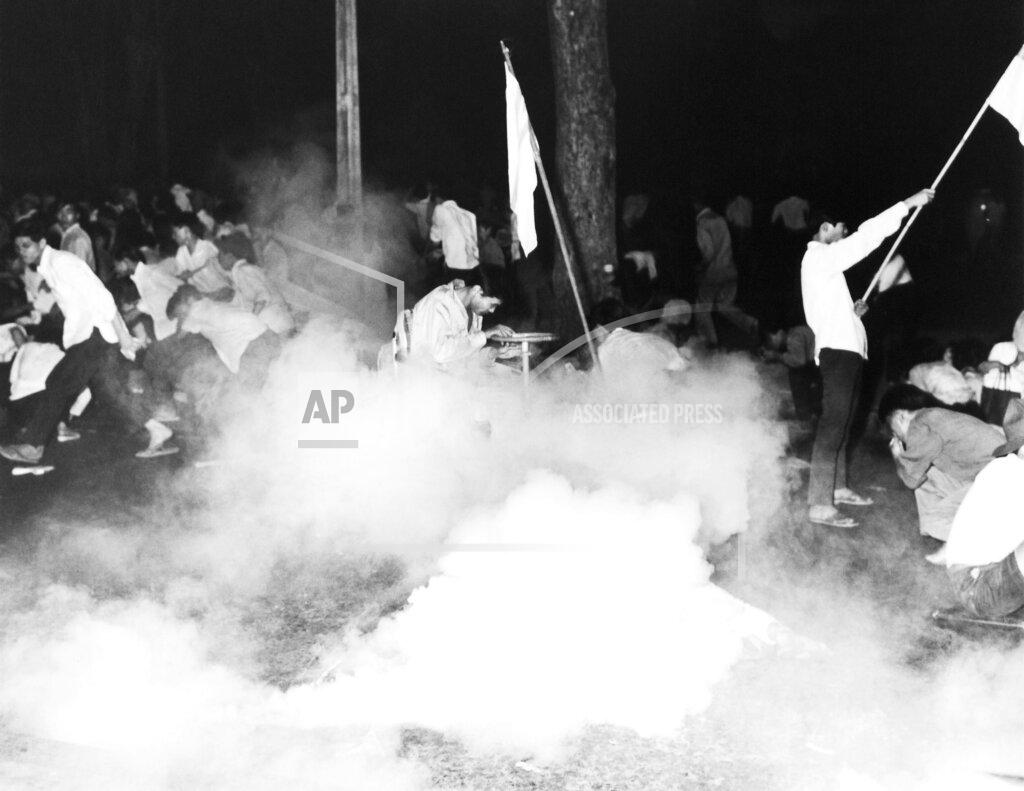
The moratorium on violent demonstrations that the Buddhists have voluntarily observed since 6 November ends today with a march by thousands of Buddhists to the palace of chief of state Phan Khắc Sửu and a resultant clash with police. On the 23rd, Buddhist leaders decide to oppose the government of premier Hương and rioting continues in Saigon. On the 26th, the government declares martial law, banning demonstrations and giving the military control over the police; on the 28th, Buddhist leaders announce that they will resort to a non-violent campaign of non-cooperation.
Thousands of rioters defied the South Vietnamese Government in the streets of Saigon today. Combat policemen hurled tear‐gas bombs into a crowd pressing alongside the chief of state’s palace, sending demonstrators fleeing for shelter in darkened side streets. The government began dispersing the crowds only after a day of angry scenes across the capital. A small group of agitators that started a protest march at mid‐morning swelled to a mob of 3,000 by nightfall, crowding into the streets surrounding the palace.
Their target was the civilian government of Premier Trần Văn Hương, a government that men haranguing the crowds called “anti‐revolutionary” and “unworthy.” Many of the leaders of the crowd were recognized as the same ones who demonstrated in Saigon for a week in August. Those demonstrations brought down the government of Major General Nguyễn Khánh with demands for civilian rule. Today the civilians were denounced with equal bitterness. The starting point of the protest marches in the morning and afternoon was the new National Buddhist Center on the outskirts of the capital. Buddhist leaders, however, denied responsibility for the demonstrations and activists of the opposition political factions were as much in evidence as known Buddhist agitators.
The United States Embassy made public today an interview in which Ambassador Taylor said the war against the Việt Cộng was “very much in doubt.” He also declared that air strikes against Communist supply routes and bases in North Vietnam and Laos could contribute to victory over the Communists. Mr. Taylor, in an interview with Life magazine, a transcript of which was released by the embassy, said, however, that “military action outside the country, just as pure military action inside the country, will not win in itself.”
Asked if the war was being lost, Ambassador Taylor said: “Let us say generally that the issue is very much in doubt. The winner will be the one that has the ultimate will to win. But the military aspect is only one piece of it.” During the same interview Life had with top members ofthe U.S. mission here. General William C. Westmoreland, commander of United States forces in Vietnam, said, “It is absolutely inconceivable to me that the Việt Cộng could ever militarily defeat the armed forces of South Vietnam.”
Ambassador Maxwell D. Taylor was reported today to be planning to urge a limited expansion of the war in South Vietnam beyond the country’s borders when he meets with President Johnson and other key United States policymakers this week. High officials here said the Ambassador favored United States air strikes against certain targets in North Vietnam and Communist-controlled areas of Laos. Indications are that some stepped‐up American airpower is already being used in the area and that the United States air activity over Laos is aimed more at the enemy in South Vietnam than at the pro-Communist Pathet Lao forces in Laos.
Mr. Taylor has argued against ground involvement. He and his associates are said to believe that limited air strikes would not involve major North Vietnamese or Chinese retaliation. The Ambassador, former Chairman of the Joint Chiefs of Staff, will return here Wednesday and will meet with the President and other officials on Friday. The officials have been studying the Vietnam situation intensely for two weeks, trying to judge the situation in the entire area and the possible alternatives to a limited expansion of the war. There is little optimism here regarding the situation in Vietnam. The three years since General Taylor first recommended the major American build‐up there have seen the enemy grow steadily stronger.
Just as three years ago there was doubt how much longer the Saigon Government could survive without a major step‐up in American assistance, now there is doubt over how much longer the present government can survive. Even before today’s riots in Saigon, the political situation was judged by Washington as being extremely fragile. There is considerable respect here for Premier Trần Văn Hương and Washington feels he has been both fair and firm in trying to form a government and control demonstrations. Just what effect the latest political demonstrations will have on the policymaking sessions this week is uncertain. Mr. Taylor and others are reported to be cautious about the idea of any kind of expanded military role for the United; States unless some form of; surface political stability can, be achieved.
The Ambassador apparently would like to see United States airpower used against alleged Communist supply stations and resting places along the infiltration route leading to South Vietnam. Although the guerrilla enemy is extremely flexible and does not use supply stations or offer tangible targets the way enemies in other wars do, highly placed officials in Washington insist that photo‐reconnaissance has pinpointed a number of positions along the Laos border that could be hit by United, States planes.
Mr. Taylor is said to feel so strongly about a limited expansion that he may quit his post if he is not satisfied with the hearing he receives in Washington. So far, according to men who deal with Vietnam policy, President Johnson has given no indication of how far he is willing to go on the idea of limited expansion of the war. He has been described by one high official here as “something of a peacemonger.” Both during the election campaign and in private since he has expressed doubts about the wisdom of involving American troops in a war on the mainland of Asia.
To the world outside South Vietnam’s hamlets and villages, the insurgents are agents of international Communism. In the grass and bamboo houses where they live, in the hamlets they have “liberated,” the Việt Cộng guerillas talk like local people about simple things. “It was hell when we were attacked every night in my hamlet,” said a peasant’s son in his early 20’s. “If the government was good enough or strong enough, I thought it should have been able to protect us at night. “So I thought maybe the Liberation Front people were the ones who were right,” he said. “Now I know they are. I don’t regret my decision to join them.” Another young man said: “I was scared and angry when they attacked our hamlet. But had to go along with them, and now I’m glad I did.”
These remarks were made recently by Việt Cộng troops in an hour‐long conversation in a hamlet in the Mekong delta. The young men said the Americans were the aggressors in South Vietnam. Their commanders would have been pleased if they could capture an American. They were armed with carbines, a submarine gun and hand grenades. No American was present. The questioner was a Vietnamese reporter. He had taken local buses to hamlets in insecure or disputed areas of the delta and found himself in a hamlet about which there was no dispute. Night and day it was governed by the Communists.
The North Vietnamese Foreign Ministry demanded today that the United States stop “all acts of provocation and aggression” against North Vietnam and that it “put an immediate end to the war of aggression in South Vietnam.” The Hanoi demand was contained in a statement issued by a ministry spokesman and was reported by Hsinhua, the Chinese Communist press agency.
Communist China today rejected proposals that it join other nuclear powers in disarmement negotiations. Peking spurned the October 22 suggestion of U Thant, the United Nations Secretary General, that China enter into fivepower talks next year with the United States, the Soviet Union, Britain and France. In its first major statement on disarmament since its nuclear test October 16, Peking also ridiculed United States acceptance of the participation of Communist China in the 17nation Geneva Disarmament Conference. The United States Government “will not have the pleasure of our company,” the statement said. The statement was made in the form of an editorial in Jenmin Jih Pao, the official party organ, which was transmitted abroad by Hsinhua, the Government press agency.
The editorial asserted that Communist China would not participate in the 17-nation Geneva talks because the conference was convened within the framework of the United Nations, of which it was not a member. It added: “Now that China has nuclear weapons, the United States wants to drag her into the affairs of the United Nations.” The question of seating Communist China in the United Nations is scheduled to be debated by the General Assembly after it convenes December 1. The editorial rejected the idea that Communist China might be seated together with the delegation of the Chinese Nationalist Government on Taiwan. “China will have nothing to do with the United Nations as long as the latter fails to restore to the People’s Republic of China her legitimate rights as the sole legal government representing the Chinese people, and as long as the illegal status of the representatives of the Chiang Kai‐shek clique is not nullified,” Peking declared.
The Kremlin is calling a secret meeting of the Communist Party’s Central Committee next month to approve the next move in the ideological conflict with China, reliable sources said today. The sources said the Central Committee might approve Chinese‐Soviet peace talks opening in Peking as early as late December. The talks had been expected to start in January. But the sources said the party Presidium — the group that guides the work of the 330‐member Central Committee — apparently has not yet decided upon a precise action. The Presidium still has not decided who will head the Moscow delegation to the Peking talks, the sources said.
The new Soviet leadership issued its first cultural policy statement today. The statement, in the lead editorial of the Communist party publication Pravda, appeared to differ little from the position in the Khrushchev period. But observers noted that Nikita S. Khrushchev’s repeated demands for “party‐mindedness” in Soviet art appeared to be muffled. The editorial emphasized raising the quality and intellectual level of artistic works. It did not include usual warnings about ideological subversion by Western influences.
British Prime Minister Harold Wilson has decided to go ahead with a formal proposal to Britain’s allies to set up a new nuclear command within the North Atlantic Treaty Organization. According to reliable sources, this was one result of a weekend of discussions between Mr. Wilson and leading members of the Labor Government at the Prime Minister’s official country estate at Chequers, 30 miles northwest of London. The decision is subject to confirmation by the full Cabinet, which includes a number of ministers who were strongly opposed, at least until they joined the government, to Britain’s retaining nuclear weapons and a nuclear role. The way around this opposition has apparently been found in a proposal that Britain will commit all her weapons with strategic nuclear capability, including V‐bombers and Polaris-armed submarines, to the new command, without the right of withdrawal in the event of a national emergency. By surrendering the right of withdrawal, Mr. Wilson can argue with Labor’s left wing that he has given up a national nuclear deterrent, as promised in the party’s election campaign.
He will also be able to argue, according to some of his associates, that the proposed nuclear command, if accepted, would give the required assurances against a “German finger on the nuclear trigger.” The British‐proposed command would embrace and water down the controversial American project for a multinational force of mixed‐manned, nucleararmed surface ships in which West Germany would play a major role. The Labor Government would prefer to see the mixed‐manned ship project scrapped altogether. But Mr. Wilson and his ministers were said to have recognized that it was probably too far advanced in West Germany and the United States for this. Instead, Britain will propose that the mixed‐manned element of the new command consist of perhaps 10 ships instead of the 25 originally conceived, officials said.
President de Gaulle solemnly warned West Germany today against renouncing her alliance with France and becoming an “auxiliary” of the United States. Speaking in Strasbourg, the ancient meeting point of the French and German cultures, the French leader told the Germans they must abide by the rules of the Common Market if, together with France, they were to build “a European Europe” that would be “independent, powerful and influential in the free world.” For either country to renounce this union, the general said, would be to turn over that country’s destiny to a power that, although “certainly friendly,” was situated in a different world and whose destiny could not be identified with that of Europe. The general did not mention the United States directly. But his entourage and the allied diplomats present, including the United States Ambassador, Charles E. Bohlen, understood that he had‐America in mind. The warning to West Germany was the most direct President de Gaulle has given Bonn over its desire to join the mixed‐manner nuclear force proposed by Washington. It was also aimed at Bonn’s delay in fulfilling the Common Market’s rules on agriculture.
In effect, he told the Germans, there can be no divided loyalties and no European unity in the future unless West Germany is prepared to reduce its ties to the United States and cleave to Europe. President de Gaulle spoke to a crowd of more than 20,000 that filled Kleber Square in the center of this old city on the Rhine. Vigorous and confident, he spoke from a balcony above which hung the Cross of Lorraine, symbol of the Free France he led in World War II. The occasion was a triple, anniversary. Twenty years ago, General Jacques-Philippe Leclerc’s Second Armored Division smashed toward Strasbourg and liberated the city on November 23, 1944. Forty‐six years ago today, at the end of World War I, General Henri Gouraud’s Fourth French; Army entered the city, which had been under German rule since the Franco‐Prussian War of 1870. Today was the 74th birthday of General de Gaulle. He grew up in the shadow of the defeat of 1870, fought to avenge it in 1914‐18 and led France from the abyss of 1940 to a role in the victory of 1945. Most persons in the crowd were French. But there were also Germans who had come from across the Rhine.
A major Belgian paratroop drop on the rebel capital of Stanleyville appeared increasingly likely today as apprehension rose over the fate of 900 whites held hostage there. Belgian and United States officials here were unusually secretive amid frenzied diplomatic activity that went on nearly all night and continued throughout the day. Though officials would not talk for the record, informed sources indicated that a parachute assault was “probable.” Premier Moise Tshombe issued a “final appeal” late tonight to all rebel forces to lay down their arms. He said those who had not committed “common crimes” would be spared any reprisal. The Congolese Army has commandeered nearly all Air Congo charter planes. It also became known that all United States Air Force planes, including four giant C‐130 transports, had been diverted to a base at Kamina, from which an airdrop could be staged.
About 600 Belgian paratroopers and support troops were flown on Friday to Ascension Island in the South Atlantic. Ascension is six to eight hours’ flying time from the Congo. There was no word on the fate of Dr. Paul E. Carlson, an American medical missionary condemned by the rebels to execution tomorrow for “spying.” Officials here had no confirmation on two conflicting reports—one that the rebels had postponed the execution, the other that it was carried out today and that the doctor’s body had been burned in a public ceremony.
The Stanleyville radio declared that all 525 Belgians and more than 30 Americans had been “moved into the bush.” This seemed to contradict the rebels’ declaration two days ago that all whites had been moved to a different location in rebel territory. Most observers doubted that the rebels had the transport to evacuate all the Europeans from Stanleyville, the city 775 miles northeast of Leopoldville that has been the capital of the “Congolese People’s Republic” led by Christophe Gbenye. The observers feared that if the whites were split into small groups and dispersed around the city, the danger of their being killed by undisciplined rebel elements would be vastly increased.
Three missionaires escaped to safety in Kitwe, Zambia today from rebel‐held territory in the Congo. Mr. and Mrs. Wesley Beardsmore and Geoffrey Hawksley of the Assembly of God Church mission had been completely isolated since early July in the rebel‐held town of Lulimba, 125 miles northwest of Albertville. They had been threatened with violence many times but never physically harmed.
The Cowra Japanese War Cemetery was dedicated in Cowra, New South Wales as a final resting place for the remains of 523 Japanese soldiers and sailors who died in Australia during World War II, and as a memorial to 231 Japanese men killed in the “Cowra breakout” from the prisoner of war camp located there.
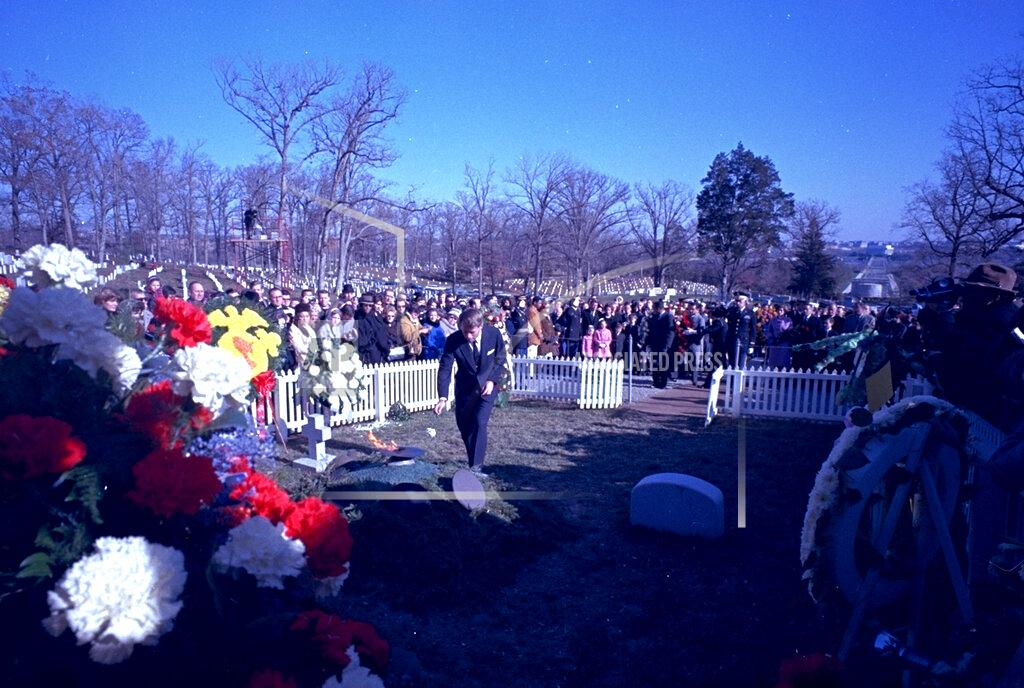
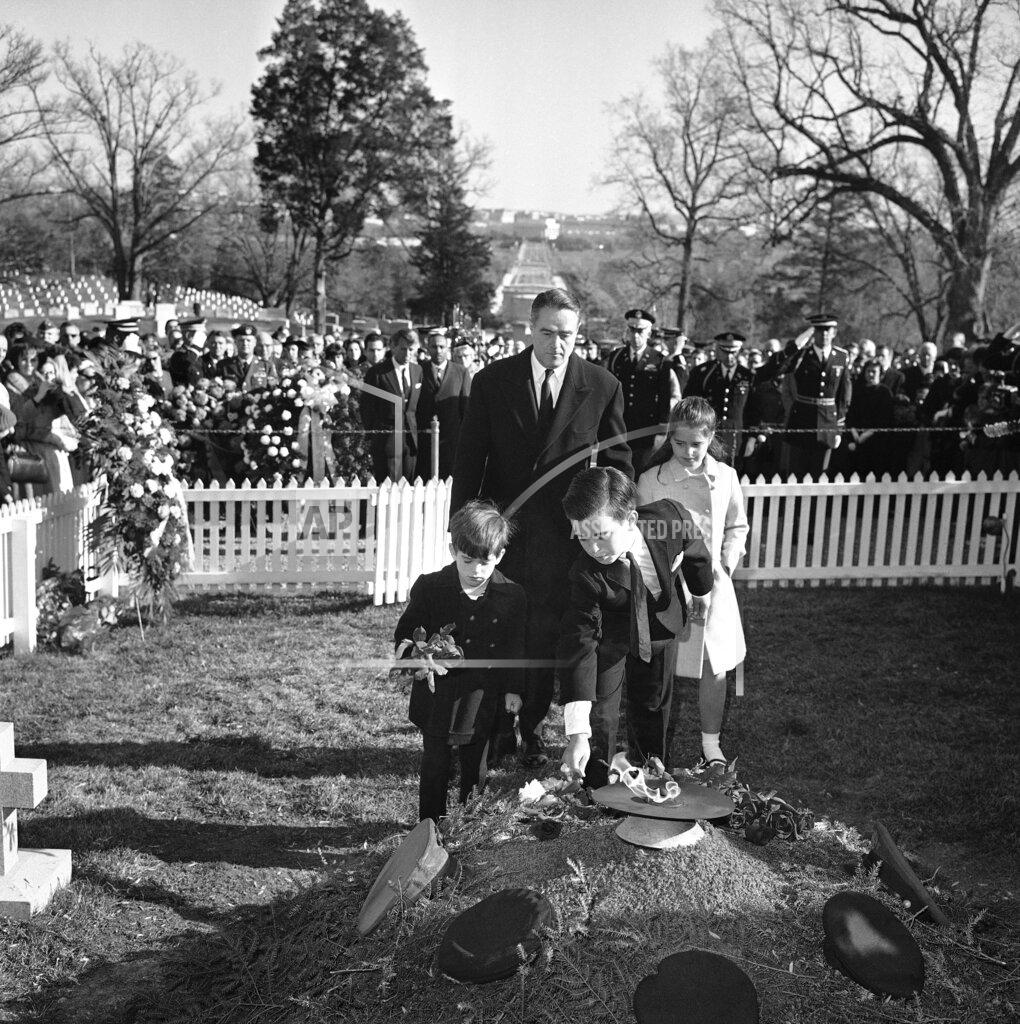
John Fitzgerald Kennedy, slain by an assassin’s bullet one year ago, was remembered today at his grave with flowers and prayers. Forty thousand persons, their waiting lines black against the Virginia hillside where he lies, came to Arlington National Cemetery on the first anniversary of that day of national horror, shame and grief. The first visitor, at sunrise, was Mrs. Kennedy’s mother. Mrs. Hugh D. Auchincloss came alone to the burial place to lay a cluster of white rosebuds and jasmine in the name of Jacqueline Kennedy upon the evergreens around the eternal flame. Mrs. Kennedy was in seclusion in New York with her children. The frail bouquet withered and went brown within the hour on the cold hillside.
Senator‐elect Robert F. Kennedy, hatless and coatless in the bitter chill, knelt at the grave to pray after placing one long‐stemmed white carnation on the mound. Mrs. Sargent Shriver, a sister of President Kennedy, shivering in a light wool suit, brought red roses as Supreme Court justices, Cabinet officers, ambassadors and other members of the Kennedy family watched. Among the earliest visitors were the two daughters of President Johnson. Each left a yellow rose. With them was Mr. Johnson’s military aide, Maj. Gen. Chester V. Cliffton, who bore a huge red, white and blue wreath. On it was a white card engraved: “The President and Mrs. Johnson.” Hour after hour, the wreaths were carried to the grave: from the German Government; the mayor, aldermen and burgesses of Wexford County in Ireland; the Secret Service; the sister of Fidel Castro; the class of 1972, Junior High School 104 in New York City. By dusk, they filled the square little enclosure formed by the white picket fence. On the ground lay the modest tributes from other visitors, who brought small sprays or a single flower in honor of the President.
The day began for the Kennedy family here with a memorial mass at St. Matthew’s Roman Catholic Cathedral, scene of the President’s funeral last November 25. The green‐domed Romanesque church was crowded with more than 1,200 worshipers. The men who had worked beside Mr. Kennedy were there: Defense Secretary Robert S. McNamara; Treasury Secretary Douglas Dillon; Labor Secretary W. Willard Wirtz; Interior Secretary Stewart L. Udall; Agriculture Secretary Orville L. Freeman, and Anthony J. Celebrezze, the Secretary of Health, Education and Welfare. Chief Justice Earl Warren moved up the cathedral steps ahead of Associate Justices Arthur J. Goldberg, Hugo L. Black and Tom C. Clark. Senator Pierre Salinger, Mr. Kennedy’s press secretary, pressed into a pew with his wife and son. Robert Kennedy, his. wife. Ethel, seven of their eight children and the President’s brother‐in‐law Peter Lawford were the last to arrive among the official mourners.
His face solemn and his head bowed, President Johnson attended a simple memorial service today in Austin, Texas for John Fitzgerald Kennedy. Sharing much of this day of painful remembrance with the President and his wife were two of the principals in the Dallas drama of a year ago, Governor John B. Connally Jr. of Texas and Mrs. Connally. The Connallys were in the limousine with President and Mrs. Kennedy at the time of the assassination. Governor Connally was wounded. To attend today’s memorial service at the University Methodist Church, President and Mrs. Johnson flew by helicopter from the LBJ Ranch, 65 miles west of here. They were met at a municipal heliport by Governor and Mrs. Connally and Federal District Judge Homer Thornberry and his wife. The three couples were driven to the church by William Greer, a White House driver, who drove the Kennedy limousine in Dallas a year ago.
Mrs. John F. Kennedy observed the first anniversary of her husband’s assassination yesterday in seclusion with her two children at her weekend residence on Long Island. She did not attend any of the memorial services. A spokesman emphasized Mrs. Kennedy’s wish to mark the anniversary in privacy. Her sister, Princess Stanislas Radziwill, and Mrs. Stephen Smith, a sister of President Kennedy, were with Mrs. Kennedy at her secluded fieldstone house near the Glen Cove residence of her brother-in-law Senator‐elect Robert F. Kennedy.
Marina Oswald, widow of Lee Harvey Oswald, President Kennedy’s assassin, sent word from her hospital room today that she “felt very sorry for Mrs. Kennedy and the children.” Mrs. Oswald entered Doctor’s Hospital last week with a stomach disorder. She was expected to remain four or five more days. “She was a very sad girl all day,” a hospital spokesman said.
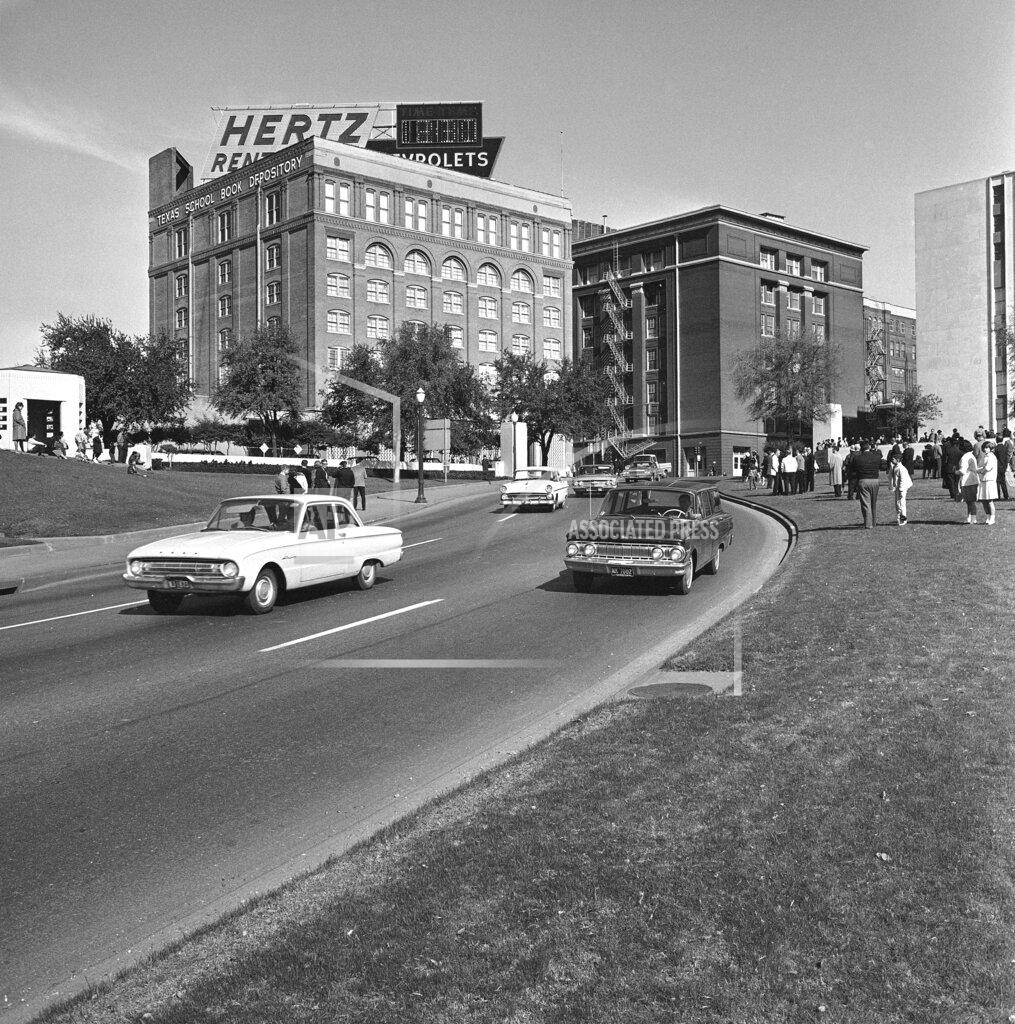
The large time-and-temperature sign in Dallas flashed 45 degrees, then 1:00. A man removed his big gray Western hat, held it to his chest and bowed his head. Another followed suit, then another. A great silence came to the city. Its citizens had been requested by their Mayor to observe a minute of prayer at 1 o’clock this afternoon. The physicians who labored in vain over the body of John F. Kennedy had pronounced him dead of an assassin’s bullets at 1 PM here a year ago today. As that hour approached today, about 200 persons gathered in Dealey Plaza, the scene of the assassination. Some had been there for hours. Others came from church services, where their ministers had recalled the memory of Mr. Kennedy in sermons and prayers. They watched the timeand‐temperature sign on the roof of the seven‐story Texas School Book Depository, from which the bullets were fired by Lee Harvey Oswald.
City officials and civic leaders did not go to the plaza. Mayor Erik Jonsson attended a memorial service later in the day at the Cathedral of the Sacred Heart. The Roman Catholic church was filled with hundreds of persons of various faiths. A solemn requiem mass was offered for the memory of the President. At 1 o’clock, automobiles stopped on their way through the Triple Underpass, where the President’s motorcade was headed when the assassination occurred. A truck driver tapped his horn to get the traffic going again, then apparently saw what was happening and stopped. On the grass triangle that separates two of the streets that feed into the underpass a small girl in a red beret knelt and clasped her hands in prayer, her eyes shut tightly. Another small girl burst into tears and buried her face in the arms of her mother.
Roy Wilkins, executive director of the National Association for the Advancement of Colored People, said yesterday he did not think that J. Edgar Hoover’s “intemperate language” against the Rev. Dr. Martin Luther King Jr. warranted his dismissal. Mr. Hoover, director of the Federal Bureau of Investigation, called the civil right’s leader “the most notorious liar in the country” in a dispute over the conduct of civil rights cases by Southern FBI agents in Albany, Georgia. Appearing on the Columbia Broadcasting Company’s television and radio program “Face the Nation,” Mr. Wilkins said that the N.A.A.C.P. had not asked for Mr. Hoover’s dismissal “because he has a long and distinguished career.”
He said Mr. Hoover was “a good public servant” but was “simply wrong’’ in this instance. Mr. Wilkins added, however, that “the truth of the matter is that 99 percent of the Negro Citizens of this country believe that the attention they received from the F.B.I. in the Southern struggle has been, say, less than satisfactory.” James Farmer, national director of the Congress of Racial Equality, said yesterday that there would be more civil demonstrations in the South in the year ahead. He said on an American Broadcasting Company television program that he expected the F.B.I. to provide protection for the marchers.
After a brief period of postelection mourning, the extreme right wing of the American political spectrum has assessed its position and found cause for elation. And some of its sturdiest foes concede that the joy is not unwarranted. Despite the. crushing defeat suffered by the candidate they labored for, Senator Barry Goldwater, ultraconservative groups are claiming a “thrilling” victory. The apparent paradox is easily explained. Never before has a candidate favored by the far right polled more than a tiny fraction of the 26 million votes Mr. Goldwater received. “26,000,000 Americans Can’t Be Wrong!” shouts a bright orange bumper sticker being distributed by the Conservative Society of America in New Orleans.
A coast‐to‐coast survey by The New York Times shows that most spokesmen for the far right feel the entire Goldwater vote reflects agreement with their views. They reject analyses that attribute the bulk of the total to voting habits of traditional Republicans. They believe the 26 million figure represents a base for recruits to such causes as getting the United States out of the United Nations and the federal government out of any undertaking that local units of government could handle. Vigorous post‐election membership drives are being started. The John Birch Society is already claiming pronounced gains stimulated by the election.
Charles H. Percy, the Republican candidate for Governor in Illinois who was defeated on November 3, said today that this was no time for Republicans to criticize each other but rather a time for self‐criticism. Mr. Percy also made it clear that he expected to continue to play a role in Republican party leadership. “I believe our party has foundered because we have dwelled too much on theory and ideology, and too little on the needs of people and the resources necessary to meet these needs,” Mr. Percy said.
The Verrazano-Narrows Bridge did a brisk business on its first full day of operation, as sightseeing motorists jammed highway approaches in both Brooklyn and Staten Island. By 3 PM yesterday, 24 hours after the first 50‐cent toll was paid, about 100,000 vehicles had crossed the bridge, including six wedding processions and a funeral cortege.Verrazano Bridge officials tried to keep traffic moving near the 40‐mile‐an‐hour limit, but they were frustrated by the leisurely pace of motorists who admired the spectacular view of the Upper and Lower Bays and the city’s skyline. Relaxed Sunday drivers, moving as slowly as five miles an hour, caused traffic to back up for more than a mile off the bridge in each direction.
Officials, proud of the public interest in “our beautiful bridge,” predicted that the traffic flow would be smooth and fast by the end of the week. The Throgs Neck Bridge, which, like the Verrazano‐Narrows, has six lanes, often handles 100,000 vehicles on Sunday with little delay, presumably because its customers do not slow down to look at the view. The George Washington Bridge, which has 14 lanes, eight of them open all the time, handles as many as 140,000 vehicles on Sundays. By 7:30 PM the tieups had been cleared and cars were moving rapidly, a police official said. He described traffic as light.
The way was cleared today for the Ford Motor Company to return to automobile production; with the ratification by the United Automobile Workers of a new contract at the key Sterling, Michigan, chassis plant. A Ford spokesman said automobile assembly lines would start up on Tuesday. Trucks will be built at two plants tomorrow. The Sterling plant and eight others went on strike November 6. Ford said the Sterling plant was vital to the operation of the company. The last two of the nine local strikes were also settled today at a car‐and‐truck assembly plant in Wayne, Michigan. A ratification vote by the members at the Wayne plant will be held tomorrow.
Ford shut down its last auto plant at San Jose, California, Friday because of a lack of parts. The strike had a crippling effect on the company. Only four truck centers were in production last week when auto production was halted. Ford has begun calling back a large portion of its 80,000 laid‐off workers. It hopes to resume total production by the start of next week. Prior to the strike, Ford had been producing nearly 10,000 cars and 1,800 trucks a day.
The Securities and Exchange Commission appears to be about ready to impose a new, and relatively low, minimum‐capital requirement on all securities firms. But the requirement may not stay low permanently. A broad hint to this effect was made over the weekend by Hugh F. Owens, a member of the commission, in a speech before a Federal Securities Act seminar in Atlanta. The commission made the text of his remarks public. While the commission is still technically in the process of deciding whether or not to require all securities firms to hold a minimum amount of capital to back their operations, it has long been known that it intends to propose a minimumcapital rule and that the minimum capital required would be $5,000 for securities firms doing a general business and $2,500 for those engaged only in the sale of mutual‐fund shares. The planned new minimums are considerably smaller than those already required of securities firms that are members of major stock exchanges and are also lower than those that have been advocated by some leaders of the securities industry.
Six men, all military personnel, died today when a U‐6 plane crashed and burned in a rural area two miles west and a mile south of Nebraska City. Joe Bodle of Nebraska City, who witnessed the crash, said the plane “came down and hit a power pole and did a flip‐flop, crashing into the ground. The plane exploded.”
Officials on the American side of Niagara Falls in the state of New York reported the appearance of a third separate waterfall after the falls “had been two cataracts from the beginning of recorded history”. The appearance of a new island created another split in the flow of the Niagara River, which was believed to be temporary.
In the little town of Schellsburg, Pennsylvania, population 288, the churchgoers “held a service of organization formalizing the union of four congregations of different denominations”, marking “the first such four-way merger in the history of religion in the United States”. The United Church of Schellsburg combined the members of the town’s Presbyterian, Lutheran, Methodist and United Church of Christ members into one group, after a 101 to 25 vote that had been taken on October 4.
Golfer Jack Nicklaus narrowly defeated Arnold Palmer to become the top money winner of the year as the 1964 PGA Tour, tying for second place in the final event of the Tour, the Cajun Classic Open Invitational. Palmer had been the top money winner in 1962 and 1963, and was the leading moneymaker going into the tournament at Lafayette, Louisiana, ahead of Nicklaus by $318 ($111,703 against Nicklaus’s $111,385). Although Miller Barber finished first at Lafayette (with 277 strokes for the 72 holes) to win his first PGA tournament ever, Gay Brewer missed a 15-foot putt on the 18th hole and finished at 282 instead of 281, and had to share second place with Nicklaus, who won $1,900; Palmer finished fourth, with $1,500. As a result, Nicklaus had earnings of $113,284.50 for the year, and Palmer had $113,202.37; the difference was only 81 dollars and 13 cents.
NFL Football:
Baltimore Colts 24, Los Angeles Rams 7
Cleveland Browns 21, Green Bay Packers 28
Dallas Cowboys 16, Washington Redskins 28
Minnesota Vikings 23, Detroit Lions 23
Pittsburgh Steelers 44, New York Giants 17
St. Louis Cardinals 38, Philadelphia Eagles 13
San Francisco 49ers 21, Chicago Bears 23
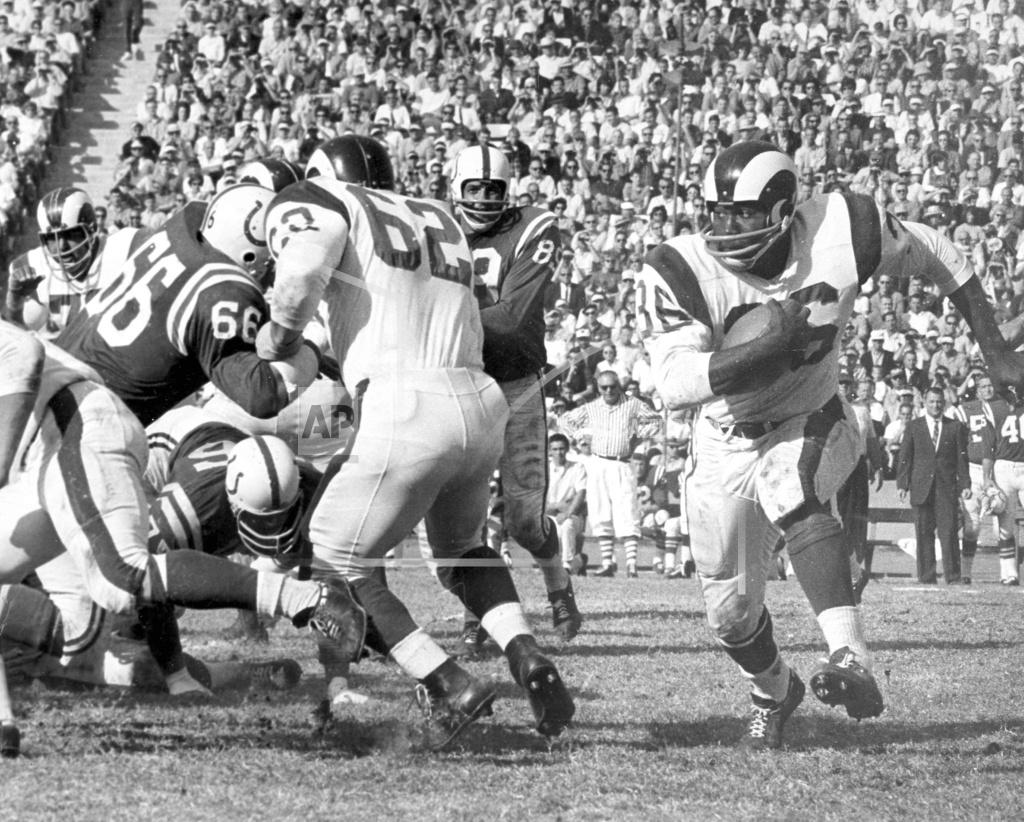
The Baltimore Colts wore down a tough Los Angeles Ram defense today to win, 24–7, and clinch the National Football League’s Western Conference title. Johnny Unitas, the Colts’ quarterback, had a rough afternoon at the hands of the Rams, but when he was stymied in the air he called ground plays to hit scoring territory. The Colts, winning their 10th consecutive game after a loss to Minnesota, led at half‐time by 7–0 and the Rams were a threat until the final period. Baltimore didn’t score until late in the first period when Lenny Moore burst through the right side of the line on an 18-yard run. The touchdown was set up by a 62‐yard pass play from Unitas to John Mackey. Unitas engineered a touchdown march again in the third period—this one largely on the ground. He tried only one pass in the five‐play march and that was incomplete. With the ball on the Ram 17, Unitas fooled the defense by calling a draw play, and Jerry Hill darted up the middle for the touchdown. Roman Gabriel was the quarterback for the Rams in the first half. He netted 8 yards while losing 56 trying to pass. A rookie, Bill Munson, took over in the third period and steered Los Angeles to its touchdown. The payoff was a 21‐yard pass to another rookie, Bucky Pope, his ninth touchdown of the season. The Colts, leading by 14–7 in the final period, scored 10 more points on Lou Michael’s 23‐yard field goal and Tony Lorick’s touchdown plunge to move out of range. The Colt defense, bulwarked by Gino Marchetti and Bill Pellington, threw Ram quarterbacks for losses 11 times and 102 yards.
The Green Bay Packers, the former masters of the National Football League, enjoyed a return to glory today, at least temporarily, by putting brakes on the Cleveland Browns’ rush toward the Eastern Conference title. Taking advantage of two of four big Cleveland mistakes in the second half, Coach Vince Lombardi’s Packers scored a 28–21 victory before 48,065 fans at County Stadium. The high spot in an otherwise mediocre campaign for the 1961‐62 league champions warmed the hearts of most of the fans, who sat bundled in 15‐degree temperature. This was the largest home crowd to watch the Packers, who play their games either in County Stadium or in City Stadium in Green Bay, Wisconsin, which seats 43,000. Two of the Cleveland errors were rare fumbles by Jim Brown, his first and second of the season. With the score 14–14 in the third period, Brown charged through the line only to be met by Ray Nitschke, the 240pound linebacker. The jolt knocked the ball out of Brown’s arms, and Lionel Aldrige pounced on it on the Cleveland 22. Four plays later, Bart Starr, Green Bay’s quarterback, rolled right and scampered 3 yards for a touchdown. Paul Hornung, limited to placement kicking today, connected on the third of four he made during the afternoon. The Golden Boy was suffering from a pinched shoulder nerve, which has bothered him throughout his football career.
The Washington Redskins turned two pass interceptions into touchdowns today in defeating the Dallas Cowboys, 28–16. Paul Krause, a rookie, ran 35 yards for a score after intercepting a Don Meredith toss in the final two minutes and John Reger picked off a Meredith pass in the opening minutes of the game and ran 6 yards for a touchdown. Krause had another interception for a total of 10 this season. The game, played in near-freezing weather, was marked by fumbles, dropped passes and penalties. The lone Dallas touchdown came as a result of a fumbled punt by Pervis Atkins that was recovered by the Cowboys on the Washington 9. The Cowboys scored two plays on a lateral pass from Meredith to Jim Stiger.
Wayne Walker’s 36‐yard field goal with less than a minute to play enabled the Detroit Lions to tie the Minnesota Vikings, 23–23, today in a National Football League game. A chilled crowd of 48,291 saw the Vikings move into a 20–6 lead midway in the third period on the passing of Fran Tarkenton and two field goals by Fred Cox. Detroit came to life when Sammy Williams picked up Tommy Mason’s fumble on the Minnesota 4 and ran it in for a touchdown. The Lions, aided by a pass interference penalty, tied the score at 20–20 early in the final quarter when Milt Plum tossed an 18‐yard pass to Terry Barr. The Vikings marched downfield quickly and Cox kicked a 38‐yard field goal to put the Vikings out in front, 23–20, with less than four minutes left. Minutes later, however, Walker tied the score again with his field goal.
The Pittsburgh Steelers blew out the reeling New York Giants. The score was 44—17 and the site was Yankee Stadium, filled to capacity for the 20th consecutive time with 62,961 paying customers. Disenchantment has infected a segment of the chilled clientele, however, and derisive song could be heard coming from the stands when the Steelers, the next‐to‐lastplace team in the Eastern Conference, scored 20 points in the third period to assume a 37–3 lead. The fans, who have so often in the past praised the Giants to the skies, were singing, “Goodbye, Allie, we hate to see you go.” John Henry Johnson and Clarence Peaks ran all over the Giant defense, which until yesterday had not had a truly bad game this season. The 35‐year‐old Johnson gained 106 yards in 23 carries and scored two touchdowns. Peaks had 97 yards in 15 carries. Other Steeler scores were made by Gary Ballman and Clendon Thomas, the wide receivers; Dick Hoak, a substitute halfback, and Mike Clark, who kicked three field goals. The Giants were alive only briefly. From the kickoff the Steelers drove 72 yards to the 2, but settled for a field goal. The Pitt offense soon took off again, but lost a fumble at the Giant 16. New York then went all the way to the Steeler end zone in 13 plays — but did not score. Clarence Childs, then playing halfback in place of the injured Steve Thurlow, fumbled the ball as he crossed the goal line with a screen pass from Y. A. Tittle. Dick Haley of the Steelers recovered for a touchback. Matters went downhill for the Giants thereafter.
The St. Louis Cardinals recovered four fumbles and intercepted three passes today in defeating the Philadelphia Eagles, 38–13, and retaining a chance to win the National Football League Eastern Conference title. Two field goals by Sara Baker gave Philadelphia a 6–3 lead in the second period, but the first Eagle fumble gave St. Louis the ball at the Philadelphia 14. Bill (Thunder) Thornton carried twice to the one, from where John Crow scored and sent St. Louis ahead to stay. Just before halftime, Ollie Matson fumbled and Dale Meinert recovered for the Cards at the St. Louis 27. Two plays later, Charlie Johnson passed 33 yards to Bobby Joe Conrad for a touchdown. Conrad scored another touchdown in the third quarter on a 2-yard reception. Larry Wilson added a defensive touchdown, returning an interception 42 yards for a score. Thornton closed out the scoring with a 31-yard touchdown run.
Roger Leclerc’s third field goal, a 20‐yard kick with 1:11 to play, gave the Chicago Bears a 23–21 victory over the San Francisco 49ers of the National Football League today. Chicago had taken an early 14–0 lead on Rudy Bukich’s touchdown passes of 12 yards to Rick Casares and 10 yards to Jon Arnett. With John Brodle at the San Francisco helm, the 49ers made it 14–7 before the quarter ended when Abe Woodson returned a kickoff 70 yards to set up a Mike Lind’s 1‐yard scoring plunge. The 49ers drove 94 yards for their second touchdown, capped by a 10‐yard pass from Brodie to rookie Dave Parks, and 76 yards for their third, which ended when Bernie Casey made a leaping catch of Brodie’s 7‐yard scoring pass.
AFL Football:
Kansas City Chiefs 28, Houston Oilers 19
New York Jets 26, Oakland Raiders 35
Len Dawson passed for three touchdowns and engineered another before he suffered a broken nose today as the Kansas City Chiefs outlasted the Houston Oilers, 28–19, in an American Football League game. Dawson, the A.F.L.’s leading passer, was injured midway in the third quarter on a touchdown pass play to Chris Burford. The victory squared the Chiefs’ won‐lost record at 5–5 in the Western Division and the Oilers plunged lower into the cellar in the Eastern Division with a 2–9 mark. A fumble and a pass interception set up two touchdowns. A third scored on an eightplay, 73‐yard drive to give the Chiefs a 21–10 halftime margin. Abner Haynes gained 156 yards on 25 carries, his greatest total since the championship game two years ago. Charlie Hennigan scored both Oiler touchdowns on passes, one from George Blanda and the other from the rookie quarterback, Don Trull.
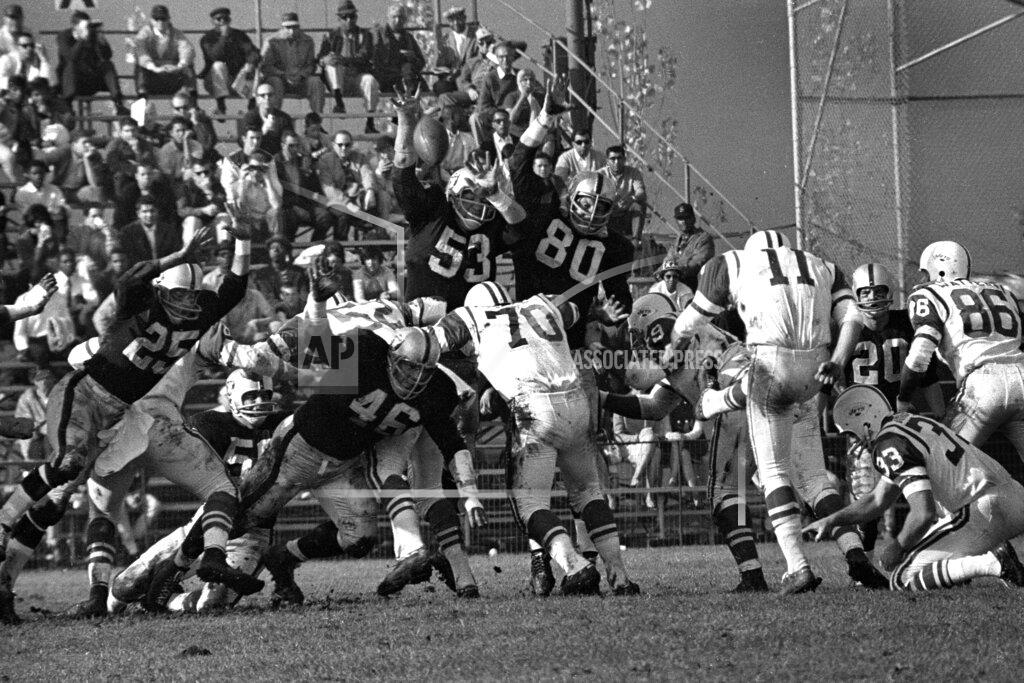
The Oakland Raiders, led by the passing and running of their seasoned quarterback, Cotton Davidson, routed the New York Jets, 35–26, with a second‐half 21‐point comeback. The loss, the second to Western Division clubs on this 10‐day trip, ended the last, lingering hopes of the Jets for an Eastern Division title. Coach Al Davis’s club, showing signs of life much too late in the season, trailed New York by 6 points at the intermission, 20–14. But in the final 30 minutes the Jets were shackled by their usual second‐half ineptness and lost control of the game. Davidson, in his eighth pro campaign, passed for three touchdowns and ran for another as he led Oakland to its third victory. The Raiders have lost seven games and tied one. Six minutes into the second half, the Raiders took the lead for the first time. Davidson moved his club 32 yards in seven plays after a fair‐catch interference call by Jim McCusker put the Raiders on the New York 32. Billy Cannon smashed over for the final yard. The score gave Oakland a 21–20 lead and the Raiders blasted the game wide open from there. The Jets seldom were more helpless than they were after they gained 68 yards on one play, a Dick Wood to Bake Turner pass for 38 yards coupled with successive 15‐yard penalties. That put New York on the Oakland 15. In three plays they failed to move the ball, and Jim Turner’s field‐goal attempt was blocked by the Raider line. The Raiders then went 90 yards in 14 plays, with Davidson passing to Cannon for the final 9. A 51‐yard pass play from Davidson to Herock set up the final Oakland score, capped by Davidson’s own 6-yard run. The Jets struck for their final score late in the fourth quarter when Wood hit Don Maynard on a 49‐pass play. That drive was started by Wahoo McDaniel’s interception.
Born:
Benoit Benjamin, NBA center (Los Angeles Clippers, Seattle SuperSonics, Los Angeles Lakers, New Jersey Nets, Vancouver Grizzlies, Milwaukee Bucks, Toronto Raptors, Philadelphia 76ers, Cleveland Cavaliers), in Monroe, Louisiana.
Gene Atkins, NFL safety (New Orleans Saints, Miami Dolphins), in Tallahassee, Florida.
David Tate, NFL safety (Chicago Bears, New York Giants, Indianapolis Colts), in Denver, Colorado.
Greg Horne, NFL punter (Cincinnati Bengals, St. Louis-Phoenix Cardinals), in Russellville, Arkansas.
Andy Schillinger, NFL wide receiver (Phoenix Cardinals), in Lakewood, Ohio.
Stephen Geoffreys, American actor (“Fright Night”, “Fraternity Vacation”), in Cincinnati, Ohio.
Pierre Vercheval, Canadian Football HOF guard (6 x CFL All Star; Edmonton Eskimos, Toronto Argonauts, Montreal Alouettes), in Rocourt, Belgium.
 History Diaries