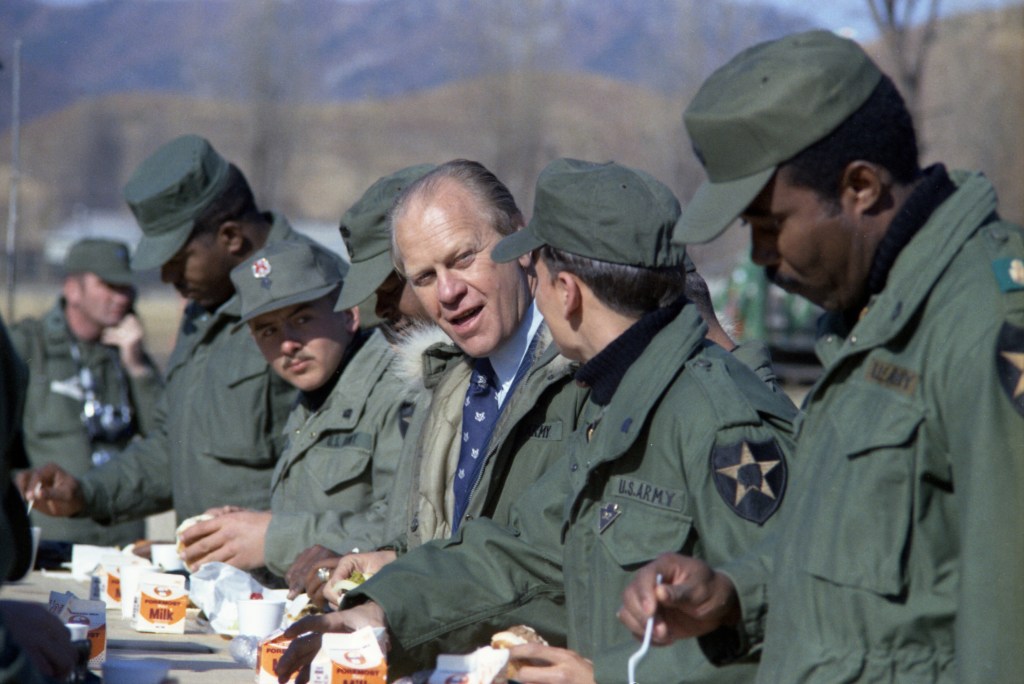
President Ford arrived in Seoul, South Korea, where he was greeted by President Park Chung Hee with full military honors. President Park greeted Mr. Ford “as our partner” in the common effort to find security in Asia. Mr. Ford said “I am here to reaffirm our friendship and to give it new life and meaning.” The visit, a controversial one in Korea, has been criticized by opposition spokesmen on the ground that it might be taken as a sign of “American approval for the Government of President Park Chung Hee, whom they denounce as dictorial and repressive. President Park welcomed Mr. Ford by declaring that the alliance between the United States and South Korea had been “confirmed in blood” during the Korean and Vietnam wars. He hailed Mr. Ford as “our partner” in the common effort to find security in Asia. President Ford, hatless in the cool wind under a sunny sky, said that th e United States mission in South Korea was to help prevent the recurrence of hostilities. “That is our continuing commitment which I today reaffirm,” he said. South Korea is the second stop on Mr. Ford’s Far Eastern tour, on which he is accompanied by Secretary of State Kissinger. After talks with officials in Tokyo Tuesday and Wednesday and a call on Emperor Hirohito and Empress Nagako, the President toured the ancient Japanese capital of Kyoto yesterday.
As President Ford’s helicopter made its approach to Camp Casey in Smith Korea today, Major General Henry E. Emerson had his soldiers of the United States Army’s Secand Division out on the field, giving them a pep talk on how to greet a President on his way to negotiate with the Soviet Union. “He’s not just our Commander in Chief,” the general’s voice boomed from the loudspeakers. “He’s Commander in Chief of all the American troops. He’s Commander in Chief of the whole free world, and he’s going to talk to the Russian Communists. He’s a hell of a man. He’s an all-American football player, and I guess that tells you what kind of a guy he is. He’s putting our country back together and he’s putting the world back together.”
President Ford’s impending meeting with Leonid I. Brezhnev this weekend is a hasty effort by both sides to reaffirm policies of accommodation at a time when there are strains on the underpinnings of détente. For the two men, the encounter in the Far East is a chance to engage in their first quick reconnoiter since the change in the United States presidency. To the gregarious Mr. Brezhnev, who has made personal contact a hallmark of his détente diplomacy; this is an especially important reason for the get‐together. However brief, the meeting will also provide the two leaders an opportunity to make some quick common declaretion, especially in the field of arms control, to provide mutual reassurances of their goodwill and to help them rebut skeptics and critics of détente when they return home. This is important for both. For despite the resilience of Soviet‐American relations lately in the face of certain strains over trade and the Middle East and a loss of earlier momenturn, each side has given indications of uneasiness about the long‐term future of détente.
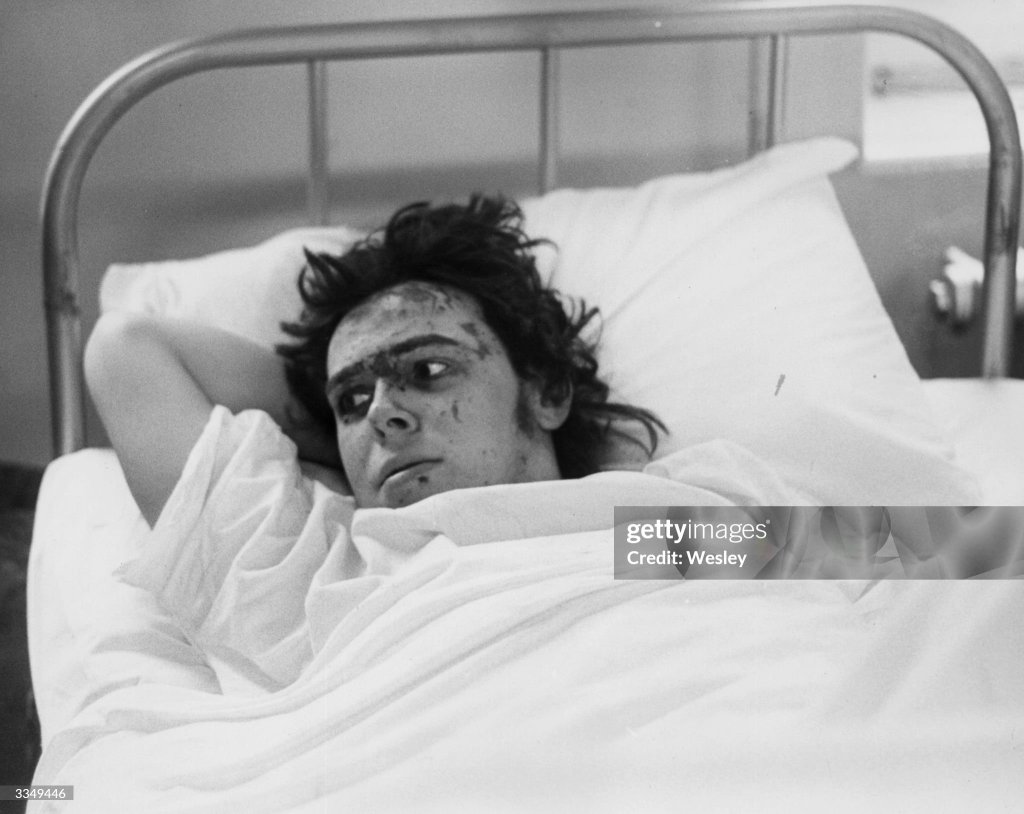
The British Government announced today that it would quickly introduce legislation to give emergency powers to the police and immigration authorities to help combat terrorism by the Irish Republican Army. The Government’s action following yesterday’s bombings of two pubs in Birmingham, which killed 19 persons and injured 184, reflected the public anger against the Irish Republican Army. In adopting more stringent countermeasures, the Government is taking a step that it has resisted both since sectarian strife began in Northern Ireland five years ago and since I.R.A. bombers became active in England 15 months ago. Home Secretary Roy Jenkins did not specify what the new measures would be. He coupled his statement in the House of Commons with an appeal to the British people not to enact “hostility or vengeance” against the more than one million Irish-born people in Britain.
Yugoslav prosecutors have charged at a trial of 16 accused terrorists that exile groups in West Germany, France and Canada are supporting a campaign for arson, bombing and assassinations in Yugoslavia. The trial began yesterday at Zadar in the Republic of Croatia. The defendants, one of whom is being tried in absentia, are charged with belonging to group called Hora, associated with the Croatian separatist movement known as Ustashi.
The General Assembly approved two resolutions declaring that the Palestinian people have the right to independence and sovereignty and giving the Palestine Liberation Organization observer status in United Nations affairs. United Nations General Assembly Resolution 3236 was enacted by a vote of 89 in favor, 8 against and 37 abstentions. The resolution declared its reaffirmation (after a 1948 resolution) of “the inalienable rights of the Palestinian people in Palestine, including…the right to self-determination without external interference; the right to national independence and sovereignty [and] the inalienable right of the Palestinians to return to their homes and property from which they have been displaced and uprooted.” In a separate resolution, the General Assembly granted the Palestine Liberation Organization observer status as a representative of the Palestinian people in and around Israel.
Three Palestinian guerrillas who hijacked a British airliner with 47 persons aboard Thursday night in the Persian Gulf sheikdom of Dubai landed in Tunis and demanded the release of 13 terrorists held in Cairo. An Egyptian plane was reported to have brought the 13 to Tunis, but official sources in Cairo denied that the men had left the Egyptian capital. Three men left the plane and entered the air terminal. Officials said they were members of Al Fatah the guerrilla group, and included Salah al‐Khalaf, an aide of Mr. Arafat. All 13 were said to belong to the same Palestinian splinter group as the three hijackers, who were described in guerrilla leaflets distributed in Beirut, Lebanon, as the “Martyr Abou Mahmoud Squad.” Abou Mahmoud was the code name of a dissident guetrilla leader assassinated last September. The three guerrillas set a number of deadlines for the release of the 13 terrorists, and as each passed they set a new one. At one point yesterday they freed two women and two children from the airliner.
The hijacking of the British airliner from Dubai to Tunis was regarded in Beirut as a challenge to the authority of Yasser Arafat, chairman of the Palestine Liberation Organization. The three hijackers belong to a splinter group that opposes the Arafat organization, which denounced the hijacking as “an irresponsible act.” While Mr. Arafat heads the over‐all guerrilla grouping, the Palestine Liberation Organization, his authority is rejected by large guerrilla groups such as the militant Popular Front for the Liberation of Palestine. The front, which is Marxist, recently withdrew from the Liberation Organization in protest against what it called Mr. Arafat’s support for American‐sponsored “capitulationist schemes” for a settlement with Israel. The Arafat organization was recognized at the recent Arab leaders’ meeting, at Rabat, Morocco, as the “sole legitimate representative of the Palestine people” and the rightful political group to establish a Palestinian state in any part of the occupied West Bank or the Gaza Strip that Israel may relinquish. In extending such recognition, the Arab leaders also called on the Liberation Organization to confer with leaders of Egypt, Syria and Jordan on a common approach to Israel.
Israeli soldiers fired automatic weapons into the air today to break up a violent demonstration by several hundred Arabs in the Old City of Jerusalem. The protest erupted after the conclusion of the Friday prayer service at the Al Aqsa Mosque in the Old City. It came as tension mounted in Jerusalem in anticipation of the passage of a resolution on the Palestinians in the United Nations General Assembly. An angry crowd of several hundred Arabs came boiling out of the mosque just after noon and marched through the narrow, twisting streets waving Palestinian flags and chanting pro-Palestine slogans. Several young men rode on the shoulders of others, waving their arms and leading the crowd in Arabic chants: “Palestine is Arab,” “Long live Arafat.”
A year after it began, the warm relationship that Secretary of State Kissinger achieved between Washington and Cairo is showing signs of severe strain, and most Western diplomats here believe that it will not survive the winter. Egyptian officials concede in private that they have lost hope of reaching a Middle East settlement through the mediation of Mr. Kissinger. Even expectations for another Israeli withdrawal in the Sinai Peninsula, which were still alive during Mr. Kissinger’s last visit there two weeks ago, have all but vanished. As a result, the Egyptians are slowly but surely aligning themselves with the mood of the rest of the Arab world. They are moving away from reliance on Washington and are looking once more to Moscow for basic political, economic and military support, and to the oil-producing Arab countries for financial backing.
For the moment, the anti‐government protest movements that burst dramatically into public view last September have lost their momentum and have slid into a quiet standoff with President Nguyễn Văn Thiệu. The opposition has been unable to expand its support significantly. Most of its potential allies have given only lukewarm endorsement, preferring to be cautious. Its major factions, with a history of mutual suspicion and fragmentation, have not yet formed anything resembling a united front. Some politicians and foreign diplomats believe that Mr. Thiệu has maneuvered shrewdly and skillfully in recent weeks to check the erosion of his political power. He made some small concessions to the opposition, and then he gave them some tough talk. How successful his tactics have been in the back corridors of military and political power where it counts is an open question. But one Western diplomat remarked: “I sense most of all a change of mood. Up until the end of October, people saw Thiệu losing his grip. Now they are saying maybe Thiệu hasn’t lost his grip. He’s slapped them down, and the opposition has shut up. There’s much more feeling that Thiệu is back in control, back in command.”
[Ed: Unfortunately, North Vietnam holds the deciding vote.]
Canada, the largest single supplier of foreign oil to the United States, announced that exports of crude oil to this country would be reduced by 100,000 barrels a day, to 800,000 from 900,000, effective Jan. 1. A further reduction to 650,000 a day may be ordered by next July if the oil-producing provinces of Alberta and Saskatchewan concur, a government statement said. Canada needs the oil for her own use, and she plans to eventually stop exports completely.
The Senate Rules Committee voted, 9 to 0, to recommend to the full Senate the confirmation of former Governor Nelson A. Rockefeller as Vice President. The vote was taken as Mr. Rockefeller began to undergo a second day of questioning before the House Judiciary Committee.
Rockefeller said yesterday for the first time that he had made a “serious mistake” in his handling of the Attica inmate uprising that led to the deaths of 43 men in September, 1971.
A House Judiciary subcommittee decided today that it would make no further effort to get an explanation from President Ford or his aides of the reasons for his pardon of former President Richard M. Nixon.
Federal District Judge John J. Sirica strongly suggested today that he would throw out two of the total of 11 counts against two defendants in the Watergate cover‐up trial. The counts charge John N. Mitchell and John D. Ehrlichman with making false statements when they told agents of the Federal Bureau of Investigation in July 1972, that all they knew about the Watergate case was what they had read in the newspapers. Judge Sirica said that the evidence the prosecution had presented to support these charges was “very weak.” The evidence involved what was and what was not in the newspapers at the time. The judge said that next Monday, when the prosecution is expected to rest its case, he would hear defense motions requesting directed verdicts of acquittal on the two counts.
Mr. Mitchell, the former Attorney General and former head of President Nixon’s reelection campaign, and Mr. Ehrlichman, Mr. Nixon’s former chief adviser on domestic matters, are among five defendants at the trial. Judge Sirica also made clear today, however, that he did not think much of the defense Mr. Ehrlichman’s chief attorney tried to raise this afternoon against the basic conspiracy charge in the case. This defense is based on the contention that the 1971 breakin at the office of Dr. Daniel Ellsberg’s former psychiatrist by the White House “plumbers unit” was a national security operation. Mr. Ehrlichman supervised the “plumbers,” a secret White House group set up to stop leaks of information.
The prosecution contends that one motivation for the Watergate cover‐up conspiracy was to keep the Watergate burglars, some of whom had bean in the “plumbers,” from disI closing such things as the Ellsberg break‐in. Mr. Ehrlichman’s attorney, William S. Frates, argued today that this could not have been a motivation because the men involved in the Ellsberg break‐in did not consider the burglary a crime. Mr. Frates said they, considered it a legitimate effort to get information about the man who says he disclosed to the press the secret Pentagon papers on the Vietnam war. “I’m not in sympathy with Dr. Ellsberg or whatever his name is, I’m not a bit in sympathy with him,” Judge Sirica said. But he added, “What’s wrong is wrong.”
The week-long deadlock in efforts to end the coal miners’ strike ended temporarily with brief, exploratory talks on the union’s steeply increased demands. The outlook for an early end to the strike remained pessimistic, however. Guy Farmer, the coal industry’s chief negotiator, Insisted again after brief meeting with top union officers that “we are not going to renegotiate” — the procedure that would plainly be required to deal with the new demands. The leadership of the United Mine Workers of America, which had described the contract revisions it would propose as “minor adjustments” to the offer tentatively agreed upon on November 13, told Mr. Farmer officially for the first time tonight that the new demands were, indeed, major. They included, for example, an 18 percent pay increase instead of the 15 percent rise contained in the proposal that Arnold R. Miller, the U.M.W. president, called last week “the best contract in the history of the labor movement.”
Henry Ford II, chairman of the Ford Motor Company, proposed that the federal tax on gasoline be increased by 10 cents to provide aid for people hit hardest by the recession — the poor and the unemployed. He said that “many people in our industry don’t share my views on this matter, but I think the idea deserves a lot of consideration now.” The federal tax, now 4 cents a gallon, raised $4.2 billion in revenue last year. It is estimated that an increase to 10 cents would raise about $11 billion more.
The Defense Department announced that it would undertake a consolidation of military bases and headquarters around the country that would result in the elimination of 11,600 civilian jobs — about 1 percent of the Pentagon’s $14 billion annual civilian payroll — and the transfer of 11,500 military personnel to other jobs. The department said that the consolidation would bring about increased combat strength but not a reduction in the defense budget.
Chief Judge George L. Hart Jr. of the United States District Court here denied today motions for dismissal of four of five criminal counts against former Treasury Secretary John B. Connally in connection with a milk price scandal.
The biggest obstacles to the financial overhauling of the troubled Lockheed Aircraft Corporation with a huge infusion of funds from Textron, Inc., were removed. The two companies announced that they had agreed to an increase in Lockheed write-offs to $800 million, and to the elimination of a former condition that Lockheed sell 45 more of its L-1011 jumbo-jet airliners.
By the time the final notes of retreat faded this evening, the last draftee serving in the Army had been discharged. Because of what the Army termed unexpected success in its two‐year‐old effort to recruit an all‐volunteer force, some 2,500 young men, all that remain of a conscripted fighting force that once numbered more than half a million, are being allowed to muster out today. For most of the 2,500, who were inducted in December of 1972 in what proved to be the nation’s last draft call, the grace period amounts to only about one month. For others, some of whom were deferred for induction until as late as June of last year, there will be a reprieve of up to seven months.
Army and Pentagon spokesmen said they would not know until next week how many of the 2,500 draftees, who are scattered at bases around the world, would take advantage of the “early‐out” option, would choose to remain for their full two‐year tour to increase educational and other benefits, or would re‐enlist. But the decision must be made before the close of business tonight and so, tomorrow morning, for the first time since before Pearl Harbor, the United States Army will be an all‐volunteer organization.
The opera Nélée et Myrthis, written by French composer Jean-Philippe Rameau, was given its first performance 223 years after it was written. The Victoria State Opera in Melbourne, Australia, staged the work that Rameau had completed in May of 1751.
Christopher B. Hemmeter, a co-owner of the Hawaiians, was named president of the World Football League today as the owners moved to shore up the league’s crumbling financial foundation.
Dow Jones Industrial Average: 615.30 (+6.73, +1.11%).
Born:
Joe Nathan, MLB pitcher (All-Star 2004, 2005, 2008, 2009, 2012, 2013; San Francisco Giants, Minnesota Twins, Texas Rangers, Detroit Tigers, Chicago Cubs), in Houston, Texas.
Leila Sobral, Brazilian National Team and WNBA forward (Olympics, silver medal, 1996; Washington Mystics), in Sao Paulo, Brazil.
Died:
Gerald Maurice Clemence, 66, American astronomer.
Ralph Capone, 80, Italian-born American mobster and the older brother of Al Capone and Frank Capone.


 History Diaries