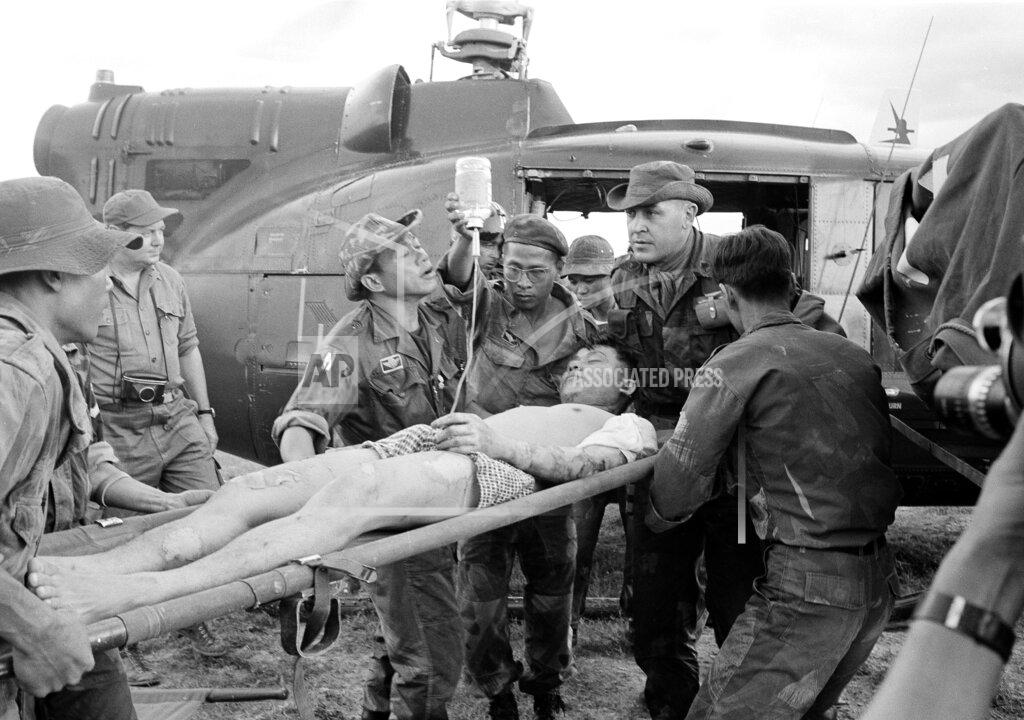
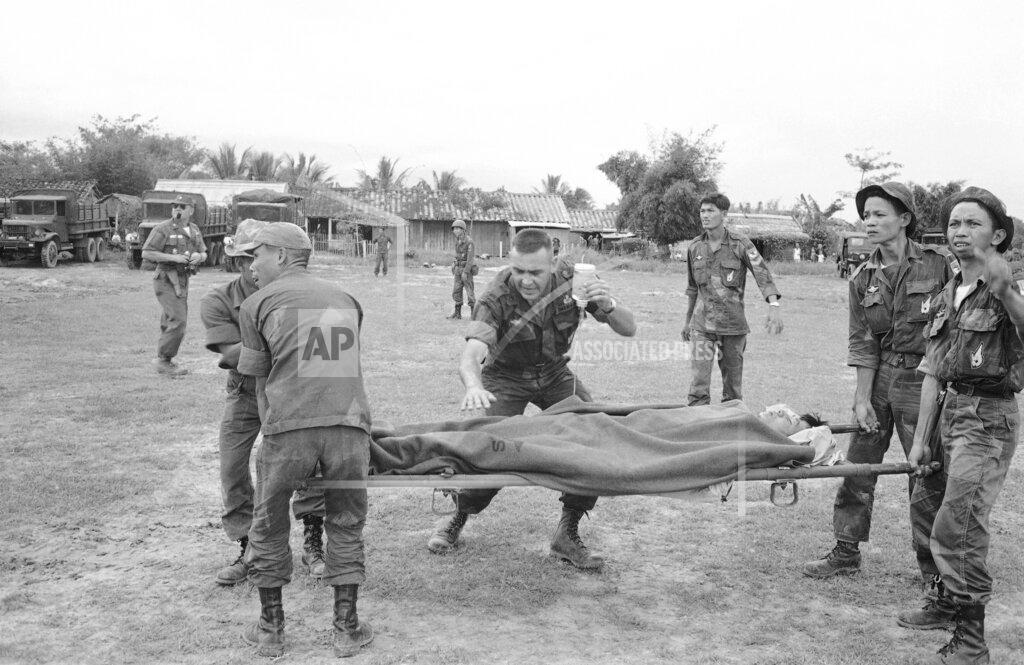
A large South Vietnamese Government force of airborne and infantry battalions overran an underground network of Communist fortifications 30 miles northwest of Saigon today. The operation was hampered by sharp small arms fire from guerrillas maneuvering through well‐concealed tunnels. The first serious resistance to the wide, coordinated action came after noon on the third day of a 7,000‐man operation against a traditional guerrilla stronghold in Tây Ninh and Bình Dương Provinces. With the operation continuing, there were no complete casualty figures. But isolated losses were reported from government units along a wide line of advance through the thick Boi Loi forest.
A government helicopter was shot down by 30‐caliber machine‐gun fire while moving away at treetop level minutes after it had picked up battle casualties. At least 10 soldiers were killed when the helicopter dropped into the woods. A military spokesman reported that one of the advancing units broke up a field meeting of suspected Communist cadres. Among the captives was a man described as a high‐ranking Việt Cộng political commissar for the Saigon‐Cholon special zone. This could make the prisoner a key member of the Communist “shadow government” that operates across the country. The administration of clandestine Communist activities in the capital is believed to draw on personnel and supplies from the base areas north and northwest of the city.
The present operation was launched Wednesday with the biggest helicopter airlift of troops yet staged in the Vietnamese war. The aim is to clear one of these longstanding base areas, into which government troops seldom penetrate. Initial results of the operation were disappointing because most of the insurgent forces based in the wooded area seemed to have pulled out, perhaps because they had received advance warning. Even with the contact made today officers were unable to estimate how many guerrillas were left behind to guard their fortifications.
There was as yet no sustained contact with the enemy. One officer described the engagement as consisting of a few guerrillas popping up from their tunnels, firing intensely for a few minutes, then disappearing before the government’s firepower could be directed at them. After a brief interval, new hostile fire would break out from another direction. Apparently the insurgents rushed through the tunnels to appear at another of the prepared openings. Major General Tôn Thất Đính, the Vietnamese commander of the operation, said his forces had destroyed underground fortifications capable of housing one Việt Cộng battalion — about 600 men — as well as two other company‐size fortifications.
For the third time in two days, a South Vietnamese Government force only a fraction of the size involved in the operation near Saigon achieved an apparent military success against Communist units in the northern part of the country. The American military spokesman said one government company of about 100 men engaged a superior Việt Cộng force in Quảng Nam Province, killing 36 guerrillas.
South Vietnam appealed today to the non‐Communist world for aid to help restore the flood‐ravaged central provinces and to ease suffering. Typhoons Iris and Joan earlier this month hit the central coastal region and, according to Government figures they left 7,000 dead, a million homeless and about five million acres flooded.
It is reported that delegations from 10 Communist countries are meeting in Hanoi. The foreign Communist delegations are now in Hanoi to attend an “international conference for solidarity with Vietnam against U.S. imperialism,” the North Vietnam press agency said today. A Hanoi broadcast said delegations had arrived from Communist China, North Korea, Indonesia, Venezuela, New Zealand, Japan, Albania, East Germany Hungary and the Sudan.
Lieutenant Commander Charles F. Klusmann, the U.S. Navy pilot who was shot down over Laos last June 6, escaped from his pro‐Communist‐captors by crawling under the wire of a stockade and struggling through leech‐infested enemy‐held jungles for three days, the Navy said today. Commander Klusmann, who escaped September 1, resumed duty today at nearby Miramar Naval Air Station. He had not been allowed to talk to newsmen and details of his escape were not disclosed until the Navy issued a 30‐page report today. The report said that three Laotian prisonres had fled the pro‐Communist Pathet Lao camp with him, but that only Commander Klusmann had made it to safety.
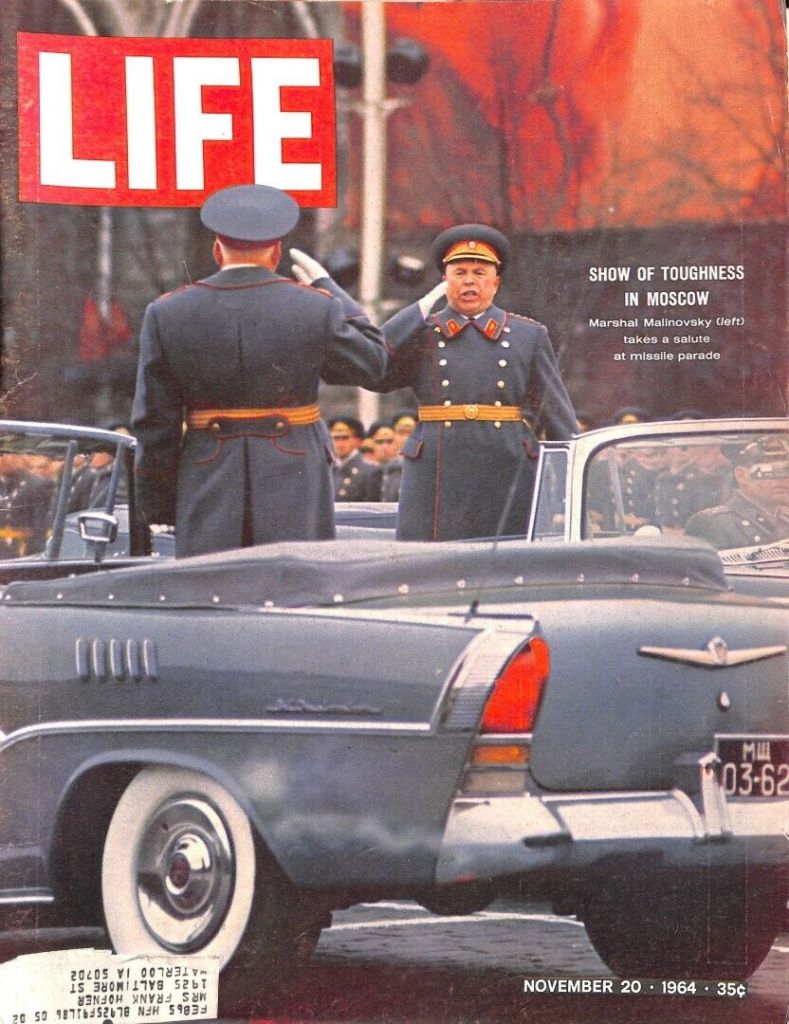
The Chinese Communist party renewed today its attack on Soviet foreign policy and the general ideological line of the Kremlin. Peking warned against those who would foster “Khrushchevism without Khrushchev.” In a major ideological declaration, the Chinese party referred to the ouster of Nikita S. Khrushchev last month as a triumph of Peking’s Marxist‐Leninist policies. “It marked the bankruptcy, the fiasco of modern revisionism,” Peking asserted. Analysts said that the declaration, in the form of a long editorial in Hung Chi, the ideological journal of the Central Committee, represented a resumption of polemical debate with the Soviet party. Devoted to the “sins” of Mr. Khrushchev, the editorial in effect denounced the current policies of the Kremlin leadership and Communist parties allied with Moscow.
The most bitter attacks were reserved for the policy of “peaceful existence” with the United States, which the new Soviet party chief, Leonid I. Brezhnev, and Premier Aleksei N. Koskgin have reaffirmed. Pro‐Soviet Communist party leaders such as Władysław Gomułka of Poland, Janos Kadar of Hungary and Walter Ulbricht of East Germany were by implication, denounced as “hobgoblins” of modern revisionism because they had attributed to Mr. Khrushchev some meritorious deeds and policies. The French and Italian Communist parties were characterized as “servile tools of the bourgeoisie” because of their adherence to concepts, approved by Mr. Khrushchev, of the possibility of attaining power without violent revolution.
Communist China issued today its 345th “serious” warning to the United States, saying a United States warship entered Chinese territorial waters off Fukien Province on the southeast coast yesterday, the Peking radio said.
The Japanese Communist party has asked the government to permit a high‐level delegation from Peking to attend the party’s convention in Tokyo next week. Peng Chen, Mayor of Peking and powerful member of the Politburo of the Chinese Communist party, was named as the leader of the five‐man visiting delegation. Rejection of the application was recommended late today by the Ministry of Justice, which also ruled against permission for a five‐man delegation from North Korea to attend the conference. The Ministry’s action will be referred to a meeting of the Cabinet tomorrow for a final decision.
About 600 Belgian paratroopers are poised on Ascension Island, in the South Atlantic Ocean, for use, if necessary, to protect the lives of about 560 whites held hostage by Congolese rebel troops in Stanleyville. The Belgian battalion was sent to Ascension, about seven hours by air from Stanleyville, in United States Air Force planes Wednesday as a precautionary measure. Secretary General Thant indicated that the moving of the Belgian troops to Ascension, a British possession, in United States planes might be an issue for the United Nations Security Council.
A Foreign Ministry spokesman emphasized that the troops would be used only if their assistance was requested by the Congo’s Central Government and if developments in Stanleyville during the next 24 hours warranted the action. Foreign Minister Paul‐Henri Spaak addressed a plea to the Congolese rebel leader, Christophe Gbenye, by means of a broadcast from Burundi. Mr. Spaak assured the rebel forces that they would be given amnesty if they put down their arms and surrendered to Congolese Army troops now rushing toward Stanleyville, the last rebel stronghold. Belgian officials reported tonight that Congolese Government troops had already passed Lubutu, about 150 miles from Stanleyville. Ascension Island is British territory and the airlift operation first was cleared in London. United States Air Force Lockheed troop carrier planes were used to transport the Belgian battalion. They were piloted by regular United States Air Force pilots. There are 63 Americans and about 500 Belgians being held in Stanleyville.
The U.N. Secretary General, U Thant, has suggested that the time has come to accept observers from nonmembers that have not been eligible to attend United Nations meetings up to now. The suggestion was expressed in the Secretary General’s annual report to the General Assembly, made public today. It stirred keen interest and was taken to allude principally to Communist China, North Korea and North Vietnam. Most observers believed Mr. Thant also had East Germany in mind. The matter arose, however, a day after a conversation between Mr. Thant and Sigismund von Braun, the observer stationed here by West Germany. Mr. Thant said then that he did not consider East Germany eligible because its sovereignty was not generally recognized.
Soviet opposition has killed a plan to solve the crisis over unpaid United Nations assessments by establishing a “rescue fund.” Reliable sources said that a negotiating group of four smallpower delegates, which submitted the rescue‐fund plan to the four major powers, decided today to suspend its activities. The group was headed by Carlos Sosa‐Rodriguez of Venezuela. Abandonment of this attempt to obtain an agreement between the United States and the Soviet Union appeared to point to a showdown when the General Assembly opens its 1964 session December 1. Adlai E. Stevenson, the chief United States representative, told Latin American delegates today that the State Department had sent notes to all Latin governments except Cuba to emphasize the importance the United States attaches to enforcement of Article 19 of the Charter. This provides that any member owing the equivalent of two years’ assessments “shall have no vote” in the Assembly. The Soviet Union, which owes $52.6 million for the United Nations peace‐keeping forces in the Congo and the Middle East, is now subject to Article 19, as are six other members of the Soviet bloc and Yemen.
The bishops at the Second Vatican Council voted overwhelmingly in favor of resolutions to reach out to Christian and non-Christian religions outside of the Roman Catholic Church, including a statement that rescinded the Church’s previous position that the Jewish people were guilty for their ancestors’ role in the crucifixion of Jesus Christ; the measure regarding Judaism passed by a margin of 1,770 to 185. Another resolution, which passed 1,838 to 136, stated that the Church would no longer take a total stance against non-Christian religions (such as Islam, Judaism or Buddhism). Finally, the council approved, 2,054 to 64, a commitment to ecumenism with non-Catholic Christians with efforts “by prayer, word and deed” to mend the rifts that divided the world’s 900 million Christians. Pope Paul VI would promulgate the doctrine, “Unitatis redintegratio,” the next day.
Linjeflyg Flight 277, a twin-engine Convair CV-340 airplane, struck electric power lines as it was making its approach for a landing at Ängelholm in Sweden. Thirty-one of the 43 people on board were killed in what was the worst air disaster in Swedish history up to that time. The plane was nearing the end of a 300-mile flight from Stockholm to the Ängelholm airport. Twenty of the 39 passengers had been scheduled to disembark at Halmstad but the plane had been prevented from landing because of bad weather.
Britain promised today to begin removing her 15 percent tariff surcharge “in a matter of months” in an effort to resolve a crisis of confidence in the European Free Trade Association. The promise, made during an eight‐hour “working dinner” of an E.F.T.A. ministerial council meeting, represents the most definite word yet by Britain on the timing of the removal of the temporary levy She imposed a month ago. The dinner ended at 4:15 AM. Heretofore, Britain had only promised to “review” the surcharge on imports in six months. In making her new promise today, Britain still asserted it was not possible to fix precise dates now for abolishing the surcharge. The tax has been strongly criticized by Britain’s six partners in the trading bloc known as the Outer Seven. They see it as a violation of E.F.T. A.’s basic free‐trade principles, and also have been angered by Britain’s failure to consult with them before she imposed the levy.
The pound sterling came under heavy pressure today and there was talk in London of a crisis of financial confidence in the new government. Reports from the various financial centers on the Continent told of renewed speculation about devaluation of the pound, now officially valued at $2.80. The selling of sterling was reported from New York and from the Continent. On foreign exchanges, the pound opened at $2.78¼, the level at which the Bank of England is obligated to step in and support it. It remained on this “floor” throughout the day.
A Yemeni royalist official in Jidda, Saudi Arabia, said today that the National Reconciliation Congress, scheduled to meet in northern Yemen November 23, had been postponed. The congress will have the objective of ending the strife between Yemeni royalists and republicans. The royalist Ambassador to Saudi Arabia, Mohammed Bin Ali Ibrahim, said in a telephone interview that a new date for the meeting had not yet been set, but it would be “around the end of the month.”
Canada’s Prime Minister Pearson announced that a previously unnamed mountain peak in the Yukon territory would be named for the late U.S. President John F. Kennedy, nearly one year after the President’s assassination. The 14,000 foot (4,300 m) high Mount Kennedy is located 15 miles away from the U.S. state of Alaska.
New York Governor Rockefeller appealed to President Johnson yesterday against the Defense Department’s order closing the New York Naval Shipyard in Brooklyn and other military facilities in the metropolitan area. Declaring that the Pentagon had not proved its contention that the Brooklyn yard was more expensive and less competent than other Navy yards, Governor Rockefeller, in a telegram to the White House, urged a reprieve pending a study of comparative operating costs. He also asked for an appointment with the President “at the earliest possible time” to discuss “this grave matter which so seriously affects the entire economy of this region.” The closing of the Brooklyn Navy Yard would mean the loss of 9,600 jobs.
The decision to close the Navy Yard, Fort Jay on Governors Island, the Brooklyn Army Terminal and 92 other bases in 33 states and five foreign countries was announced Thursday by Defense Secretary Robert S. McNamara. This economy move by the Administration would eliminate 63,000 civilian jobs. Anguished cries rose from Congressmen, state officials and mayors, but many were, nonetheless, thankful that the announcement had come after the election. Secretary McNamara promised that all career workers whose jobs were eliminated would be offered other jobs, and that any moving expenses would be borne by the Government
The Pentagon said yesterday that a job placement task force would be set up at the Brooklyn yard within two weeks. Navy officials said there was “no cause for panic in Brooklyn,” that work in progress there would be completed, and that the phase‐out (Mr. McNamara hopes to close the yard within a year to 18 months) might be eased by sending a few ship repair jobs to Brooklyn. Meanwhile, a glum parade of Democratic politicians, all of whom had promised their best efforts to “save the yard,” moved through the Brooklyn installation. They tried to fan the last flickering fires of hope by assuring workers that they would continue the fight. Privately, they conceded that hopes for the yard were dimmer than the lights of a Sands Street saloon.
President Johnson promised today to “spare no expense” in seeking ways to lower the cost of converting salt water to fresh. The President’s views on this and other conservation matters were detailed by Secretary of the Interior Stewart L. Udall following a conference with Mr. Johnson at the LBJ Ranch. Mr. Udall flew back to Washington tonight. Before he left, he said: “The President wants a major breakthrough in finding ways to convert salt and brackish water inexpensively.” As one step in the crash program for converting the water, Mr. Udall went on, the budget for converting water will be more than doubled during the present fiscal year ending next July 1.
The present budget, financing five demonstration plants, is $12 billion. Mr. Udall said that the President had agreed to a supplemental appropriation of $16 million. The sum to be sought for the expanded program in the next fiscal year was not disclosed. Mr. Udall said that the eventual goal was to lower the present cost of about $1 for each 1,000 gallons to 25 to 35 cents. Mr. Udall declined to give details of the program he will seek from Congress next year. However, he characterized it as “an exciting one.” He confirmed that he planned to remain in the Cabinet and he said that he would “stay with a sense of new excitement.”
President Johnson made a sentimental journey to his old college in San Marcos, Texas today. He visited his onetime boarding house, dropped in on friends and got his motorcade lost or snarled at least three times. The Johnson caravan through this community of 13,000 even produced one fender ‐ bending collision, involving Mrs. Johnson’s limousine and a car carrying White House staff members. No one was hurt. After a ceremony inaugurating the new president of Southwest Texas State College, Mr. Johnson went to the town’s Federal fish hatchery for a nostalgic look. He recalled that he used to go walking with a blond girl there before he met the future Mrs. Johnson.
A crowd broke up the motorcade at this point and Mr. Johnson went down one road while Mrs. Johnson, riding two cars behind, went down another. It took 10 minutes to reunite them. The next stop was the Victorian‐style boarding house of Mrs. Martha Falls, a spry, white‐haired woman who bought the house in 1935 after Mr. Johnson had left San Marcos. Taking Mrs. Falls in tow, Mr. Johnson, headed for his old first‐floor bedroom. “I just want to see the room where I lived,” he explained. “It’s very much the way it was then.”
Going next past the Hays County Courthouse, Mr. Johnson decided to have his car make a U turn. As a result of this maneuver the police car leading the procession headed in the wrong direction. Finally the caravan halted and a Secret Service agent asked a bystander for directions to “the Kellam house.” The man ran inside and emerged with a telephone directory. Under way again, the motorcade proceeded to the home of Mrs. Juliet Kellam, widowed mother of J. C. Kellam, manager of the Johnson‐owned television station, KTBC, in Austin.
President Johnson promised today to establish the nation’s first Job Corps training center in this small town where he went to college. “We are ready,” he said. “The rest is up to you.” Mr. Johnson’s surprise announcement came in a speech at Southwest Texas State College where, as a self‐help student in the late nineteen‐twenties, he used to sweep floors. San Marcos, with a population of about 13,000, has been seeking for some years to enlist federal support in setting up some sort of training course for young people. The Job Corps is a key part of the Administration’s antipoverty program, authorized by Congress late last summer. To date, no projects of any kind have gone into operation.
President Johnson is known to have been impatient in recent weeks over what he feels has been foot‐dragging in getting his antipoverty program under way. His decision to announce plans for placing the first Job Corps training center here in San Marcos — made in off‐the-cuff remarks, not in his prepared speech — was viewed as an indication that he plans to take a personal hand in moving the program along more rapidly. It was learned that Mr. Johnson conferred by telephone this morning with Sargent Shriver, director of the antipoverty program, and told him to prepare for activating the San Marcos project.
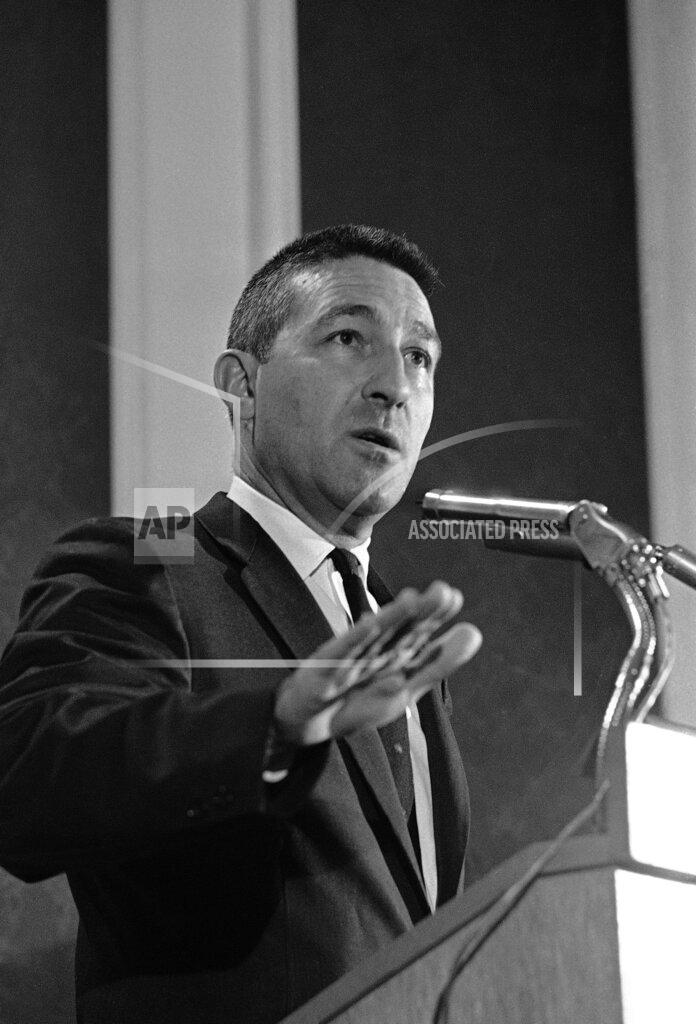
In Boston, Bishop James K. Mathews of the Methodist Church called today for the resignation of J. Edgar Hoover, director of the Federal Bureau of Investigation, because of Mr. Hoover’s remarks about the Rev. Dr. Martin Luther King Jr. Mr. Hoover, in a news conference Wednesday, called Dr. King a “notorious liar” for reportedly saying that the bureau’s agents in Albany, Georgia, would do nothing about the Black complaints because the agents were Southerners. Dr. King denied making the statement.
[Ed: Sadly, Not going to happen. Hoover’s blackmail files make him the most feared man in the country, and perhaps the most powerful. LBJ has no intention of kicking that hornet’s nest. Particularly as he is one of the people in those files.]
The Pennsylvania Human Relations Commission said today that the Chester school district “has committed and continues to commit unlawful discriminatory practices” that deprive Blacks of their civil rights. The commission ordered the school board to take immediate steps. The finding and the order were contained in a report on a series of public hearings started last May 4 at the order of Governor William W. Scranton, following a series of racial demonstrations in March and April.
Former Governor LeRoy Collins of Florida called for a second Southern Manifesto tonight to proclaim that the South “is done with a fatal fascination for lost causes.” Mr. Collins, director of the Community Relations Service, made the suggestion in a speech to the Southern Regional Council. The council is a biracial group whose stated objective is equal opportunity for all persons in the region. The original Southern Manifesto was signed in March, 1956, by 101 Southern members of Congress. It pledged them to use all possible lawful means to resist the Supreme Court’s decision outlawing segregation in public schools. “I believe the kind of thinking reflected in that manifesto is disappearing now,” Mr. Collins said. “How splendid it would be if we could join in a second Southern Manifesto, one which would speak for the South, which is enduring, reaffirming old truths but recognizing new realties, a manifesto which would meet the present needs of our day.” Mr. Collins said the South was compiling a good record in compliance with the Civil Rights Act of 1964.
The nation’s longest metropolitan newspaper strike neared an end today after the dramatic intervention of Walter P. Reuther, president of the United Automobile Workers. Members of Local 13, International Pressmen’s Union, will vote tomorrow morning on terms worked out early this morning in a secret meeting of Solidarity House, U. A. W. headquarters. On July 13 — 130 days ago — the pressmen and members of Local 10, Affiliated Paper and Plate Handlers Union, walked off their jobs at The Detroit Free Press and The Detroit News.
Churches and synagogues throughout New York City will mark the first anniversary of the assassination of President Kennedy at solemn memorial services during the next three days. At 12:05 P.M. on Monday a special mass for the late President will be offered in St. Patrick’s Cathedral.
Dmitri Shostakovich’s 9th/10th String Quartet premieres in Moscow
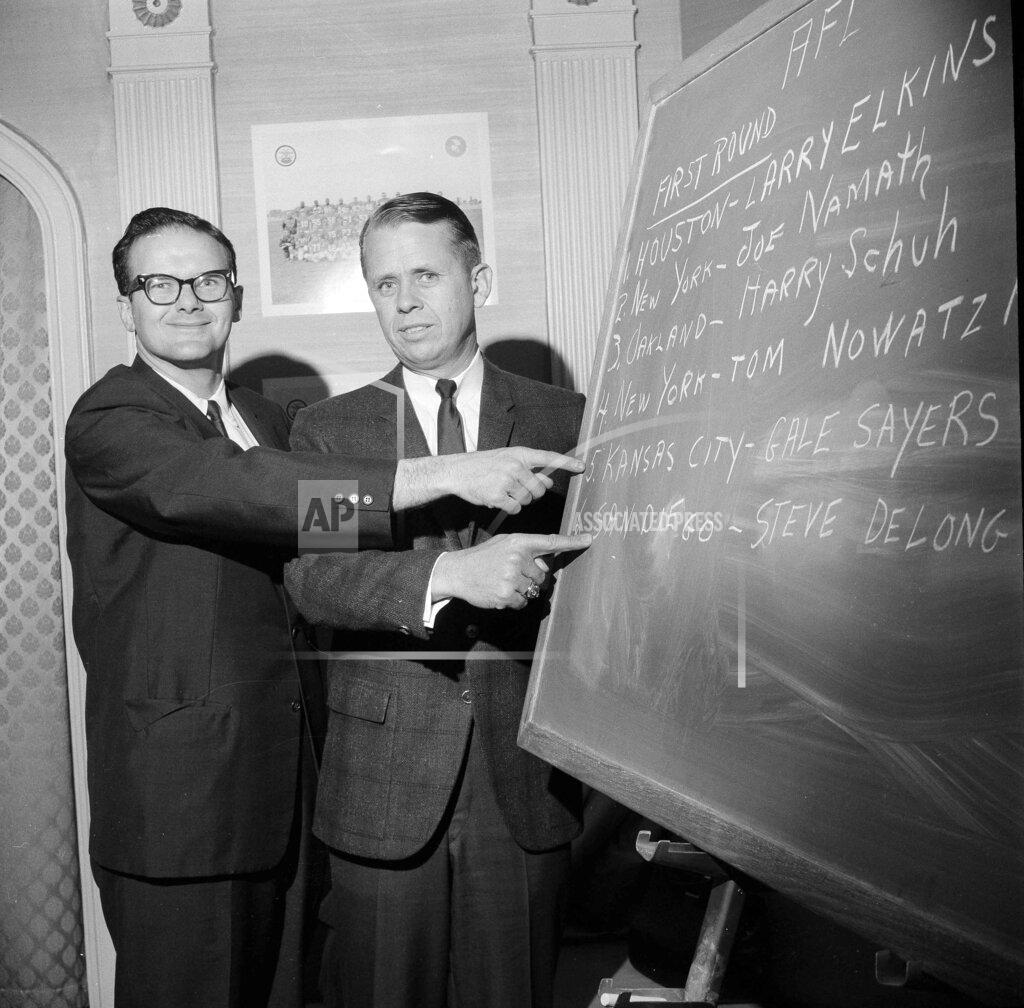
AFL Football:
Denver Broncos 7, Boston Patriots 12
Gino Cappelletti, the American Football League’s leading scorer, added 10 points tonight in pacing the favored Boston Patriots to a 12‐7 victory over the Denver Broncos. Capelletti, who at 132 points is only 15 short of the record he set in 1961, caught a 26‐yard pass from Babe Parilli for Boston’s only touchdown of the game. The Boston end also kicked a 50‐yard field goal, his longest of the season, and a conversion. The only Patriot points he did not figure in were scored by the Boston defense when Jack Rudolph, a linebacker, hauled down Jackie Lee, Denver quarterback, in the Bronco end zone. Lee threw an 11‐yard scoring pass to Lionel Taylor for the Bronco touchdown, and Dick Guesman converted. A crowd of 24,979 at Fenway Park saw Ron Hall and Ross O’Hanley intercept passes and Jim Lee Hunt recover a fumble to check Denver scoring bids during wild exchanges in the final minutes. Hall’s theft of a pass by Mickey Slaughter was his ninth of the season and tied him with Dana Paulson of New York for the league leadership. Boston scored 9 of its points in the first half. A 72‐yard run back of an intercepted pass from Parilli by Leroy Moore, a 230‐pound Denver lineman, set up the Bronco touchdown. Moore is a former Boston player.
Dow Jones Industrial Average: 890.72 (+2.01)
Born:
Doug Ford, Canadian politician (26th premier of Ontario, 2018 –) in Etobicoke, Toronto, Ontario, Canada.
John MacLean, Canadian NHL right wing (NHL Champions, Stanley Cup-Devils, 1995; NHL all-star, 1989, 1991; New Jersey Devils, San Jose Sharks, New York Rangers, Dallas Stars), in Oshawa, Ontario, Canada.
Tom Brown, NFL fullback (Miami Dolphins), in Ridgway, Pennsylvania.
Jamie Waller, NBA shooting guard (New Jersey Nets), in South Boston, Virginia.
Ned Vaughn, American actor (“The Rescuer”), in Huntsville, Alabama.



 History Diaries