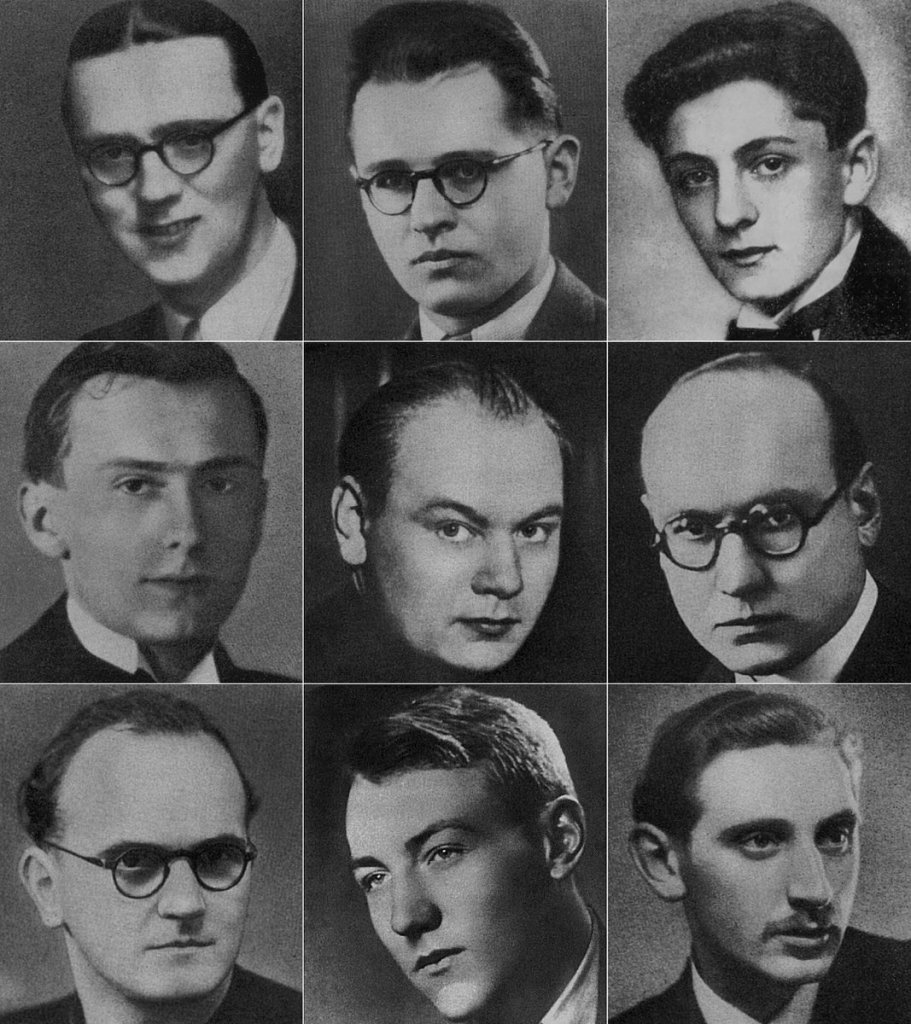
Sonderaktion Prag: Germans stormed the university dorms in Prague and other towns in the former Czechoslovakia, attacking and arresting thousands of students. Reichsprotektor Konstantin von Neurath closed all Czech universities and colleges, had 1,850 students arrested and ordered the execution of a professor and eight student leaders. Over 1,200 Czech students were interned in the Sachsenhausen concentration camp. The Nazis executed the nine Czechs by firing squad without trial that day for leading the recent demonstrations. Today International Students’ Day is observed on November 17 in remembrance of the students who were killed or sent to concentration camps for opposing the Nazis.
Professor Josef Matoušek is among those shot. The others:
- Jaroslav Klíma
- Jan Weinert
- Josef Adamec
- Jan Černý
- Marek Frauwirt
- Bedřich Koukala
- Václav Šafránek
- František Skorkovský
Sometime around eight o’clock in the evening, the execution squad at the Ruzyňský gallows ended the lives of the nine men.
On the 50th anniversary of the Sonderaktion Prag, 16 and 17 November 1989, demonstrations were held in Bratislava and Prague. The uprising finally led to the Velvet Revolution and the election of Václav Havel as President on 29 December 1989. The Prague demonstrators chose the same route taken by the funeral procession for Jan Opletal 50 years earlier: from Albertov via the Národní třída to Wenceslas Square.
Dr. Hans Frank, as Governor, today introduced conscript labor in the conquered Polish territory. His decree, based on the principle that “everyone is obligated to work who is capable of working,” regulates the conditions of this work. Refusal to cooperate or insubordination will bring “corresponding punishment.”
“This decree,” says the semi-official German News Bureau, “gives the Polish population an opportunity not only to learn the blessing of work, but also to set aright the results of two decades of misuse of the Polish economy by an irresponsible Polish Government.”
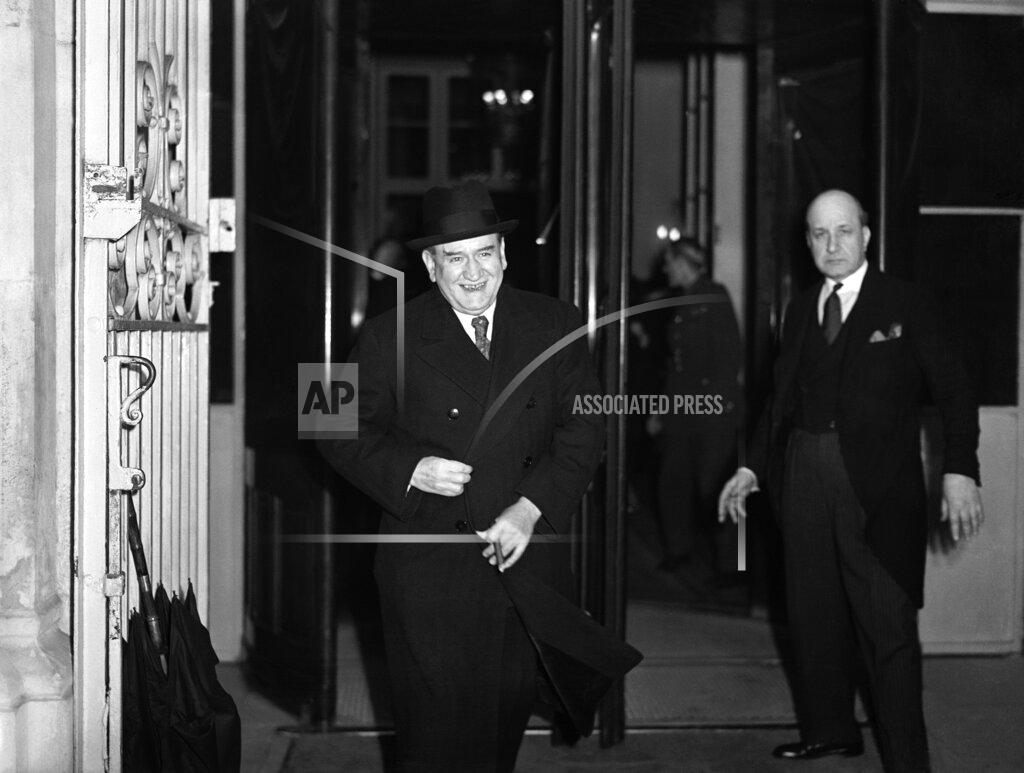
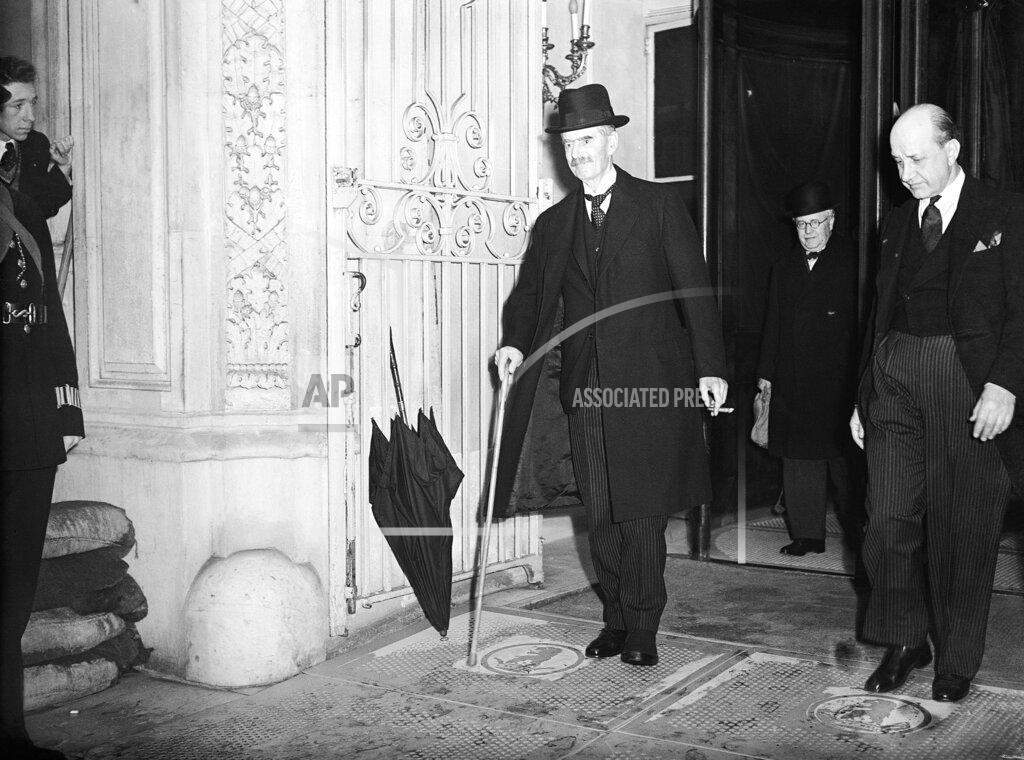
The Anglo-French Supreme War Council held its third meeting in Paris. Supreme Allied War Council approved a plan for British and French war production.
The Allied Supreme War Council agreed to the Dyle Plan or “Plan D” which called for an immediate advance to the River Dyle between Antwerp Line and Brussels if the Germans invaded Belgium. However, the French turned down proposals to bomb industrial targets in the Ruhr fearing Luftwaffe retaliation against Britain and France.
Only in the air was there any marked activity today in the military field and it raises important points affecting neutral States. German reconnaissance planes not only flew over Northeast France as in recent days, but pushed far to the south. There were two air raid alarms in the region of Lyon.
The Luftwaffe drops leaflets over central and southeast France. It also performs reconnaissance over northwest England, specifically one plane over South West Lancs, Cheshire, and North Wales, while another flew over the Shetlands.
The RAF flies over Wilhelmshaven and gets some good photos.
Great Britain and France perfected their alliance today at a meeting of the Supreme War Council here by extending it from military and diplomatic fields into the realm of economics. In a closely guarded meeting at No. 10 Downing Street the Allied Supreme Economic Council was created.
Leslie Burgin, the Minister of Supply, gave the first official indication of what the war is costing Britain by telling representatives of the Dominions and leading British engineers today that his department alone had spent about 2,000,000 a day since the outbreak of hostilities.
A Czechoslovakian National Committee is established in Paris under the leadership of the former President of Czechoslovakia, Eduard Benes. The group is recognized by Britain and France in mid-December.
Italian state radio broadcasts in Russian warning the Soviets to leave the Balkans alone.
U-boats are seen aiding Russia, setting up a blockade of Finland. The Reich, on behalf of the Soviet Union, stops Finnish ships. Fifteen vessels with cargoes for neutrals are held in German ports.
Africa’s east coast prepares for an attack. British areas of the country worry about the nearness of a German raider.
U-36 set sail for Basis Nord, a secret base at Zapadnaya Litsa on the Kola Peninsula in northern Russia provided by the Soviet Union.
The Lithuanian steam merchant Kaunas was torpedoed and sunk by the U-57, commanded by Kapitänleutnant Claus Korth, approximately 7 miles west-northwest of Noordhinder in the North Sea. At 20.15 hours the unescorted and neutral Kaunas was hit amidships by one G7e torpedo from U-57 and sank by the stern after seven minutes. The ship was attacked without warning because no nationality markings were visible. The survivors, one of them injured, abandoned ship in two lifeboats and were saved. Of the ship’s complement of 16, 1 died. The 1,566-ton Kaunas was carrying ballast and was bound for Hartlepool, England.
The pocket battleship Deutschland arrives in Gdynia (in occupied Poland) after her Atlantic raiding cruise in which 2 ships were sunk.
German vessel Henning Oldendorff is captured by the Royal Navy.
Kriegsmarine destroyers Z11 Berndt von Arnim, Z19 Herman Künne, and Z21 Wilhelm Heidkamp lay more magnetic mines off the Thames estuary. International law requires that such mines be reported, but the Germans make no notifications as usual.
U.S. freighter Nishmaha, detained at Gibraltar since 11 November, is given option of submitting to further detention or proceeding to Barcelona and thence to Marseilles to unload items seized by British authorities. Nishmaha’s master chooses the latter. On the same day the British allow Nishmaha to clear Gibraltar, however, they detain U.S. freighter Examiner and seize 11 bags of first-class mail.
Freighter Black Condor, detained by the British at Weymouth, England, since 5 November, is released after part of her cargo and 126 bags of mail are seized.
U.S. freighter Black Gull is detained by British authorities.
Convoy SL.9F departs from Freetown, while Convoy OG.7 forms at Gibraltar. Convoy HXF.9 departs from Halifax.
The War at Sea, Friday, 17 November 1939 (naval-history.net)
Battlecruiser REPULSE sustained damage to her breakwater and aircraft carrier FURIOUS had engine trouble which limited her speed to 23 knots while at sea from Halifax.
Light cruisers EDINBURGH, BELFAST, GLASGOW, SOUTHAMPTON and AURORA arrived at Rosyth.
Light cruiser NEWCASTLE departed Scapa Flow for Loch Ewe, leaving there on the 21st for Northern Patrol.
Light cruiser CARDIFF departed Loch Ewe after refueling and repairing damage sustained in heavy weather, and arrived back on the 20th.
Light cruisers DIOMEDE and DUNEDIN departed Loch Ewe on Northern Patrol duties, with DIOMEDE arriving back on the 21st.
Armed merchant cruiser AURANIA departed the Clyde for Northern Patrol duties.
On Northern Patrol were two cruisers between the Orkneys and the Faroes, two cruisers and two AMCs between the Faroes and Iceland, and one cruiser and three AMCs in the Denmark Strait.
Polish destroyers ORP BŁYSKAWICA, ORP BURZA, and ORP GROM arrived at Rosyth for a visit by the Polish Prime Minister, and left on the 18th to return to Harwich.
Destroyers ESK and EXPRESS arrived at Harwich for minelaying in the Thames approaches in operation RG. They departed Harwich at 0815, accompanied by minesweepers SKIPJACK and LEDA.
ESK and EXPRESS laid more mines in this field on the 29th assisted by minesweepers HARRIER and HUSSAR, followed on 1 December by auxiliary minelayer HAMPTON and four destroyers which laid another line of mines, assisted by minesweepers SKIPJACK and LEDA.
Destroyer FURY departed the Clyde with base ship MASHOBRA on the 16th. FURY was relieved by destroyer INGLEFIELD at 1735/17th which took MASHOBRA on to Rosyth, arriving on the 19th. FURY proceeded to Loch Ewe, and after refueling, joined the Main Fleet at sea.
Convoy FN.38 departed Southend, escorted by escort vessels/destroyers VIVIEN, VALOROUS and sloop BITTERN. On passage, VIVIEN was damaged in collision with an unknown merchant ship, which carried on without stopping, arrived at Harwich on the 17th and was later taken to North Shields for repairs completed on 5 December. Destroyer JERVIS, which had been searching the Outer Dowsing area joined the convoy on the 18th from dawn to dark, and the convoy arrived at Methil on the 19th.
Convoy FS.38 departed Methil, escorted by destroyers WHITLEY, WALLACE and sloop STORK. Seaplane carrier PEGASUS travelled in company. Destroyers JAGUAR and JUNO operated in the area of FS.38 from dawn to dark on the 18th, and the convoy arrived at Southend on the 19th.
German steamer HENNING OLDENDORFF (3986grt), which had departed Huelva, Spain, on the 2nd disguised as a Russian ship, was captured by light cruiser COLOMBO near Iceland in 62 59N, 10 44W. The German ship, the Royal Navy’s 19th prize of the war, was taken in to Kirkwall by a prize crew commanded by Lt Cdr L A Lambert on the 19th due to insufficient coal for the voyage to Leith. She was later renamed EMPIRE INDUSTRY for British service.
GERMAN DESTROYER MINELAYING IN THE THAMES ESTUARY
German destroyers HERMANN KÜNNE and WILHELM HEIDKAMP of the 5th Destroyer Division, escorted by destroyer BERND VON ARNIM, laid 180 magnetic mines in the Thames Estuary during the night of the 17th/18th. Returning to Wilhelmshaven, they were met off Terschelling by light cruisers LEIPZIG, NÜRNBERG and torpedo boats LEOPARD, ILTIS, and SEEADLER. Seven merchant ships grossing 27,565 tons were sunk and one more damaged in the field:
On the 18th, Dutch steamer SIMON BOLIVAR (7906grt) in 51 49N, 01 41E; 84 passengers and crew went missing. Survivors were rescued by destroyer GREYHOUND, anti-submarine trawlers MAN O’WAR (517grt), CAPE WARWICK (516grt), DANEMAN (516grt), WELLARD 514grt), LADY ELSA (518grt), and tug FAIRPLAY II (282grt).
On the 18th, steamer BLACKHILL (2492grt), 7½ cables 145° from Longsand Head Light Vessel in 51 47N, 01 39E; one crewman was lost and destroyer GIPSY rescued the survivors.
On the 18th, tanker JAMES J MAGUIRE (10, 525grt) of convoy OA.37 was severely damaged in 51 46N, 01 40E.
On the 19th, steamer TORCHBEARER (1267grt), two miles 25° from Shipwash Light Vessel; four crew were lost and destroyer GREYHOUND rescued the eight survivors.
On the 20th, naval trawler MASTIFF (520grt, Lt Cdr A A C Ouvry) one mile off the Tongue; five ratings went missing and one rating died of wounds. The survivors were rescued by the Margate lifeboat and minesweeping trawler CAPE SPARTEL (346grt).
On the 21st, Japanese liner TERUKUNI MARU (11, 930grt) in 51 50N, 01 30E; all 206 passengers and crew were picked up by trawler GAVA (256grt) and other small craft.
On the 22nd, steamer GERALDUS (2495grt), three miles WNW of Sunk Light Vessel; destroyer WIVERN rescued the survivors.
On the 22nd, steamer LOWLAND (924grt) two miles ENE of Northeast Gunfleet Buoy; nine crew were lost and minesweeping trawler MYRTLE (550grt) rescued three survivors.
On 10 December, auxiliary minesweeper RAY OF HOPE (98grt, Skipper W Hayes RNR) off Ramsgate; four crew were killed and five missing. Auxiliary minesweeper SILVER DAWN (85grt) sweeping in company with RAY OF HOPE picked up Cdr C E Hamond DSO, DSC Rtd of VERNON, Hayes and the mate.
U-19 laid mines off Orfordness during the night of the 17th/18th. Destroyer GIPSY and one merchant ship was lost in the field. The merchantman was Yugoslav steamer CARICA MILICA (6371grt), sunk on the 18th, 3½ miles 005° from Shipwash; the entire crew was rescued.
Anti-submarine trawler DRANGEY (434grt) was damaged in a collision at Rosyth.
Destroyers BROKE and ECLIPSE were submarine hunting in 48 05N, 6 32W, and joined by destroyers VANESSA, VESPER and VIVACIOUS, released from the escort of convoy BC.15.
Minesweeping trawler CORENA (352grt) reported sighting a U-boat in 50N, 4-35W, and destroyers WOLVERINE and VERITY sailed to investigate.
Destroyer WALLACE attacked a submarine contact 10 miles NE of Blyth.
Anti-submarine trawler CAPE ARGONA (494grt) attacked a submarine contact 1½ miles 010° from Outer Dowsing.
Steamer COREA (751grt) sighted a submarine in 57 44N, 5 52W, and destroyers WOLVERINE and VERITY were ordered to carry out a search.
U-57 sank Lithuanian steamer KAUNAS (1566grt) 6½ miles WNW of Noordhinder Light Vessel; one crewman was lost and 15 survivors picked up.
U-15 laid mines off Lowestoft during the night of the 16th/17th, on which one merchant ship was sunk.
Convoy HXF.9 departed Halifax at 1200 escorted by Canadian destroyer HMCS ST LAURENT until detached on the 18th. Ocean escort was armed merchant cruiser ALAUNIA, and the convoy arrived at Liverpool on the 29th.
Aircraft carrier ARGUS, and destroyers STURDY and GALLANT arrived at Gibraltar. GALLANT left to return to Plymouth and was ordered en route to search for German merchant ships reported leaving Vigo.
Convoy SLF.9 departed Freetown escorted by sloop AUCKLAND, and was joined on the 29th by destroyers ESCAPADE, GALLANT and GRAFTON. The convoy arrived later that day and AUCKLAND reached Portsmouth on the 30th.
Light cruiser CARADOC arrived at San Diego, California, for refueling, the first foreign warship to visit a US port since the start of the war.
Light cruiser DESPATCH (Captain Allen Poland DSC), which entered the Pacific through the Panama Canal on the 1st, arrived at Callao, Peru with steamer LOBOS (6479grt).
Light cruiser GLOUCESTER, attached to Force I from the 16th, departed Rangoon, and on the 18th sailed from Colombo to patrol north of Madagascar.
Swedish steamer VALAPARISO (3759grt) was seized by German warships for contraband violations in the Baltic.
French submarine SIDI FERRUCH departed Port of Spain for Martinique.
Germany and all her absorbed territories were placed on the government’s tariff blacklist today by President Roosevelt in proclaiming the reciprocal trade agreement between the United States and Venezuela that was signed, on November 6.
President Roosevelt answered today the demands for a Congressional investigation of naval ship design and construction methods with the explanation that “top-heavy” tendencies of recently built destroyers which prompted the proposed inquiry already had been corrected.
President Roosevelt said that nothing short of a real emergency could persuade him to nominate a new associate justice of the Supreme Court to take the place of Pierce Butler before January, when Congress will be in session.
President Roosevelt admitted publicly today that he was enjoying the speculation as to whether he would be a candidate to succeed himself in 1940 and that on at least one occasion he had encouraged such guess-work just for the laugh.
Defense counsel for Fritz Kuhn, leader of the German-American Bund, put Mayor La Guardia, District Attorney Thomas E. Dewey and other officials on the witness stand yesterday in an effort to prove that the charge of stealing German-American Bund funds on which Kuhn is being tried in General Sessions Court was really a political plot to destroy an individual.
Pleading for peace between the American Federation of Labor and the Congress of Industrial Organizations, Senator Robert F. Wagner and Mayor La Guardia told representatives of 900,000 C.I.O. unionists at the opening of their second State convention yesterday that the enemies of labor were the principal beneficiaries of the split in labor’s ranks.
The two-week-old strike of the International Longshoremen’s Association, which put thousands of seamen, dock workers and office employes out of work and severed New York’s sea connections with other coastal cities, was officially called off last night.
Mayor Angelo Rossi moved today in the San Francisco waterfront tie-up with a sharp attack on Harry Bridges, West Coast C.I.O. leader, in a telegram sent to President Roosevelt asking his intervention in the strike situation. Rossi said “San Francisco is sick and tired of Bridges.”
James F. Dewey, Labor Department conciliator, indicated today that if the negotiations to end the dispute between the Chrysler Corporation and the United Automobile Workers of America-C.I.O. were speeded up an agreement would be possible by tomorrow night to permit 55,000 Chrysler employes to return to work Monday.
A gas explosion in Kansas City lifts a building from its foundation.
Alphonse Malachi, former president of the Armour local of the Packinghouse Workers Organizing Committee, C. I.O. union, testified today at a hearing conducted by Representative Martin Dies, chairman of the House committee investigating unAmerican activities.
A third name was added by a Federal grand jury yesterday to the list of aliases allegedly used by Earl Browder, Communist leader, in his dealings with the Department of State.
Behind a barrier of secrecy, Al Capone began treatment tonight calculated to relieve paresis, a progressive brain paralysis, which attacked him in prison more than two years ago.
Five United States Senators and seven Representatives received a seventeen-gun salute when they landed at Albrook Field today after a flight through Central America to inspect the Panama Canal.
The historical film “Tower of London” starring Basil Rathbone, Boris Karloff and Vincent Price was released.
Jerome Kern and Oscar Hammerstein II’s musical “Very Warm for May”, featuring June Allyson, Eve Arden, and Vera-Ellen, and directed by Vincente Minnelli opens at the Alvin Theatre, NYC; runs for 59 performances, inspiring 9-year-old audience member Stephen Sondheim’s love for musical theater.
The Canadian and British Governments are understood to have agreed on the financial basis of the empire air training scheme, and general conferences will now be held to work out its other details.
The Royal Canadian Navy destroyer HMCS Assiniboine arrived in Halifax from Esquimalt.
The Japanese at Pakhoi (Behai), including the Imperial Japanese Army (IJA) 21st Infantry Division, push inland rapidly, advancing 30 miles in three days and then capture Yamhshien. Japanese forces have completed the occupation of Yamhsien and are driving toward Nanning, Kwangsi Province, the Japanese. Domei news agency repórted today. In Chungking, the Chinese admitted that Japanese forces, including cavalry, had landed from transports on Yamhsien Bay, in the Gulf of Tongking. The landings were made at Chisha and Fangcheng. The Chinese said their forces were “counterattacking on all fronts.” The Domei agency said there was intense Japanese military activity in the Canton, Yamhsien and Hainan Island areas and that Japanese operations would branch out from these points “into the hinterland.”
Foreign military attachés do not believe the Japanese intended any major land drive into Yunnan Province, the center of Generalissimo Chiang Kai-shek’s southwest defense zone. They believe the drive toward Nanning is designed primarily to consolidate Japanese control of Kwangtung Province in advance of the proclamation of a new Nanking Government headed by Wang Ching-wei. Kwangtung’s capital, Canton, traditionally is the cradle of Chinese political movements, and Mr. Wang must depend to a large extent on the Cantonese for support if his movement is to be successful. In addition, most overseas Chinese are from Kwangtung. These groups have been sending large contributions to the Chungking Government and Japan would like to divert their support to Mr. Wang.
China is rushing some of her best troops, Kwangsi Province units, to South Kwangtung Province to stem the advance of Japanese forces that are driving toward the Chinese southwestern “lifeline” supply routes. These troops, who had been operating in Eastern Kwangtung, were dispatched to the areas west of Pakhoi, where the Japanese are pushing inland and northward toward the vital routes. The Japanese said tonight that their forces were consolidating control of the area around Yamhsien, about thirty miles inland from the place where the Japanese landed. Wednesday under covering fire from warships. The landing place was forty-five miles west of Pakhoi, treaty port on the Gulf of Tonkin.
The Japanese asserted they were straddling the road from Pakhoi to Nanning, Chinese Army headquarters in Kwangsi. This would put the troops at least sixty miles from the main highway between Kwangsi and French Indo-China. The chief rail and motor “lifeline” at which the Japanese drive is aimed lies 600 difficult miles inland, in Yunnan Province. The Japanese route to this goal lies across Kwangsi Province. The Chinese are destroying bridges and roads through districts of Kwangtung threatened by the advancing Japanese, who are pushing northward west of Pakhoi. The Chinese claimed Pakhoi still was in their hands. The Japanese said Chinese resistance was negligible, but the Chinese said it was stubborn, with Chinese gunners sinking a number of Japanese landing boats.
Powerful elements in Japan are urging the government to conclude a non-aggression treaty with Russia “without paying the slightest attention to displeasure felt and loudly voiced” by Britain and the United States, the Domel news agency said today. The agency, which usually expresses the opinions of the Foreign Office, said it is felt that “a fundamental adjustment in relations between Japan and Russia is needed in connection with the maintenance of peace in the Far East.”
Japan’s attitude toward Russia, Domei said, need not necessarily be connected with her relations with Britain and the United States. The government, it says, desires to improve its relations with Washington and London but some officials fear that negotiations with the United States will be delayed “by innumerable obstacles.”
The question of coming to an accord with Russia, on the other hand, is one of immediate urgency and advantage should be taken of Moscow’s open invitation for solution of pending questions, after which broad political agreements could be reached, it contends. Those in favor of a nonaggression treaty with the Soviet, Domei said, believe that Russian-Japanese friction, such as the intermittent warfare on the border between Japan’s Manchukuoan. dependency and Russia’s Outer Mongolian protectorate, is a “dormant powder keg fraught with the danger of developments which might lead to a full-dress war.”
The assertion of Yakichiro Suma, the Japanese Foreign Office spokesman, in Shanghai yesterday that the United States Government in official communications to Tokyo had admitted that America was not blind to new realities in East Asia was met today with a reaffirmation of American rights in China by Sumner Welles, Acting Secretary of State. Mr. Welles discussed the subject briefly in response to questions at his press conference. He pointed out that the position of the United States concerning developments in East Asia in recent years had been set forth in three communications to the Japanese Foreign Office, all of which had been published. There is nothing, he declared, that in any way varies from the point of view enunciated in those communications. Beyond that he had nothing to say for the present in commenting on Mr. Suma’s statement.
Secretary Welles had reference, first, to the note of April 29, 1934, which expressed the opinion that “treaties can lawfully be modified or be terminated, but only by processes prescribed or recognized or agreed upon by parties to them.” The second note, of October 6, 1938, insisted upon observance of American rights and interests in China. The third note, of December 31, 1938. Mr. Welles had particularly in mind in his comment. In that communication the United States reserved all rights in China and declared that international arrangements could be altered only by orderly processes of negotiation and agreement among the interested parties, but announced a readiness to consider any proposals Japan might make in discussions with representatives of the other powers whose rights and interests were involved.
The reaffirmation of the American position was obviously calculated not to interfere with the discussions that Joseph C. Grew, the United States Ambassador to Japan, is having with the Foreign Office in Tokyo, looking to an improvement in relations, but it was interpreted as meaning that the United States was not retreating from its position. It is believed that this held particular significance at a time when, according to reports, Great Britain through discussions with the Japanese may be preparing the way for a partial retreat from her position in China.
Dow Jones Industrial Average: 151.00 (-0.15)
Born:
Auberon Waugh, journalist, in Dulverton, England, United Kingdom (d. 2001).
Willie Richardson, NFL wide receiver (Pro Bowl, 1967, 1968; Baltimore Colts, Miami Dolphins), in Clarksdale, Mississippi (d. 2016).
Died:
Josef Matoušek, 33, Czech historian and professor (executed by the Nazis).
Naval Construction:
The Kriegsmarine (German Navy) Type VIIC U-boats U-371 and U-372 are laid down by Howaldtswerke AG, Kiel (werk 2 and 3).
The Royal Canadian Navy gate vessel and auxiliary minesweeper (ex-fishing trawler) HMCS Venosta (J 11) is commissioned.
The Sjøforsvaret (Royal Norwegian Navy) Sleipner-class destroyer HNoMS Odin is commissioned.
 History Diaries