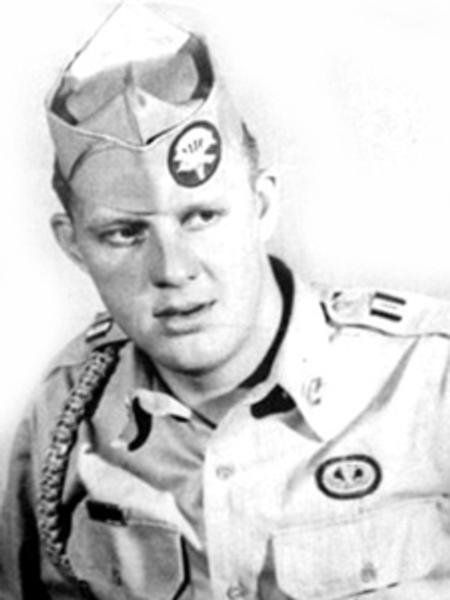
In a skirmish in Biên Hòa Province, one U.S. military adviser and four ARVN soldiers are killed during a Việt Cộng anbush; one U.S. adviser and six ARVN soldiers are wounded.
The High National Council, formed to oversee South Vietnam’s transition to a civilian government, said today that it would appoint an inquiry group “to reconsider the cabinet” of Premier Trần Văn Hương. The Hương Government has faced opposition from student and religious groups since it took over rule of South Vietnam from Major General Nguyễn Khánh’s military regime earlier this month. The 17‐man National Council approved Mr. Hương’s appointment as Premier, but made it known that it does not like his cabinet, some of whose members were in the Ngô Đình Diệm regime that was overthrown a year ago. The Premier has refused to change his cabinet. The council cannot compel him to, but it can advise him. This apparently is what it plans to do. Earlier, a student delegation presented a petition demanding dissolution of the government.
William P. Bundy, Assistant Secretary of State for Far Eastern Affairs, said today that a decision on United States policy in the Far East could be expected within a few weeks. However, he asserted in a speech at the Women’s National Democratic Club that the recent United States election had made no change in the basic situation in Southeast Asia. What has changed, he said is the mandate given President Johnson. Mr. Bundy emphasized that the United States would continue to play a major role in the Far East.
Senator Wayne Morse suggested last night that the answer to the “mess in Vietnam” was a United Nations peacekeeping force and a United Nations trusteeship for the country. Speaking at a Cooper Union forum, the Oregon Democrat said that such a trusteeship might last as long as 10 years. The Senator also cautioned the United States against expanding the war into North Vietnam. He said that such a maneuver would invite disaster and flout “every principle of international policy we have espoused since World War II.”
Vietnamese diplomatic sources said tonight the new South Vietnamese Government headed by Premier Trần Văn Hương was making funds available for payment of official and private bills left unpaid by Mrs. Ngô Đình Nhu. The total of the bills was not disclosed, but was reported to be more than $11,000.
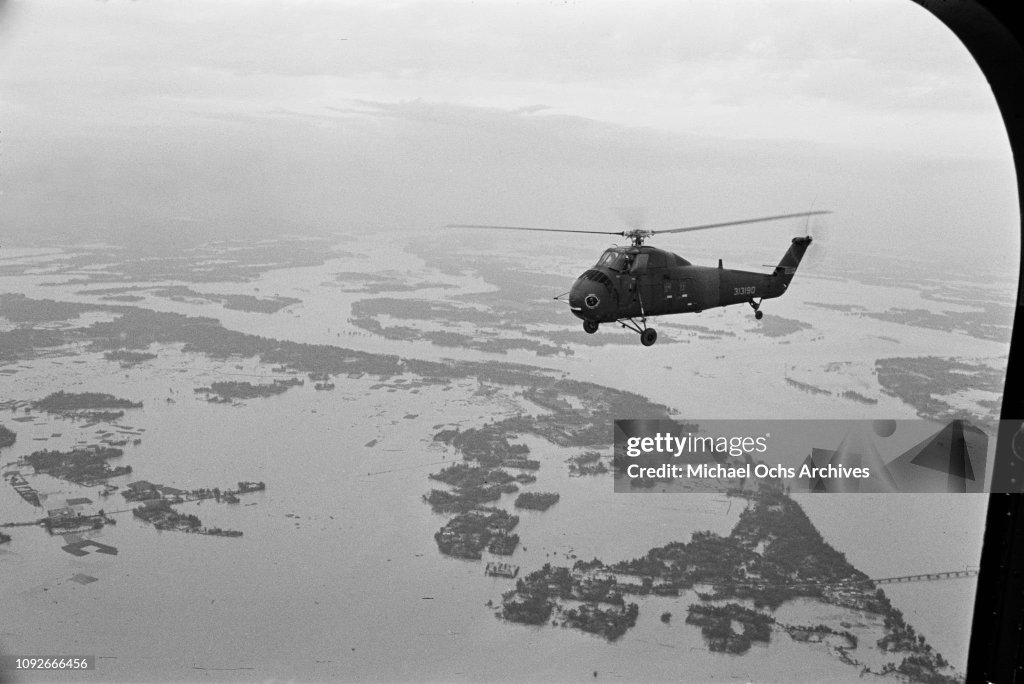
The typhoon called Kate, which had been expected to hit Saigon with 100-mile-an-hour winds, veered tonight after having struck the mountainous coastline. The typhoon headed for Nha Trang, 200 miles northeast. No damage was reported. Officials are still coping with the havoc of recent floods in central Vietnam. A defense spokesman said government forces fired on a group of villagers who had been ordered by the Việt Cộng to disguise themselves as flood refugees and attack oficials. Seven persons were reported killed and 11 wounded in the incident, which occurred last Thursday.
The Cambodian National Assembly postponed indefinitely today a decision on whether to close the United States Embassy here. An unofficial report said the delay had been ordered because the Government of Prince Norodom Sihanouk had not yet completed its study of alleged improprieties by embassy personnel. Prince Sihanouk’s chief charge against American officials had been that they provided United States correspondents with unfavorable information about Cambodia. In criticizing American reporters last weekend, the Prince said he was “certain that these journalists obtain all their absurd information from the embassy, of whose activities, past and present, we are not ignorant.” There was general agreement that Prince Sihanouk, whose control in Cambodia is unchallenged, had ordered the delay in Assembly action.
The 33 American Embassy staff members had calmly awaited news from the Assembly. A spokesman said that Washington had been notified early yesterday that a special Assembly session had been called to debate the expulsion of the American staff. Possible reasons for the Prince’s seeming move toward expulsion of the embassy staff and his last‐minute change of heart were being discussed in the capital. Persons sympathetic to the 43‐year‐old chief of state suggested that the wearying schedule of last week’s Independence Day celebrations had left him especially sensitive to the judgments and reports of Western correspondents.
At Prince Sihanouk’s request a committee of Cambodian journalists reviewed yesterday all cables sent this month by American reporters. Western correspondents, who are here on special visas issued for the observation of Cambodia’s 11th anniversary of independence, were barred from the country last April because of the Prince’s objections to their dispatches. The Cambodian Press Committee concurred that the American cables were again insulting to Cambodia. It recommended that the Government ask Jack Langguth of The New York Times and Francois Sully of Newsweek magazine to leave the country at once. Late tonight neither man had received orders to that effect.
William Healy Sullivan, one of the State Department’s leading experts on Southeast Asia, has been named Ambassador to Laos by President Johnson, it is understood. It was said that Mr. Sullivan’s appointment had been submitted to Vientiane, but that King Savang Vatthana had not yet given his assent. Mr. Sullivan, who is 42 years old, left Saigon last month on leave after having served as executive assistant to Maxwell D. Taylor, United States Ambassador in South Vietnam.
He would replace Leonard Unger, another career officer, who has been Ambassador to Laos since July, 1960. Anmbassasor Unger has been appointed a deputy to William P. Bundy, Assistant Secretary of State for Far Eastern Affairs. Mr. Unger, who is 47, was honored today by Laotian officials and his ambassadorial colleagues. He is leaving at a time of relative stability in Laos, after a succession of political crises and military threats from the pro‐Communist Pathet Lao. The future of the Government headed by the Premier, Prince Souvanna Phouma, remains uncertain but it is no longer on the verge of collapse as it was last spring.
Mr. Unger will probably be best remembered here for what has become known as his “balcony scene” with Prince Souvanna Phouma. It took place last April during a coup d’état after the Premier was imprisoned in his residence by right‐wing generals. Ambassador Unger walked through a cordon of right‐wing troops surrounding the residence to see the Premier. With Souvanna Phouma standing beside him on the balcony of the residence, Mr. Unger, shouting, read to the Prince a United States declaration of support that deterred him from resigning.
The Communist Party of the Soviet Union reorganized its Politburo a little more than a month after ousting Nikita Khrushchev as its leader and replacing him with Leonid Brezhnev. Frol Kozlov, who had once been viewed as Khrushchev’s successor but who had been incapacitated by a stroke, was removed and former KGB Director Alexander Shelepin replaced him. Petro Shelest, the leader of the Ukrainian SSR party, was elevated from candidate membership to full membership. As a final purge of Khrushchev’s legacy, his son-in-law, Alexei Adzhubei, was expelled from the Central Committee “for errors committed in his work”.
Syria and Israel accused each other in the Security Council today of having provoked serious new border troubles in which seven Syrians and three Israelis were killed last weekend. The Council listened to opening statements from both sides and then agreed to await an on‐the‐spot report from Lieutenant General Odd Bull of Norway, head of the United Nations Truce Supervision Organization in the Middle East. No meeting was scheduled pending his report. The Syrian‐Israeli clash, which began Friday in the area north of the Sea of Galilee, was the most serious outbreak since incidents in the border area in August, 1963.
Rafik Asha, Syria’s chief delegate, charged that Israeli planes attacked Syrian villages Friday in an act of “carefully planned aggression.” He demanded that the Council condemn Israel in the strongest terms and take steps to prevent future attacks. For Israel, Michael S. Comay accused the Syrians of having triggered the clash by firing across the border on an Israeli border patrol vehicle and shelling three Israeli villages. He said that Israeli planes went into action only as a last resort and then only to knock out heavily fortified Syrian positions from which the bombardment was coming. The gravity of the incident was underscored by Dey Ould Sidi Baba of Morocco, who questioned whether the Israeli air attack was a “prelude” to preventive war.
One of the nine Israeli soldiers wounded in Friday’s border clash died today, bringing the total Israeli casualties to four armed forces members killed and eight wounded, and two civilians wounded.
A Syrian position opened fire on an Israeli patrol near the border today, an Israeli spokesman said. He said that three machine‐gun bursts were fired at the patrol.
Prime Minister Harold Wilson warned France tonight that her “nostalgic delusions” could endanger the strength and security of the Western alliance. In a major address on foreign and domestic policies, Mr. Wilson said Britain’s objectives were to strengthen the alliance and to check tendencies to “separatism.” Speaking before the nation’s most influential bankers and economists at the annual dinner for the Lord Mayor in the historic Guild Hall, the Prime Minister did not mention France directly, but his repeated references to the policies of President de Gaulle made the allusion obvious. “In a nuclear world safety lies in collective security, in alliances based on interdependence,” Mr. Wilson said. “There is nothing so debilitating as an alliance within an alliance.”
“We reject categorically any idea of a separate European deterrent,” he declared, adding that such a course would divide the North Atlantic Treaty Organization, prompt the United States to reappraise its attitude toward Europe and be a “grave step in the proliferation of nuclear weapons.” The Prime Minister apologized for speaking only generally on defense issues, but said the problems of the alliance would dominate his discussions with President Johnson and European leaders over the next few weeks and months.
British Prime Minister Wilson declared in a speech to Parliament, “If there is one nation that cannot afford to chalk on the walls ‘World go home’, it is Britain. We are a world power, and a world influence, or we are nothing.” The statement came after Wilson had announced that the United Kingdom would phase out its military bases in the Persian Gulf and in the Pacific Ocean.
The Secretary General of the North Atlantic Alliance, Manlio Brosio, challenged President de Gaulle today to add positive proposals to France’s criticisms of NATO. Dr. Brosio, making his first major speech as NATO’s chief, condemned “loose talk” about reforming the organization and asked for a “practical proposal.” Dealing witn tne French leader’s opposition to the United States proposal for a mixed‐manned nuclear force, Dr. Brosio said “those who object must argue their case and put forward their counter‐proposals.” He also contradicted France’s assertion that the North Atlantic Treaty could be separated from the integrated command and administrative structure of NATO. Such a separation would enable the French to their forces from the organization but retain United States protection under the treaty.
The organization, Dr. Brosio said, cannot “exist apart from the treaty” and “allthough one can establish a logical distinction between the two, practically and politically the treaty cannot operate effectively without some form of organization to implement it.” Dr. Brosio’s speech, delivered to the opening session of the NATO parliamentarians’ conference, was something of a landmark in the organization’s history. Without directly attacking the Gaullist position, the Secretary General defended the alliance against French criticism. This criticism is directed primarily at the proposed mixedmanned force. France’s Foreign Minister, Maurice Couve de Murville, told the conference that no power should “impose” any “ready‐made solutions” on other members. It was understood that he alluded to the United States.
Seventeen countries presented their opening bids today for the biggest international trade negotiations that have ever been held. Delegates of the United States, Canada, Japan, 13 Western European countries and Czechoslovakia submitted their proposals in sealed envelopes at a brief ceremonial session in an 18th‐century mansion overlooking Lake Geneva. Thus, after a year and a half of haggling over the rules of play, the Kennedy round of tariff negotiations got down to hard bargaining over tangible goods — atomic reactors, coal, chemicals, textiles and trucks, among other things.
The Chinese Communists said today that India was breaking off “friendly contacts,” such as scientific and cultural exchanges, with China after having voiced strong opposition to Peking’s drive to develop nuclear arms. China’s Hsinhua press agency disclosed that a series of sharp diplomatic notes exchanged between Peking and New Delhi since April reached a peak of bitterness in October — the month in which Peking exploded its first atomic bomb. According to the agency, an Indian note delivered in October to the Chinese Embassy in New Delhi declared: “That as the Chinese Government was opposed to the tripartite partial test ban treaty and was determined to manufacture atomic bombs, India could not enter into any scientific and cultural exchanges with China.”
Peking announced tonight that the Chinese Communist air force had shot down a pilotless United States reconnaissance plane. The incident took place yesterday over central south China, according to Hsinhua, the Chinese press agency. The announcement said: “A pilotless high‐altitude reconnaissance military plane of U.S. imperialism, intruding into China’s territorial airspace over the area of central south China on November 15, was shot down by the air force of the Chinese People’s Liberation Army.” In a separate report Hsinhua said that Marshal Lin Piao, Minister of National Defense, had commended the air unit responsible for the action.
Joshua Nkomo, the leader and founder of the Zimbabwe African People’s Union, was transferred from the prison in Salisbury (now Harare), along with 16 other ZAPU party members who had been detained by the white-ruled colonial government of Rhodesia, following a ruling by the southern African nation’s highest court. Nkomo and his men remained imprisoned, however, and were transferred 440 miles (710 km) away to the remote Gonakudzingwa Restriction Camp. Nkomo would remain at Gonakudzingwa for the next ten years.
The USSR performs a nuclear test at the Semipalatinsk Test Site in northeast Kazakhstan.
President Johnson, back in his office for the first time since the election on November 3, plunged into a round of conferences on domestic and international matters today. Looking tan and rested after what he called his “extended vacation” at his LBJ ranch in Texas, the President spent most of the day at his desk. He conferred in the morning with Secretary of Defense Robert S. McNamara and Secretary of State Dean Rusk on matters a White House spokesman described as “nothing unusual.” Further details were not available.
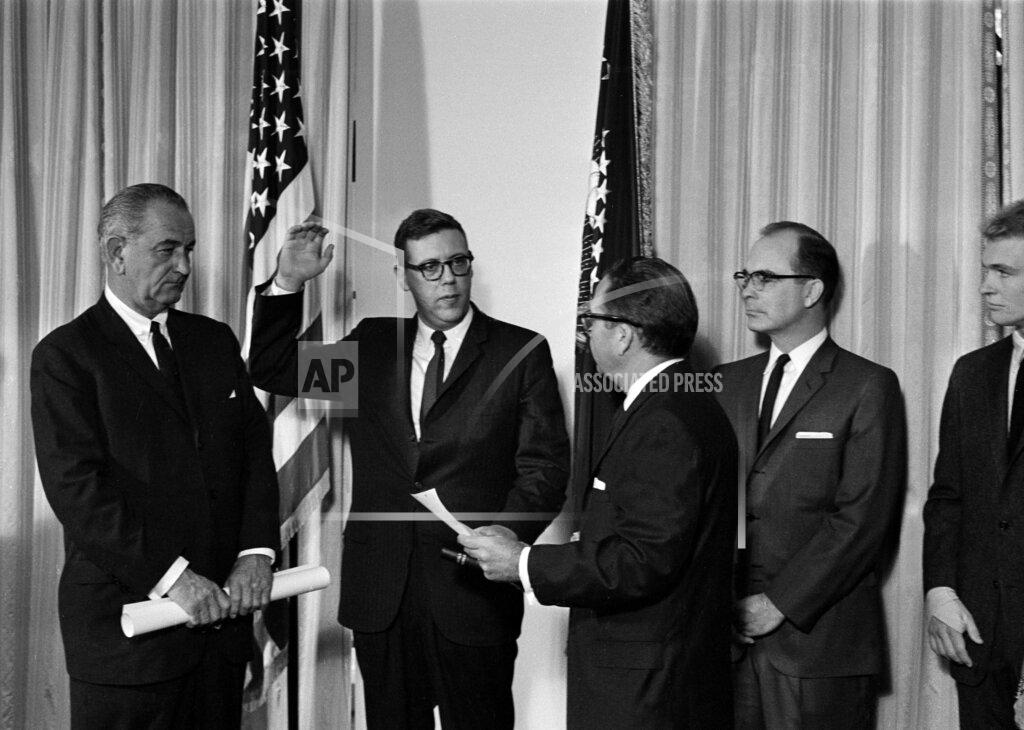
Shortly after noon, the President presided over ceremonies marking the elevation of Dr. Gardner Ackley to the chairmanship of the Council of Economic Advisers. Dr. Ackley succeeds Dr. Walter W. Heller, who has resigned from the council to return to teaching at the University of Minnesota. Noting that he had tried for a year to persuade Dr. Heller to remain as council chairman, the President grinned and said: “His persistence in getting out of here has caused me to reflect a little the past week about the real condition of our economy.”
President Johnson described the nation’s economy as prosperous but said that unemployment was still far too high. “We have 3,200,000 18-year-olds who want to go to school or want to find a job this year,” he said. “Educational opportunities, therefore, must be increased.” The state of the nation’s economy was also discussed in a mid‐month review released today by the Labor Department. The report said there were signs of “substantial strength” in the economy despite a slowdown in expansion last month.
Republican leaders showed a distinct lack of enthusiasm today over Senator Barry Goldwater’s suggestion for a “real realignment” of the Democratic and Republican parties into “two new teams” under “Liberal” and “Conservative” banners. The handful of recognized party spokesmen in town declined to comment publicly on the proposal. Others reached by long‐distance telephone were equally reticent. Some questioned whetner the Arizona Senator appreciated the full implications of his suggestion and whether he was prepared to have the Republican party forswear its historical identification as the party of Lincoln.
Senator Goldwater said on Saturday at Montego Bay, Jamaica, that the trend toward political realignment of the major political parties that had begun during the Hoover‐Smith Presidential campaign in 1928 might well have ripened during his own contest with President Johnson. Henry Cabot Lodge, who was a write‐in candidate for the Republican nomination against Senator Goldwater, denounced the realignment idea yesterday as “totally abhorrent to the American two‐party system.” The House Republican leader, Charles A. Halleck of Indiana, was indirectly critical of the Goldwater suggestion today. He said that in spite of the Republican losses in the House and Senate in the election, “you can be absolutely confident that the Republican party is very much alive.”
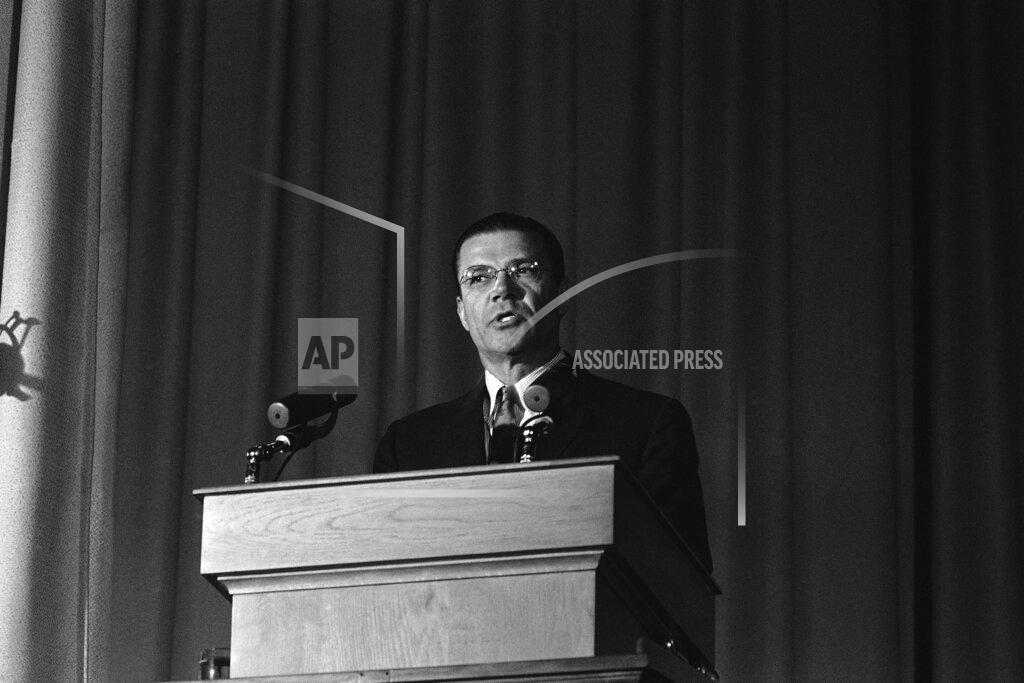
The flame that has flickered at the grave of John F. Kennedy for almost a year will remain as the central symbol of the final monument to the slain 35th President of the United States. Detailed plans were released today by John Carl Warnecke, whom Mrs. Kennedy designated as architect for the project, and Defense Secretary Robert S. McNamara, whose department has jurisdiction over Arlington National Cemetery. Contrary to many expectations, there will be no statue, no building and no vertical tombstone or sarcophagus on the site.
The design calls for a circular granite walk leading up the hillside toward the gravesite in Arlington; an elliptical overlook inside and at the top of the circle, and steps from there up to a white marble terrace where the President and two of his children will lie in a grassy rectangle. Their graves will be marked by slate tablets set almost flush with the ground. Behind Mr. Kennedy’s simple horizontal marker is the eternal flame lit by Mrs. Kennedy the day of his funeral, November 25, 1963. It will be cupped in a triangular bronze font, and will remain alight in all weather although open to the elements.
The whole low‐lying design — circular walk and two terraces above it — hugs the hill’s contours: The highest structure is the seven and one‐half foot high retaining wall in back of the flame, engraved with the Presidential seal. From across the Potomac in nothing obstructs the view of the columned Custis-Lee mansion, atop the hill in Arlington. Those facing toward the capital city from the mansion’s portico still have an unobstructed view of the Lincoln Memorial, the Jefferson Memorial, the Capitol building and the Washington Monument.
The six unions representing railroad shopcraft workers announced today that they had called a nationwide strike to start at 6 AM next Monday. If the strike occurs, it would directly affect all but two of the railroads, tying up freight and passenger traffic, including commuter runs, and affecting tens of thousands of people. The two roads are the Southern Railway System and the Florida East Coast Railroad. They bargain separately. James E. Wolfe, who as chairman of the National Railway Labor Conference is the industry’s chief labor‐relations spokesman and negotiator, said that “the Department of Labor and the Administration will eventually come into the picture” if a settlement was impossible.
Walter Reuther, president of the United Auto Workers Union, offered a plan today to harmonize wages and working conditions for nearly two million automobile workers in the non‐Communist world. Headquarters for the international union effort will be Tokyo. Mr. Reuther called it “the grand plan for reducing crass differences in living standards among international auto workers.” Speaking at the fifth world congress of auto workers unions, he told the 110 delegates from 30 countries that his plan did not call for “one big international union or for joint collective bargaining.” “What we want is greater cooperation among all of us so those auto workers who are not receiving a just part of the wealth they produce will achieve a higher standard of living based on harmonization of wages, working conditions and social benefits,” he said.
The nation’s two largest seamen’s unions told the Maritime Advisory Committee today that the nation’s cargo preference laws were being “grossly maladministered.” Paul Hall, president of the Seafarers International Union, in a 40,000‐word statement, called for the replacement of Orville L. Freeman, Secretary of Agriculture, bccause of his record as head of the Federal department administering the largest cargo preference program of the Government. The statement described Mr. Freeman as being “not only anti‐maritime but anti‐union.”
Cargo preference laws require that at least 50 percent of Government aid shipments be transported overseas in United States flag ships at “fair and reasonable rates.” Joseph Curran, president of the National Maritime Union, described the statutes as the “most important legislation designed to protect and foster American‐flag vessels” in foreign commerce. The reason for the statutes, he said, is the fact that foreign flag vessels can operate at much lower costs that American flag vessels.
The Church of Jesus Christ of Latter‐day Saints cannot be expected to change its attitude toward Black members in the near future, David O. McKay said today. Mr. McKay, the 91‐year‐old president of the Mormon Church’s two million members, spoke at a news conference at the Boatel and Motor Lodge in Jack London Square in Oakland, California. Among several questions on the Mormon attitude toward Blacks was one as to whether the church would change its rules governing the status of Black members. Mr. McKay replied: “Not while you and I are here.”
The Mormon attitude toward Blacks stems from the beliefs and interpretations of Scripture by Joseph Smith, the prophet. According to these beliefs, Blacks are suffering the punishment of Cain, who, the Bible says, killed his brother, Abel, and the color and physical characteristics of the race are “the mark of Ham,” the son of Noah who married a descendant of Cain. Theologically, it has been argued, the Black is a second-class Mormon if he joins that church. The church, founded by Joseph Smith and shaped by Brigham Young, is a lay religious group, with each male adult Mormon a member of the priesthood.
But a Black may not be a priest. Mormon theology holds that there are three levels of paradise, and admission to the upper two levels depends on good works during life, with priesthood as the first requirement. The priesthood is also denied to women, but their rank in paradise is conditioned on the place won by their husbands, or, if spinsters, by that of their fathers. There are relatively few Blacks among the Mormons, and the vigorous proselytizing of the church is not found among the Black nations.
The Mississippi Supreme Court dismissed today the appeal of Cleve McDowell, the second Black to enter the University of Mississippi, from his conviction on a charge of carrying a concealed weapon on the campus last year. The court said it was without jurisdiction to hear the charges resulting from the incident that led to Mr. McDowell’s ouster from the university. Mr. McDowell was arrested September 23, 1963, after a pistol fell from his pocket on the campus. Five days later he was convicted in Justice of the Peace Court in Lafayette County and fined $100 and costs.
Blacks for the first time in Alabama directly sought protection today under the public accommodations section of the Civil Rights Act. Two Gadsen Blacks filed suit in United States District Court, charging the owner of the Rebel’s Roost cafe with refusing to serve Blacks August 1 and August 5, violating the accommodations section. No Black had previously filed suit under the section in Alabama. The similar suits in Tuscaloosa and Selma were filed by the Justice Department at the request of Blacks. The suit said Mrs. Leola Hoyt and her teenaged daughter, Shirley, and son, Derry, sought service and were refused. Mrs. Hoyt returned four days later Joseph Faulkner, and again they were refused. The restaurant, owned by Mrs. Mary Bailey, is in an old section of Gadsden called Alabama City. All the Blacks are residents.
Dow Jones Industrial Average: 880.1 (+5.99)
Born:
Dwight Gooden, MLB pitcher (World Series Champions, 1986-Mets, 2000-Yankees; All-Star, 1984-1986, 1988; NL Cy Young Award, ERA leader, and strikeout leader, 1985; no-hitter, May 14, 1996; New York Mets, New York Yankees, Cleveland Indians, Houston Astros, Tampa Bay Devil Rays), in Tampa, Florida.
Rob Mallicoat, MLB pitcher (Houston Astros), in St. Helens, Oregon.
Diana Krall, Canadian jazz pianist and singer, in Nanaimo, British Columbia, Canada.
Harry Lennix, American actor (“Man of Steel”, “Dollhouse”), in Chicago, Illinois.
Maeve Quinlan, American actress ( “The Bold and the Beautiful”), in Chicago, Illinois.
Monica Bandini, Italian racing cyclist (World Championship gold women’s team time trial 1988), in Faenza, Italy (d. 2021).
Ken Bell, NFL kick returner, running back and wide receiver (Denver Broncos), in Greenwich, Connecticut.
Darrell Colbert, NFL wide receiver (Kansas City Chiefs), in Beaumont, Texas.
Ted Elliott, NFL nose tackle (New Orleans Saints), in Inver Grove Heights, Minnesota.
Died:
Piet Moeskops, 71, Dutch track cyclist (world sprint champion 1921-1924, 1926).
John Emery, 59, American actor (“Ship Ahoy”, “Kronos”, “Mademoiselle Fifi”).


 History Diaries