
A return to Soviet-American détente was called for by Konstantin U. Chernenko, the Soviet leader. He said this could open the way to “broad possibilities for cooperation,” such as in combating famine and protecting the world’s environment. In responding to written questions submitted by an NBC News correspondent, Mr. Chernenko also said that if the Reagan Administration was sincere, the way was open to resolving key arms-control questions. “If the statements that are being made lately in Washington with regard to the desire to seek solutions to problems of arms limitation do not remain just words, we could, at last, start moving toward more normal relations between our two countries and toward a more secure world,” Mr. Chernenko said.
Secretary of State George P. Shultz, who has been entrusted by President Reagan with seeking more constructive relations with the Soviet Union, said: “We welcome his statements. We agree with the goals he states.” He said the Chernenko responses were “a positive statement.” Interviewed by NBC News, Mr. Shultz said, “We’re ready to sit down and engage in real negotiations with the Soviet Union on arms control and seek concrete results and work out problems.” He said the proposal made by Mr. Reagan for wide-ranging talks on arms control was consistent with that goal.
The tone of Mr. Chernenko’s responses was forthcoming and lacked any criticism of the Reagan Administration, something distinctly different from the Soviet comments before the election. Mr. Chernenko, who was a close associate of Leonid I. Brezhnev, the Soviet leader during the period of detente in the 1970’s, said that in those years, “it became possible, through joint effort of our two countries, to achieve for the first time a major breakthrough on the way to solving what theretofore seemed an insoluble task – that of limitation and reduction of nuclear arms.”
“It was at that time,” he said, “that the U.S. and the U.S.S.R. also had a fairly good interaction in solving certain international problems. All this taken together had a most positive effect on the world situation as a whole.” Mr. Chernenko said that what made possible “the relaxation of international tensions” in the 1970’s was “the realization that the arms race could not insure the security of either side and, also, the actual willingness to build relations between them on the basis of equality with due account taken of the legitimate interests of each other and without prejudice to the interests of third countries.”
Josef Stalin’s daughter was tormented by guilt and longing for her son and daughter in the Soviet Union, she said at a news conference in Moscow, her first since she returned to the Soviet Union recently. Svetlana Alliluyeva, who took her 13-year-old American-born daughter with her to Russia, said her decision to return after 17 years in the West was “purely human” and voluntary. She said she had contemplated coming back twice before. She said her final decision on Sept. 10, which was announced by the Soviet Union on November 2, was prompted by the illness of her son and the loss of contact with her oldest daughter. Both are Soviet citizens.
Five Solidarity sympathizers in Poland were abducted and tortured earlier this year by men who identified themselves as security officials, according to members of newly formed civil rights groups. The incidents, they said, were subsequently covered up. The abductions were said to have occurred in Torun. In the same general area of northern Poland, a pro-Solidarity priest, the Rev. Jerzy Popiełuszko, was seized last month by three security agents who now are charged with his murder.
General Wojciech Jaruzelski, the Polish leader, made an unannounced visit to East Berlin today and met with Erich Honecker, the East German leader. No communiqué was issued about the visit, which came after General Jaruzelski’s equally abrupt trip to Hungary last week. Some party members have privately suggested that the Polish leader wanted to assure his allies that he was in control after the killing of the pro-Solidarity priest Popiełuszko in October.
An Italian movie star, Rossano Brazzi, and a suspect in the 1981 plot to assassinate Pope John Paul II, Bekir Celenk, were among 37 people indicted after a major investigation of international arms and drug smuggling, a prosecutor said today. Judge Carlo Palermo issued the indictments Thursday night in the northern Italian city of Trento. The indictments ended a five-year investigation into a ring that is said to have operated in Italy, West Germany, Spain, Bulgaria, Turkey and other parts of the Mediterranean.
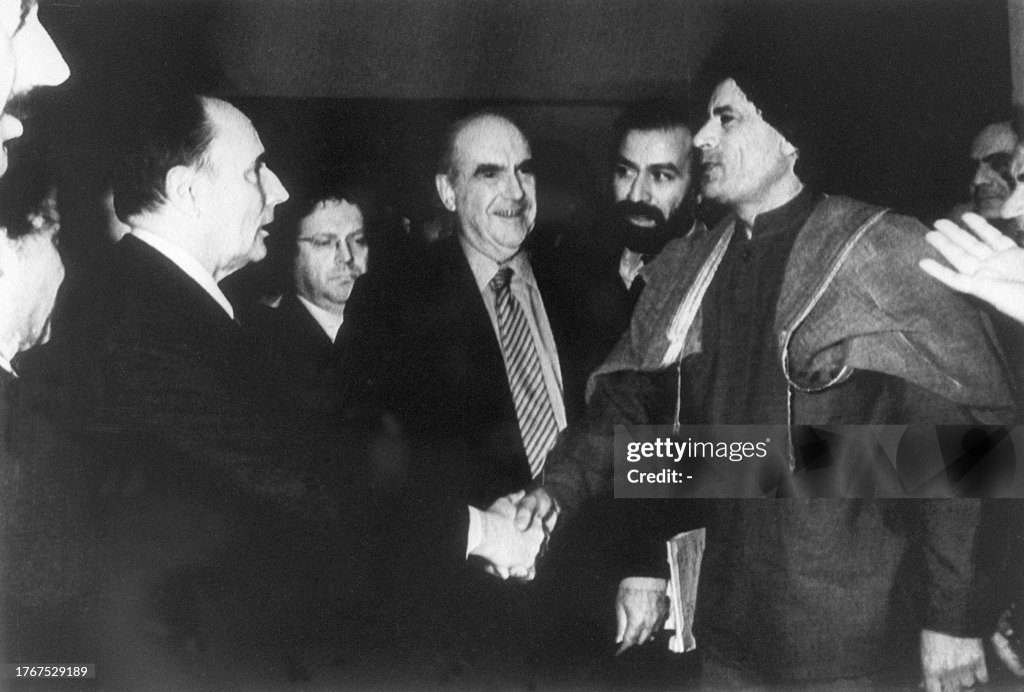
Libyan troops remain in Chad, President Francois Mitterrand acknowledged. He indicated that France had completed the withdrawal of its forces from its former African colony while knowing that the Libyans had halted their own pullout. Mr. Mitterrand told reporters that two to three Libyan battalions, or 800 to 1,200 men, still held positions in Chad. The admission was a striking turnabout from statements by the Government last Saturday, at the United Nations on Wednesday night, and again in the National Assembly on Thursday that the withdrawal on both sides was total and complete. The Government spokesman, Roland Dumas, said today that France realized the Libyan troop withdrawals were slowing down last Saturday. Mr. Mitterrand, in a statement, described it as “a slowing down of this withdrawal movement, or a reinforcement of the Libyan presence.”
Libya asserted today that Colonel Muammar el-Qaddafi’s “suicide squads” killed a former Libyan Prime Minister who has been missing for four days. The official Libyan press agency and the Tripoli radio said Abdul Hamid Bakkush, the last Prime Minister under the Libyan monarchy overthrown by Colonel Qaddafi in 1969, had been killed because he “sold his conscience to the enemies of the Arab nation and Libyan people.” In Cairo, where Mr. Bakkush has lived since 1977, Egyptian officials said they were unaware of the reported assassination. Egypt’s Government-run Middle East News Agency said one of its reporters who went to Mr. Bakkush’s suburban residence found the house heavily guarded by Egyptian security forces. The Tripoli radio said Mr.Bakkush was “executed” about 3 PM Monday by “suicide squads” set up “to liquidate the enemies of the revolution.”
[Ed: LMAO. This is not what it seems. Wait for part two tomorrow. “How to make Qaddafi look like even more of a moron.”]
Ethiopia’s leader said today that he was grateful to the people of the United States and Europe for “bringing pressure to bear on their governments” to send emergency famine relief to this country. But he said the American aid would not lead to a thaw in relations with Washington. “The differences that exist between Ethiopia and the U.S. do not emanate from the fact that we were not getting food aid,” the Ethiopian leader, Lieutenant Colonel Mengistu Haile Mariam, said at a three-hour news conference at the end of the Organization of African Unity conference here.
The Indian Government said today that it would ask Norway to extradite a former Indian diplomat who is accused of having paid $100,000 for the assassination of Prime Minister Indira Gandhi. A Foreign Ministry official said a special police team investigating the October 31 slaying of Mrs. Gandhi had requested that the government seek extradition of Harinder Singh, a Sikh, who resigned as First Secretary of the Indian Embassy in Oslo June 19. The decision came after an English- language newspaper, The Hindustan Times, quoting investigative sources, reported Friday that Mr. Singh had paid $100,000 to one of two Sikh bodyguards who were said to have killed Mrs. Gandhi.
In Oslo today, Harinder Singh said in an interview, “I categorically deny any allegation that I had anything whatsoever to do with the assassination of Mrs. Gandhi.” A Norwegian Justice Department official said it was unlikely Oslo would agree to India’s request to extradite Mr. Singh, adding that “even if the diplomat has committed a crime, he or she is still liable for political asylum in Norway under our laws.”
France flew 280 riot policemen to the South Pacific territory of New Caledonia today to counter threats of trouble from pro-independence militants determined to disrupt parliamentary elections on Sunday. The French officers arrived at dawn with equipment including shields, riot sticks and tear gas, the police said. Their arrival marked a stepping up of action against militant Kanakas seeking independence. The indigenous Kanakas make up 43 percent of the territory’s 145,000 people and are outnumbered by French settlers, Polynesians and other groups.
Salvadoran rebels eased their policy of refusing to participate in elections until they gain a formal role in the Government, one of the rebel leaders said. He said they are prepared, in principle, to take part in elections organized by the Government of President Jose Napoleon Duarte. The Salvadoran Government and the Reagan Administration have repeatedly said that the guerrillas cannot gain a share of power unless they stop fighting and participate in elections. Mr. Ungo said a political settlement of the Salvadoran civil war would be impossible unless the insurgents gained some share of power. But he said that the exact shape of their involvement remained open to negotiation and that their participation in elections was not necessarily contingent on their gaining a share of power.
More than 100 United States military officials have gathered in Honduras this week, and United States and Honduran sources say the officials are planning a major military exercise next year. A statement from the Honduran military implied that the planning involved an exercise to be known as Tall Pines 3, a sequel to two large-scale training exercises here in the last two years.
Chile’s leading prelate warned the Government against blaming the church for the country’s political problems and called for a day of prayer and fasting next Friday. Archbishop Juan Francisco Fresno said he was “profoundly worried” about the level of subversive and repressive violence. The statements were among some of the strongest made by the country’s highest Roman Catholic Church leader, and they reflected growing tension between church and Government.
The Zaire Government said today that Tanzanian-based rebels captured a town on Lake Tanganyika this week, but were driven out by paratroopers and ground forces. Information Minister Sakombi Inongo said more than 100 rebels and about 10 civilians were killed when the Government forces retook the town, Moba, formerly Baudouinville. He gave no figure for Government losses.
South Africa held out the possibility tonight of three-way talks with the United States and Angola on the withdrawal of Cuban soldiers from the former Portuguese colony. But after two days of discussion with a senior United States envoy, Foreign Minister Roelof F. Botha gave no indication of whether significant progress had been made in long-running, American-sponsored negotiations designed to secure a Cuban withdrawal in tandem with independence for neighboring South-West Africa. Chester A. Crocker, Assistant Secretary of State for African Affairs, arrived in Johannesburg Thursday to hear Mr. Botha’s response to Angolan proposals that are reported to offer a reduction and redeployment of the 30,000 Cubans in Angola in return for South Africa’s withdrawing its forces and relinquishing control of South-West Africa, or Namibia.
About 2,300 people were arrested by the South African police in raids on a black township near Johannesburg. A police spokesman said that they had been arrested for purported nonpayment of rent and other minor civil offenses, and that most had paid fines and had been released.
A safe return to Cape Canaveral was made by the space shuttle Discovery on its completion of mission STS-51-A after eight days in orbit. The Discovery, carrying the first two salvaged satellites, landed just after sunrise today in the successful conclusion of a mission that delighted officials of the shuttle program and sent satellite insurers “absolutely over the moon.” The winged spaceship soared out of the west into the blue of dawn, made a wide left turn out over the Atlantic and glided to a smooth touchdown on the long runway at the Kennedy Space Center a few seconds before 7 A.M. In the Discovery’s eight days in orbit, the crew of five astronauts deployed two new communications satellites and, in daring space walks, retrieved two others that were misfired into useless orbits last February. The retrieved satellites, brought back in the cargo bay, are to be refurbished and sold for re-launching. ‘A Spectacular Mission’ “We had a wonderful time up there doing a spectacular mission,” said Capt. Frederick H. Hauck of the Navy, the mission commander, after the landing. Calling this “a very historic day in the American space program,” Jesse W. Moore, the shuttle program chief for the National Aeronautics and Space Administration, said that the salvage operation “clearly demonstrated” the ability of astronauts and machines to accomplish a wide range of tasks in orbit.
Construction projects in space seem more feasible following the successful manipulation of wrenches by the Discovery’s astronauts in their successful rescue of drifting satellites from space, scientists say. The satellites were bolted into place into Discovery’s payload bay. “This will give people a lot more confidence to construct a space station,” said Saunders B. Kramer, a space and missiles scientist, who in the early 1960’s received the world’s first patent for a manned space station. In a week of startling images of the shuttle Discovery on a salvage mission in space, one stands out as a vision of the future: astronauts manipulating wrenches as they worked methodically in the cold void. They plucked satellites from orbit, wrestled them into the payload bay and bolted them into place. It was a mission that demonstrated the skills and daring needed for an impending era in which construction crews in spacesuits may be called on to erect platforms or stations or even whole vehicles while floating in space.
A deficit cut to under $150 billion by 1988 is a goal the Reagan Administration hopes to achieve through reductions in domestic spending, Administration officials said privately. They said driving the deficit to such a level would require adoption by Congress next year of deep cuts in many areas, citing as possibilities Medicare, civil service retirement, student loans and farm subsidies. Specific options for spending cuts to reach the target by the fiscal year ending September 30, 1988, will be presented to President Reagan after his Thanksgiving vacation in California. The projected deficits for this fiscal year and next are running at about $200 billion. Mr. Reagan has ruled out two possible ways to reduce them, raising taxes or cutting Social Security, and has expressed opposition to any slowing of military spending. Congress is expected to resist any proposal to slash domestic spending.
President Reagan limits Cabinet meetings to Cabinet members due to recent leaks to the press.
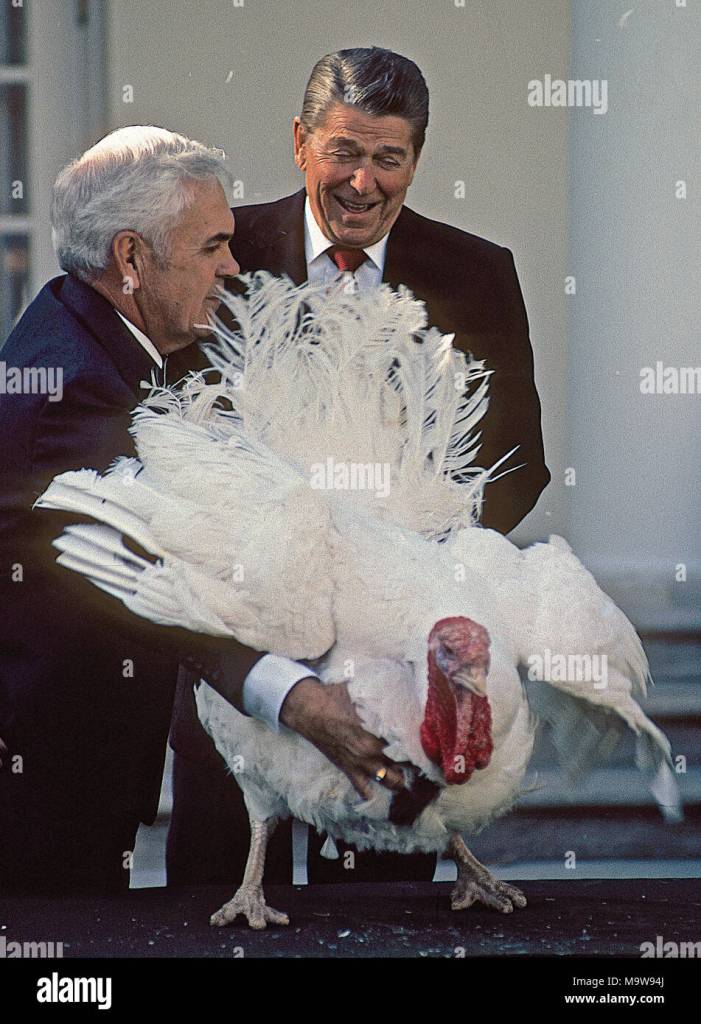
President Reagan participates in a ceremony to receive the 37th annual Thanksgiving turkey from the National Turkey Federation.
Nancy Reagan will visit her mother, Edith Davis, in Phoenix on Saturday, the First Lady’s office announced today. Mrs. Reagan will fly to Los Angeles on Sunday and join her husband Monday at their ranch near Santa Barbara, California, for Thanksgiving.
Baby Fae’s death was apparently caused by complications that developed when her body rejected a transplanted baboon heart. Her doctor, Dr. Leonard L. Bailey, said the transplant had advanced medicine and one day would save the lives of many children. He said he would attempt another baboon-to-human heart transplant.
Baby Fae died at 9 PM Thursday Pacific Standard Time after her kidneys deteriorated and she developed a lethal cardiac complication called complete heart block. Complete heart block disrupts the electrical impulses that travel from the top to the bottom chambers of the heart to control its beat. As a result, the bottom chambers of Baby Fae’s transplanted heart began to beat independently of the upper chambers and her heart rate ranged from 75 to 100 beats per minute instead of the 140 to 160 rate at which it had been beating. A transplanted heart tends to beat faster because the nerves that inhibit its action are severed in the process of the operation. Also, a baby’s heart normally beats faster than an adult’s.
Dr. Bailey indicated that the medical team was surprised at the sudden turn of events Thursday night. Throughout the experiment the medical team met each afternoon about 4 PM to discuss the infant’s progress and laboratory test results and to plan therapeutic strategies. Thursday’s meeting “ended on an upbeat,” Dr. Bailey said, although he also said he was deeply concerned about the management of her kidney problems. For the three previous days she produced increasingly smaller amounts of urine although the creatinine test of her kidney function was normal. The test is a standard measure of kidney function. Only late Thursday did the tests begin to indicate serious kidney failure, he said. But two hours after the meeting, “things changed fast,” as they can in a tiny infant, Dr. Bailey said.
Although Baby Fae had developed a degree of heart failure earlier this week, Dr. Bailey said she lost heart function only in the last two hours of life. That loss, he said, was from a culmination of events surrounding the rejection process. Dr. Bailey said his team struggled to the very end to save Baby Fae’s life. Thursday night they used a form of artificial kidney therapy known as peritoneal dialysis to rid her body of the wastes that her kidneys could not excrete. About 9 PM, when her heart stopped, Dr. Bailey’s team tried to start it again with closed cardiac massage. The effort failed. Baby Fae’s rapid demise followed a rejection epsiode that began about one week ago.
Reaction to the death of Baby Fae came quickly yesterday from heart and organ transplant experts. Some defended the experimental transplant of a baboon heart for the infant as a necessary step to save her life and as a valuable step in medical research. Other experts raise procedural or ethical questions. Still others argued that until the case was reviewed it would not be possible to know whether signifcant knowledge or experience had been gained.
A man with symptoms of acquired immune deficiency syndrome, or AIDS, was ordered to leave Boston City Hospital because workers feared he would infect them, but hospital officials said today that a mistake had been made and one doctor might be disciplined. “This is a very unusual circumstance,” said the hospital’s public relations director, Carolyn Walden. The patient, identified only as John, told The Boston Globe that he had been about to undergo a biopsy of the lymph tissue when a young resident, Dr. Richard Freeman, ordered him to leave the hospital. “He told me I had to get out,” the patient said. “To put my clothes on and and get out. He told me it was because of the nature of my problem and the suspicion I had AIDS that I could be contaminating the other patients.” Dr. Freeman, reached this morning, refused to talk, referring all questions to the hospital spokesman, who said the doctor had “misunderstood” the hospital’s AIDS policy.
David Carpenter was sentenced today to die in the gas chamber for the murders of two young women hikers he shot through the head at state parks in 1981. The 54-year-old defendant terrorized Northern California hikers for three years. A Superior Court jury recommended October 5 that Mr. Carpenter, who has spent much of his life in prison for violent crimes, be executed for the slayings in Santa Cruz County of Ellen Hansen and Heather Scaggs, both 20, and the attempted murder of Stephen Haertle, 23. The authorities in the San Francisco Bay area say they plan to prosecute Mr. Carpenter on charges of murdering four other women and one man in 1980 in Marin County. Prosecutors said all seven victims were shot through the head with the same .38-caliber pistol on or near hiking trails. The authorities have also linked Mr. Carpenter to other slayings, but said there was insufficient evidence to charge him.
General William C. Westmoreland repeatedly asserted at his libel trial against CBS yesterday that he had never imposed a ceiling on estimates of enemy strength in South Vietnam nor had he ordered those figures to be suppressed or altered. The 70-year-old retired general – whose $120 million suit was prompted by a 1982 CBS Reports documentary titled “The Uncounted Enemy: A Vietnam Deception” – testified that his concern in 1967 with how the press would interpret enemy troop estimates stemmed, not from an attempt to mislead, but from an effort to have the figures understood. “Certainly we were sensitive to press reaction, and it was logical that we be,” he told the jury in Federal Court in Manhattan in a long, impassioned answer to a question concerning a cable that was sent on Aug. 20, 1967, to General Earle G. Wheeler, Chairman of the Joint Chiefs of Staff. The cable expressed a fear that the press would draw “erroneous and gloomy conclusions” if “inflated figures” showing a 120,000 to 130,000 “increase” in enemy size were released. It was written by General Westmoreland’s deputy, General Creighton W. Abrams, and endorsed by General Westmoreland, who was commander of American forces in Vietnam from 1964 to 1968.
U.S. fishermen want a moratorium for a year on the American-Canadian fishing boundary established by the World Court last month. The boundary line gave 75 percent of the Georges Bank fishing grounds to the United States, but reserved the richest part of the grounds for Canadian use. New England fishermen want time to work out a compromise with American and Canadian fishing and governmental representatives, even though the World Court decision is understood to be beyond appeal.
A businessman pleaded guilty today in Federal court to falsely telling investigators that Labor Secretary Raymond Donovan helped launder $20 million in Teamsters Union contributions to the 1980 Presidential campaign of Ronald Reagan. The man, Michael E. Klepfer of Binghamton, N.Y., had originally pleaded not guilty to four counts of making false statements on the matter to agents of the Federal Bureau of Investigation.
A group of eighth-graders studying pioneer life killed their own Thanksgiving turkey, a bit of realism that has prompted complaints from the humane society. As about 40 other students watched in front of Highland Middle School, 13-year-old Robin Ham used an ax to sever the neck of the bird the youngsters had named Willy Wally. Gloria Fedele, executive director of the Kentucky Humane Society Animal Rescue League, said she was appalled that the school had approved the turkey project. She said the society received calls from parents of four or five children “who said their children had come home very upset and crying.”
The stock market, which suffered seven consecutive relatively moderate losses since President Reagan’s re-election, staged a full- scale retreat yesterday in heavier trading. The Dow Jones industrial average plunged 18.22 points to close at 1,187.94, bringing its loss for the week to 31.03 points. The loss in the average yesterday was its largest since it fell 18.33 points on July 11.
The Houston Rockets block 20 Denver Nuggets shots tying NBA regulation game record.
Dow Jones Industrial Average: 1187.94 (-18.22)
Born:
Gemma Atkinson, British actress and model, in Bury, Greater Manchester, England, United Kingdom.
Kimberly J. Brown, American actress, in Gaithersburg, Maryland.
Died:
Leonard Rose, 66, American concert cellist (New York Philharmonic, 1943-1951).





 History Diaries