A winter offensive in the north by Communist guerrillas was set back at least two months by severe floods in three provinces last week, government spokesmen said today. The floods, which killed more than 6,000 Vietnamese in Quảng Ngãi, Quảng Nam, and Quảng Tín provinces, were believed to have drowned or injured hundreds of Communist guerrillas, destroyed scores of underground Communist storehouses and wiped out ammunition dumps. It became known today that the guerrillas had begun their first military assault in central Vietnam. Since last week’s floods with about two companies of soldiers, or 200 men. The assault took place at Khiêm Mỹ, 275 miles northeast of Saigon. Three government soldiers were reported killed, but a government spokesman said “the Việt Cộng were beaten off and forced to withdraw, leaving 10 of their dead behind.”
Meanwhile, a United States military spokesman reported that one American and two Vietnamese Army men had been wounded by automatic‐weapons fire from guerrillas on the ground as they flew helicopter flood relief missions in two United States Army helicopters near Quy Nhơn. In Communist-infested Vĩnh Bình Province, about 68 miles southwest of the capital, another American was wounded seriously during an antiguerrilla operation when a mine went off under an M‐113 personnel carrier.
McGeorge Bundy, a special assistant to President Johnson, said today that “we have to take very seriously” forces outside South Vietnam who are the initiators and the prime movers in this Communist aggression.” Mr. Bundy, who was interviewed on the C.B.S. television show “Face the Nation,” also viewed the angry Soviet reaction to the NATO mixed-manned nuclear idea as “no more than a reassertion of a position which they have taken for a long time.”
Prince Norodom Sihanouk, the chief of state, has called a special session of the Cambodian National Assembly tomorrow to debate whether to expel the staff of the United States Embassy here. The Cambodian, press agency reported today that no more American reporters would be permitted to enter Cambodia until their attitudes toward the country underwent “a radical change.” It was made known that the “more guilty” American correspondents now in Cambodia would be “courteously invited” to leave. The Cambodian Journalists Association “invited” Jack Langguth of The New York Times and François Sully of Newsweek magazine to leave the country for having filed “injurious cables,” United Press International reported.
The news agency said the Prince had objected to reports filed from Phnom Penh by United States correspondents who were admitted to Cambodia this month. It was their first entry since April. Prince Sihanouk was said to hold American Embassy officials responsible for having circulated material for the dispatches that displeased him. The news agency said the embassy personnel were also considered to be engaged in secret activities against the Prince’s People’s Socialist Community, Sangkum, the major Cambodian political movement. As the Prince apparently headed toward a severing of Cambodia’s strained relations with the United States, he offered two conditions for reestablishing harmony between the two countries.
In reply to written questions, Prince Sihanouk, who has declined to grant interviews to foreign newsmen, said the United States would have to obtain a firm agreement from the South Vietnamese Government to end attacks on the Cambodian border. Saigon has explained that border incidents have occurred when its units crossed the line by mistake in pursuit of Việt Cộng guerrillas. Vietnamese and American forces have also charged the Việt Cộng are using Cambodia as a sanctuary and route of supply. The Prince also demanded that the United States stop making such accusations, saying that they could be used to justify further military attacks against Cambodia.
Cambodia is considering breaking relations with the United States, a Peking broadcast of what was described as a Phnom Penh dispatch to Hsinhua, the Chinese Communist press agency, said today. Hsinhua said that Prince Sihanouk made a statement to that effect Saturday night.
The Security Council will meet in urgent session at the request of Syria and Israel tomorrow to consider the outbreak of hostilities on the border between the two countries last Friday. Adlai E. Stevenson of the United States, this month’s president of the Council, called the meeting for 3 PM after consultations with representatives of other member states. As the Security Council prepared to meet on the border conflict, the United Nations remained preoccupied with the United States‐Soviet dispute over finances.
The Soviet Union was putting pressure on smaller countries to oppose any action to take away its General Assembly vote as a penalty for being more than two years in arrears on paying United Nations assessments. Israel’s request for the Council session was filed today by Michael S. Comay, the country’s chief delegate. His communication supplemented a letter to Mr. Stevenson yesterday that gave details of the border clash. Mr. Comay had asked that Mr. Stevenson circulate that letter to the Council membership. Yesterday Rafik Asha, head of the Syrian delegation, called for a meeting of the Council to take up “the latest aggression committed by Israel” against Syria. His letter to Mr. Stevenson did not include any details of the fighting.
The clashes on Friday occurred near the Israeli settlement of Dan north of the Sea of Galilee. According to the Israelis, the Syrians opened fire with mortars, artillery and heavy machine guns against a mobile Israeli patrol. Jet fighters retaliated with an attack on Syrian positions along the frontier, the Israeli Army high command said. Syria charged that the Israeli patrol had crossed to a distance of about 165 feet into Syrian territory “supported by tanks and artillery.” She accused Israel of “deliberate aggression against the demilitarized zone.” Yesterday Syrian and Israeli jets clashed north of the Sea of Galilee and each side claimed an air victory. A military. spokesman in Tel Aviv said four Syrian planes had penetrated into Israel’s airspace, and had been driven off, with one hit. The Syrians said the Israeli planes were intercepted when they flew across the border, and in the ensuing battle one was seen “exploding in midair.” Each side denied that any of its planes had been hit.
The replacement of Nikita S. Khrushchev saved the independent‐minded Rumanian Communist leadership from a head‐on policy collision with the Soviet Union, qualified sources said today. The Rumanian party is reported to have been all set last month to call a Central Committee meeting to make a decision on the Khrushchev invitation to a preparatory meeting for a world conference on the Soviet‐Chinese split. The sources said the party leader, Gheorghe Gheorghiu‐Dej, had made up his mind to keep neutral and stay away from the meeting. The Chinese party had rejected the invitation publicly in August. Until then the cautious Rumanians had been able to avoid committing themselves openly to a flat opposition to Soviet policy.
In the eyes of experienced observers, the planned Central Committee decision in October would have brought about what someone called “the greatest showdown” in Rumanian‐Soviet relations since the Bucharest leadership began its independence drive two years ago. As it is, the fall of Mr. Khrushchev brought a welcome pause in the Soviet‐Chinese conflict and has given the Rumanians a new lease on their independent neutrality. It is assumed here that the Rumanians would attend a global communist conference only if the Chinese agreed to do so.
Leaving aside the Soviet‐Chinese split, there are still tensions between Bucharest and Moscow, partly as a result of Rumania’s determination to extend her Communist sovereignty. This autumn the Government abolished the traditional 10‐day celebration of Soviet‐Rumanian friendship that precedes the commemoration of the Bolshevik Revolution. The “Friendship Week” was replaced by a lowerkeyed affair called “Days of Soviet Culture.” The argument used to defend the change was that the Soviet Union had never celebrated a Rumanian ‐ Soviet friendship week at the time of the Rumanian national holiday, and that Bucharest wanted equality.
The Common Market gave a big lift today to the Kennedy round of tariff negotiations by offering 81 percent of its members’ industrial imports for tariff reductions. Jean Rey, Foreign Relations chief of the Common Market’s Executive Commission, announced at a news conference that the six member nations of the Common Market had agreed to withhold “only 19 percent of total dutiable imports as exceptions to the tariff cuts expected during the Kennedy round.” Thus the Common Market, or European Economic Community, dramatically affirmed its intention of going ahead with the Kennedy round, which is widely regarded as the most ambitious trade‐expansion effort in history.
Patrick Gordon Walker, Britain’s new Foreign Secretary, moved today to strengthen his country’s shaky relations with West Germany. In the course of his first visit to a continental capital since taking office, Gordon Walker invited Foreign Minister Gerhard Schröder to see him in London on December 11. This would be immediately after Prime Minister Harold Wilson returns from Washington, where he is expected to lay before the United States a plan of Britain’s Labor Government to modify the projected North Atlantic Treaty Organization’s nuclear defense force. Mr. Gordon Walker sketched out for Bonn officials what was called his government’s “preliminary, unbinding views” on the mixed‐manned fleet. A West German spokesman said no comment on these ideas was required from Bonn at this time.
General Ibrahim Abboud, who had ruled as the President of the Sudan for almost six years, resigned along with his military chiefs, the Supreme Council of the Armed Forces, after more than three weeks of protests and strikes. Abboud was temporarily replaced by his civilian Prime Minister, Sirr Al-Khatim Al-Khalifa, who would turn over power to a civilian “Sovereignty Council” until elections for a non-military government could be held in March.
The People’s Republic of China shot down the first of hundreds of unmanned American drone aircraft that the United States would send into Chinese airspace to monitor China’s support of North Vietnam during the Vietnam War. The drone flights would continue for nearly seven years before being suspended in July 1971.
Pedro Albizu Campos, the 73-year old leader of the Puerto Rican independence movement, was given a second pardon by Puerto Rico’s Governor, Luis Muñoz Marín. Albizu, still the chairman of the Puerto Rican Nationalist Party, was presented the pardon at his room in San Juan’s Presbyterian Hospital, where he had been stayed, under police guard, for the past eight years after suffering a stroke in 1956. Muñoz had pardoned Albizu in 1953, but the pardon had been revoked in 1954 after Puerto Rican nationalists had wounded five U.S. Congressmen in an attack on the U.S. Capitol. Albizu would die five months later, on April 21, 1965.
President Johnson flew back to Washington from Texas today to begin studying reports of his advisory committees on how to attain the Great Society. Mr. Johnson had spent almost two weeks at his LBJ Ranch near Johnson City, Texas. White House sources said he would begin to read and consider the recommendations of 13 committees that have been directed to suggest actions on a wide range of domestic problems. The reports of the committees were due today. It was possible that Mr. Johnson would also confer with members of some committees in the next few days at the White House.
The President’s plane landed at Andrews Air Force Base in Maryland shortly after 6 PM. He and Mrs. Johnson walked hand in hand to the helicopter that took them to the White House. They paused to shake hands with members of a small group of watchers. At the White House a larger group waited on the lawn for them. There were nearly 100, including most of the members of the Cabinet, their wives and children, plus White House staff members and their families. The Johnsons shook hands and chatted with these greeters for several minutes. They stopped to pat their beagles, Him and Her, before walking into the White House. There was a third canine greeter, as well. This was Blanco, a white collie given to the President as a Christmas gift last year by 9‐year‐old Lois Nelson of Woodstock, Illinois. Blanco, 17 months old, wears District of Columbia dog tag No. 3. Nos. 1 and 2 belong to Him and Her, respectively.
At the White House this week, Mr. Johnson is certain to confer with officials of the Bureau ofthe Budget about the Federal budget for the fiscal year 1966, which begins July 1, 1965. During the last week Mr. Johnson conferred with six members of his Cabinet at the LBJ Ranch. Yesterday he did paper work, according to his associate press secretary, Malcolm Kilduff.
Sargent Shriver announced yesterday that the Peace Corps was starting a program to involve hundreds of American physicians in furthering universal health education. “Just as the Peace Corps has sent thousands of teachers overseas to help developing nations achieve universal school education, so now we must help them make universal health education a reality,” the director of the corps said. The corps is an independent agency within the State Department and is financed through a separate appropriation by Congress. Speaking at a special academic convocation in his honor the Albert Einstein College of Medicine at Yeshiva University, Mr. Shriver said that the health program would be the first step in an attack on disease and premature death affecting most of the world’s population.
“Let universal health education become a reality,” he said, “and the Chinese Communists will have more than a headache. We do this not to make the Communists sick but to make the world’s people well. Give us a healthy world — in the full sense — and Communism will finally disappear from the earth in every sense.” Mr. Shriver said the need for a broader health program had been under study since the Peace Corps was established in 1961. During the last year, he said, 100 physicians served as volunteers or through assignment from the United States Public Health Service in foreign countries. “We must double that number next year,” he said. “And we need to go on from there to at least 500 Peace Corps doctors. With 500 doctors we can put 5,000 other volunteers to work effectively overseas.”
Mr. Shriver said that special steps were being taken to make it possible for physicians of all ages to participate in the program. “First of all,” he said, “our National Advisory Council is considering the establishment of a new foundation to help volunteer doctors carry during their Peace Corps service the educational and other debts incurred in their long medical training.” He said he expected this action would be taken at the council’s meeting in January. Physicians who join the program, Mr. Shriver explained, will be enrolled as volunteer leaders to head Peace Corps medical teams. This would enable them to take their families with them overseas.
Civil rights organizations are planning a continuing assault against segregation and discrimination in Mississippi, a center of racial violence and conflict in recent months. Some white leaders are moving to make a peaceful adjustment to integration and pressures for it from outside. There have also been some significant breaks in the state’s organized resistance. However, a good portion of the white population is in a mood of angry defiance that could lead to renewed violence as Blacks pursue demands for equal opportunity in new areas of public life.
The results of the national election left many whites in a state of shock and confusion. They had been told that the cause for segregation had been gaining throughout the nation and that it would be only a matter of time before the Civil Rights Act would be repealed. After the defeat of Senator Barry Goldwater of Arizona in the election November 3, one white official here said: “There’s going to be bitter resistance, and maybe more bloodshed, but we believe that the conservative cause has made a good start and will win out yet.”
The sharp divisions that exist were pointed up in the recent Presidential election. While President Johnson won by a landslide outside the Deep South, he polled only about 13 percent of the vote in Mississippi, despite the state’s Democratic tradition — receiving about 53,000 votes to 360,000 for Senator Goldwater, the Republican candidate. Blacks, few of whom participated in the official election, voted 63,000 for Mr. Johnson to 17 for Mr. Goldwater in a mock election conducted by the Freedom Democratic party. In both instances, the racial question was the overriding issue.
The obstacles in the Black’s path to fuller participation in American affluence have been underscored by Census figures on the economic status of Blacks in 68 selected cities. The figures, based on the 1960 Census, cover employment, wages, education and housing. They show that 50 to 84 percent of Black wage earners fall into four menial and unskilled categories. The categories are operative, household, service and laborer. An operative is an unskilled mill or factory worker. The Census figures, supplied at the request of the National Urban League, show that in New York City alone 63 percent of Black wage earners are in the four categories — 273,997 classified as operatives, household and service, and 60,207 as laborers.
It is the view of the National Urban League, the Association for the Advancement of Colored People and other civil rights organizations that raising the economic status of the Black population will require a major national effort because it may be beyond the scope of local resources. In the 68 cities studied, Black families with an annual income of less than the Government “poverty line” figure of $3,000 ranged from 15 to 62 percent. There were proportionately fewer Black families living below the “poverty line” in Hartford and in Englewood, New Jersey, than in any other urban center. In Hartford, 15 percent, or 1,810 Black families in a total of 6,328, had incomes of less than $3,000. In Englewood, 251 families, or 15 percent of the 1,719 Black families, were in the same classification. At the other end, 50 percent of the Black families in Tulsa, Oklahoma; 51 percent in Tampa, Florida; 51 percent in New Orleans, 57 percent in Memphis and 62 percent in Little Rock, Arkansas, earned less than $3,000 annually. Even in the industrial cities, with their varied job opportunities, the percentage of Black families living in poverty was exceptionally high.
Henry Cabot Lodge objected strongly tonight to Senator Barry Goldwater’s proposal to realign the two major political parties into Liberal and Conservative parties. He said the idea was “totally abhorrent to the American two‐party system.” “That would be going back to the old ideological parties of Europe, and it would be most unfortunate,” Mr. Lodge, the 1960 Republican Vice‐Presidential nominee, said on “Meet the Press,” a National Broadcasting Company program. “The thing that makes America great is that we have politicians who form these coalitions.” Mr. Lodge was commenting on statements by Senator Goldwater yesterday at Montego Bay, Jamaica.
A lively three‐way contest is developing for the job of majority whip, or assistant Democratic leader, in the Senate. The post, often a stepping stone to higher office, is being vacated by Senator Hubert H. Humphrey of Minnesota, the Vice President‐elect. It will be filled by majority vote of Senate Democrats in caucus early next January. The announced candidates are Senators John O. Pastore of Rhode Island, A. S. Mike Monroney of Oklahoma and Russell B. Long of Louisiana. Senator Pastore, who delivered the keynote address at the Democratic National Convention last August, is the apparent choice of most liberals, and currently seems to have an advantage over the others.
Bonanza Air Lines Flight 114, a Fairchild F27 Friendship, crashed near Sloan, Nevada, while on approach to McCarran International Airport in the resort city of Paradise, in poor weather conditions, killing all 29 people on board. The event would be the only fatal accident in the 23-year history of Bonanza Air Lines.
The Louisville Federation of Teachers called off its strike today and urged all teachers to return to classrooms tomorrow.
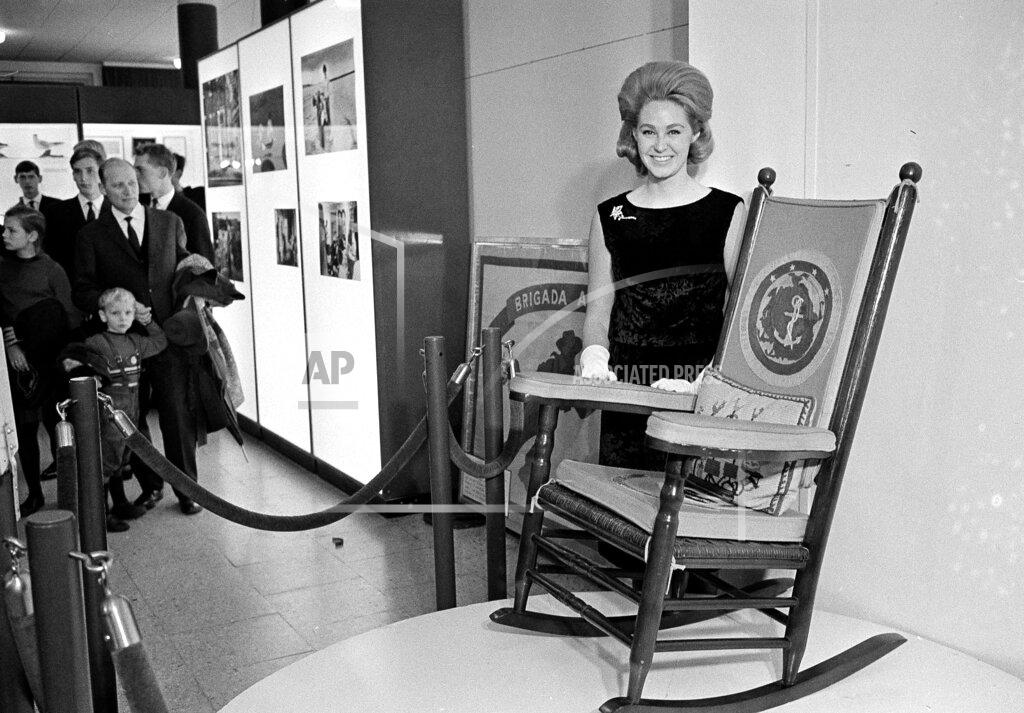
The construction of the Protestant Chapel at Kennedy International Airport entered its final phase with a cornerstone laying ceremony.
At least eight persons were missing, hundreds of motorists were stranded and many hunters were marooned tonight as a snowstorm engulfed northern Arizona. Sheriff’s officers in Kingman, near the northwestern edge of the state, said eight residents were missing in the area. Winds of 25 to 30 miles an hour piled up two‐foot snowdrifts. The snowfall was around four inches, but the winds reduced visibility to zero along State Route 93, the main highway from Phoenix to Las Vegas, Nevada.
Bill Cosby, the 26‐year‐old Black comic who went from Greenwich Village to East Basin Street within two years, will be the co‐star of a TV series. Mr. Cosby has been signed to appear opposite Robert Culp next season on the National Broadcasting Company’s international intrigue series, “I Spy.” They will play agents of the Central Intelligence Agency, whose undercover work takes them around the world.
Mickey Wright shoots a 62, lowest golf score for a woman pro at the Tall City Open, Midland, Texas.
NFL Football:
Chicago Bears 34, Los Angeles Rams 24
Detroit Lions 21, Cleveland Browns 37
Green Bay Packers 14, San Francisco 49ers 24
Minnesota Vikings 14, Baltimore Colts 17
New York Giants 10, St. Louis Cardinals 10
Philadelphia Eagles 17, Dallas Cowboys 14
Washington Redskins 30, Pittsburgh Steelers 0
Rudy Bukich threw three touchdown passes today and led the Chicago Bears to a 34–24 triumph over his former teammates, the Los Angeles Rams. Another ex‐Ram, Jon Arnett, had a great day, scoring one touchdown and gaining 86 yards on 27 carries. The Rams frittered away their chance to win in the third period when they fumbled the ball three times. The Bears scored two field goals and a touchdown after recovering the fumbles. Bukich, normally the No. 2 quarterback behind another ex-Ram, Billy Wade, played the entire game. After the Rams opened the scoring in the first period on a 12‐yard pass play from Roman Gabriel to Bucky Pope, Bukich tied it up within a few minutes on a 10‐yard toss to Johnny Morris.
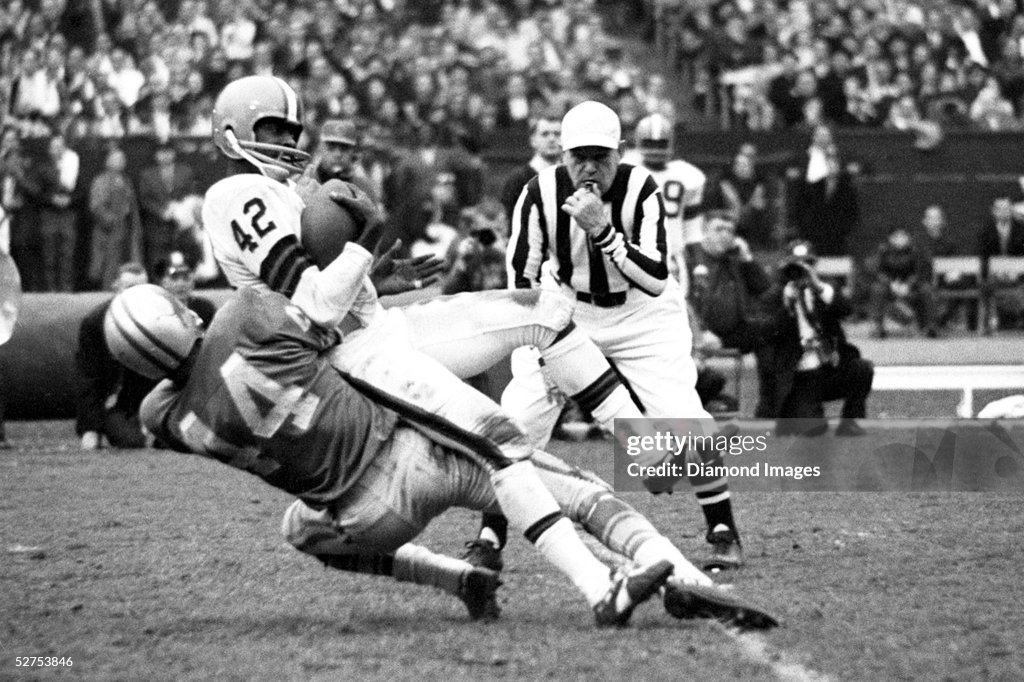
Jim Brown kept adding to his achievements today and the Cleveland Browns kept their course steady in pursuit of the Eastern Conference title by whipping the Detroit Lions, 37–21. Jim rushed for 147 yards to raise his season total to 1,081, the sixth time he had reached the 1,000‐yard mark in eight pro seasons, and he raised his career mark to 10,403, increasing his National Football record. He also scored twice. A crowd of 83,064 watched the game at Municpal Stadium. But Brown’s success was only part of the Browns’ success story as they earned their first regular‐season triumph over the Lions in six games. Cleveland beat Detroit in the 1954 championship game. Though Brown scored the first touchdown of the game and Lou Groza, as usual, converted, Cleveland had to rally to win. An 8‐yard pass from Frank Ryan to Paul Warfield in the third period put the Browns in front to stay, 27–21. A field goal by Groza, his third of the game, and a 65-yard return of an intercepted pass by Walter Beach in the fourth quarter put the game out of the Lions’ reach. After Brown’s first touchdown run of 6 yards, Milt Plum of Detroit passed to Dan Lewis for a spectacular 92‐yard touchdown play. Lewis caught the ball on the Detroit 30 and ran the rest of the way. A little later, Plum hit Jim Gibbons for a 4‐yard touchdown pass. Wayne Walker converted after each score for a 14–7 Detroit lead before the first period had ended. Then Groza hit a field goal from 38 yards, and Brown scored after Paul Wiggin had fallen on a Detroit fumble on the Lions’ 2‐yard line. But Plum retaliated with a 39‐yard pass to Terry Barr for a touchdown and a 21–17 Detroit lead.
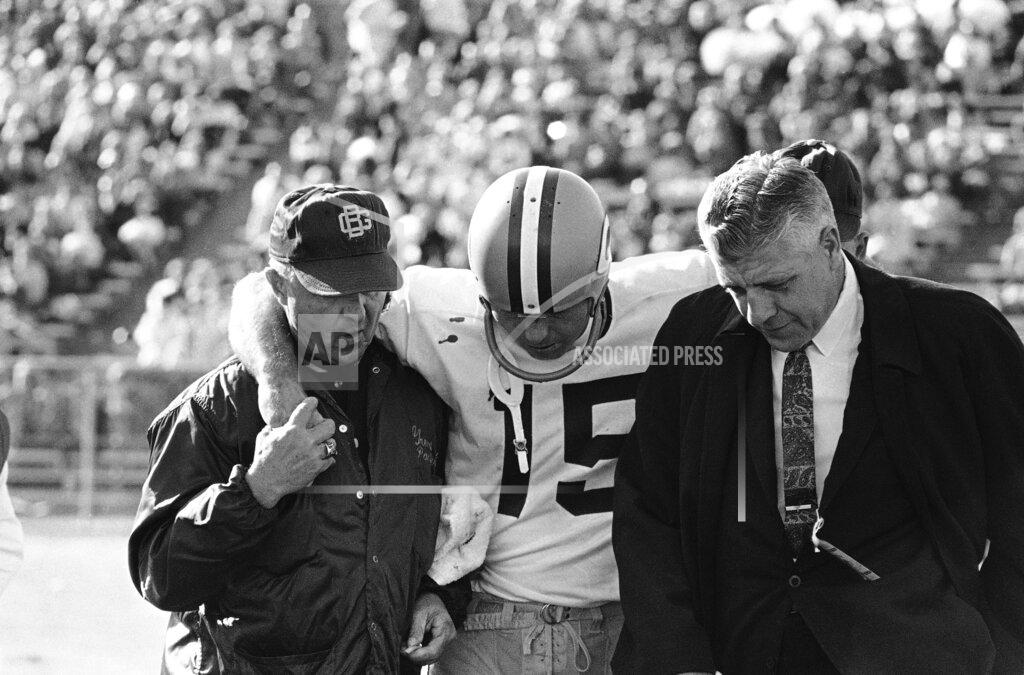
George Mira, aided by an alert San Francisco defense that set up all the points, led the 49ers to an upset 24‐14 National Football League victory over the Green Bay Packers today. Mira, the 49ers’ rookie quarterback, kept the Green Bay defense off balance with his pass‐run option plays. Bart Starr, the crack quarterback of the Packers, was injured early in the second quarter and the Green Bay offense wasn’t able to click under the guidance of Zeke Bratkowski. Runs by San Francisco’s backs led to three scores. Kermit Alexander returned a punt 70 yards for a touchdown. Jimmy Johnson intercepted a pass by Bratkowski and returned the ball 22 yards to the Green Bay 6 to set up a score. And Abe Woodson returned a kickoff 40 yards to the Green Bay 39 to set up a 39‐yard scoring drive by Mira.
Alex Hawkins made a diving catch in the end zone of a pass from Johnny Unitas in the fourth quarter to give the Baltimore Colts a 17–14 victory today over the Minnesota Vikings. The National Football League victory was the ninth in a row for the Western Conference leaders following an opening-game loss to the Vikings. After a scoreless first half, the Colts went ahead by 10–0 in the third period on a 35‐yard field goal by Lou Michaels and a 74‐yard pass play from Unitas to Lenny Moore. The Vikings then scored on a 16‐yard touchdown pass from Fran Tarkenton to Hal Bedsole. Minnesota went ahead in the fourth period on a 21‐yard scoring run by Tommy Mason, which capped a 69‐yard drive. But the Colts got some clutch passing from Unitas in a 74-yard march for the winning touchdown. Unitas hit Jimmy Orr with a 35‐yard pass, then ended the drive with his toss to Hawkins, who was filling in for the injured Ray Berry. The Vikings’ defensive line held the Colts’ much improved ground game to 107 yards. But Unitas completed 15 of 31 passes for 289 yards.
The New York Giants and St. Louis Cardinals played a game called football in the mud today at Busch Stadium. It did not particularly resemble many other football games because of the morass, and the teams struggled to a 10–10 tie. Field position and errors, under the circumstances, became the game’s most important factors. The first error, a Cardinal fumble by Johnson, led to the first score, a 21‐yard touchdown pass from Y. A. Tittle to Aaron Thomas for the Giants. Andy Stynchula recovered the fumble and the Giants had the ball at midfield just beyond the sea of mud. The Giants had reasonably good footing and struck quickly for the score, going 53 yards in six plays. On the touchdown pass, both the receiver, Thomas, and the covering back, Jerry Stovall, fell on the slippery grass of the end zone. Thomas got up and caught the ball while Stovall stayed down. That was at 6:35 of the first period. After running eight plays in the swamp, the Cardinals got close enough for Jim Bakken to kick a 27‐yard field goal as the second quarter began. The Giants’ 4‐point lead held up for 28 minutes, or until Johnson hit Conrad with a 15yard touchdown pass. That opportunity had also been set up by a fumble, Alex Webster losing the ball and Bill Koman recovering it at the New York 19. In the last period, the Giants moved through the mud twice to threaten the Cardinals’ goal. Don Chandler had two fieldgoal attempts from close range. The first one .was blocked by 300‐pound Ken Kortas of the Cardinals at the St. Louis 18, but the second one, from the 21, was good and tied the score at 10–10 with six minutes to play.
The Philadelphia Eagles ended the Dallas Cowboys’ three‐game National Football League winning streak before the club’s largest home crowd in its history today with King Hill-toPete Retzlaff passes in the opening and final minutes providing a 17–14 victory. The Eagles smashed 78 yards in three plays from the opening kickoff, ignited by Earl Gros’s 47‐yard dash on the first play, to jump into a 7–0 lead on a 29‐yard Hill‐to‐Retzlaff aerial. The lead mounted to 10–0 in the second quarter on Sam Baker’s 43‐yard field goal. The Cowboys rallied to the delight of a crowd of 55,972 and pulled ahead, 14–10, in the second half with the defense setting up Don Meredith’s 3yard scoring saunter and Don Perkins’ 2‐yard dive for the other. Hill then sparked the Eagles on a 96‐yard drive that included two completions to Retzlaff, who kicked off the winning toss from 38 yards out with 2 minutes and 9 seconds to play.
Sonny Jurgensen, the leading touchdown passer in the National Football League, threw two for 80 yards each today in helping the Washington Redskins beat the Pittsburgh Steelers. 30–0. The quarterback’s accomplishments raised his scoring passes for the season to 19. Both of his long scoring passes were made in the second quarter. Jurgensen hit Angelo Coia on the Redskin 29 and Coia outraced the Steelers’ defensive halfback, Brady Keys, to the goal line for the first long score. Charlie Taylor was the target on the second. Taylor had scored the first Washington touchdown when . he drove 3 yards over right tackle in the opening period to cap a 63‐yard march. Jurgensen completed seven of 10 passes for 210 yards. Johnny Sample, a former Steeler, intercepted Ed Brow‐n’s pass in the opening minutes of the third period and ran 15 yards for a touchdown. A few minutes later, Paul Krause, who leads the league in pass interceptions with eight, snagged a pass by Brown to set up Jim Martin’s 31‐yard field goal.
AFL Football:
Boston Patriots 36, Buffalo Bills 28
New York Jets 16, Denver Broncos 20
San Diego Chargers 28, Kansas City Chiefs 14
Houston Oilers 10, Oakland Raiders 20
Babe Parilli’s five touchdown passes and Gino Cappelletti’s 24 points led the Boston Patriots to a 36–28 American Football League victory today that ended the Buffalo Bills’ unbeaten streak at nine games. A record War Memorial Stadium crowd of 42,308 saw Cappelletti catch three touchdown passes from Parilli, a 2-point conversion pass from Parilli and kick 4 extra points in raising his season point total to 122. Parilli also hurled scoring passes to Tony Romeo and Larry Garron. The triumph pulled the Patriots, with a 7–2–1 won‐lost-tied record, to within a game and a half of the Eastern Division leading Bills. Jack Kemp had sparked the Bills to a 28–14 lead in the third period with two touchdown passes, but when the Patriots overwhelmed the No. 2 Buffalo quarterback, Daryle Lamonica, later in the period, the tide turned against the Bills. Lamonica entered the game with Buffalo on its 27. The Bills were penalized 5 yards for delay of game, then Lamonica missed on a pass attempt, was thrown for a 10‐yard loss on the next play, then had a pass batted from his hand at the 5. Larry Eisenhauer recovered for Boston and Parilli completed a touchdown pass to Cappelletti. Then in the fourth period, Parilli hit Garron with a 6‐yard scoring pass and put Boston ahead, 29–28, with a 2‐point conversion toss to Cappelletti. Minutes later, a fumble by Kemp gave Boston the ball on the Buffalo 34 and Parilli promptly threw his fifth scoring pass to Cappelletti.
The New York Jets, their attack crippled by the loss of Dick Wood’s passing arm for nearly three quarters, began their Western invasion today by bowing to the Denver Broncos, 20–16, in Bears Stadium. Wood was shaken up on the Jets’ third play from scrimmage and did not return to action until the last minute of the third quarter. By that time Coach Mac Speedie’s club, loser of its last four games and with an overall record of one victory in nine starts, had run up a 20–7 margin. Mike Taliaferro, the rookie from Illinois, had to run Coach Weeb Ewbank’s offensive during Wood’s absence. He tossed the first touchdown pass of his professional career at 9:26 of the opening quarter. The scoring play was a 35‐yard aerial to Bake Turner capping a Jet drive of 67 yards in five plays. That put the Jets into the lead for the only time in the game. Midway through the second quarter Jackie Lee of the Broncos went to work. After John McGeever’s interception of a Taliaferro pass on the New York 40, Lee took the Broncos into the end zone in six plays. Lee capped the short march when he hit his split end, Lionel Taylor, in the end zone at 8:06 of the second quarter. Taylor beat Dainard Paulson as he slanted in to take the pass. Denver moved to a 14–7 lead at 7:54 of the third quarter when Odell Barry, a rookie safety from Findlay College, gathered in Curley Johnson’s punt on the Denver 48 and scurried through a maze of Jet defenders to cross the goal standing up.
The San Diego Chargers did all their scoring in the second quarter today en route to a 28–14 American Football League victory over the Kansas City Chiefs on a rain-drenched field. John Hadl threw two touchdown passes in the Charger victory, which all but eliminated Kansas City from the Western Division race. Hadl, Paul Lowe and Lance Alworth triggered the Chargers’ second‐period spurt, which was aided by three key fumble recoveries. Lowe ran fifty yards for San Diego’s first touchdown, then tight end Dave Kocourek gathered in a 38-yard touchdown throw. Alworth scored on a 47-yard reception from Hadl and again on a 19-yard run. The Chargers got their first two touchdowns in a 44-second span and their last two in a 54-second span. San Diego lost a linebacker, Emil Karras, for the season. He suffered a broken left leg in the third quarter.
The Oakland Raiders, taking advantage of mistakes by the Oiler quarterback, George Blanda, in the second half, scored a 20–10 victory over Houston today. The loss was the seventh straight for the Oilers. Blanda kicked an 11‐yard field goal and gave the Oilers a 3–0 halftime lead. Then Oakland took a 10–3 lead in the third period and added a field goal and touchdown in the fourth period after Blanda had lost a fumble and had a pass intercepted. Cotton Davidson of the Raiders connected on scoring passes of 26 and 20 yards to Art Powell. Mike Mercer kicked field goals from the 32 and the 12. The Oilers got a touchdown when Blanda passed to Bob McLeod from 6 yards out with seven seconds left in the game.
Born:
Chris Terreri, Team USA and NHL goaltender (Olympics, 1988; NHL Champions, Stanley Cup-Devils, 1995; New Jersey Devils, San Jose Sharks, Chicago Blackhawks, New York Islanders), in Providence, Rhode Island.
Daryl Irvine, MLB pitcher (Boston Red Sox), in Harrisonburg, Virginia.
 History Diaries