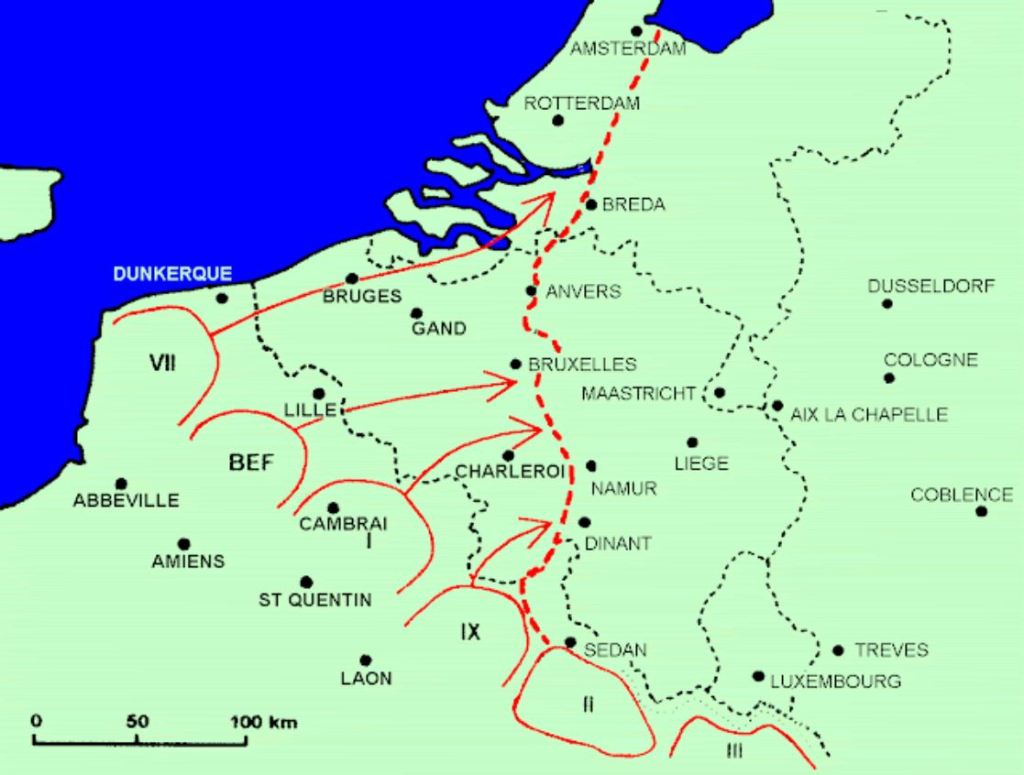
The British and French military commands (after secret, inconclusive discussions with the Belgians) agree to an immediate advance to the “Meuse-Antwerp Line,” south and east of Brussels, in Belgium if the Germans invade. This agreement is referred to as “Plan D” (the “Dyle Plan”). The plan calls for holding in the south with the Maginot Line and meeting a German thrust through the Ardennes and low countries with the deployment of the BEF north from where they are encamped around Sedan to the British Channel. They will form a defensive line called the “Meuse-Antwerp Line.” This line barely covers Brussels and, if the Germans invade Holland as well, Amsterdam as well. However, Liege and vast parts of Belgium and Holland would be unprotected.
The Maginot Line itself, of course, remains incomplete due to its massive cost. The Dyle plan inherently requires a violation of Belgian neutrality which is assumed to be acceptable to the Belgians (the Belgians have not agreed to this and in fact remain non-committal). It also includes an advance into Holland, though that could more easily be side-stepped if the Dutch protested. The Dyle Plan is called “Plan D.” It brilliantly covers the German Empire’s attack of 1914.
Initial German reaction to the offer of mediation made by Queen Wilhelmina and King Leopold is reported to be negative.
The Netherlands was added back to the German invasion plan for Western Europe as the Luftwaffe stressed the importance of having airfields in the Netherlands.
Allies coordinate economic policies. France and Britain are likely to save a supply of dollars for U.S. purchases.
The Great Synagogue of Łódź was burned to the ground by the Nazis.
The President of Lódz joins other jurisdictions and mandates that Jews wear the Yellow Star of David armbands. In addition, the Germans burn to the ground the city’s Great Synagogue of Łódź.
Theodor Eicke was named the commander of all SS Death’s Head units; Richard Glucks was to take over Eicke’s former position as the inspector of concentration camps.
In Vienna, Austria detachments of the SS-Verfügungstruppe placed stocks of hand grenades at Jewish synagogues preparatory to setting fire to the buildings.
Continued turmoil in the provinces of Bohemia and Moravia (former Czechoslovakia). Police are reported to have broken up a Czech Fascist demonstration in Prague, 12 persons being injured.
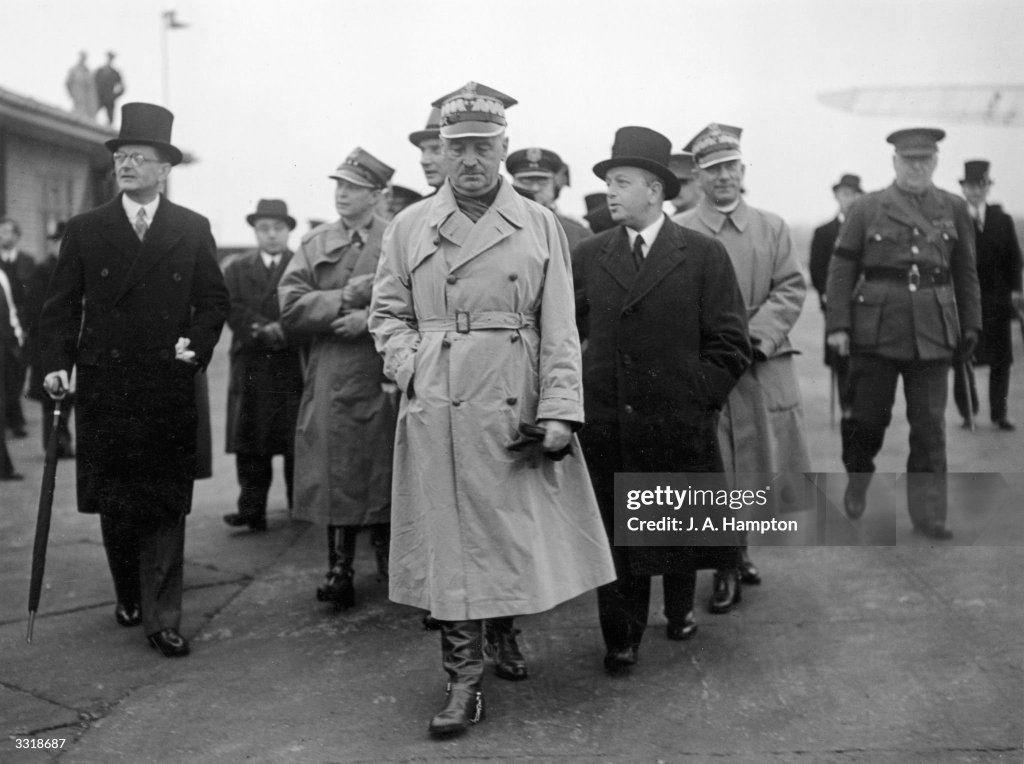
The Polish government-in-exile, headed by General Władysław Sikorski, moved from Paris to London. He and Foreign Minister Zaleski arrive in London fr talks.
Trade talks between Sweden and Germany are broken off.
The Finnish Army, some 175-200,000 men, digs in on the Karelian Isthmus north of Leningrad. The Soviets muster an army approaching a million men opposite them.
Finnish officials tonight reported a series of land and air incidents along the Russian frontier, and it was reported without confirmation that a Soviet warplane had been shot down in the developing “war of nerves” between the two countries.
The French cargo ship Alaska collided with the British Dotterel in the English Channel 12 nautical miles (22 km) south east of the Owers Lightship ( United Kingdom). Alaska sank early the next day with the loss of two of her crew. Survivors were rescued by the British ship Sardinian Prince and HMS Scimitar (Royal Navy).
The British cargo ship Dryburgh struck the sunken wreck of the Canada in the North Sea 2 nautical miles (3.7 km) off Holmpton, Yorkshire (53°40′N 0°17′E) and was holed. An attempt was made by Yorkshireman (United Kingdom) to tow and beach her, but she capsized and sank.
The Belgian fishing vessel Maurice-Marguerite struck a mine and sank in the North Sea off Gravelines, Nord, France with the loss of three crew.
German vessel Trifels is captured by French auxiliary cruiser Koutoubia near the Azores.
During heavy weather, U-49’s machine gun was swept off the conning tower.
Convoy OA.35 departs from Southend and OB.35 departs from Liverpool.
The War at Sea, Tuesday, 14 November 1939 (naval-history.net)
Carrying the first shipment of French gold to the United States, French Force Z of battleship LORRAINE, and light cruisers MARSEILLAISE and JEAN DE VIENNE departed Toulon escorted by destroyers AIGLE, FORTUNE and LA RAILLEUSE in Operation MACARONI. The escort was reinforced by destroyers LION, which departed Gibraltar on the 13th and SIMOUN from Oran. The French ships, less FORTUNE, LA RAILLEUSE and SIMOUN which were detached en route for Casablanca, arrived at Mers el Kebir on the evening of the 15th when U-boats were reported in the area. The Force, escorted by LION and AIGLE, departed on the 17th and on the 19th was joined by the three destroyers which had been detached to Casablanca. Later on the 19th these three destroyers returned to Casablanca, followed by LION and AIGLE on the 20th. Force Z reached Bermuda at 0900/27th, remained until 1230/29th and arrived at Halifax at 1400 on 1 December.
On Northern Patrol were three cruisers between the Orkneys and the Faroes, three cruisers and one AMC between the Faroes and Iceland, and one cruiser and three AMCs in the Denmark Strait.
Anti-aircraft cruiser CURLEW departed Grimsby on FN.36 escort duties with destroyers JERVIS and JUPITER, and arrived back later the same day.
Anti-aircraft cruiser CALCUTTA with destroyers JERSEY and JAGUAR departed the Humber on FS.36 escort duties and arrived at Grimsby later the same day.
Anti-aircraft cruiser COVENTRY departed Grimsby on the 14th, and in heavy weather, in the Pentland Firth, her power steering failed and she arrived at Sullom Voe under hand control. From 16 November to 14 January 1940, COVENTRY was anti-aircraft guard ship for Sullom Voe and depot ship MANELA which maintained the flying boats operating over the Arctic Ocean. Light cruiser CARDIFF was held at Sullom Voe until COVENTRY’s arrival to provide anti-aircraft protection for MANELA.
Destroyer KEITH and the Polish ORP BURZA replaced destroyer GLOWWORM and Polish ORP GROM on East Coast patrol.
Light cruisers DRAGON and COLOMBO departed Sullom Voe on Northern Patrol duties, and arrived at Loch Ewe on the 20th.
Destroyer GLOWWORM dropped depth charges on a submarine contact off North Foreland.
Destroyer TARTAR investigated a contact 59° off Rattray Head, later determined to be the wreck of CAIRNMONA, sunk by U-boat on 30 October.
Anti-submarine trawler IMPERIALIST (520grt) attacked a submarine contact off Kentish Knock in 51-42N, 1-48E.
Anti-submarine trawler LOCH TULLA (423grt) attacked a submarine contact in Hoy Sound.
Act/Sub Lt (A) E S Woodford was killed when his Skua of 758 Squadron from RAVEN crashed near Saverlake Forest.
Convoy OA.35 of six ships departed Southend escorted by destroyer KEITH on the 14th and destroyers ESCAPADE and ENCOUNTER on the 14th and 15th. Submarine NARWHAL departed Gosport and escorted from the 14th to 19th, and destroyers ACASTA and ARDENT from the 15th to 19th, when the convoy dispersed and NARWHAL proceeded independently to Halifax for escort duties.
Convoy OB.35 departed Liverpool escorted by destroyers WINCHELSEA and WALPOLE until the 17th.
British steamer DOTTEREL (1385grt) and French steamer ALASKA (5399grt) collided seven miles east of St Catherine. DOTTEREL was able to proceed to Southampton, but ALASKA sank early on the 15th.
Belgian fishing vessel MAURICE MARGUERITE (28grt) was sunk on a mine off Dyck Light Vessel, outside Gravelines, with the loss of three crew.
Finnish steamer VERNA H (983grt) was seized in the Baltic by German warships and taken to Swinemünde.
Convoy HG.7 departed Port Said on the 3rd, Malta on the 5th, and left Gibraltar on the 14th with 31 ships, escorted by destroyers VELOX, VIDETTE and also French destroyers TARTU and VAUQUELIN from the 14th to 21st when they arrived at Brest. Destroyer WOLVERINE escorted convoy HG.7A – the east coast portion – from the 21st to 23rd, and on the 21st, 28 miles 200° off Start Point, steamers DUNBAR CASTLE (10002grt) and CLAN MACFARLANE (6193grt) were in collision. DUNBAR CASTLE proceeded to Southampton for repairs. HG.7 arrived at Liverpool on the 22nd, while HG.7A arrived in the Downs on the 23rd with WOLVERINE.
Canadian destroyer HMCS FRASER was damaged in a collision with Canadian minesweeping trawler HMCS BRAS D’OR (221grt) at Halifax. FRASER was repaired at Halifax completing on 4 December.
Off the Azores, French armed merchant cruiser KOUTOUBIA captured German steamer TRIFELS (6198grt) which had departed Ponta Delgada on the 12th carrying 21,000 cases of gasoline. TRIFELS was taken to Casablanca and renamed SAINT LOUISE for French service, but later returned to German service after the fall of France.
French submarines CASABIANCA, SFAX, PASTEUR and ACHILLE of the 2nd Submarine Division departed Brest escorting French armed merchant cruiser QUERCY, and arrived at Halifax for escort duty on the 25th.
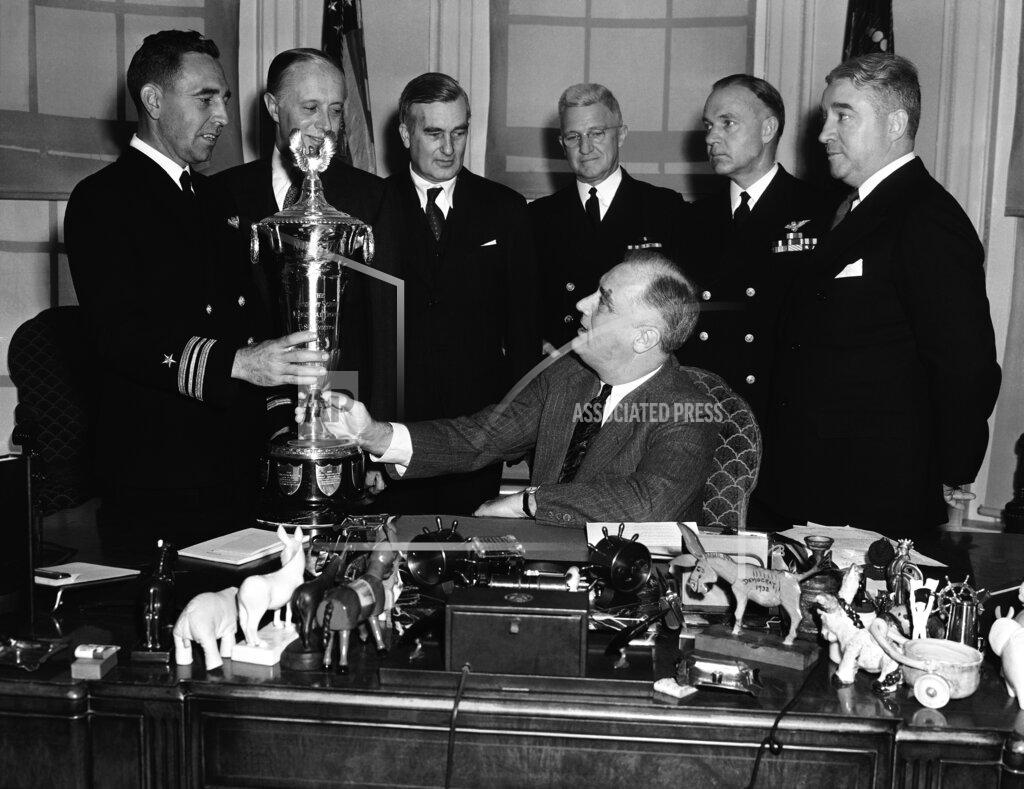
U.S. President Roosevelt indicated today that he would veto the Maritime Commission’s approval of plans to transfer eight United States Line ships to Panamanian registry. Although he told his press conference that he had not made a final decision, his statement of his attitude was such as to leave no doubt in the minds of his hearers that he had deferred to Secretary Hull and would overrule the Maritime Commission, which has given the plan tentative approval.
With the statement that he had still to decide finally on the issue, the President coupled an observation that the press conference probably could see in which direction the wind was blowing. In State Department circles it was said to be only a question of days before the Maritime Commission reversed its position, an interim during which nation-wide discussion of the controversy probably would subside.
Mr. Roosevelt at first seemed reluctant to discuss the subject and answered a question as to whether there had been any decision on the plan by remarking on the direction. of the wind. It was not until he was reminded of Secretary Hull’s statement that the proposal would violate the spirit of the Neutrality Act that the President said he agreed with that view in part.
Then he went on to say that the United States would be reluctant to put a sister Latin-American republic in a different position from our own with respect to neutrality policy. This thought had been overlooked in the discussion for and against the shifting of flags and registry of the eight United States Line liners, he said. At his press conference last Friday Mr. Roosevelt had said that many persons had overlooked the human equation involved in the beaching of seamen as a result of the restriction on United States shipping forced by the Neutrality Act.
As the President spoke to the press conference the Maritime Commission was rejecting an application from Anthony C. Stralla for transfer to Panamanian registry of four ships owned by the Pacific. Steamship Lines, Inc., a Nevada Corporation now in process of liquidation under the Bankruptcy Act. The application was denied for the stated reason that the transfer “would be detrimental to the best interests of the United States.”
President Roosevelt is silent on the 1940 election despite the drive for Vice President John Garner.
Senator Borah of Idaho said today that he has no intention of bolting the Republican party, although some circles so interpreted a statement in which he told of the importance of independent voting.
In the U.S., Republicans ask to ban partisanship in the trade act fight. They request the adjournment of politics on the issue to force the law’s death.
The case against Fritz Kuhn, charged with stealing $5,614 of the funds of the German-American Bund, of which he was the “führer,” was virtually completed yesterday by the testimony of James D. C. Murray, lawyer, who denied the receipt of $500 which Kuhn told the bund members he had paid the lawyer for legal services. The last witness was Benjamin Blattner, an accountant attached to the office of the District Attorney, who testified that the Bund books showed the receipt of $3,678 which was not accounted for, in addition to the $500 about which Mr. Murray testified, the $717 Kuhn used to move the furniture of a Mrs. Florence Camp around the country, and $60 he paid to a physician for services the doctor rendered to Mrs. Virginia Cogswell, a nine-times married woman in whom the Bund leader was interested.
It all came to $4,955, or $600 less than the sum Kuhn was charged with having stolen, but Assistant District Attorney Herman J. McCarthy declared, in answer to questions after the trial session had ended, that the Bund books were so scanty and in such condition there was no prospect of proving the total theft charged down to the last penny.
Earthquake tremors rock Philadelphia. Earth tremors were felt in Philadelphia, in parts of Southern New Jersey and in Delaware and Maryland late this evening. Buildings were shaken and dishes were rattled.
A huge radio system is set up at the airport at LaGuardia Field.
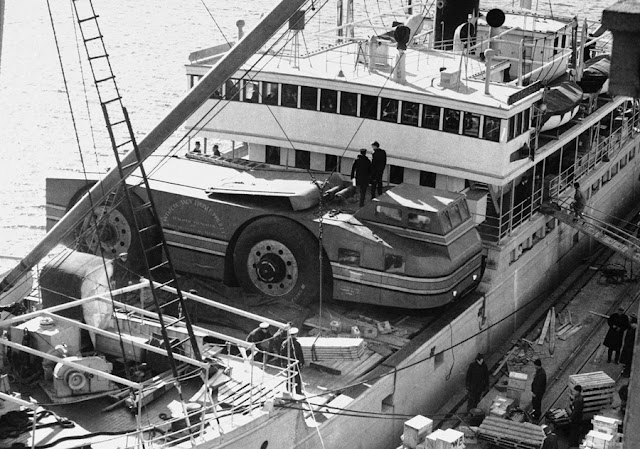
The sailing of the North Star, lead-off ship in the government’s first Antarctic venture in 100 years, under command of Rear Admiral Richard E. Byrd, was delayed today by the work of lashing a twenty-seven ton snow cruiser on the vessel’s foredeck, and departure was set for dawn tomorrow.
Royal Canadian Air Force planes go hundreds of miles out to sea to watch for enemy raiders and to escort merchant shipping safely to port, a National Defence Department spokesman revealed tonight.
Canadian destroyer HMCS Fraser is damaged in a collision with the armed trawler HMCS Bras D’Or. HMCS Fraser will be under repairs until 4 December 1939.
An oil refinery fire in Lagunillas, Venezuela killed 500 people and destroyed the town.
The reactions of Japan’s educated classes to United States Ambassador Joseph C. Grew’s speech are now beginning to appear in channels other than the daily press and they are basically pessimistic. The speech shook the Japanese into realizing that America’s opposition to Japan’s plans for a “New Order” in East Asia goes deep, and they are pessimistic because they know the strength of the Japanese behind the continental forces policy.
This, perhaps unconsciously, is revealed by an editorial in the Oriental Economist, a liberal organ that is not given to war hysterias. The Ambassador’s speech warning Japan of the United States attitude represented virtually no progress toward improvement in Japanese-American relations, in the Oriental Economist’s view. It quotes Mr. Grew’s statement that American opinion is strongly opposed to some of the things the Japanese Army is doing in China, infringing on America’s established rights. The Japanese public is disappointed, it continues, “for what it wanted was a practical suggestion for improving Japanese-American relations on constructive bases.”
The Japanese blockade of the British and French concessions in Tientsin, imposed last June, will remain unaffected by the recent decision of Britain and France to withdraw most of their troops from North China, a Japanese Army spokesman said today.
Dow Jones Industrial Average: 149.77 (+0.70)
Born:
[Walter] Wendy Carlos, American transgender musician and composer (Switched-On Bach, three Grammy Awards; score for “Tron”), in Pawtucket, Rhode Island.
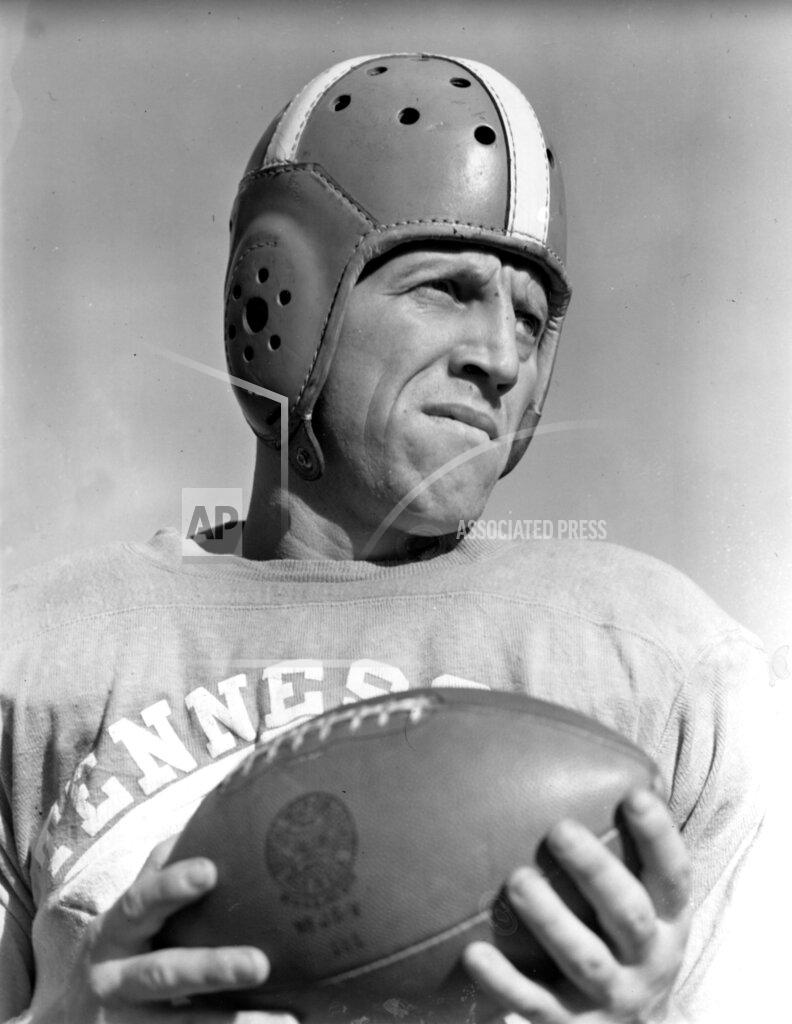
Bobby Reed, NFL halfback (Minnesota Vikings), in New Orleans, Louisiana.
Died:
Bluey, Australian cattle dog and world’s oldest reliably recorded dog dies at 29 years and 5 days.
Naval Construction:
The Royal Fleet Auxiliary Dale-class fleet tanker and landing ship, gantry RFA Derwentdale (A114) is laid down by Harland & Wolff Ltd. (Govan, Scotland).
The Royal Navy “T”-class (Second Group) submarine HMS Thrasher (N 37) is laid down by the Cammell Laird Shipyard (Birkenhead, U.K.).
The Royal Navy Flower-class corvettes HMS Heartsease (K 15), HMS Mallow (K 81), HMS Hibiscus (K 24), and HMS Camellia (K 31) are laid down by Harland & Wolff Ltd. (Belfast, Northern Ireland).
The U.S. Navy Griffin-class submarine tender USS Pelias (AS-14) is launched by the Sun Shipbuilding & Drydock Co. (Chester, Pennsylvania, U.S.A.).
The Royal Navy Dragonfly-class river gunboat HMS Mosquito (T 94) is launched by Yarrow Shipbuilders Ltd. (Scotstoun, Scotland).
The Royal Navy “T”-class (First Group) submarine HMS Tetrarch is launched by Vickers Armstrong (Barrow-in-Furness, U.K.).
The Marine Nationale (French Navy) Le Hardi-class torpilleur d’escadre (squadron destroyer) Le Corsaire (later renamed Siroco) is launched by Forges et Chantiers de la Méditerranée (La Seyne-sur-Mer, France).
 History Diaries