A United States Army sergeant was killed and another soldier was seriously injured today when a land mine was detonated under their jeep, a United States military spokesman said here. He reported that Communist guerrillas had detonated the mine electrically under the jeep in Định Tường Province, about 40 miles southwest of Saigon.
The Communist Việt Cộng guerrillas have turned from jungle warfare to attacking convoys and helicopters that carry relief supplies for 700,000 flood victims along Vietnam’s central coast, United States aid officials said today. The death toll in five flooded provinces has mounted near 7,000. The Việt Cộng are reported to be seizing goods both for their use and to turn over to flood victims for propaganda. A compound of United States military advisers at the city of Quảng Ngãi was attacked Friday by guerrillas in search of food and ammunition. No American casualties were reported.
In Saigon, as criticism of the government continued today, student demonstrators faced the loss of their draft exemptions under a new emergency decree. The move was aimed at halting demonstrations against the 11‐day‐old government. The Saigon Students Union staged a noisy protest march last night in defiance of the police, and reports circulated that the students might demonstrate again tomorrow.
Policemen permitted a brief demonstration by a splinter group today. About 50 marchers paraded in front of the presidential palace while their leader conferred with the chief of state, Phan Khắc Sửu. The group, headed by Phan Huy Có, a Vietnamese politician who lived in France in exile for 12 years, called for immediate elections and for the dissolution of the high National Council, the provisional legislature. Demonstrators have charged that the Cabinet is composed of ineffectual technicians rather than politicians and that some of its members served under President Ngô Đình Diệm, who was overthrown a year ago in a military coup.
Bình Dương Province, rich in rubber, has perhaps crucial strategic significance in the complex guerrilla war in South Vietnam. It points like an arrow from two of the Communists’ oldest strongholds in South Vietnam directly to the suburbs of Saigon. Here the insurgents have shown an alarming capability to force both economic dislocation and large‐scale battle confrontation on their own terms. Extension of effective government control over the southern point of the province is one of the highest priority tasks for the Vietnamese and American military commands. It is an early phase in their intricate operations intended to clear the guerrillas from the environs of Saigon in successive concentric circles.
Bình Dương’s strategic importance arises not only from its proximity to Saigon but from its position as a gateway to two Communist base areas. To the northwest is northern Tây Ninh Province, headquarters of the insurgent political organization, the National Liberation Front of South Vietnam. To the northeast is the virtually impenetrable jungle area known to the old French colonial troops as War Zone D. Communist control over this forbidding sector has been unquestioned for years. With an estimated 7,000 troops in these two bases and in Bình Dương itself, an infantry pincer operation to join the two strongholds remains a very serious military threat.
The barrier to this threat and the lifeline of the province is the national highway, Route 13, leading‐ north from Saigon to the wealthy rubber‐producing areas and to the Cambodian frontier. As long as the government holds its tenuous command of this highway, the guerrillas are unable to move in force between their two base areas. If the route should be cut, the insurgents would in effect secure a vast territorial base only 50 miles north of the capital. Rubber exports would be halted and food supplies to the rubber areas would be endangered.
The League of Red Cross Societies appealed today for food, clothing, blankets and medicine to aid victims of typhoons Iris and Joan in Vietnam.
The Communist Government of North Vietnam announced today that it would be host to an international conference “against United States imperialist aggression” this month. The Hanoi radio, monitored here, told of the plan but set no date for the conference. It said a drive “for solidarity with the people of Vietnam” would last from November 20 to December 20. The communique announcing the conference cited American “aggression” in South Vietnam, North Vietnam and Laos and “infringement upon the territory of Cambodia.”
Twenty thousand Cambodians are not working, and their idleness is a source of worry to the country’s chief of state. Americans here are inclined to see the rise in unemployment as a natural result of the suspension of $28 million a year in aid from the United States for a country of 5.7 million. The aid was cut off a year ago because Prince Norodom Sihanouk, the chief of State, felt that American “imperialist” aims were compromising his nation’s neutrality. Prince Sihanouk denies that the jobless are unemployed at all. He terms them “unoccupied.” In statements and discussions, the Prince has indicated that the problem bothers him for political as well as economic reasons. What little opposition there was in past years to Prince Sihanouk’s party came largely from the Democratic party, which drew its strength from discontented youths.
Stubborn resistance in the last two days by pro‐Communist Pathet Lao forces has slowed cleanup operations by government troops in Savannakhet Province. On Route 9, connecting the town of Tchepone (now Xépôn) with Savannakhet, Pathet Lao mortars and machine guns have stopped government advances. Tchepone forms part of the Hồ Chí Minh Trail, the path network that serves as a Communist supply line. Government and Pathet Lao forces are dug in on opposite sides of a bridge across a narrow stream, separated by 200 yards of thick scrub trees.
Syria has called for “an urgent meeting of the Security Council to consider the latest aggression committed by Israel against the Syrian Arab Republic” in fighting yesterday and today. Israel submitted an eightpage report to the Council. She blamed the Syrians for the fighting on her northeastern frontier, but did not ask any action by the Council. Informed sources said the Council probably would meet on Monday. Jet fighters of the Israeli and Syrian Air Forces fought briefly north of the Sea of Galilee today.
Today’s letter from Rafik Asha of Syria to Adlai E. Stevenson, the United States delegate, who is this month’s President of the Security Council, gave no details of the fighting that produced the request for the meeting. A copy was sent to the Secretary General, U Thant. The Israeli report, addressed to Mr. Steventon late this afternoon by Michael S. Comay, said, “As the incident is one of the greatest clashes on this border in recent years, my government deems it proper that the relevant facts should be made available to you and to the other members of the Security Council.” The Israeli delegate charged that the Syrians started the fighting yesterday afternoon with an attack on a routine Israeli patrol that was passing along a track within its own territory. He denied Syrian charges that the patrol had crossed into Syrian territory.
The Soviet Union served notice tonight that it would “take appropriate measures” to safeguard its security if the United States and West Germany insisted on through with plans for a mixed‐manned nuclear force. It charged that the plans for such a force were a cover for a policy of giving the West Germans access to nuclear weapons. The “entire responsibility” for the consequences of these plans, Moscow said, would rest with those who joined the force. The 2,500‐word Soviet declaration was in the form of an “authorized statement” by Tass, the official press agency. Such statements rate only a shade below a statement of the Soviet Foreign Ministry. It was thought by observers to have been timed to coincide with the announcement in Washington of United StatesGerman agreements on defense strategy and on the manner and timing of the use of tactical nuclear weapons.
This was not the first time that Moscow had issued a warning about the mixed‐manned fleet, a project that calls for surface ships armed with nuclear missiles and manned by crews drawn from the participating North Atlantic Treaty Organization countries, under NATO command. On July 11, for instance, Moscow warned in notes delivered to a number of Western embassies that such a fleet, by giving West Germany access to nuclear weapons, would greatly increase the risk of world atomic war. A major part of today’s statement was devoted to a denunciation of German “militarists” and “revanchists.” It also singled out the United States for criticism of its role as the chief initiator of the plan for the mixed‐manned force. It declared that the other NATO powers were reluctant to go along with the project. The statement contended that the proposed force was “nonsense from a military viewpoint,” that it added “nothing to the strength of the West” and that it would “not change the existing balance of power in the world.”
The European Economic Community won a race against the clock early today as ministers of the six member nations reached agreement on a common negotiating position for the Kennedy round of tariff discussions. The agreement came after an all‐night session of hard bargaining. It had capped four days and nights of wrangling over which of the Common Market’s industrial imports should be excepted from the sweeping tariff cuts that are the goal of the Kennedy round. Some time later today, after a few technical points are cleared up, a courier will fly to Geneva to submit the European Community’s list of proposed exceptions tomorrow. The list will be received by officials of the General Agreement on Tariffs and Trade with lists of proposed exceptions prepared by the United States and by other major industrial powers in the non‐Communist world.
By observing the deadline, the negotiating nations will give great impetus to the trade‐expansion effort, which has been virtually stalled since summer. The Kennedy round, named for the late President because of his association with the Trade Expansion Act adopted by Congress, is widely regarded as the most important liberalization effort in modern history. The act authorizes United States Participation in the negotiations. The primary objective is to make simultaneous tariff cuts on all possible industrial products involved in world trade. The reductions are to be reciprocal, with the goal 50 per cent across the board.
The United States and West Germany announced far‐reaching military accords today and emphasized, in a communiqué, “the close and continuing German‐American military relationships.” The agreements, made known in unusual detail, call for continued large‐scale German purchases of American arms and other military equipment at a level of nearly $700 million a year. A major new item will be the Bonn Government’s order of three modern missile destroyers to be built in American shipyards. The first is scheduled to be delivered in 1969.
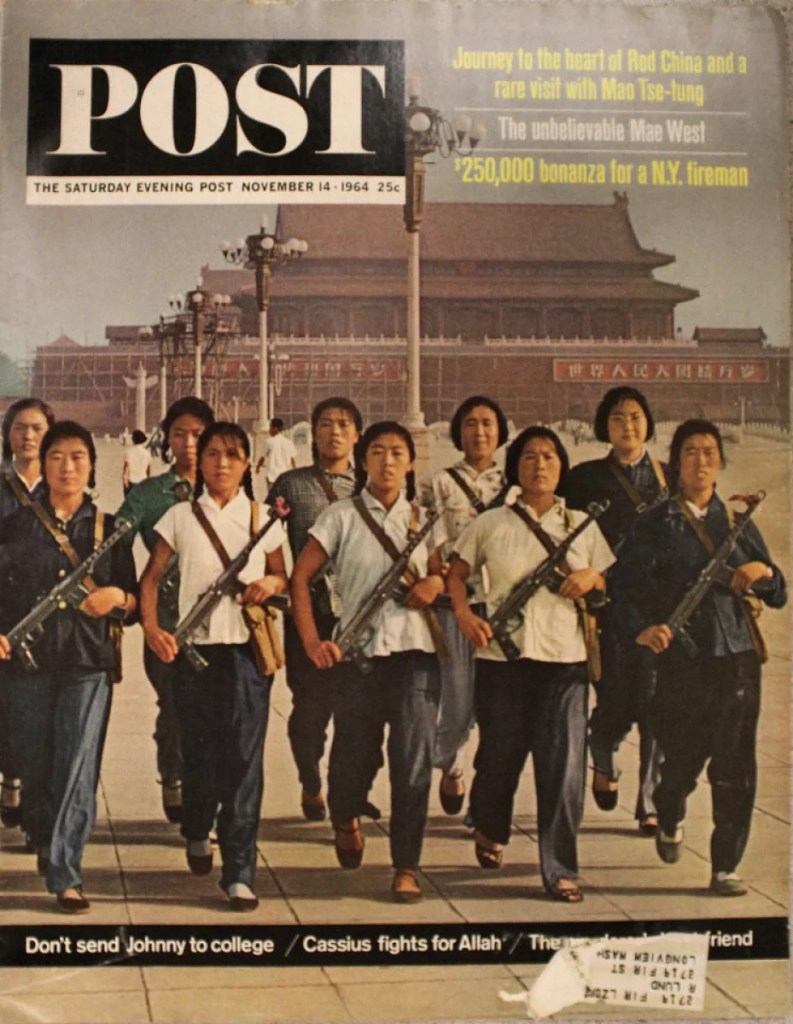
In step with improving harvests, the Communist regime is exerting tighter control over China’s 74,000 rural communes. After early mistakes and setbacks, these giant farming units apparently are making progress in raising yields and pooling manpower to build irrigation works and other needed projects. Many communes, however, are hampered by poor management and what Mao Tse‐tung, the Chinese Communist leader, has called “spontaneous tendencies toward capitalism on the part of small producers.” According to reliable sources, a broad campaign has been started to combat tyranny and corruption by commune managers and peasants. There is still no official confirmation of this campaign and it has yet to be mentioned in the Peking press, but it is widely discussed in the capital.
Japanese leftists apparently have suffered a severe blow to their prestige in the adverse public reaction to street demonstrations against the start of visits to Japan by United States nuclear submarines. The general indifference, reflected in the relatively small turnout to protest against the arrival of the USS Seadragon at Sasebo this week, is interpreted as a victory over the Opposition for the new Premier, Eisaku Sato. Mr. Sato, who took office last Monday, has been expected to take a tougher line than his predecessors toward Japan’s vociferous leftists. His older brother, Nobusuke Kishi, had been forced out of the Premiership in 1960 after huge leftist outbreaks had caused cancellation of a state visit by President Dwight D. Eisenhower.
South African Prime Minister Hendrik F. Verwoerd said today that if Britain did not honor her contract to supply Buccaneer aircraft to South Africa, the agreement on the Simonstown naval base “can no longer be maintained.” Under the agreement, signed in 1955, Britain is entitled to use the base, whose facilities are also to be open to Britain and her allies in time of war. The agreement committed Britain to supply South Africa with the means for a naval expansion program.
American anthropologist Napoleon Chagnon began his stay with the Yanomami people who would become the subject of his 1967 bestseller, “The Fierce People.” The Yanomami lived in Venezuela’s Amazonas state (where Chagnon set up his camp) and across the Amazon River in Brazil. Chagnon’s ethics would come under question years later from another anthropologist, R. Brian Ferguson of Rutgers University, who would publish a followup study, “Yanomami Warfare,” in 1995. “A war started between groups which had been at peace for some time on the very first day Chagnon got there”, Ferguson would write, “and it continued until he left. I don’t think that was an accident.” In Ferguson’s opinion, Chagnon had formented warfare between the two rival groups in order to write the 1967 book.
Queen Elizabeth Hospital, Bridgetown, Barbados, was officially opened.
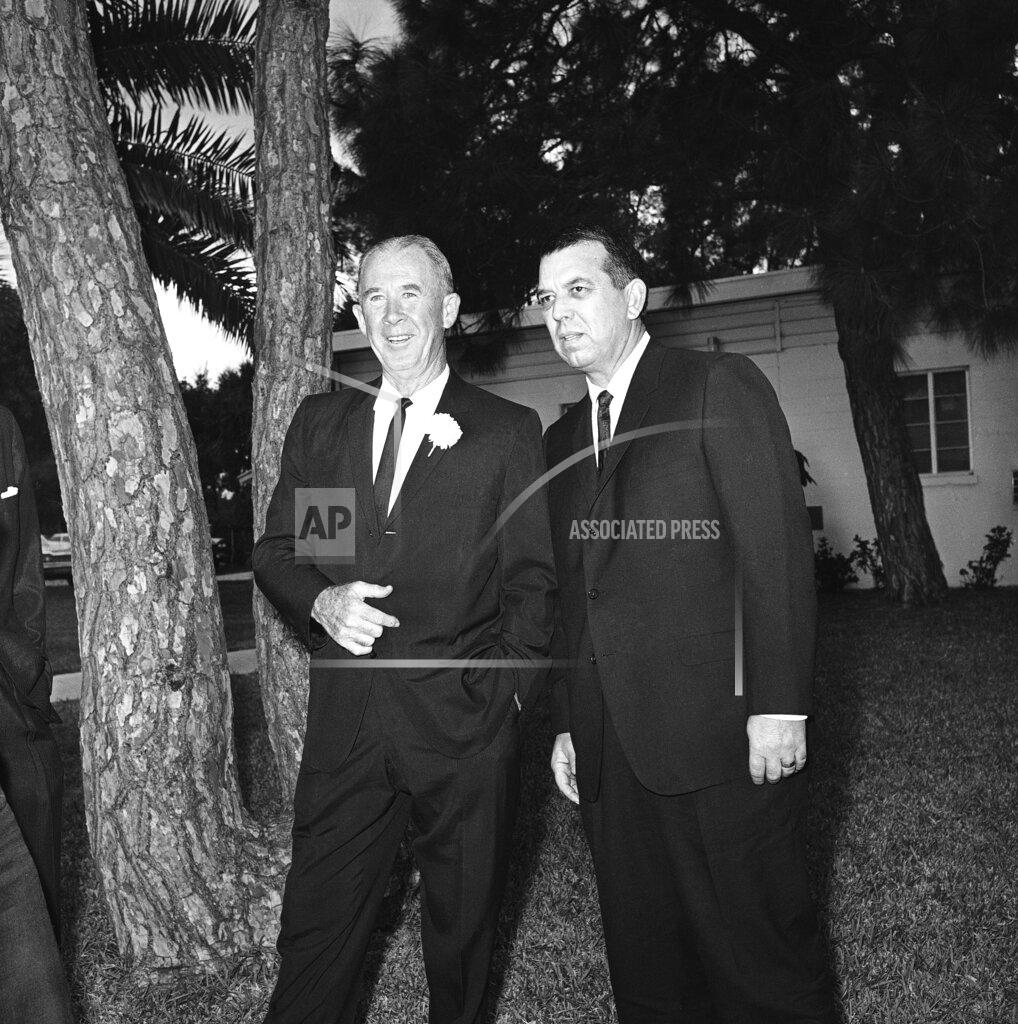
Senator Barry Goldwater said today that the time might well have come for “a real realignment” of the political parties into “two new teams.” He suggested that they be called the Liberals and the Conservatives. At a news conference, the Arizona Republican also accused President Johnson of uttering “complete lies” in the Presidential election campaign. He charged that “so‐called Republicans” like Governor Rockefeller of New York had contributed to the wide margin by which the party’s ticket was beaten November 3. Other Republicans whom he blamed were Governor George Romney of Michigan and Senators Hugh Scott of Pennsylvania and Thomas H. Kuchel of California.
The Senator also lauded Dean Burch’s performance as Republican National Chairman and absolved him of any blame for the election losses. He predicted that the Republican National Committee would vote in January to support Mr. Burch for his full four‐year term as leader of the party’s national organization. Flanking the 1964 Presidential nominee during the news conference were Representative William E. Miller, the VicePresidential nominee; John Grenier, executive director of the National Committee, and Mr. Burch.
Mr. Goldwater’s closest political associates, who had been coupling vacations with political strategy meetings at this Caribbean resort for several days, were clearly surprised by the scope of his comments, especially his call for a reshuffling of the major parties. Asserting that a trend toward realignment had started in the Hoover‐Smith election of 1928, Mr. Goldwater said it could well have ripened in his own unsuccessful contest with President Johnson. “The time has come to choose up two new teams and get going,” he said.
Black Republican leaders demanded today that Goldwater elements be ousted from the Republican National Committee. They said they could then lead Blacks back into a reformed party. The demand came at a news conference held in connection with a closed meeting here of 30 executive board members of the National Negro Republican Assembly. The assembly was formed in San Francisco last July after Black delegates had walked out of the Republican Convention to protest the nomination of 8enator Barry Goldwater for President. Grant Reynolds, director of the assembly’s political organization, who is a lawyer in White Plains, New York, said that one target of his group was Dean Burch, the national party chairman.
President Johnson today appointed a 14‐member commission to explore ways of coping with problems created by automation and technological advances. Howard R. Bowen, president of the University of Iowa, will head the panel, called the National Commission on Technology, Automation and Economic Progress. He and the other members were given recess appointments. They will be nominated, subject to Senate confirmation, when Congress convenes in January.
A. Philip Randolph said today that the “civil rights revolution” needed more federal legislation. Blacks need “billions of dollars” from the federal government, said Mr. Randolph, president of the Brotherhood of Sleeping Car Porters. He said in an interview thhat the government should spend the money for public works projects, new low‐cost housing developments and thousands of new schools.
The Civil Rights Act of 1964 will not, in itself, achieve equal rights for Blacks in this or the next generation, Assistant United States Attorney General Burke Marshall declared yesterday. Mr. Marshall, head of the civil rights division of the Attorney General’s office, said that the law’s objectives would be difficult to attain unless there was a change of heart and mind in most of the southern states.
Mr. Marshall addressed 400 members of the New York University Law Alumni Association at its seventh annual Dean’s Day meeting at the Law Center, 40 Washington Square South. He noted that the late Federal Judge Learned Hand had stressed, in one of his opinions, the idea that justice to minority groups subjected to discrimination could not be achieved by statutes, judicial decisions and other legal steps unless the general public really wanted such justice.
Although the Civil Rights Act is a long step toward elimination of racial discrimination, Mr. MarshalI said, its full implementation is subject to three factors: These he listed as the willingness of the executive branch of the federal government to use force to back federal court decisions to compel state and local governments to carry out the provisions of the Civil Rights Act, and the problem of coping with massive resistance to the law in some Southern states. Mr. Marshall was one of several speakers in a day‐long program that included making Chief Judge Charles S. Desmond of the New York State Court of Appeals an honorary member of the group. Judge Desmond was the first person to be given honorary membership.
A Roman Catholic priest denounced racism yesterday as “a desecration of Christian civilization, a blasphemy in the Mystical Body of Christ.” “It is, with all respect and accuracy, a God‐damned thing,” the Rev. William J. Kenealy declared at the fifth annual mass for human rights at St. Francis Xavier Church, 30 West 16th Street. Father Kenealy, a Jesuit and a professor of law at Boston College, said the “failure of the Founding Fathers to implement in the federal Constitution the full philosophy of the Declaration of Independence has been matched by our failure as Catholics to practice in our daily lives the teachings of Christianity” in the matter of racial discrimination and segregation.
“We Catholics, like other religious groups, have our skeletons in the closet,” the priest said. “In fact, some of ours seem to insist upon sitting up‐ right in the front pew, and some pop up grotesquely on the the other side of the altar rail.” Father Kenealy said that, instead of advocating an “uncritical return” to the Founding Fathers, Americans should “proceed forward from their achievements.” The human rights mass was sponsored by the St. Thomas More Society, a lay group dedicated to a spiritual view of the world.
A former executive of Procter & Gamble, manufacturer of products that included one of America’s most popular brands of toothpaste, Crest, was arrested after trying to sell a 188-page Crest marketing strategy to Procter & Gamble’s top competitor in the dentifrice industry, Colgate-Palmolive, which made Colgate. From Chicago, Eugene Andrew Mayfield had called a New York executive at Colgate-Palmolive, who, in turn, contacted the FBI. Mayfield flew from Chicago to New York and, as arranged, the two sat in adjacent stalls in the men’s restroom at the TWA terminal at the Kennedy Airport. “Mayfield passed over the copied document while the Colgate man passed over $20,000 in marked bills. Then Mayfield walked out into the arms of waiting FBI agents.” At Mayfield’s criminal trial, testimony was presented that estimated the worth of the document to be more than one million dollars.
Betty Comden & Adolph Green and Jule Styne’s musical “Fade Out-Fade In”, goes into lay-off due to star Carol Burnett’s illness.
“Folies Bergere” closes at Broadway Theater NYC after 191 performances.
Lionel Bart’s musical “Oliver!”, based on Charles Dickens’ 1838 novel “Oliver Twist”, and featuring Clive Revill, Danny Sewell, and Davy Jones, closes at Imperial Theater, NYC, after 774 performances and 3 Tony Award wins.
MLB right fielder Roberto Clemente (30) weds Vera Zabala at San Fernando Church in Carolina.
Detroit Red Wings Gordie Howe sets NHL record 627th career goal.
Born:
Joseph Simmons, American hip hop artist who went by the stage name “Run” when teaming up with Darryl “D.M.C.” McDaniels for the group Run–D.M.C.; in Queens, New York, New York.
Andrew Banfield, British pop and R&B singer (The Pasadenas – “Riding On A Train”; “I’m Doing Fine Now”), born in London, England, United Kingdom.
Patrick Warburton, American actor and voice actor (“Seinfeld”; “The Civilization of Maxwell Bright”; “The Tick”); in Paterson, New Jersey.
Silken Laumann, Canadian rower (Olympic bronze, silver-1992, 1996), in Mississauga, Ontario, Canada.
Bill Hemmer, American television news reporter (“Americas’ Newsroom” on Fox News), in Cincinnati, Ohio.
Died:
Heinrich von Brentano, 60, former West German politician (Federal Minister of Foreign Affairs).
 History Diaries