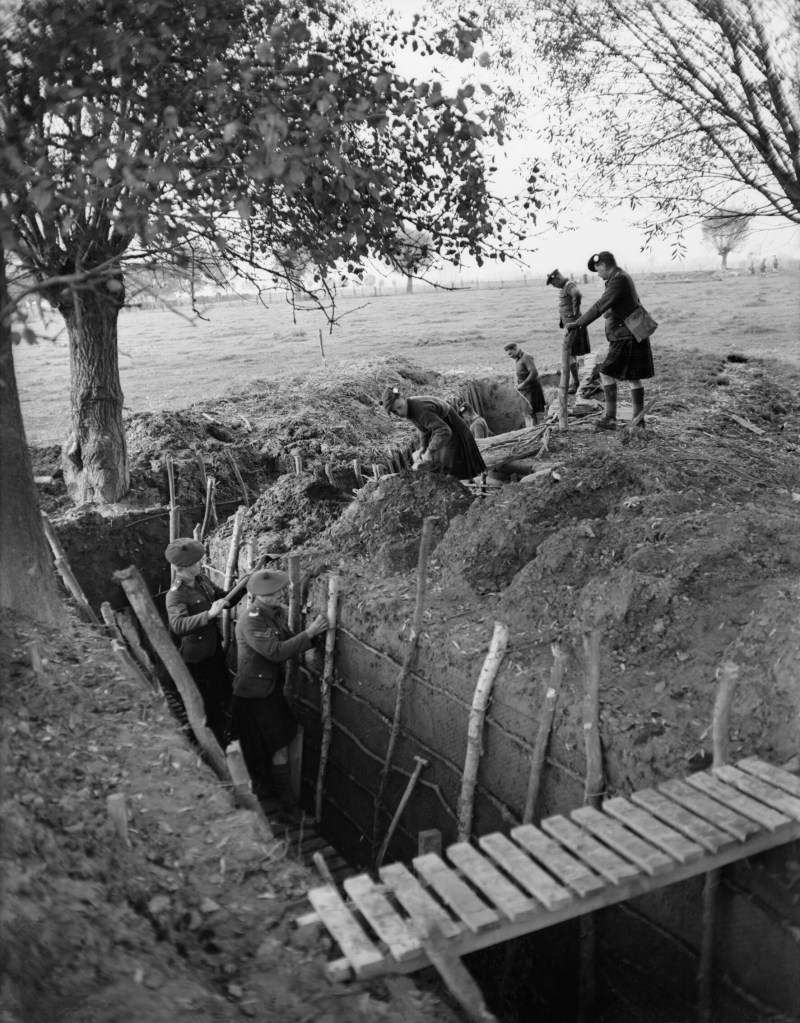
A New York Times corresondent reports:
“Motoring from Amsterdam to the extreme southeastern corner of the Netherlands today, one had the impression of intensified military preparations in that crucial peninsular of Dutch territory bordering Germany and Belgium to which strategists long have paid especial attention. That was also the impression of those living there. In the neat little villages of the Province of Limburg, the Dutch took their Sunday walks, pushed baby carriages or went on bicycle rides.
“Their children played tag upon the still wet concrete tops of barricades across the roads or dodged in and out among bristling steel rails embedded in concrete and standing erect in the center of the highway. It was an amusing game, and the children laughed with glee. Their elders did not laugh. But they seemed calm enough as they speculated in the cafes and on the village squares what it all meant.
“As one traversed more than 100 miles of green meadows and woods and bright, clean, modern towns and villages. one was reminded every few minutes of the menace that must be taken into official calculation. All the main roads of Limburg and some farther north and east were closed to traffic. One road that was open at midday on the eastward journey was closed in the afternoon when the travelers returned and they were sent on a detour by policemen.”
France said that the Belgian and Dutch offer of mediation required Germany to repair “the injustices which force has imposed on Austria, Czechoslovakia and Poland” before peace could be discussed. George VI wrote a reply explaining that the “essential conditions upon which we are determined that an honorable peace must be secured have already been plainly stated”, but if the Queen of the Netherlands was “able to communicate to me any proposals from Germany of such a character as to afford real prospect” of achieving Britain’s aims he would “give them my most earnest consideration.” French President Lebrun also responds negatively to the Belgian-Dutch mediation offer.
First Lord of the Admiralty Winston S. Churchill said in a radio broadcast that if the British get through the winter without any serious setback, the first campaign of the war will have been won. He emphasized the continued threat to Europe from Nazi Germany. “If words could kill, we should be dead already.”
Many hundreds of dissidents and Jews are arrested in the search for the Munich bombers. There are said to be thousands of people arrested in the continuing Munich Bürgerbräukeller bomb explosion. Those detained include the usual victims of the Germans – such as Jews – but also people who have very tangential relationships to the affair. For instance, Munich locksmith Max Niederholer, who sold an item used in the bomb to the prime suspect, Johann Georg Elser, is being subjected to imprisonment and beatings. Elser’s home town of Königsbronn becomes known by the Gestapo as “Assassinville” and is treated as an outlaw city. The net is being cast wide.
Meanwhile, ration cards for clothing are issued in Germany.
German authorities began the deportation of Jews from Polish territories annexed by Germany to the General Government.
King Carol of Romania offered to mediate peace between Germany and the western powers.
The Dutch and Belgian foreign ministers meet at Breda.
Mussolini increases the Italian army by 23,000; specialists are enrolled to strengthen units.
A Te Deum is sung in the Cathedral of Munich in order to thank the divine Providence in the name of the archdiocese for the “Führer’s fortunate escape from the criminal attempt made upon his life.”
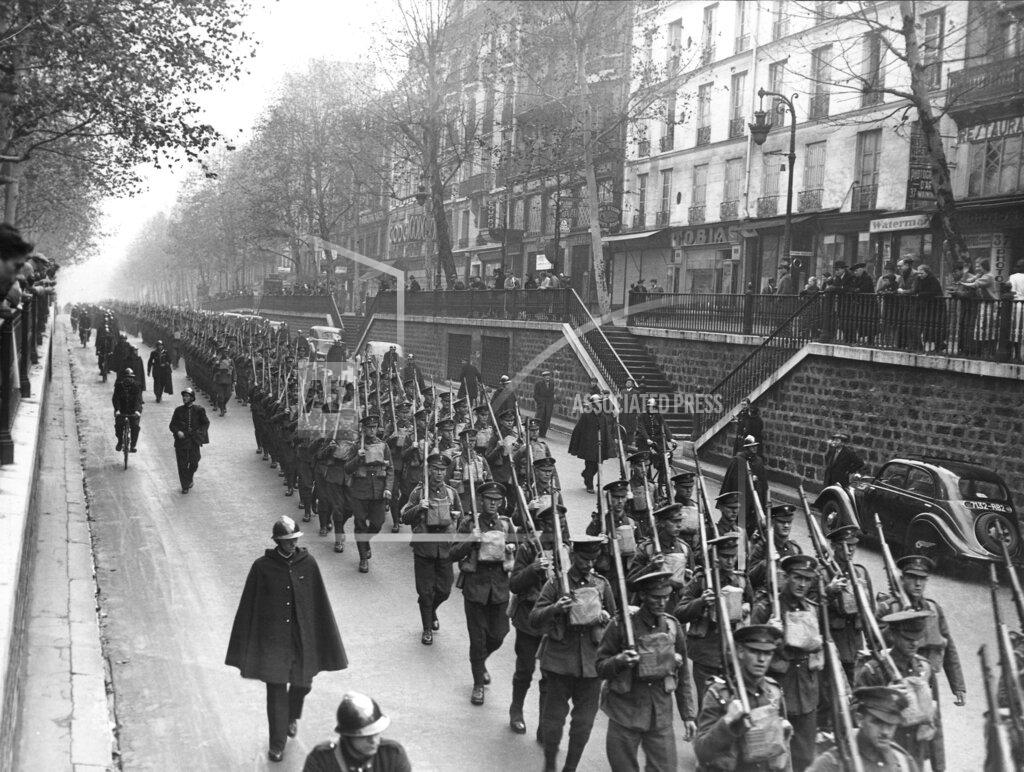
An air-raid scare takes place in Paris. The seventh alarm lasts nearly an hour.
The first ENSA (Entertainments National Service Association) concert is given for British and French troops in France, starring Maurice Chevalier and Gracie Fields.
Italy acclaims the birthday of the King, age 70. Military ceremonies are held and the press extols his reign.
Generalissimo Francisco Franco is determined to remove from Spain Francisco Cardinal Vidal y Barraquer and several Bishops, including Mgr. Matteo Mugica, Archbishop of Vitoria, because he believes them to be hostile to the Falangist regime, it was authoritatively learned today.
The Soviets issue a statement expressing dissatisfaction with the current status of negotiations with the Finns.
An impassable deadlock in the FinnishSoviet talks and their probable breakdown were announced in Helsinki today by Foreign Minister Eljas Erkko. He said that unless the outlook improved — a slender hope, he thought— the delegation would have to be recalled from Moscow.
The unescorted and neutral Norwegian motor tanker Arne Kjøde was torpedoed and sunk by the U-41, commanded by Kapitänleutnant Gustav-Adolf Mugler, northwest of Butt of Lewis in the northern Atlantic Ocean (58°51′N 8°07′W). Of the ship’s complement, 5 died and 34 survivors were picked up. She broke in two and was later scuttled by Royal Navy ships. The bow section was taken in tow by HMS Guardian and HMS Isis. The crew were rescued by HMS Isis, which shelled and sunk the bow section at 59°06′N 6°55′W on 15 November. The stern section was scuttled by HMS Chitral at 59°20′N 7°12′W. The 11,019-ton Arne Kjøde was carrying gas oil and was bound for Nyborg, Denmark.
The 275-ton British steam fishing trawler Cresswell was stopped by gunfire and after the crew abandoned ship was torpedoed and sunk by the U-41 18 miles northwest by west of Flannan Isles, Outer Hebrides. Of the ship’s complement, 6 died and 7 survived. Survivors were rescued by U-41 and later transferred to the trawler Phyllisia.
The Royal Navy trawler HMT Cape Comorin ran aground at Whitby, Yorkshire and was wrecked. Later salvaged, repaired and returned to service.
The British cargo ship Deerpool ran aground 3 nautical miles (5.6 km) off Spurn Head, Yorkshire and sank. All crew were rescued. The wreck was dispersed in 1948.
The Finnish cargo ship Elsie ran aground on Terschelling, Friesland, Netherlands and broke her back, a total loss.
The British cargo ship Fireglow struck the wreck of Canada ( Denmark in the North Sea 2 nautical miles (3.7 km) east of Holmpton, Yorkshire (53°40′N 0°17′E) and sank. She was later refloated, repaired and returned to service.
The German cargo ship Mecklenburg was intercepted in the Atlantic Ocean northwest of the Faroe Islands (62°37′N 10°36′W) by HMS Delhi (Royal Navy). She was scuttled at 63°09′N 11°38′W). All 63 crew were rescued by HMS Delhi.
The British Home Fleet escorts a British iron ore fleet from Narvik.
U.S. freighter Express, with cargo earmarked for Greece, Turkey, and Rumania, is detained by British authorities at Malta.
Convoys OA.34 and OB.34 depart from Southend and Liverpool, respectively.
The War at Sea, Sunday, 12 November 1939 (naval-history.net)
Battleships NELSON, RODNEY, and destroyers FAULKNOR, FORTUNE, FORESIGHT, FOXHOUND, FAME departed Rosyth to carry out full calibre firings before proceeding on patrol between the Faroes and Norway to cover convoys ON.2/HN.2. The force was joined by destroyer FURY at sea. ON.2, consisting of just one British ship, departed Methil escorted by destroyers IMOGEN, ICARUS and IMPULSIVE. Light cruiser AURORA left Immingham to provide near cover and anti-aircraft cruiser CURLEW was ordered to guard ON.2, but the order was changed and CAIRO was assigned. CAIRO joined at daylight on the 14th and arrived at Rosyth on the 17th after this duty. ICARUS, IMOGEN and IMPULSIVE refueled at Sullom Voe on the 14th, and ON.2 arrived without incident at Bergen on the 15th. The big ships arrived at Loch Ewe on the 17th, departed on the 20th after refueling and reached the Clyde on the 21st.
Light cruiser EDINBURGH and destroyers AFRIDI and MAORI departed Rosyth for the Humber, arriving that afternoon.
Destroyer KINGSTON departed Rosyth for repairs at Leith, completed on the 19th.
Destroyer IMPERIAL departed Rosyth for boiler cleaning.
Submarine SEAHORSE departed Blyth for a patrol off Terschelling, arriving back on the 28th.
On Northern Patrol were two cruisers between the Orkneys and Faroes, three cruisers and one AMC between the Faroes and Iceland, and light cruiser NEWCASTLE and two AMCs in the Denmark Strait.
Light cruisers CALYPSO, CALEDON and CERES departed Sullom Voe on Northern Patrol duty. CALEDON suffered damage to her upper deck in heavy weather on the 15th.
Anti-aircraft cruiser CALCUTTA departed Rosyth and arrived in the Humber on the 13th.
On East Coast patrol, destroyer KEITH was off Orfordness and the Polish BURZA off the Sunk.
Destroyers GRIFFIN (D.1), GIPSY, GREYHOUND and GLOWWORM arrived at Harwich from Plymouth, when Captain Creasy’s designation changed from D.1 to D.22. GIPSY and GREYHOUND were in a collision which caused minor damage to both ships. GIPSY repaired at Harwich and GREYHOUND at Sheerness. GLOWWORM escorted convoy HXF.7A to the Sunk.
Destroyer VIMY on patrol reported a split in her hull which contaminated her fuel, and was forced to return to port.
Steamers APPLEDORE (5218grt), CLAN MACGILLIVRAY (6464grt), DEERPOOL (5167grt) SAINT MARGARET (4312grt), MAIHAR (7563grt) and tanker ATHELKING (9557grt) of convoy FN.35 all ran aground off Lowestoft, each following the next one on to the shore. Steamer FLIMSTONE (4674grt), managed to avoid this fate but only after colliding with SAINT MARGARET.
German steamer MECKLENBURG (7892grt) had left Pernambuco on 14 October disguised as Dutch steamer HOOGKERK. She was intercepted on the 12th in 62 37N, 10 36W by light cruiser DELHI and scuttled to avoid capture NW of the Faroes in 63 09N, 11 38W. DELHI arrived at Sullom Voe with her 56 man crew on the 15th.
Anti-aircraft cruiser CURLEW departed Rosyth and arrived at Grimsby on the 13th.
Destroyers ESK, EXPRESS, BLANCHE and BASILISK departing Rosyth for the Humber, were held up by fog near Outer Dowsing.
In a German air attack on Sullom Voe and Lerwick, two Sunderland flying boats at Lerwick were destroyed.
Sloop FLAMINGO departed Rosyth with submarines SEALION, SHARK, SNAPPER and SUNFISH for passage to Harwich, arriving on the 14th.
Convoy OA.34 of 14 ships departed Southend escorted by destroyers ELECTRA and ESCORT from the 12th to 14th.
Convoy OB.34 departed Liverpool escorted by destroyers VANESSA until the 13th, and destroyers WARWICK and WHIRLWIND until the 15th.
U-41 badly damaged Norwegian tanker ARNE KJODE (11,019grt) in 58 51N, 08 07W and five crew were lost. Destroyer ISIS and net layer GUARDIAN took the stern portion of the ship in tow and were later joined by destroyer KASHMIR. However, the tanker was beyond saving. ISIS rescued the survivors and sank the stern in 59-20N, 7-12W on the 15th, while armed merchant cruiser CHITRAL sank the fore section with gunfire in 59-06N, 6-55W.
U-41 sank trawler CRESSWELL (275grt) 18 miles NW by N of Flannan Island, Outer Hebrides, 40 miles WSW of the Butt of Lewis; six crew were lost, her survivors rescued by the U-boat and later transferred to trawler PHYLLISIA (324grt).
GERMAN DESTROYER MINELAYING IN THAMES ESTUARY
German destroyers KARL GALSTER, HERMANN KÜNNE and HANS LÜDEMAN, escorted by destroyer WILHELM HEIDKAMP laid 288 magnetic mines in the Thames Estuary during the night of the 12th/13th. Destroyers ERICH GIESE, THEODOR RIEDEL and HERMANN SCHOEMANN also sailed, but when RIEDEL and SCHOEMANN broke down, they were escorted back by GIESE. On their return, they were met at sea by light cruisers KÖLN, NÜRNBERG and torpedo boats LEOPARD, SEEADLER, WOLF, ILTIS. Destroyer BLANCHE and thirteen merchant ships for 48,725grt were sunk in this field.
On the 12th, cruiser minelayer ADVENTURE (Captain A R Halfhide) escorted by destroyers BLANCHE (Lt Cdr R M Aubrey) and BASILISK (Cdr M Richmond) departed Grimsby en route to Portsmouth. At 0518/13th, three miles 120° from the Tongue Light Vessel, ADVENTURE struck a mine laid by the German destroyers that morning and was badly damaged; Nine ratings were killed, fifteen missing and 67 wounded. She was able to proceed under her own power at five knots to Chatham assisted by tugs DORIA and SALVA from Ramsgate and LADY BRASSEY from Dover. Sixty-two wounded were transferred to BASILISK, which led ADVENTURE in to Sheerness. She was taken to Chatham for temporary repairs, departed on 19 December for Plymouth and arrived there on the 21st for permanent repairs lasting until 18 September 1940.
At 0825, near the same spot at one mile 80° from North East Spit Buoy, BLANCHE towing one of the rescue tugs, struck another mine. BLANCHE had one rating killed, one rating missing, and Midshipman C L Byrne RNR, Act/Sub Lt D L Davenport, Warrant Engineer G F D Dunn and nine ratings injured. survivors were rescued by tugs FABIA (151grt), LADY BRASSEY (362grt) and trawler KESTEREL (75grt). BLANCHE sank two hours after striking the mine.
Destroyer GLOWWORM was stationed east of the Tongue Light Vessel to redirect Thames-bound shipping, and trawler MYRTLE redirected shipping coming out of the river, but the following vessels were mined and sunk in the field.
On the 13th, steamer PONZANO (1346grt) in 51 29N, 01 25E; Her crew was rescued by two Norwegian trawlers.
On the 13th, steamer MATRA (8003grt) from convoy HXF.7, one mile east of Tongue Light Vessel; Sixteen crewmen were lost and she was beached in Shingles Patch.
On the 15th, steamer WOODTOWN (794grt) 3/4 mile off North East Spit Buoy, Margate; eight crewmen were lost.
On the 19th, Italian steamer GRAZIA (5857grt), five miles north of North Foreland; six crewmen were lost and 24 survivors picked up by destroyers GRIFFIN and GIPSY.
On the 23rd, steamer HOOKWOOD (1537grt) in convoy FS.40, 3½ miles ENE of Tongue Light Vessel; two crewmen were lost and 15 survivors picked up by sloop BITTERN.
On the 27th, Dutch liner SPAARNDAM (8857grt), two miles NE of Tongue Light Vessel; seven crewmen were lost and the survivors rescued by a pilot vessel.
On the 28th, steamer RUBISLAW (1041grt), 1½ miles ENE of Tongue Light Vessel, four cables SW of Knock South Buoy; thirteen crewmen were lost and survivors rescued by a minesweeping trawler.
On the 30th, steamer SHEAF CREST (2730grt) in 51 32N, 01 26E; one crewman was lost, 12 survivors picked up by Polish destroyer BLYSKAWICA and taken to Harwich, and 15 other survivors picked up and taken to Ramsgate.
On 1 December, steamer DALRYAN (4558grt), 2½ miles SW of Tongue Light Vessel in 51-31N, 1-19.5E; the crew was rescued and taken to Margate.
On 2 December, tanker SAN CALISTO (8010grt), 2½ miles NNE of the Tongue Light Vessel; six crew were lost and 36 rescued.
On 6 December, Greek steamer PARALOS (3435grt), two miles ENE of Tongue Light Vessel in 51-31N, 1-37E; three crewmen were killed and 22 rescued by British steamer ROEK (1041grt).
On 8 December, steamer MEREL (1088grt), 270° from Gull Light Vessel, one cable north of No. 22 North Gull Buoy near Ramsgate; sixteen crew were lost and only two saved.
On 15 December, Swedish steamer URSUS (1499grt), off Margate in 51-35N, 1-36E; nine crew were lost and 11 survivors rescued by Dutch trawler BRINDA (200grt).
German destroyers BRUNO HEINEMANN, FRIEDRICH IHN, ERICH STEINBRINCK and FRIEDRICH ECKHOLDT conducted an anti-shipping sweep in the Skagerrak from the 13th to 15th.
Heavy cruiser KENT departed Hong Kong and arrived at Singapore on the 15th.
Heavy cruiser EXETER was bumped and damaged while alongside a tanker near Montevideo.
Light cruiser DAUNTLESS arrived at Singapore after patrol in the Sunda Strait.
Light cruiser CAPETOWN departed Gibraltar on escort duty and arrived back later the same day.
Constantine A. Oumansky, Ambassador to the United States from Russia, has not had a happy homecoming. At the dock he was asked whether he had been a member of the OGPU; he testily explained that it was “beneath his dignity” to answer. Arriving in his drafty but imposing Washington embassy, he has probably already discovered that his welcome will not be so warm as of yore. Ambassador Oumansky is a small, sleek, natty man with an amazingly insinuating manner and such a display of gold teeth that his ready smile seems almost ostentatious. In the old days no one excelled him in the peculiar Communist trick of intellectual acrobatics, by which realism and idealism were exquisitely blended, and the most ardent American liberals were made to feel that a blood purge was a small thing between friends. In the old days Ambassador Ouraansky was decidedly popular among extreme New Deal Left Wingers and their numerous friends and camp followers.
Since the Russo-German pact, however, Ambassador Oumansky is going to have to find his friends and companions chiefly on the German Embassy staff, a group with which his contact was formerly limited. The Left-Wing New Dealers, like liberals all over the world, clung to their faith in the Soviet Union until the last breathless moment. Now their bitterness is compounded by their disillusion. It is not only a matter of a few high officials staying away from embassy receptions, which, being rather conservative, they always wanted an excuse to avoid. It is a general feeling, among 90 percent of Ambassador Oumansky’s real cronies, that they have been sold down a very nasty river.
Activity on a scale and at a pace never known before in the history of the Boeing Aircraft Company is going on at the company’s plant in Seattle where are built the giant long-range hard-striking “flying fortresses” of the United States Army and the commodious clippers which maintain regular commercial service across both the Atlantic and Pacific.
The activity, clearly expressed in the 5,300 men employed in three daily shifts, results from a backlog of orders totaling $26,000,000, about 80 percent of which is for the United States Army. Optimism, implied in plans for acquiring additional factory space and for putting vocational courses in the local high schools to help create a reservoir of trained workers, is engendered by the prospect of more orders. Although it could not be confirmed, it is understood that both Britain and France are now considering the purchase of a substantial number of the highly successful long-range bombing planes built by the company.
Boeing is now building the B-17B model of the “flying fortress” for the army and high altitude stratoliners for several commercial airlines. The best estimate obtainable of its output is “about one plane every few days.” This vague estimate is said to be close to the capacity of the present plant, which covers 540,000 square feet, but it was explained that production could be stepped up to almost any level by increasing factory area.
The United States keeps many air devices secret. Bomb sights, detectors, and some searchlights will not be sold to foreign buyers.
Twenty-three U.S. plants are currently working on military planes.
Governor Culbert L. Olson proposed today that California seek Federal cooperation in a program to pay its senior citizens of 60 years of age or more a monthly pension of $50, the highest in the nation.
Unless the dispute of the Chrysler corporation and the United Automobile Workers —C.I.O. is settled in the coming week it is likely to last as long as the General Motors strike of 1937, which halted production for fortyfour days. Negotiations for a settlement will be resumed tomorrow.
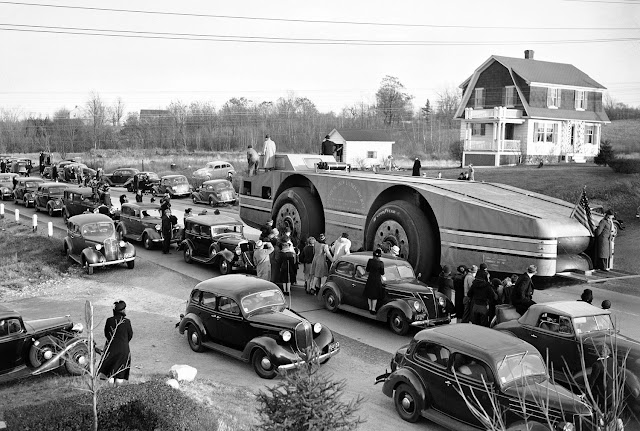
Admiral Byrd continues his demonstration drive of his Snow Cruiser with unintended results. At Framingham, Massachusetts, on November 12, 1939 traffic is snarled for 20 miles in a jam that involved 70,000 automobiles, as the curious flock for a glimpse of the gigantic Snow Cruiser. It is the ultimate rubbernecking attraction.
City College in New York City reports that only 2 percent of its 1936 graduates are currently unemployed.
Steel operations are high at 93 percent production.
Wheat crops are hit hard by the drought and the welcome rains provide little relief.
The youngest of the 3 DiMaggio brothers, Dom, is bought for $40,000 by the Boston Red Sox from San Francisco (PCL).
The Swedish cargo ship Sumatra ran aground in Hooghly River 16 nautical miles (30 km) downstream of Calcutta, India. She sank the next day.
Britain removes its north China force. The situation in Europe is cited. The War Office announced today a decision to withdraw British troops from North China, leaving only a number sufficient to protect property and to maintain order. The decision was made “for reasons of military convenience arising from the conflict in Europe.” Various governments, that, like Britain, have been maintaining troops in that area in accordance with the International Protocol of 1901, have been notified. The fact that such notification has been given is taken as an indication that Britain is relying upon other signatories of the protocol to look after her interests. The United States is one of those signatories.
The British North China Force now numbers about one battalion, maintained at Tientsin, the storm center of the Anglo-Japanese discussions of last Summer. These discussions, which included a Japanese demand for $50,000,000 (Chinese) in silver deposited by the Chinese National Government in the British Concession at Tientsin are not yet concluded. Meanwhile, the silver is still there. Prior to the murder of a customs superintendent of the Japanese-controlled administration last April 9, British troops had been scattered at various North China outposts. When the Japanese decided to blockade the British Concession at Tientsin as a result of Britain’s refusal to hand over four Chinese alleged to have murdered the customs official, all the British troops were ordered into Tientsin and have been there since.
The Associated Press reported that Britain had had a force of 750 men in Tientsin and that presumably the War Office announcement meant that only enough of these would be left to police the Concession, leaving a French Colonial infantry regiment, two batteries of artillery and a light tank company — 1,500 officers and men altogether — along with 250 United States Marines in North China. Although only a skeleton force of about 100 men would remain to guard the British property and the few British nationals still in Tientsin, it was pointed out unofficially here that the situation as regards that protection would be unchanged. It is mentioned that there has been little to deter a Japanese force, superior in numbers to the British, from entering the Concession at any time that it pleased, and it was emphasized that the Japanese had not done so.
Japanese Prince Nagahisa’s daughter Princess Hatsuko was born.
Pitcher Victor Starffin wins his 42nd game in a 96-game season, leading the Yomiuri Giants to the Japanese baseball pennant, and setting a post-1900 world record for season victories that will be equaled (by Kazuhisa Inao in 1961) but never broken. Starffin, the 6’4” son of Russian immigrants, was exempt from the military call-up of able-bodied Japanese. Born in Russia, Starffin moved to Asahikawa, Hokkaido at a young age, and was picked as part of the national baseball team for an exhibition game against the United States in 1934. From 1936-55 he won 303 games, the first in Japanese baseball to top the 300 mark. Except for Oh, he is the only non-Japanese player in the Japanese baseball Hall of Fame.
Born:
George Blaney, NBA point guard (New York Knicks), in Jersey City, New Jersey.
Lucia Popp [Poppová], Slovakian operatic soprano, in Záhorská Ves, Slovak State (now Slovakia) (d. 1993).
Died:
Norman Bethune, 49, Canadian physician, communist and humanitarian (Spanish Civil War, Second Sino-Japanese War), dies of blood poisoning from a cut on his finger from operating on a wounded soldier.
Oscar [Bachigaloupi] Tourniaire, 59, Dutch actor and director (“Pink Kate”).
Naval Construction:
The Nihon Kaigun (Imperial Japanese Navy) Type C (C1 sub-class) cruiser submarine I-24 is launched by the Sasebo Naval Arsenal (Sasebo, Japan).
The Вое́нно-морско́й флот СССР (ВМФ) (Soviet Navy) “M” (Malyutka)-class (3rd group, Type XII) submarine M-97 is commissioned.

 History Diaries