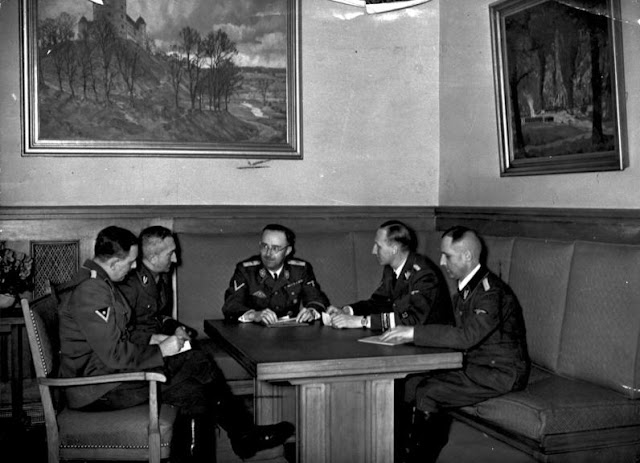
Adolf Hitler issues directive No. 9 which calls for German aircraft and submarines to attack British shipping and port facilities.
The Supreme Commander Of The Armed Forces.
Berlin. 29th November, 1939. 11 copies
Directive No. 9 — Instructions For Warfare Against The Economy Of The Enemy
- In our fight against the western powers, England has shown herself to be the animator of the fighting spirit of the enemy and the leading enemy power. The defeat of England is essential to final victory. The most effective means of ensuring this is to cripple the English economy by attacking it at decisive points.
- The development of the general situation and of our armaments should provide within the foreseeable future favourable conditions for extensive operations against the economic foundations upon which England rests. Early preparations must therefore be made, by concentrating the appropriate weapons upon the most important objectives, to deal an annihilating blow to the English economy. Nonmilitary weapons will be employed in conjunction with the measures taken by the Armed Forces and in accordance with special orders.
- Should the Army succeed in defeating the Anglofrench Armies in the field and in seizing and holding a sector of the coast of the Continent opposite England, the task of the Navy and Air Force to carry the war to English industry becomes paramount. Efforts will be made to secure the cooperation of the Sabotage Column and Fifth Column organisations.
- The Navy and Air Force will then carry out the following tasks, given in the order of importance: (a) Attacks on the principal English ports by mining and blocking the sea lanes leading to them, and by the destruction of important port installations and locks. In this connection aircraft are extremely valuable in mine laying, particularly outside English west coast ports, in narrow waterways, and in river estuaries. (b) Attacks on English merchant shipping and on enemy warships protecting it. (c) Destruction of English depots, oil storage plants, food in cold storage, and grain stores. (d) Interruption of the transport of English troops and supplies to the French mainland. (e) The destruction of industrial plant whose loss would be of decisive significance for the military conduct of the war, in particular key points of the aircraft industry. and factories producing heavy artillery, antiaircraft guns, munitions, and explosives.
- The most important English ports, which handle 95 percent of foreign trade and which could not be adequately replaced by other harbours, are:
London } for the import of foodstuffs and
Liverpool } timber, the import and refining
Manchester } of oil.
These three ports, accounting as they do in peacetime for 58 percent of total imports, are of decisive importance.
Newcastle }
Swansea }
Blyth }
Cardiff } for the export of coal.
Sunderland }
Barry }
Hull }
Alternative ports, of limited capacity, and for certain types of cargo only, are:
Grangemouth
Holyhead
Leith
Bristol
Middlesbrough
Belfast
Grimsby
Newport
Southampton
Goole
Glasgow
Dundee
It will be necessary to keep constant watch for any possible shift in the use of these ports. We must also seek constantly to compress and shift English foreign trade into channels which are open to effective attack by our own Navy and Air Force.
French ports need only be attacked in so far as they are involved, geographically or economically, in the siege of England, or are used as harbours for troopships.
- In ports where effective minefields cannot be laid, shipping will be crippled by blocking the approaches to the ports with sunken ships and by destroying vital harbour installations. In this connection it is particularly important, in the harbours of
Leith
Sunderland
Hull
Grimsby
London
Manchester (Ship Canal)
Liverpool
Cardiff
Swansea
Bristol-Avonmouth,
to destroy the large sealocks upon which, particularly on the west coast, the regulation of the water level, and thus the effectiveness of the ports, depends.
- In preparing these operations it will be necessary: (a) To constantly check and bring up to date all facts known to us about English ports, their equipment and capacity, and about the English war industry and supply depots. (b) To develop with high priority an effective means of employing aircraft as minelayers for anchored as well as floating mines. (c) To provide a supply of mines sufficient to satisfy the very heavy demands and equal to the capacities of the Navy and Air Force. (d) To ensure that the conduct of operations be the joint responsibility of Navy and Air Force, coordinated as to time and place by both services. Preparations to this end will be undertaken as quickly as possible. I request Commanders In Chief Navy and Air Force to keep me constantly informed of their intentions. I reserve to myself the right to decide the moment at which the restrictions imposed by my previous Directives for Naval and Air Warfare shall be lifted. This will probably coincide with the opening of the great offensive.
(signed) Adolf Hitler.
Adolf Hitler again postpones the invasion of France; the next date for decision is to be 13 Nov 1939 for a possible invasion date of 19 Nov 1939.
German newspapers note that the attempted assassination on Adolf Hitler which took place yesterday in Munich, Germany was the work of British secret service agents. Joseph Goebbels has the propaganda apparatus blame Great Britain for the Bürgerbräukeller explosion.
Johann Georg Elser is being held at Munich Gestapo Headquarters, one of many suspects of the 8 November 1939 bombing of the Bürgerbräukeller. At some point, he is identified by a waitress, Maria Strobl, as an odd patron who only drank one beer during his visits. Another witness, a storekeeper, identifies Elser as the man to whom he sold a a ‘soundproofing insulation plate’ to deaden the sound of ticking clocks. The head of the Vienna Gestapo, Franz Josef Huber, comes in and asks to see Elser’s knees: they are bruised from his work in tight spaces planting the bomb. During the interrogation, Elser is savagely and repeatedly beaten. Heinrich Himmler himself, who could have been killed by the bomb, participates.
There is a sense of outrage throughout the German apparatus that is genuine and destructive. For instance, on this day, SS guards at Buchenwald Concentration Camp march 21 Jewish inmates out to a wall and shoot them in retaliation. Food rations for the entire camp are suspended for three days.
Hitler’s remark, on learning of the bombing: “A man must have luck.”
On Hitler’s instructions, Goebbels cancels the Day of National Solidarity (Blutzeuge) in Munich, saying, “In these times, it is too dangerous.”
Odilo Globocnik appointed SS and police leader in the Lublin district, the intended capital of the Jewish state.
Łódź is officially annexed to the Reich, becoming its tenth largest city. It is renamed to Litzmannstadt in honor of a German General of World War I.
The Secret Polish Army (Tajna Armia Polska, TAP) was set up on this day, and was chiefly composed of military and civilian activists. Its commander was Major Jan Włodarkiewicz (pseudonym : Darwicz), while the post of organising inspector was held by Second Lieutenant Witold Pilecki (pseudonym: Witold). The intelligence network of the TAP concentrated on the observation of transport routes, on the gathering of information about German industrial production for military purposes, and about the repressive actions of the German occupant, soon including the crimes committed by the SS officers at Auschwitz.
Authoritative French quarters today regarded the Munich beer cellar explosion as a desperate, last-minute attempt to overthrow the Hitler regime.
Supreme Allied Commander Maurice Gamelin revealed his Dyle Plan at a conference of senior Allied officers in Vincennes.
Prime Minister Neville Chamberlain was unable to walk today because of an acute attack of gout, but he conferred with War Cabinet Ministers in his bedroom and he is expected to be all right again in a few days.
A whispering campaign tending to convince Belgians of the imminence of a German onslaught upon their country and the Netherlands has called forth a series of vigorous official denials aimed to set at rest rumors that for the last few days have sorely tried the nerves of the population.
The Venlo Incident: Two British Secret Intelligence Service (MI6) officers, Major Richard Stevens and Captain S. Payne Best, are kidnapped by the Gestapo while attempting to contact members of the German resistance to the Nazis. The two British agents have been meeting with a “Major Schaemmle” who claims to represent German Army officers plotting to overthrow Hitler. (He is actually Walther Schellenberg, a Gestapo officer.) Their meetings have been at Venlo, 5 miles (8 km) from the German border. Today, they are to meet at a cafe a few yards from the border. Upon arriving, their car is hit by machinegun fire, they are overpowered by German security forces and forcibly taken across the border. Himmler ordered the kidnapping immediately after the Munich bombing incident. One of the officers is carrying a list of British agents with him and from this and other indiscretions as well as from their interrogation, the German authorities are able to arrest many British agents in former Czechoslovakia and other occupied territory. The Venlo Incident undermines MI6 operations throughout Greater Germany. The captured officers have lists of British agents and provide other useful information. While they could be shot on sight under the rules of war, the two British secret agents are imprisoned instead. Both officers remain imprisoned until April 1945.
Eire, in the midst of economic troubles caused by the war, was faced tonight with the prospect of the deaths of four young Republicans on a hunger strike as a challenge to the government to force their release. Premier Eamon de Valera refuses to release them, citing the danger from the I.R.A..
In Moscow, Russia at 1800 hours, Finnish diplomats Paasikivi and Tanner met with Joseph Stalin and Vyacheslav Molotov in the final attempt to avoid war. They did not reach an agreeable conclusion.
The Finnish government responded to continued Soviet demands for land concessions and military bases by rescinding their offer to yield the Gulf of Finland islands. The government restated its position that Finland “cannot grant to a foreign military power military bases on her territory and within the confines of her frontiers.”
The Finnish emissaries, Paasikivi and Tanner, rescind their government’s offer to yield the Gulf of Finland islands in a meeting with Stalin and Molotov. Stalin is incredulous and asks, “Nothing doing?” Molotov tries to buy the Hanko Peninsula, and the Finns refuse. The Finns pack their bags and leave. Negotiations are over.
An alleged Nazi plot by armed South African black shirts to sabotage vital industries in Johannesburg and Pretoria is revealed.
The British steam merchant Carmarthen Coast struck a mine and sank 3 miles east of Seaham Harbour on the eastern coast of England. Of the ship’s complement of seventeen, 2 died. Survivors were rescued by the Seaham lifeboat. The 961-ton Carmarthen Coast was carrying general cargo and was bound for London, England.
The British cargo ship Pacific Coast was set on fire by an onboard explosion at Brest, Finistère, France, and was towed out of the port and grounded. Nine crewmen and seven French dockworkers were killed. She was a total loss.
The neutral Norwegian steam merchant Snar was stopped off Southern Norway by U-34, , commanded by Kapitänleutnant Wilhelm Rollmann, but high seas prevented an inspection and she was ordered to stand by until the weather improved. The next morning the U-34 stopped two other ships, the Danish steam merchant N.J. Ohlsen and the Norwegian Gimle, which were both allowed to continue. That afternoon the Snar, was searched and found to be carrying pulpwood.
The Royal Navy destroyer HMS Isis captures German vessel Leander off Cape Finisterre and starts bringing it to Scotland.
U.S. freighter Tulsa, detained at London by the British since 23 October, is released.
U-26, one of three U-boats previously ordered to enter the Mediterranean passes through the heavily guarded Straits of Gibraltar.
The War at Sea, Thursday, 9 November 1939 (naval-history.net)
Battleships NELSON, RODNEY, anti-aircraft cruiser CAIRO, and destroyers FAULKNOR, FAME, FORTUNE, FOXHOUND, FORESIGHT, FEARLESS, KINGSTON and IMPERIAL arrived at Rosyth at 0700 for refueling. KINGSTON had developed a leak in her reserve fuel tank and required repair.
On Northern Patrol were two cruisers between the Orkneys and the Faroes, four cruisers and one AMC between the Faroes and Iceland, and one cruiser and two AMCs in the Denmark Strait.
Light cruiser SHEFFIELD departed Rosyth on patrol, and arrived at Loch Ewe on the 21st.
Convoy FN.34 departed Southend, escorted by sloops GRIMSBY, WESTON, FLAMINGO, which had arrived from Rosyth for this duty. Kites were flown from the sloops at 1000 feet to hinder air attack. The convoy arrived at Rosyth on the 11th.
Convoy FS.34 departed Rosyth, escorted by destroyers VALOROUS, WOOLSTON and sloop HASTINGS, and arrived at Southend on the 11th.
Steamer ASHANTIAN (4917grt) reported sighting a submarine in 48 27N, 15 40W, and destroyer ECLIPSE was detailed to search.
Destroyer KANDAHAR departed Scapa Flow to join destroyer KELLY submarine hunting in Yell Sound. They were later joined by destroyer ICARUS and also searched in Colla Firth.
A U-boat was reported 250 miles SW of Fastnet, and destroyers BROKE and ECLIPSE were sent to search.
Submarine H.43 and trawler COMET (formerly TAMURA, 301grt) departed Devonport and exercised off the west coast of Ireland to see if submarines and trawlers could effectively work together. The patrol ended on the 21st.
U-33 laid mines off North Foreland in Bristol Channel, but no shipping was sunk or damaged.
U-34 seized Norwegian steamer SNAR (3176grt) as a prize off southern Norway.
Steamer CARMARTHEN COAST (961grt) was sunk three miles east of Seaham Harbour on a mine laid by U-24 on 27 October; two crewmen were lost.
Norwegian steamers GEISHA (5113grt) and SUSANNA (810grt) were seized by German warships in the Baltic for contraband violations.
Light cruiser GALATEA departed Alexandria on patrol and arrived back on the 19th.
Destroyer GRIFFIN of the 1st Destroyer Flotilla had departed Malta on 20 October and arrived at Gibraltar on the 22nd. She left on the 25th with sister ship GRENADE to escort convoy SL.5, but returned to Gibraltar. She left again with convoy SL.6 on the 30th and arrived at Plymouth on the 9th November. This completed the transfer of the 1st Destroyer Flotilla, now based at Harwich with the three Polish destroyers. Convoy SL.6A was escorted by destroyers ELECTRA and ESCORT into the Downs.
French destroyers TARTU and VAUQUELIN arrived at Gibraltar to escort convoy HG.7.
German steamer LEANDER (989grt) departed Vigo to return to Germany. At 0400, 100 miles west of Vigo in 42 32N, 12 46W, she was captured by destroyer ISIS, joined convoy HG.6 which ISIS was escorting, arrived at Falmouth on the 13th, and was renamed EMPIRE CRUSADER for British service.
German steamers LAHN (8498grt) and TACOMA (8268grt) departed Talcuhuana, Chile, and arrived at Montevideo on the 23rd.
The first break in the deadlock imposed on the American merchant marine by the neutrality ban on North Atlantic shipping came yesterday when Robert C. Lee, executive vice president of Moore-McCormack Lines, announced that the company’s American Scantic Line would resume service to Scandinavian countries tomorrow.
After deliberating for days on the various possibilities of shipping, each laden with complications and limitations, the company decided to try running into the port of Bergen, far north on the Norway coast and just outside the combat zone described by the President. The first ship, the freighter Mormactide, will leave tomorrow with cargo for its customary Scandinavian consignees.
From Bergen all goods not destined for that city will be transshipped by rail to inland Norway points and other cities in Scandinavia. The Scantic Line in peacetime ran into the Baltic and as far east as Leningrad, but between the declaration of war and the establishment of the combat areas by the President the service was partly abandoned, with Leningrad and the mine-surrounded Baltic ports omitted.
Mr. Lee said that the success of the new venture would depend a great deal on the extent of trouble and delay caused by the British contraband control system, which already has held up ships of the company at Kirkwall, Scotland. If by complying strictly with the control regulations the company can continue to operate profitably, the ships will continue to sail, he said. A second ship, the Mormacport, is scheduled to leave on November 21 for Bergen and will make an additional call at Trondhjem. The ships will pass as far as possible from the combat areas, sailing below Iceland and above the Faroe Islands.
Another American concern affected by the ship embargo, the Black Diamond Line, operating through the English Channel to Rotterdam and Antwerp, was still studying the problem yesterday but was not ready to schedule sailings. One of this company’s vessels, the Black Gull, is now en route to Europe. Other ships are either in foreign ports or are en route home. They will be laid up as they return and will probably be chartered out to other American lines at a later date.
Maritime labor continued its criticism yesterday of the transfer of American ships to foreign flags and also lodged protests with Scandinavian envoys in this country against importation of Swedish, Danish and Norwegian seamen to replace Americans. Joseph Curran, president of the National Maritime Union, declared that 1,500 seamen had been brought to the United States recently. He sent telegrams to the envoys in Washington as follows: “Protest further importation of Scandinavian seamen on transit visas to United States ports. Unemployment here already too large. Suggest you forward protest to Scandinavian governments for immediate action.”
George Denver Guggenheim, only son of Simon Guggenheim, philanthropist, former United States Senator and president of the American Smelting and Refining Company, committed suicide yesterday by shooting himself through the head with a heavy-caliber hunting rifle in a room in the Paramount Hotel in West Forty-sixth Street.
Answering critics who charge the Roosevelt Administration with trying to get us into war, Assistant Secretary of War Louis Johnson asserted last night that the government’s preparedness program was one of national defense to safeguard the peace of the Western Hemisphere rather than to lead up to involvement in the war.
Marriner S. Eccles, chairman of the Federal Reserve Board, called tonight for higher taxes on small individuals and big corporations to finance national defense expenditures, balance the budget and solve the problem of idle money.
With the Neutrality Act less than a week old, foreign traders are already seeking amendments which they hope will make the measure less confusing and end its ambiguities, it developed yesterday.
A jury of business men was completed last night for the trial of Fritz Kuhn on charges of stealing $5,641.24 from the funds of the German-American Bund, of which he is the leader or Bundesführer.
The Nobel Prize for physics is awarded to American Ernest O. Lawrence for his invention of the cyclotron and work on atomic structure.
A clock called the “most accurate in the world” is invented. Displayed at the AT&T on Broadway, it shows the times of other countries of the world, as well. It is said to be accurate to a hundredth of a second and updated several times a day by signal from the U.S. Naval Observatory.
Paramount Pictures shows a net profit of $710,000 for the quarter.
The profit of the PepsiCo Corporation is estimated to be $4.6 million.
Liquidation which originated in Amsterdam and then gathered adherents in this country forced the stock market back to its lowest point since mid-September.
The romantic comedy film “Ninotchka,” directed by Ernst Lubitsch and starring Greta Garbo, premieres.
Auburn Stadium, later renamed Jordan–Hare Stadium, opened on the campus of Auburn University in Alabama.
Canadian wheat piles up and the government must look at adjusting its exporting policies with Britain.
A preferential position for Japan throughout European colonies in the Pacific, with special reference to Netherland oil, is claimed by the new Institute of the Pacific in an article published in its official organ. The article succinctly and clearly states an opinion widely held by the Japanese people and has immediate importance in view of Holland’s position. If any hopes existed that the formation of an East Asian economic bloc would solve Japan’s economic problems, the institute dispels them and claims that the natural resources of the tropical South Seas are needed to make the “New Order in East Asia” self-sufficient.
It is asserted that Japan, as an Asiatic power controlling the air and land of China and possessing the strongest air force and navy in the Pacific, has a better right than Europeans to those regions and that the European war provides a “golden opportunity to round off the New Order by acquiring their natural resources. The article in which these claims are made is entitled “The European Conflict and the South Seas” and is written by Misao Kondo in the magazine The Pacific, official organ of the Institute of the Pacific. A summarized translation follows:
“The only certain outcome of the present European war is that Europe’s strength is being wasted and its power to bring pressure in the South Seas greatly reduced. In the last war Japan was Britain’s ally and our influence was restricted to Manchuria. Today Japan has occupied China and commands its air and seas. We possess the strongest navy and air force in the Far East and dominate the South Sea markets. The South Seas belong to the Far East and Japan is entitled to share the wealth of those regions, which Europe snatched while Japan was self-isolated.
“It is necessary to rectify Japan’s economic portion, and now is the psychological moment, while European powers with interests in the South Seas are preoccupied. To achieve fruition of our continental policy and make the New Order self-sufficient it is absolutely essential to utilize the resources of the South Seas. From racial and geographical viewpoints Japan has the best right to the resources of those regions. Now that European influence is weakened by war, an opportunity has come to regulate the South Sea question.”
Dow Jones Industrial Average: 148.75 (-1.60)
Born:
Marco Bellocchio, Italian film director (The Conviction), in Bobbio, Italy.
Paul Cameron, American psychologist and sex researcher, in Pittsburgh, Pennsylvania.
Roy Curry, NFL wide receiver (Pittsburgh Steelers), in Lula, Mississippi.
Died:
Lieutenant Dirk Klop, 33, Dutch army intelligence, shot by theGerman Sicherheitsdienst during the Venlo Incident.
Naval Construction:
The Kriegsmarine (German Navy) Type VIIB U-boat U-84 is laid down by Flender Werke AG, Lübeck (werk 280).
The Royal Navy Fiji-class (Crown Colony-class) light cruiser HMS Newfoundland (59) is laid down by Swan Hunter and Wigham Richardson Ltd. (Wallsend-on-Tyne, U.K.); completed by Wallsend.
The Royal Navy armed merchant cruiser HMS Andania is commissioned. Her first and only commanding officer is Captain Donald Keppel Bain, RN.
 History Diaries