Prince Norodom Sihanouk proposed today a conference of delegates from four countries to denounce the United States’ role in Southeast Asia. The delegates would apparently be drawn from the pro-Communist political parties of South Vietnam and Laos. The 42‐year‐old chief of state made the suggestion in a speech marking Cambodia’s 11th year of independence from French colonial rule. He said that Sangkum (People’s Socialist Community), the political movement he leads, was asking “all the parties and patriotic movements” of North, and South Vietnam and Laos to attend the conference.
The object would be to convince world opinion that peace in Southeast Asia “has been stolen from us by the Americans,” he said. The Prince called such a conference “the best method of compelling the United States to accept a peaceful solution for our region and so prevent the war in South Vietnam from degenerating into an international conflict that would sound the knell for humanity.” At the end of his address, the Cambodian leader sent greetings to the Neo Lao Hak Xat, the political arm of the pro‐Communist Pathet Lao, and the National Liberation Front of South Vietnam, that country’s underground Communist party.
If the conference he urged were held, the neutralist Government of Prince Souvanna Phouma in Laos and the new Nationalist Government of South Vietnam would be certain to refuse to attend. By accepting representatives of the Communist insurgents, Prince Sihanouk would be granting de facto recognition to their parties as the legitimate governments in Laos and South Vietnam. Western observers here agreed that members of the Neo Lao Hak Xat and the National Liberation Front would accept the Prince’s invitation. They felt also that plans for the conference probably were made during his recent visit to Communist China.
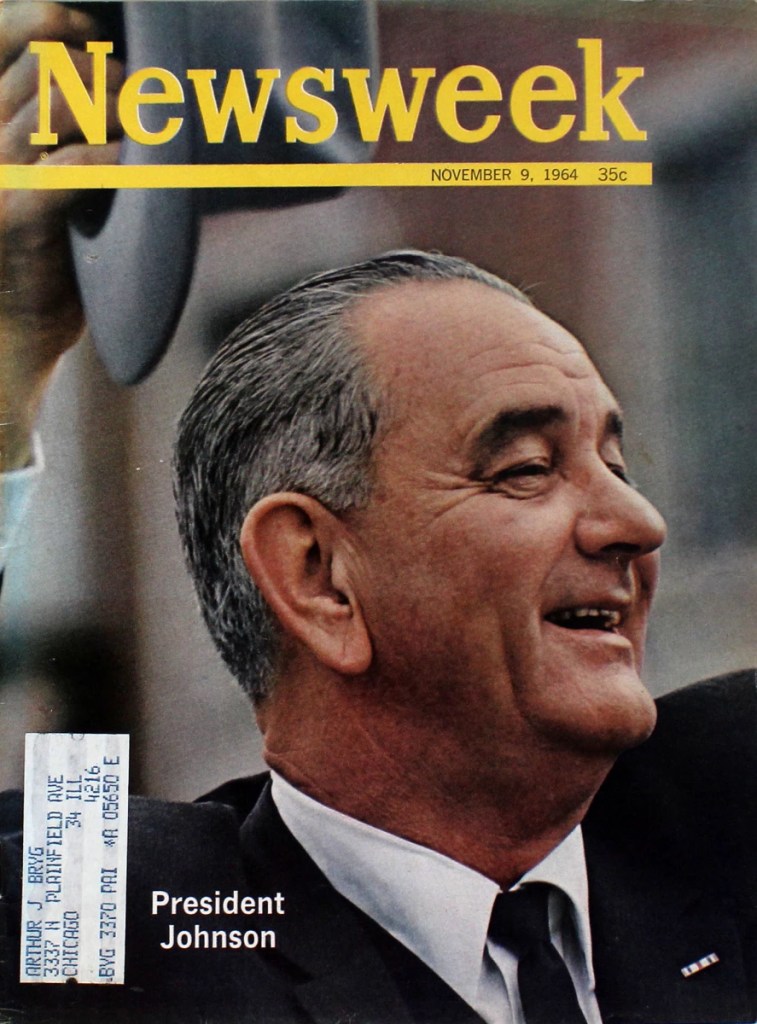
In his remarks the Prince took note disparagingly of the “so‐called reassuring election” of President Johnson. He said that the President would “probably never have the courage to admit to his people that the population of South Vietnam, which has not known peace for 20 years, has overcome its ‘fear of Communism’ and will accept even Communism provided the war stops.” He quoted Senator Barry Goldwater as having said that the third world war was already under way in South Vietnam, and remarked that the only American statesman who had “the courage to renounce the enterprise”in South Vietnam had now “tragically disappeared.”
Cambodia would “adopt a Communist regime if that could save the honor of our fatherland and the flag and protect our national borders,” the Prince stated. As thousands of soldiers, athletes and youth groups marched through the streets on a red carpet, five Soviet built MIG17 fighter planes flew overhead, followed by four jet trainers trailing pink and blue smoke. Prince Sihanouk also displayed 12 Soviet 76‐mm. artillery guns, several French tank destroyers and Chinese and Russian trucks pulling 37‐mm. anti‐aircraft guns.
Senator Goldwater made many statments during the recent Presidential election campaign about the war in South Vietnam, but a check of his speeches failed to turn up any specific comment that a third world war had started there. The Senator first used the phrase “We are at war” in a speech September 19 to a group near Buffalo, North Dakota He said then: “We are at war as certainly as the sun sets in the west.” But he did not limit the charge to South Vietnam. In fact, he described the enemy as Communism in general. He explained his meaning this way: “By following the course of confusion and dream‐world diplomacy, it [the Administration] allowed the greatest threat to American security of modern times to become a vivid and frightening reality.” joining the Communists if necessary.
South Vietnam has proposed that the United Nations name a jurist of interna tional reputation to try to settle the country’s dispute with Cambodia over border clashes. The proposal for a mediator was made in a letter to the Secretary General, U Thant, from Phan Huy Quat, Foreign Minister of South Vietnam. The letter expressed confidence that a mediator could find a solution and contended that the poorly defined frontier between the two countries was responsible for recent border incidents.
About 3,000 rice mill employes in Saigon went on strike today in demand of a 40 percent wage increase. Both the strike and heavy floods in central Vietnam, are expected to reduce rice supplies drastically.
Typhoon Joan struck South Vietnam quickly after Typhoon Iris (1964) and parts of North Vietnam, temporarily halting most Vietnam War operations and causing torrential rains and floods that would kill amore than 5,000 people. The floods affected 13 provinces in South Vietnam, with most of the dead in the Quảng Ngãi, Quảng Nam and Quảng Tín provinces.
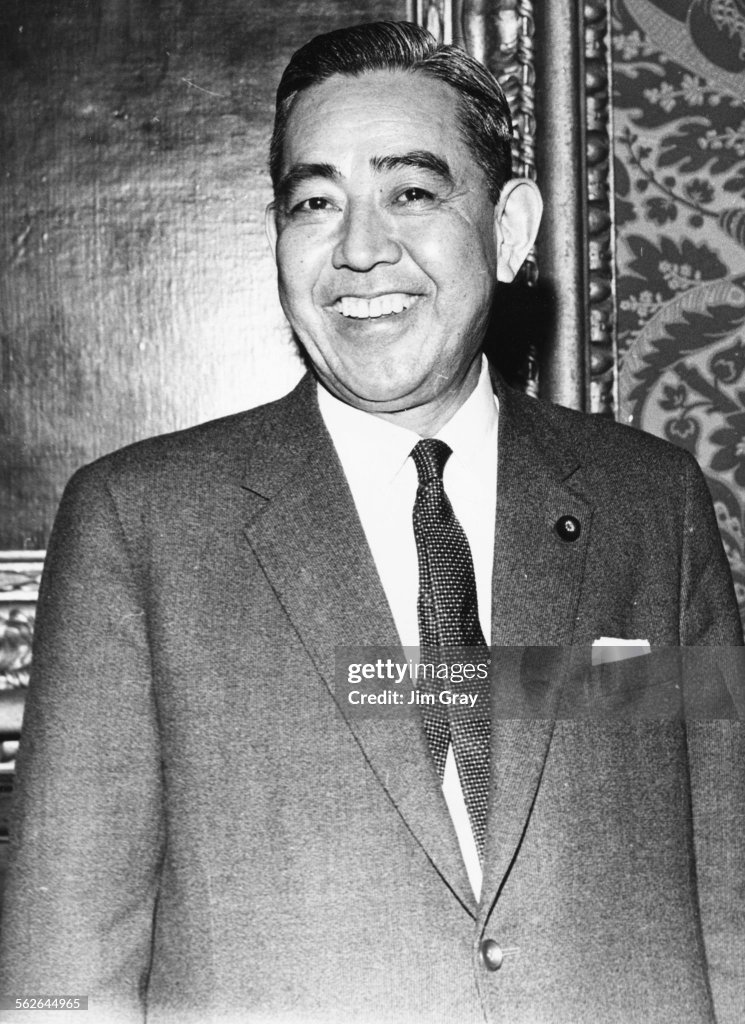
Eisaku Satō was sworn in as the new Prime Minister of Japan on the retirement of Hayato Ikeda due to ill health. In his inaugural speech, he pledged to bring the island of Okinawa, which had been under American control since Japan’s surrender in World War II, back to Japanese sovereignty. Acting with unexpected swiftness, Mr. Sato announced his new Cabinet a few hours after he was elected by the Diet with an overwhelming majority. He retained the entire Cabinet of his predecessor with two exceptions. As chief Cabinet secretary. an official who often acts as spokesman for the government, Mr. Sato named Tomisaburo Hashimoto, an experienced politician, in place of Zenko Suzuki. Shuzo Hayashi, chief of the Cabinet’s legislative bureau, was replaced by Masami Takatsuji.
Thousands of leftist demonstrators shouting anti‐United States slogans marched to Japan’s Parliament building tonight as Eisaku Sato was formally received as the new Premier by Emperor Hirohito. The demonstrators, estimated by authorities at 10,000, marched to the white stone Diet building and shouted “Yankees, go home!” They were protesting the scheduled calls of United States nuclear submarines at Japanese ports. About 500 riot policemen lined the marchers’ route from a nearby park, where they massed in a chilly rain, to the Diet building. Several hundred women accompanied the marchers, who were mostly students and union members. The gathering was led by members of the Communist party, who distributed leaflets demanding that the government reverse its decision to let the nuclear submarines come to Japan on recreational visits for their crews.
Soviet leaders continued today their consultations with representatives of 12 Communist countries, including Communist China. Leonid I. Brezhnev, First Secretary of the Soviet party, was host at a luncheon attended by both Chou En‐lai, the Chinese Premier, and Veljko Vlahovic, representative of the Yugoslav party. The Chinese and Yugoslav Communists have taken extreme positions on opposite sides of the ideological dispute within the Communist world. Mr. Brezhnev addressed the gathering. According to Tass, the official press agency, he proposed a toast to the “unity of the brotherly family of Communist countries” and “Communists of the whole world.”
Government and party leaders from Bulgaria, Czechoslovakia, Hungary, East Germany, Poland, Rumania, North Korea, North Vietnam, Mongolia and Cuba were present at the luncheon, as well as representatives of the Communist parties of Argentina, Bolivia, Ceylon, Syria and Uruguay. Exiled Communist leaders from Spain and Portugal, as well as Field Marshal Abdel Hakim Amer, Vice President of the United Arab Republic, and Hadj Ben Allah, a delegate from Algeria, were present. All the active members of the Soviet party Presidium and Secretariat attended.
Paul‐Henri Spaak, the Belgian Foreign Minister, sought today to tone down current talk of “crisis” in relations among members of the Atlantic alliance. Mr. Spaak commented in general terms after lunching with Secretary of State Dean Rusk and other high officials of the State Department. He said he was “convinced” that the six countries of the European Common Market would solve their present difficulty over agriculture, which finds France and West Germany arguing with each other over grain prices. The other members are Italy, Belgium, the Netherlands and Luxembourg. Military and nuclear problems dividing national viewpoints in the North Atlantic treaty organization “are more difficult,” Mr. Spaak said. But, he added, “it is not necessarily a crisis.”
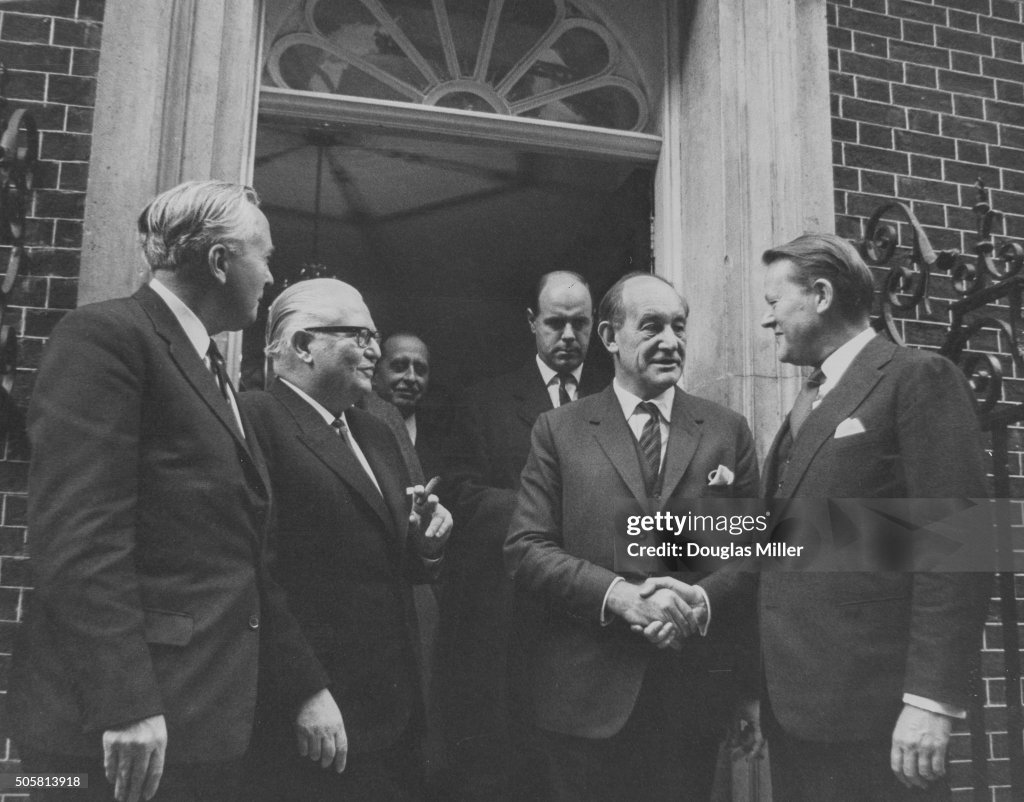
The new Labour Party government of Britain’s Prime Minister Wilson narrowly overcame a vote of no confidence, raised by the Conservative opposition in opposition to Labour’s plans to again nationalize the British steel industry. By seven votes, the Labor Government passed its first major hurdle of the new Parliament tonight. The motion failed, 300 to 307, in the House of Commons. The Conservative attack was in the form of an amendment to the government’s motion thanking Queen Elizabeth for outlining the government’s program in her address opening the session on November 3.
Melchior Wankowicz, a Polish‐American writer and lecturer, was convicted today and sentenced to 18 months in jail for distributing “false and slanderous” material against the Polish Government both in Poland and abroad. The 72‐year‐old defendant was given the minimum sentence of three years because of his advanced age and this was halved through application of a general amnesty decreed three months ago on the occasion of the 20th anniversary of the Communist regime in Poland. Mr. Wankowicz was allowed to go free until the sentence is formally ratified or appealed. This must take place within one to three weeks.
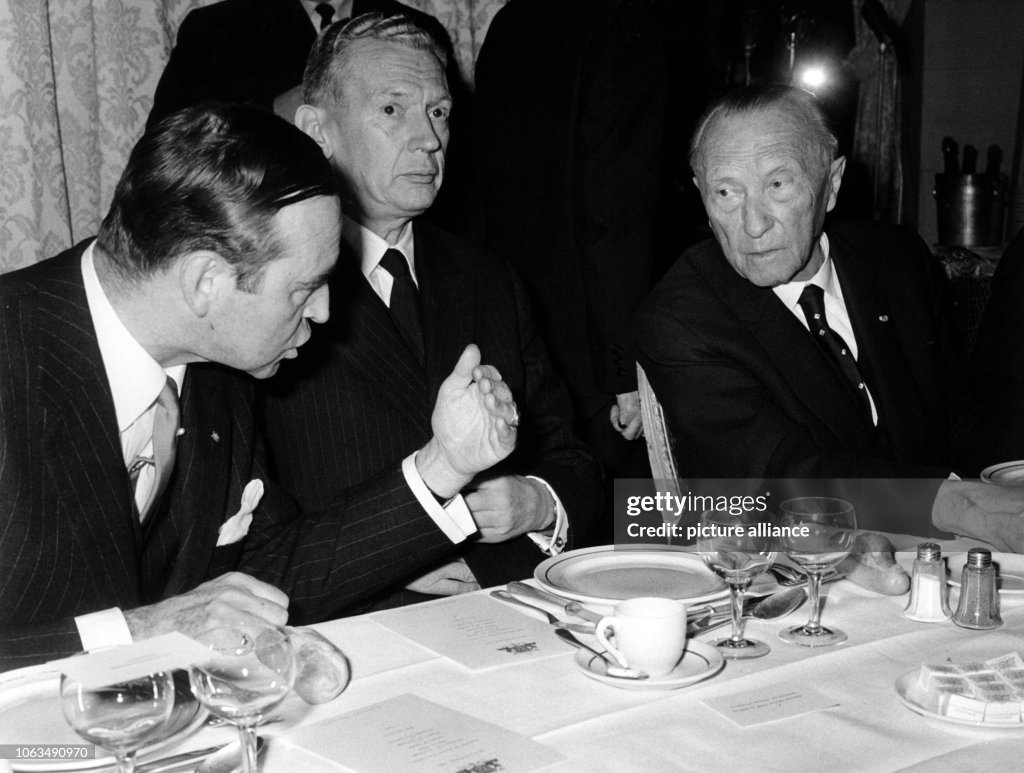
Dr. Konrad Adenauer, one of the architects of European unity, pleaded today for French and German “collaboration in the construction of Europe.” West Germany’s former Chancellor, erect, vigorous and confident at 88 years of age, addressed a gathering of France’s intellectual and political leaders, headed by President de Gaulle, at the French Institute. The leaders had gathered for ceremonies that installed Dr. Adenauer as an associate foreign member of the institute’s Academy of Moral and Political Sciences. While President de Gaulle, the Protector of the academy, sat apart in an armchair according to custom, his old ally in the cause of French and German friendship made a strong appeal for a reinvigoration of the two countries’ Treaty of Cooperation. Earlier, the former Chancellor, who is still a power within Bonn’s governing Christian Democratic Union, conferred privately with the French leader on means of healing the rift between their countries. Dr. Adenauer, as Chancellor, signed the treaty here in January, 1963, with President de Gaulle.
The Baathist Government in Syria is waging a nation‐wide psychological campaign against the Government of President Abdel Salam Arif of neighboring Iraq. Government‐organized demonstrations have been staged in Damascus and other Syrian towns since last Friday. Demonstrators took an oath to “continue the struggle until Arif falls.” Syrian propaganda organs are devoted almost entirely to attacking President Arif and his government. The Syrians accuse Mr. Arif of having jailed and tortured political leaders, mostly of Iraq’s underground. Baath Party. They also accuse his government of giving in to the “secessionist demands.”
The cease‐fire in Yemen is the most encouraging sign to date of an approaching end to the futile, wasteful struggle that has been upsetting the Middle East for two years. As it happens, the present solution is much the same plan the United States suggested when the revolt began that overthrew the monarchy. When the Imam was driven out of Sana in 1962 and a republic proclaimed, Yemen was the most backward — in fact medieval — nation of the Middle East. The revolution ended the country’s historic isolation under an autocratic priest-king and let in the “winds of change.” However, the winds were not strong enough to blow the monarchy away completely. Many tribes in the north remained loyal to the Imam. President Nasser of Egypt immediately jumped in with arms, men and money to support the republicans, while the then Crown Prince, now King, Faisal of Saudi Arabia did likewise for the royalists.
The Sudan’s 10‐day‐old civilian Government struggled to maintain order today against a reported “reactionary coup” by the army. Citizens swarmed into the streets in response to a radio appeal for a general strike in protest against the purported coup. The United National Front, the powerful coalition that has been backing the civilian administration, broadcast on the Omdurman radio last night that armored columns had moved out of the military barracks area in an attempt to seize power. The front called on the people to “rush into the streets to fight reactionary and imperialist elements.” Early today, a Government spokesman broadcast a denial of “rumors” of a military seizure.
Prime Minister Lester Pearson approved a minor revision of the new Flag of Canada before submitting it to the approval of Canada’s Parliament. Although George Stanley’s winning proposal of a red maple leaf on white background between two red bars remained the same, designer Jacques Saint-Cyr revised the number of points on the leaf from 13 to 11.
The South African Government has moved to crush a new subversive movement — the cult of the “little black box.” According to the Government, this insidious movement has “destroyed mighty empires” and is now seeking nothing less than “the destruction of white South Africa.” The cult consists of those who seek to bring television to So uth Africa. Its leaders are alleged to be Harry F. Oppenheimer, chairman of the powerful Anglo‐American Corporation, and other “mining interests.” The Government of Dr. Hendrik F. Verwoerd has firmly resisted pressure for television, known here as “the little black box” or “the bioscope [cinema] in a box.”
President Johnson began today a series of conferences at his LBJ Ranch with Cabinet members on national security affairs and budget making. Secretary of Defense Robert S. McNamara and Deputy Defense Secretary Cyrus R. Vance arrived at the ranch this afternoon and immediately began discussions of the military budget for the next fiscal year, beginning July 1, 1965. They will stay overnight and join in a discussion of foreign policy and national security matters tomorrow with Secretary of State Dean Rusk and McGeorge Bundy, special assistant to the President for national security affairs, who both arrive tomorrow.
Meanwhile, it was learned that Clark Clifford, a Washington lawyer and longtime confidant and adviser to Mr. Johnson, also arrived at the ranch today. His visit was not announced and its purpose was not disclosed. A qualified source said later, however, that Mr. Clifford had been studying a reorganization of the White House staff for Mr. Johnson, and that discussion of this subject was the probable reason for Mr. Clifford’s visit today.
White House sources, meanwhile, said the President believed that in the normal order of things the next budgetwould be between $103 billion and $105 billion. Last year his budget request was $97.3 billion. However, many observers doubted the President had any intention of letting his total requests reach up to $105 billion. It was felt that this was the top level from which he would begin cutting in the next few weeks.
Senator Barry Goldwater’s unsuccessful campaign for the Presidency ended with a surplus of $1.2 million, according to officials at Republican national headquarters in Washington. Presidential campaigns in modern times have usually wound up with a sizable deficit. The Republican leaders differed sharply yesterday over whether the accomplishment merited praise or censure. Mr. Goldwater and Dean Burch, the Republican National Chairman, have pointed proudly to the party’s unusual debt‐free position, without publicly disclosing how much money is on hand.
On the other hand, some party leaders contended that the Republican cause would have been better served if national campaign organizations had saved less and spent more on trying to elect Senators, Representatives and Governors.
Michigan Governor George Romney urged today consideration of a proposal that the Republican party hold a special national convention in 1965 to spell out a revised platform. The idea was offered Sunday by Attorney General Edward W. Brooke of Massachusetts on the National Broadcasting Company’s “Meet the Press” television program. Governor Romney said the proposal “has considerable merit.” “It’s an idea that should be explored,” he added. The Governor told a news conference he felt that if such a convention were held “party people throughout the country would elect the delegates to determine the party position or platform prior to the 1966 elections. ”
The U.S. Supreme Court put into effect today a Justice’s statement of 14 years ago that juries must be selected without any regard to color—that Blacks cannot be intentionally included or excluded. The tribunal did so in refusing to hear an appeal from a lower Federal court ruling that Louisiana had violated the rights of Woodman J. Collins, a Black. The grand jury that indicted Collins in the rape of a white woman was selected from a panel of 20, with six Blacks purposely included.
The tribunal, which has often made clear its belief that Blacks cannot be systematically excluded from juries, made no comment in refusing unanimously to hear Louisiana’s appeal from a holding that Blacks may not be purposefully included. This let stand a ruling by the United States Court of Appeals for the Fifth Circuit in New Orleans that relied in large part on a comment in a decision in 1950 by Justice Stanley F. Reed now retired. In that decision barring exclusion of Blacks from juries, he said: “An accused is entitled to have charges against him considered by a jury in the selection of which there has been neither inclusion nor exclusion because of race.”
The Supreme Court refused today to rule on whether Federal courts in Philadelphia should have interfered with the seizure by city authorities there of several thousand publications on the ground of obscenity. The United States District Court in Philadelphia had declined to act on protests by George Rosenbloom that he had a constitutional right to a judicial determination of obscenity before publications could be seized. The district court held it could not interfere with the state court function of determining obscenity, and its holding was affirmed by the United tates Circuit Court in Philadelphia. Mr. Rosenbloom was arrested October 1, 1963, on a charge of distributing obscene material. The police, allegedly without a warrant, searched his parked truck and confiscated magazines and paperback books. On October 3 and 4, 1963, the police obtained warrants and seized publications from his home and a storage area not connected with his home. Last May, Mr. Rosenbloom was acquitted of obscenity charges and some of his publications were returned to him.
A 1959 Congressional statute limiting the power of the states to tax interstate commerce survived its first major legal test today. The Supreme Court declined to review a Louisiana decision upholding the constitutionality of the statute. Nineteen states had joined Louisiana in asking the Court to hear the issue. The case thus ended as a significant victory not only for the 1959 law but also for the general proposition that Congress may lay down rules for state taxation of interstate commerce. There has been growing support for such rules to end confusion and duplication of state taxes. For many decades Congress avoided the whole question of state taxing powers and interstate commerce.
The Supreme Court denied today a request for an expedited decision on an appeal in‐ volving the constitutionality of the Public Accommodations Section of the 1964 Civil Rights Act. The request was made October 28 by Moreton Rolleston Jr., an Atlanta lawyer who is an official of the Heart of Atlanta Motel Corporation. The Court acted today on numerous cases, but made no mention of the Heart of Atlanta Motel case other than to note that Mr. Rolleston’s request was denied.
Former President Dwight D. Eisenhower has reversed his 1959 view that the United States Government should not promote birth control in underdeveloped countries. Five years ago General Eisenhower said that “as long as I am here” in the White House, the Government would not use foreign‐aid funds for this purpose. But yesterday it became known that the general, along with Harry S. Truman, the nation’s only other living former President, has agreed to serve as co‐chairman of the honorary sponsors council of Planned Parenthood‐World Population.
The move was announced by William H. Draper Jr., vice chairman of Planned Parenthood‐World Population, who was associated with the administrations of Mr. Truman, General Eisenhower and the late President John F. Kennedy. President Kennedy, Mr. Draper said, “ought to be given credit” for offering the first United States Government support for birth control as a means of coping with world population problems. Mr. Draper, an investment banker and retired Army Reserve general, said that former President Eisenhower had come to the conclusion that he had “probably gone too far” in opposing Government participation in such programs and now welcomed the chance to express his support for them.
Civil rights representatives and officials of the New York City school system met for four-and-a-half hours to discuss the Board of Education’s future integration plans. The meeting, which was agreed upon last Monday, was the first since discussions broke down last August. Some civil rights groups then charged that school officials were “dragging their feet” on integration. After yesterday’s session, Carl Fields of the New York Urban League, who served as spokesman for the other representatives, said that everyone was convinced of the board’s “serious intent to promote school integration.”
A 44‐year‐old New York man identified by the police as a member of the Mafia was found dead of a shotgun wound. He had been scheduled to appear a few hours later before a grand jury investigating an $88,000 gem swindle involving Carmine Lombardozzi, another Mafia figure. The police said that the man, Andrew K Alberti, was an apparent suicide. According to the medical examiner, he died of a shotgun wound oh the right side of his head.
Federal and state mediators announced today that a news conference will be held tomorrow concerning contract negotiations between Detroit’s strikebound daily newspapers and one of two striking craft unions. The two unions struck the afternoon Detroits news and the morning Detroit Free Press on July 13. The mediators’ announcement came after representatives of the newspapers had held a two-hour bargaining meeting with Local 10 of the Plate and Paper Handlers Union. Although neither side would comment on the session, observers said there were signs that a tentative agreement have been reached.
Mrs. Lyndon B. Johnson is beginning to catch up on her rest and work at the LBJ Ranch. The President’s wife visited the beauty shop in Austin today.
Dr. Bertram D. Cohn of the Maimonides Medical Center in Brooklyn applied for the patent to the earliest version of the inferior vena cava filter, beginning “[t]he modern era of limited surgical invasive prophylaxis” of pulmonary embolism” and would be granted U.S. patent number 3,334,629 on August 8, 1967; during the same year that Dr. Cohn’s patent was granted, Dr. Kazi Mobin-Uddin of the University of Miami would create the filter that “would be the first to gain wide acceptance in clinical use”, the “umbrella filter” because its six spokes opened to widen the inferior vena cava, the large vein that brings blood into the right atrium of the heart.
Victor Borge’s “Comedy in Music – Opus 2” opens at John Golden Theatre, NYC; runs for 192 performances.
Dean Chance, a 23‐year‐old right‐hander who was a big factor in helping the Los Angeles Angels move into the American League’s first division last season, was named today the winner of the 1964 Cy Young Award as the major league’s most valuable pitcher. Chance, involved in more close games than any pitcher in the last 31 years, received 17 of the 20 votes cast by a special committee of the Baseball Writers Association of America. Results of the annual balloting were announced by Hy Hurwitz, the secretary of the Association. Chance, who had a 20–9 wonlost record and led both major leagues in shutouts with 11, learned of his victory at his home in Wooster, Ohio.
Dow Jones Industrial Average: 874.57 (-2.3)
Born:
Robert Duncan McNeill, American actor (‘Tom Paris’ – “Star Trek: Voyager”), in Raleigh, North Carolina.
John Joseph Thomas, American actor (“Young Daniel Boone”), in Arcadia, California.
Sandra “Pepa” Denton, Jamaican-born American hip hop artist and part of the group Salt-N-Pepa; in Kingston, Jamaica.
Kevin Mmahat, MLB pitcher (New York Yankees), in Memphis, Tennessee.
Died:
Cecília Meireles, 63, Brazilian poet and educator





 History Diaries