[Ed: Thirteen minutes. What might have been different? Göring had little taste for the war in the west. How many lives might have been saved? It is unknowable, but the possibilities haunt me.]
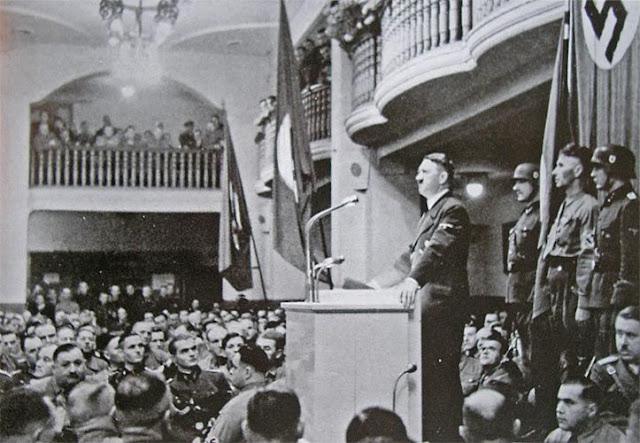
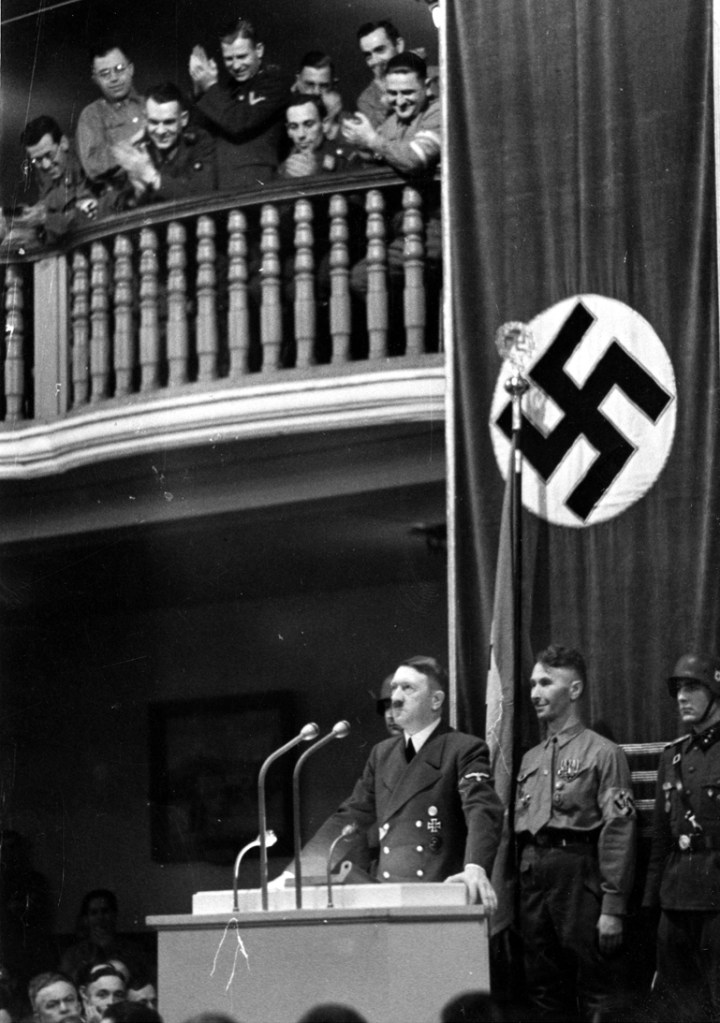
Hitler tells a meeting of “Old Fighters” in Munich, “What were the aims of Britain in the last war? Britain said she was fighting for justice. Britain has been fighting for justice for three hundred years. As a reward God gave her 40 million square kilometers of the world and 480 million people to dominate.” Hitler begins the speech 30 minutes earlier than usual to a packed house. He condemns the British as warmongers and for the first time predicts a five-year war. He can’t fly home due to the weather, so he leaves earlier than he might otherwise to board his train for the ride back to Berlin.
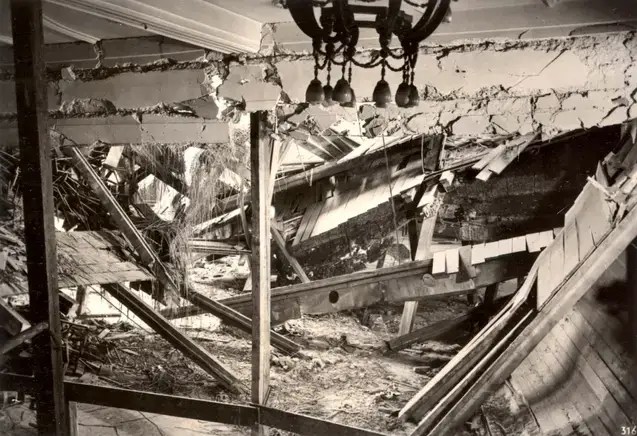
Thirteen minutes after Hitler concluded a speech at the Bürgerbräukeller in Munich on the 16th anniversary of the Beer Hall Putsch, a time bomb exploded near the speaking platform that killed 8 people. Hitler had cut short his speech and abruptly left shortly before the explosion. Eight are killed and sixty are injured in the blast. Hitler, of course by now is on the train.
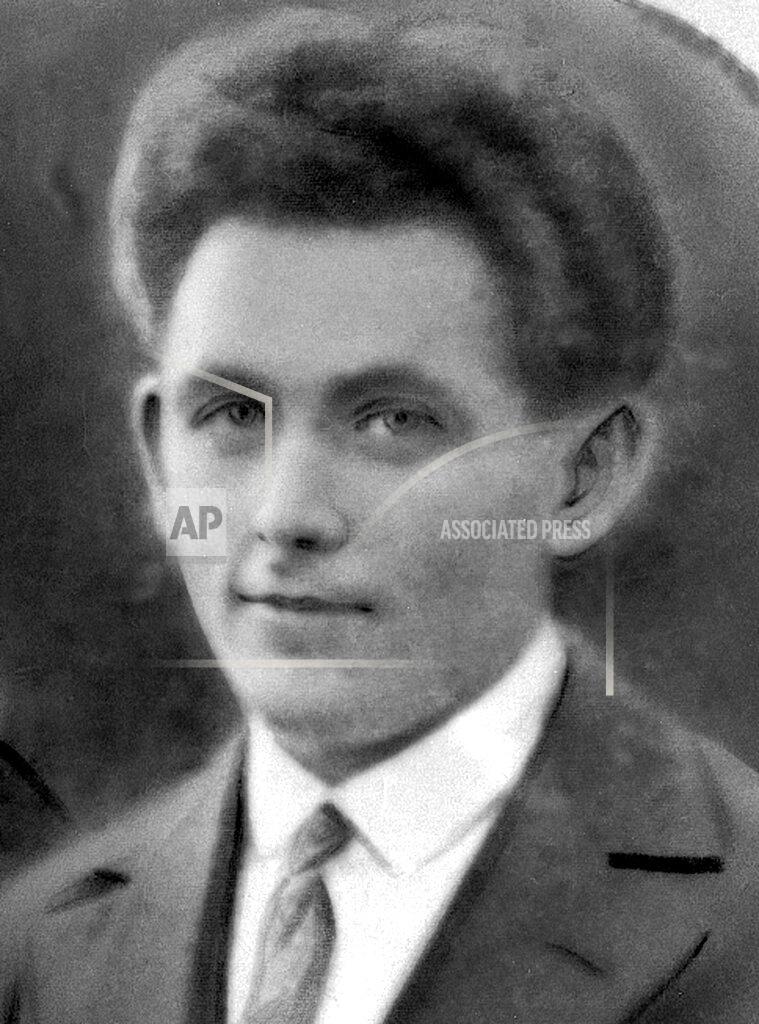
That night, border control at the Swiss border at Konstanz is unaware of the bombing. However, they detain a carpenter, Johann Georg Elser, from Württemberg, with what appears to be suspicious items (wire cutters, sketches of bombs, and a postcard of the interior of the Bürgerbräukeller). It is just odd enough for them to detain Elser, 25 paces from the Swiss border. During interrogation, news arrives of the attempt on Hitler’s life, and Elser is returned to Munich for interrogation. However, he remains one of many suspects, including the entire staff of the Bürgerbräukeller. The Nazis become convinced Elser is involved in a British plot with Otto Strasser, who was in Switzerland and returned to England soon after the explosion. His attempt to assassinate Hitler would have succeeded if the Führer’s annual speech had not begun 30 minutes earlier than it did in previous years.
Hitler rarely is in a specific public place at a specific time, varying times and places of visits with very little notice or none at all. The anniversary of the Putsch is a very rare exception. This unpredictability has been Hitler’s best defense against assassinations in the past, and it is the breakdown in this pattern which placed him in jeopardy. If the bomb plot had succeeded, Hermann Goering, who was not at the event despite being a Putsch veteran, would have acceded to power. Goering being a confirmed opponent to the conflict (but always bowing to Hitler’s wishes), the vast majority of World War II might have been averted.
The bomb is rumored by some to have been planted by the Nazis as an excuse for measures against what remains of the German opposition and as anti-British propaganda. There is no proof of this, and much evidence that supports Elser as the bomber.
Belgian King Leopold III revealed to Dutch Queen Wilhelmina that Belgium was aware of a German plan to invade the Low Countries, and it could be launched as soon as within a few days.
Reports of German movements on the Dutch border cause the government to widen the defensive flooding zone in Holland.
There are three minor German attacks along the Western Front.
A New Zealand fighter operates at extreme altitude over an RAF aerodrome in France and brings down a Luftwaffe reconnaissance plane.
Hans Frank, Governor of the General Government, in that part of former Poland occupied by the Germans but not annexed, takes office and consolidates plans to transport 600,000 Jews and 400,000 Poles from the incorporated territories in the General Government. The operation is to begin December 1st.
In early September 1939, a meeting had been arranged between a German refugee named Fischer and the British SIS agent Captain Sigismund Payne Best. Fischer’s real name was Morz, a former follower of Otto Strasser, who was coerced by threat of death to be an agent of the SD (Agent F479). Best was an experienced British Army intelligence officer who worked under the cover of a businessman residing in The Hague with his Dutch wife. Subsequent meetings included Major Richard Henry Stevens, a less-experienced intelligence operative who was working covertly for the British SIS as the passport control officer in The Hague. To assist Best and Stevens in passing through the Dutch mobilized zones near the border with Germany, a young Dutch officer, Lieutenant Dirk Klop, was recruited by Chief of the Dutch Military Intelligence, Major General Johan van Oorschot. Klop was permitted by Van Oorschot to sit in on covert meetings but could not take part because of his country’s neutrality.
At the early meetings Fischer brought participants who were posing as German officers who supported a plot against Hitler, and who were interested in establishing Allied peace terms if Hitler was deposed. When Fischer’s success in setting up the meetings with the British agents became known, Sturmbannführer Walter Schellenberg of the Foreign Intelligence section of the Sicherheitsdienst began to attend these meetings. Masquerading as a “Hauptmann Schämmel”, Schellenberg was at the time a trusted operative of Heinrich Himmler and was in close contact with Reinhard Heydrich during the Venlo operation.
On this day, Best, Major Stevens and Lieutenant Klop met only with “Schaemmel” (Schellenberg) at the Cafe Backus. Schaemmel said the general, who was to have come, had been called by Hitler to urgent meeting in Munich to consider an appeal for peace made by the Queen of the Netherlands and the King of Belgium. Schaemmel asked Best and Stevens to meet again on the following day at the same venue to enable the general to be present, adding that as an ‘attempt’ against Hitler was to be made on Saturday, the next day would be the last chance for a meeting.
Instead, the Germans will bring the talks to an abrupt end with the kidnapping of Best and Stevens.
British party girl Unity Mitford, one of Hitler’s pre-war favorites and a member of his inner circle, is in the hospital in Munich following a suicide attempt. She had shot herself in the head due to her conflicting loyalties upon the outbreak of war on 3 September 1939. Hitler genuinely cares for Unity and, before his big speech, goes out of his way to visit her. He pays her bills, then arranges for her safe conduct home to England and her family via Switzerland.
Winston Churchill, the first lord of the admiralty, stirred the House of Commons today with a rousing speech about the Royal Navy. The war at sea — the grim relentless death struggle that Great Britain’s navy is waging in the North Sea and the Atlantic against Germany’s submarines and surface raiders — made a gripping, dramatic story this afternoon as Winston Churchill, First Lord of the Admiralty, a master of narrative, unfolded it in the House of Commons, adapting the necessities of wartime secrecy to the storyteller’s art by spicing the tale with mystery.
His speech was not lacking in positive assertions or admissions of loss. Some time since the start of the war the British Navy’s submarine HMS Oxley, built for Australia and turned over to the Royal Navy in 1931, was destroyed by an “accidental explosion,” he disclosed, but he left his audience guessing as to where and when the disaster occurred and what happened to the 275-foot undersea craft’s normal complement of fifty-four men. The Admiralty announced later that four officers and forty-nine men were lost with the Oxley, The Associated Press reported.
With characteristic satire Mr. Churchill ridiculed the Germans’ claims that they had sunk the Hood, Repulse, Ark Royal and various other British warcraft, declaring that the Ark Royal had just captured an enemy ship. He could not resist saying in answer to German claims, he declared, that he would be “content to engage the entire German Navy, using only vessels which at one time or another they have declared they destroyed.”
The First Lord of the Admiralty declared that the submarine was being mastered and that “we may face the future with confidence.” Having assumed at the opening of his speech a share of blame for the loss of the Royal Oak at her anchorage in Scapa Flow, he avoided any suggestion of bombast or overconfidence. Still, his voice rang with the determination of a fighter when he said: “We shall suffer and we shall suffer continually, but by perseverance and by taking measures on the largest scale, I feel no doubt that, in the end we shall break their hearts.”
[Ed: And they shall, but it will take four long, terrible years. And as for the Oxley, her “accident” was actually “friendly fire”: She was torpedoed by another British submarine when she drifted out of her patrol area and did not respond to a challenge. One of those awful and unavoidable calamities of war.]
Germany’s demands that deliveries of Yugoslav goods be increased immediately has been refused by the Belgrade government, it was authoritatively stated here tonight.
Finland refused a Russian demand for territorial exchange. Finnish negotiators reject Soviet proposals for border revisions. The Finnish negotiators wish to accept some concessions but their government sees the Soviet attempts to bargain as a sign of weakness. Marshal Mannerheim opposes this view.
U.S. freighter Yaka is detained by the British and her cargo examined.
U.S. freighter Wacosta, detained by the British since 24 October, is released after cargo billed for delivery to Rotterdam, Holland, is seized as contraband.
U.S. freighter Exeter is detained by French authorities.
U.S. freighter Express is detained by British authorities at Gibraltar but is released the same day after her cargo is examined.
U-26 conducts a frustrated attempt to lay mines off heavily guarded Gibraltar.
Convoy OB.32 departs from Liverpool, OA.32G departs from Southend, SL.8 departs from Freetown, HXF.8 departs from Halifax.
The War at Sea, Wednesday, 8 November 1939 (naval-history.net)
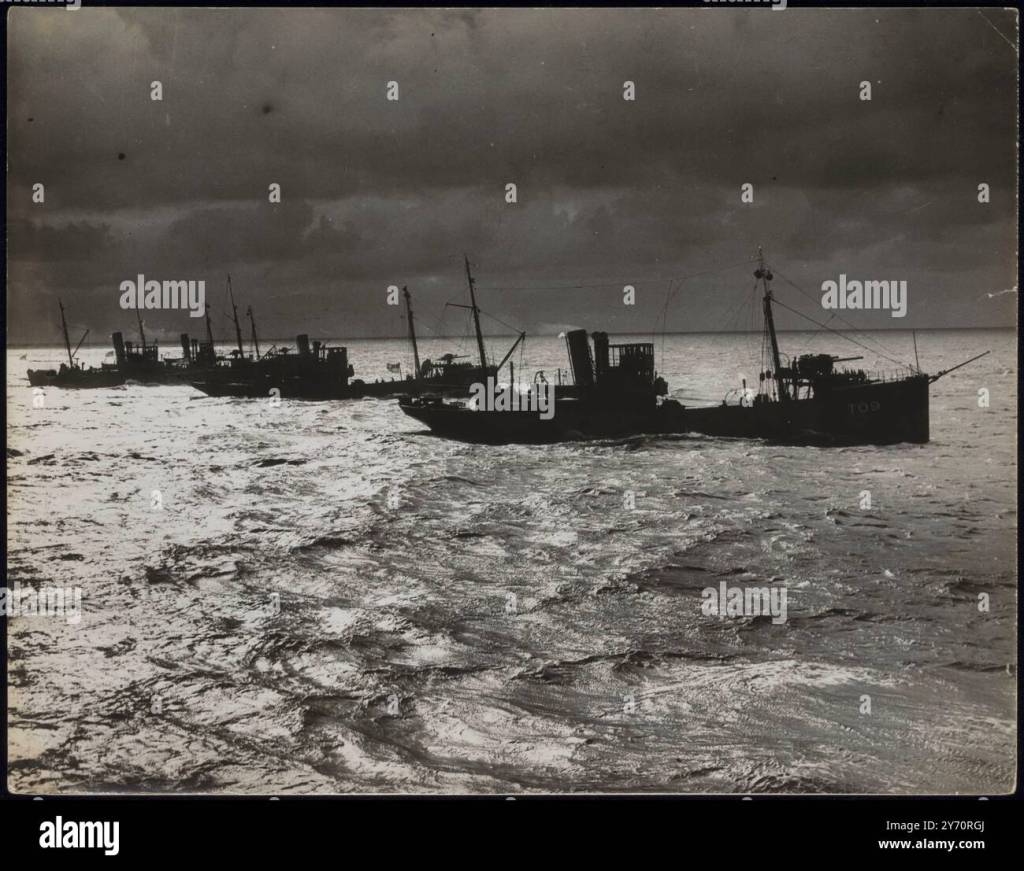
On Northern Patrol, were two cruisers between the Orkneys and the Faroes, three cruisers and one AMC between the Faroes and Iceland, and light cruiser NEWCASTLE and two AMCs in the Denmark Strait.
Light cruisers DUNEDIN, DELHI and DIOMEDE departed Sullom Voe. DUNEDIN and DELHI relieved light cruisers CALEDON and CERES which then returned to Sullom Voe on the 9th. DUNEDIN, DELHI and DIOMEDE all arrived at Loch Ewe on the 15th, DUNEDIN with rudder trouble and DIOMEDE with weather damage to her upper deck. DIOMEDE and DUNEDIN reported sighting a periscope in Yell Sound and DUNEDIN dropped a depth charge on the contact, after which destroyer KELLY searched unsuccessfully for the U-boat. Coast watchers reported a submarine in Yell Sound during the afternoon of the 9th and five destroyers were eventually detailed to search. As a result of these sightings, the Northern Patrol cruisers were ordered to use Loch Ewe instead of Sullom Voe.
Sloops GRIMSBY and FLAMINGO, on passage to Harwich, were searching for a submarine six miles ENE of Hartlepool.
Convoy OA.32G of 23 ships departed Southend escorted by destroyers VENETIA and WIVERN from the 8th to the 10th, and destroyers WAKEFUL and WHITEHALL from the 10th to 11th. On the 11th, the convoy merged with OB.32G, which was escorted by destroyers MACKAY and VIMY until the 11th, becoming OG.6.
Steamers DUNKELD (4944grt) and FERNPOOL in convoy SL.6B collided at 2350/8th. Destroyer WALPOLE escorted the damaged ships to Bristol Channel, and then returned to the convoy at 1530/9th.
Planned minelaying operations during the night of the 8th/9th in the Thames and 10th/11th in the Humber by German destroyers KARL GALSTER, HANS LÜDEMAN and HERMANN KÜNNE of the 5th Destroyer Division, FRIEDRICH ECKHOLDT and FRIEDRICH IHN of the 6th Destroyer Division, and PAUL JACOBI, THEODOR RIEDEL and HERMANN SCHOEMANN of the 2nd Destroyer Flotilla, were cancelled due to defects in KÜNNE.
Convoy HXF.8 departed Halifax at 1400 escorted by Canadian destroyers HMCS FRASER and HMCS ST LAURENT, which detached on the 10th. Ocean escort was armed merchant cruiser ASCANIA, which detached on the 19th and then returned to Halifax. The convoy was escorted in Home Waters by destroyers WINCHELSEA and WARWICK from convoy OB.35, and ACASTA and ARDENT from convoy OA.35 from the 19th to 20th. The convoy arrived at Dover on the 21st.
Aircraft carrier EAGLE, Australian light cruiser HMAS HOBART and destroyer WESTCOTT departed Singapore for Colombo on convoy duty, arriving on the 12th.
Sloops EGRET departed Durban and ROCHESTER from Aden, both to return to Home Waters, via Suez.
Destroyer DAINTY departed Gibraltar for refitting at Malta, arriving on the 10th.
Convoy SL.8 departed Freetown escorted by armed merchant cruiser CILICIA. On the 23rd, destroyers VANQUISHER, VERSATILE and WITHERINGTON from convoy OB.39 joined the convoy, which arrived next day.
French torpedo boats BALISTE and LA POURSIVANTE arrived at Gibraltar from Toulon, departing on the 9th for Casablanca.
After a quiet afternoon at his Dutchess Hill cottage in Hyde Park, New York, President Roosevelt left his family home late today and boarded a special train for Washington, where he is to decide soon on the proposed transfer of eight United States Line ships to Panama registry.
The Maritime Commission today prepared for President Roosevelt a requested report on the proposed transfer of eight vessels of the United States Lines to Panama registry in order to permit them to cruise through the North Atlantic combat area, from which American vessels are banned.
Secretary of Agriculture Henry A. Wallace reiterated today his belief that President Roosevelt should seek a third term. He said that he had not changed his mind since he expressed that opinion in San Francisco October 25.
Rejection yesterday of the “ham and eggs” pension plan in California and the old-age pension proposal in Ohio was regarded by members of the major political parties as indicating that the voters were turning away from socialistic proposals and that the pendulum had swung back to more conservative ideas. Aside from this, the election was held to have failed to point to any real popular trend. While the Republicans gained in some State elections over 1936 and 1938, when the Democrats won by large majorities, nothing was shown in the election. according to the view here, to encourage any type of politicians.
In Pennsylvania the Republican majority was greater than in the State-wide election of 1938 and the Republican vote for Mayor in Philadelphia surpassed that of four years ago. In New Jersey the Republicans also gained in their control of the Legislature. But these gains, said Democratic leaders here, could not be accepted as indicative of a loss of strength for New Deal policies. In neither Pennsylvania nor New Jersey, they asserted, had the State administrations measured up to the expectation of the voters and in Pennsylvania the Democratic party was divided and weakened by its espousal of C.I.O. policy in 1938.
John M. Hamilton, Chairman of the Republican National Committee, saw in the result a trend that pointed to a Republican victory in 1940 and an end to reckless and “crackpot government.” “Results in yesterday’s election generally confirm that the trend toward conservatism and sound government which became apparent one year ago still continues to mount,” Mr. Hamilton said in a statement. “Elections from the Atlantic to the Pacific reflect this fact.”
Three steps were suggested today by Senator Thomas of Utah, chairman of the Strategic Materials Committee, to stimulate the development of domestic resources. The need was shown clearly, he said, by results of the first attempts by the Treasury to purchase stockpiles of minerals necessary for national defense. He criticized the Securities and Exchange Commission for what he termed unnecessary restrictions on mining.
Senator Thomas pointed to the fact that the Treasury was able to buy only 30,000 tons of manganese when it called for bids on October 19, and he asserted that the country. faced a shortage of this mineral because of the current rate of steel production and the fact that most of our foreign sources of manganese had been cut off by the war. He said the best information available indicated that four times as much manganese ore was withdrawn from stocks on hand in October as was brought into this country.
As to the situation and the suggested remedy, Senator Thomas said: “One of the objectives of the Strategic Minerals Act was the stimulation of domestic sources of supply of these important minerals. To accomplish the real purposes of the Strategic Minerals Act, which authorized expenditure of $100,000,000 for necessary defense reserves, several steps should be taken.
“First, the Bureau of Mines should push ahead with its investigation of profitable sources of these minerals, such as manganese, chromium, tungsten, etc.
“Second, processes for making possible the use of low-grade ores should be investigated.
“Third, restrictions on mining development by the Securities and Exchange Commission should be lightened. This commission should serve to stimulate development of mining properties, rather than retard such development by undue restrictions.”
The Republic Steel Corporation lost its fight today before the Third Circuit Court of Appeals to have set aside an order of the National Labor Relations Board directing it to reinstate about 5,000 employes dismissed in the “Little Steel” strike of 1937 and pay them “lost” wages estimated at $7,500,000.
The U.S. Department of Agriculture forecasts an abundant supply of meat and dairy products.
A band of unidentified men attacked workers at a coal mine fifteen miles west of Greenville, Kentucky today, killing Robert Brown, construction superintendent, and wounding Brent Hart, president of the coal company.
Before more than 1,000 public officials, engineers and sandhogs, at the foot of East Forty-second Street, New York Mayor La Guardia pulled a switch at 11.40 A.M. yesterday setting off a blast of dynamite below the East River bed that holed through the $58,000,000 Midtown Queens vehicular tunnel.
More cars have sold in the first ten months of 1939 than during the entire year of 1938.
Sweden has contracted for about eighty fighting planes from the Republic Aviation Corporation at Farmingdale, Long Island, New York, it was learned yesterday. [These will be Republic P-35s.]
Howard Lindsay and Russel Crouse’s stage comedy “Life with Father” opens at Empire Theatre, NYC, later transferring to the Bijou, and then the Alvin Theatre; runs for 3224 performances.
The Japanese Foreign Office spokesman, commenting on American naval expansion plans, said today that “if such a plan is passed, we, as Japanese cannot remain indifferent.” “Statesmen on both sides of the Pacific should strive to avoid friction,” he said. “The Japanese are trying to keep Japanese-American relations as tranquil as possible, but passage [of a big American naval program] would result in changing the atmosphere in this country.” The spokesman said Japan was not concerned with reported Netherland-American negotiations that might lead to American defense of the Netherland East Indies.
Three of Japan’s biggest newspapers hammered at American policy toward Japan today in a journalistic “coincidence” that led observers to believe they were officially inspired. Indications were that projected conversations between Ambassador Joseph Grew and Foreign Minister Kichisaburo Nomura to clear up Japanese-American relations might begin in an explosive atmosphere. Asahi declared the United States was preparing both economic and naval pressure against Japan, Nichi Nichi poked fun at the United States repeal of the arms embargo and Yomiuri said it would be a “serious matter” if the United States attempted to “encircle Japan” by taking the Netherland East Indies under its protection.
As fears that the Netherlands will be forced into the European war increase, the Japanese press displays a sudden revival of interest in the future of the Netherlands’ rich Pacific colonies. The nationalist newspaper Kokumin, mouthpiece of the more extreme army elements, predicts an early war in the Pacific and it links Japan’s policy of consolidating her “new order” in China with future plans for controlling the Pacific. It informs its readers that the United States is weak because the American people lack spiritual force. Then, dealing with the future of the Pacific, Kokumin says:
“After the European war another war to acquire the South Seas’ resources will be fought in the Pacific and the Philippines and other South Sea islands will become the focus of contest among various powers. “In preparation for this situation Japan must urgently see that China becomes an independent nation with internal peace and order. If the United States persists in its present attitude of hostility toward Japan it is likely to be excluded from East Asia altogether.”
The rising interest in the area to the south is testified by the formation in Tokyo of an “Institute of the Pacific.” Its articles of association repeat Kokumin’s contention that the acquisition of the South Seas’ resources is inseparable from Japan’s continental policy. Like Kokumin the Institute foresees a “titanic battle” in the Pacific and proclaims that Japan, which has been awaiting its fate for the past 3,000 years, will play the leading role in that contest.
The Institute of the Pacific at present consists of a board of directors with a research staff. It has not appealed for members, but commands adequate funds for regular publication of the reports of its research staff. Yusuke Tsurumi, well known as a lecturer in the United States, is one of its leading figures. Kenkichi Yoshizawa, former Foreign Minister, is another. Kokumin declares today that Admiral Kichisaburo Nomura was selected as Foreign Minister for the purpose of adjusting relations with the United States and then proceeds to demonstrate that this effort must fail. It declares that American insistence on the settlement of 600 pending questions has wrecked any conversations between Admiral Nomura and Ambassador Joseph C. Grew at the start.
The United States, says Kokumin, is like a spoiled child. America conceitedly imagines, it declares, that her riches will make Japan desire her friendship. But Japan, it insists, can fight the China war without American supplies, while abundant resources will not assure American independence. “America’s sole strength lies in its ability to provide war materials,” it says. “Once its spiritual weakness is exposed, its strong gestures become comic.”
[Ed: Ah, you poor bastards. You do not understand. We will have to instruct you. No one in Japan will be laughing when B-san comes to visit in 1945.]
Dow Jones Industrial Average: 150.35 (-1.11)
Born:
Bernie Darre, NFL guard (Washington Redskins), in New Orleans, Louisiana (d. 2006).
Elizabeth Dawn, actress, in Leeds, England, United Kingdom (d. 2017).
Meg Wynn Owen, actress, in Wales, United Kingdom (d. 2022).
Laila Kinnunen, singer, in Vantaa, Finland (d. 2000).
Naval Construction:
The Nihon Kaigun (Imperial Japanese Navy) Kagerō-class destroyer HIJMS Nowaki (野分, “Autumn Gale”) is laid down by the Maizuru Naval Arsenal (Maizuru, Kyoto Prefecture, Japan).
The Royal Navy Lake-class ASW whaler HMS Windermere (FY 207) is commissioned. Her first commanding officer is Lieutenant Commander George Witheridge Couch, RD, RNR.


 History Diaries