The South Vietnamese Government bans the sale of the current issue of Newsweek because it carries a photograph showing a Việt Cộng prisoner being tortured by ARVN personnel. The Newsweek correspondent here, Francois Sully, said he was informed the issue had been prohibited because it contained an Associated Press photograph of a Việt Cộng prisoner being tortured.
The latest U.S. intelligence analysis claims that the Việt Cộng now number about 30,000 professional full-time soldiers, many of whom are North Vietnamese. It can no longer be claimed that the Việt Cộng is a movement of South Vietnamese simply opposed to the government.
On the 7th, the South Vietnamese Air Force raids a Communist stronghold near Biên Hòa; then some 1,200 ARVN troops push through the jungles in the area over the next few days, all part of the attempt to find the guerrillas that attacked the U.S. air base at Biên Hòa.
The accepted image of South Vietnam’s Việt Cộng guerrillas is one of fleet‐footed little men in black pajama uniforms, rising from nowhere amid the vast paddy lands to frighten local farm people. Faced with the war news, these days, that no longer seems to fit. Last Sunday these small round faces peering through the rice shoots managed to deploy six simple but powerful weapons, 81 millimeter mortars, virtually under the gaze of government security forces at Biên Hòa Airbase. In a 20‐minute barrage they devastated perhaps $25 million worth of sophisticated American jet aircraft. The image has long been only partially accurate, but it took the bold attack at Biên Hòa to force a new look at the nature of the Communist enemy in South Vietnam. In weaponry, in numbers and in organization, South Vietnam’s insurgents have become a formidable military and political force. Even the term guerrilla war seems inappropriate to much of the fighting in the country, though it is wrong to say the Việt Cộng are moving into Mao Tse‐tung’s third phase of insurgency, the phase resembling conventionl warfare in which a classic military triumph is possible.
There will be no Điện Biên Phủ, most analysts feel, for this time the Communists seek a subtler but equally thorough triumph through a ready‐made government apparatus waiting to surface. There exists in South Vietnam, an area the size of the state of Washington, a full‐time standing army of at least 30,000 professional rebel soldiers, well trained, well armed and well disciplined, according to cautious American intelligence analysis. A year ago, the Communist main force was estimated by the same analysts to be only two‐thirds that size though wide credence was given to higher unofficial estimates then as it is now. There are good arguments for dropping the term Việt Cộng in describing this standing army. The word was always pejorative — it means “Vietnamese Communists” — and is used only by Saigon and its allies, not by the Communists themselves. The more accurate term, in the view of observers here, is nothing less than the old Việt Minh, the Communist army that led the fight for independence against France, securing its adherents in the southern half of the divided nation before it went underground.
The pretense that the forces in South Vietnam were only local citizens rising up against the Diệm government or its successors has now been dropped in international discussion. The government built by the Việt Minh in Hanoi openly talks of “our struggle” and its military leaders acknowledge their share in the strategic direction of the South Vietnamese war. The numbers of North Vietnamese soldiers who have been dispatched to lead the fight in the South will perhaps be the most important military fact of this year. American intelligence officials are worlking on an over‐all survey of infiltration during 1964. The final estimate is expected to approach 10,000, five times the number of men who have entered the country clandestinely from the north in each of the years up to now. Increasingly the infiltrators are not just native southerners returning to their homes after a few years of training and Communist indoctrination. Intelligence officers have gathered what is considered conclusive evidence that North Vietnamese soldiers, members of the Việt Minh army, have been detached from their units in the north to command companies and battalions of what they call “liberation fighters” in the South.
Prince Norodom Sihanouk has appealed to President de Gaulle of France to try to prevent an attack that the Cambodian Chief of State said the United States and South Vietnam were mounting against his country. The Prince said his Government had information that a “large‐scale action” was being prepared by the two countries. In a letter to President de Gaulle, printed today in Le Matin, a French‐language newspaper, Prince Sihanouk called on France to “stop the dangerous evolution of a situation we neither created nor wanted.” The Prince warned that “the murder of our civilian population will not be permitted.” He said the United States was pursuing a course that “threatened the peace in Southeast Asia and even in the world.”
The Cambodian leader said the full responsibility rested with the United States and to a lesser extent with its “South Vietnamese confederates.” He wrote that “the American Force” bombed a frontier village last month, an apparent reference to attacks on Anlong Kres that Saigon has attributed to errors in map reading. “Information that we have at our disposal shows that the United States and the South Government are preparing an action on a large scale against our country,” the Prince added. Public statements by the 42-year‐old chief of state have grown steadily more critical of United States policy as his ties with Communist China have improved. In his message today the Prince said he was “convinced that history will justify our patience and our will to protect peace.” He termed France one of the “great powers that defend peace and justice.”
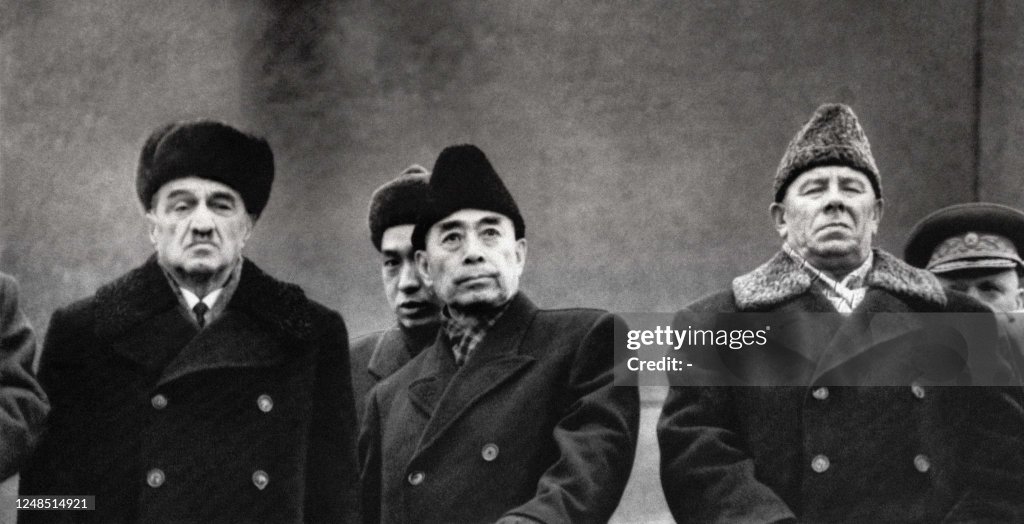
Soviet Communist Party leader Leonid Brezhnev attempted to mend relations with the People’s Republic of China by hosting Chinese Prime Minister Zhou Enlai and his advisers in Moscow on the anniversary of the Bolshevik revolution, the first celebration since the removal of Nikita Khrushchev as leader three weeks earlier. However, the position of China’s Mao Zedong (declared the same day in the party newspaper People’s Daily) was that reconciliation was not possible so long as the Soviets continued to appease “United States imperialism” and to attempt a peaceful co-existence with “the common enemy” of Communism. Another historian notes that any patching of relations “that had seemed possible after Khrushchev’s fall evaporated after the Soviet minister of defense, Rodion Malinovsky… approached Chinese Marshal He Long, member of the Chinese delegation to Moscow, and asked when China would finally get rid of Mao like the CPSU had disposed of Khrushchev.”
Peking gave prominence today to strong denunciations of President Johnson by high‐ranking Chinese Communists, who forecast that his Administration would pursue a “policy of aggression and war.” The remarks, by Peng Chen, a member of the Politburo of the party and Mayor of Peking, and Liu Ning‐yi, a Central Committee member, represented a striking contrast with a major policy address by Leonid I. rezhnev, leader of the Soviet Communist party, in the Kremlin last night. Mr. Brezhnev found comfort in the United States elections where Mr. Liu and Mr. Peng found none. Mr. Brezhnev said the elections had convincingly shown that a majority of the American people cherished the idea of peace, implying that President Johnson’s victory was a good thing. Mr. Liu and Mr. Peng saw no difference between the candidates and no good in the President’s triumph.
At the annual parade of new weapons through Red Square in Moscow, the Soviets displayed the first anti-ballistic missile, referred to as the ABM-1 Galosh by NATO and the A-350 by the Soviet military. The large new weapon — 60 feet (18 m) long, 8 feet (2.4 m) in diameter and driven by four motors, was described as being capable of destroying incoming missiles at great distances and “was an unexpected surprise to Western intelligence analysts.”
The leaders of the Communist world, in a show of unity, watched today as the Soviet Union displayed its newest and most powerful missiles. Premier Chou En‐lai of Communist China and leaders from 11 other Communist states stood with the members of the new Soviet regime on the Lenin Mausoleum as Soviet Army units towed 14 types of missiles across the cobblestone expanse of Red Square. In a message to the new Soviet leadership, Mao Tse‐tung and other Peking leaders called for Communist unity that would make the United States and other “imperialist” powers “shudder.” Marshal Rodion Y. Malinovsky, the Soviet Defense Minister, also introduced a harsh note into the celebration of the Bolshevik Revolution by denouncing the United States Secretary of Defense, Robert S. McNamara. Some observers termed today’s parade the most impressive in many years. Six of the weapons had not been shown before.
The most important of the weapons, experts believed, was a four‐engine missile, 60 to 65 feet long, enclosed in a cigarlike tube about eight feet in diameter. It was mounted on an eight‐wheel trailer. The missile was described as an antimissile missile by Tass, the Soviet press agency. Western experts agreed that the missile looked like an antimissile missile capable of reaching very high altitudes. Last year Soviet commentators at the parade marking the Bolshevik Revolution asserted that a new weapon was an antimissile missile. But that assertion was disputed by Western specialists.
Several hundred Soviet soldiers paraded today in front of General Ivan I. Yakubovsky, the commander of Soviet forces in East Germany, at the Soviet War Memorial in the British sector of Berlin. It was the first time that General Yakubovsky had attended a ceremony of this kind in West Berlin. The occasion was the 47th anniversary of the Bolshevik Revolution. The Soviet soldiers, brought from East Berlin in buses and staff cars, were accompanied by a party of diplomats and civilians, headed by Pyotr A. Abrasimov, the Soviet Ambassador to East Germany. The British temporarily removed the barbed fence that has surorunded the monument since the Communists divided East and West Berlin with a wall in 1961.
The controversy on whether India should produce her own atomic weapons erupted here today a meeting of the national committee of the ruling Congress party. The issue arose in discussion of a party foreign‐policy resolution that emphasized the need for disarmament, declared that “advances in science… should be exploited only for… peaceful development,” and advocated that “efforts be redoubled” to advance “peaceful uses of atomic energy.” Of 22 delegates who spoke in English and Hindi on the resolution, 12 proposed or supported amendments advocating development of an Indian atomic bomb. A larger number criticized India’s foreign policy as “weak” or “ineffectual.” Nowhere did the resolution specifically restate the renunciation of nuclear weapons that has been the policy of record in India.
Poland’s Communist leaders have accepted the removal of Nikita S. Khruschev from power in the Soviet Union with much greater calm and understanding than many of their colleagues eisewhere in Eastern Europe. Various reasons for this attitude are given by Poles in and out of the party. Among them is the belief of so‐called liberals here, who have warmly supported most Khrushchev policies, that Poland’s leader, Wladyslaw Gomulka, may learn from the events in Moscow to conduct a more orderly and less personal government and to pay more attention to the advice of his experts. Mr. Gomulka is said to be pleased by the opportunity to reduce the bitterness of the polemic inside the Communist world, especially bewteen Moscow and Peking.
According to Fidel Castro, the Cuban armed forces are in control of the surface‐to‐air missiles sent here in 1962 by the Soviet Union and are prepared to shoot at United States U‐2 reconnaissance planes if “legal means” cannot be found to put an end to their flights. Cuban missile crews, Premier Castro said, are fully trained and now man the weapons. In a six‐hour conversation with this writer, the Cuban leader insisted that enough Soviet military technicians were left in Cuba to form “a solid combat force” that would fight against any “actual invasion” of the island by the United States or “some other country instigated by the United States.” “I don’t mean something like the Bay of Pigs,” Premier Castro said. “I mean an actual invasion by the armed forces of the United States or by such another country.”
Several windows were shattered in the Soviet Embassy in Rome tonight when a small bomb exploded about 15 feet from the building. Embassy officials, who said they were acting on orders of Ambassador Semen Kozyrev, barred Italian policemen from the grounds when they arrived to investigate the explosion. The police said that as far as they could determine the bomb had been detonated in the embassy’s garden. They said there was no serious damage.
The world’s financial powers agreed today to the terms for extending $1 billion in aid to Britain because of her balance‐of‐payments crisis. In return, Britain gave assurances about plans for wiping out the payments deficit and especially about playing no favorites under her stiff new surtax on imports. The assurances on the surtax are likely to stir up new trouble among Britain’s partners in the European Free Trade Association, who claim favored status. The aid will come from the International Monetary Fund, probably in more than one installment and probably beginning this month. It will be a normal borrowing, but to finance it the Fund will tap a special $6 billion reserve arrangement for the first time.
Cyprus and East Germany signed a trade and payments agreement today that will cover exports by both countries, valued at about 360,000 British pounds (about $1 million), until the end of 1965, the Cyprus Government announced.
Britain’s new Labour Government has begun to take steps to improve relations with President Gamal Abdel Nasser, and its efforts have so far been well received here. Since the Suez crisis of 1956 and especially with the clash in interests in the Arabian Peninsula this year, there has been a decided chill in diplomatic relations between Cairo and London. In an effort to change the atmosphere, Foreign Secretary Patrick Gordon Walker has already sent a personal message to President Nasser asserting the Labor Government’s desire for “friendlier relationships with the Arab states and especially with Arab nationalism.”
The rebel Congolese regime in Stanleyville has declared that all Americans and Belgians behind rebel lines are prisoners of war, it became known today. A radio announcement by the rebel “President,” Christophe Gbenye, said this was in retaliation for “the bombings carried out by foreigners in liberated [rebel] areas.” There are 60 Americans, 800 Belgians and 500 other foreigners held hostage in territory controlled by the Congolese rebels. Government T‐28 fighter planes have been used to attack rebel‐held towns, such as Albertville and Uvira in the eastern region. Reliable sources said last month that the T‐28’s and six B‐26 American‐lent planes used by the Government were temporarily grounded. Mr. Gbenye also warned that the prisoner‐of‐war measure might be extended to include American and Belgian “allies” of the central Government.
Members of the Rhodesian Cabinet are spending the weekend studying the latest exchanges between Rhodesian and British leaders on the independence issue—exchanges that have put the heat back into this Central African problem. The question Britain has to settle is whether to give independence to this colony, where four million Africans are ruled by 210,000 Europeans. Lending urgency to the situation is the threat that if Britain will not give independence freely, the white Government will take it despite the political and economic consequences. After the mainly white electorate, 39 percent of which did not participate, had given Prime Minister Ian D. Smith an overwhelming vote in favor of independence yesterday, he sent a message to the British Government inviting the new Commonwealth Secretary, Arthur G. Bottomley, to Salisbury for talks.
Dressed only in a nightgown, the Countess of Lucan burst into the Plumbers Arms pub in Belgravia, London, just before 10pm on this day, screaming for help. The landlord said later that 37-year-old Lady Lucan was “covered from head to toe in blood” and shrieked: “Help me! Help me! I’ve just escaped from being murdered… he’s murdered the nanny.” The “he” in question, an inquest jury later decided, was Lady Lucan’s husband, Lord Richard John Bingham, Seventh Earl of Lucan. Armed with a piece of lead piping, he allegedly bludgeoned to death Sandra Rivett, the 29-year-old nanny who cared for his three children, mistaking her for his wife, Veronica. He then tried to kill Lady Lucan, police claimed.
Lucan was in the middle of a bitter drawn-out battle with his estranged wife over custody of their children. He disappeared immediately after the attacks and nobody has officially seen him since, apart from a friend, Susan Maxwell-Scott. It was established that after Lady Lucan raised the alarm her husband drove 45 miles to Uckfield in East Sussex, where his close friends, Ian and Susan Maxwell-Scott, lived. Ian was away but Susan invited in her dishevelled visitor. She said later he told her he was passing by the house when he saw Veronica being attacked by a man. He let himself in but slipped in a pool of blood at the bottom of the stairs. He told Mrs Maxwell-Scott that the attacker ran off, and that Veronica was “very hysterical” and accused him of having hired a hitman to kill her.
The car that Lucan had used to reach Uckfield was later found bloodstained and abandoned at the nearby port of Newhaven, from where ferries sailed regularly to France. A warrant for the peer’s arrest, to answer charges of murdering Sandra Rivett, and attempting to murder his wife, was issued on 12 November 1974. In his absence, an inquest jury later decided that the cause of Ms Rivett’s death was “Murder by Lord Lucan.” In Britain, interest in the case has scarcely dwindled over the decades and there have been many reported sightings of Lord Lucan in countries including Portugal, Ireland, Australia, South Africa, Mozambique and New Zealand. Lord Lucan was legally declared dead in 1999 and a death certificate was issued in 2016. Susan Maxwell-Scott, the last person officially to see him alive, died in September, 2004, taking any secrets she might have held to the grave. The disappearance of Lord Lucan is one of the great unsolved mysteries of British criminal history.
Who voted for Senator Barry Goldwater for President? This question emerged last week as a serious one for political analysts, especially for those of the Republican party, which must now struggle to rebuild its ranks and heal its wounds. To accomplish this, the party must reassess its friends and opponents. A broad statistical sketch of Goldwater voters — obtained from computer vote analysis and opinion‐poll data — discloses four main types under a general heading of “hard core Republican.” Not all of Mr. Goldwater’s supporters were Republicans, but a large majority were. And not all his supporters fit into the categories.
However, assuming a “largely Republican” distribution of party allegiance, other statistical characteristics indicate that the average Goldwater voter was white. In the cities and towns, he was a young man on the rise professionally and financially. On the farms he was distinctly Southern. Among the aged, he was financially independent, reasonably secure without the help of Social Security. And among low‐income persons, he was a rarity. Following one of the greatest and most unusual election defeats in Presidential history, many officials of both parties agreed last week that the overwhelming national consensus expressed in Tuesday’s voting was not simply a tribute to President Johnson’s popularity as a national leader.
It was also, they said, a public assertion that Mr. Goldwater, on the basis of his campaign, was unacceptable to a huge majority of the electorate as an aspirant for the highest office in the land. Polls indicate that, partly for this reason, at least 2 million persons who otherwise would have voted refrained from voting, and that many — perhaps most — were Republicans. There was also evidence that many Republicans voted in local contests but left the top of the ballot blank.
The issue of post‐election control of the operating machinery of the Republican party is complicated this year by a major factor that was created by the widespread defection of Republicans in state office and candidates therefor. Consequently, the issue has quickly centered on whether these defectors shall take the leadership of the reorganization and in shaping the political philosophy of the party in the next four years.
Senator Barry Goldwater, who suffered the heaviest defeat of any Presidential nominee, was the first to invoke this central issue at his news conference the day after the election. His announced intent to devote himself “to the leadership and strengthening of the party” on conservative lines was promptly challenged by prominent defectors from the 1964 national ticket, with clear indications that they propose to take charge of the reorganization themselves.
Their attitude, which was immediately challenged in turn by former Vice President Richard M. Nixon, the most active and distinguished of the “loyalists” in the campaign, is the element which has added the special and inflammatory complication to the usual problem of how to rebuild a badly‐defeated party into an effective Opposition. This dispute was thrust into the open with unusual rapidity, by Nixon’s statement that party “dividers” and “spoilsports” (foremost in which category he named Governor Nelson A. Rockefeller of New York) cannot successfully assume the post‐campaign role of national leadership. And the controversy is concentrated in two aspects of professional politics — the ethical and the practical.
The ethical question raised is whether one who fully participates in the decision‐making of a party convention — conducted strictly according to the party rules — is not bound in honor to abide by these decisions for the duration of the campaign. The practical question raised, and to this Nixon confined his news conference comment, whether full participants in the decision‐making at San Francisco who defected from the party ticket, or were otherwise deliberately “divisive” of the party, can effectively lead its reorganization.
New York Representative John V. Lindsay called yesterday for the rebuilding of the Republican party by young Republicans of moderate views across the country. He said that Senator Barry Goldwater, the defeated Presidential candidate, should have a voice in this process, but that “obviously the leadership of the party will be emerging in other areas.” Ultimately, he declared, Dean Burch, Republican National Chairman, would have to resign. “I think it will happen in due course,” he added. “But I am not calling for his resignation. I am just saying we need new leadership.”
Governor George C. Wallace’s hope of becoming a national political leader has been dealt a severe blow by the outcome of Tuesday’s election, both nationally and in his own state. This is the consensus of all political factions here as the white backlash failed to materialize outside the Deep South and as Republicans gained in Alabama. Mr. Wallace, who made a good showing in three Democratic Presidential primaries in the North last spring, thad planned Ito start a nationwide campaign against Supreme Court rulings affecting the public schools immediatelv after the election.
President Johnson has asked Douglas Dillon to remain indefinitely as Secretary of the Treasury, informed sources said today. Mr. Dillon is restless for a change after four years in the post but he has made no decision, the sources said. The 55‐year‐old Republican has held a variety of jobs in international affairs and finance since he entered government under President Dwight D. Eisenhower in 1953. After the assassination of President Kennedy, Mr. Dillon told Mr. Johnson he would stay until the new Administration was well established. During the Presidential campaign, he said he considered himself a liberal Republican and he openly attacked policies recommended by Senator Barry Goldwater, the Republican nominee. The Secretary believes that good progress has been made in bolstering the domestic economy and stemming the flow of dollars abroad.
President Johnson underwent a partial medical examination today and had a tooth filled. The associate White House press secretary, Malcolm Kilduff, said the results of an electrocardiograph examination and a chest X‐ray were normal and that the President’s health was good. Mr. Johnson stopped at the Air Force School of Aerospace Medicine at Brooks Air Force Base near San Antonio while on his way to the ranch of Governor John B. Connally Jr. near Floresville, about 30 miles southeast of San Antonio. “The President had a simple dental restoration (filling) while at the School of Aerospace Medicine. A routine electrocardiogram was done. Eyes were checked, and a routine chest X‐ray was accomplished. The electrocardiogram and X‐ray of the chest were normal. The maxillary upper left first molar was restored.”
The American Federation of Teachers, a militant union‐affiliated organization, has reversed its stand on Federal aid to education and now favors Government support for parochial as well as public schools. The new position was announced yesterday at a testimonial luncheon at the Americana hotel for Charles Cogen, president of the 100,000‐member A.F.T. and former head of the United Federation of Teachers in New York. Mr. Cogen was elected president of the parent group last August after holding the local presidency for 12 years. The new stand places the A.F.T. more firmly than ever in opposition to the 900,000-member National Education Association, which has steadfastly opposed federal aid to private schools. The N.E.A. looks also with disfavor on teacher unions.
More Black criticism was directed yesterday at the Police Department’s exoneration of Lieutenant Thomas R. Gilligan in the fatal shooting of a Black youth last summer. Black leaders renewed demands for an independent civilian board to review complaints of police brutality. They said “there was never any doubt” that the department’s own review board would clear Lieutenant Gilligan of wrongdoing in the killing of 15‐year‐old James Powell in Yorkville on July 16. Such a decision, they said, was expected after a New York County grand jury had cleared the white police officer on September 1 of any criminal liability. The Powell slaying touched off six nights of rioting in Harlem and the Bedford‐Stuyvesant section of Brooklyn. One person was killed, 118 were injured, and 465 men and women were arrested.
The New York representatives of Elijah Muhammad’s Black Muslim movement are awaiting with concern the return of Malcolm X from Mecca, Saudia Arabia, where the defector was endorsed by the World Muslim Council. Henry X and Joseph X, the New York representatives of Elijah Muhammad’s movement, have denounced Malcolm as a “self-erving hypocrite consumed by a passion for personal power” over America’s 20 million Blacks. In a recent letter from Mecca to a New York friend, Malcolm said he would open an official Muslim Center in New York with the support of the World Muslim Council. The council, he wrote, had promised to send certified teachers, and to provide 15 scholarships for Americans to study at the Islam University in Medina, Saudi Arabia.
The United States Supreme Court was described yesterday by Msgr. John Paul Haverty, Secretary of Education in the Roman Catholic Archdiocese of New York, as the “greatest evil in the country today.” Monsignor Haverty attacked the Court in a talk to 200 teenagers attending a workshop that took up the issue of obscene literature. The meeting was one of several being conducted at the Catholic Youth Organization’s annual two‐day convention in the Commodore Hotel. “The thinking in the Supreme Court is all off‐center,” Monsignor Haverty declared, and added the Court could be modified only if its membership was changed.
A national crusade to save the giant California condor was opened in Tucson, Arizona today by the National Audubon Society. The bird has a wingspread that sometimes exceeds 11 feet. Such pioneers as members of the Lewis and Clark expedition knew it as the royal vulture. To many Indians it was a deity, sometimes called the thunderbird. They believed it was so big that the flapping of its wings made thunder.
With their home attendance below 800,000 for the past 2 seasons, the National League orders the Braves to stay in Milwaukee in 1965, but permits a move to Atlanta in 1966.
Born:
Dana Plato [as Dana Michelle Strain], American child actress (‘Kimberly Drummond’ – “Diff’rent Strokes”), in Maywood, California (d. 1999)
Gill Holland, Norwegian-American producer (“Hurricane Streets”), in Chapel Hill, North Carolina.
Liam Ó Maonlaí, Irish vocalist and pianist (Hothouse Flowers – “I’m Sorry”), in Monkstown, County Dublin, Ireland.

 History Diaries