Sonderaktion Krakau: German occupation forces in Poland arrested the professors of University of Krakow. One hundred and eighty-three professors of Jagiellonian University in Kraków were arrested by the Nazis. 168 of them were sent to Sachsenhausen concentration camp. Soon after the establishment of the German occupation of Poland, following the invasion of Poland, on 19 October 1939, the Senate of the Jagiellonian University decided to open the university for a new academic year, which was to start on 13 November. This decision was communicated to German occupation authorities, who did not express objections. However, on 3 November, the Gestapo chief in Kraków SS-Obersturmbannführer Bruno Müller, commanded Jagiellonian University rector Professor Tadeusz Lehr-Spławiński to require all professors to attend his lecture about German plans for Polish education. The rector agreed and sent an invitation throughout the university for a meeting scheduled at the administrative center building in the Collegium Novum (entrance pictured). On 6 November 1939, in lecture room no. 66 (currently no. 56) at noon, all academics and their guests gathered; among them, 105 professors and 33 lecturers from Jagiellonian University (UJ), four from University of Economics (AE) and four from Lublin and Wilno. There were also 34 professors and doctors from University of Technology (AG), who did not intend to start the academic year, and attended their own meeting in a different room.
The academics filled the hall but no Vortrag (lecture) on education was given. Instead, they were told by Müller that the university did not have permission to start a new academic year and that Poles were hostile toward German science and acted in bad faith. They were arrested on the spot by armed policemen, frisked, and escorted out. Some senior professors were kicked, slapped in the face (Stanisław Estreicher) and hit with rifle butts. An additional 13–15 university employees and students who were on site were also arrested, as well as the President of Kraków, Dr Stanisław Klimecki who was apprehended at home that afternoon.
All 184 persons were transported first to prison at Montelupich Street, then to barracks at Mazowiecka, and — three days later — to a detention center in Breslau, Germany (now Wrocław, Poland), where they spent 18 days split between two prison facilities: the detention center (Untersuchungsgefängnis, at the Świebodzka 1 Street), and the Strafgefängnis penal complex at Kleczkowska 35. The Gestapo were unprepared for such a large transfer of prisoners, and awaited permission to send them to Buchenwald concentration camp. However, that was filled to capacity and so, on 27 November 1939, at night, they were loaded onto a train to Sachsenhausen concentration camp located on the other side of Berlin, and in March 1940, sent further to Dachau concentration camp near Munich after a new batch of arrested younger academics arrived.
Following loud international protest by prominent Italians including Benito Mussolini and the Vatican, 101 professors who were older than 40 were released from Sachsenhausen on 8 February 1940. Additional academics were released later. Some elderly professors did not survive the roll-calls, held three times a day even in ice and snow, and the grim living conditions where dysentery was common, warm clothes rare and food rations scarce. Twelve died in the camp within three months, and another five within weeks of release. Three professors of Jewish origin were separated and later were murdered or died of other causes: (Leon Sternbach, Wiktor Ormicki and Joachim Metallmann ). Among the notable professors who died in the camp were Ignacy Chrzanowski (UJ; 19 January 1940), Stanisław Estreicher (UJ; 29 December 1939), Kazimierz Kostanecki (UJ; 11 January 1940), Antoni Meyer (AGH; 24 December 1939) and Michał Siedlecki (UJ; 11 January 1940, after roll-call). In March 1940, the able prisoners from Kraków who remained alive were sent to Dachau concentration camp and most released in January 1941 on intervention. The last one, Kazimierz Piwarski, was released in late 1941.
Many of those who went through Sonderaktion Krakau and the internment formed an underground university in 1942 in defiance of the German punitive edicts. Among the 800 students of their underground college was Karol Wojtyła, the future Pope John Paul II, taught by Professor Tadeusz Lehr-Spławiński among others.
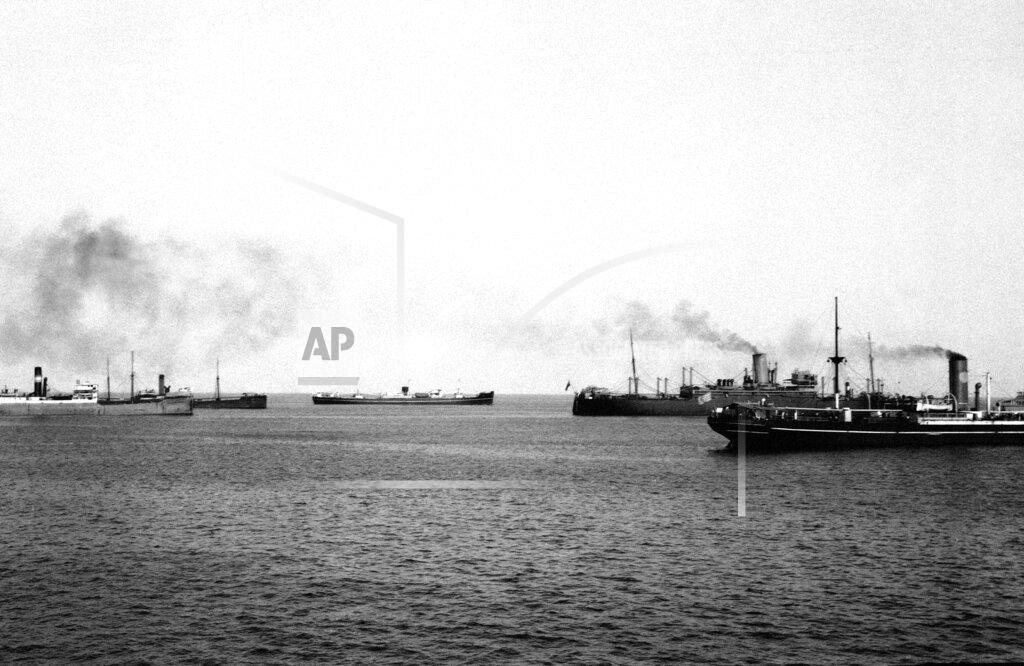
With her German prize crew interned by the Norwegians, the captured U.S. freighter City of Flint is handed back to her Master, Captain Gainard, and sails under ballast to return to the United States. Captain Joseph H. Gainard, in Norway, told today how his U.S. cargo ship, City of Flint, was taken by the German armored ship Deutschland. A party from the Deutschland came aboard on 9 October and declared the ship a prize of war. The Germans painted out all U.S. insignia and headed for Murmansk in Russia, and then for Germany. But the Norwegian Navy stopped them, and another German ship ordered them to Haugesund where the U.S. ship was returned to her captain.
The requirement that the Jews of Warsaw live in a ghetto is temporarily suspended.
The death penalty was decreed in Berlin today for persons attempting to undermine the morale of soldiers, for desertion, and for looting. Invoking military law for those offenses, Colonel-General Wilhelm Keitel of the Army High Command said those convicted in “less serious” cases of trying to undermine the morale of troops would be imprisoned fifteen years to life. In “less serious” cases of looting, he added, a prison or penitentiary sentence, also may be imposed.
The Reich Food Ministry announced today increases in the rations per person that may be bought for the month of December of 250 grams of meat, 250 grams of butter, six eggs and 375 grams of rice. For the four months beginning November 20 the purchasable meat ration will he increased by 125 grams monthly, or about 60 grams more a person each week.
Repeal of the arms embargo by the United States is being deprecated or soft-pedaled today by the Berlin press, which publishes comments showing such a strong similarity of outline that the purpose of the comment by Propaganda Minister Joseph Goebbels on Saturday is clearly evident.
Himmler departs for Munich to prepare for the annual Blutzeuge celebration to commemorate the 1923 putsch.
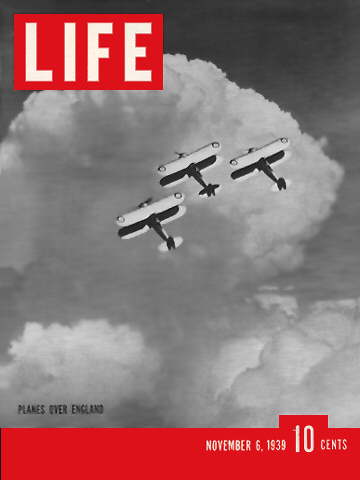
In the first large air battle over the Saar in northwestern France, 9 French Curtiss P-36 Hawk fighters shot down 4 out of 27 German Messerschmitt Bf 109E. There have been numerous uneventful air reconnaissance patrols by both sides over the other’s territory, and today, 6 November 1939, one of those erupts into the first massive dogfight of the war. Nine Curtiss P-36 Hawks are escorting a Potez 637 reconnaissance plane when they are bounced by what the French estimate as 27 BF 109 Ds between the Maginot and Siegfried lines in the Saar. In the resulting melee, eight Messerschmitts go down (four crash-land and, of the eight, seven are behind French lines) and one Hawk piloted by Lt. Tremolet crash-lands in French territory.
The P-36 is generally inferior to the Messerschmitts. It only has four 7.5 mm Browning machine guns, whereas the Bf 109s have two 7.92 mm MG 17s plus 2 wing-mounted 20mm cannon.
Meanwhile, the RAF announces that it has performed successful reconnaissance flights over western Germany. One aircraft is lost.
Seven invasion routes are indicated in the west. The terrain will determine Nazi choice; the French believe that they have prepared appropriately.
King Leopold of Belgium sees the British Queen on war matters. The Belgian-Dutch position in case of an offensive is believed to be the subject.
Finns draft a reply to Soviet demands; 150,000 square miles of border land plus Hango is believed to be the subject of talks.
In a speech, Molotov says that the Soviet Union is committed to a policy of peace and blames the war on the forces of capitalism. Meanwhile, the Communist International issues a manifesto in which the German Government is classed with those of Britain and France as being hostile to the workers.
The BBC radio broadcasts the classic drama “The Adventures of Sherlock Holmes “The Bruce Partington Plans” starring film stars Basil Rathbone and Nigel Bruce.
The Norwegian cargo ship Hansi ran aground in the Orkney Islands, United Kingdom and was wrecked. All crew survived.
The German merchant ship Uhenfels is intercepted by the British aircraft carrier Ark Royal and scuttled by own crew.
The Admiral Graf Spee is in the Indian Ocean near Madagascar.
U-21 encountered the British submarine HMS Sealion in the North Sea. The Sealion fired six torpedoes at U-21, but all missed.
Freighter Exminster, detained at Gibraltar by the British since 1 November, is released without any confiscation of cargo.
U.S. freighter Exeter is detained at Gibraltar by British authorities. She is released the same day after 700 bags of U.S. mail are removed from the ship .
Convoy OA.31 departs from Southend. Convoy OB.31 departs from Liverpool. Convoy HG.6 departs from Gibraltar.
The War at Sea, Monday, 6 November 1939 (naval-history.net)
Destroyer KHARTOUM (Cdr D T Dowler) was completed. Following working up at Portland, she joined the 5th Destroyer Flotilla operating with the Home Fleet on 1 December.
Destroyer AFRIDI, whose defects were repaired in the Tyne, departed the Tyne and arrived at Rosyth on the 7th for operations.
On Northern Patrol, there were three cruisers on patrol between the Orkneys and the Faroes, two cruisers and one AMC between the Faroes and Iceland, and one cruiser and two AMCs in the Denmark Strait.
Light cruisers CARDIFF, COLOMBO and DRAGON departed Sullom Voe on Northern Patrol duties, and arrived back on the 12th.
Light cruisers DUNEDIN, DELHI, CALYPSO arrived at Sullom Voe from Northern Patrol.
Armed boarding vessel NORTHERN DUKE received instructions to take over a merchant ship from light cruiser CERES and escort her into Kirkwall.
Anti-aircraft cruisers CAIRO and CALCUTTA arrived at Rosyth to strengthen the air defences at Rosyth while the Home Fleet was refueling there.
Sloop FLAMINGO, en route from the Clyde to Rosyth, was ordered to attempt to locate an aircraft down in the sea 20 miles northeast of Fraserburgh. She was unable to locate it and arrived at Rosyth on the 8th.
Polish submarine ORP ORZEL, escorted by destroyer WHITEHALL, departed Rosyth for Dundee for docking. After the escort duty, WHITEHALL arrived back the same day.
Destroyers INTREPID and IVANHOE arrived at Scapa Flow, and after refueling, departed for Plymouth, arriving on the 11th. They departed later that day and anchored in the Medway on the 12th, before reaching Chatham on the 13th for conversion to minelaying destroyers. On 4 December, the conversions were completed and both destroyers departed Chatham for Sheerness. At this time, INTREPID and IVANHOE were detached from the 3rd Destroyer Flotilla and attached to the 20th Flotilla.
Submarine SEALION on Dogger Bank Patrol at 0943 fired six torpedoes at U-21 in 55-10N, 02-11E.
Convoy OA.31 of 16 ships departed Southend escorted by destroyers ANTELOPE and VISCOUNT from the 6th to 10th. When the convoy was dispersed, the destroyers joined inbound HXF.7.
Convoy OB.31 departed Liverpool escorted by destroyers WINCHELSEA and WITHERINGTON to the 9th.
Convoy AXS.4 of one steamer departed Fowey, escorted by destroyer WAKEFUL, and arrived at Brest on the 7th. Of the next three convoys, AXS.5 through 7, no information or dates are available. Convoy AXS.8 arrived at Brest on 11 December.
Convoy SA.16 departed Southampton with one steamer, escorted by destroyers SALADIN and SARDONYX, and arrived at Brest on the 7th.
Battleship WARSPITE escorted by destroyers DAINTY and DIANA arrived at Gibraltar from Malta. WARSPITE departed Gibraltar the same day escorted by destroyers ISIS, ILEX, DAINTY and DIANA and crossed the Atlantic arriving at Halifax on the 14th. She remained there until the 18th when she left as heavy escort for convoy HX.9.
Convoy HX.6 of 52 ships, escorted by battleship RESOLUTION was met in the Western Approaches by eight destroyers, including WARWICK and WHIRLWIND. The convoy split on the 7th. RESOLUTION with two destroyers proceeded directly to Plymouth, leaving the two convoy sections each escorted by three destroyers.
Convoy HG.6 departed Gibraltar with 34 ships, escorted by destroyers WATCHMAN, VORTIGERN and the French CHACAL and MISTRAL. The French ships were escorts from the 6th and patrolled in 43-30N, 12-30W on the 10th. On the 13th, they arrived at Brest. Destroyer ISIS, after joining with captured German steamer LEANDER, was with the convoy from the 12th to 14th. Submarine depot ship CYCLOPS travelled in convoy returning to England for duty in Home Waters. The convoy arrived at Liverpool on the 14th.
Light cruiser GALATEA departed Port Said, arrived at Haifa on the 7th, and Alexandria on the 8th.
Armed merchant cruiser ASCANIA carrying £2,000,000 in gold bullion arrived at Halifax, escorted into port by Canadian destroyers HMCS FRASER and HMCS ST LAURENT.
French large cruiser MILAN passed Gibraltar east to west.
Finnish steamer JESSIE (1405grt) was seized in the Baltic by a German warship, and taken to Kiel.
U.S. Senator Key Pittman, chairman of the Senate Foreign Relations Committee, predicted today that Congress would authorize economic pressure against Japan to halt alleged anti-American activities in China. Mr. Pittman said he would press for action on his resolution to empower President Roosevelt to embargo vital shipments to Japan soon after the United States-Japanese Treaty of Amity and Commerce expires next January 26. Mr. Pittman expressed doubt that the treaty, renounced by this government, would be replaced by a new pact. He said “mere adoption” of the resolution “is bound to have a salutary effect” because it would be a good bargaining weapon, even if not used.
“I think the resolution is favored by the Foreign Relations Committee and will be reported as soon as our treaty of amity with Japan expires Jan. 26,” Mr. Pittman said. “I think it will have no serious opposition in Congress.” He said the Japanese Government realized that it could virtually ignore American protests about restrictions on United States business in China because it knew “that we have nothing to back them up.”
Two provisions of New Deal laws were unanimously upheld by the Supreme Court when it handed down the first opinions of the present term today. In one case the court held, through Justice Black, that the Glenn L. Martin Company could not include the cost of social security taxes in a contract with the government for airplanes. In the other the tribunal, through Chief Justice Hughes, refused to let Maryland charge a tax for recording mortgages of the Home Owners Loan Corporation. These were the principal decisions among more than a dozen announced, in addition to action on many petitions for review. Of the cases left undecided, several involved the issues over ordinances. restricting the distribution of handbills.
The Martin case, which will have a bearing on future government contracts, arose through a 1934 agreement with the War Department, This provided that should Congress change or impose any taxes applicable to the production, manufacture or sale of supplies, the contractor could put the difference in the contract. While the planes were being manufactured, Congress passed the Social Security Act and Maryland its Unemployment Insurance Law. Under these the Martin company paid $794 to the government and $6,943 to Maryland, or a total of $7,737 for 1936 and 1937.
When the airplane concern sought a refund the government won in the district court on the ground. that the social security tax did not apply directly to the production, manufacture and sale, and that the Maryland tax was not imposed by Congress. The Fourth Circuit Court reversed that judgment.
“The contract was concerned with Federal taxes ‘on’ the goods to be provided under it, whatever the occasion for the taxes,” said Justice Black for the court. “And a tax ‘on’ the relationship of employer-employe-characterized as a tax on payrolls — is not of the type treated by the contract as a tax ‘on’ the goods or articles sold. Since a tax on payrolls, or on the relationship of employment, is not — but in fact is distinct from — the type of tax ‘on’ articles represented by sales taxes and processing taxes, respondent is not entitled to the additional compensation which it seeks.”
American citizens, except diplomatic and consular agents and army and naval officers on duty, at a prohibited from traveling on belligerent ships in combat zones, unless specially authorized to do so by the Secretary of State, under neutrality regulations issued today by Secretary Hull.
The United States weighs a plan to shift eight merchant ships to Panama’s flag. A petition by the United States Lines for permission to transfer nine of its vessels to the registry of the Republic of Panama so the ships could enter the combat zone is being held in abeyance. The Maritime Commission was reported today to have tentatively approved the proposal in the case of eight of the craft, but at midnight the commission issued a statement saying that final action was being delayed pending study of the proposal. The Commission’s statement followed an announcement made earlier by authorized spokesmen of the Maritime Commission that the Federal shipping body had decided “in principle” to permit the transfer of eight of the nine ships to the flag of Panama if the United States Lines met certain conditions laid down.
Its issuance at such a late hour was interpreted in some circles as an indication that the Administration wanted further time to judge public reaction to the step. The first announcement was made after the State Department had informed the Maritime Commission that no question of foreign policy was involved in the transfer of the vessels to the Panamanian flag. Ships which United States Lines. wants to transfer include the President Roosevelt and the President Harding, as well as the “American” class passenger-cargo ships, the American Banker, Farmer, Importer, Merchant, Shipper, Trader and Traveler.
The application of the United States Lines for the transfer of the registry of some of its ships to the flag of Panama because of the ban on American shipping to the ports of European nations at war, drew sharp criticism in marine labor circles yesterday and caused surprise among the operators of other shipping lines.
About 100,000 bales of cotton had piled up at New Orleans and other Gulf ports today as a result of cancellation of sailings to Europe through the barring of American-flagged ships from combat zones. At the same time, American-flag operators were confronted by the problem of what to do with the excessive idle ship tonnage.
President Roosevelt will cast his vote in the New York State election tomorrow in the Town Hall of Hyde Park, accompanied by his wife, who will return from a lecture tour in the morning. The President has never failed to return to his home for an election since he entered public life.
The “ham-and-eggs” pension plan, which is declared by its promoters to be aimed primarily at revision of the State’s monetary system, and eventually at revision of the monetary system of the United States, goes to California’s 3,605,907 registered voters tomorrow after an election campaign which tops any “off-year” effort this State has ever seen before.
The American Labor party issued a statement yesterday through its State secretary, Alex Rose, asserting that the speech delivered by Earl Browder, general secretary of the Communist party, in Boston on Sunday proved conclusively that the Communist party was an agency of the Soviet Government and justified the recent action of the A.L.P. in reading Communists out of its organization. At the same time the Social Democratic Federation, right-wing Socialist affiliate of the A.L.P., declared through Algernon Lee, its city chairman, that Mr. Browder’s speech “leaves no excuse for any one to doubt where he should stand with regard to communism and. nazism,” which Mr. Lee coupled as representing the same kind of despotism masquerading as socialism.
In his speech Mr. Browder denounced President Roosevelt as a spokesman of “Wall Street” and a reconciled ally of “economic royalists,” assailed the President for his part in the lifting of the embargo on arms and, while exculpating Germany, attacked France and England as imperialist aggressors in the European war. Mr. Browder predicted revolution in Europe and called for a “quick transition” to socialism in the United States similar to the revolution accomplished by the Bolsheviks in Russia in 1917. He also denounced Laborites and Socialists as “supporters of the capitalist rulers.”
Coca-Cola’s business is at a new peak. In addition to announcing a yearend dividend to holders of common stock and an extra month’s salary to all employer, R.W. Woodruff, chairman of the Coca-Cola Company, reported yesterday the largest volume of business in any quarter year in its history.
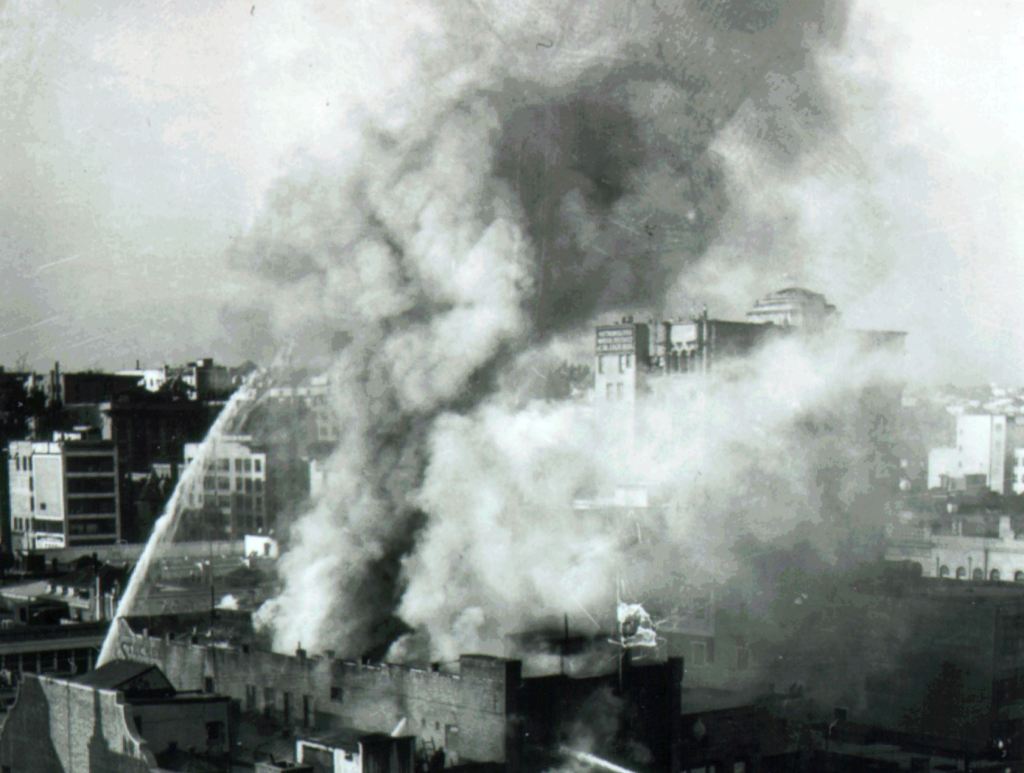
The Grey Building Fire in Los Angeles kills one fireman and causes $400,000 in damage.
Borden’s raises its milk prices by one cent. An increase of one-fourth cent a quart in the price of milk was announced yesterday by William H. Marcussen, president of Borden’s Farm Products. The increase, effective with home deliveries tomorrow morning, will bring the price of Grade B milk to 15 cents a quart, but probably will not affect the cost of milk sold in stores.
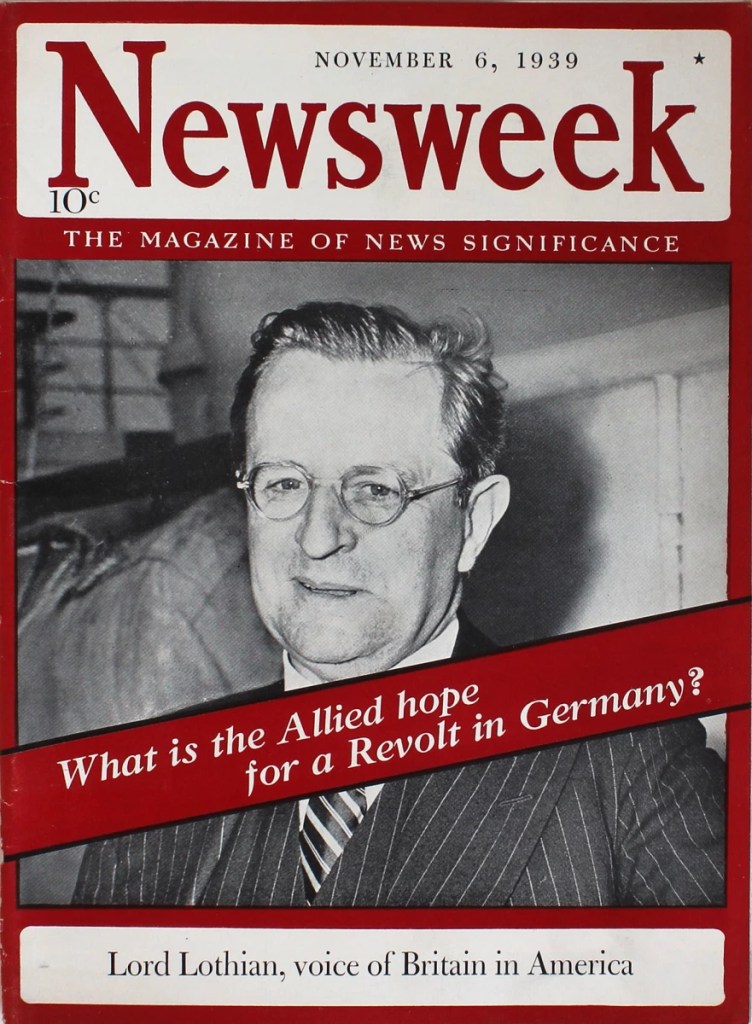
Gandhi talks hint at disobedience; a veiled threat of reversion to his former policy in India causes concern in London. Ominous words by Mohandas K. Gandhi added to the concern felt here today over the cooperation of India in the war following widespread resentment there against the report by the Viceroy, the Marquess of Linlithgow, recommending postponement of the discussions relative to granting dominion status after the war.
The Japanese Foreign Office spokesman today confirmed the impression that the next phase of Japanese foreign policy would. turn on the results expected to follow the advent of Wang Chingwei’s Japanese-sponsored government in China. That is a “cardinal point,” the spokesman said, because Japan believes that the “new government will satisfy not only the aspirations of the Chinese people but the desires of foreign powers.”
When Japanese officials use such words they mean that if Mr. Wang can establish peaceful conditions over a large area in China, the actions of which the United States complains will automatically cease. The spokesman did not say so, but to the Japanese mind his words imply that not only will military operations terminate throughout the pacified area but that once peace is recognized the Tokyo Government can exert greater authority over the armed forces, which, as long as a state of war exists, are virtually independent of the Cabinet.
With the repeal of the arms embargo, Australia’s demand for U.S. arms may easily equal 5,000,000 yearly [about $25,000,000] in addition to present purchases, if the sterling rate holds.
Dow Jones Industrial Average: 151.46 (-0.90)
Born:
Michael Schwerner, American civil rights activist, in New York, New York (murdered in Mississippi, 1964).
Ernie Wright, AFL and NFL tackle (AFL Champions-San Diego, 1963; AFL All-Star, 1961, 1963, 1965; Los Angeles-San Diego Chargers, Cincinnati Bengals), in Toledo, Ohio (d. 2007).
Ron Vander Kelen, NFL quarterback (Minnesota Vikings), in Green Bay, Wisconsin (d. 2016).
Pat Dye, American College Football Hall of Fame coach (East Carolina, Wyoming, Auburn; record 153–62–5), in Blythe, Georgia (d. 2020).
John Tresvant, NBA power forward (St. Louis Hawks, Detroit Pistons, Cincinnati Royals, Seattle SuperSonics, Los Angeles Lakers, Baltimore Bullets), in Washington, District of Columbia.
Athanasios Angelopoulos, theology professor, in Katerini, Greece.
Carlos Emilio Morales, jazz guitarist, in Marianao, Havana, Cuba (d. 2014).
Leonardo Quisumbing, Associate Justice of the Supreme Court of the Philippines, in Masbate City, Philippines (d. 2019).
Died:
Adolphe Max, 69, Belgian politician (Mayor of Brussels – escaped German captivity WWI).
Naval Construction:
The Royal Navy Bangor-class (Turbine engined) minesweeper HMS Polruan (J 97) is laid down by Ailsa Shipbuilding Co. Ltd. (Troon, Scotland).
The Royal Navy “U”-class (Second Group) submarines HMS Upright (N 89) and HMS Usk (N 65) are laid down by Vickers Armstrong (Barrow-in-Furness, U.K.).
The Kriegsmarine (German Navy) Type IXB U-boat U-65 is launched by AG Weser, Bremen (werk 953).
The Royal Navy armed merchant cruiser HMS Letitia (F 16) is commissioned. Her first commanding officer is Captain (retired) William Reynard Richardson, RN.
The Royal Navy armed merchant cruiser HMS Forfar (F 30) is commissioned. Her first commanding officer is Captain (retired) Hubert Henry de Burgh, DSO, RN.
The Royal Navy “K”-class destroyer HMS Khartoum (F 45) is commissioned. Her first commanding officer is Commander Donald Thorn Dowler, RN.
The Nihon Kaigun (Imperial Japanese Navy) destroyer HIJMS Kagerō (陽炎, “Mirage”), lead ship of her class of 19, is commissioned. Her first commanding officer is Commander Yokoi Minoru.
 History Diaries