South Vietnamese Navy officers refuse to order their boats and troops along a canal they regard as militarily insecure, delaying a major operation planned to break the Việt Cộng’s hold on the Mekong Delta town of Năm Căn; the U.S. military advisers openly express their disgust with such lack of aggression. United States military advisers here were disgusted and showed it. They said the navy men had “dreamed up some damn regulation” that had forbidden them to carryout their role. Năm Căn is the southernmost district capital in South Vietnam and is about 180 miles southwest of Saigon. A Communist blockade that began in February has turned it into a ghost town and virtually destroyed its multi-million-dollar charcoal industry. United States military advisers said the navy had been wary of sending its craft along the inland waterways surrounding Năm Căn since the Việt Cộng shelled and almost sank an LST last year.
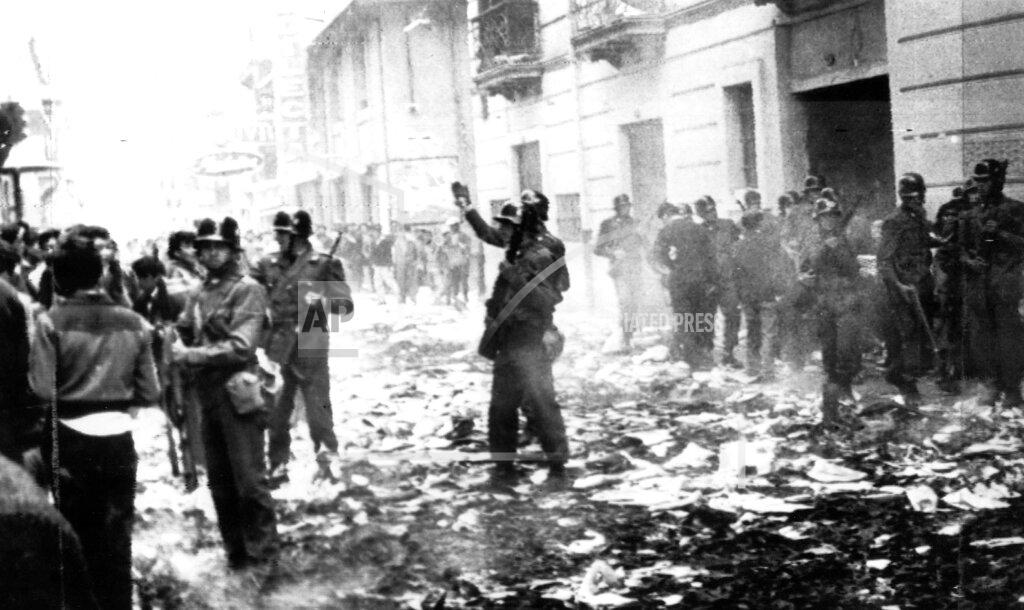
Increasing opposition led Premier Trần Văn Hương to appeal to the people of South Vietnam by radio tonight to give his three‐day‐old civilian government a chance to rule. He spoke out because of the prospect of hostile demonstrations by student and religious factions. Students were expected to take to the streets over the weekend to demand the dissolution of the government, which took over only last Wednesday from Major General Nguyễn Khánh’s military regime with the diplomatic blessing of the United States.
Buddhist and Roman Catholic elements also expressed opposition but, according to some reports, agreed to hold off mass action for at least two weeks. The 61‐year‐old Premier, a former schoolteacher, went on the radio a few hours after having conferred with United States Ambassador Maxwell D. Taylor on the tense situation. Other American officials talked informally with pressure group leaders in an effortto persuade them to case up on Mr. Hương’s Administratio, which the United States hoped would bring stability to the country and enable it to concentrate on the war against the Communist Việt Cộng. The Premier acknowledged that his Government had some weaknesses but added: “I urge all persons of all classes, especially religious groups, political parties, youths, and students and the whole people to help us restore authority and discipline in building the country against Communism.
Criticism of the Cabinet, made up of technicians rather than politicians, spread even to the High National Council, the interim legislature that confirmed Mr. Hương in the Premiership. Reports circulated that seven members of the council, which started out as a 17member agency in September, had resigned or were about to do so. Dr. Nguyễn Xuân Chữ quit as council chairman yesterday. He complained that the council had not been consulted on selection of the new Cabinet and that there was insufficient representation of political factions. About 500 members of the National Student Union called at a noisy meeting for dissolution of the Government. Speakers charged that there were “former secret policemen, drunkards and Diệmists,” or followers of the late deposed President, Ngô Đình Diệm, among the 15 ministers. The students were reported to be displeased with Mr. Hương’s announced policy of separating politics from the classrooms.
Major General Nguyễn Khánh, comnmander of South Vietnam’s armed forces, appealed again today to the United States to carry the war to North Vietnam. While on an inspection trip in the Mekong Delta 100 miles southwest of Saigon, he recalled that he had made such a plea “six or seven months ago” to Secretary of State Dean Rusk and Defense Secretary Robert S. McNamara.
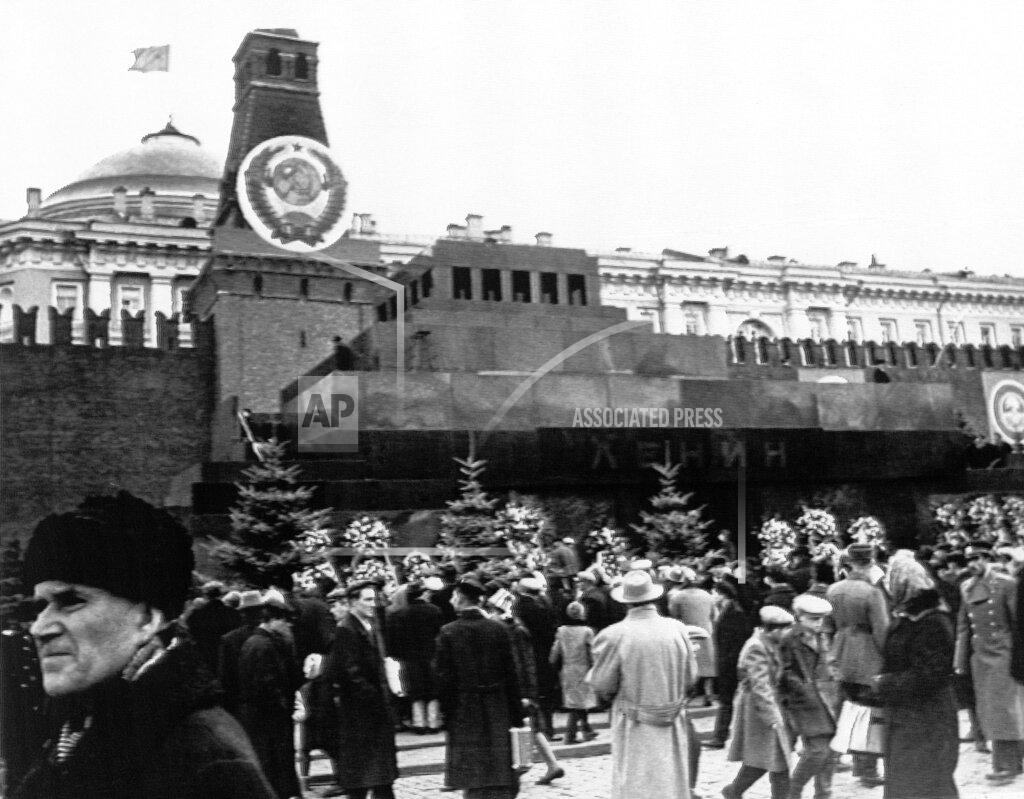
The new Soviet regime appealed today to the leaders of world Communism to seek a settlement of their differences at a conference. Leonid I. Brezhnev, the new Soviet party chief, made the appeal in an address in the Kremlin on the eve of the 47th anniversary of the Bolshevik Revolution. Behind him on the dais, listening impassively, sat Chou En‐lai, Premier of Communist China. The audience broke into thundering applause after Mr. Brezhnev’s appeal for Communist unity, but Premier Chou sat quietly and fiddled with the earphones that gave him a simultaneous translation in Chinese of the Russian speech. At another point, however, Mr. Chou joined the applause when Mr. Brezhnev stressed Soviet rocket might and lauded the country’s armed forces.
Also on the dais were Government and Communist party leaders, chiefs from 11 other Communist countries as well as all the top members of the Soviet leadership. The tone of Mr. Brezhnev’s speech and the presence of Mr. Chou dramatized the changes in the Soviet Union and the international Communist movement since Nikita S. Khrushchev was deposed three weeks ago. Mr. Brezhnev, who has assumed the largest single share of Mr. Khrushchev’s power, reiterated many of the ousted ieader’s policies, including some that have been under attack by the Chinese Communists. But he did so in carefully measured and conciliatory terms without polemical overtones. In sharp contrast with statements made during Mr. Khrushchev’s rule, potentially divisive passages in the speech were overshadowed by the stress on the need for unity in the Communist camp.
The new Kremlin leadership, in its first reversal of a specific policy of Nikita S. Khrushchev, has moved to enhance the importance of private farming as a means of increasing agricultural output. The ruling group also decided to continue increased capital investment in agriculture and fertilizer and farm‐implement factories as well as in retail trade and consumer services, long a neglected area of the Soviet economy. These policy decisions emerged tonight from a speech by Leonid I. Brezhnev, First Secretary of the Soviet Communist party, at a celebration of the anniversary of the 1917 Bolshevik Revolution. Mr. Brezhnev acknowledged that “farm production still falls short of the growing requirements of our society.”
Peking delivered a scathing attack today on Nikita S. Khrushchev, the former Soviet leader, and declared that it was “a very good thing” that he had been removed from power. The attack was in an editorial in Jenmin Jih Pao, the Communist party newspaper, marking the 47th anniversary of the Bolshevik Revolution. The text of the editorial was carried by Hsinhua, the Chinese Communist press agency. The editorial called for an “unceasing struggle” aggainst “modern revisionism.” It added: “Khrushchev is the chief representative of modern revisionism. He has betrayed Leninism, betrayed proletarian internationalism, betrayed the path of the, October Revolution and betrayed the interests of the Soviet people. The Soviet people and the Communist party of the Soviet Union recently removed Khrushchev from the leading posts he held in the party and the state. This is a very good thing and it has the support of Marxist‐Leninists and revolutionary people of all the world.”
The French Communist party chairman, Waldeck Rochet, said at a news conference tonight that Nikita S. Khrushchev was living in Moscow. Mr. Khrushchev, Mr. Rochet said, submitted his resignation from the Secretariat of the Soviet Communist party and from the Presidium in a written statement to the party’s Central Committee after a regular Presidium meeting presided over by him. His reasons were age and “aggravation of the state of his health,” Mr. Rochet added. The French party apparently is prepared to accept these reasons. However, Mr. Rochet drew attention to the former Premier’s mishandling of the agricultural problem and his failure to observe the rules of collective leadership.
Turkish officials said today that they had Soviet support in the dispute between Turkey and Greece over Cyprus. In a communiqué published during the day in Ankara and Moscow following a week of talks by Foreign Minister Feridun Cemal Erkin in the Soviet capital, the governments expressed support “for the independence and territorial integrity of Cyprus and for the legal rights of two national communities, and recogniation of the existence of two national communities on the island.” Turkish officials regard such Soviet “recognition” as tantamount to Russian support for the Turkish Cypriot minority. The reference to the “independence and territorial integrity of Cyprus” is taken here as implying rejection of enosis, the union of Cyprus with Greece, and a defeat for President Makarios of Cyprus.
West Germany disclosed today proposals it had laid before its five Common Market partners to restore the impetus to the movement for European union. The two‐phase plan, formally submitted Wednesday to the governments concerned, proposes the formation of a consultative committee of experts to draft the outlines of a treaty for a European political union. In the economic sphere it proposes acceleration of tariff cutting within the European Economic Community so that by Jan. 1, 1967, duties on industrial goods will be removed and a common market in agricultural products will be “in sight.”
France has given a cool reception to the West German proposals for accelerating European political unity. Officials here took the position that it was futile to discuss political unity until the European Economic Community had agreed on a common farm policy and the crisis over the proposed mixed‐manned nuclear force had been resolved. In each case, qualified sources emphasized, the issue must be resolved in favor of France if her Government is to support the German proposals. This would mean agreement by the West Germans to lower their wheat prices to the $106.25‐a‐ton level accepted by their Common Market partners, while the French and the others raised their prices to that point. It would also mean Bonn’s rejection of the mixed‐manned NATO fleet idea, which the Germans now strongly support.
A senior member of the House Foreign Affairs Committee warned the Council of Europe today that a “recent European impulse for independence” jeopardizing the United States’ alliance with Western Europe. The warning, drafted, according to reliable sources, in close consultation with Secretary of State Dean Rusk, was delivered by Representative Wayne L. Hays, Democrat of Ohio. Mr. Hays, the sources said, spoke with the approval of the White House, although President Johnson had not seen the text of his speech. In a 30‐minute address that concentrated on the issues that divide the United States and France, Mr. Hays declared that since World War II the United States had been determined to cooperate as closely as possible with its European partners. But, the Congressman said with emphasis, “this will remain true until — and this condition must be heeded with the utmost care in Europe — it is forced upon Americans that European nations desire to break off the partnership in order to pursue courses independent of a close‐knit alliance.”
A Polish weekly economic paper said today Poland may switch her grain purchases from the United States to some other country because of “discrimination.” The Government‐owned Zycie Gospodarcze (Economic Life) termed recent United States changes in its grain export regulations “district discrimination.” Poland has been paying for United States grain in Polish zlotys with long‐term credit, with a right to prolong credits further by paying in dollars. But the new rules, according to the paper, state that Poland may get only a five-year credit even for dollar payments, while other countries are allowed 20 years.
Public order was restored in most of Bolivia today as a military junta headed by Lieutenant General René Barrientos Ortuño began attempting to win a political truce among the widely divergent forces that helped raise him to power. Air force and army units patrolled La Paz with rifles and machine guns although tensions were decreasing appreciably 72 hours after a revolt overthrew the Government of President Victor Paz Estenssoro. In a major attempt to gain the support of political parties and return stability to this violence‐torn country, General Barrientos pledged to hold free elections “within six months or a year.”
More than 2,000 Congolese government troops, spearheaded by almost 400 white mercenaries, swept into Kindu at dawn this morning. The capture of Kindu, the second‐largest city under rebel control, is the Central Government’s biggest victory since the leftist rebellion erupted six months ago. Late today the Government also announced the seizure of Ikela, a key road junction only 180 miles southwest of Stanleyville. Both Ikela and Kindu fell without resistance. Mercenary-led columns are now poised for a final two‐pronged drive on Stanleyville, capital of the rebels’ “Congolese people’s Republic.” Today’s victories have led even the most cautious observers here to believe that rebel forces are on the verge of collapse.
Uganda’s Prime Minister Milton Obote gave instructions to the African nation’s security police “to use such powers as they have to protect the lives and the properties of the public” and gave authorization to use deadly force against civilians as they felt necessary. Four days later, the Naakulabye neighborhood in the capital, Kampala, police responded to a husband and wife argument by firing their weapons into a crowd of people who had gathered around to see what was happening, killing six of them indiscriminately.
An Australian athlete has had himself shipped home C.O.D. from Britain in a wooden crate because he could not afford a passenger ticket for the 11,000‐mile flight. Reginald Spiers, 22 years old, of Adelaide spent 63 hours in the slatted box without food or water. Sydney newspapers reported. Friends and relatives in Adelaide confirmed the story today. The accounts said that a friend nailed up the box October 17 in London and Mr. Spiers landed at Perth October 20 on an AirIndia flight, then hitchhiked 1,800 miles to Adelaide. “There was enough space between the planks to give me air and allow me to peep out,” he said.
Dean Burch clung to the national chairmanship of a defeated and divided Republican party today with the public backing of its titular leader, Senator Barry Goldwater. Senator Goldwater, returning to Washington for the weekend before taking a vacation, said it would be “wrong to go off half‐cocked with recommendations and suggestions now” regarding the party’s future. He said Mr. Burch had done a “very, very commendable job” and should continue as chairman. The Republican Presidential candidate arrived from Phoenix aboard his silver campaign jeti and was greeted by about 50 supporters on a windswept strip at Dulles International Airport. He looked composed and said he felt. “like a million dollars.” Earlier in the day, Mr. Burch declared his intention to stay on as chairman “as long as thel Republican party wants me to.”
He said he would call a meeting of the Republican national committee in January at which “all questions of interest to the party, including that of my chairmanship, will be discussed fully and frankly.” “We must now strive for a consensus — ideological, financial and organizational — which represents all elements of our party,” he said. “In the light of such opportunity, how foolish it would be to continue any in traparty squabbling and bickering.” There were continued demands, meanwhile, for a shakeup in the conservative leadership that some Republicans blame for the party’s defeat in Tuesday’s elections.
Senator Jacob K. Javits urged Senator Barry Goldwater yesterday to relinquish his leadership of the Republican party. Mr. Javits, New York’s senior Senator, advocated replacing the present conservative leadership of the party with a non‐factional “caretaker” group. Senator Jacob K. Javits of New York at news conference where he urged Senator Barry Goldwater to step aside. Such a body, Mr. Javits suggested, would remain at the helm until a party conclave, to be held some time in 1965 or 1966, could reshape the goals and choose the leadership of the G.O.P.
Speaking at a news conference in his New York City office, the Senator said: “The electoral disaster of 1964 can also be the political opportunity of 1964. The Republican party, badly in need of modernization, can now modernize as it has not done since 1940.” He attributed the Johnson landslide to what he called the “radical views” of the national candidates. Echoing the plea made on Wednesday by Governor Rockefeller, Mr. Javits called upon the Senator from Arizona to step down from his position as de facto head of the party. “Mr. Goldwater’s kind of thinking,” he said, “cannot keep the party a viable alternative” to the Democrats.
The maneuvers and bickering among Republicans over their party’s national leadership are taking on the earmarks of the confused struggle that resulted in Senator Barry Goldwater’s nomination last July, Privately, most moderate and liberal Republican officials and even many conservatives share Senator Jacob K. Javit’s feeling that the party’s survival is at stake in the coming showdown for control at national headquarters. Furthermore, in the wake of Mr. Goldwater’s resounding defeat last Tuesday many are convinced a majority of national committee members want Mr. Goldwater’s lieutenants who dominate the organization to step aside or be ousted in favor of more generally acceptable leaders.
But at this point, observers see little evidence that non-Goldwater Republicans have become more willing or able to work in tandem than they were before the nominating convention last summer — or even the election disaster last Tuesday. Noting the welter of accusations, proposals and self‐serving maneuvers by fellow‐Republicans yesterday, a major national Republican figure shook his head, sadly, and said: “If those of us who want the party to have a future don’t learn quickly to work together this anti‐Goldwater thing is going to bog down. It looks like the preliminaries to San Francisco all over again. Nobody seems to be doing anything in concert. Even Cabot Lodge is trying to set up a meeting of his own.”
A comment in Washington yesterday by Senator Everett McKinley Dirksen, of Illinois, the minority leader, called to mind the last harsh feud over the Republican leadership — the one that followed Governor Thomas E. Dewey’s surprise defeat by President Harry S. Truman in 1948. “Everybody will come out of his corner with a lot of ideas,” Mr. Dirksen observed of the current struggle. “Now, I intend to stand still. I intend to do a lot of thinking and get a new perspective.” After the Republican defeat 16 years ago, however, Mr. Dirksen’s was one of the first names proposed for national chairman by a group demanding the removal of Hugh Scott. Although the Democratic triumph and Republican losses this week were much greater than in 1948, what happened among Republicans in the aftermath of that defeat is reminiscent of political observers of what appears to be developing now.
The New York Police Department cleared Lieutenant Thomas R. Gilligan yesterday of any wrongdoing in the fatal shooting of a Negro youth on July 16. The shooting touched off six nights of rioting in Harlem and Brooklyn. The Gilligan case also gave impetus to a drive by a number of civil rights groups, particularly the Congress of Racial Equality, for the creation of a civilian board, independent of the police, to review cases of alleged police brutality. So far the drive has been fruitless. Lieutenant Gilligan was cleared by the department’s civilian complaint review board. It is made up of three deputy police commissioners. Two of the commissioners did not rise through police ranks, but were appointed to the department from civilian life. The board’s decision was announced in a terse statement over the name of Police Commissioner Michael J. Murphy. It said: “The members of the civilian complaint review‐ board have carefully studied the entire testimony of witnesses before the New York County grand jury in the case of Lieutenant Thomas R. Gilligan and have unanimously concluded that there were no violations of the rules and procedures of the department. I have approved the board’s recommendation that the case be filed.”
It is getting cold now in the Northern cities that were racked last summer by racial rioting. A gray winter bleakness is overtaking the low‐income housing projects and the ghetto tenements where thousands of Blacks revolted against the white communities and then against the police who were sent to calm them. There is sparse evidence now of the desperate hatred that filled the air on those summer nights in Harlem and Bedford-Stuyvesant and in Rochester, Paterson, Jersey City, Elizabeth, and Philadelphia. But those who have been watching the situation say the fire is still smoldering, and that the white people have done little since then to extinguish it.
The National Association for the Advancement of Colored People will put its major emphasis on efforts to involve Black youths and adults in the Federal antipoverty program, Roy Wilkins, the executive director, said yesterday. All 1,800 local units throughout the nation, he continued, will try to develop “plans utilizing the provisions of the antipoverty program to secure better vocational training and job opportunities for Negro youths and adults.” The N.A.A.C.P. also will attempt to further the implementation of the Civil Rights Act of 1964, he declared. Mr. Wilkins said peaceful demonstrations and boycotts would be used if necessary to obtain compliance with the act.
Two white men, one an acknowledged member of the Ku Klux Klan, were arrested today on charges of killing two Blacks whose bodies were found by chance during the search for three civil rights workers. The Justice Department announced that James Ford Seale, a 29‐year‐old truck driver, and Charles Marcus Edwards, 31, a paper mill employee, had been charged with the murder last last spring of Charles Moore and Henry Hezekiah Dee, both 19. The two Blacks vanished last spring. Their torsos were found in the Mississippi River near Tallulah, Louisiana, in July by a search party looking for the rights workers — Andrew Goodman, 20, and Michael Schwerner, 24, of New York and James E. Cheney, a Black from Meridian, Mississippi. The rights workers were later found buried beneath an earthen dam near Philadelphia, Mississippi. They had been shot to death. Their killers have not been apprehended. Mr. Moore, a college student, and Mr. Dee, a local laborer, were not connected with civil rights activity, authorities said.
Mr. Seale and Mr. Edwards were arrested by local officers and agents of the Federal Bureau of Investigation at their homes near here this morning. The two Blacks were killed “on or about May 2,” authorities said. The F.B.I. identified Mr. Edwards as a “self‐admitted Klansman.” Mr. Seale, the father of three children, works for a mill in Roxie. Mr. Edwards, the father of four, is employed by a paper mill at Natchez. The F.B.I. said the arrests culminated an “extensive and lengthy” investigation but declined to specify what evidence led to the apprehension of the two men. Authorities said the investigation was continuing.
The lower portion of a body identified as that of Mr. Moore was spotted by a fisherman. James Bowles of Tallulah, on July 12. A second lower portion of a body, that of Mr. Dee was fished out of the river the following day in the same general area. They had been last seen on May 2 hitchhiking near Meadville. The F.B.I. said a search of the Seale residence uncovered a sawed‐off pump shotgun. The two white men were arrested on warrants charging them with “willfully, unlawfully, feloniously and with malicelice aforethought” killing the two Blacks. An autopsy performed on the first body in Jackson in July showed the victim’s legs had been bound with twine similar to that used for baling hay.
Evidence in the slaying of the three rights workers was presented to a Federal grand jury at Biloxi last month. Five Neshoba County law enforcement officers were indicted on charges of beating Black prisoners, but no indictments were returned involving the three slayings.
The United Automobile Workers went on strike yesterday at nine key plants of the Ford Motor Company in a dispute over unsettled local issues. The company said that the walkout would reduce its average daily car production by 12 percent and its truck output by 34 percent. In recent weeks the company’s 17 assembly plants have been building about 10,000 cars and 1,800 trucks a day. The local strikes by 25,500 of the company’s 160,000 production workers resulted from the failure of Ford and U.A.W. negotiators to reach local‐level agreements supplementing the national labor pact achieved on September 18.
Growing unrest among teachers over salary disputes has cropped up in widely separated areas. Walkouts are threatened in Georgia, Oklahoma, Kentucky and Louisiana. In the northwest Georgia county of Catoosa, citizens have formed a club to raise funds to keep the public schools open in the face of a threatened walkout by teachers. Nineteen teachers walked out earlier this week forcing Lakeview High School at Ringgold to close. The 196 teachers at the other schools in the county have voted to walk out November 25 unless provisions are made to pay them. Teachers in two Oklahoma school districts voted to take a one‐day holiday Monday. About 600 teachers in Midwest City, an Oklahoma City suburb voted for a protest walkout and Tulsa’s 2,500 teachers also plan a “professional holiday.”
A White House spokesman said today that while President Johnson “obviously” wants to confer with Western European leaders, no foreign travel by Mr. Johnson is contemplated. The President spent the day at his LBJ Ranch, 65 miles west of Austin.
AFL Football:
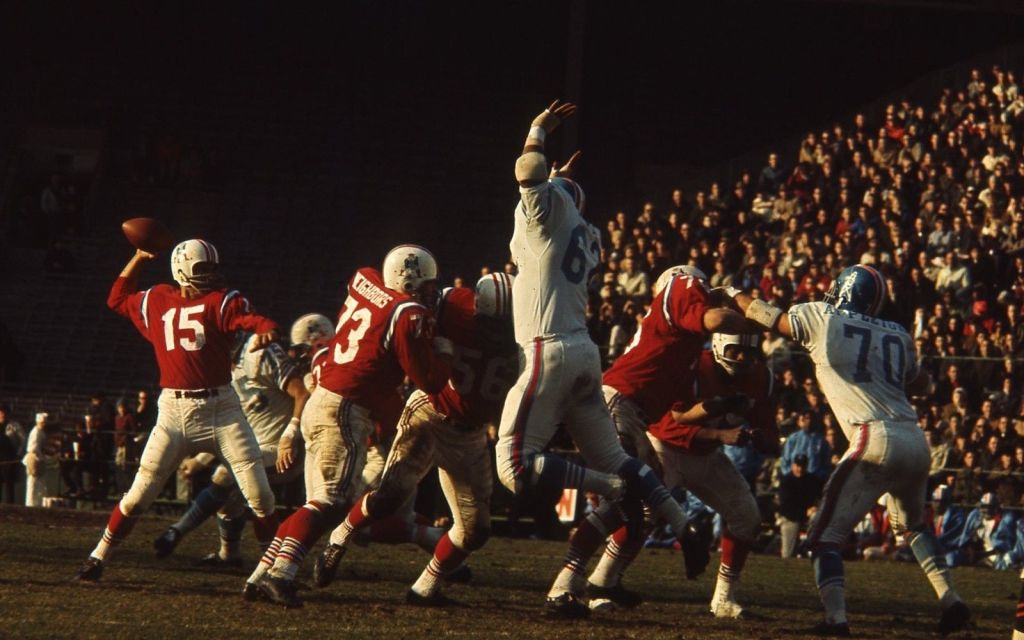
Houston Oilers 24, Boston Patriots 25
Gino Cappelletti’s 41-yard field goal tonight with one second remaining gave the Boston Patriots a 25–24 victory over the Houston Oilers. Cappelletti, who kicked his fourth field goal of the night after the underdog Oilers had rallied with 32 seconds left, was mobbed by hundreds of spectators and had to be escorted from the field by policemen and ushers. The last‐second kick wiped out an exhibition by the Houston passing master, George Blanda, who had hurled touchdown passes of 80 yards to Willie Frazier and 38 yards to Charlie Frazier. Charlie Tolar plunged 2 yards for the other Houston score. The Boston quarterback, Vito (Babe) Parelli, scored both his team’s touchdowns on runs of 1 and 5 yards after he set the scoring stage with a series of passes and handoffs to Larry Garron.
Dow Jones Industrial Average: 876.87 (+3.33)
Born:
Corey Glover, American rock guitarist and singer (Living Colour), in Brooklyn, New York, New York.
Erik Kramer [William Erik Kramer], NFL and CFL quarterback (Atlanta Falcons, Calgary Stampeders [CFL], Detroit Lions, Chicago Bears, San Diego Chargers), in Encino, California.
Greg Graffin, American singer (Bad Religion), in Madison, Wisconsin.
Kerry Conran, American filmmaker (“Sky Captain and the World of Tomorrow”), in Flint, Michigan.
Died:
Hans von Euler-Chelpin, 91, German-born chemist, Nobel Prize laureate (investigated the fermentation of sugar and enzymes (Nobel 1929).
Hugo Koblet, 39, Swiss cyclist (1951 Tour de France).
Samuil Samosud, 80, conductor of the Moscow Philharmonic Symphony Orchestra.

 History Diaries