The invasion of France, Belgium and the Netherlands – “Case Yellow” – was set for November 12, 1939. The Commander-in-Chief, General Walther von Brauchitsch, warned German Chancellor Adolf Hitler that the Army was unprepared for an immediate invasion and also reminded him of the risks of a winter campaign.
Every senior commander in the Wehrmacht is certain that now is not the right moment to attack France (Operation “Fall Gelb”) due to several reasons, including the weather and the state of the military.
Three German Army commanders (Fedor von Bock, Wilhelm Ritter von Leeb and Gerd von Rundstedt) who believed an invasion of France would fail held a secret meeting to discuss ways to dissuade Hitler from ordering an attack on the western front.
A possible plot to arrest or even kill Adolf Hitler, hatched by of his most senior military staff, collapsed. Led by General Franz Halder, the architect of the invasion of Poland, many Generals were appalled by Hitler’s plans to continue the conflict by invading Belgium and the Netherlands and feared that the adventure would founder in another Great War quagmire. Walther von Brauchitsch, who met with Hitler and was supposedly to be the one to issue the order for his arrest, got cold feet and lost the opportunity to stop Hitler. He argues very strongly that it should not take place as scheduled on November 12th because of weaknesses in the army. Hitler loses his temper during the meeting but is unconvinced by the arguments. Brauchitsch loses his nerve and returns to OKH (Army High Command) headquarters at Zossen, where the conspiracy collapses.
As the core of his argument, von Brauchitsch states that the infantry had lacked fighting spirit in Poland. The troops were undisciplined and there had been mutinies against officers. The army, he said, could not be relied upon without further training, which would require time.
Hitler is furious and explodes into a rage. As a former front-line soldier, he believes that he knows about soldier morale. As he later states, he believes the German soldier is the best in the world and of better character than the Generals. He does, however, keep the memorandum and read it later, calling it a “pack of lies.” Hitler angrily dictates an order dismissing von Brauchitsch, but his aide General Keitel dissuades him from issuing it on the grounds that there is no suitable successor.
Von Brauchitsch does achieve his main goal. Fall Gelb is postponed again. The meeting, however, irreparably damages Hitler’s relations with his Generals. He inherently sympathizes with the “grunts” and not the “swivel chair cowards,” and this incident reawakens those dormant prejudices. He refers to the sorts of arguments made by von Brauchitsch, which he considers defeatist, as “the spirit of Zossen” (Heer headquarters south of Berlin). Von Brauchitsch later offers his resignation, but Hitler cools down and refuses it because he has established his authority and von Brauchitsch has been cowed – which makes him compliant. This is perhaps the first real illustration of Hitler’s ability to completely destroy the self-confidence of an Army General.
Some accounts call von Brauchitsch the leader of the “Zossen conspiracy” and so forth. There indeed was wild talk behind the scenes – but there was throughout the war. These accounts state that von Brauchitsch went to the meeting with the objective of either getting the Führer to agree with him or shooting/arresting him. However, since neither happened (at least at the meeting), those claims appear to be false or wishful thinking. There is no indication that a putsch was ever on von Brauchitsch’s mind that day.
However one of the conspirators, Colonel Hans Oster of German Military Intelligence, tipped off the Dutch and Belgians about Hitler’s invasion intentions. He warns Colonel Sas, the Dutch military attaché in Berlin, of the impending invasion of the Low Countries. Sas informs the Belgian military attaché. Hans Oster is considered a leader of the “opposition” by those in the know.
German artillery is still shelling the Forbach salient —with about 150 shots during the day. Approximately the same number of shells fell on the Ohrenthal salient just south of the German town of Hornbach.
Jews face famine in Poland. The 1.5 million in German-held areas are reported to be condemned to starve. The Jews’ plight in the German-occupied part of Poland is worse than in the Reich, judging from the steady flow of allegations of Nazi brutality and persecution reaching the Polish Government and Jewish relief organizations in Paris.
The German government lodges a protest in Oslo against the release of the interned City of Flint and the German prize crew. The ship itself reaches Bergen to unload its cargo.
The Norwegian Government tonight formally rejected Germany’s protest demanding return of the American steamer City of Flint and release of her interned Nazi prize crew with a statement that Germany had violated The Hague Neutrality Convention of 1907.
Britons break up a fascist meeting. Crowds stone a bus and scuffle with fascists after their rally. While Sir Stafford Cripps. noted lawyer and Labour Member of Parliament, was warning, in a speech at Bristol today, that Britain must fight the “fascist-minded at home as well as fascists abroad,” a meeting of Sir Oswald Mosley’s fascist British Union at Wilmslow, near Manchester, was broken up by a hostile crowd.
Sir Oswald, who began his political career as a Socialist, addressed a small crowd of his followers in a movie theater. He declared that a new union in Europe and new security could be based on universal disarmament and upon “making up our minds at long last to mind our own business.” A crowd of his supporters who had traveled from Manchester in two double-decker buses applauded his assertion that Britain was wasting her strength by fighting against aggression in other countries where the British had no interest, but outside the hall a small but threatening crowd had gathered.
As Sir Oswald was leaving a stick was hurled at his car. Several fights and scuffles followed. One man’s face was cut and a man and a woman were scratched and cut on their necks. Stones were thrown at one of the two buses, smashing its windows. The second bus started off empty and about half of those who had turned out to hear the British fascist leader marched in a body down the main street followed by a hooting, jeering crowd. No one was seriously hurt and no arrests were made.
Sir Stafford, who represents the East Bristol constituency, asserted that many supporters of the government hoped for an alliance with 2 restored monarchist Germany against Soviet Russia. He declared. that if the British war aims were clearly stated the people would be “so disgusted that they would refuse to continue the war.” Going on, he said: “Don’t let us forget that we have two enemies in this war — the fascists abroad and the fascist-minded at home. We must fight each with equal determination.”
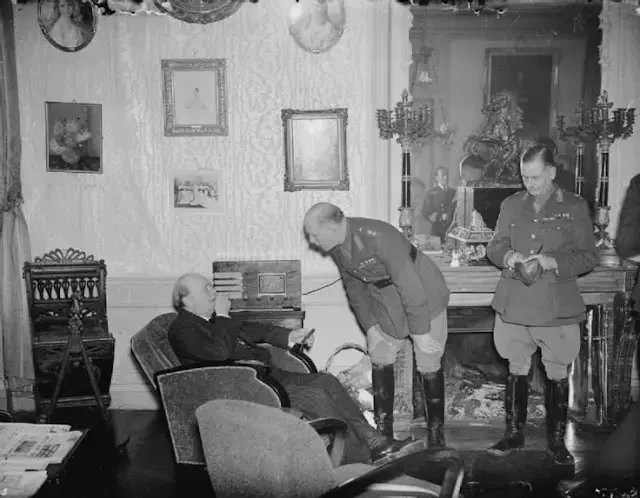
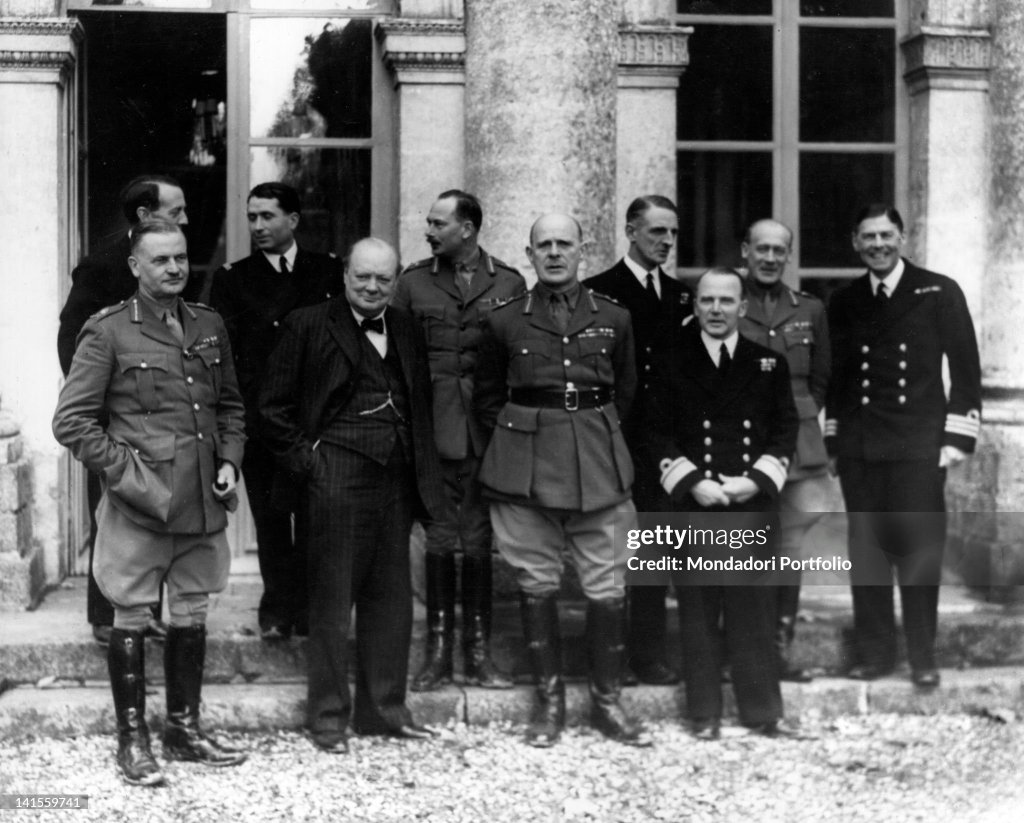
Winston Churchill, British First Lord of the Admiralty, visits the French Marine Headquarters. Churchill, in Paris, meets with Lord Gort, in charge of the BEF force.
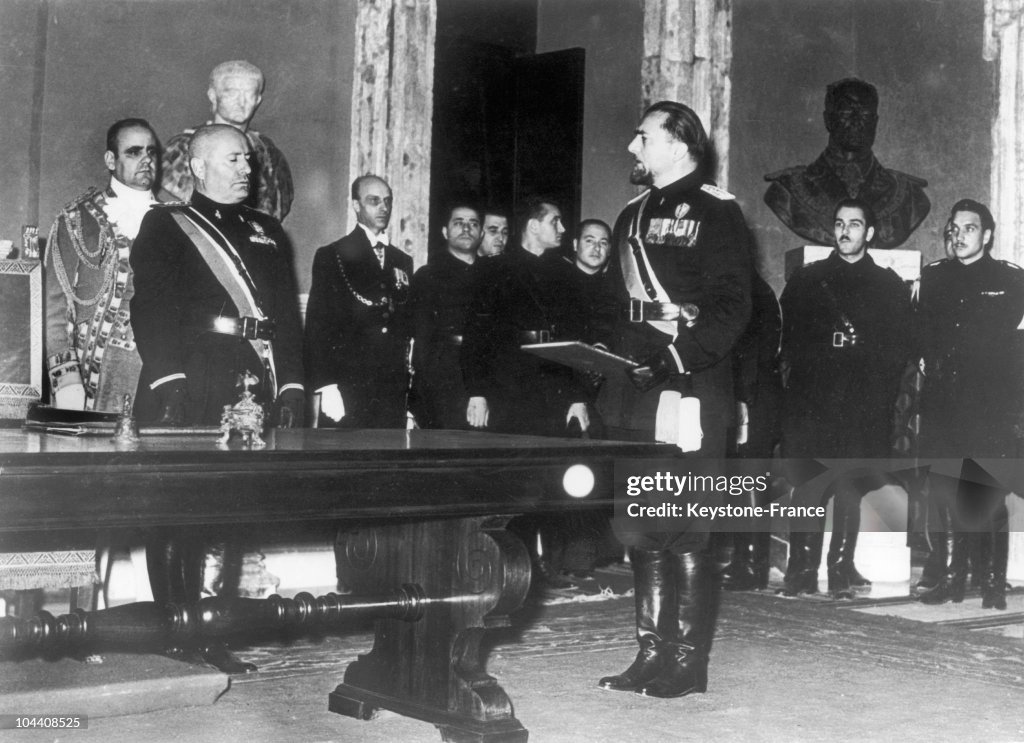
Mussolini orders an increase in the army. Pushing ahead with his program of reorganization and mobilization of the Italian Army, Premier Mussolini in his capacity as Minister of War today instructed General Ubaldo Soddu, Under Secretary of War, to increase the effectives of the Italian Army.
The Swedish government protests the German mining of waters only three miles from the Swedish coast.
General Gonzalo Queipo de Llano, one of the leading Nationalist officers in Spain’s civil war, predicted tonight that Germany would win the war and “show Britain and France some tremendous surprises within the next few weeks.”
Finnish-Soviet negotiations continue. The Finnish delegation reports to Helsinki and asks for further instructions. Negotiations adjourn as the Finns consider their options. Up to this evening there had been no further communication between the Kremlin and the Finnish delegation.
Dmitri Shostakovich’s 6th Symphony premieres in Leningrad.
The Kriegsmarine recalls the Deutschland from its raid in the North Atlantic.
Royal Navy aircraft carrier Ark Royal captures the German vessel Uhenfels.
U.S. freighter Scanmail is detained by the British at Kirkwall, Orkneys. Part of her cargo is seized.
U.S. freighter Black Condor is detained by British authorities at Weymouth, England.
U.S. freighter Black Eagle, detained by the British since 26 October, is released.
U.S. steamship President Polk is detained by the British at Port Said, Egypt, and certain items of her cargo confiscated for inquiry.
The War at Sea, Sunday, 5 November 1939 (naval-history.net)
On Northern Patrol, two cruisers were between the Orkneys and the Faroes, two cruisers and an AMC between the Faroes and Iceland, and one cruiser and two AMCs in the Denmark Strait. Armed merchant cruisers TRANSYLVANIA departed the Clyde for Northern Patrol duties and AURANIA departed her patrol station for the Clyde to overhaul her guns. Armed boarding vessels NORTHERN ISLE, NORTHERN PRINCESS and NORTHERN FOAM relieved armed boarding vessels NORTHERN CHIEF and KINGSTON BERYL on patrol in the vicinity of Muckle Flugga.
Convoy FN.32 departed Southend, escorted by destroyers WHITLEY, WALLACE and sloop STORK. Destroyers WOOLSTON, VALOROUS and sloop HASTINGS departed Harwich and relieved the original escort which proceeded to Rosyth. The convoy arrived on the 7th.
Convoy FS.32 departed Methil, escorted by destroyer VIVIEN and sloops BITTERN and FLEETWOOD. Six merchant ships left at 1200, despite fog, and the rest departed later. Destroyers JUNO and JUPITER were at sea to act as a fighting force from daylight on the 6th. Destroyer JAGUAR remained at Methil Roads until ordered to proceed at 1540 and overtook the convoy. JUNO and JUPITER were detached at dark on the 6th to proceed to Rosyth. There they joined minelaying cruiser ADVENTURE and escorted her to the Humber. The convoy arrived at Southend on the 7th. There was no convoy FS.33.
Danish steamer TEKLA (1469grt) reported sighting a U-boat four miles SE of Flamborough Head. Destroyer JUNO was sent to search.
After a D/F bearing on a suspected submarine 150 miles SW of Ushant, destroyers ACASTA, ESCAPADE, VERSATILE and GRENVILLE conducted searches in the area.
Destroyer ANTHONY, which had departed the Clyde on the 4th, was escorting base ship MANCHESTER CITY to Rosyth, where they arrived early on the 6th. Later that day, ANTHONY left for Plymouth.
Destroyer VANSITTART was sent to the Tongue Light Vessel to investigate a report of a fast motor boat, but the order was later cancelled and she returned to normal patrol.
Submarine L.26, on Dogger Bank patrol, reported sighting a suspicious merchant ship in 54-32N, 3-26E. The submarine was ordered by Rear Admiral Submarines to follow the ship.
U-33 laid mines off North Foreland, on which two ships were sunk and one damaged.
Force K, consisting of aircraft carrier ARK ROYAL, battlecruiser RENOWN, light cruiser NEPTUNE, and destroyers HARDY, HASTY, HEREWARD, HERO and HOSTILE departed Freetown on 28 October. HERO was detached on escort duties shortly after the first of the month. In 6N, 17 W, 300 miles WSW of Freetown on the 5th, ARK ROYAL aircraft sighted German steamer UHENFELS (7603grt) which had departed Lourenco Marques, Portuguese Mozambique, on her third attempt to escape back to Germany and after evading sloop EGRET patrolling off the port. HEREWARD was detached from the screen to investigate and UHENFELS attempted to scuttle herself. However, she was captured, Force K and prize arrived at Freetown on the 6th, and UHENFELS was taken for British service and renamed EMPIRE ABILITY. She arrived in the Thames for duty on 5 April 1940.
Australian light cruiser HMAS PERTH departed Bermuda and arrived at Kingston on the 9th.
Congressional leaders of both parties who had been expected to remain here between adjournment of the special session and convening of the regular session in January to consult with President Roosevelt “on the course of events in foreign affairs” have left Washington, it was learned tonight.
Whether they will be summoned to return will depend, it was assumed, upon future developments. The likelihood that they would consult with the President “at frequent intervals” according to the plan outlined by Mr. Roosevelt in his message to the special session on September 21, however, was considered by some to be remote. In that message the President said that the “perilous days ahead” demanded cooperation “without a trace of partisanship” in the pursuit of policies intended to “keep America out of this war.”
“In that spirit,” he said, “I am asking the leaders of the two major parties in the Senate and in the House of Representatives to remain in Washington between the close of this extraordinary session and the beginning of the regular session on January 3. They have assured me they will do so and I expect to consult with them at frequent intervals on the course of events in foreign affairs and on the need for future action in this field, whether it be executive or legislative action.”
During the special session there were demands from Republicans and some Democrats that Congress remain in session until January 3, ready to act in any emergency that might arise. It was understood that one of the reasons these demands were not pressed and the special session was able to adjourn after revising the neutrality laws in accordance with Administration desires was because of the understanding that the party leaders would be on the job in Washington while the rank and file of its members were at home. Last week, shortly before adjournment, Representative Rayburn, the majority leader in the House, stated that it still was the plan for the leaders to remain here during the recess.
Bitterly attacking President Roosevelt as a spokesman for “Wall Street” and as a reconciled ally of “economic royalists” and dismissing the New Deal as a “forgotten liberal dream,” Earl Browder, secretary of the Communist party, who is under indictment here on a charge of passport fraud, called upon his followers last night to duplicate the feat of the Russian Bolsheviki in achieving “socialism” in the United States by “a quick transition.” Mr. Browder, speaking at Symphony Hall in Boston at a meeting celebrating the twenty-second anniversary of the establishment of the Soviet Union, laid down the bases. for a new line for his party to replace the Popular Front policy that had been outmoded by the Russo-German rapprochement. It followed the political analysis of the magazine Bolshevik, reported in a Moscow dispatch published yesterday. The prepared text of the address was distributed from New York by the Communist party’s national committee and was printed in full this morning in The Daily Worker, central organ of the Comintern affiliate here.
At the outset Mr. Browder admitted again, as he had done before. the Dies Committee, that he had used a pseudonym in obtaining passports to gain readmission to this country, and he defended the action as one that was necessary if he was to carry on his work at that time. He denied that it was done to “defraud” any one. His speech began with the declaration that the Communist party. “advocates socialism for the United States as the only solution of our problems,” and continued with the assertion that the European war “is placing the Socialist revolution on the order of the day there as a practical question.” It concluded with the contention that the Communist party of the United States was not so weak “in comparison to the gigantic tasks which history has placed upon us of leading 130,000,000 Americans to a new Socialist system” as the Russian Bolsheviks had been when they achieved power.
Mr. Browder asserted that the Roosevelt Administration was persistently and systematically provoking an atmosphere of bad relations between this country and the Soviet Union. “Such a course,” he said, “is capable of rational explanation only upon the assumption that Washington, having proclaimed its un-neutrality in thought, is preparing rapidly to become unneutral in deed, that is, to enter the imperialist war in support of Britain and France.” “This imperialist war, with relentless inevitability, is tearing away the veils of hypocrisy behind which the monopoly capitalists were hiding their ruthless dictatorship,” he went on. “Thus ‘democratic’ France is already indistinguishable in the brutality of its inner regime from the fascist dictatorships.
Representative Dies said tonight that he would ask the House for $100,000 to finance another year of work by his committee to investigate un-American activities. Just before Congress adjourned Mr. Dies introduced a resolution to continue the committee until January 3, 1942, two years from its present expiration date. He said there had been a clerical error, however, and that he would request only one year more for the committee. The committee already has received $125,000.
The Texan predicted that the House would continue the committee “unless there is opposition from the White House.” Mr. Dies will leave Washington tomorrow for New Orleans, accompanied by committee aides, to investigate the case of William C. McCuistion, a committee witness.
McCuistion, who testified concerning alleged Communist penetration. of the National Maritime Union, was jailed here immediately after he stepped from the witness stand a few days ago and is awaiting an extradition hearing on a New Orleans charge of murder. Mr. Dies said he wanted to know whether McCuistion was being subjected to “intimidation” and whether any of his civil rights had been violated. The committee’s hearings are to be resumed in about three weeks, at which time, Mr. Dies asserted, it will investigate “communism in the schools.”
Milk prices will rise one-quarter of a cent a quart following signing of the uniform labor agreement under which 15,000 unionized milk employees will receive wage increases, representatives of leading distributors predicted last night.
The Department of Agriculture predicts a rise in farm income in 1940. War exports and industrial gains at home are cited as factors.
The food stamp program continues to grow, as two more cities in Pennsylvania will participate.
A U.S. Palestine group seeks $1 million. They vote to raise funds to build a homeland for Jews.
Canada is expected to buy U.S. planes. Rush orders are coming from training schools.
India talks have failed, the viceroy declares; a setback to the new constitution is seen. Announcing that his talks with the leaders of India had failed to solve differences over the country’s future, differences that have caused the resignation of five provincial Congress Ministries in the last few days, the Marquess of Linlithgow, the Viceroy, declared in a broadcast. to all India tonight that he had no choice left but to use emergency powers. Such powers vest authority in the provincial governors in the event of a breakdown of the constitutional machinery. The Viceroy said that the events of the past few weeks had revealed the extent of the “differences that threaten to retard or even to reverse the course of constitutional development.”
“It is with profound regret that I have to announce that the conversations which had been inaugurated at my instance with representatives of the Congress party and the Moslem League have so far not achieved what I had hoped,” he said.
Two former Japanese Foreign Ministers were among the influential Japanese who today suggested that Japan pay indemnities for damage done to American interests in China as one method of improving Japanese-American relations.
Shigeru Fukudome was named the chief of staff of the Japanese Navy Combined Fleet.
Born:
Fionna Duncan, Scottish jazz vocalist (Clyde Valley Stompers), born in Garelochhead, Scotland, United Kingdom.
Died:
Charles Barrois, 88, French geologist and paleontologist.
Naval Construction:
The Kriegsmarine (German Navy) Type VIIB U-boats U-73 and U-74 are laid down by Bremer Vulkan-Vegesacker Werft, Bremen-Vegesack (werk 1 and 2).
The Вое́нно-морско́й флот СССР (ВМФ) (Soviet Navy) Project 69 (Kronshtadt-class) heavy cruiser Sevastopol is laid down by 61 Kommunara (Nikolajev, U.S.S.R.) / Yard 200 (never completed).
 History Diaries