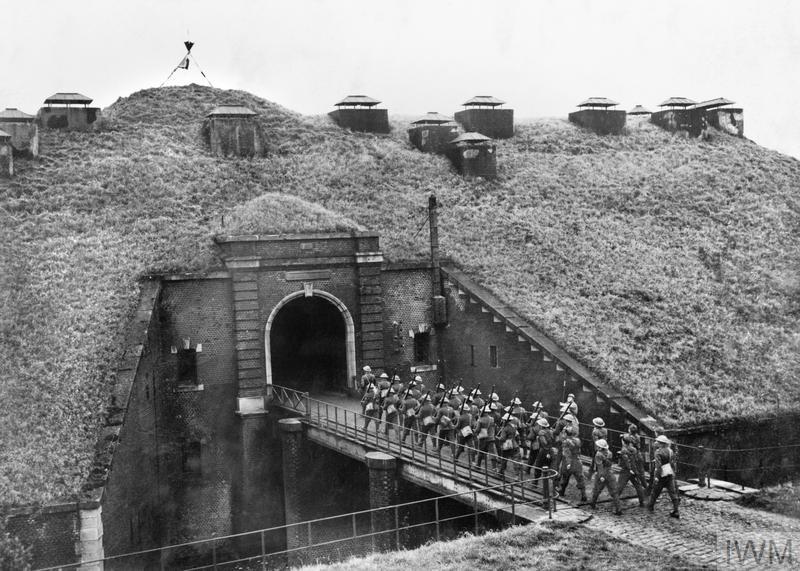
Two months to a day since the war began public opinion is being prepared for the seeming inevitability of the Allied armies taking Winter quarters. Yet in those two months no battle has been fought, casualties have been negligible, the respective armies are virtually on their frontier lines and outside the war zone life proceeds normally. Unless the Germans spring a surprise, which is now considered scarcely likely, the troops will be practically inactive at least for three months and possibly more. A few army corps, relieving each other periodically, would suffice to hold the front. Nevertheless there, could be no thought of even partial demobilization; the armies must remain ready for instant action. This situation has been brought about by two factors — the Allies’ decision not to engage in “any rash offensive” and what is described in Paris as Chancellor Hitler’s subsequent hesitation or indecision.
The German-controlled American freighter City of Flint entered port in Haugesund despite being ordered by its Norwegian escort, the minelayer Olav Tryggvason, not to. The German captain later told interrogators he was just following orders from his government and did not know why he was instructed to dock in Haugesund, but it was probably to get instructions from the vice consul on how and when to proceed to Germany. Norway decided to seize the freighter and return its command to the Americans, and at 23:30 a boarding party stormed the ship and removed the German prize crew. The Germans were interned at Kongsvinger Fortress for violating international law, which forbade a ship from entering a neutral port without sufficient cause.
The Norwegian Admiralty reports that it has interned the German crew of the captured U.S. freighter City of Flint after she docked at Haugesund, en route from Murmansk to Germany.
Jews in Sudetenland are deported to Poland. A mass exodus is feared. The first transport with some 300 Jews left the town of Brünn for Poland early on the morning of October 31, it was learned today. It was reported that there were about 300 in all, between the ages of 18 and 30.
Nazis, bitterly critical of United States embargo repeal action, hinted darkly today at a merciless submarine campaign to slop an expected flow of war planes, guns and munitions to the Allies. Unofficial Nazi quarters charged that repeal of the embargo would mean outright American support of the Allies.
The Nazi press, angered by the United States embargo repeal vote, accused Mrs. Franklin D. Roosevelt today of “attempting to create among the American people a hysterical fear of German attack.”
Hitler suggests using The Protocols of the Elders of Zion abroad to demonstrate that the true instigators of the war are Jews and Freemasons.
Franz Halder sent a message to Ludwig Beck telling him to be ready to move against Adolf Hitler on or shortly after 5 November 1939, which was the date the plans for the invasion of France, was supposed to be made known to top German military leaders.
Scandinavians fear attack; Sweden’s anxiety increases as the U.S. envoy prepares to evacuate Americans. Russian broadcasts and the high-powered anti-Finnish and anti-Swedish propaganda in the Moscow Pravda have caused a feeling in all Scandinavia that the crisis is near its culmination. In Sweden the nervousness of the population was increased by the United States legation’s purchase of twenty-two automobiles in Stockholm for evacuation of Americans if necessary. All foreign correspondents in Helsinki today bought bicycles.
In Copenhagen a meeting was held by the Friends of Finland which sent a sympathy telegram to an allied organization in Finland. Arrangements are being made to send supplies and financial aid to evacuated Finns. Official circles are reticent but they are said to believe a 50-50 chance of avoiding war still exists.
Talks continue between the USSR and Finland on Soviet requests for an exchange of territory and border alterations. Finnish delegates met with Soviet Marshal Josef Stalin and Soviet Commissar for Foreign Affairs Vyacheslav Molotov at the Kremlin. The Finnish position remained the same as their position of October 23, 1939. The Finns offered the islands in the Gulf of Finland but the Hanko peninsula (guarding the mouth of the Gulf) was not for discussion. Finnish counterproposals were presented, stating it recognized Soviet security needs but that Finland has now gone as far as its “independence, security and neutrality permit.” The Soviet position also hadn’t changed either. Molotov warned that “now is the turn of the military to have their say.” Pravda publishes a scathing attack on Finland which is picked up by other media.
The Helsinki correspondent of the newspaper Berlingskes quoted Foreign Minister Eljas Erkko of Finland today as saying the time had come for his country to say “stop” to Russia. The newspaper said that Mr. Erkko, asked by reporters whether Finland would consider the lease of Hangoe, asked by Russia for a naval base, replied: “When one already has ceded two-thirds of what is asked, there must come a point where an independent State must say ‘stop.’ ” A correspondent asked, “And this is it?” “Yes,” Mr. Erkko was quoted as replying, “Finland is firm.”
Deliveries of more than 800 airplanes and large contracts in raw materials and military equipment are believed in France to be only waiting President Roosevelt’s signature to the neutrality revision bill. Allied ships are ready to start carrying them to Europe to increase preparedness for any event.
Repeal of the Neutrality Bill opens up “an arsenal of tremendous resources” for the Allies, Edward Leslie Burgin, British Minister of Supply, said today.
Great Britain’s First Lord of the Admiralty, Winston Churchill, is visiting Paris, it was announced tonight by British sources. Mr. Churchill has come over to consult his French colleague, Navy Minister Cesar Campinchi. He had interviews today with Premier Edouard Daladier and Admiral Jean Darlan, spending two hours with the Premier and having luncheon with the admiral. Later M. Daladier called a conference of his economic advisers. Mr. Churchill dined this evening with M. Campinchi.
The British propaganda film “The Lion Has Wings,” rushed through production after the outbreak of war, was released to cinemas in the United Kingdom.
The British government reduced the nightly blackout regulations by an hour. After complaints from employers and trades unions, the blackout is reduced by an hour. It now runs from half an hour after sunset to half an hour before sunrise.
The British Government announces that over 500,000 tons of contraband have been seized from vessels. Some of that “contraband” would be disputed by the owners.
The South African Prime Minister, General Smuts, promises to defend British colonies in Africa if required.
The Danish cargo liner Canada struck a mine in the North Sea off Holmpton, Yorkshire (53°40′N 0°17′E) and sank. All 64 crew were rescued by the Norwegian ship Ringhorn. The wreck was subsequently dispersed by explosives.
U-37 suffered slight damage after an air attack.
Convoy HG.7 departs from Port Said bound for Liverpool, while Convoy OG.5 forms at Gibraltar.
Friday, 3 November
American steamer CITY OF FLINT (4963grt) departed Murmansk during the night of 26/27 October, called at Tromso on the 30th and was ordered to leave, escorted by Norwegian destroyer SLEIPNER. On the 3rd, she was interned at Haugesand by Norwegian minelayer OLAV TRYGGVASON after entering the port without permission, arrived at Bergen on the 4th and was later set free after the German prize crew was removed. CITY OF FLINT departed Bergen on the 27th and arrived at Haugesand later that day to discharge her cargo, departed there on 20 December and Bergen on the 22nd, arriving at Narvik on the 28th.
German steamer NEW YORK (22,337grt) successfully ran the blockade while the Home Fleet was involved with CITY OF FLINT. She departed Murmansk on 31 October and successfully used the Indreled, arriving at Hamburg on the 12th escorted by three minesweepers and aircraft.
Light cruiser GLASGOW and destroyers KELLY, BEDOUIN, ESKIMO and MATABELE had been involved in trying to intercept CITY OF FLINT and NEW YORK as they came down the Norwegian coast. All four destroyers arrived back at Scapa Flow on the 5th after sustaining severe weather damage. GLASGOW arrived at Rosyth that day with her forecastle dropped by two inches from the effect of the weather.
Light cruiser NEWCASTLE arrived at Sullom Voe on the 3rd for refueling, then went off on Northern Patrol.
KELLY, after emergency repairs at Kirkwall departed with destroyer ICARUS for temporary repairs from depot ship GREENWICH at Scapa Flow, before going on to Hebburn for permanent repairs. She was back in service on 14 December. ESKIMO departed Scapa Flow on the 6th and arrived at Newcastle on the 7th, repairing until the 24th. MATABELE and BEDOUIN departed Scapa Flow on the 7th, MATABELE arriving at Rosyth on the 8th and reaching Newcastle on the 10th, where she repaired until the 25th, while BEDOUIN arrived at Rosyth on the 8th for boiler cleaning and repairs.
Convoy OA.28G departed Southend on 31 October escorted by destroyers ACASTA and ARDENT, while OB.28G departed Liverpool on the 1 November escorted by destroyers VERSATILE and VOLUNTEER. On the 3rd, the convoys with 33 ships merged as OG.5, and were joined in the Western Approaches by French large destroyers VAUQUELIN and TARTU the same day. The British escorts were relieved and returned to England. The convoy and the French escorts arrived at Gibraltar on the 9th.
Light cruisers DRAGON, COLOMBO, DIOMEDE arrived at Sullom Voe.
On Northern Patrol were light cruisers CALEDON and CERES between the Orkneys and the Faroes, three cruisers and one AMC between the Faroes and Iceland, and three AMCs in the Denmark Strait. Light cruiser SOUTHAMPTON was returning to Scapa Flow from Denmark Strait patrol.
Anti-aircraft cruiser CALCUTTA departed Grimsby on escort duties and arrived back later the same day.
Convoy FS.31 departed Methil escorted by destroyers VALOROUS, WOOLSTON and sloop HASTINGS, and arrived at Southend on the 5th. There was no convoy FN.31.
German steamer SCHWABEN (7773grt) had departed Santos on 26 September and passed through the Denmark Strait on 21 October. She entered Haugesand shortly after the CITY OF FLINT and was allowed to continue, arriving safely in the Weser on the 8th.
French torpedo boat BRANLEBAS reported the track of a torpedo in 49-38N, 2-50W.
Heavy cruisers DEVONSHIRE and SUFFOLK departed Alexandria and NORFOLK Malta on the 5th. All three cruisers called at Gibraltar on the 7th and 8th, and left on the 8th, escorted by destroyers DOUGLAS and KEPPEL. The destroyers were relieved in 44N by destroyers ISIS and ILEX which had escorted battleship WARSPITE from Gibraltar on the 6th. DEVONSHIRE and NORFOLK arrived at Plymouth on the 11th and SUFFOLK at Portsmouth on the 12th. NORFOLK reached the Clyde on the 18th and departed the same day on Northern Patrol duties. SUFFOLK arrived in the Clyde on the 19th and also departed later the same day for Northern Patrol. DEVONSHIRE repaired at Devonport until the 21st, and then arrived at the Clyde on the 22nd for duty with the Home Fleet.
Destroyer DECOY departed Malta after refitting, and escorted steamer NEVASA to Marseilles. The destroyer returned, escorting ocean boarding vessel VAN DYCK and reached Malta on the 7th.
Destroyers ISIS and ILEX, which had departed Plymouth, arrived at Gibraltar for escort duties with battleship WARSPITE and later, with cruisers of the 1st Cruiser Squadron.
Submarine OSIRIS was damaged by a motor room fire at Alexandria. She departed Alexandria on the 8th escorted by anti-submarine trawler CORAL and arrived at Malta on the 13th, where she was under repair and refit until 30 December.
Light cruiser CARADOC departed Kingston for duty in the Pacific Ocean.
The U.S. Congress votes final approval of the conference report to lift the embargo on the export of arms to belligerents. The U.S. Congress amended the Neutrality Act of 1937, repealing the embargo on arms to belligerents but placing sales on a cash-and-carry basis to avoid a repeat of the situation after World War I when Britain and France ran into difficulty with making their war debt payments to the United States. The bill now goes to the White House for the president’s signature.
Congress gave final approval late today to the Neutrality Resolution repealing the arms embargo and substituting cash-and-carry regulations, and then adjourned the extra session at 6:35 PM. The final version of the bill was designed to carry out the recommendations made by President Roosevelt in his message in September, and the President expressed himself as well pleased with the result. In a letter to Congressional leaders, Mr. Roosevelt expressed the hope that “world events will not make it necessary to have any other extraordinary session” of Congress before its next regular meeting date of January 3, and wished the members “a pleasant Thanksgiving and Merry Christmas.”
Mr. Roosevelt arranged to sign the joint resolution at noon tomorrow, thus making it law, and it was presumed that he would at the same time issue at least one proclamation, and perhaps more, under the authority the new law would give him. The first, and major, proclamation indicated under the law will be the President’s finding that “there exists a state of war between foreign States,” naming the States involved in the conflict. This finding will bring automatically into effect most of the provisions of the resolution which are intended to prevent the involvement of the United States in the European war.
The Senate and House conferees met for nearly four hours this morning. The time was spent drafting minor perfecting amendments to the Senate Resolution, which was accepted in its entirety as to main points. As soon as the result. of their labors was reported to both houses it was approved, almost without debate. The Senate accepted it by a vote of 55 to 24 and the House immediately followed suit by a vote of 243 to 172.
While the House was voting on the conference report the Senate was passing the adjournment resolution, and Speaker Bankhead had hardly finished announcing the result when the Secretary of the Senate arrived to report the Senate’s adjournment action, which had been taken at 6:21 PM by a vote of 46 to 25. The House voted its concurrence in the adjournment idea by 223 to 189, the threatened Republican revolt against permitting Congress to leave the capital at this time having failed to materialize, and the gavel fell just fourteen minutes after the Senate ended its session. The comparatively few members left in the House when the President’s message was read enjoyed a laugh as, after Thanksgiving and Christmas felicitations, the message continued: “May I add that I hope those members in the States where Governors have set November 30 as Thanksgiving Day will celebrate both Thanksgivings — on the 23rd and the 30th.”
Action in the Senate today was brief. After Senator Pittman had explained the changes made in the bill by the conferees, Senator Johnson of California told him that he should have said also that two of the Senate conferees, Senators Johnson and Borah, had refused to sign the conference report. This was all there was to the discussion, which lasted about ten minutes. The roll was called and the Senate concluded its action on the Neutrality Resolution. In the House only about a half hour was spent after Chairman Bloom of the Foreign Affairs Committee obtained “immediate consideration.” This was granted with the required unanimous consent, despite advance fears of leaders that some member might object and delay proceedings for another day.
In addition, the Neutrality Acts of 1935 and 1937 are repealed, meaning U.S. ships and citizens are forbidden to enter the European war zone; this is easily avoided by re-flagging US ships to flags of neutral nations, a process that has been ongoing already. The National Munitions Control Board is given jurisdiction over all arms imports and exports, and licenses are required to export arms and munitions.
“Cash-and-carry” is considered important because Britain and France borrowed so much to pay for war goods during World War I that they had difficulty repaying it.
President Roosevelt today charged bad manners to the Russian Foreign Office and to Premier and Foreign Commissar Vyacheslav Molotov in particular.
Norway’s action in interning the German prize crew of the City of Flint and turning the freighter and her American seamen over to Captain Joseph A. Gainard brought welcome relief to official Washington tonight.
Balkan states hail the end to the U.S. arms embargo. The Yugoslav press says it will end the fear of small nations.
Congressman Martin Dies says he will trace Reds in shipping unions. The Dies Committee investigating un-American activities takes a surprise recess. The House Committee to Investigate Un-American Activities voted unexpectedly today to take a long recess. The decision came after several days of testimony purporting to show Communist control over the workers in the merchant marine.
The German-American Bund was denounced by New York Assistant District Attorney Herman J. McCarthy yesterday afternoon as an “organization conducted as a racket” by its leader, Fritz Kuhn.
Some progress toward a settlement of the dispute which has crippled the Chrysler Corporation’s operations and brought idleness to more than 58,000 employes, was reported today by Federal and State mediators and by the corporation spokesmen.
The World Fair Railroad carried more than 7 million passengers to this year’s festivities. This accounts for about 54 percent of the fair attendees.
Franklin Roosevelt laid the cornerstone of the Franklin D. Roosevelt Library in Hyde Park, New York, United States.
Clare Booth’s “Margin for Error” premieres in NYC.
The John Ford-directed historical film “Drums Along the Mohawk” starring Claudette Colbert and Henry Fonda was released. “The Flying Deuces” starring Laurel & Hardy is released. “Popeye: Never Sock a Baby” also is released by Fleischer Studios for Paramount Pictures.
Canada will become a buyer of war essentials in the United States as soon as the neutrality amendment has been signed. She, as well as Britain, will place war orders there.
China hails the U.S. vote against the embargo. Establishment of the new United States neutrality policy, signalled by the vote of the House of Representatives against the arms embargo, is generally welcomed in the Chinese temporary capital of Chungking. The new Neutrality Law is held to strengthen a power friendly to China and in a most advantageous postion to help her.
The British Church Missionary Society reported to the British Embassy in Shanghai today that its hospital at Hingwa, seventy miles southwest of Foochow, had been wrecked in a Japanese air raid Wednesday. There were several casualties among Chinese.
A dispatch from Foochow said today that nine Japanese airplanes made direct hits with four bombs on the American-operated British Mission’s St. Luke Hospital and demolished twelve wards, killing two patients and wounding two seriously.
United States Ambassador Joseph C. Grew called at the official residence of the Foreign Minister at 10 AM today and told the Japanese Government in blunt terms that it was in danger of economic pressure from the United States if it continued its present program in China. The Ambassador’s visit was the first of a series of conferences with the Foreign Minister, Admiral Kichisaburo Nomura, to determine what should be done when the present Japanese-American commercial treaty, the basic agreement between the two nations, expires January 26. It followed his address of last month before the America-Japan Society, in which he told the Japanese “straight from the horse’s mouth” that Americans did not approve of many of the actions of the Japanese armed forces in China.
Mr. Grew was equally frank in his conversation today. He reiterated the points he made in his October 19 address, asserting that the American people have a very clear conception of what Japan means when she says she intends to “create a new order in East Asia.”
Americans believe, he said, that the proposed “new order” will be one in which American rights may be seriously curtailed. Mr. Grew then reviewed in detail attacks on American property in China, curtailment of American rights of navigation, travel and trade, and individual acts against American citizens by armed Japanese.
A serious situation now exists, the Ambassador said, and unless it is improved soon Japanese-American relations are likely to grow even worse. He reminded the Japanese Government that Congress would convene in regular session in January, before expiration of the present basic Japanese-American treaty, which has been abrogated by President Roosevelt.
If Japanese-American relations are not improved by that time, he said, it may be expected there will be a demand by many Americans for an embargo on sales of all American products to Japan. The United States expects both “negative and positive” action by the Japanese Government, the Ambassador said. On the negative side it expects a cessation of all anti-American actions by Japanese in China. On the positive side it expects “concrete evidence of the intention of the Japanese Government to effect an improvement in the situation which has existed.”
It was the strongest action taken by any power to protect its interests in China since the Chinese-Japanese war started in July, 1936, and was doubly important in that it came while Japan openly was preparing to launch a new “National Government” of China in Nanking under former Chinese Premier Wang Ching-wei.
Dow Jones Industrial Average: 152.64 (+1.08)
Born:
Terrence McNally, American playwright (“Kiss of the Spider Woman”), in St Petersburg, Florida (d. 2020).
Died:
Waldemar Lindgren, 79, Swedish-American Geologist (economic geology, ore classification).
Naval Construction:
The Royal Navy Flower-class corvette HMS Columbine (K 94) is laid down by Charles Hill & Sons Ltd. (Bristol, U.K.); completed by Richardson, Westgarth & Clark.
The Royal Navy Implacable-class aircraft carrier HMS Indefatigable (10) is laid down by the John Brown Shipbuilding & Engineering Company Ltd. (Clydebank, Scotland).
The Royal Navy Black Swan-class sloop HMS Flamingo (L 18; later U 18) is commissioned. Her first commanding officer is Lieutenant Commander John Herbert Huntley, RN.
The U.S. Navy Sims-class destroyer USS Russell (DD-414) is commissioned. Her first commanding officer is Lieutenant Commander John Conner Pollock, USN.


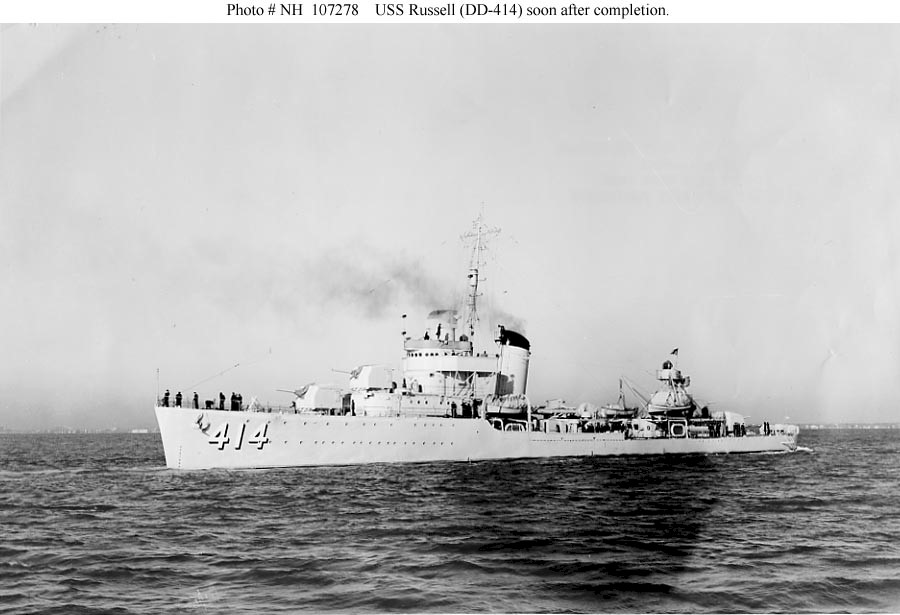
Commissioned two months after the outbreak of World War II in Europe, Russell cruised in the western Atlantic and in the Caribbean on neutrality patrol until the bombing of Pearl Harbor. She spent the rest of the war participating in many of the iconic Pacific battles, including Coral Sea, Midway, Guadalcanal, Santa Cruz Islands, Kiska, Tarawa, Kwajalein, Morotai, Luzon, and Okinawa. Decommissioned 15 November 1945. Stricken 28 November 1945. Sold 28 September 1947 and broken up for scrap.
Russell earned 16 battle stars during World War II, making her among the most decorated U.S. Naval vessels of World War II.
https://www.hazegray.org/danfs/destroy/dd414txt.htm
 History Diaries