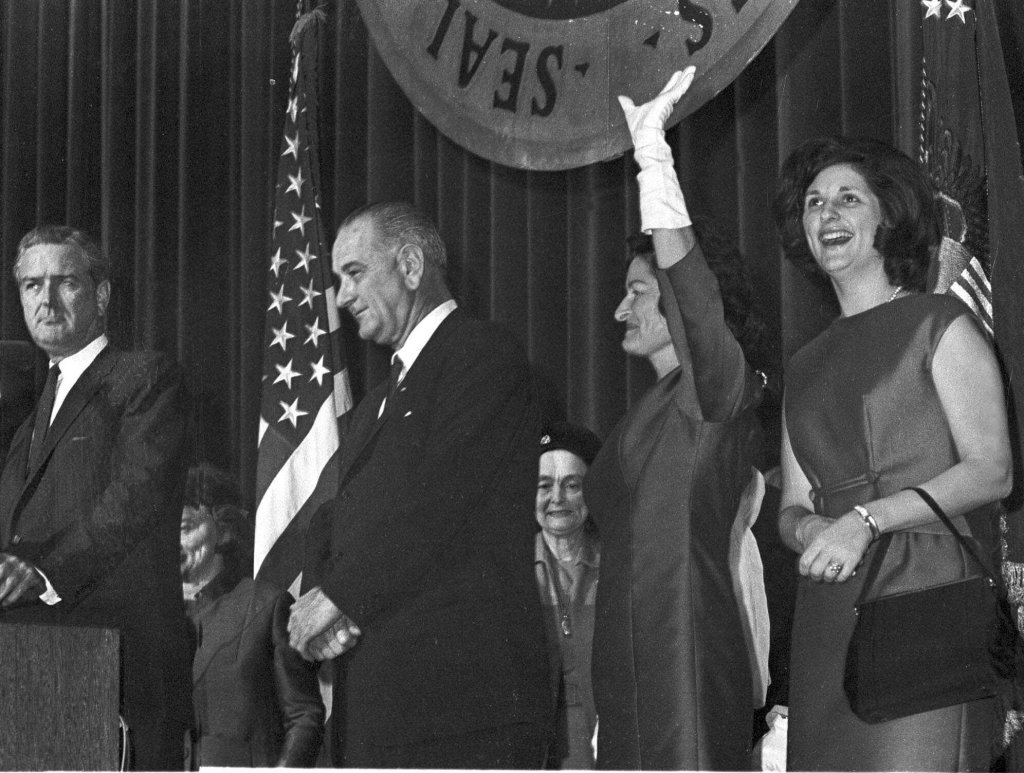
Lyndon Johnson is re-elected by a landslide over Goldwater in part, at least, because so many Americans believe Johnson is less likely to escalate the U.S. involvement in Vietnam.
An interagency ‘working group,’ headed by William Bundy, holds its first meeting. This group is charged with drawing up the various military and political options for the United States in Vietnam and then presenting these to the high-level officials such as Rusk, McNamara, Wheeler and Taylor, who will in turn refine and present them to the President. ‘Bundy’s group’ will meet throughout the next three weeks.
The Soviet Union formally expressed concern to the United States today over the deteriorating situation on the Cambodian‐South Vietnamese border. The State Department said this had been voiced in a 15minute meeting between Secretary of State Dean Rusk and Ambassador Anatoly F. Dobrynin, who had requested the interview. The department offered no details on Mr. Dobrynin’s presentation, but it said that Secretary Rusk had noted “the continued use by the Vietcong of the Cambodia‐Vietnam border area.”
A department spokesman said Mr. Rusk had told the Soviet Ambassador that the United States hoped “no further steps would be taken either inside or outside Cambodia to exacerbate the situation further.” The Soviet diplomatic intervention coincided with the delivery to Cambodia of Soviet arms, including two jet fighters and artillery. Earlier, Cambodia received weapons from Communist China. These deliveries were reported to be fairly substantial. Prince Norodom Sihanouk, the Cambodian chief of state, has warned that all this equipment will be used to “defend” his country from South Vietnamese and United States forces. There was concern here that new border incidents might occur.
The United States expects a major political crisis next month in the Atlantic community. The issues are unity in the North Atlantic Treaty Organization, the pact’s nuclear defenses, the future of the European Economic Community, or Common Market, and trade negotiations with Western Europe. The consensus among high United States officials is that the NATO Ministerial Council meeting opening in Paris December 15 will be confronted with the crisis. At the root of the situation, officials indicated, are the policies of France, regarded here as increasingly negative, and also conditions in Britain and West Germany.
Initial discussions on the crisis were held in Washington with the British Foreign Secretary, Patrick Gordon Walker, last week. There will be conferences in Washington later this month with the West German Defense Minister, Kai‐Uwe von Hassel, and early in December with the new British Prime Minister, Harold Wilson. Among the elements in the approaching confrontation, officials said, is French opposition to creation of a nuclear armed NATO fleet manned by mixed crews from the participating nations. Another is the desire of Britain’s new Labor Government to see the alliance’s structure revised. But to an increasing degree, the United States tends to regard President de Gaulle as the principal single factor in disrupting the Atlantic community’s political, economic and military unity.
There has long been a sense of irritation in Washington with General de Gaulle because of his policies on recognizing Communist China and advocating the neutralization of the war in Vietnam. But now the most recent hints from Paris that France is considering adopting an inactive role both in NATO and in the Common Market have led United States officials to resentment of the French President. While the United States became reconciled long ago with France’s opposition to the proposed NATO fleet, the judgment here today is that the de Gaulle Government has taken a drastic new step in threatening, in effect, reprisals against NATO members who may agree to join. This was the interpretation placed by officials on this morning’s speech before the French National Assembly by Foreign Minister Maurice Couve de Murville. They noted that he seemed to suggest that participation in the mixed‐crew force was incompatible with European political and economic unity.
An Italian Communist party delegation returned from Moscow tonight and said it was dissatisfied with the Kremlin’s explanation of how and why Nikita S. Khrushchev was ousted three weeks ago. Enrico Berlinguer, member of the Italian party’s Central Committee who headed the delegation, said that explanations given to the Italians in Moscow “did not seem to us sufficient to make us abandon the reservations that our party has expressed concerning the method followed in informing public opinion” of the deposing of Nlr. Khrushchev. Mr. Berlinguer said that the new Soviet Communist party chief, Leonid I. Brezhnev, and others had satisfactorily affirmed the Soviet policy of peaceful coexistence.
United States officials said today that reports had been received here that the Soviet Union had stopped jamming broadcasts from Communist China. United States Information Agency officials said initial reports from United States monitoring stations around the periphery of the Soviet Union indicated that the jamming ceased over the weekend. The jamming was inaugurated earlier this year during the height of the Peking-Moscow dispute.
Five new types of rockets, including a huge multistage weapon larger than any rocket yet displayed by the Soviet Union, are being towed through the center of Moscow by night. The rockets are part of the military equipment display being rehearsed for the celebration of the Bolshevik Revolution on Saturday. Two of them appear to be field‐artillery rockets, but one of these might be a high‐altitude antiaircraft weapon. The two others are surface‐to‐surface rockets, including a liquid-fueled one about 85 feet long and 10 to 12 feet in diameter. It is hard to detect details because the rockets are draped in canvas. The covers will come off when the weapons are pulled through Red Square as the new Soviet leaders watch from atop Lenin’s Mausoleum. The parade will be the high point of celebrations marking the 47th anniversary of the revolution.
Czechoslovakia considers herself first in line among Communist countries that will seek new relationships with Washington after the Presidential election. Officials hope in the next few months to make new commercial, consular and cultural agreements with the United States, probably in one large pact. To some extent they expect this to follow the pattern set earlier this year by Rumania. Hungary is also interested, although her case is thought in Washington to present greater domestic political problems.
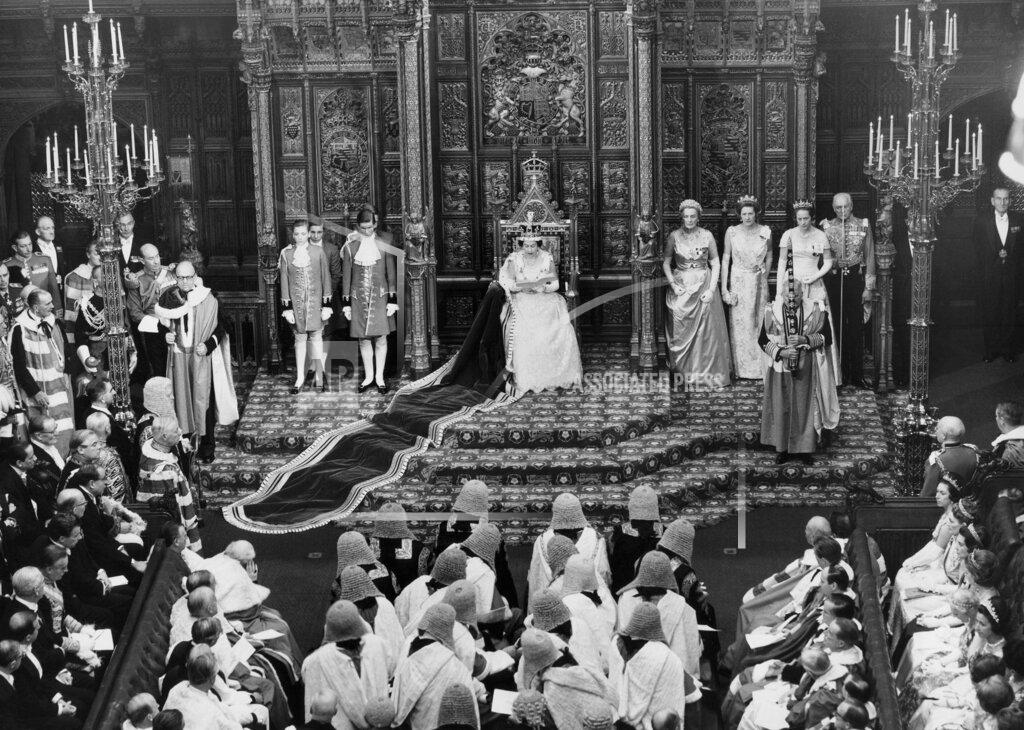
Britain’s new Labor Government offered a program of controversial legislation to Parliament. Headed by a demand for renationalization of the steel industry, the proposals indicate one of the bitterest sessions in parliamentary history.
Britain’s partners on the Council of Europe turned against her today with sharp attacks on her decision to impose the special 15 percent duty on most imports. Apparently surprised by the harshness and near‐unanimity of the onslaught, the British delegation took the unusual step of calling for help from London. At the end of today’s opening session of the 17‐nation council assembly, it was announced that a high Government official would come here tomorrow to deliver an authoritative statement of the new Labor Government’s case.
The United States and the European Common Market removed today a major obstacle to the Kennedy round of trade‐expansion negotiations by agreeing to exchange special tariff lists on November, 16 as scheduled. In a related development, highly placed sources here indicated tonight that West Germany would submit new proposals tomorrow to the trade bloc’s member nations designed to resolve the present Franco-German impasse over grain prices.
The crew of an East German freight locomotive has been arrested in the wake of the accident Saturday near Rostock in which 39 passengers died in a collision between an express train and the freight, the East German press agency, A.D.N., said today.
Israeli Deputy Premier Abba Eban denied tonight that German scientists were taking part in Israeli nuclear research. There is no parallel in Israel to the presence of German scientists who are developing missiles in the United Arab Republic, he said. He made the statement in opposing motions of no confidence in the Government. The motion was defeated. Communists supporting the move had attacked what they called the “activity of West German scientists in Israel generally and in the nuclear sphere particularly.”
Yemeni republican and royalists have agreed to hold a plebiscite to determine the future regime of Yemen, the newspaper Al Hayat reported from Jidda. Saudi Arabia, today. The newspaper attributed its information to a member of the royalist delegation. Delegations from the two sides met in Erkwit, in the Sudan, over the weekend. The royalists, supported by Saudi Arabia, have been battling the republicans since they deposed Iman Mohamad el‐Badr in September, 1962. The United Arab Republic supports the republicans, whose government is normally headed by President Abdullah al‐Salal.
Eduardo Frei Montalva was inaugurated for a six-year term as the 29th President of Chile. He pledged to carry out “a profound revolution within liberty and law” to break social barriers and correct the inequitable distribution of wealth, which he called the “shame” of the Western Hemisphere. He also issued a call to the other Latin‐American nations and to the United States to renew their dedication to the Alliance for Progress and to cooperate with other areas of the world to achieve peace and prosperity. The inaugural address emphasized a domestic platform of democratic social reform that swept Mr. Frei’s Christian Democratic party to victory two months ago.
A military revolt broke out in Bolivia and appeared to be spreading across the country. A truce designed to open the way for efforts “to resolve the present crisis” facing the Government of President Victor Paz Estcnssoro was announced.
Conflicting reports circulated here today concerning the plans of Juan D. Perón, the former Argentine dictator, for the immediate future. Four leading Perónists from Argentina who are conferring with him said he was still determined to return home this year. Last night a participant in the conference at Mr. Perón’s residence said he had reversed his previous decision to go back to Argentina soon because ‘the objective conditions” for such a move were lacking. This was understood as an acknowledgement of the armed force’s opposition to his return. The military ousted him in 1955. Anti‐Perón Argentines in Madrid said that the former dictator appeared to be seeking to remain in exile for the time being without losing face in the eyes of his Argentine supporters, who eagerly expected his return.
The Central African Republic severed diplomatic relations with the Chinese Nationalist Government on Taiwan today and asked the recently accredited Ambassador to leave.
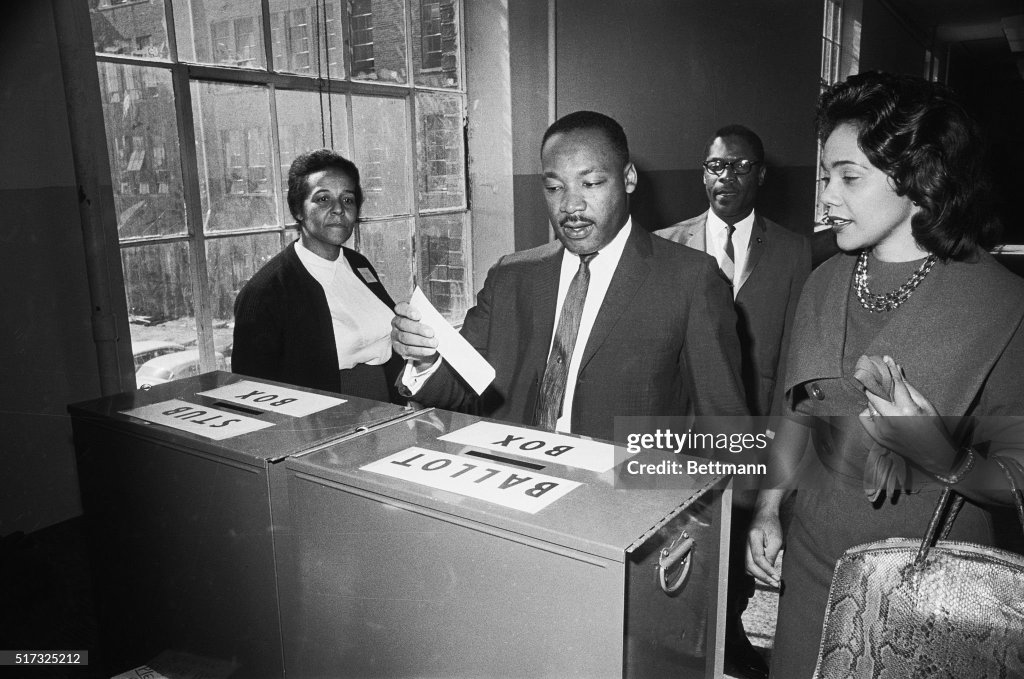
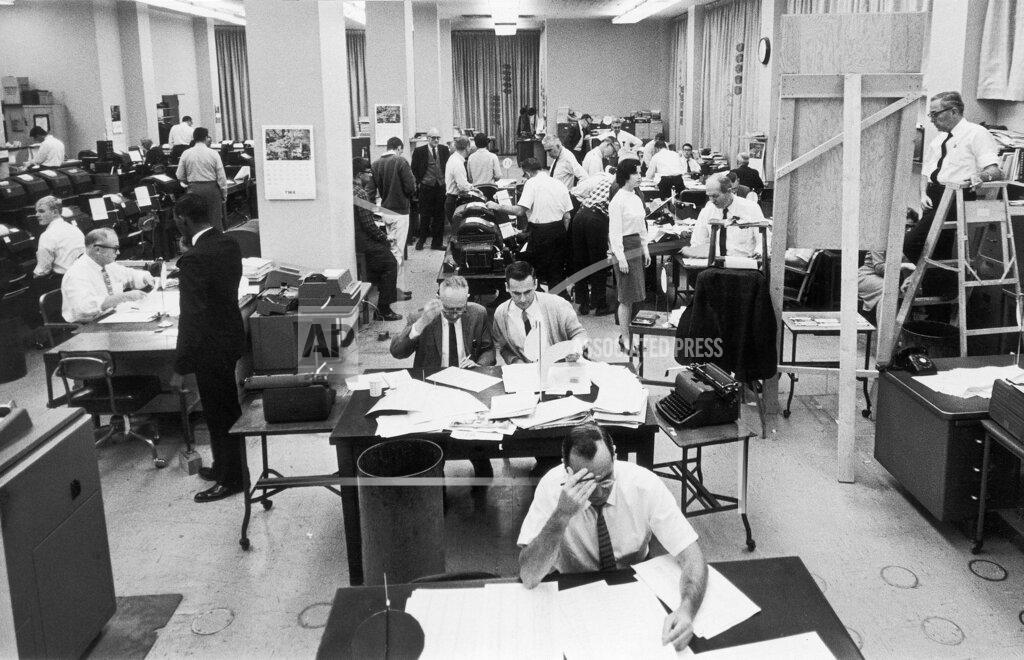
In the U.S. presidential election, President Lyndon Johnson defeated his Republican challenger, U.S. Barry Goldwater with a record of 61.05 percent of the popular vote and the electoral votes of 44 of the 50 states. Johnson received 43,127,041 out of 70,639,284 votes and Goldwater got 27,175,770; he also got 486 electors to Goldwater’s 52. The election marked a change in traditional voting patterns, with five Democratic Party states in the Deep South (Louisiana, Mississippi, Alabama, Georgia and South Carolina) being carried by Goldwater and nearly all of the commonly Republican Party strongholds favoring Johnson. The Johnson/Humphrey ticket received no votes in Alabama because no Democratic party electors were on the ballot in that state; 210,732 of the 689,817 votes cast there went to other presidential candidates.
Lyndon Baines Johnson of Texas compiled one of the greatest landslide victories in American history yesterday to win a four‐year term of his own as the 36th President of the United States. Senator Hubert H. Humphrey of Minnesota, Mr. Johnson’s running mate on the Democratic ticket, was carried into office as Vice President. Mr. Johnson’s triumph, giving him the “loud and clear” national mandate he had said he wanted, brought 44 states and the District of Columbia, with 486 electoral votes, into the Democratic column. Senator Barry Goldwater, the Republican candidate, who sought to offer the people “a choice, not an echo” with a strongly conservative campaign, won only five states in the Deep South and gained a narrow victory in his home state of Arizona. Carrying it gave him a total of 52 electoral votes.
A heavy voter turnout favored the more numerous Democrats. In Austin, Texas, Mr. Johnson appeared in the Municipal Auditorium to say that his victory wvas “a tribute to men and women of all parties.” “It is a mandate for unity, for a Government that serves no special interest,” he said. The elec tion meant, he said, that “our nation should forget our petty differences and stand united before all the world.” Mr. Goldwater did not concede. A spokesman announced that the Senator would make no statement until 10 AM tomorrow morning in Phoenix.
But the totals were not the only marks of the massive Democratic victory. Traditionally Republican states were bowled over like tenpins — Vermont, Indiana, Kansas, Nebraska, Wyoming, among others. In New York, both houses of the Legislature were headed for Democratic control for the first time in years. Heralded Republicans like Charles H. Percy, the gubernatorial candidate in Illinois, went down to defeat.
President Johnson captured all 37 New England electoral votes today in the first sweep of the region by a Democratic nominee for the nation’s highest office.
On the impetus of his imposing victory, Mr. Johnson can be expected to move rapidly on a broad front in domestic policy, and to grapple with several serious foreign problems. He has said that a program of medical care for the aged through the Social Security system will be his first priority in legislative matters. He has also pledged to seek a major education program and to extend his “war on poverty.” In international matters, Mr. Johnson must soon seek positive answers to the problems of establishing some form of international nuclear force that would include West Germany, of reorganizing the North Atlantic Treaty Organization and its forces, and of prosecuting the anti‐Communist guerrilla warfare in South Vietnam.
Nationwide voting also gave the Democrats a larger majority in the House of Representatives (295 to 140 over the Republicans) and in the Senate (a 68 to 32 advantage).
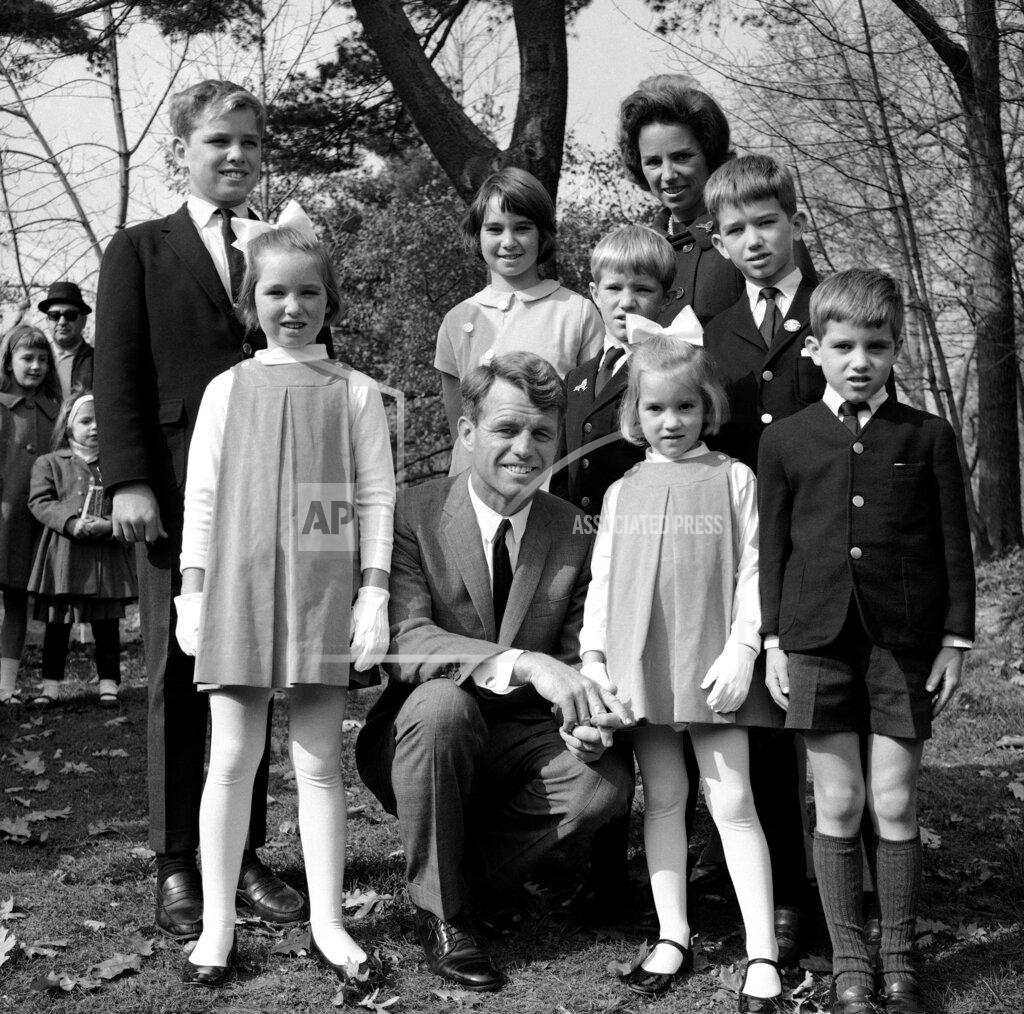
Robert F. Kennedy was elected to the United States Senate from New York yesterday in his first bid for elective office, overwhelming Republican Senator Kenneth B. Keating. With more than 80 percent of the vote counted, Mr. Kennedy held a 6‐to‐5 lead. Because most of the untallied vote was in heavily Democratic New York City, it appeared that the former Attorney General’s plurality might reach 650,000. Mr. Keating conceded defeat at 11:39 PM with the announcement at the Roosevelt Hotel that he had sent a congratulatory telegram to Mr. Kennedy.
President Johnson captured California’s 40 electoral votes in his triumph over Senator Barry Goldwater in yesterday’s election. On the basis of the incomplete count of ballots, however, the President’s former press secretary, Senator Pierre Salinger, apparently lost his Senatorial battle to George Murphy, the Republican nominee. Mr. Salinger late last night refused to concede defeat but said he “would be less than candid if I didn’t say the vote doesn’t look good.”
Proposition 14, a civil rights ballot measure that would nullify most of California’s antidiscrimination legislation in housing, was adopted last night.
Arkansas Governor Orval E. Faubus, seeking re-election to a sixth term, held a commanding lead over Winthrop Rockefeller early today as the count in the Arkansas gubernatorial contest came in slowly.
For first time since 1800, residents of Washington, D.C. are permitted to vote. President Johnson won an overwhelming victory in the nation’s capital.
Jack Roland Murphy was annoyed a little. “I was supposed to be on my way to Hawaii to surf,” he said today, lighting a cigar. “Now all this inconvenience has fouled the whole thing up.” The inconvenience referred to by Murphy, also known as Murph the Surf, was the great interest shown in his and his friends’ recent and current activities by the Federal Bureau of Investigation, the New York City police and the Miami police. He and his friends, Allan Dale Kuhn and Roger Frederick Clark, are the prime, indeed the only, suspects in last week’s acrobatic theft of $410,000 worth of jewels from the American Museum of Natural History in New York City. The gems — including the 563‐carat Star of India sapphire — have not been found since Murphy and Kuhn flew here last Friday from New York. The theft took place Thursday night.
The Administration that takes office in January will face a mixed economic picture composed of prosperity — and problems. As voters went to the polls yesterday, tile nation’s economy was at best spotty.
The United States balance of trade, which has been consistently favorable, has improved recently, the Commerce Department reported today.
The Seabrook Methodist Church in Texas was filled to overflowing today for a memorial service for Captain Theodore C. Freeman, the United States astronaut killed in a plane crash last Saturday. Among the mourners were the 28 other astronauts, and their wives.
Philadelphia voters approve $25 million to build a new sports stadium that would become Veterans Stadium, home to MLB Phillies and NFL Eagles. Due to cost overruns, a 1967 measure will be needed to authorize an additional $13 million, bringing the final price tag to approximately $50 million, making Veterans Stadium one of the most expensive ballparks ever built.
Born:
Paprika Steen [as Kirstie Steen], Danish film actress, in Frederiksberg, Denmark.
Brenda Fassie, South African singer known as MaBrrr and nicknamed “The Queen of African Pop”, in Langa, Cape Town (d. 2004).
Garland Rivers, NFL defensive back (Chicago Bears), in Canton, Ohio.
Died:
John Henry Barbee, 58, American blues guitarist and singer, of a heart attack.

Bush did not win. But he did better in Texas than Goldwater did.

 History Diaries