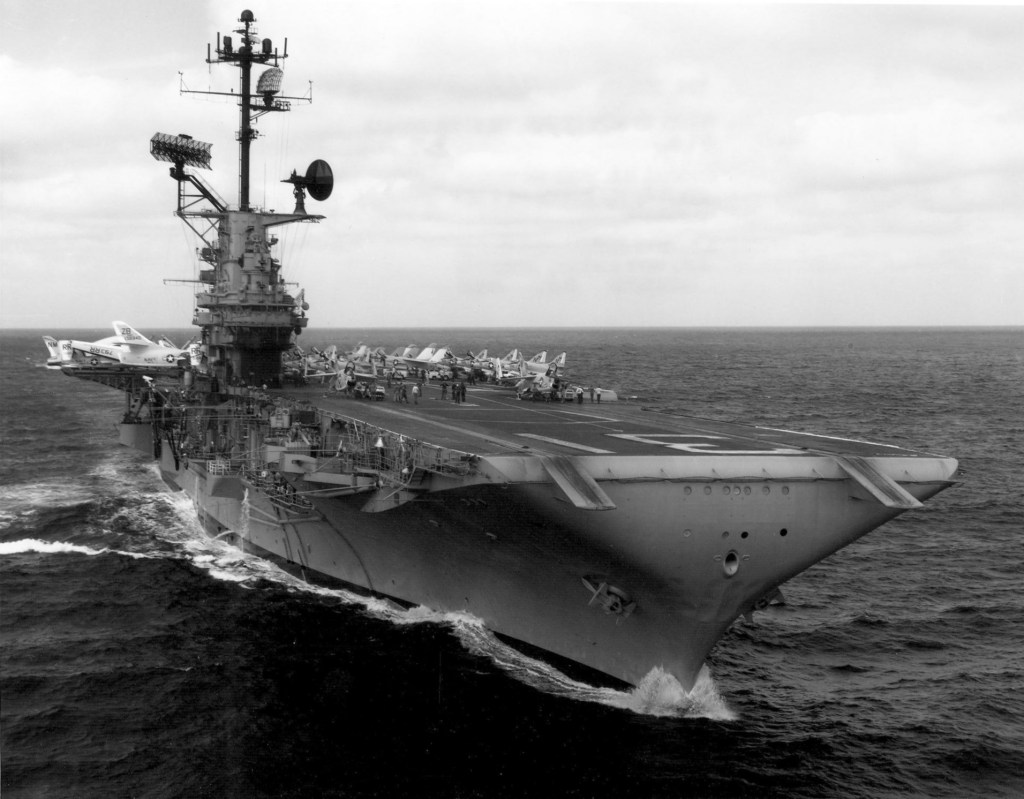
In the last day before the election, presidential candidate Barry Goldwater and ex-Vice-President Nixon attack the President’s handling of events in Vietnam, charging that the Pentagon was warned two days before that Biên Hòa was exposed to just such an attack and that security is inadequate; Goldwater challenges Johnson to admit to the American people that the United States is involved in an undeclared war in Vietnam.
More than 800 South Vietnamese troops, supported by United States Army helicopters, searched the area around Biên Hòa airbase for nearly 10 hours yesterday without encountering any of the Vietcong troops who shelled American installations. The guerrilla mortar squads made a complete getaway, a United States spokesman said today. In less than half an hour of intense bombardment of United States installations at the base early yesterday, they killed 4 Americans and 2 Vietnamese and wounded 33 of the defenders. They destroyed 5 B‐57 jet bombers and damaged 15 more B‐57’s, 4 American helicopters and 3 Vietnamese A‐1H Skyraider bombers. Ground pursuit forces, which were not sent out until eight hours after the attack, found imprints in the dirt of six heavy mortar base plates and 80 canisters in which mortar rounds had been packaged.
This evidence, disclosed by the United States Military Assistance Command, indicated that both the number of mortars involved in the bombardment and the number of rounds delivered were underestimated in preliminary reports. Spokesmen said yesterday they suspected three mortars had been fired and estimated the number of rounds at 25 to 30. The mortars were fired from a meadow of shoulder‐high brush just over half a mile from the fence of the airbase. The shells landed in the aircraft parking area about 3,000 yards south of the mortar emplacement. Heavy mortars of the type used — either 81 mm, or 82 mm. of a Chinese type — could be fired by teams of three men for each weapon. Vietnamese sources believe, however, that a full company of Việt Cộng — more than 100 men — took part in the attack.
In repeated broadcasts today, the Hanoi radio and the Việt Cộng’s own clandestine radio heralded the “glorious performances” and “brilliant exploits of the troops and people of Biên Hòa.” The broadcasts indicated that the Communists considered the Biên Hòa bombardment a direct reply to the American aerial attack on North Vietnamese torpedo boat bases in August, following naval clashes in the Gulf of Tonkin. The Việt Cộng radio further linked the Biên Hòa attack with the execution in Saigon of a convicted Việt Cộng terrorist, Nguyễn Văn Trỗi, on October 15. Trỗi, who shouted “Down with the Americans!” as he was shot by a firing squad, is depicted as a martyr in Việt Cộng propaganda.
A full battalion of Vietnamese marines and one company each of rangers, regional forces, and regular army troops combed the area north of the airbase from 8:30 AM to about 6 PM yesterday. The bombardment occurred shortly after midnight. Apparently the search operation started in the wrong place, for it was only as the patrols were ending that they came upon the empty canisters and imprints from the mortar base plates, an American spokesman said. During the night of the assault, 17 heavily armed Vietnamese Air Force Skyraiders made strikes at the area where the mortars were believed to be mounted. But the ground forces that searched during the day reported no signs of bomb or rocket damage around the site.
Senator Strom Thurmond of South Carolina said tonight that he had learned “on reliable authority” that there were 300 to 400 casualties, mostly Vietnamese, in the attack by Communist guerrillas on the Biên Hòa airbase near Saigon early Sunday morning. The official report said that four Americans had been killed and five B‐57 jet bombers destroyed.
President Johnson conferred on the Vietnamese situation today with Secretary of State Dean Rusk, Secretary of Defense Robert S. McNamara and other high officials.
A U.S. Air Force HH-43F helicopter based at Biên Hòa Air Base, South Vietnam, conducted the first night rescue by the Air Force’s Air-Sea Rescue Service in Southeast Asia.
In Saigon, the Vietnam Independence Day was celebrated with parades and speeches.
Communist China has declared that it “cannot ignore any acts of aggression endangering the security” of Cambodia. The statement was contained in a reply from Liu Shao‐chi, the Chinese head of state, and Premier Chou En‐lai to a message from Prince Norodom Sihanouk, the Cambodian head of state. Prince Sihanouk’s message carried an implicit appeal for aid in the event of “new aggressions” by the United States or “its puppets in Saigon.” Analysts of Southeast Asian affairs noted that the Peking message avoided any specific promise of support while issuing the warning. The terms were similar to those used to deter the United States from attacking North Vietnam; Peking then said that it could not “stand idly by” in the face of United States ‘“aggression” there.
Prince Sihanouk’s message said it was impossible for Cambodia to “suffer new aggressions passively.” He said he believed that “all peace‐loving countries” such as China would help Cambodia “resist criminal acts of aggression by the United States‐South Vietnamese forces of oppression.” The Chinese leaders condemned “the grave crimes committed by United States imperialism and its South Vietnamese puppets against the Cambodian people” and expressed China’s firm support for the Cambodian Government and people in “their just struggle.”
The Soviet Union delivers a major shipment of arms to Cambodia, to replace U.S. equipment no longer available. New Soviet arms aid, including two MIG‐17 fighter planes, has arrived in Cambodia. Many of the weapons and vehicles, sent at Prince Sihanouk’s request, are arrayed at the airport in the Cambodian capital awaiting a presentation ceremony. Within two days, the Soviet Union will also be calling for a new international conference to guarantee Cambodia’s neutrality.
Soviet leaders indicated today they planned to hold the controversial conference of 26 Communist parties that was to prepare for a world Communist meeting next year. The preparatory sessions had been due to convene in Moscow on December 15. The conference was mentioned in an official document for the first time since the overthrow of Nikita S. Khrushchev. No date was given, however. A communiqué issued at the end of talks between Soviet leaders and a delegation from the Austrian Communist party said that the two sides were agreed on the necessity to convene the preparatory meeting as well as the full‐scale conference of all Communist parties that was to follow later. Western observers said the communiqué appeared to rule out cancellation of the meeting but made its postponement likely.
Newspapers in Peking published today statements by a number of world Communist leaders indicating that the ouster of Mr. Khrushchev had not removed the causes of the ideological dispute with Moscow. Their publication was interpreted in Hong Kong as an indication the present truce in the quarrel might be short‐lived.
It was thought that the character of the conference might be changed. As planned by Mr. Khrushchev, it had been intended as a means of getting foreign parties to stand up and be counted on one or the other side of the Kremlin’s ideological dispute with the Communist Chinese. The new Soviet leaders, it is believed, envision a discussion going beyond the Chinese issue. This would make the meeting more acceptable to foreign parties. The new leaders are represented as being anxious to get off the collision course with the Chinese Communists. They are believed to feel that Mr. Khrushchev had become a prisoner of his own violent polemics, while they have freedom of movement to begin a conciliation effort. Soviet officials who have been willing to talk privately about this subject say that the new approach involves only a change in tactics and that the Kremlin has no real hope to overcome the basic disagreement with the Chinese.
The U.S. State Department announced today that “a wired microphone system” was discovered October 7 within the walls of the new building of the United States Embassy in Warsaw. Robert J, McCloskey, the department’s spokesman, said that Polish authorities had “denied knowledge or authority” in the installation of the listening devices when Ambassador John Moors Cabot presented “an initial protest” to the Foreign Ministry. Mr. Cabot declared that the wiring of the building was “a flagrant violation of the immunity of our embassy’s premises,” Mr. McCloskey said. Ambassador Cabot presented his protest the day following the discovery of the microphones. How the devices were discovered was not specified.
Mr. McCloskey emphasized that a special “secure room” was built in the embassy by State Department security officers just before the building was occupied on July 1, 1963. This room, similar to security installations in United States Embassies in some other countries, is used by staff members for classified discussions and meetings, Mr. McCloskey said. Polish employes of the embassy have no access to this room. The “secure rooms” are assumed to be espionage‐proof. They are rooms within rooms, built entirely by United States security personnel. They can be likened to soundproof booths and are under permanent guard. The practice of setting up such rooms in embassies in Eastern Europe dates back to just after World War II.
The State Department said that more than 130 listening devices had been discovered in United States Embassies in Communist‐ruled countries since 1949. These included a microphone inside a carved replica of the Great Seal of the United States presented to the United States Embassy residence in Moscow by the Soviet Government in 1945. Forty more microphones were discovered inside the walls of the embassy office building in the Soviet capital early this year. The discovery of the microphone inside the Great Seal was made in 1952 but it was announced only in 1960.
Thousands of elderly East Germans poured across the boundary to the West today as the Communists permitted such traffic for the first time since they built their wall more than three years ago. About 2,500 men and women of pension age arrived in West Berlin on the first day of a program that allows them visiting periods of four weeks with relatives in the West. Thousands of others traveled in overcrowded trains to destinations in West Germany. Tears of joy, embraces and kisses were the order of the day at West Berlin’s elevated stops and street crossings. But tragedy struck when an elderly woman succumbed to the excitement of being reunited with her daughter at the Zoo railway station. The police said Mrs. Anna Goebel, 83 years old, of Bernburg, collapsed of a heart attack on the platform. She died in a hospital, her daughter at her side.
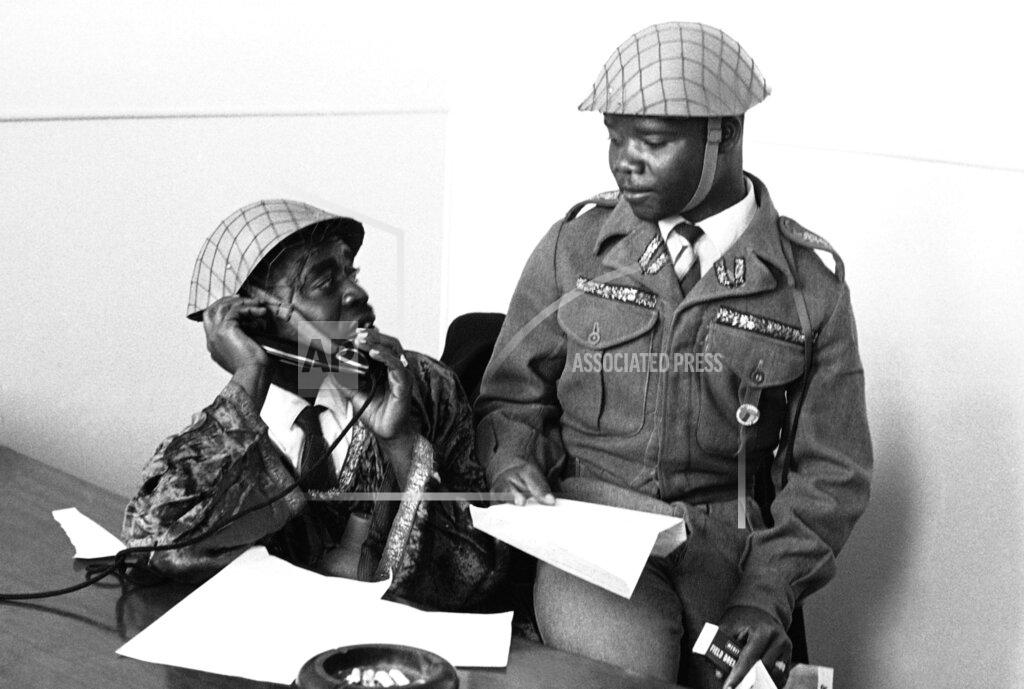
The Congolese rebel regime based in Stanleyville has demanded a halt to United States and Belgian “participation” in the government’s campaign against the rebels as a condition for releasing 556 Belgian and American civilians held hostage there. These conditions were contained in an appeal from the Belgian Consul, Baron Nothomb, which was broadcast by the Stanleyville airport control tower to the control tower in Bujumbura, capital of neighboring Burundi. The message said all Americans and Belgians in Stanleyville were now under house arrest. The voice was that of Baron Nothomb, but his words suggested that they had been dictated by the rebels. Baron Nothomb asked that his message be conveyed to both the Belgian and United States Embassies in Bujumbura. He said the release of all Americans and “the 5,000 Belgians living in liberated territory” would come only after the Belgian and United States Governments “forbid” any involvement in the war.
The broadcast was received in Bujumbura on October 29, the same day that Christophe Gbenye, president of what the rebels call the Congolese People’s Republic, sent a message to King Baudouin of Belgium warning that “since Belgians are attacking us, we can no longer guarantee the security of Belgian subjects and their properties.” Diplomats here believe these broadcasts reflect the Stanleyville regime’s rising anxiety over recent rebel losses to Congolese Army units spearheaded by South African, Rhodesian, and Belgian mercenaries. American participation is presently confined to flying Congolese troops and equipment aboard four Air Force C‐130’s and financing the Congolese Air Force, whose pilots are Cuban exiles. There are 31 Americans in Stanleyville, including five consular officials who have been under arrest in one room for more than six weeks. There are a total of 60 Americans, mostly teachers and missionaries, throughout the rebel territory, which covers roughly a fifth of the Congo.
King Saud was forced to abdicate the throne and his younger brother, 59-year old Prince Faisal was proclaimed as the new King of Saudi Arabia. Crown Prince Faisal, who assumed the title of Viceroy last March, was proclaimed King in a joint statement by the Cabinet and the consultative council, called the Shura. Their statement was endorsed by the Ulema, or council of religious teachers, who acted on the basis of a request from a council of the royal family. This request for the dethronement of Saud and the enthronement of Faisal was written last March and was backed during the last five days by a gathering of the family — a score of uncles and cousins, brothers and sons of the late King Abdel Aziz Ibn Saud. Saud departed into an exile in Greece, and would die of a heart attack at his hotel suite in Athens on February 23, 1969. King Faisal would rule until being assassinated in 1975.
The Government today called a special session of the Diet (Parliament) for Monday. The resignation of Premier Hayato Ikeda will be submitted and a new Premier elected on the opening day. Mr. Ikeda, who is undergoing hospital treatment for a throat tumor described as “precancerous,” approved the decision by his Cabinet and executives of the ruling Liberal‐Democratic party. The Premier announced last Wednesday that he would resign as head of the Government and party president. Party officials said that little progress had been made toward resolving the rivalry of Eisaku Sato, Aiichiro Fujiyama and Ichiro Kono for the posts. Mr. Sato, a former Finance Minister and brother of former Premier Nobusuke Kishi, has been favored over Mr. Fujiyama, a former Foreign Minister, and Mr. Kono, who has held several Cabinet posts and was state minister in charge of arrangements for the recent Olympic games.
The Royal Dutch Shell oil corporation announced that it had found a large expanse of oil beneath the Sultanate of Oman in the southeast Arabian Peninsula, with an expected output of 140,000 barrels per day by 1967.
The toll in the collision of two trains last night near Langhagen in Mecklenberg, East Germany, rose to 39 persons killed and more than 100 injured.
An avalanche of votes — an expected record total of more than 70 million — will decide tomorrow the outcome of the 1964 Presidential election campaign. Every index points to an overwhelming victory for the Democratic candidate, President Johnson, over his Republican rival, Senator Barry Goldwater. The polls are unanimous. Those giving the President the biggest lead indicate he is ahead by margins of 64 to 36 percent or more. If these polls are correct, he would win with a plurality of up to 20 million votes, the widest margin ever achieved by a Presidential candidate. President Johnson’s aides have conceded to Senator Goldwater only the two Deep South states of Mississippi and Alabama.
The President’s name will not even appear on the ballot in Alabama. Instead, Alabamians may choose between two slates of electors: a Republican slate pledged to Senator Goldwater and an unpledged Democratic slate, A slate pledged to President Johnson was defeated in the May primary. Residents of the District of Columbia will vote for President and Vice President for the first time since 1800. Congress barred voting in the District, because of the fear that Federal employes would always vote for the party in power. Fair weather, with mild temperatures, has been forecast for the metropolitan area, Long Island, New Jersey and Connecticut. The Johnson plurality, assuming he wins, may be cut by voter apathy. Few believe that the apathy is pervasive enough to produce a lower total vote than the previous record, the 68,838,005 in the Kennedy‐Nixon election of 1960.
Observers feel that apathy exists because the campaign seemed dull and because the polls eliminated suspense by showing President Johnson a top‐heavy favorite. It was believed that many would abstain, sharing the gloom of the Very Rev. Francis B. Sayre Jr., dean of the Washington Cathedral. He concluded that the tactics and ethics of both Presidential candidates offered little choice. Besides electing a President, the voters will choose 35 Senators, 25 Governors and all 435 members of the House of Representatives.
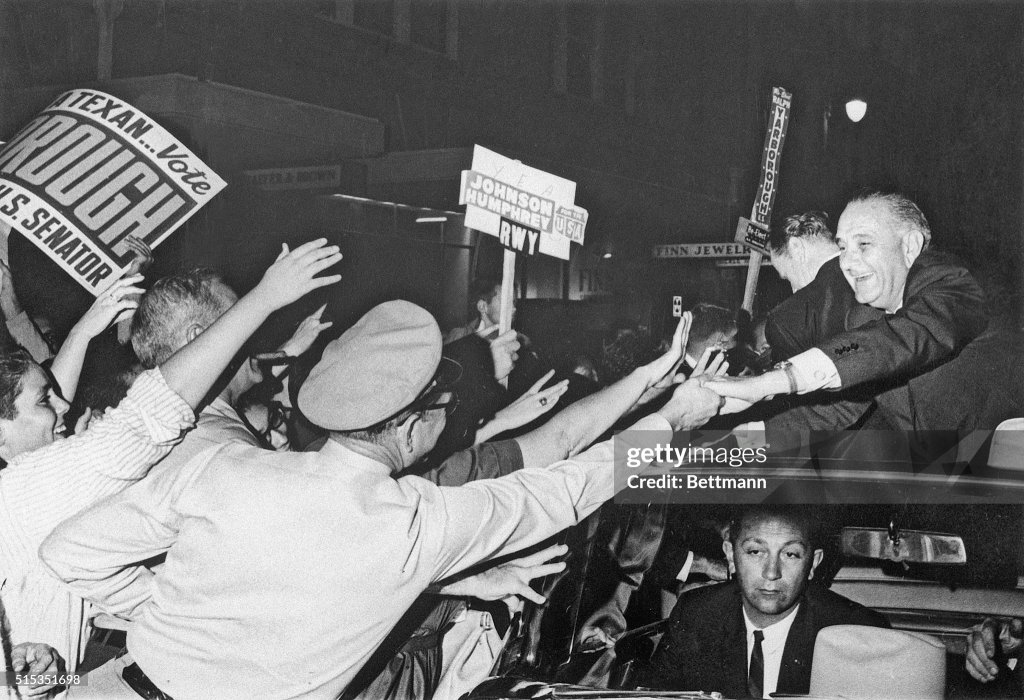
President Johnson came back to his home state today to await the results of the election. He told his hill country neighbors that it seemed “I have spent my life getting ready for this moment.” The President traveled from Washington to Houston for three speeches this afternoon and then came to Austin to speak from the steps of the State Capitol. Austin gave him a hero’s welcome. The crowds were so thick on broad Congress Avenue approaching the Capitol that his car could barely move, and the President happily hung from the open automobile to shake hands with “the folks.” But to say that Mr. Johnson campaigned was less than accurate. The campaign was over, and Mr. Johnson spoke primarily of his hopes and plans if the nation’s voters tomorrow give him a full term of his own.
In a final television appearance tonight, Mr. Johnson told Republicans that the health of the two‐party system would be restored by “an overwhelming repudiation of the small minority which has seized the Republican party and is already planning to keep it.” He said that “only a massive defeat” could drive conservative Goldwater followers “from their places of present power.” Mr. Johnson also said that his opponent was against the major social and economic legislation since the New Deal and called this “an intention to shatter the tested foundation of our economy” that would “bring disaster.”
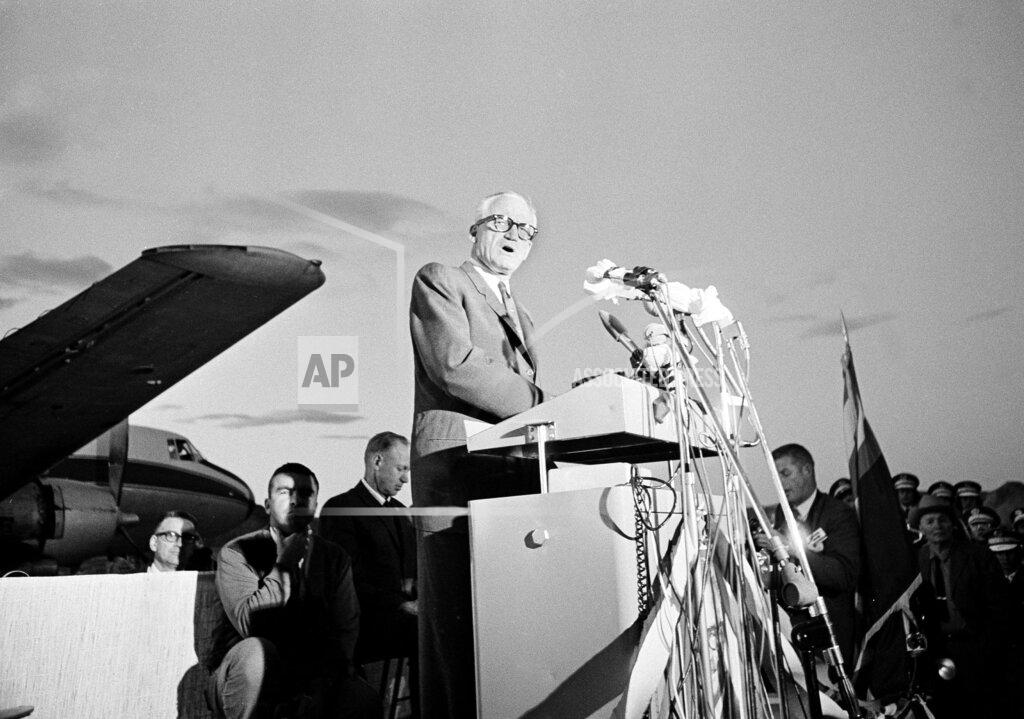
Senator Barry Goldwater, returning on the last day of his campaign to the scene of his greatest triumph, was met today by one of the most impressive receptions he has yet received. It was in the Cow Palace here in July that the Republican convention, with the California delegation in the forefront, picked Mr. Goldwater as the party’s Presidential nominee. Today, a crowd estimated by the police at 100,000 turned out to cheer his motorcade as it passed through the downtown area on the way to the civic auditorium. The crowds were dense as the motorcade wended its way through a swirl of brightly colored confetti and tickertape in the financial district along Montgomery Street. They thinned out to normal lunchtime dimensions, however, as the motorcade drove up Market Street in a less prosperous area.
The total crowd was far smaller than the one that President Johnson drew when he was here October 11, according to local observers. There were few Johnson signs along the motorcade route, but two youths on Market Street held up a large banner that said: “Welcome back to the scene of the crime.” This was a reference to the Republican convention. At the civic auditorium, about 10,000 ardent supporters, who filled the 8,000 seats to overflowing, repeatedly interrupted Mr. Goldwater with cheers, whistles and applause.
The final political polls have predicted President Johnson should win the contest for President today by a majority of up to 20 million votes. A victory of that magnitude would set a record. The biggest popular vote margin to date was the 11 million by which, President Franklin D. Roosevelt defeated Alf M. Landon, Republican, in 1936. President Dwight D. Eisenhower’s re‐election over Adlai E. Stevenson, Democrat, in 1956, was by a 9.5‐million vote plurality. Significantly, all the professionally conducted voter opinion surveys, national and in states, are uniform in indicating a landslide for the Democratic ticket of Mr. Johnson and Senator Hubert H. Humphrey, over the Republican ticket of Senator Barry Goldwater and Representative William E. Miller. The final report of Dr. George E. Gallup’s nationwide poll forecast a Johnson sweep by 64 percent of the popular vote to 36 percent for Mr. Goldwater. Samuel Lubell, whose report does not include percentage figures, predicted a “Johnson landslide.”
Senator Hubert H. Humphrey wound up his long campaign for the Vice‐Presidency on a high‐level note on election eve, pledging that the chief aim of the new Administration would be to “labor to improve the quality of life.” In a prepared speech, Mr. Humphrey said tonight that the nation needed much more than naterial prosperity. The “more enduring contribution” of the present generation, he declared, will be the “spirit of public morality.”
“The ethical conduct of the highest order in which a President can engage, the most fundamentally moral course which an Administration can pursue,” he continued,” is to assure the right of every individual to achieve all of which he is capable. “For that spirit, the hallmark of a civilization in full flower, has been the distinguishing characteristic of every significant achievement of the Kennedy‐Johnson Administration.”
Representative William E. Miller, looking back on what he called “a long arduous, strenuous campaign,” said today that it had been a“clean campaign, as campaigns go.” Answering reporters’ questions in Washington as he left to return here to vote tomorrow, the Republican Vice‐Presidential nominee said he thought that all four men on the two national tickets had undoubtedlv made statements in the heat of the campaign that they regretted. But he said the campaign ad not been as vitriolic as some in the past. He defended his own speeches — which toward the end stressed the theme that the Administration was leading the nation into socialism — with the statement that there had never been any documentation for the criticism that he made “wild statements.”
Harry S. Truman was back in his office today for the first time since October 13, when he fell in the bathroom of his home and suffered two fractured ribs and a head cut. The 80‐year‐old former President spent several hours at his office. He said he planned to be there short periods each day. His staff said he would not receive visitors or take telephone calls. Mrs. Truman said he would vote tomorrow, but she said she did not know when. Mr. Truman was released October 23 from Research Hospital in Kansas City and until today had spent all his time at his home.
The priceless gems stolen from the American Museum of Natural History were carried to Miami by a 19‐year‐old girl, a Police Department source said yesterday. The girl, Janet Flockiewitz, a secretary in a Wall Street insurance brokerage firm, was in $5,000 bail yesterday as a material witness. No mention of her asserted role was made at her hearing, but the police source said that she had transported the stolen gems. This source said that she flew to Miami, leaving Kennedy International Airport at 9:15 the morning after the theft, in the same plane with two of the suspects. She allegedly told the police that the suspects had given her a locked briefcase to hold on the plane and had told her: “Don’t sit on the plane with us. Pretend you don’t know us.” Miss Flocklewitz denied that she knew she was carrying stolen gems, but admitted, the police said, that on several occasions she had visited the museum’s gem room with the suspects when they were casing it.
Blacks held a demonstration at the Alabama Capitol today and hundreds of children boycotted classes to protest alleged discrimination against Black voters. The demonstrators — most of them school‐age children — showed up here with signs and ignored officers’ orders to disperse. Twenty‐six were arrested and charged with parading without a permit. In Anniston, about 650 Black children stayed away from classes, and Black leaders said the boycott would spread to other parts of Alabama on Election Day tomorrow.
There were also reports of heavy absenteeism in Tuscaloosa.
Daniel Harrell, a Black leader in Mobile, said the boycott had been called for tomorrow to protest the fact that “we cannot vote for President Johnson and the rigid‐voter registration rules against Negroes in Alabama.” In Tuscaloosa, the Rev. T. Y. Rodgers said that the boycott had been originally planned for tomorrow only, but that some of the children had decided to hold two days of protests. Mr. Rodgers said students would remain out of classes tomorrow in at least seven of the state’s cities and towns. In addition to alleged discrimination against Blacks, protest leaders said they were demonstrating because it was virtually impossible for Alabama voters to cast ballots for President Johnson.
Returns from a four‐day mock election conducted by the Freedom Democratic party to dramatize a desire for non‐registered Blacks to voice their political choices showed a total of 45,218 votes for President Johnson and 12 votes for Barry Goldwater. Freedom Democratic party leaders said returns had been received from 34 counties out of 44 in which the unofficial ballotting took place. In four “Congressional” races the freedom vote ballot gave Aaron Henry, Clarksdale druggist, a total of 36,792 votes and Mrs. Fannie Lou Hamer, Ruleville, 18,450 votes; Mrs. Annie Devine, 2,805 votes, and Mrs. Virginia Gray, 7,450 votes. The four Congressional candidates were listed on the freedom vote ballot in opposition to the Democratic incumbents, Senator John Stennis and Representatives Jamie Whitten, Arthur Winstead and William M. Colmer.
Prince Chambliss, a 16‐year-old, Black honor student from Alabama, was enrolled today as a junior at Ridgefield High School in Connecticut and adapted quickly to his new environment. The youth’s transfer from Birmingham’s all‐Black Parker High School to this wealthy community’s high school had been the subject of a week‐long dispute. The dispute was settled yesterday when the Board of Education, at the urging of the town’s people, relaxed its regulation against admission of nonresident students, and accepted the youth. The youth, whose academic record at Birmingham was called excellent, was assigned by Dr. Harold E. Healy, the high school principal, to the first session. The school, which was designed to accommodate 850 students, has an enrollment of almost 1,200 — including 20 Blacks — and the students are divided into two overlapping sessions.
Senator Everett McKinley Dirksen of Illinois received further hospital treatment today for a pinched nerve in his back. An aide said that Mrs. Dirksen had reported that the Senator was feeling better yesterday although still suffering pain. He was reported to be in traction at Sibley Memorial Hospital.
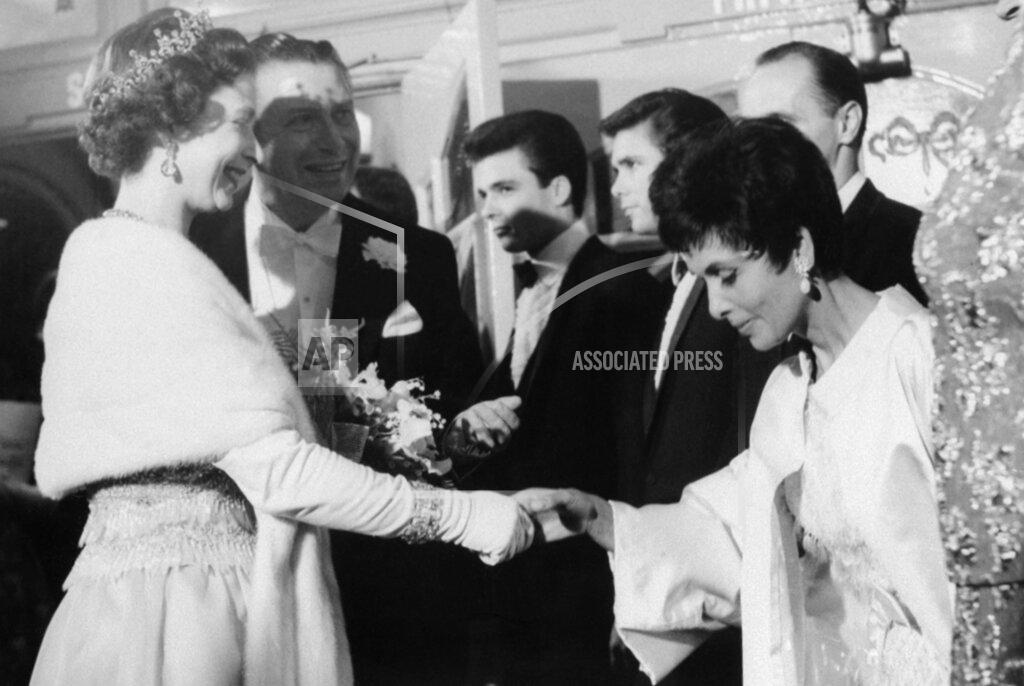
Stars appearing in front of Queen Elizabeth II of the United Kingdom at the annual Royal Variety Performance included Tommy Cooper, The Bachelors, Cilla Black, Millicent Martin, Kathy Kirby, Brenda Lee, Morecambe and Wise, Gracie Fields, Jimmy Tarbuck, Cliff Richard & The Shadows, Bob Newhart and Lena Horne.
The purchase of baseball’s New York Yankees by the Columbia Broadcasting System became effective with the payment of $14.4 million to owners Dan Topping and Del Webb by CBS.
Dow Jones Industrial Average: 875.51 (+2.43)
Born:
Britta Lejon, Swedish Social Democratic politician, in Järfälla Municipality, Sweden.
Kevin Gogan, NFL guard and tackle (NFL Champions, Super Bowl 27 and 28-Cowboys, 1992, 1993; Pro Bowl 1994, 1997, 1998; Dallas Cowboys, Los Angeles-Oakland Raiders, San Francisco 49ers, Miami Dolphins, San Diego Chargers), in San Francisco, California.
Dale Dawson, NFL kicker (Minnesota Vikings, Philadelphia Eagles, Green Bay Packers), in West Palm Beach, Florida.
Duane Pettitt, NFL defensive end (San Diego Chargers), in Long Beach, California.
Lynn Nottage, American playwright (first woman playwright to win two Pulitzer Prizes – “Ruined” 2009, “Sweat” 2017), in Brooklyn, New York, New York.
Michael D’Asaro II, American fencer-sabre, in Brooklyn, New York, New York.
Lauren Vélez, American film and television actress (“Dexter”), in Brooklyn, New York, New York.
Died:
José Ramón Guizado, 65, Panamanian politician who briefly served as President of Panama after the 1955 assassination of José Antonio Remón.
 History Diaries