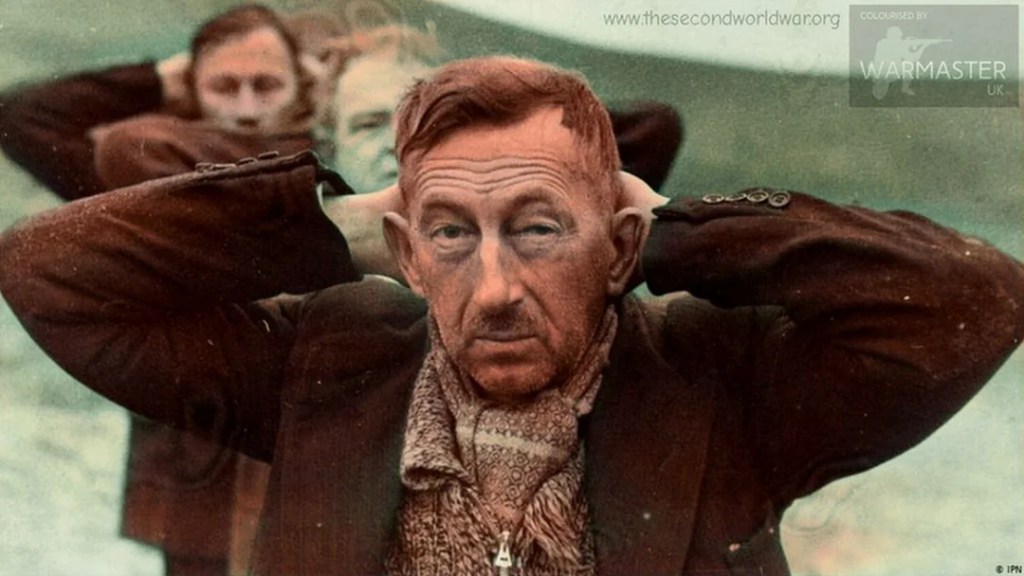
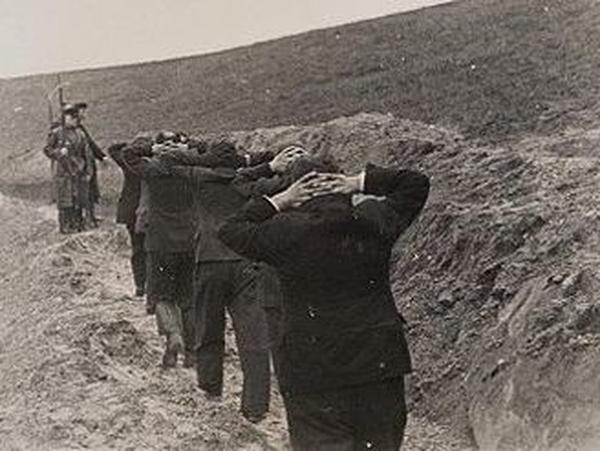
Mass killings of undesired inhabitants pursuant to Operation Tannenberg continues in Poland with liquidations in Bromberg (Bydgoszcz) by “Volksdeutscher Selbstschutz” and the Gestapo.
Germany formally annexed western Poland, Danzig and the Polish Corridor adding the new districts of Posen, Greater East Prussia and Danzig West Prussia to the Third Reich.
The Soviet Union formally annexed part of occupied eastern Poland and incorporated it into the Ukrainian Soviet Socialist Republic, following the results of plebiscites in which the majority of the inhabitants living in the territory supposedly favored annexation.
About forty Soviet tanks from Vileika entered Vilna last night. The reason for their arrival was not known.
Jews must leave Vienna by March 1. Authorities set the final date as 4,000 move from the city to a reservation in Poland and property is confiscated.
The German military complained that the Soviet Union purchases too much war materials from Germany, which was hampering with the German ability to prepare for a war against France; it was acknowledged, however, the import of Soviet oil was vital.
German long-range artillery is shelling French villages and fortifications well behind the front lines.
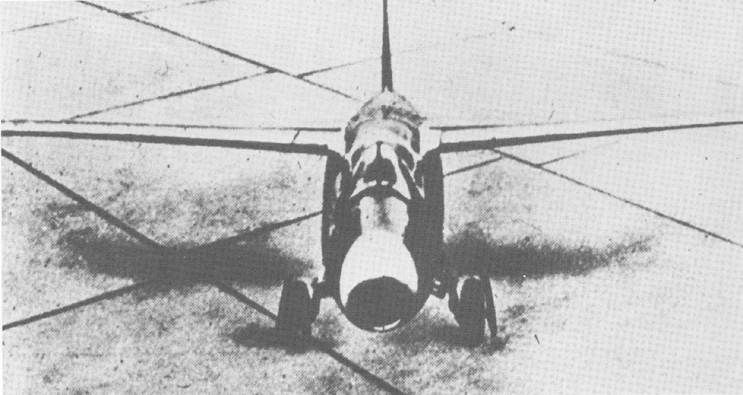
Heinkel demonstrated the first jet aircraft He 178 to the German Air Ministry, but the German officials were not impressed. The new jet He 178 V1, which first flew in late August, is demonstrated for top Luftwaffe chiefs at the Luftwaffe test center at Rechlin. Amazingly, despite the advances made, the Air Ministry (RLM) has not been told of the extensive progress made, so the demonstration comes as something of a surprise. Ernst Udet and Erhard Milch, who essentially control Luftwaffe purchasing decisions, attend, but Air Minister Goering does not. The demonstration is an absolute technical success, as the jet performs flawlessly. However, Milch and Udet are not sold on the design due to a weak engine that limits the He 178’s speed to an unimpressive (for a supposedly revolutionary technology) 372 mph (598 km/hr) and flight endurance of only ten minutes. No orders are placed.
Ernst Heinkel, however, is certain the technology will revolutionize aviation. He decides to proceed with his own private development of a jet fighter based on the He 178, the He 280, despite the RLM’s disinterest. He does not know, though, that the RLM already is backing other jet projects, though their prototypes have not flown yet.
Georg von Küchler was named the commanding officer of 11th Army.
A royal decree in the Netherlands established martial law in key regions mostly along the German-Dutch border. The Netherlands declares a “State of Siege” and makes plans to flood their frontier to hinder any invasion.
Contingency plans are laid in case of an invasion in Switzerland.
Pope Pius XII publishes encyclical Sertum laetitiae.
In Birmingham, England, John Randall invented the cavity magnetron this month. It was a microwave transmitter 1,000 times more powerful than any other at the time.
Polish Corridor, Posen, and Upper Silesia annexed by Germany.
Physicist Hans Ferdinand Mayer submits the Oslo Report on German weapons development to the British Government.
The British Government’s decision to reopen as many schools as possible in areas vulnerable to air raids was announced in the House of Lords today by Earl De La Warr, Minister of Education.
The British Government expects to restrict the consumption of butter and bacon for every inhabitant of the United Kingdom to four ounces of each a week starting the middle of next month, Food Minister William S. Morrison told the House of Commons today.
Alan Turing wrote an Enigma report on November 1, 1939. In the report, Turing suggested building a “4-Bombe” (8 Enigmas) to solve messages more quickly.
No. 606 and No. 615 Squadron, equipped with the Gloster Gladiator, are sent to France this month.
The RAF makes reconnaissance flights over northwest Germany.
The Finnish delegation returns to Moscow after Molotov’s ultimatum of the day before.
The Finns defy the Soviet Union. They mine the Hangoe port and firmly resist the Kremlin’s demand for defense base sites and a demilitarized border.
Forty Russian tanks arrive at Vilna after anti-Semitic riots and a clash between Reds and Polish nationalists.
The International Olympics Committee meets and decides that the 1940 Olympics cannot take place in Finland as planned. This effectively cancels the Games for 1940.
The first HN/ON convoys between the Firth of Forth and Norway sail in November and are covered by the Home Fleet. They are discontinued in April.
The British cargo ship Mervyn collided with another vessel and sank in the Bristol Channel off St Davids, Pembrokeshire.
The Norwegian cargo ship Mim ran aground on Reef Dyke Skerry, North Ronaldsay, Orkney Islands (59°21′00″N 2°22′16″W) whilst on her maiden voyage. There were no casualties; eleven crew reached shore in their own boat, while the rest were taken off by the Stromness lifeboat. She broke up the next day.
U.S. freighter Exminster is detained at Gibraltar by British authorities.
Convoy OB.28 departs from Liverpool.
The War at Sea, Wednesday, 1 November 1939 (naval-history.net)
Destroyers KELLY, ESKIMO, MATABELE, BEDOUIN, FEARLESS and FOXHOUND refueled at Sullom Voe and departed on 29 October to search for American steamer CITY OF FLINT coming down the Norwegian coast. They fueled again at Sullom Voe on the 1st to continue the search.
Light cruisers GLASGOW and NEWCASTLE, after convoy escort in the Atlantic, departed Portsmouth on 31 October, escorted by destroyers ANTHONY, BASILISK, BRAZEN, and arrived at Rosyth on the 1st. The cruisers departed Rosyth that day to provide cover for these destroyers.
Battleships NELSON (Forbes), RODNEY, battlecruiser HOOD, and destroyers ICARUS, INTREPID, IVANHOE, IMPULSIVE, FAULKNOR, FORESIGHT, FORTUNE and PUNJABI departed Loch Ewe at 0930/2nd to provide heavy cover for the GLASGOW force and for convoy ON.1 which departed Methil on the 5th. FEARLESS and FOXHOUND of the CITY OF FLINT operation joined NELSON at sea.
Destroyers FEARLESS, FOXHOUND, IMPERIAL and KANDAHAR, after refueling at Scapa Flow on the 4th, departed to rejoin Forbes on the 5th. Destroyer FAME also departed Scapa Flow on the 5th to join Forbes. ICARUS and IMPULSIVE were detached for refueling at Kirkwall on the 7th.
Very early on the 9th, HOOD was detached with FEARLESS, and passed Dunnet Head westbound as the rest of the fleet turned south for Rosyth. HOOD arrived for refit at Devonport on the 11th escorted by destroyers ISIS and ILEX, and completed on the 24th.
Anti-aircraft cruiser CAIRO departed Grimsby on escort duties and arrived back the same day.
Convoy BC.12S of fourteen ships, including BALTRADER, BARON KINNAIRD, BARON NAIRN, CITY OF KEELUNG (Commodore), CLAN MONROE and TREVERBYN departed the Loire, escorted by destroyer EXPRESS, and safely arrived in the Bristol Channel on the 3rd.
Convoy FN.30 departed Southend, and arrived at Methil on the 3rd. There was no convoy FN.31.
Convoy FS.30 departed Methil, escorted by destroyers WALLACE and WHITLEY and sloop STORK, and arrived at Southend on the 3rd.
Destroyer JUPITER and sloop FLEETWOOD dropped depth charges on a submarine contact in 52 28N, 1 59E.
Destroyers VERSATILE and VOLUNTEER were submarine hunting in 53 00N, 5 00W after a merchant ship in convoy reported a submarine 10 miles west of Holyhead.
Destroyer BROKE searched for a submarine reported by D/F, 40 miles east of Buchan Ness in 57-20N, 0-30W.
Sloop GRIMSBY attacked a submarine contact four miles east of Whitby.
After a submarine was reported by British fishermen off Londonderry, patrol sloops WIDGEON and SHELDRAKE unsuccessfully searched for it.
Four destroyers from Harwich were on patrol off Smith’s Knoll, NE of Yarmouth, searching for vessels reportedly cooperating with U-boats.
Norwegian steamer MIM (4996grt) sent to Kirkwall by light cruiser COLOMBO under guard, ran aground on Reef Dyke Skerry, and broke up the next day. Norwegian steamer HANSI (1028grt) which was going into Kirkwall voluntarily, also ran aground at the same location; her crew was taken off by Swedish steamer CASTOR (8714grt).
Admiral Cunningham transferred his flag ashore at Malta from battleship WARSPITE, which was preparing to leave his command for the Home Fleet.
Rear Admiral N A Wodehouse was relieved by Vice Admiral Sir Dudley North on the 1st as Vice Admiral North Atlantic Station, based at Gibraltar. North departed England on liner NARKUNDA (16,632grt) on the 10th and arrived at Gibraltar on the 17th.
Destroyer DELIGHT departed Gibraltar for Marseilles escorting liner LANCASHIRE which had arrived at Gibraltar in convoy OG.4. The two ships later departed Marseilles on the 6th and arrived at Malta on the 8th.
French convoys 11.B of steamers ANDRE MOYRAND, SENNEVILLE, ONTARIOLITE, DJURJURA, DOUAISIEN, ANGE SCHAIFFINO and CAMBRADSIEN, which departed Brest on 26 October, and convoy 6.X of steamers PRESCAGEL, PIERRE CLAUDE, PALLAS, OPHELIE and ENSEIGNE MAURICE PRECHAC, escorted by sloop GAZELLE, from Le Verdon also on 26 October, merged on the 27th. They were joined by steamer AIN EL TURK, escorted by sloop COMMANDANT BORY. On 1 November, six steamers from 11.B were taken into Gibraltar by the two sloops, which returned to the convoy as it continued on to Casablanca. AIN EL TURK and 6.X arrived at Casablanca on the 2nd.
Light cruiser DESPATCH departed Panama on patrol.
Destroyers HYPERION, HUNTER, HOTSPUR and HAVOCK departed Pernambuco for Trinidad. HAVOCK stripped a turbine and was diverted at sea to Freetown, arriving on the 9th. Destroyer HEREWARD from Freetown was designated to replace her in the 4th Destroyer Division on the South America Station. HAVOCK departed Freetown on the 16th with convoy SL.9 and arrived at Gibraltar on the 27th. She then departed Gibraltar on 12 December, arrived at Sheerness on the 16th, and was under repair at Chatham until mid-March, arriving in the Clyde for duty on 26 March.
French submarine REDOUTABLE fired four warning shots at steamer EGBA (4989grt) at 0736 in 32-40N, 13-23W thinking she was a German blockade runner. EGBA replied with gunfire forcing the submarine to submerge. The attack was broken off when REDOUTABLE received the steamer’s distress signal revealing her identity.
Destroyer SCOUT departed Singapore for duty at Hong Kong.
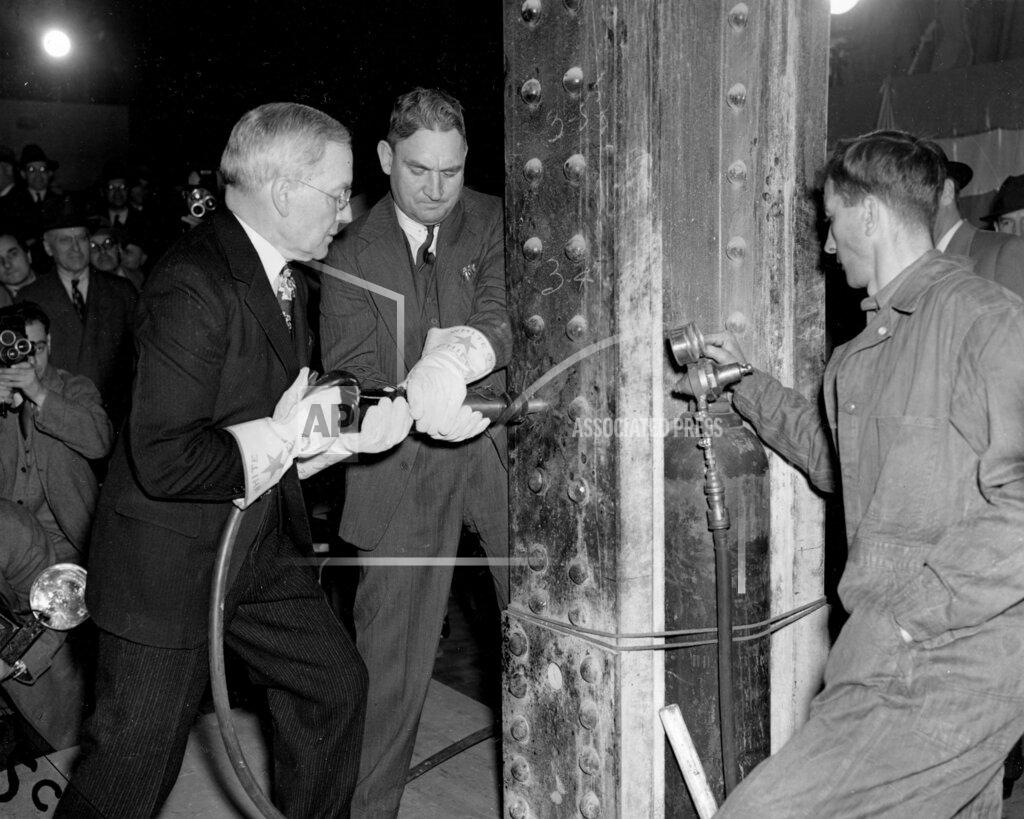
President Roosevelt went for a short motor drive in Washington today during which he inspected the progress on the new Jefferson Memorial at the Tidal Basin and viewed the Danish training ship Danmark, anchored off Haines Point in the Potomac. He conferred earlier with Frank Taylor, president of the Merchant Marine Institute, on shipping restrictions under the Neutrality Act and with Senator Green about a $25,000,000 airport project at Quonset, Rhode Island.
The Senate was in recess.
The House debated the Neutrality Bill, hearing addresses from Representative Barton, Rankin and many others and adjourned at 8:31 PM, until 11 AM, tomorrow.
The Monopoly Committee opened its investigation of the steel industry. The Dies Committee continued its examination of William McCuistion regarding alleged communist activities in the National Maritime Union.
Democratic leaders of the House of Representatives decided today to push through the neutrality revision resolution before adjournment tomorrow after nine and a half hours of discussion today, wherein about two score Representatives expressed their views on the subject. Unless the leaders have made a grievous miscalculation, the result will be completion of the victory for President Roosevelt’s effort to repeal the arms embargo. Although they conceded the margin to be close, Speaker Bankhead, Representative Rayburn of Texas. majority leader; Representative Boland of Pennsylvania, Democratic whip, and Representative Warren of North Carolina agreed that the Administration forces had the votes. necessary to effect repeal of the embargo, as well as to follow it with quick adjournment of the special session.
The reference to adjournment came as much as a statement of purpose as a prediction, and in response to the demand of Representative Martin of Massachusetts, speaking for the Republican minority, that Congress be kept in session for the duration of the war emergency. Mr. Martin issued a statement saying that he was “resolved to oppose any motion to end the special session.” The more acute the emergency, the greater the need for the deliberate national judgment of Congress,” he said.
Despite Mr. Martin’s statement, many observers doubted that the Republicans would present a solid front in any movement to prevent adjournment after the embargo fight has been settled. The end of the session by the end of the week. or early next week was the general forecast in Washington tonight. The test tomorrow will come on. three different questions-two relating to the embargo, one to the financial section of the “cash-and-carry” substitute voted by the Senate, all offered in the form of instructions to the conferees on the Pittman resolution. One proposal, offered by Representative Shanley of Connecticut, would instruct the House managers in the Senate-House conference to restore to the measure the embargo against warring nations on arms, munitions and implements of war as found in present law.
Another, offered as an amendment by Representative Vorys of Ohio, would compel the conferees to insist upon the so-called Vorys amendment adopted by the House bill last June, embargoing shipment of lethal weapons and poison gas to belligerents but exempting unarmed airplanes. The new test on the financial sections will come through an amendment proposed by Representative Wolcott of Michigan, instructing the conferees to insist upon a provision prohibiting federally owned corporations, such as the Reconstruction Finance Corporation and the Export-Import Bank, from extending loans to finance exports to belligerent countries. Following pleas today from Representatives Barton of New York and Rankin of Mississippi, both early supporters of the Administration’s foreign policies, that the House postpone repealing the embargo as an incentive to peace moves abroad, the Democratic leaders decided to take another check of their strength. The result was a reiteration of the prediction of a favorable vote for repeal, but a downward revision of the size of the majority.
The White House replied in kind today to Premier Vyacheslav Molotov’s characterization of President Roosevelt as a “meddler” in the relations between Soviet Russia and Finland and suggested that the Russian spokesman had deliberately timed his speech before the Supreme Soviet to influence the important House vote yesterday that sent the arms embargo repealer to conference with the Senate. Not long after his usual morning session with President Roosevelt, White House Secretary Stephen T. Early recalled the Russian Premier’s criticism of Mr. Roosevelt for lending “moral support.” to Finland and, after impugning the motive behind the criticism, suggested that Mr. Molotoff was more interested in the fate of the arms embargo repeal measure than in the President’s friendly gesture to the Finns.
Just before the White House executive offices closed for business later in the day Mr. Early borrowed the words of Mikhail Kalinin, Chairman of the Presidium of the U.S.S.R., to reject the meddling charge of the Soviet Premier and Foreign Commissar. He did this, by issuing copies of Mr. Kalinin’s message to Mr. Roosevelt on April 16, thanking the President for his appeal to Chancellor Hitler and Premier Mussolini asking for a ten-year guarantee of the territorial integrity of specified European nations. With the Kalinin reply the White House also issued copies of the President’s original message to Chancellor Hitler and Mr. Roosevelt’s reply to the unsolicited Kallnin message of thanks, which became available for the first time today. The White House called attention to that paragraph of the President’s message to Herr Hitler specifying the nations for which he asked the territorial guarantee and of which Finland was the first mentioned.
The text of Mr. Kalinin’s note to President Roosevelt follows. “Mr. President: I consider it my pleasant duty to convey to you my cordial congratulations and an expression of profound sympathy with the noble appeal which you have addressed to the governments of Germany and Italy. You may rest assured that your initiative finds most ardent response in the hearts of the people of the Soviet Socialist Union. Sincerely desirous of preservation of universal peace.” — KALININ.
It was in answer to this gratuitous expression of Russian thanks that President Roosevelt sent his hitherto unpublished note of thanks as follows: “I have received your friendly message and am glad to learn that your views with regard to my efforts on behalf of world peace are similar to those expressed to me by the heads of numerous other States.”
Issuance of the correspondence was without comment either from Mr. Early or any other authorized White House spokesman. Mr. Early said the documents spoke for themselves, but reporters were left to speculate on whether the unusual procedure was intended only to reinforce the earlier White House reply to the Molotov speech or whether it was to be construed as a renewed appeal for restraint by Russia in her dealings with Finland. With more than a trace of sarcasm in his voice, Mr. Early recalled at his regular morning press conference that the negotiations between Finland and Russia referred to by Mr. Molotov, growing out of the Russian territorial demands on the Northern State, had been carried out in the utmost secrecy over the past three weeks.
Yet, Mr. Early remarked, the Russian Premier had waited until yesterday to make known the points at issue in the negotiations, on the same day that the House was scheduled to have its first test vote on the neutrality issue. It was made clear to him, the White House spokesman implied, that Mr. Molotov was far more interested in the fate of the arms embargo repeal bill than in Mr. Roosevelt’s appeal to Russia and Finland that they keep the peace.
White House sentiment was more mildly reflected earlier in the day by Secretary of State Cordell Hull, who indirectly at least denied the contention of the Russian Premier that the President had violated the spirit of American neutrality in dispatching notes to the Russian and Finnish Governments. He said first that he had “nothing especially in mind to say” about the Molotov speech, and it was not until pressed for a reply that Mr. Hull remarked: “The President’s appeal speaks for itself. There have been other occasions when nations have intervened among each other in behalf of maintaining peace.”
A description of the manner in which the Communist party is alleged to dominate the National Maritime Union was given to the House Committee on Un-American Activities today by William C. McCuistion, who testified for the third day before the committee.
Wendell L. Willkie, public utilities executive, assailed the Dies Committee Investigating Un-American Activities yesterday for employing methods “undermining the democratic process.”
General Sessions Judge Saul S. Streit refused yesterday to deprive District Attorney Thomas E. Dewey of the use of documents and records of the German-American Bund in the forthcoming trial of Fritz Kuhn, Bund leader, on charges of stealing more than $14,000 of the Bund’s money.
First animal conceived by artificial insemination (rabbit) is displayed. The first animal, a rabbit, conceived by artificial insemination was exhibited in the United States at the 12th Annual Graduate Fortnight at the New York Academy of Medicine. Gregory Pincus, an American biologist, removed an egg from the ovary of a female rabbit and fertilized it with a salt solution.
The Advisory Committee on Uranium recommended that the U.S. government purchase graphite and uranium oxide for fission research.
Canada’s plan for the training of 25,000 airmen a year advanced two steps nearer realization today with the arrival in Ottawa of the Australian Air Mission and the announcement of arrangements to train aircraft mechanics in the Dominion on a large scale.
Three Indian leaders met at the Viceroy’s residence today to discuss constitutional problems—Mohandas K. Gandhi, Rejendra Prasad, Congress President, and M.A. Jinnah, president of the Moslem League.
Chinese forces launched the Winter Offensive on multiple fronts against the Imperial Japanese Army. Chinese forces launched their first major counter-offensive. Although this offensive failed to achieve its original objectives, some studies have shown that it came as a heavy blow to the Japanese forces, as well as a massive shock to the Japanese military command, which did not expect the Chinese forces to be able to launch an offensive operation on such a large scale. The Chinese had repulsed two Japanese offensives in the summer at the Battle of Suixian-Zaoyang and in fall at the 1st Battle of Changsha. They believed that the Japanese forces were now too dissipated to take and hold new territory and would not be able to launch large offensives unless they received more reinforcements. However, by defending interior lines and with control of the lines of communication, they could still shift forces and launch local offensives to damage Chinese forces or mop up guerrillas in the rear areas. Additionally, during 1939, the Japanese were replacing many of their large four-regiment square Divisions with the smaller three regiment triangular Divisions and weak Independent Mixed Brigades. This weakening of forces encouraged the Chinese to plan a large offensive to exploit that fact.
The Chinese objective in the offensive was to take the initiative by conducting multiple-front attacks to tie down the Japanese forces. They intended to use their position of exterior lines to advantage to prevent the Japanese from launching new local offensives or shifting their forces to concentrate for a large offensive. The main effort was to be by the 2nd, 3rd, 5th and 9th War Areas, which received all newly trained and reorganized units. Secondary efforts in support of the main efforts or as diversions were to be conducted by 1st, 4th, 8th, Shandong-Jiangsu and Hebei-Chahar War Areas with their existing units.
Long-hsuen’s “History of The Sino-Japanese War” then ends the narrative of the operation with the mention that supply difficulties greatly affected operations because of Communist raids in their rear area and instigation of revolts, which seized food and forbade it to be sold to the government forces. Despite this, the 40th Corps and 27th Corps accomplished their aim of pinning down the Japanese in the Zhangzi and Changzhi area. However, in southwestern Shanxi, the main effort of 2nd War Area and of the whole North China offensive failed to seize the major towns on the railroad or Japanese strongpoints that were their objectives or to cut the Tongpu railway, except for the area between Wenxi and Anyi. At the end of the campaign, the 2nd War Area claimed that 13,770 Japanese killed or wounded. The 1st War Area reported that 5,130 Japanese killed, and seems to have accomplished its mission of tying down Japanese troops in its area of operations. The 8th War Area, after a see-saw campaign, had succeeded in rolling the Japanese back to Baotou in the Battle of Wuyuan. Guerrilla forces in the Hebei-Chahar and Shandong-Guangdong War Area carried out attacks but apparently without decisive results, and in the Shandong peninsula they received a serious counterattack.
Japan made heavy use of chemical weapons against China to make up for lack of numbers in combat and because China did not have any poison gas stockpiles of its own to retaliate. Japan also used poison gas against Chinese Muslim armies at the Battle of Wuyuan and the Battle of West Suiyuan.
Japan’s plans for a settlement in China will enter what is hoped will be the final stage today when the China Affairs Board meets to decide Japan’s concrete policy toward a new Chinese government. Its findings will be communicated to Wang Ching-wei, former Chinese Premier and prospective head of the Japanese-controlled regime, who next week will meet at Tsingtao the head of the Nanking provisional government to arrange for the advent of his new Chinese administration.
The China Affairs Board has full authority and its decisions need not be submitted even to the Cabinet for formal endorsement. While its proposals are kept profoundly secret, the press predicts Japan’s conditions will be lenient. The North China party — that is to say those who believe Japan’s essential interests largely are confined to North China and Inner Mongolia — appears to be in control. According to the newspaper Asahi, Japan merely will request the new government to recognize that North China and Inner Mongolia are the regions where Japan has special interests. Neither indemnities nor territory will be asked.
Japan seems to have definitely decided on the adoption of a “make or break” policy in her gigantic gamble on the Eastern Asiatic mainland in connection with her relations with the United States and Britain. Tokyo’s abrupt reversal of its attitude of willingness to approach the United States Ambassador, Joseph C. Grew, is attributed in Shanghai to pressure by the army, which is insisting that the “new order in East Asia” must be at least technically established before conversations begin.
The army is too deeply committed to its plan for founding a new Chinese Government at Nanking to relinquish it despite the pressure of abrogation of the trade treaty by the United States, Ambassador Grew’s frank speech and the gradual massing of American naval strength at strategic Pacific bases. It is now planned to establish the new Wang Ching-wei regime in Nanking soon, probably next Wednesday.
There would be immediate recognition of the new government by Tokyo, followed by the conclusion of non-aggression, anti-Communist and military alliance pacts. Tokyo would then turn to Washington and London and say: “A new Chinese Government has been established and we are so deeply committed to its support that we cannot retreat, so all negotiations must be based upon the recognition of existing realities.” After recognizing the Wang Ching-wei Government, Japan would have no other alternative than to continue hostilities until General Chiang Kai-shek’s government is crushed or Japan is forced to withdraw from the mainland because of exhaustion, for the Chinese Government at Chungking will not negotiate peace on any terms that include partitioning of the country or the recognition of any Japanese puppets.
Apparently, Japan intends to abide by her pledge not to demand direct territorial expansion at China’s expense and, instead, will demand that Wang Ching-wel’s regime affirm the “special nature” of North China and Inner Mongolia. Preliminary to establishing his government Wang Ching-wei has engaged in a round of hat-in-hand calls upon Japanese leaders. Yesterday he journeyed to Nanking and visited General Juzo Nishio, commander of Japanese forces in China. Today he returned to Shanghai and humiliated himself to the extent of calling upon Vice Admiral Koshiro Oikawa aboard the flagship Idumo to thank Japan for her “assistance” in the founding of the new government.
Captain Aritomo Goto was relieved as the commanding officer of the Japanese battleship HIJMS Mutsu.
Australian Prime Minister Robert Menzies announces that the country will increase the size of the armed forces. Prime Minister Menzies announced today extensive expansion of the defense program, costing 59,500,000 this year, exceeding the pre-war estimate by 26,250,000. The expenditure was 19,600,000 in the first year of the World War.
Dow Jones Industrial Average: 151.60 (-0.28)
Born:
Barbara Bosson, American actress (Fay Furillo – “Hill Street Blues”; “Hooperman”; “Murder One”), in Charleroi, Pennsylvania (d. 2023).
Jo Morrow, American actress (“Our Man in Havana”), in Cuero, Texas.
Bob McAdams, AFL defensive tackle (New York Jets), in Durham, North Carolina.
Died:
Kálmán Darányi, 53, Prime Minister of Hungary 1936–1938
Naval Construction:
The U.S. Navy Gleaves-class destroyers USS Wilkes (DD-441) and USS Nicholson (DD-442) are laid down by the Boston Navy Yard (Boston, Massachusetts, U.S.A.).
The Kriegsmarine (German Navy) Type VIIB U-boat U-50 is launched by F. Krupp Germaniawerft AG, Kiel (werk 585).
The Royal Navy armed yacht HMS Valena (FY 028) is commissioned. Her first commanding officer is Captain Walter Henry Poole, RNR.
The Royal Indian Navy auxiliary patrol vessel HMIS Kutubtari (FY 086) is commissioned. Her first commanding officer is T/Sub-Lieutenant George Saldanha, RINR.
The Royal Indian Navy auxiliary patrol vessel HMIS Oostcapelle is commissioned. Her first commanding officer is T/Lieutenant Charles Henry Potten, RINR.
The U.S. Navy Benham-class destroyer USS Trippe (DD-403) is commissioned. Her first commander is Lieutenant Commander Robert L. Campbell, Jr., USN.
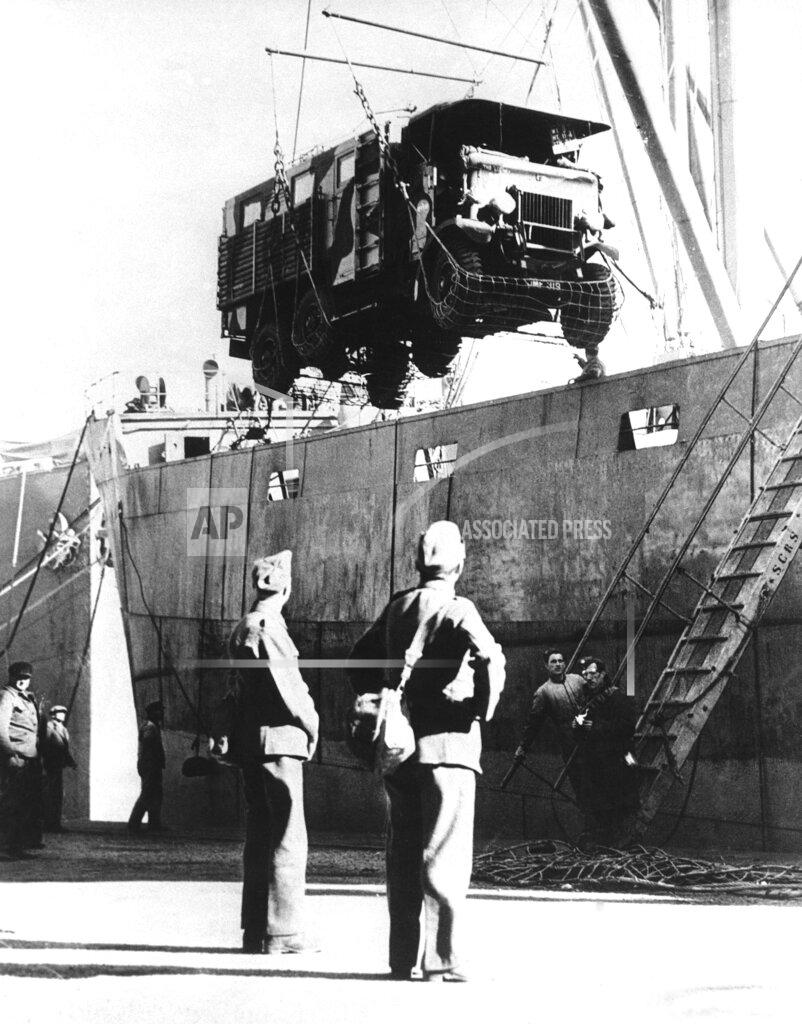
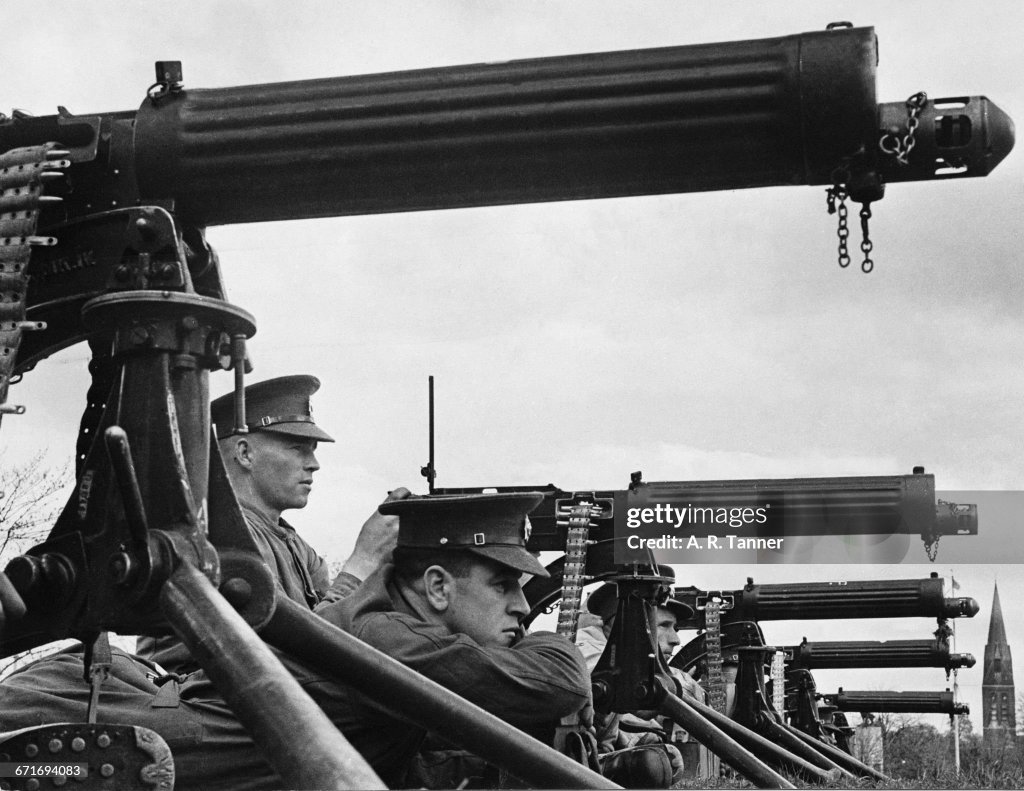

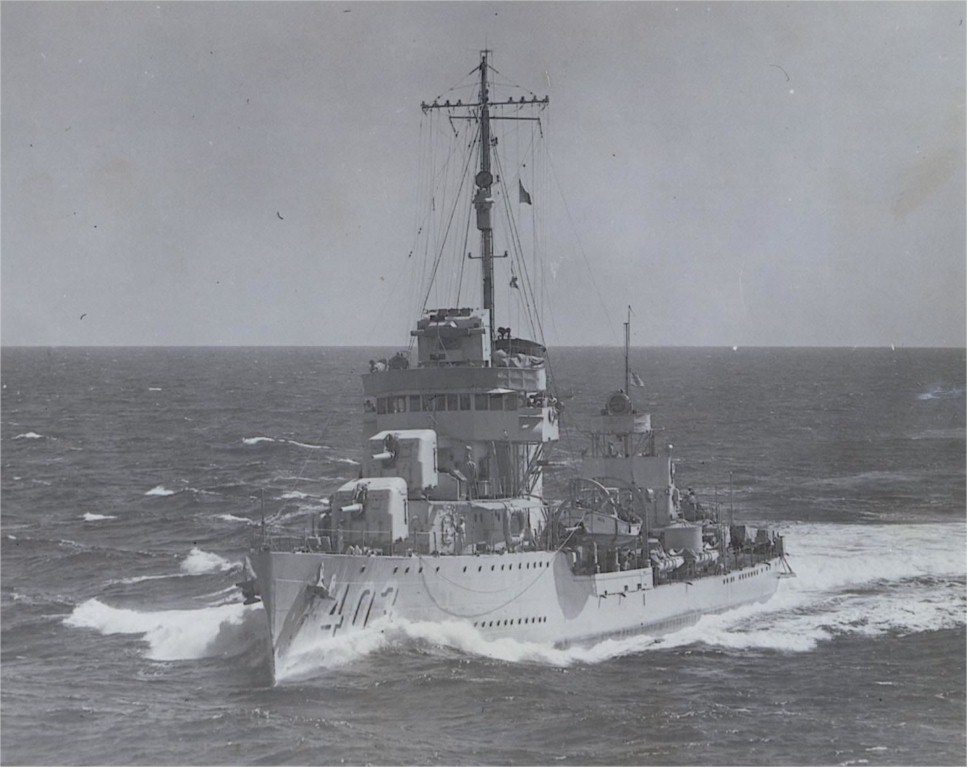
After serving in the Neutrality Patrol before Pearl Harbor, and on Atlantic convoy duty in 1942, Trippe spent most of her war in the Mediterranean, beginning with the Torch landings and continuing through the invasions of Sicily and Italy. She was sent to the Pacific in mid-1945 but arrived just as hostilities were ending. She was later expended in the Bikini atomic tests in July 1946. Decommissioned 28 August 1946. Scuttled off Kwajalein on 3 February 1948. Stricken 19 February 1948.
Trippe earned six battle stars for World War II service.
https://www.history.navy.mil/research/histories/ship-histories/danfs/t/trippe-dd-403-iii.html
 History Diaries