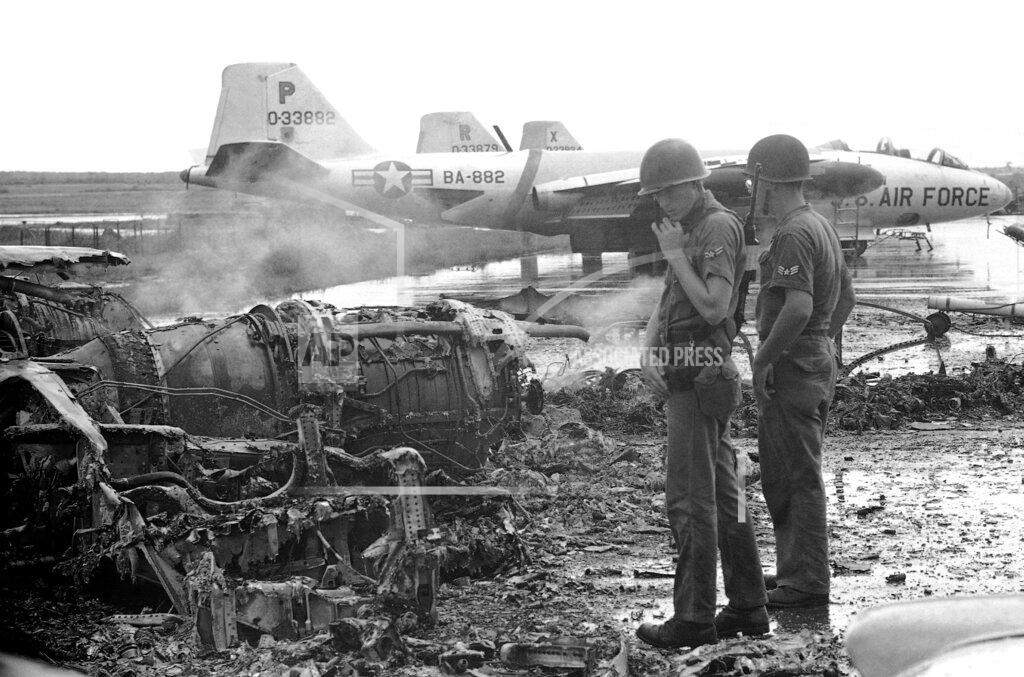
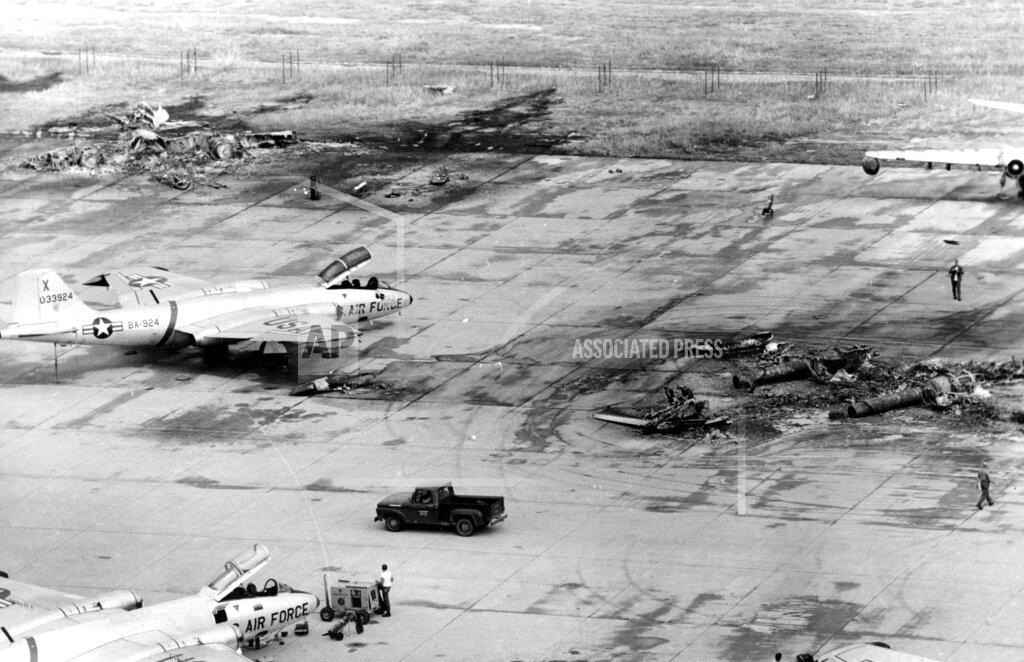
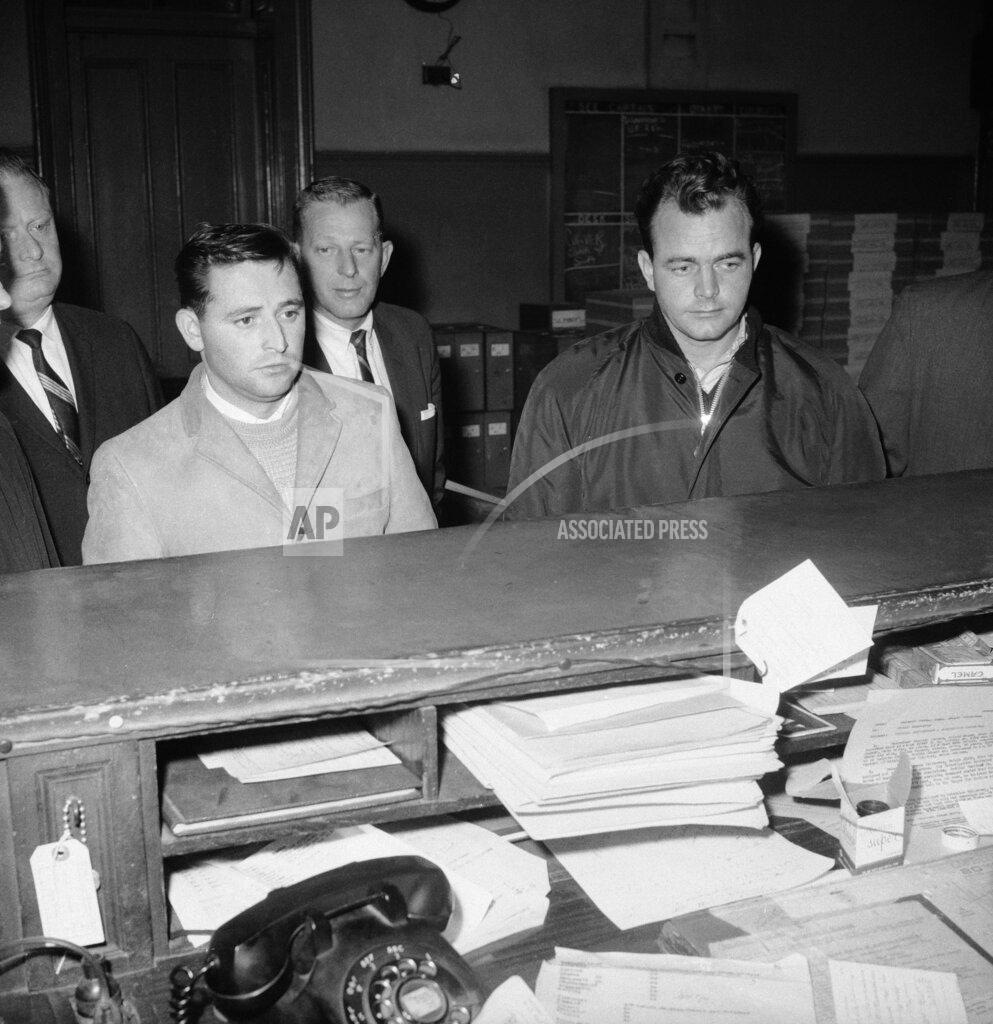
Việt Cộng raiders infilitrate the U.S. air base at Biên Hòa, 12 miles north of Saigon, and launch a heavy mortar attack in the darkness that catches the U.S. and South Vietnamese offguard. Việt Cộng infiltrators staged a mortar attack on Biên Hòa Air Base in South Vietnam, destroying five U.S. Air Force B-57 Canberra bombers, a U.S. Air Force HH-43F helicopter, and four Republic of Vietnam Air Force A-1 Skyraider attack aircraft, and damaging 15 B-57 bombers and some HH-43F helicopters. The attack happened shortly after midnight Indochina Time (after 1700 hrs 10/31 UTC, or after 12 noon 10/31 in Washington). Before the Việt Cộng flee without a known loss, they kill four U.S. servicemen and two Vietnamese, wound about 76, destroy six B-57s, and damage some 20 other U.S. and Vietnamese aircraft. A lengthy search of the area around Biên Hòa fails to locate any of the Việt Cộng.
Several of the rounds landed in the 118th Assault Helicopter Company compound, killing three UH-1 helicopter repairers and one food service worker. They included mechanics PFC Richard P. Bubar, SP4 Ronald T. O’Keefe, and SP4 Harry J. Sickler, and cook PFC Thomas J. Hanley. Seventy-two other Americans were injured, including one critically and two seriously, plus fifteen more requiring hospitalization. Two Vietnamese nationals also died in the barrage.
Word of the attack reaches Washington early in the morning, and the JCS call for ‘a prompt and strong response,’ i.e., long series of military actions against North Vietnam and Laos. Ambassador Taylor calls for a more limited response, but also advocates retaliation bombing raids. President Johnson, well aware that the presidential election will be underway within 48 hours, essentially decides to do nothing except order the immediate replacement of the destroyed and damaged planes. Administration officials, when briefing the press about the Biên Hòa raid, distinguish between it and the Tonkin Gulf attacks, where the destroyers were ‘on United States business’ virtually implying that Americans must be prepared to accept such attacks when U.S. armed forces are aiding other nations.
President Johnson has ordered the immediate replacement of the B‐57 jet bombers destroyed or damaged this morning in a Communist mortar attack on Biên Hòa Airbase in South Vietnam. The order was presumably issued early in the day, after the President learned the details of the surprise attack, which cost four American lives. It was announced by the White House after an hour‐and‐a‐quarter conference involving Mr. Johnson, Secretary of State Dean Rusk, Secretary of Defense Robert S. McNamara and other high officials. While Administration officials depicted the Biên Hòa attack as serious, they stressed that it did not call for instant retaliation against North Vietnam, where the Việt Cộng movement has its base.
In this respect they distinguished the new attack from the North Vietnamese patrol boat strikes at American destroyers in the Gulf of Tonkin last August, which provoked bombing raids by United States planes against bases in North Vietnam. The Administration took the Biên Hòa attack as an occasion to issue new warnings to North Vietnam and Communist China. It cautioned them against believing that after the Presidential election Tuesday the United States would alter its Asian policies and move toward disengagement from the Vietnam war. Officials also insisted that while the new episode was important because of the losses suffered, it should not be taken as a sign that the over‐all situation in. Vietnam was deteriorating. In fact, high officials were adamant in maintaining that the Administration was greatly encouraged by the formation of a civilian government Saigon last week and that it hoped the stabilization of the political situation would be reflected in better conduct of the war effort. They said the situation the countryside was brighter than reported.
Senator Barry Goldwater, in a videotaped interview in Phoenix, Arizona, said it was time for the President to admit to the people that the United States was fighting an undeclared war in South Vietnam.
The United States tightened security tonight at airbases throughout South Vietnam after Communist guerrillas’ mortar fire this morning took five American lives, destroyed 5 jet bombers and damaged 22 other aircraft. A final inventory of losses from the Biên Hòa attack showed major damage to eight B‐57 jets and minor damage to seven more in addition to the five that burned after hits by 81‐mm. shells. Four American air‐sea‐rescue helicopters were lightly damaged, and three Vietnamese A‐1H Skyraider bombers were hit.
Two charred patches were etched into the concrete ramps here where the Việt Cộng had scored direct hits. Air Force crews drove among the damaged aircraft to haul away the twisted remains of the bombers. The attack, obviously well planned, came shortly after midnight and drew attention from South Vietnam’s celebration of the first anniversary of the overthrow of President Ngô Đình Diệm. By focusing on an important United States target, it also seemed aimed at mobilizing overt and latent antiAmerican sentiment throughout the country. General William C. Westmoreland, commander of United States forces in Vietnam, inspected the base and termed the incident “very serious.” Other observers said it was the most damaging blow the Việt Cộng had succeeded in dealing the U.S. in the three years of major American involvement in South Vietnam.
At 6 A.M., the Việt Cộng struck with mortars again — at Tân Uyên, about 10 miles north of Biên Hòa. One more American officer was killed and an American enlisted man and 15 Vietnamese were wounded. Because smaller mortars were used during this brief attack, it was considered unlikely that the same band had attacked both installations. Major Thomas D. Whitlock was a Military Assist Command Vietnam (MACV) advisor serving with Advisory Team 88 assigned to the Army of the Republic of Vietnam’s (ARVN) 48th Infantry. On November 1, 1964, Viet Cong gunners mortared allied military installations in Biên Hòa Province, including the 48th ARVN headquarters near Tân Uyên, six miles northwest of Biên Hòa city. Whitlock suffered fatal shrapnel wounds during the attack.
One year after the overthrow and assassination of Ngô Đình Diệm, a survey of South Vietnam reveals it has deteriorated in both the political and military spheres. The deterioration is both military and political, and it has touched all aspects of the life of a weary people. An immense effort in men, money and ideas from the United States has not sufficed to break the momentum of a Communist revolution. Observers trace some of the present decay directly to the collapse of the central Government last November 1, when a coup d’etat ended President Diệm’s nine‐year iron rule over the newly independent state of South Vietnam, and brought his death at the hands of the rebels. But a more significant deterioration dates from months before the coup, when the Diệm Government had become so ineffective as to make its claims to authority and popular support appear specious.
Meanwhile, the High National Council confirms the appointment of Trần Văn Hương as premier, and he promises to wage total war against the Communists while separating religion and politics.
The U.S. Embassy in Phnom Penh sends dependents out of Cambodia because of the increase in anti-U.S. demonstrations following charges of U.S. involvement in border incidents. Wreckage of the C-123 shot down on 24 October is now displayed in Phnom Penh. Women and children left by air for Bangkok, the Thai capital, as Cambodian officials and the press continued to denounce what was termed United States complicity in the recent series of clashes on the border with South Vietnam. United States advisers have been serving with South Vietnam units operating against pro‐Communist Việt Cộng guerrillas, who take advantage of the poorly marked border to conduct hit‐and‐run raids into South Vietnam. Cambodia has denied Saigon’s charges that the Việt Cộng are using this king‐dom as a sanctuary and supply route. The United States Embassy was alerted to the possibility of a demonstration yesterday morning when the police began putting up barriers around the chancery building. A Cambodian source said later that demonstrators had gathered before the National Assembly building in preparation for a march on the embassy but that they had been dissuaded from doing so.
The new Soviet leaders have sent a message to Communist China calling for solidarity between the Soviet and Chinese Communist parties and for the unity of the world Communist movement, the Chinese press agency Hsinhua reported today.
The new Soviet leadership gave the green light today to the implementation of economic reforms that would replace arbitrary planning procedures with a system of self‐regulating economic levers including prices, credits and profits. The reforms were initiated while Nikita S. Khrushchev was Premier. The pledge to go ahead With a more rational management of the Soviet economy was regarded as one of the significant points of an editorial in Pravda, the Communist party newspaper, indicating an overall continuity of Mr. Khrushchev’s domestic and foreign policies. It meant a victory for the supply‐and‐demand system advocated by Yevsey G. Liberman, the Kharkov economist whose ideas were revived last Septemher after having been pigeon-holed for two years.
Peking strongly reaffirmed today its stand that an “armed struggle” was essential to a successful revolution. In an editorial marking the 10th anniversary of Algerian independence, Jenmin Jih Pao, the official organ of the Chinese Communist party, asserted that armed struggle was the “path, that leads to national liberation.” Peking uses the term “national liberation” movements to describe Communist and Communist‐backed struggles against non‐Communist governments. The Chinese Communist stand on this question was a key issue in the ideological debate with Moscow during the tenure of Mr. Khrushchev. Analysts here believe that Chinese Communists took the opportunity presented by the Algerian anniversary to notify the new leadership in Moscow that, while Peking has demon strated its readiness to foster a climate for rapprochement, its basic position remains unchanged. These analysts believe Peking may also want to draw Moscow into a statement of policy that might provide some indication of the possibility of a rapprochement.
The initial Chinese Communist reaction to Mr. Khrushchev’s removal has been interpreted here as a peace overture. Peking warmly greeted Moscow’s new leaders, refrained from any propaganda exploitation of the changes in the Soviet leadership and halted its press campaign of criticism of Soviet “revisionism.” Moscow has yet to make a positive response to these gestures. Jenmin Jih Pao’s editorial was the climax of several days of press propaganda aimed at focusing attention on the Algerian anniversary and its significance for the Communist movement. A message from Mao Tse‐tung and other party leaders hailed Algeria’s independence as a “great event for the African national liberation movement of our epoch.” Jenmin Jih Pao declared that the great significance of the Algerian revolution lay in the fact that it had “lit up on the African continent the revolutionary torch of armed struggle and set a glorious example of daring to struggle and daring to seize victory.”
The United States and the Soviet Union are expected to start negotiations soon on the issue of whether Moscow is to lose its vote in the General Assembly because of unpaid assessments. According to reliable sources, the United States and the Soviet Union have assured each other that they want to find a settlement of the financial question that would avert a showdown when the 1964 General Assembly opens a month from today. The assurances were said to have been given by Secretary of State Dean Rusk and Foreign Minister Andrei A. Gromyko to the respective ambassadors. Meanwhile, however, each side has rejected any compromise on the issue, the most important one now facing the United Nations.
President Johnson named a special group today to study new policies to help prevent the spread of nuclear weapons in the world. Roswell L. Gilpatric, who was Under Secretary of Defense until last January and now practices law in New York, was appointed as chairman. Officials said Communist China’s detonation of a nuclear device last month was a major element in the decision to review United States policies on the problem of nuclear proliferation. They said that if China continued to test nuclear devices, other countries in Asia competent to develop nuclear weapons — such as India and Japan — might begin to question the wisdom of refraining from doing so themselves.
The new Soviet leaders, in a newspaper editorial today, promised a more effective domestic economy, reaffirmed the foreign policy of the last few years and remained purposely vague about their. ideological dispute with Communist China. The editorial in Pravda, the Communist party newspaper, praised last year’s treaty on a partial nuclear test ban for the first time since Nikita S. Khrushchev was removed from power October 14. The two‐week silence about the treaty in official statements had been theone notable departure from previous foreign policy declarations. Since the treaty had been regarded as Mr. Khrushchev’s personal achievement and had been severely criticized by the Chinese, the silence had raised fears of an impending change of emphasis. This possibility has now been detroyed and complete continuity in Soviet policy toward the West has been assured, Western specialists concluded today.
More than 90,000 West Berliners crossed the Comunist‐built border wall today to bring to 200,000 the number who have visited relatives in East Berlin in three days. Cars queued for hours at the four street crossings through the wall. Special elevated and subway trains were put into service. Tomorrow the first groups of East Germans are expected to travel the reverse route when the Communists inaugurate their program of allowing old‐age pensioners to visit relatives in the West. The visits are being made under a recent East‐West agreement. Under its provisions, almost a million West Berliners may make three visits each during two‐week periods ending November 12 and at Christmas. Under the agreement, passes for both West Berliners and East Germans are restricted to persons with close relatives on the other side of the wall. Western sources estimate that 1.5 million East Germans will be able to visit West Berlin or West Germany once a year if the agreement is maintained.
At least 18 persons were killed and more than 100 injured in a train crash in Communist East Germany tonight, the official press agency A.D.N. reported. The agency said the crash occurred when a freight train overran a stop signal and smashed into the Berlin-Rostock express. Many of the injured were reported to be in serious condition. Rostock is East Germany’s biggest port on the Baltic Sea. A ferry links it with Gedser in Denmark.
On the eve of the 1964 Presidential election, political professionals and observers believe President Johnson is certain to carry 27 states with a total of 369 electoral votes‐99 more than the 270 needed to assure his victory. Sixteen additional states, having 109 electoral votes, are believed to be “leaning” narrowly toward Mr. Johnson. If the Democratic candidate should carry all of them, he would achieve a landslide, winning 43 of the 50 states and 478 out of a possible 538 electoral votes. In sharp contrast, political experts believe the Republican nominee, Senator Barry Goldwater, is certain to carry only the two states that have been conceded to him from the beginning — Alabama and Mississippi, with a combined total of 17 electoral votes. In one other state, Louisiana, with 10 votes, Mr. Goldwater is believed to have a narrow edge in the last days before the voting.
By the most objective judgments, five states with 33 electoral votes are considered genuinely in doubt as the campaign closes. They are Mr. Goldwater’s home state of Arizona, Florida, South Carolina, Vermont and Wyoming. The probability is that these five states will be divided between the two candidates. Even if all five went for one candidate, however, they could have little effect on the outcome. These conclusions are based on surveys by correspondents of The New York Times in each of the 50 states. They interviewed political professionals, poll‐takers and experienced analysts, took spot checks of voters, and studied the political history of the states. In addition, the findings of poll‐takers and of other publications making similar surveys have been taken into account.
A somewhat similar survey, completed a month ago, showed Mr. Johnson with safe leads in 17 states and narrower margins in 14 others. Because he is now considered sure of victory or ahead in 43 states, the President apparently has been gaining steadily in the final weeks of campaigning. Another indication of that is that a month ago the national gambling odds were 7 to 1 on Mr. Johnson. Now, in Washington, bookmakers are said to have “washed Johnson off the board.” They will not accept bets on him at any odds, but instead are offering a “point spread” of Mr. Goldwater plus 10 million votes. The latest pre‐election analysis indicates that the possibility of a Johnson landslide may depend on a heavy turnout of voters on Election Day Tuesday. The most optimistic Democratic predictions are based on a turnout of about 72 million voters — nearly 4 million more than went to the polls to choose between John F. Kennedy and Richard M. Nixon in 1960.
The strange thing about Lyndon B. Johnson’s Presidential campaign has been its early‐19th-century styling. It exploits all the latest 20th-century gadgetry, but its spirit derives from Andrew Jackson, who dispelled the early grandeur of the Presidency and opened the White House to the folks. “Come on down to the speakin’ ” is the call that comes from the Presidential bullhorn in the custom‐built, bubble-top, armor-plated limousine. And what the folks hear when they do is not a new‐fangled, ghost‐tailored image‐builder but an honest‐to-goodness 19th‐century speakin’ that is liable to go on until they are limp, glassy‐eyed and begging for mercy. In Pittsburgh the other night, the crowd laughed when the President told them he was “not going to take over an hour or so” to speak — but an hour later he was stil talking.
There has been nothing quite like it in recent memory. For President Kennedy, 20 minutes was a long speech. Dwight D. Eisenhower was a 30‐minute speech reader and Harry S. Truman favored the short, punchy style. But loquacity alone is not the essential difference. The trend in this century has been to isolate and glorify the Presidency, to call it a “splendid misery,” to maintain it aloof and mysterious to the masses. Mr. Johnson’s campaign has changed this. All week long, from Boston to Los Angeles, from Wichita to Milwaukee, he has put the Presidency on display at street corners, urging the crowds to come and touch it and trying to make his audiences not merely understand but also feel what it is like to be President. In his effort to establish a personal communion with every individual within earshot, he uses the old‐shoe technique. His are “you folks,” and a constant refrain is, “I want you folks to know…”
President Johnson has continued to pick up support in the South in the last two weeks and appears likely to win a majority of the region’s 128 electoral votes. This is true despite continued strong sentiment for Senator Barry Goldwater and the fact that the outcome of the Presidential election in several of the 11 Southern states is in doubt. The Goldwater tide, which reached its peak after the Republican National Convention in July, has receded until there is now a good chance that President Johnson will carry a majority of the states as well as the electoral vote. This assessment is based on the near‐unanimous opinion of political observers in the states involved, the polls and informal samplings of opinion.
Senator Goldwater’s candidacy in the South may have been boosted somewhat last night when he visited Columbia, South Carolina, one of the doubtful states, and received a tumultuous welcome. His speech condemning the Civil Rights Act of 1964 was carried by television to 15 regional states. Senator Goldwater’s main strength in the South roughly parallels the “black belt,” the rural counties of heavy Black population that have been traditionally Democratic in the past. Thus, the Goldwater belt extends from northern Louisiana and eastern Arkansas over west Tennessee, Mississippi, most of Alabama, south Georgia north Florida and to some extent into the Carolina and Virginia counties on the Eastern Seaboard.
Voters in this area have made their decision for Senator Goldwater primarily because of the race issue. The Democrats have tried to show that the Senator has a record of favoring integration and has pledged to enforce the rights bill, if elected, even though he voted against it. “This misses the whole point,” said one Goldwater supporter in South Carolina. “Senator Goldwater wants to return control in this area back to the states, and that is all anyone in the South is asking.”
The perspiring young man stood below the speaker’s platform, exhorting his candidate through an electronic megaphone. “Take off the 16‐ounce gloves and put on the brass knuckles,” he pleaded. But Senator Barry Goldwater never really did. The incident occurred last week at Madison Square Garden, in New York City. But what happened there was not an isolated instance. It has been an important element in the campaign.
Time after time, the Republican Presidential candidate has begun his speech after a surging, roaring, pulsating ovation. He has stood with the cheers and the spotlights beating down on him, sometimes waving, sometimes smiling and sometimes looking as though he were embarrassed by the whole business and wished he were alone out in his beloved Arizona desert. The fact is that Mr. Goldwater’s style does not come close to matching the fervor of his audiences. If it did, he would be a different kind of candidate, and this a different kind of campaign.
Bouncy and exuberant to the end, Senator Hubert H. Humphrey made a last‐minute attack on Barry Goldwater today in the Republican challenger’s home state. After a series of rallies in the Los Angeles area this afternoon, Mr. Humphrey darted briefly into Arizona for a speech at Tucson before returning here. In the Tucson speech Mr. Humphrey repeated his standing line, “Barry Goldwater is a good man and a good fishing companion. I would like to have him for a neighbor. But I don’t want him as my President.”
New York’s hard‐fought Senate and legislative races again commanded the center stage yesterday after President Johnson’s farewell visit Saturday closed out the state’s Presidential campaign here. With no more personal appearances scheduled by Presidential or Vice‐Presidential candidates of either party, Senator Kenneth B. Keating and Robert F. Kennedy continued their attacks on each other. Voters were flooded with last‐minute oratory, leaflets and radio and television appeals from candidates locked in the most unpredictable struggle for control of the State Legislature in decades. Most professional pollsters and analysts give Mr. Kennedy the edge in the Senate race, particularly if President Johnson piles up an overwhelming plurality. A wide margin for the national ticket could sweep the Senate candidate in on a sea of Democratic votes.
A 16‐year‐old Black honor student from Alabama will be enrolled in Ridgefield High School in Connecticut tomorrow morning. The Board of Education voted unanimously today to admit Prince Chambliss as a high school junior, providing his tuition of $650 a year was paid. The Carol Rosenberg Memorial Education Fund, which sponsored the boy’s transfer from the segregated Parker High School in Birmingham, announced it would pay. The board’s adoption of an exception to its own policy against admission of most nonresident pupils in its top flight but overcrowded system was the climax of a special meeting attended by an overflow audience of 500 residents. The townspeople seemed almost unanimous in the opinion that the National Honor Society student should be welcomed. They were divided, however, on the question of whether he should be enrolled tuition‐free as a bona fide resident. None of the 20 speakers suggested that Prince should be barred because of his race.
A rural Rankin County, Mississippi Black church was discovered burned today. It was the second church burning of the weekend in Mississippi. The Rev. J. L. Baker of Wiggins said he discovered that his church, St. James Methodist, had been burned when he arrived for services. The Antioch Baptist Church, near Ripley, burned yesterday.
The Studebaker Corporation announced a bankruptcy settlement of its debts owned on its retirement pension plans. Although people who were already drawing full benefits would continue to do so, and workers who had at least 10 years of service and were at least 60 years old got full payment, all other participants got little or nothing. Lump sums representing about 15% of accrued benefits were paid to 4,080 participants, who got between $200 to $1,600 if they had 10 years service and were between 40 and 59 years old. The 2,900 remaining employees who were less than 40 or who had less than 10 years got nothing back from their plan contributions.
Captain Theodore C. Freeman, the astronaut killed south of Houston yesterday in the crash of his jet trainer, will be given a hero’s funeral in Arlington National Cemetery Wednesday. Services for Captain Freeman, a former Air Force test pilot, will be held at 10 AM Tuesday in the Methodist Church at Seabrook, Texas, about three miles from the Manned Spacecraft Center. Fellow astronauts and neighbors will be pallbearers. The body will be flown to Washington and buried with military honors.
NFL Football:
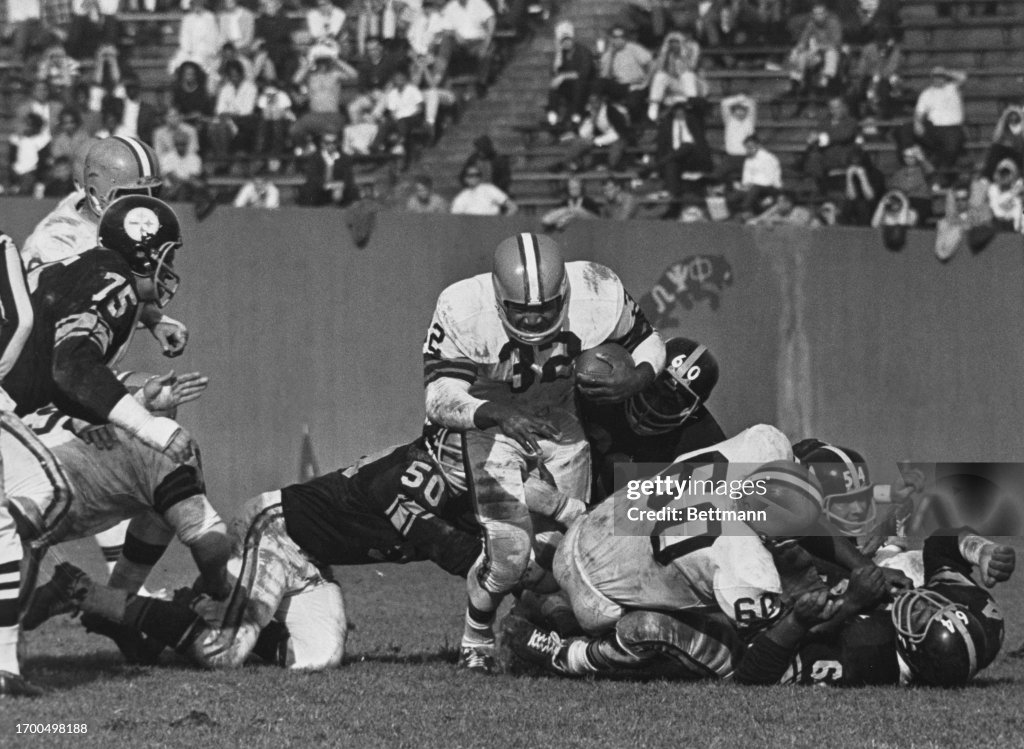
Cleveland running back Jim Brown runs for 149 yards in the Browns’ 30–17 win at Pittsburgh to become the first NFL player to exceed 10,000 yards career rushing.
Cleveland Browns 30, Pittsburgh Steelers 17
Dallas Cowboys 24, Chicago Bears 10
Green Bay Packers 42, Minnesota Vikings 13
Los Angeles Rams 17, Detroit Lions 37
St. Louis Cardinals 17, New York Giants 34
San Francisco 49ers 7, Baltimore Colts 37
Washington Redskins 21, Philadelphia Eagles 10
Jim Brown became the first National Football League player to break the 10,000‐yard rushing barrier today in pacing the Cleveland Browns to a 30–17 victory over the Pittsburgh Steelers. The all‐pro fullback gained 149 yards in 23 carries to lift his career total to 10,135. It was the 47th time Brown rolled up more than 100 yards a game. A crowd of 49,568 — the second largest in Steeler home‐game history — saw the game under ideal weather conditions at Pitt Stadium. The temperature was in the high 60’s. Their sixth victory enabled the Browns. to solidify their lead in the Eastern Conference. Pittsburgh handed Cleveland its only defeat last month and the St. Louis Cardinals fought the Browns to a 33–33 tie. Lou Groza kicked field goals of 36, 22, and 16 yards and kicked three conver sions. Frank Ryan hurled a 25‐yard touchdown pass to Clifton McNeil and Ernie Green scored two touchdowns. That accounted for all the Browns’ scoring. The teams were tied 10–10 at half‐time. Cleveland went ahead, 10–0, but the Steelers drew even in the closing seconds of the second period. Bob Harrison, a linebacker, recovered Ryan’s fumble with 38 seconds remaining and Mike Clark kicked a 26‐yard field goal. Clarence Peaks ran 5 yards to cap a 79‐yard drive for the Steelers’ first score.
Don Meredith’s sharp passing and a grinding ground game gave the Dallas Cowboys a 24–10 victory over the Chicago Bears today. The Bears, several of whom had been ill with stomach influenza the last two days, took a 3–0 lead on Roger Leclerc’s 12‐yard field goal the first time they had the ball, but they never really were in the game they suffered their sixth less in eight starts. Dallas, a 31–13 winner over the St. Louis Cardinals last week, kept up constant pressure with the passing of Meredith, who tossed a 31‐yard scoring shot to Jim Stiger and scored himself on a quarterback sneak. The first Cowboy touchdown, scored late in the first quarter by Don Perkins on a 2‐yard smash, capped a 63‐yard drive.
The Green Bay Packers, bent on making up for their four defeats in the first half of the season, scored three touchdowns in the second quarter today for a 42–13 victory over the Minnesota Vikings before a record crowd of 44,278. The Packers, with a 4–4, National Football League won‐lost record, like the Vikings, used Bart Starr’s four touchdown passes, Jim Taylor’s punishing runs and a crushing defense to send the Vikings to their worst defeat of the season. Starr capped his perforrmance with a 45‐yard scoring pass to Max McGee to end an 81‐yard drive in the fourth quarter. The Packers converted two Minnesota fumbles into scores in the big second period for a 28–7 halftime lead.
Miit Plum threw three touchdown passes and set up three other scores with passes today as the Detroit Lions scored a 37–17 victory over the Los Angeles Rams. The victory kept the Lions in contention for the National Football League’s Western Conference championship with a 5–2–1 won‐lost‐tied record. Los Angeles, which had entered the game tied for second place with the Lions, was left with a 4–3–1 mark. Plum threw scoring strikesl of 40 and 16 yards to Terry Barr, and hit Tommy Watkins with a 37‐yarder. Nick Pietrosante ran for two touchdown’s after Plum’s passing had taken the Lions deep into Los Angeles territory. Wayne Walker added a 42-yard field goal and 4 extra points for Detroit. On Detroit’s fourth scrimmage play, Plum hit Barr for 6 points with a 40‐yard pass. Later in the first quarter, Bruce Maher recovered a fumble at the Detroit 47 and the Lions marched 53 yards in five p1ays.
The St. Louis Cardinals had two players, Jimmy Burson and Mal Hammack, to hide against the New York Giants yesterday and a third, Ernie McMillan, who might as well have stayed home. The Giants, led by the fine rookie backfield combination of Ernie Wheelwright and Steve Thurlow, quickly located and exploited the three Cardinals and surged to an impressive 34–17 victory at Yankee Stadium. It was not necessarily an exciting game for the capacity crowd of 63,012. The way the Giants have been going this year, it was more of a revelation. The home team, still in last place, played at its best without errors against an outfit that is supposed to be a contender for the league championship. Jim Oertell Burson, a second‐year professional from Auburn, worked at defensive cornerback for the Cardinals in the absence of the injured Jimmy Hill, a 10‐year‐man. Burson was introduced to Frank Gifford of the Giants in the first half, then Joe Morrison in the second half. Against Burson’s coverage, these two Giants caught eight of Y. A. Tittle’s passes for 146 yards and six first downs.
The Baltimore Colts posted their seventh straight victory, a club record, when they turned three San Francisco fumbles into touchdowns to rout the 49ers, 37–7, today. The Colts, who have not been beaten since dropping their opening game to the Minnesota Vikings, were sparked by Lenny Moore’s two touchdowns on runs of 2 and 5 yards. They were Moore’s 12th and 13th touchdowns of the season, tops in the National Football League. Baltimore opened the scoring on a 30‐yard pass from John Unitas to Ray Berry. The extrapoint attempt by Lou Michaels was blocked, but he contributed a 30‐yard field goal minutes later. The other Colt touchdowns were made on an 8‐yard run by Steve Stonebreaker with a recovered fumble and a one‐yard pass from Gary Cuozzo to Joe Don Looney. San Francisco got its touchdown on a 2‐yard pass from John Brodie to Dave Parks. The Colts went 68 yards in six plays to open the scoring on the Unitas pass to Berry. The Western Conference pacesetters increased their lead to 9–0 midway in the first period on Michael’s field goal after a drive stalled at the 22‐yard line.
The Washington Redskins took a two‐touchdown lead in the first five minutes today on a long punt return and a recovered fumble to beat the Philadelphia Eagles, 21–10. The victory was the Redskins’ second of the season over the Eagles. Charlie Taylor, a rookie halfback, scored twice for the Redskins in a loosely played game before a sellout crowd of 60,671. A tough and alert defense also helped the Redskins win twice in a row for the first time this year. A passing duel between Sonny Jurgensen and Norman Snead, the quarterbacks who were traded by the teams at the end of last season, failed to materialize. Jurgensen completed seven of 18 for 141 yards and one Washington touchdown, while Snead had 12 for 29 far 116 yards. The Redskins gained a 7–0 lead in the first two minutes when Pervis Atkins made a dazzling punt return of 68 yards to the Eagle 1. Taylor, who netted 65 yards on 22 carries, went over on the second play. Fumble recoveries gave the Redskins their next two scores. Earl Gros fumbled on the first play after the kickoff, and Paul Krause recovered on the Eagle 22. The Redskins’ third touchdown followed a third‐quarter fumble by Ray Poage. John Sample grabbed it and ran 31 yards to the Eagle 15. Jurgensen passed to Angelo Coia to the 2, and Taylor carried the ball over.
AFL Football:
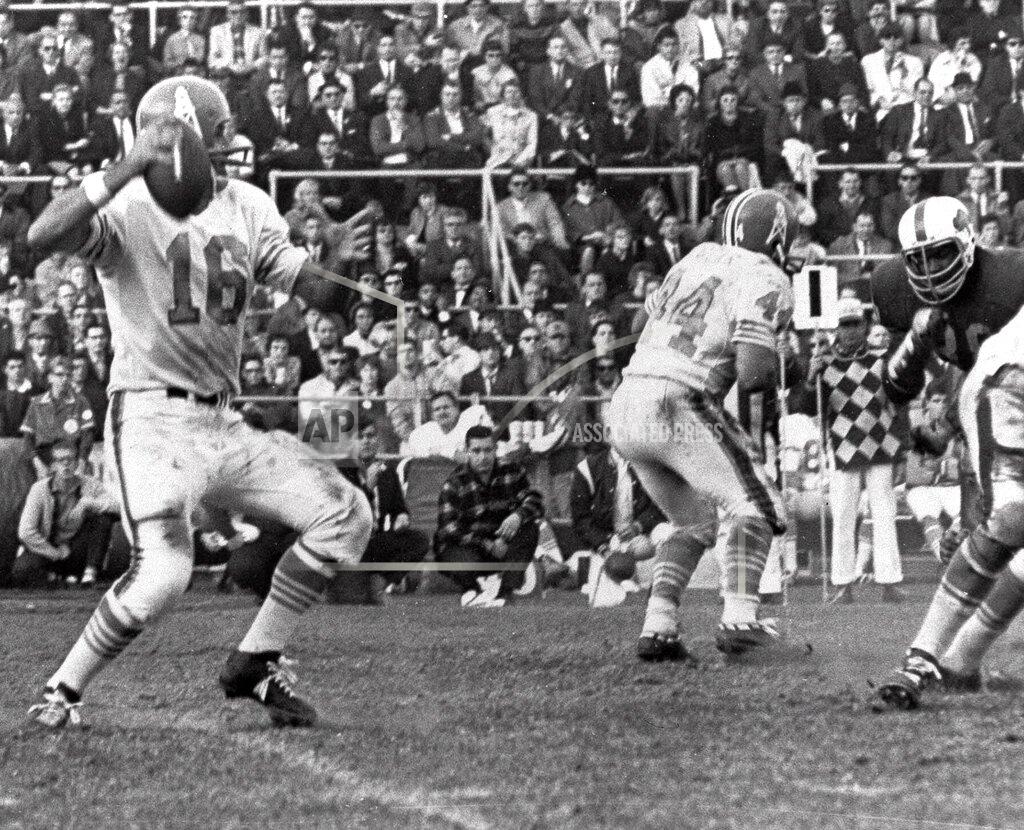
Houston Oilers quarterback George Blanda attempts an AFL record 68 passes (37 completions) in a 24–10 loss vs. the Buffalo Bills at War Memorial Stadium.
Houston Oilers 10, Buffalo Bills 24
Denver Broncos 39, Kansas City Chiefs 49
Oakland Raiders 17, San Diego Chargers 31
The unbeaten Buffalo Bills scored 17 fourth‐period points today to overpower the Houston Oilers, 24–10, despite a record American Football League passing performance by George Blanda before 40,119 fans. Blanda, the 37‐year‐old quarterback in his 15th pro season, pitched 68 passes in a vain effort to prevent Houston’s fifth straight loss. Instead, the Oilers dropped their sixth in eight starts and Buffalo rang up its eighth triumph to move 2½ games ahead of Boston in the Eastern Division. Blanda completed 37 passes for 393 yards and Houston’s only touchdown, but the Bills led by Bob Smith, Cookie Gilchrist and Daryle Lamonica, wore down the Oilers in the last 15 minutes. Blanda’s 37 completions broke his own A.F.L. record of 31 set against Los Angeles in 1960 and his 68 pass attempts bettered the record of 56 attempts by Frank Tripucka of Denver against Buffalo in 1962. Smith, a North Texas State speedster who tallied Buffalo’s first touchdown in the opening period, got the go‐ahead score on a 3‐yard smash after 2 minutes 37 seconds of ‐the final quarter. Gilchrist ran 60 yards with 7:27 left in the came for the insurance touchdown after Lamonica’s passing and running fired the Bills.
Kansas City Chiefs quarterback Len Dawson passes for 435 yards in 49-39 win over Denver at Municipal Stadium. Dawson tossed six touchdown passes to spark Kansas City to an American Football League victory over the Denver Broncos today. The Chiefs snapped a three‐game losing streak. Dawson’s passing had built up a 42–10 lead for the Chiefs midway through the third quarter before the Broncos left the partisan Kansas City crowd of 15,053 breathless with an incredible comeback.
Lance Alworth and Keith Lincoln scored two touchdowns each today to give the San Diego Chargers a 31–17 victory over the Oakland Raiders, in the American Football League. Alworth tallied on pass plays of 77 and 47 yards. He caught eight passes for 203 yards. Lincoln’s scores came on rushes of 9 and 12 yards up the middle. The victory avenged, two Charger losses to the Raiders last season. The key to San Diego’s triumph was a defense that picked off six Raider passes.
Born:
Sophie B. Hawkins, American singer-songwriter (“Damn! I Wish I Was Your Lover”), in New York, New York.
Daran Norris [as Daran Morrison Nordlund], American voice actor (“The Fairly OddParents”), in Ferndale, Washington.
Eddie Williams, MLB first baseman and third baseman (Cleveland Indians, Chicago White Sox, San Diego Padres, Detroit Tigers, Los Angeles Dodgers, Pittsburgh Pirates), in Shreveport, Louisiana.
Richard Cooper, NFL tackle (New Orleans, Phildelphia Eagles), in Memphis, Tennessee.
Hank Goebel, NFL tackle (Los Angeles Rams), in Evergreen Park, Illinois.
Died:
Henry “Doc” Carlson, 70, American Basketball Hall of Fame collegiate coach (University of Pittsburgh, 1922-53: 367–248 [.597]), originated figure 8 play.




 History Diaries