Turkish Cypriots are resettling in a large section of Cyprus occupied last summer by the Turkish army. One of the key questions about the future of Cyprus is whether the Greek Cypriot refugees who fled the Turkish invasion will be allowed to return to their homes. Thousands of Greek-owned houses, farms and businesses have already been taken over by Turkish Cypriots who have moved into the occupied areas. The resettlement is taking place rapidly. A foreign diplomat commented: “The northern part of, Cyprus is becoming a Turkish province.” Turkish Cypriot officials say that ethnic Turks have not settled in Famagusta, the seaport and tourist center the Turks hold on the east coast, and nearby villages. They imply that this area will be returned to the Greek Cypriots if they agree to divide the island.
Ethnic Turks are moving into towns and villages throughout the rest of the region, however, including the citrus center of Morphou. Some diplomats, have suggested that Morphou would also be turned over by the Turks as part of a political settlement. Turkish officials say workers have to be moved there now to save the citrus crop. The resettlement is most visible here in Kyrenia, the focal point of the Turkish Army’s landing last July 20. The Turkish Cypriot administration has issued its own postal stamps and letters are now addressed “Girne, Mersin 10, Turkey.” Girne is the Turkish name for Kyrenia, and Mersin is a district on the Ttirkish mainland, only 40 miles away.
The General Assembly, in a rare show of unanimity, adopted a resolution tonight that called on the Greek and Turkish Cypriotes to negotiate a “mutually acceptable political settlement.”
Along with all the other gloom in the troubled province of Ulster, there is a growing feeling these days that British Government policy is approaching bankruptcy. To many Roman Catholics land Protestants, it appears that British officials have run out of ideas and perhaps even interest in Northern Ireland and its sectarian violence. “The British have hope and that’s about all,”, said one Catholic politician. “They don’t seem to care about the place and it’s no wonder. Many of us think they would like nothing more than to pull out if they could leave something viable behind. “There is a growing acceptance here that the British are really looking for ways to go,” said a moderate Protestant. “I don’t say there is any devious plan to call the troops home. If they did it too soon, it would be a clear dereliction of duty.” Accordingly, there is no general conviction that London will soon withdraw the 15,000 soldiers sent here since the outbreak of fighting five years ago. But the British often do seem to be laying the groundwork for an eventual withdrawal, given the insolubility of the problem and the growing weariness of the British public.
A Brooklyn-born woman in Lithuania who has been seeking to return to the United States for 30 years has informed the American Embassy in Moscow that the Soviet authorities have at last granted her an exit visa.
The Palestine Liberation Organization plans to appeal to the United Nations to help it find “common grounds for a settlement” with Israel, a high-ranking source in the grouping of guerrilla movements said today.
Israeli army raiders blew up two homes in Blida, a village a mile inside Lebanon last night. “The houses had served to shelter terrorists and the inhabitants extended assistance to the terrorists,” an official military announcement said. Military headquarters here said the task force that carried out the action got the inhabitants out of the houses before the detonation. The raiders met no resistance from Lebanese soldiers or guerrillas and returned safely to Israel. It was stated here that three Arab marauders who infiltrated near Yiftah earlier this week and were killed by Israeli soldiers had received food, water and shelter in Blida on their way to the border. Officers here have acknowledged that Israeli patrols have repeatedly crossed the border to police areas in Lebanon believed to harbor terrorists. The policy has been to punish people helping the guerrillas, whether they do so willingly or reluctantly.
United States defense experts are engaged in a major review of Saudi Arabia’s security needs with an eye to maintaining a dominant position in arms sales to the oil producing country. Robert Ellsworth, Assistant Secretary of Defense for International Security Affairs, is scheduled to arrive here on November 10 for high‐level meetings after technical committees have completed their studies. Mr. Ellsworth is expected to meet with Prince Sultan ibn Abdel Aziz, Saudi Arabia’s Minister of Defense and Aviation, in a session of the United States Saudi‐Arabian Joint Security Commission, which was created earlier this year. Informed sources said the United States was prepared to place Saudi Arabian arms procurement within a government-to‐government military-sales agreement based on a joint assessment of the country’s needs.
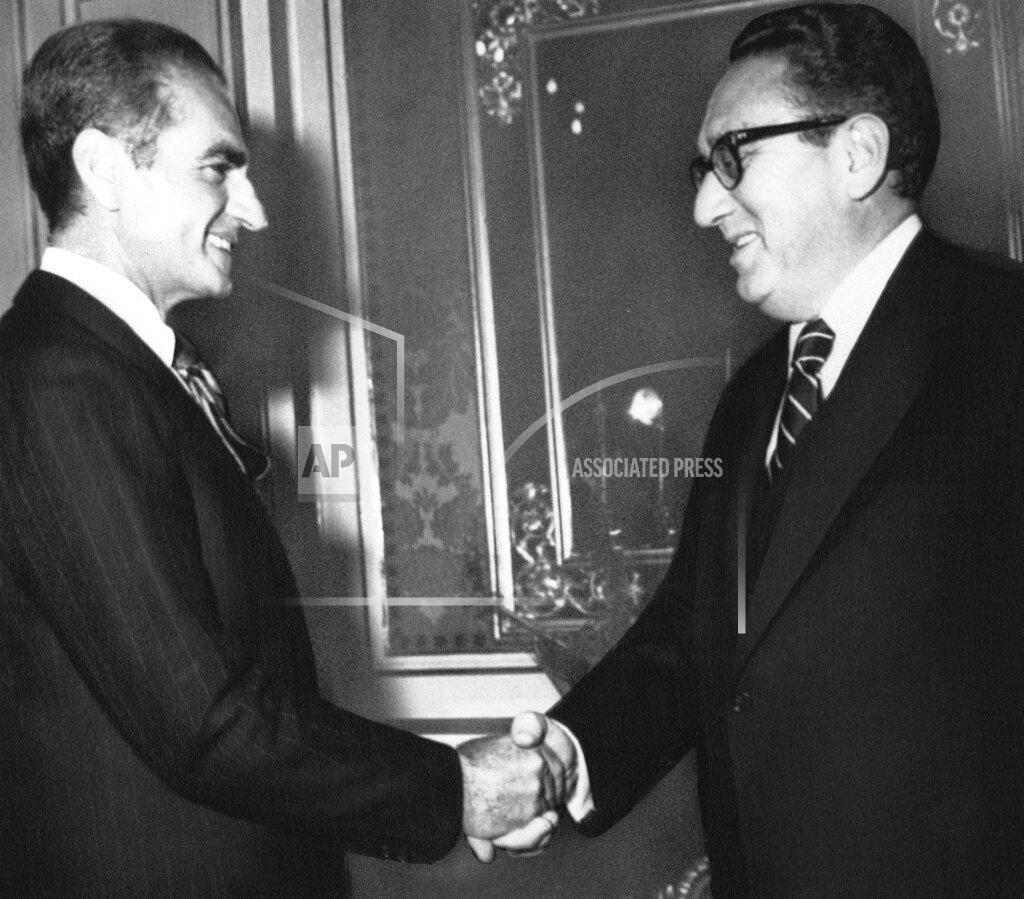
Secretary of State Kissinger sought to persuade the Shah of Iran tonight of the crippling effect continuing rises in oil prices could have on the whole fabric of the Western world. In two hours of talks, and at a dinner in Mr. Kissinger’s honor the two men covered a range of problems. But foremost was the sharp policy difference in the last year between Iran, which has played a leading role in pushing the price of oil upwards, and the United States, which has led the campaign to curb the rise. Tomorrow morning, as part of an effort by both sides to accentuate the positive in this visit, the United States and Iran will announce the formation of a joint economic commission, patterned after those between the United States and other countries. Mr. Kissinger will hold a news conference and Shah Mohammed Reza Pahlevi has agreed to meet with American correspondents.
The death toll in yesterday’s train disaster in northern India — in which an explosion caused a fire in an express train — rose to 52 today with the recovery of seven more charred bodies and two deaths in a hospital, a railway statement said. The explosion was believed to have been caused by a cigarette that ignited a bag of fireworks carried by a passenger.
In the wake of violent clashes between anti-government demonstrators and the police in Saigon, several opposition leaders denounced President Nguyễn Văn Thiệu and Mr. Thiệu assailed his domestic opponents as lackeys of the Communists. Dương Văn Minh, a retired general about whom sections of the opposition are rallying, said in a statement that Mr. Thiệu’s government was “a regime that has completely lost the confidence of the people.” General Minh, who led the coup that ousted President Ngô Đình Diệm 11 years ago today, called Mr. Thiệu’s Government “a regime that has completely lost the confidence of the people” and said South Vietnam needed new leaders to bring peace to the country. From the Ấn Quang pagoda, which also played an important part in the toppling of Mr. Diệm, a charactetrization was issued portraying the Thiệu Government as “a great obstacle to peace.”
“For that reason,” Thích Trí Thủ, a principal Ấn Quang leader said, “the Buddhists cannot possibly accept the leader of the present government, nor can we accept any similar leader in the future.” Some opposition leaders predicted that a wholesale crackdown against them was in the offing following clashes in Catholic neighborhood on the edge of Saigon, where about 75 civilians were believed to have been injured. However, more than a score of journalists and a dozen youths who had been detained were later released.
An armed rebellion of dissident Montagnard tribesmen has broken out in the South Vietnamese province of Darlac and may be spreading into neighboring corners of the strategic Central Highlands. If it continues to grow, the uprising, which is thought to have some 500 men under arms, could imperil the Saigon Government’s struggle against the Communists in the highlands. Some people here believe that the Communists have infiltrated the nascent movement. Others argue that a Government crackdown on the rebels is rapidly alienating tribesmen who are not disposed to join the insurrection and who hate the Communists. Compounding the problems, a wave of brutal killings and robberies—attributed by some to the rebels, by others to bandits who justify pillage in the name of rebellion — have heightened tension between Vietnamese and the montagnards. That is the generic name for the Central Highlands tribesmen who are not of the same racial origin as the Vietnamese. Montagnards are ethnically distinct from the lowland Vietnamese, whose civilization is largely derived from China. Montagnard languages are Malayo‐Polynesian or Mon Khmer stock.
Ending 10 weeks of recuperation from a heart attack, Laotian Premier Souvanna Phouma returned today from Paris to find his coalition Government still intact and apparently durable. The absence of the 72-yearold neutralist had presented the coalition with its greatest risk so far, for Souvanna Phouma is a symbol of reconciliation to both the Communist-oriented Pathet Lao and the pro-Western Vientiane side.
Alberto Villar, Argentina’s federal police chief, and his wife were killed when a bomb blew their cabin cruiser 30 feet out of the water. He was Argentina’s equivalent of the director of the Federal Bureau of Investigation, and was widely dreaded, even by his own men, for his harsh tactics. Villar, the director of the Policía Federal Argentina secret police and a member of the Argentine Anticommunist Alliance terrorist group, was assassinated by the Montoneros terrorist group after a team of commandos, led by diver Maximo Nicoletti, placed a remote-controlled bomb underneath Villar’s cabin cruiser yacht and detonated it. Chief Villar died along with his wife in the blast, which took place as the boat was sailing near Tigre, Buenos Aires.
The white minority government of South Africa granted limited self-government to QwaQwa, a 253-square-mile (660 km2) portion of land bordering the Kingdom of Lesotho, as “homeland” (bantustan) for 180,000 members of the Sotho people. The homeland, which would exist until 1994, was governed during its 20-year existence by Chief Minister Tsiame Kenneth Mopeli and its capital was Witsieshoek (now Phuthaditjhaba).
Unemployment, increasing to 6 percent of the work force in October, was at its highest level in nearly three years. Labor Department figures indicated that there were fewer jobs in October for virtually every work group. The unemployment rate for adult white males, the group least prone to unemployment, rose to 3.9 percent from 3.5 percent. This was regarded as a very large increase for a single month.
President Ford interrupted a political trip on the West Coast to visit former President Nixon in the intensive care section of Memorial Hospital Medical Center in Long Beach, California Mr. Ford stayed eight minutes with the former President, and said afterward that “it was very obvious to me that he has been very, very ill.” He also said that he gave Mr. Nixon a briefing on Secretary of State Kissinger’s current diplomatic trip abroad. The President entered the cardiac care unit at 10:10 AM, and was greeted by the Nixon family. There was an emotional and fervent, though apparently tearful greeting. The President hugged Mrs. Nixon, then kissed her. Mr. Ford kissed the Nixon’ daughters, Julie Eisenhower and Tricia Cox and then spread his arms wide and hugged all three simultaneously. “It’s great to see you,” Ron Nessen later reported the President telling Mrs. Nixon. “I talked to Betty this morning.”
Former President Richard M. Nixon’s doctor said today that he “is slowly and steadily improving” and had less pain, although he still needed “critical care” for complications resulting from an operation last Tuesday. Dr. John C. Lungren, Mr. Nixon’s physician, said in bulletin that the former President’s “oozing of blood” had apparently stopped. Nevertheless, the specialist in internal medicine said “we are still concerned with the potential danger of hemorrhage.” Dr. Lungren issued the bulletin an hour and a half before greeting President Ford as he arrived to visit Mr. Nixon in an intensive care unit on the seventh floor of Memorial Hospital Medical Center of Long Beach. In his bulletin, Dr. Lungren said President Ford’s visit “would prove to be extremely therapeutic at this time.” He limited the visit to eight minutes.
“We can’t get rid of this burden,” said a campaign aide to Houston Flournoy, the Republican candidate for the California governorship, when it became apparent that President Ford would visit former President Richard Nixon in the hospital. Mr. Ford’s visit to California to help campaigning Republicans has demonstrated how the burden of Watergate continues to cling to both the new President and the Republican party. The Flournoy campaign aides made it plain that the hospital visit would be one more painful reminder of what was causing Mr. Flournoy to run behind his Democratic opponent, Jerry Brown.
Harold Nelson and David Parr, two former leaders of the country’s largest dairy cooperative, were sentenced to four months in prison for bribing politicians they believed could influence milk price decisions in the White House and Congress. Judge George Hart of Federal District Court in Washington fined each man $10,000, but suspended all but four months of their three-year sentences.
Jeb Stuart Magruder testified today that the defendants in the Watergate cover‐up trial had concocted a story about his taking money from the 1972 Nixon re‐election campaign in an effort to make him a “scapegoat” for the Watergate affair. He appeared to be accusing John N. Mitchell, former Attorney General and later campaign director, in particular. Mr. Magruder, once Mr. Mitchell’s deputy in the campaign and now a Federal prison inmate as a result of his guilty plea to conspiracy in the cover‐up, conceded that he had withheld for a number of months some $7,000 in committee funds. He contended, though, that he had started to withhold the money only when he began to worry about being made a “scapegoat,” and that he had done so only to insure that the Committee for the Reelection of the President kept its promise to pay whatever legal fees he would incur as a result of Watergate.
Ted Bundy victim Laura Aime, 17, disappears in Utah. She was Bundy’s eleventh known murder victim. On Halloween, October 31, 1974, Laura was attending a Halloween party. Shortly after midnight on November 1, Laura left. To get home, she tried to hitchhike. She was never seen again. Laura was the third of five teenage girls to disappear in the area. Laura’s nude body was found by hikers in American Fork Canyon, Utah, on November 27, 1974. She was raped and sodomized, and her face was beaten beyond recognition. She was also strangled with her stockings. She was believed to have died the week prior, meaning she was held captive for some time. Laura was identified via dental records on November 28, 1974. Laura’s killer would later be identified as Ted Bundy, who was first apprehended in 1975. Bundy confessed to Laura’s rape and murder. He also described “rituals” he did with the already dead bodies of Laura, and another victim, Melissa Smith, including washing their hair and applying makeup.
A former Kent State University student who was wounded by Ohio National Guardsmen testified today that a single guardsman fired into a group of students on May 4, 1970, and “within a tenth of a second” a number of other guardsmen turned and fired into the crowd. Donald Mackenzie, 26 years old, of Millersburg, Pa., testified in United States District Court here in the trial of eight former guardsmen charged in connection with the shootings in which four students were killed and nine others wounded during a demonstration against, the expansion of the war in Indochina. Mr. Mackenzie described the movements of a group of National Guard troops who had moved into the vicinity of a pagoda on the campus. It was from this area that shots were fired at students on a roadway and in a parking lot down the hill from the pagoda. He said under cross‐examination that the guardsman who had started the firing shot from the hip and had not put his rifle to his shoulder. Mr. Mackenzie said he had not heard gunfire from any area of the campus other than that near the pagoda. He testified that he was struck by a bullet after he began to run when the guardsmen opened fire.
Officials of the Federal Energy Office obtained documents early this year that they believed showed that the New England Petroleum Corporation, a major supplier of fuel oil to utilities in the Northeast, had overcharged its customers, and they turned the informa-. tion over to United States Attorney Paul J. Curran, according to officials close to the case.
James Earl Ray killed the Rev. Dr. Martin Luther King Jr. believing he would be the “champion of the white race,” and then readily pleaded guilty because he was confident no prison could hold him, his former attorney testified today.
The president or the Puerto Rican Independence party charged today that the United States was preparing to spend $500-million a year on food stamps in Puerto Rico as a “demagogic means to win approval of the poor” at the expense of American taxpayers and to help American companies keep paying low wages.
National Airlines’ passenger jets operated today for the first time since July 15. “Everything seems back to normal,” a National spokesman said. “We have eight departures and three arrivals here today.” The first commercial flight since a machinists’ strike halted airline operations more than three months ago took off on time at 8:15 AM for San Francisco. The super DC‐8 jet with a 197‐passenger capacity had 11 paying passengers aboard, officials said.
Dow Jones Industrial Average: 665.21 (-0.31, -0.05%).
Born:
Faisal bin Farhan Al Saud. Saudi Arabian Foreign Minister since 2019 and prince in the House of Sajd; as the son of Prince Farhan bin Abdullah Al Saud in Frankfurt, West Germany.
Ryan Glynn, MLB pitcher (Texas Rangers, Toronto Blue Jays, Oakland A’s), in Portsmouth, Virginia.
Phillip Ward, NFL linebacker (St. Louis Rams, New Orleans Saints), in Gardena, California.
Died:
Baroness Moura Budberg, 82, Russian adventuress and suspected double agent for both the Soviet Union’s OGPU secret police and the United Kingdom’s MI6 intelligence agency.
Ralf Harolde, 75, American actor (“Framed”, “Smart Money”, “Tip-off”).
Ernest Muir FRCS, CIE, CMG, 94, Scottish medical missionary known for work with leprosy.
Poco Pine, 20, American Quarter Horse and winner of 50 AQHA horse showing competitions during his career and sire of 37 other horse show champions.
Bullet Joe Bush (born Leslie Ambrose Bush), 81, American Major League Baseball pitcher who played for seven major league teams in a 17-year career.

 History Diaries