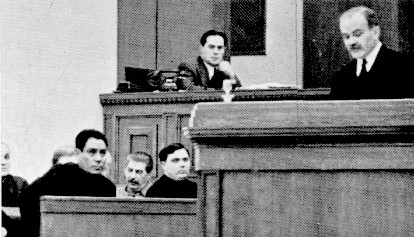
Liquidations continue throughout Poland. For instance, and just as an example because to recount sterile numbers alone is just not sufficient to emphasize what is happening, Polish Diocesan Priest Leon Nowakowski is shot in the town of Piotrków Kujawski in Poland.
The SS establishes the death penalty for all Poles who become a problem, with violators to be tried in SS courts.
Soviet Foreign Minister Vyacheslav Molotov sent a Soviet ultimatum to Finland making several demands, including that the town of Hanko be handed over for use as a Russian naval base. Negotiations resume about the border. Molotov, now assured of the backing of the Supreme Soviet, issues his first ultimatum to Helsinki. It includes his demands about Hanko, Petsamo and the other items on his wish list.
Vyacheslav Molotov, Soviet Foreign Minister, gloated over the dissolution of Poland, “ugly offspring of the Versailles Treaty”, by the combined Soviet-German attack. He also accused the British of aggressive acts.
Soviet Commissar for Foreign Affairs Vyacheslav Molotov made a speech to the Supreme Soviet and publicly announced the details of the Soviet-Finnish negotiations which have so far been secret. Molotov also lectured Britain and France for continuing the war but gave no more than moral support to Germany. The announcement of the Finnish negotiations was designed to isolate Finland from potential international support and to cause an uprising of the Finnish public against their government. The tactic was successful in respect to international relations but the Finnish people rallied behind their leaders. All of Finland backs the Finnish reply to the Soviet Union. Parliamentary groups are united in the stand against concessions.
Colonel Gwido Langer, the leader of the brilliant Polish cryptologists who have been working with their French and British counterparts to solve the mysteries of the German Enigma enciphering machine, arrived in France this month with his team and two Enigma machines. The Poles have thus fulfilled the orders of their General Staff that “in the case of a threat of war the Enigma secret must be used as our Polish contribution to the common cause of defense and divulged to our future allies.” It is hoped the Poles, helped on their journey by the British Secret Service, will carry on with their work to enable the Allies to read the German’s secret codes.
Lieutenant General Erich von Manstein’s first memorandum on the invasion of France arrived at Army High Command (Oberkommando des Heeres or OKH). Manstein’s memorandum proposed that Germany attack through the Ardennes rather than through Belgium – the expected attack route. The memorandum was quickly rejected but 5 more would follow.
The commanding officer of the German Wehrkreis IV district in Dresden, Germany gave the order to convert Colditz Castle to a prisoner of war camp named Offizierslager IV-C, or Oflag IV-C for short.
At least 4,000 Jews have left Vienna in the last two weeks for a Jewish reservation in former Polish territory and local authorities have told the Jewish community there that Vienna must be “Jew-free” by March 1, 1940.
The Reich press sees a divided America. The government is seen as taking steps toward war against the wishes of the people.
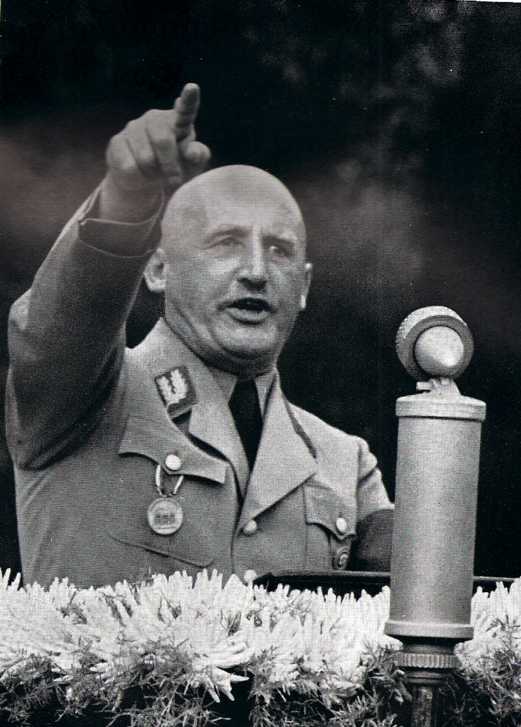
Julius Streicher speaks to a mass meeting in Nuremberg. Streicher encourages people to have faith in Hitler and rejoice in the fact that Jews no longer ruled Germany. Streicher is most known as the leading anti-Semite of the Third Reich (after Hitler, of course). He was also Gauleiter of Franconia. This may be his last major public speech, since he was in a variety of difficulties by this time, and was soon exiled to his estate outside Nuremberg.
The Dutch doubt a Nazi attack and troop moves cause no alarm.
Benito Mussolini dismissed three military chiefs (Alberto Pariani, Giuseppe Valle and Luigi Russo) and two cabinet ministers (Achille Starace and Dino Alfieri), all of whom had been popularly considered pro-German. Ettore Muti replaced Starace as Fascist Party Secretary and Alessandro Pavolini replaced Alfieri as Popular Culture Minister. Count Ciano (Mussolini’s son-in-law) remains Foreign Minister. Count Grandi remains head of Justice and is known to be an Anglophile.
The British Parliament discussed the internment of enemy aliens.
The British appoint a Consul General to Tirana, Albania, effectively recognizing the occupation Italian government there subsequent to the invasion of April 1939.
The Royal Navy starts a global hunt for the pocket battleships Admiral Graf Spee and Deutschland. The RN is also stepping up its offensive action against German submarines. Since the Royal Oak was sunk at anchor in Scapa Flow a fortnight ago the fleet has stayed at sea. German battleships have seized at least six merchant ships in the last month, but most damage has been effected by the U-boats. The submarines have been laying mines on all the routes out of the Scottish supply bases and prowling close to shore. British destroyers, frigates and corvettes are in constant action against U-boats, relying mainly on an echo-sounding device from the last war, ASDIC (from its inventors, the Allied Submarine Detection Investigation Committee). Patches of oil can give rise to a kill claim, but they’re often deceptive.
The British send four battleships, 14 cruisers and 5 aircraft carriers to hunt down the Admiral Graf Spee in the South Atlantic. This weakens convoy protection, one of the hidden benefits to the Germans of the pocket battleship’s mission.
Sailing with Convoy 20.K, the French steam merchant Baoulé was torpedoed and sunk by the U-25, commanded by Kapitänleutnant Viktor Schütze, approximately 45 miles west-northwest of La Corunna, Spain in the eastern Atlantic Ocean (43°48′N 9°08′W). Of the ship’s complement, 13 died and 33 survived. The 5,874-ton Baoulé was carrying palm kernels, cotton, cocoa, coffee, and rubber and was bound for Bordeaux, France.
Theodore Krancke takes command of the pocket battleship Admiral Scheer.
Convoy OA.28G departs from Southend. Convoy SL.7 departs from Freetown for Liverpool. Convoy HXF departs from Halifax for Liverpool.
For the month of October 1939, German U-boats sank 34 Allied ships (185,305 tons) and damaged 3 ships (22,328 tons). Five U-boats were sunk.
U.S. freighter Black Osprey is detained at the Downs by British authorities.
U.S. freighter Gateway City, detained by the British since 16 October, is released after cargo billed for delivery at Antwerp and Rotterdam, Holland, is seized as contraband.
The War at Sea, Tuesday, 31 October 1939
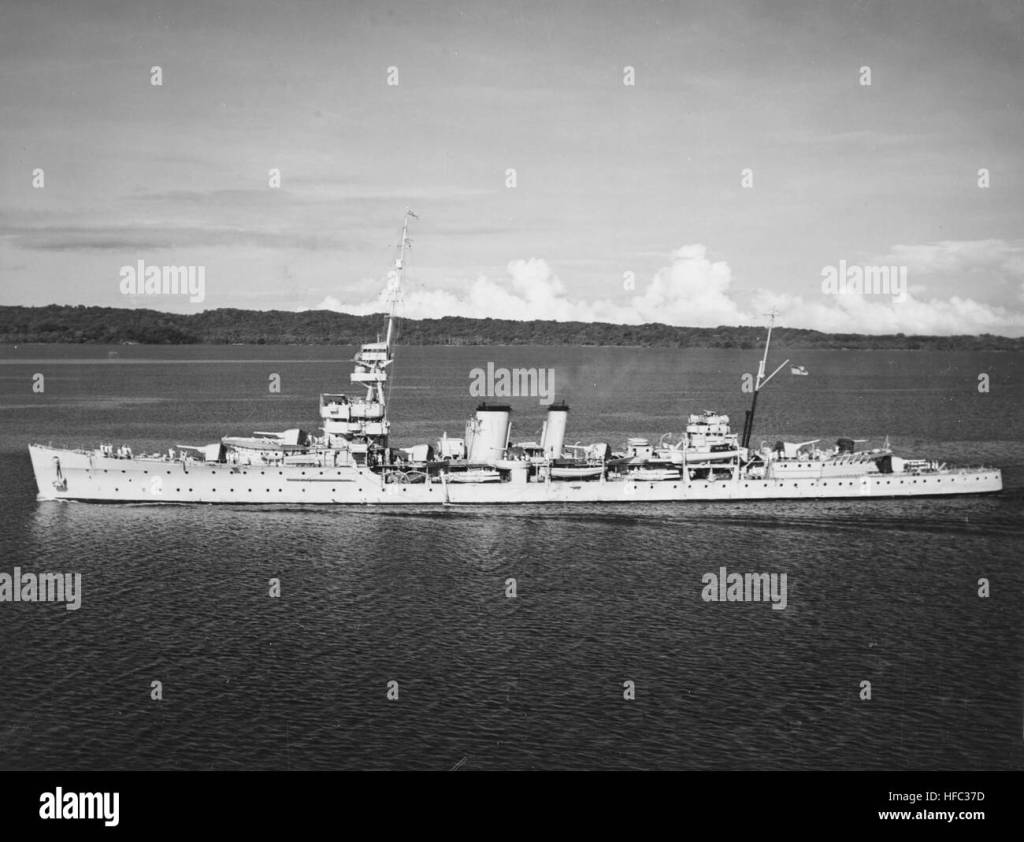
Light cruisers CALYPSO, DELHI, DUNEDIN departed Sullom Voe. CALYPSO was in a minor collision with Admiralty drifter SEA BREEZE, but there no damage to her, and she arrived back at Sullom Voe on 6 November.
Three cruisers were on Northern Patrol duties between the Orkneys and the Faroes, three cruisers between the Faroes and Iceland, and cruiser SOUTHAMPTON and armed merchant cruisers CHITRAL and AURANIA in the Denmark Strait.
Light cruiser EDINBURGH began repairs at Rosyth, which were completed on 3 November.
Light cruisers GLASGOW and NEWCASTLE, escorted by destroyers ANTHONY, BASILISK, BRAZEN departed Portsmouth for Rosyth, and arrived on 1 November.
Light cruiser CERES departed Kirkwall for Scapa Flow.
Anti-aircraft cruiser CURLEW departed Scapa Flow, and arrived at Rosyth on the 31st.
Anti-aircraft cruiser CALCUTTA departed Grimsby, and arrived back on 1 November.
Anti-aircraft cruiser CAIRO departed Grimsby, and arrived back later that same day.
Convoy OA.28G of 14 ships departed Southend escorted by destroyers VENETIA and ACASTA from 31 October to 2 November. Destroyer ARDENT joined the escort on 1 November and remained until the 2nd. On the same day, OA.28G merged with OB.28G, escorted by destroyers VERSATILE and VOLUNTEER to the 3rd, to become OG.5.
Steamer STARCROSS (4662grt) in a Norwegian convoy off Rattray Head, reported she rammed what she thought was a U-boat. Destroyer BROKE was sent to investigate.
Coastal steamer KINDIESEL (339grt) reported she was being chased by a submarine in 53 49N, 0 11E, and destroyer JUPITER was detached from convoy FS.29 to assist.
Convoy HXF.7 departed Halifax at 0200 escorted by Canadian destroyers FRASER and ST LAURENT. Ocean escort was armed merchant cruiser ASTURIAS, which detached on 11 November. She was in collision with a merchant ship while leaving Halifax, but able to continue. The convoy was joined on 10 November by destroyers ANTELOPE and VISCOUNT from convoy OA.31 and WINCHELSEA and WITHERINGTON from OB.31. The latter remained with the convoy until it arrived at Liverpool on the 12th, the same day ASTURIAS reached the Clyde.
U-25 sank French steamer BAOULE (5874grt) from convoy 20.K, en route from Casablanca to Brest, in 43 48N, 09 08W, 45 miles WNW of Corunna; two crew were killed and eleven missing. U-25 sustained damage to her torpedo hatch caused by the blast of her own gun, and was forced to return to Germany.
Heavy cruiser SUSSEX on patrol in the South Atlantic lost her Walrus reconnaissance aircraft when it failed to return from patrol. A three-and-a-half-day search for the aircraft was set in motion, but the aircraft was never found. The crew of three, pilot Lt (A) S M Bird, observer Lt C H E Osmaston and the telegraphist air gunner, Airman W H Brown, were lost.
Submarine depot ship MAIDSTONE, escorted by destroyer DEFENDER, departed Alexandria and arrived at Malta on 3 November.
Convoy SL.7 departed Freetown escorted by armed merchant cruiser MONTCLARE. Destroyer WREN joined the convoy on 16 November and it arrived later that day with both escorts.
Heavy cruiser KENT departed Hong Kong on patrol, and arrived back on 8 November.
Heavy cruiser YORK and Australian light cruiser HMAS PERTH departed Halifax for Bermuda, and arrived on 5 November. YORK remained for the repair of boiler defects completed on 13 November.
At the end of October, the following destroyers were out of service – AFRIDI at Newcastle for repairs, AMAZON at Portsmouth for repairs, ARROW at Portsmouth with defects, BOREAS at Portsmouth for repairs, DIAMOND at Singapore for repairs, DIANA at Malta for repairs, ECHO at Plymouth with damage, ECLIPSE at Plymouth with defects, ENCOUNTER at Plymouth for repairs, FAULKNOR at Clyde for repairs, FORESTER at Clyde with defects, FORTUNE at Clyde for repairs, FURY at Clyde with defects, GARLAND at Malta for repairs, GRAFTON at Plymouth for boiler cleaning, IMOGEN at Liverpool for repairs, INGLEFIELD at Liverpool for repairs, JAVELIN at Middlesbrough for repairs, MASHONA at Tyne for repairs, MOHAWK at Newcastle for repairs, MONTROSE at Plymouth for boiler cleaning, NUBIAN at Southampton with defects, SABRE at Grangemouth for repairs, SIKH at Malta for repairs, VANOC at Liverpool for repairs, VANQUISHER at Plymouth for repairs, VETERAN at Chatham for repairs, VISCOUNT at Plymouth for boiler cleaning, WALKER at Plymouth with defects, WALPOLE at Liverpool for boiler cleaning, WARWICK at Liverpool for repairs, Canadian HMCS OTTAWA at Esquimalt refitting, HMCS RESTIGOUCHE at Esquimalt refitting, HMCS SKEENA at Halifax refitting.
Today in Washington, President Roosevelt conferred with Representative Havenner and Richard J. Welsh of California on proposed expansion of West Coast naval facilities, with Senator Pepper on an appointment to the Federal judiciary in Florida and with E. H. Bermingham, chairman of the Iowa Democratic State Central Committee. At a press conference he made known he would ask for a $275,000,000 deficiency appropriation to defray increased costs of the army, navy and Coast Guard because of expansion of their activities due to national defense requirements.
The Senate heard debate on the reciprocal trade treaty program, returned to the Judiciary Committee the bill providing $1,338,000 for old-age pensions in Ohio and adjourned out of respect to the late Representative Bolton at 1:13 PM until noon on Thursday.
The House sent the Neutrality Bill to conference, considered the Shanley motion to instruct the conferees and adjourned at 6 PM until 11 AM tomorrow.
The Administration reaffirmed its control over the legislative situation involved in revision of the Neutrality Act today when the House sustained by a vote of 237 to 177 the leadership’s plan to send the amending measure to conference with the Senate. Before Speaker Bankhead could name the conferees, however, and under a procedure entirely agreeable to the Democratic helmsmen, opponents of President Roosevelt’s. wartime policies forced the question of repealing the arms embargo forward for at least two more days’ debate and another test in the lower chamber.
This resulted when Representative Shanley, Democrat, of Connecticut, who voted against the embargo when it was originally before the House, gained the floor amid the confusion following the first test on the new neutrality proposals and moved to have the conferees instructed to restore the controversial arms prohibition which the Senate deleted by a two-to-one margin last Friday. The Democratic leadership was prepared for such a motion. The only surprise was that it was made by Mr. Shanley and not by Representative Fish of New York, ranking Republican of the Foreign Affairs Committee, as originally planned by opponents.
Confident from today’s vote that they had a safe majority to defeat moves by the embargo advocates, the leaders decided to permit discussion to continue until Thursday afternoon, unless ended sooner by the other side, at which time they will move to close the debate and vote on all the instructions which may be offered for the conferees.
Today’s roll-call came on a technical motion to end debate on the rule which actually ordered the measure to conference for adjustment of the differences between. the Senate and House versions. Although the majority of sixty votes which the Administration leaders were able to muster was not an absolute test on the eventual issue! of embargo repeal, it was considered nonetheless as indicative of what is ahead. A margin of twenty to forty for repeal was the forecast most frequently heard in the lobbies and press gallery.
On today’s vote supporters of embargo repeal mustered 231 Democrats, 4 Republicans, 1 Farmer-Labor and 1 American Labor member. Voting against the motion were 155 Republicans, 20 Democrats and 2 Progressives. Debate preceding and succeeding the roll call was largely a repetition of discussions heard in the Senate and over the radio for the last six weeks or more, except that today’s statements were, in spots, more specifically upon the question of House procedure looking to the expediting of the neutrality revision. For the most part members went through short talks, some of them merely introducing themselves and asking permission to extend their remarks later in The Congressional Record. More than a score of members took advantage of the rather liberal rule of debate allowed by the leaders, although at times not many more than that number were on the floor. The galleries were not more than one-third filled at any time after the test vote.
Representative Rayburn of Texas, majority leader, was applauded by the Democrats when, closing the debate on the rule, he asked the House to try to keep the debate on the same high level as established by the Senate during its four-weeks’ consideration of the resolution. “There were no cries of ‘phony bill’ and ‘city-slicker legislation’ in the Senate,” he said, referring to remarks made earlier by some of the opponents of the measure in their castigation of the rule.
Under the arrangement as announced by Mr. Rayburn, the debate that followed adoption of the rule was divided equally between supporters and opponents of the Senate resolution, the time of the former being alloted in blocks of one to forty minutes by Representative Bloom of New York, chairman of the Foreign Affairs Committee, and that of the latter being distributed similarly by Representative Fish.
For nearly four hours, therefore, one member after another took the floor to praise or condemn the Administration’s plan to change the Neutrality Act, and especially to repeal the embargo. Among those supporting the proposal to repeal the embargo were Representatives Bloom, Allen of Pennsylvania, Lanham of Texas, Johnson of Texas, Martin of Colorado and Sirovich of New York. Earlier, during debate on the rule, Representatives Sabath of Illinois, Taylor of Tennessee, Cox of Georgia, Colmer of Mississippi, Nichols of Oklahoma and Warren of North Carolina had thrown their lot in with the Administration. Among those either to condemn or question embargo repeal or other parts of the Administration’s foreign policies were Representatives Horton of Wyoming, Fish of New York, Halleck of Indiana, Vorys of Ohio, Massingale of Oklahoma, Barry of New York, Dondero and Crawford of Michigan, O’Connor of Montana, Pfeifer of New York, Miller of Connecticut and Springer of Indiana.
Supporters of the President’s demand for repealing the arms ban contended, for the most part, as the repealists had done in the Senate, that it was “the best assurance of keeping out of this war and keeping our boys at home,” that it gave incidental benefit to the side which the American people obviously favored in the European conflict; that it restored to the United States the truly neutral position which it left when Congress passed the act originally in 1935, and that repeal of the embargo would contribute to the national defense of the United States through the aid it would give to the democracies abroad.
Opponents contended, just as they had done in the Senate, that repeal of the embargo was a step toward possible or even probable involvement of the United States in the present war; that it would be an unneutral act now that hostilities had started abroad; that it would give the United States an economic stake in the continuance or outcome of the war, while opening this country to a sordid trade in “instruments of death.”
President Roosevelt adds $275,000,000 to the country’s defense budget. President Roosevelt today placed at $275,000,000 the cost of his program for safeguarding American neutrality under the proclamation of a limited national emergency. He said that he would ask Congress to authorize a deficiency appropriation of that amount, representing peacetime increases in the army, navy, Coast Guard and other service branches and recommissioning of World War destroyers for patrol duty.
Mr. Roosevelt revealed at his press conference that he had written to Representative Taylor, chairman of the House Appropriations Committee, notifying him of the cost of the program. A breakdown of the estimate, according to various purposes for which it would be used, will be sent to the proper committee on November 13 for study, he said, but action would not be requested until the regular session in January.
The President made no attempt to itemize the $275,000,000 total. It was taken for granted that the largest part of it would go to the navy and increase to nearly $1.000,000,000 the $773,049,151 already voted for the navy for the current fiscal year. In addition to army, Marine Corps and Coast Guard increases, the limited emergency program included 150 additional agents for the Federal Bureau of Investigation.
A majority of American voters believe the Dies committee investigations of un-American activities should be continued, with Congressional appropriations provided for another year.
Arrests in Poland alarm labor in the United States. Socialist and union leaders are reportedly taken to the Soviet Union by Russian leaders.
The labor dispute which had thrown about 50,000 Chrysler Corporation employes out of work was further complicated today by the closing of the Dodge truck plant. The closing affected 1,290 employes, of whom 789 were engaged in production.
The New York World Fair closes at 2 a.m. and will reopen in May 1940.
President Roosevelt by proclamation today fixed November 23 as Thanksgiving Day and called on the nation to join then in grateful prayer for the blessings of peace and prosperity on this continent.
Scattered engagements of bitter intensity are raging in China’s Western Shansi Province between the Fen and Yellow Rivers in the Taning, Siangling, and Hotsin districts. The Japanese are pushing westward from points on or near the TatungPukow railway, attempting another clean-up drive. Resorting to ambushes, quick raids and sieges of garrisoned points, the Chinese claim to be smashing the Japanese efforts to consolidate their positions.
Meanwhile in Southeast Shansi the Chinese continue to besiege Changtze, Changchih, and Hukwan, centers captured by the Japanese in their big offensive in July and August and among the few places still held by the invaders out of the extensive area occupied then. A Japanese foray carried out in force by 4,000 men west of Changtze is reported to have been repulsed. The Japanese continue their frequent bombing of Sian, and in the last few days have also raided. Liang, Pingliang, and Hanchung.
In a sign of slight easing of tensions about the conflict, the Australian Government scales back its plan to send an entire expeditionary air force to Great Britain, and instead will send just a reconnaissance squadron.
Dow Jones Industrial Average: 151.88 (-1.33)
Born:
Ron Rifkin [Saul Rifkin], American actor (Arvin Sloane – “Alias”; “Brothers & Sisters”; “L.A. Confidential”), in New York, New York.
Tom O’Connor, British comedian and TV game show host, in Bootle, Lancashire, England, United Kingdom (d. 2021).
John Guerin, American session and touring jazz-rock drummer and percussionist (Frank Zappa; L.A. Express; Joni Mitchell: Linda Ronstadt), in Hawaii (d. 2004).
Ali Farka Touré, Malian musician, in Timbuktu Region, Mali (d. 2006).
Tommy Brooker, AFL end and kicker (AFL Champions-Texans, 1962, Chiefs, 1966; AFL All-Star, 1964; Dallas Texans-Kansas City Chiefs), in Demopolis, Alabama (d. 2019).
Bucky Wegener, AFL guard and defensive end (Houston Oilers), in Higginsville, Missouri.
Ed Stroud, MLB outfielder (Chicago White Soc, Washingotn Senators), in Lapine, Alabama (d. 2012).
Died:
Albrecht, Duke of Württemberg, 73, German field marshal of World War I.
Naval Construction:
The Royal Navy Flower-class corvettes HMS Candytuft (K 09) and HMS Carnation (K 00) are laid down by the Grangemouth Dry Dock Co. (Grangemouth, Scotland); completed by N.E. Marine. The Candytuft will later be transferred to the U.S. Navy, becoming the USS Tenacity (PG-71). Carnation later becomes the Koninklijke Marine (Royal Netherlands Navy) HrMs (HNMS) Friso.
The Royal Navy Flower-class corvettes HMS Delphinium (K 77) and HMS Dianthus (K 95) are laid down by Henry Robb Ltd. (Leith, U.K.); completed by the Ailsa Shipbuilding Company Ltd. (Troon, Scotland).
The Вое́нно-морско́й флот СССР (ВМФ) (Soviet Navy) Project 68 (Chapayev-class) light cruiser Zheleznyakov (Железняков) is laid down by Admiralty Shipyard (Shipyard 194), Leningrad, Russian SFSR, Soviet Union (completed 1950).
The Royal Navy “T”-class submarine (First Group) HMS Tigris (N 63) is launched by the Chatham Dockyard (Chatham, U.K.).
The Japanese Nitta Maru-class cargo liner Yawata Maru (八幡丸) is launched for Nippon Yusen Kaisha (NYK) by the Mitsubishi Shipbuilding & Engineering Co., Nagasaki, Japan. She would be converted to an IJN Taiyō-class escort carrier, HIJMS Un’yō (雲鷹, “Cloud Hawk”), in 1942.
The Royal Indian Navy auxiliary patrol vessel HMIS Kalavati (4.158) is commissioned. Her first commanding officer is Lieutenant George Meredith Hart, RINR.
The Royal Indian Navy auxiliary patrol vessel HMIS Sonavati (4.206) is commissioned. Her first commanding officer is Temporary/Lieutenant (E) Fleming Robb, RINR.
The Nihon Kaigun (Imperial Japanese Navy) minelayer HIJMS Hatsutaka (初鷹, “First Hawk”), first of her class of 4 (3 completed), is commissioned.
The Royal Navy “T”-class (First Group) submarine HMS Truant (N 68) is commissioned. Her first commander is Lieutenant Commander Robert Witherington Peers, RN.

 History Diaries