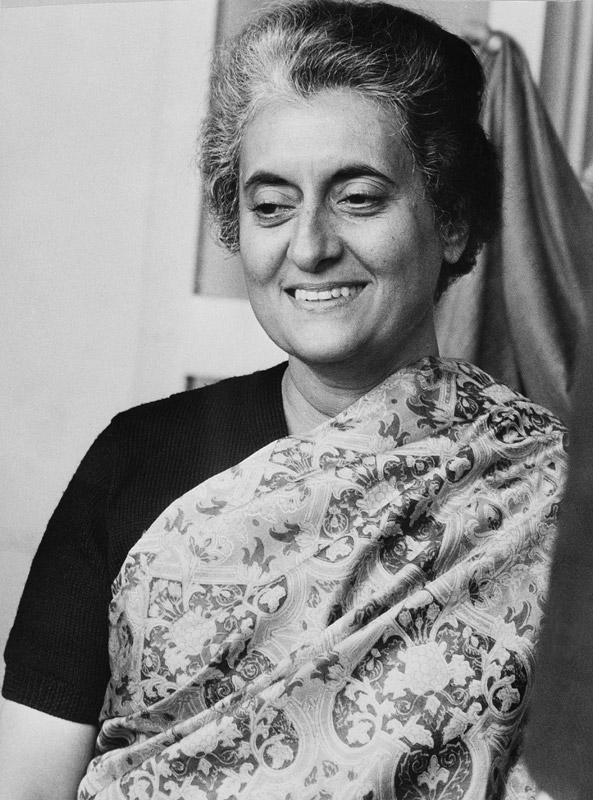
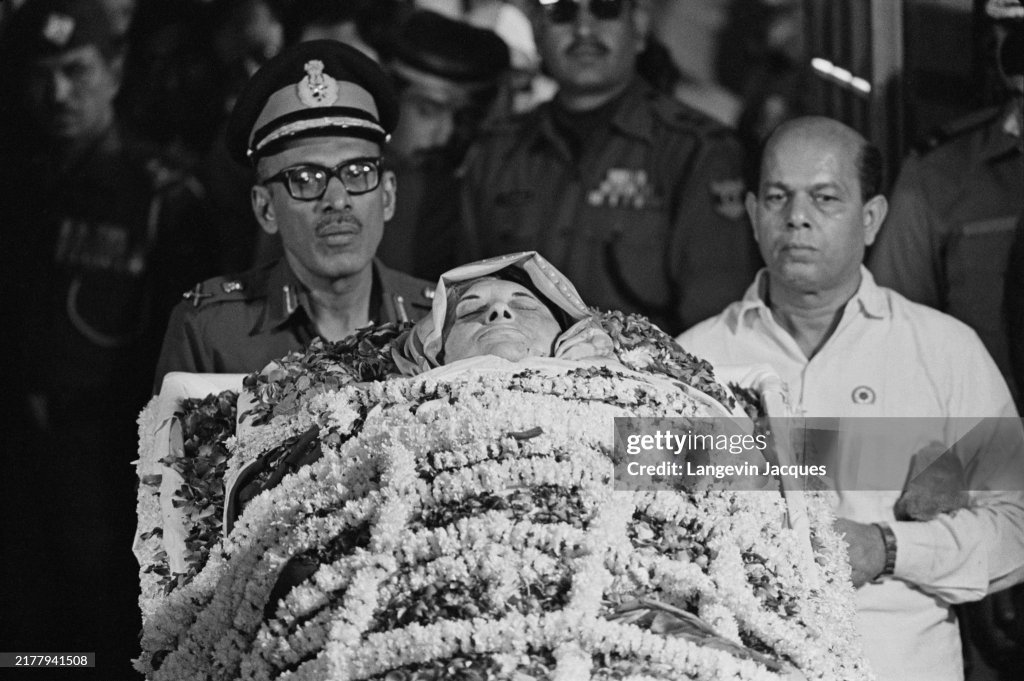
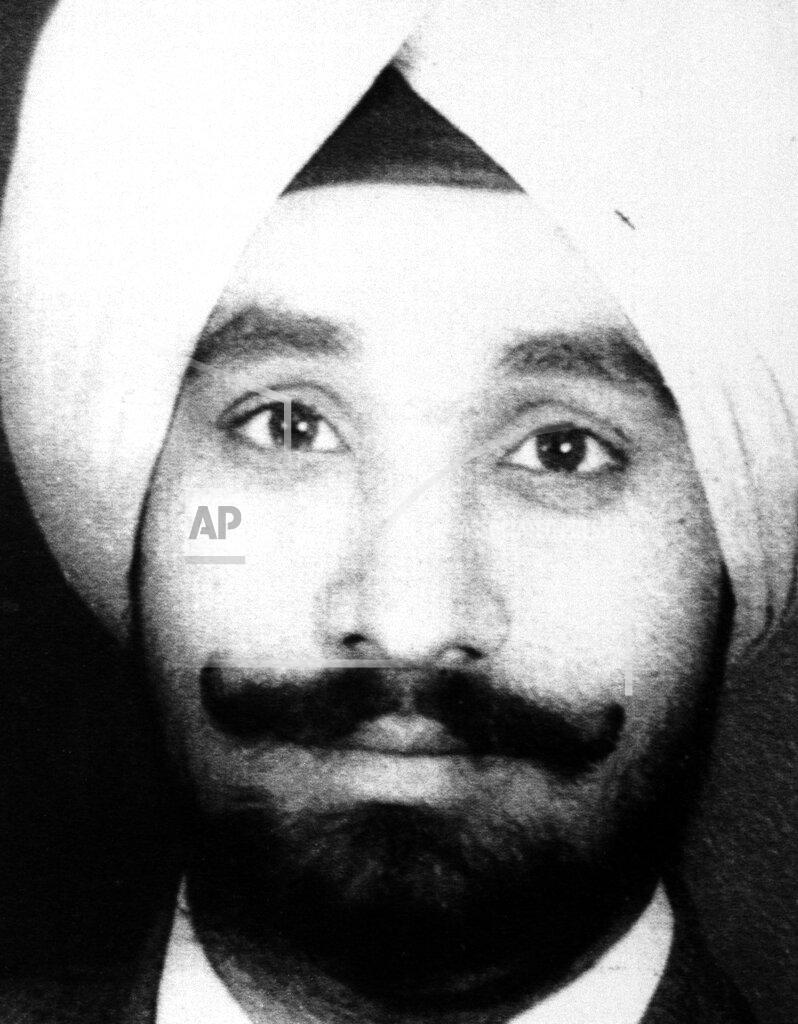
Assassination in India. Indira Gandhi was fatally shot at her home in New Delhi by two men identified by police officials as Sikh members of the Prime Minister’s personal bodyguard, Satwant Singh and Beant Singh. Officials said the longtime Indian leader was killed by at least eight bullets fired at close range from a submachine gun and a pistol.
Anti-Sikh violence rocked New Delhi and at least seven other Indian cities after the assassination of Prime Minister Gandhi. Army troops were deployed in Calcutta and many other cities to curb the wave of street attacks. The entire army was placed on alert.
Indira Gandhi was the dominant figure in Indian politics for nearly two decades. The 66-year-old leader was strong-willed, autocratic and determined to govern an almost ungovernable country.
Rajiv Gandhi, who was sworn in as his mother’s successor, was propelled into public life after his younger, more politically ambitious brother, Sanjay, died in a stunt plane crash in 1980. Before entering politics, Rajiv, who is now 40 years old, was a pilot with Indian Airlines.
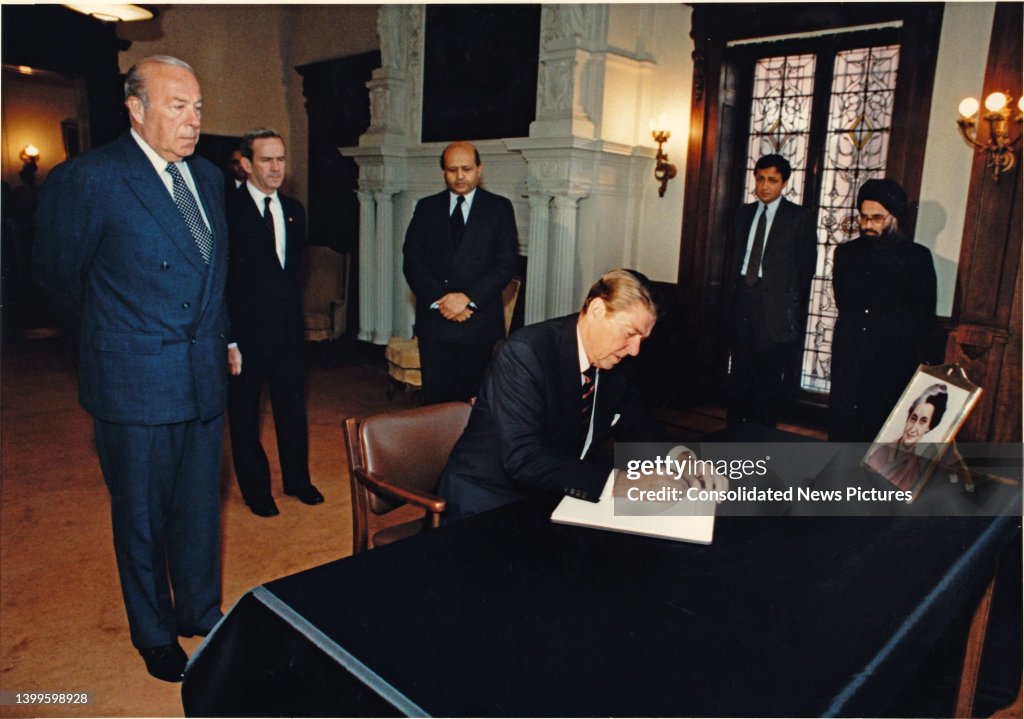
Political and religious leaders around the world deplored the assassination of Indira Gandhi and, with a rare unanimity that cut across all ideological boundaries, praised the Prime Minister as a champion of her people. Many leaders portrayed the murder as an assault on democracy everywhere and some said they feared for India’s continued unity.
Reagan Administration officials expressed concern that the murder of Prime Minister Gandhi could lead to extended violence.
Three Polish security officers arrested in the slaying of a pro-Solidarity priest will soon be charged with murder, according to an Interior Ministry official. As the official spoke, a pathologist appointed by the Roman Catholic Church began an autopsy on the body of priest, the Rev. Jerzy Popiełuszko. The body was found Tuesday in a reservoir in northern Poland 11 days after his abduction. The autopsy was conducted in the presence of a church-designated lawyer. No results of the autopsy were made public. A ministry official said the hospital where the examination was conducted was being kept secret to prevent it from becoming a place of pilgrimage.
The decision to allow church representatives to conduct the post-mortem was one of several steps by the Government to build its credibility in the case and to lessen the rising public outrage that erupted with the news that the 37- year-old priest had been found dead. As the investigation proceeded, the three suspects – Grzegorz Piotrowski, a 33-year-old captain in charge of a unit that reportedly monitored clerics, and two lieutenants, Waldemar Chmielewski, 29, and Leszek Pekala, 32 – were expelled from the Communist Party by the party organization at the Interior Ministry. The three men, all Interior Ministry workers, have been charged in the priest’s abduction, according to Poland’s Interior Minister, General Czeslaw Kiszczak.
There were also reports, passed on by diplomats in Warsaw, that the highest party circles were preparing to discuss a long-standing rift in the security apparatus. The schism, diplomats said, pitted former army men who support the Polish leader, General Wojciech Jaruzelski, and what was called his policy of normalization, against those described as hard-liners who came up through the ranks of the security establishment and who are said to command the loyalty of many agents.
Pope John Paul II appealed for calm in Poland today as he described the murder of Father Popiełuszko as a shock to the conscience of the world. The Pope, speaking in his native Polish to about 200 Polish pilgrims, said of the priest: ”Although in human understanding he suffered death, our hope is full of immortality. Let us pay him final homage with Christian dignity and in peace.” In an apparent call for restrained reaction, he added, ”May the great moral eloquence of this death not be disturbed by anything.”
President Reagan hailed Father Popiełuszko today as a courageous spokesman for liberty and said that ”the world’s conscience will not be at rest until the perpetrators of this heinous crime have been brought to justice.”
A year ago some of the West European members of NATO, rattled by the problem of winning public opinion to the deployment in Europe of new American nuclear missiles, began talking about a way to put a more visible European stamp on Western security policy. The discussion fell under the catchword ”Europeanization,” and it largely involved a plan to revivify the Western Europe Union, a little-used intergovernmental defense policy agency. The goal, beyond the officially stated desire to strengthen the European pillar of the Atlantic alliance, was to take a little distance from the Reagan Administration and from what was widely regarded as its overly confrontational style of dealing with the Soviet Union. Last weekend, plans for reorganizing the W.E.U. were announced by the foreign and defense ministers of the seven participating countries, who met here without the United States. But the program was discreet, and the put-the- Americans-at-arms-length undertone virtually gone. In the space of a year, it appeared, a central concern of the Europeans had become keeping the United States close at hand.
Soviet Foreign Minister Andrei A. Gromyko met with U.S. Ambassador Arthur A. Hartman to continue to search for ways to improve chilly relations between Moscow and Washington, a U.S. Embassy spokesman said in Moscow. The spokesman said the meeting at the Kremlin, which lasted several hours, was a follow-up to a discussion begun last month when Gromyko visited New York and Washington. The official Soviet news agency Tass said Hartman had requested the meeting.
Challenger Gary Kasparov agreed to a draw in the shortest game so far in the world championship chess series with defending champion Anatoly Karpov in Moscow. The 20th game between the two Soviet grandmasters was drawn on the 14th move, making it the 16th draw of the series. Karpov leads, 4-0; the first player to win six games will capture the match. Play will resume Friday.
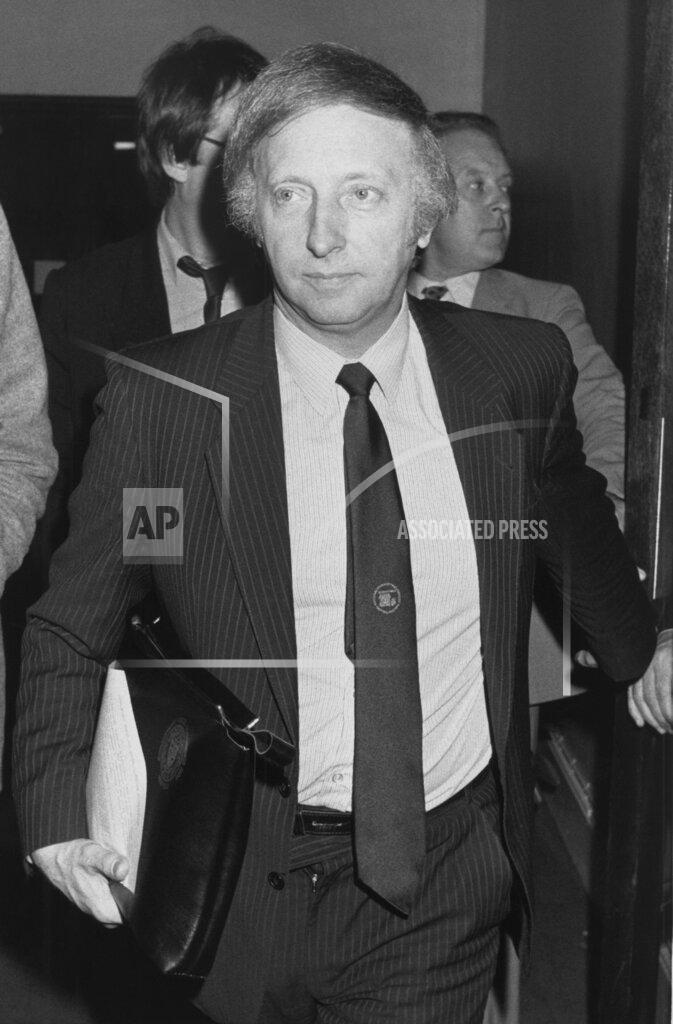
Negotiations between striking coal miners and the state-owned National Coal Board collapsed again tonight, raising the prospect of the walkout dragging on into 1985. The 10th attempt to settle the strike, which is nearly eight months old, broke down in mutual acrimony after 10 hours of meeting at the offices of the independent Arbitration, Conciliation and Advisory Service. The mediation service issued a brief statement saying no progress had been made. No further talks were planned.
Masked gunmen shot and killed a 40-year-old Catholic man, Harry Muldoon, in Belfast, Northern Ireland, today in what the police there said they believed was a sectarian murder. Protestant loyalists said the victim drove an unlicensed taxi in the Catholic Falls Road area.
Israeli and Lebanese negotiators will begin talks on Monday in southern Lebanon on an Israeli withdrawal from the region, the United Nations announced. The military conferees will also deal with the security of Israel’s northern border, a topic that Israel has long demanded as a precondition for any pullout. U.N. Secretary General Javier Perez de Cuellar has arranged talks between Israel and Lebanon to discuss the withdrawal of Israeli forces from southern Lebanon, it was announced. A U.N. spokesman said the conference will begin Monday at the headquarters of the U.N. Interim Force in Lebanon at Naqoura. Druze leader Walid Jumblatt has agreed to let Lebanese army troops deploy along the coastal road running down to Israel’s southern Lebanon defense lines, where they would be prepared to move south to occupy areas that might be vacated by the Israelis, political sources in Beirut said.
The State Department defended President Reagan’s 1982 Mideast peace initiative against criticism by the U.S. ambassador to Israel, Samuel W. Lewis. In a speech at Tel Aviv University, Lewis said that the Reagan plan “was a genuine effort” but that “the timing was abysmal,” the presentation “even worse and the results nil.” State Department spokesman John Hughes said, “There are aspects of his remarks that are troubling to people in Washington.” Lewis was appointed in 1977 by President Jimmy Carter.
CARE, the private aid organization, announced at the United Nations that it has signed an agreement with Ethiopia for the shipment of 50,000 tons of food and $10 million worth of other assistance to the famine-stricken nation. The group’s executive director, Philip Johnston, said the agreement took a year to work out. He attributed this to his own “mistaken strategy” in initially stressing the agency’s stringent criteria for use of the aid in the best way possible.
An American tourist couple and two other foreigners who were trapped in a town in northern Ethiopia when insurgents seized it were freed by the rebels and arrived here tonight, apparently unharmed. ”We’re alive and very well,” Margaret Marshall, 65 years old, of Ventura, California, said in an interview. She and her husband, Edwin Marshall, a 67-year-old retired aircraft engineer for Lockheed, were flown to the capital on a Red Cross plane along with a British tourist, Alison Gillard, and a Swiss representative of the International Committee of the Red Cross, Markus Mueller.
The Soviet Union’s military involvement in Afghanistan has grown significantly in the last six months, according to Western intelligence sources. In addition to the 115,000 Soviet soldiers and airmen reportedly stationed in the country, the sources reported this week that another 50,000 airborne troops have been deployed just north of the Soviet-Afghan frontier. These troops are flown into Afghanistan when guerrilla forces are sighted on the move or when the insurgents’ fortified strongholds must be reduced, the sources said. They are believed to be better trained than other Soviet forces, which hold the cities, airfields and main roads.
Prime Minister Yasuhiro Nakasone of Japan reshuffled his Cabinet to satisfy faction leaders who, hours earlier, formally voted to reelect him, making him the first two-term ruling Liberal Democratic Party leader since 1972. Nakasone retained his top foreign affairs and economics ministers. The new roster includes the first woman minister in 22 years, Shigeru Ishimoto, director general of the Environment Agency. At the same time, he gave several key Cabinet posts to followers of former Prime Minister Kakuei Tanaka. Mr. Nakasone, whose faction in the governing Liberal Democratic Party is only the fourth largest, has managed to stay in office because of the support of the largest faction, headed by Mr. Tanaka, who is appealing his conviction for taking bribes to promote the sale of Lockheed Corporation aircraft while in office from 1972 to 1974.
The Philippine Government ombudsman said today that he had begun evaluating evidence against the armed forces Chief of Staff and others implicated in the Benigno S. Aquino Jr. assassination, but had not decided whether to hold public pretrial hearings. The ombudsman, Justice Bernardo Fernandez, whose office investigates criminal complaints against Government personnel and prosecutes them before the courts, said he could not say how soon his office could make a ruling on whether there was sufficient evidence to bring the case to trial. The Chief of Staff, General Fabian C. Ver, who has gone on a ”leave of absence” to prepare his defense, has waived his right to a preliminary investigation to speed up proceedings against him, the Philippine News Agency reported.
Nicaragua charged that a U.S. spy plane flew over Managua to prepare for an American invasion after the Nov. 4 U.S. presidential election. A flight over the Nicaraguan capital created a sonic boom, sparking rumors it had been bombed. A Nicaraguan Defense Ministry spokesman said it was a U.S. SR-71 plane that flew from the Atlantic coast, crossed over Managua and a new military airport north of the capital and flew on toward Honduras.
A key Nicaraguan rebel leader said the Central Intelligence Agency recruited him to serve as a senior director of the largest insurgent force two years ago and told him, “We are going to help you change the Government in Managua and do it within a year.” The officer asserted that the CIA paid his family’s expenses for more than a year.
Ecuador’s United Labor Front staged a 24-hour general strike today in its first challenge to the 10-week-old conservative Government, crippling industrial belts in cities around the country, unionists said. The organization’s leader, Jose Chavez, told reporters that 600,000 of Ecuador’s one million workers stayed off their jobs today, but transport workers failed to heed the strike call. The organization called the strike Monday to protest what it called Government compliance with conditions set by the International Monetary Fund for an agreement to pave the way for the refinancing of Ecuador’s $7 billion foreign debt.
Forty-three people were reported killed and 22 injured today in Argentina when a train slammed into a commuter bus at a suburban railroad crossing. Wooden traffic barriers at the crossing in San Justo, 10 miles west of Buenos Aires, are designed to be operated manually by a railroad employee. Railway officials said that the barriers at the crossing were down before the collision and that the bus driver went around them. Bus company officials said the barriers were raised.
President Reagan, responding to criticism from Bishop Desmond Tutu of South Africa, said today that the United States finds that country’s racial policies ”repugnant,” but prefers to try to change them quietly. ”Perhaps he isn’t aware of all that we are doing,” Mr. Reagan said of Bishop Tutu, an Anglican who won the 1984 Nobel Peace Prize on October 16 for his decades of nonviolent struggle for racial equality in South Africa. Bishop Tutu said two weeks ago that most South African blacks view the Reagan Administration as collaborators with ”this racist regime here” and want Mr. Reagan to lose the election. When asked about Bishop Tutu’s criticism as he visited his national campaign headquarters today, the President replied: ”Obviously, we find apartheid repugnant. Yet, there are two ways you can go. You can rise up in indignation and turn your back, or try to be of help in changing the situation.”
New rioting was reported today in black South African townships where violent protests on Tuesday claimed three lives. A police spokesman said the police made extensive use of tear gas, rubber bullets and birdshot to disperse rampaging youths in townships on the south coast.
A pledge not to discriminate against women, unmarried people and those receiving public aid was made by the Household Finance Corporation, one of the largest consumer finance companies. Under a consent agreement with the Justice Department, the company also pledged to invite 800 former loan applicants, chosen at random, to reapply under conditions insuring their rights.
The President, reflecting confidence about the election outcome, visited his Washington campaign workers and joked about dozing at Cabinet meetings to catch up on sleep lost to politics.
President Reagan participates in a ceremony for the launch of the new Hispanic Stamp in the Rose Garden.
Walter F. Mondale warned warmly responsive crowds in Louisville, Kentucky, and Baltimore that the re-election of President Reagan would be marked by economic and social injustice. Mr. Mondale described Republicans as the party of the rich hostile to the poor, middle-class students, women and minorities.
The choice of Geraldine A. Ferraro as the Democratic Vice-Presidential nominee prompted women’s groups to predict an outpouring of volunteers, money and votes that would buoy female candidates. But now expectations are lower.
The infant known as Baby Fae continued to make remarkable progress as she was cuddled and fussed over by her mother and father, according to physicians. The blood tests of the infant were reported normal, with no indication of adverse reaction from the heart of a baboon she received last Friday. Both parents wore masks and gowns to help protect the infant from infection. Her vulnerability to infection is greater than it would normally be because of medications being used to suppress her immune system to keep her body from rejecting the heart. When Baby Fae cried and squirmed, as any normal baby does, her mother, holding her in a rocking chair, talked to her, gave her a pacifier, caressed her and calmed her down.
Arson and vandalism in Detroit destroyed an apartment building and forced firefighters to respond to more than 400 smaller blazes. At least 17 people were arrested in disturbances that included dozens of fires in garbage dumpsters, vacant lots and abandoned cars. Tuesday night’s disturbances occurred despite what Mayor Coleman Young described as ”an unprecedented effort” to keep the city calm on the night before Halloween, which is known here as ”Devil’s Night” and has been marked by violence in recent years. No serious injuries were reported. Residents of one block on Detroit’s East Side were evacuated when flames from a vacant building threatened a row of adjacent houses, but firefighters managed to bring the fire under control and keep the rest of the block from being damaged extensively.
Ford Motor Co. Chairman Philip Caldwell and United Auto Workers President Owen Bieber were among those who signed a new three-year contract that follows the pattern set at General Motors Corp. but also includes a moratorium on plant closings. The contract, ratified by a 64% vote that ended Sunday, covers 114,000 hourly workers at 54 locals nationwide. Unlike the GM pact, the agreement reached October 14 includes a three-year ban on the closing of Ford plants. The pact calls for wage increases of between 1% and 3.5%. The typical assembler will receive a 2.25% first-year increase, or 15 cents an hour, on top of current wages of $9.60 an hour.
A middle-age man and a woman died as a tornado slammed into a mobile home park near Carbondale, Kansas, about 29 miles south of Topeka. The twister struck the Mineral Springs Trailer Park after dark, inflicting heavy damage as it apparently caught residents unaware, said Kent Cornish, a reporter with Topeka radio station WIBW. The exact number of other injuries was not known. As many as four tornadoes whirled through Oklahoma, meanwhile, but no injuries were reported.
U.S. District Judge Franklin Dupree denied an appeal by condemned murderer Velma Barfield and refused to halt her execution in North Carolina Central Prison Friday, when she is scheduled to become the first woman put to death in the United States in 22 years. Dupree granted a petition to send the case to the U.S. 4th Circuit Court of Appeals in Richmond, Virginia. Barfield, 52, was convicted of murdering her boyfriend with poison in 1978. She also confessed to killing three other people, including her mother, but has not been convicted in those slayings. She is scheduled to die by lethal injection. In the hearing in Raleigh, defense attorneys argued that Barfield was incompetent to stand trial in 1978 because she was withdrawing from an addiction to prescription drugs. Prosecutors said she was ruled competent and doctors knew of her drug abuse.
Recent Supreme Court decisions and government actions have weakened the constitutional wall separating church and state, the Anti-Defamation League of B’nai B’rith said in a report prepared for the group’s national executive committee meeting in Denver. Among the actions cited are recent high court decisions upholding publicly sponsored Christmas religious displays in Rhode Island and prayers in the Nebraska Legislature by a state-employed Christian minister and congressional sanctioning of prayer and worship meetings by student groups in public schools.
The quality and quantity of active military personnel increased in fiscal 1984, according to the annual Pentagon assessment of manpower strength. For the first time, 90% of new recruits in every branch of the military held high school diplomas and average to excellent scores on the Armed Forces Qualification Test, Assistant Defense Secretary Lawrence J. Korb said. In addition, the active force grew by 14,900 members, to 2,138,200, and the reserves grew 41,300, to a record 1,045,800. The number of new recruits declined, Korb said, but that was offset by an increase in re-enlistments.
U.S. Attorney Philip Hogen filed a motion in U.S. District Court in Rapid City, South Dakota, asking Judge Andrew Bogue to dismiss a federal unlawful flight charge against jailed Indian activist Dennis Banks. The charge dates back to January, 1983, when Banks fled from California to a New York reservation. At the time, Banks was wanted in South Dakota for sentencing on riot and assault convictions stemming from a 1973 disturbance at the Custer County Courthouse. Banks surrendered to state authorities September 13, ending nine years as a fugitive. He is serving a three-year prison term.
A divided federal appeals court today refused to remove restrictions on voter registration procedures in an Oregon county where an Indian guru tried to register thousands of new voters. The United States Court of Appeals for the Ninth Circuit, in a 2-to-1 vote, rejected the request by followers of the Bhagwan Shree Rajneesh for an injunction against the Wasco County Clerk, Sue Proffitt. Miss Proffitt had ordered a blanket rejection of voter registration applications as of October 10 and told new applicants to attend hearings at which their eligibility to vote would be determined. She said the rules were prompted by attempts at organized voter fraud. Disciples of the guru, who have been accused of trying to take over the county by bringing in homeless people to vote, said they would boycott the election on November 6 but decided to fight the clerk in court anyway. Federal District Judge Edward Leavy of Portland had refused earlier to halt the voter registration system.
The United State Court of Appeals for the District of Columbia today lifted its seven-week-old injunction blocking the commercial operation of the Diablo Canyon nuclear power plant in California. The order frees the Nuclear Regulatory Commission to issue a full-power license for the first of two reactors at the $5.1 billion nuclear plant. Joseph Fouchard, a spokesman for the commission, said the the agency ”is working on the license and it could be issued sometime this week.” The license would allow the plant to go beyond 5 percent power for the first time. The five-member commission, by a 3-to-1 vote, approved the full-power operating license for the Diablo Canyon reactor on August 2 after operations of the facility had been delayed for more than a decade by design problems and fears of an earthquake. However, in a response to a suit by opponents of the plant, who charged that not all of the potential earthquake problems had been adequately addressed, the Court of Appeals two weeks later issued a stay preventing the commission from actually issuing the license. The court order lifting the stay came after 90 minutes of oral arguments in the case on Tuesday.
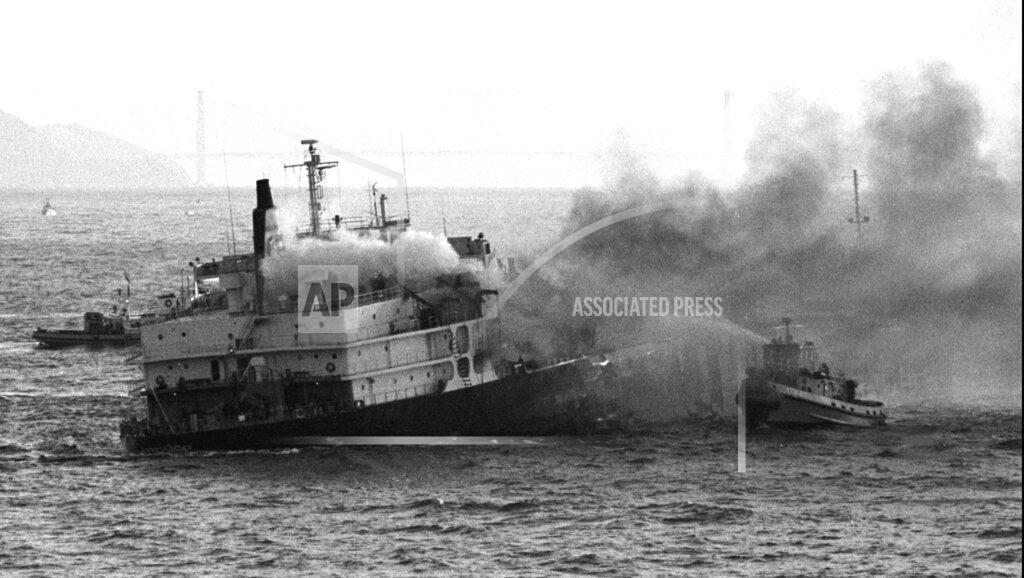
The tanker SS Puerto Rican explodes spilling 2 million gallons of oil as ship the caught fire just after leaving San Francisco bound for New Orleans with a cargo of 91,984 barrels of lubricating oil and additives. In addition to the cargo the ship was fueled with 8,500 barrels of Heavy Fuel Oil (Bunker C) before departure. The ship had departed just after midnight and was in the process of disembarking the pilot when an explosion occurred. The ship was eight miles off the Golden Gate bridge at 3:24 AM, when she was torn by a very large double explosion just forward of her deck house. A 100-foot section of deck, the whole width of the vessel, was thrown up and then back down forward on the deck in front of it, as flames shot hundreds of feet in the air.
A bar pilot, the third mate, and a crew member were thrown into the sea. The pilot boat San Francisco rescued the badly injured pilot and mate, but the crewman was lost. As fire raged onboard, the Coast Guard towed the crippled ship further out to sea, to keep her from breaking up and dumping her cargo near San Francisco Bay. On November 1, a storm passed through the area, battering the Puerto Rican with 35-mile-per-hour winds and 16-foot-high seas. That evening, after 32 hours of effort, navy fireboats finally extinguished the fire. On November 3, 30 miles southwest of the Golden Gate, she broke up, her stern section sinking to a depth of 1500 feet within the boundaries of the Gulf of the Greater Farallones National Marine Sanctuary. Over a million and a quarter gallons of refined petroleum products, about one-third of Puerto Rican’s cargo, went into the water.
In the days after the explosion, there were intimations in the media of sabotage linked to a labor dispute. The vessel had been picketed in a Bay Area port and some of its crew harassed by maritime union pickets. The FBI intervened, but it was quickly determined that no point source explosion had occurred. Later it was found that the explosion probably resulted from holes in tank compartment bulkheads that allowed caustic soda to mix with zinc, forming deadly hydrogen gas that then exploded. A Coast Guard board of investigation attributed this to the negligence of the ship’s officers on the inbound voyage from Long Beach. But no cause of the explosion could be established with certainty.
The environmental impact was significant. In addition to the initial spill, the sunken stern section continued to discharge heavy bunker oil – as much as 8,000 barrels – for months and possibly years afterwards. An estimated 4,815 seabirds were killed by oiling as a result of this spill; another 1,368 were recovered.
Howard Goodall & Melvyn Bragg’s musical “Hired Man” premieres in London.
Dow Jones Industrial Average: 1207.38 (-9.93)
Born:
Anthony Varvaro, MLB pitcher (Seattle Mariners, Atlanta Braves, Boston Red Sox), in Staten Island, New York, New York (d. 2022, in a head-on collision with a wrong-way driver).
Died:
Indira Gandhi, 66, 4th Prime Minister of India (1966–77, 1980–84), assassinated by two of her Sikh bodyguards.
Eduardo De Filippo, 84, Italian playwright, director, actor and poet (7 Deadly Sins, Shoot Loud).



 History Diaries