West of the Orkney Islands, the German submarine U-56 encountered the British battleship HMS Nelson with First Lord of the Admiralty Winston Churchill aboard. U-56 fired three torpedoes. Two of the torpedoes hit home but fortunately for the Nelson both proved to be duds. The U-boat’s commander, Leutnant Wilhelm Zahn, became known as “the man who almost killed Churchill.”
Defective torpedoes have been a problem for the Germans since the beginning of the war. Several German U-boat attacks have failed, and U-boats lost, because of them. U-boat Captains are returning from missions furious with anger at lost opportunities and the resultant peril of detection. German technicians at the Torpedo Directorate are working furiously to isolate the problem and find a solution, which seems to have something to do with the detonators. No solution is yet in sight, but reports from the field are flowing in about the continuing problem.
The U.S. Navy will have a similar problem in 1941-42, and bureaucratic bungling and emppire-building will cost many American lives before the problem is finally addressed in 1943.
The City of Flint ended up in Tromsø again, to the displeasure of the Norwegians who were trying to avoid being drawn into any international incidents involving belligerent ships in their ports. Norway dispatched a naval escort to see the City of Flint through Norwegian waters to ensure that the freighter neither tried to stop again nor came under attack from Allied warships.
The USSR formally annexes its share of occupied Poland.
A Soviet purchasing mission places orders for German warships, ship engines, and turrets.
Himmler orders that all Jews must be cleared out of the rural areas of western Poland within 3 months. In the Poznan region, 50 communities are immediately uprooted.
Germany and Latvia sign a treaty for the evacuation of ethnic Germans from Latvia.
More than 2,000 German nationals from Estonia and Latvia have arrived in Danzig harbor and are now being quartered in the near-by towns of Adlershorst and Gotenhafen. The latter, before the war, was Polish Gdynia.
Activity resumes on the western front. Clearing weather allows air-scouting patrols to resume. There is some local activity all along the front, including artillery fire, but no major operations.
Hans von Mackensen, the German Ambassador to Italy, left for Berlin today at Chancellor Hitler’s request. Officially he has gone to make a periodic report to the Chancellor. But it is generally agreed that there is something much more important than that in view.
Britain details Nazi tortures. A government white paper exposes Nazi brutality towards dissidents and Jews, including the concentration camp system. Concentration camp horrors are told; the practices recall the “darkest ages” with floggings and killings by guards.
“The Lion Has Wings,” the first war film of the conflict, is shown. It features newsreel footage of RAF Ansons attacking a German fleet.
First kill by the Hawker Hurricane, a German Do 17 bomber.
An ignition of firedamp and coal dust caused a devastating explosion in Valleyfield Colliery, Fifeshire, Scotland, killing 35 men.
Rumanian officials reiterated tonight that they would refuse flatly to cede an inch of soil to Bulgaria, which is reported to have Soviet Russian support for return of the Dobruja territory.
Consultations on Finland’s reply to Soviet Russia between the Finnish Cabinet and parliamentary leaders of all parties today brought completion of the answer and the official communiqué emphasizes that there was full agreement on all points. Finland rejects the demanded territorial concessions.
The anti-submarine trawler HMS Northern Rover was torpedoed and sunk by the U-59, commanded by Oberleutnant zur See Harald Jürst, approximately 100 miles west of Sumburgh Head, Shetland Islands in the northern Atlantic Ocean (49°25′N 11°18′W). All of the ship’s complement of 27 died.
The neutral British steam merchant Thrasyvoulos was stopped by signals by the U-37, commanded by Kapitänleutnant Werner Hartmann, south of Ireland in the eastern Atlantic Ocean. After it was determined that she was carrying contraband and the crew abandoned ship the Thrasyvoulos was torpedoed and sunk. The 3,693-ton Thrasyvoulos was carrying French nuts and anthracite cobbles and was bound for Halifax, Nova Scotia.
Dispersed from Convoy HX.5, the British steam merchant Cairnmona was torpedoed and sunk by the U-13, commanded by Kapitänleutnant Karl Daublebsky von Eichhain, three miles east-northeast of Rattray Head, Scotland in the North Sea (57°38′N 1°45′W). She was taken in tow by the tug Englishman but sank later that day. Of the ship’s complement, 3 died and 42 survivors were picked up by the drifter HMS River Lossie. The 4,666-ton Cairnmona was carrying general cargo, including wool, copper and grain and was bound for Leith, Scotland.
The Finnish cargo ship Juno struck a mine and sank in the North Sea off Withernsea, Yorkshire (53°40′N 0°17′E) with the loss of all six crew.
The British Admiralty reports that two of its destroyers were attacked by German bombers south of the Dogger Bank, with no damage.
Various reports of Luftwaffe reconnaissance over the northeast and southeast England, but no shoot-downs. There also are Luftwaffe reconnaissance flights over France.
The RAF, in turn, makes reconnaissance flights over north German airfields.
U-34 aborted patrol and returned to base due to serious engine trouble.
U.S. freighter Scanpenn is detained by British authorities at Kirkwall, Orkneys.
U.S. freighter Hybert is detained by British authorities at the Downs the same day.
The War at Sea, Monday, 30 October 1939 (naval-history.net)
Two cruisers were on Northern Patrol between the Orkneys and the Faroes, three cruisers between the Faroes and Iceland, and one cruiser and three armed merchant cruisers in the Denmark Strait.
U-59 sank armed boarding vessel NORTHERN ROVER (655grt, Lt M H Macpherson Rtd) on patrol in Fair Island Channel near Kirkwall. She had brought Danish steamer NAJADEN (1963grt) in to Kirkwall for examination on the 30th, left her at the gate and returned to patrol. There was no further contact and she was lost with Lt Macpherson, A/Sub Lt G B Grey, RNR, T/Lt A E White, RNVR, T/Sub Lt G A R Darlow, RNVR and twenty-three ratings.
Destroyers GRENVILLE and GIPSY of the 1st Destroyer Flotilla arrived at Plymouth after departing Alexandria on the 14th, reaching Malta on the 19th, and leaving Gibraltar on the 22nd with convoy HG.4.
As Admiral Forbes was returning to Loch Ewe after escorting a group of iron ore ships from Narvik to the Firth of Forth, battleships NELSON and RODNEY, battlecruiser HOOD, and destroyers ICARUS, IMPULSIVE, IVANHOE, INTREPID and KELLY ran into a U-boat line west of the Orkneys. U-56 fired three torpedoes at NELSON and while all three struck the target, none exploded. U-boats U-57, U-58, U-59, also in the area, did not contact the Home Fleet units. Admiral Forbes arrived back at Loch Ewe on the 31st without further interference.
Convoy BC.13S of fifteen ships, including DELIUS (Commodore), GRETA FORCE, GWENTHILLS and SANDHILL departed Bristol Channel escorted by destroyers EXPRESS and VIVACIOUS, and safely arrived in Quiberon Bay on 1 November.
Convoy AXS 3 of one steamer departed Fowey, escorted by destroyer VESPER, and arrived at Brest on the 31st.
Convoy SA.15 of two steamers departed Southampton, escorted by destroyers SCIMITAR and SARDONYX, and arrived at Brest on the 31st.
Convoy FN.29 departed Southend, and arrived at Methil on 1 November.
Convoy FS.29 departed Methil escorted by destroyer VIVIEN and sloops BITTERN and FLEETWOOD, and arrived at Southend on 1 November.
U-13 torpedoed steamer CAIRNMONA (4666grt) out of convoy HX.5B west of the Orkneys in 57 38N, 01 45W. She was taken in tow by tug ENGLISHMAN, and sank, still in tow at 1638/30th. Three crew were killed.
U-37 sank Greek steamer THRASYVOULOS (3693grt) in 49 25N, 11 18W; twenty-two crew were missing and six survivors rescued by Norwegian steamer HAVMOY (1342grt).
Heavy cruiser EXETER arrived in the Falkland Island after leaving her patrol on the South American east coast on the 27th.
Light cruiser ORION departed Kingston, and arrived back on 8 November.
On the 30th, the 8th Submarine Flotilla was formed at Colombo with submarines OLYMPUS, OTUS and ODIN under the command of Commander S M Raw for operations against German raiders and supply ships thought to be operating in the Indian Ocean. The three submarines departed Singapore on the 24th and arrived at Colombo. Submarine REGENT departed Singapore to join the Flotilla on the 30th. However, on arrival at Colombo, she was found to have defects and was ordered back to Singapore. She departed Colombo on 6 November and arrived back on the 11th. The final submarine of the Flotilla, ORPHEUS, was under repair at Hong Kong, left there on 5 December and joined them at Colombo on the 14th.
Today in Washington, President Roosevelt sent a message to President Ismet Inonu of Turkey expressing wishes for the nation’s continued peace and prosperity on its anniversary as a republic. He conferred with Paul Raver and Secretary Ickes on the Bonneville Dam project and with Don Miguel Lopez Pumarejo, retiring Ambassador of Colombia, on defaulted Latin-American debts in this country.
With the Senate in recess, the House heard of the death of Representative Chester Bolton of Ohio and adjourned in respect after granting permission to its Rules Committee to file a rule before midnight giving the right-of-way to the Senate-adopted bill repealing the arms embargo.
The arms ban repeal meets its first real test in the U.S. House of Representatives today. The Rules Committee adopts a resolution to send the neutrality measure to conference. The Administration leadership won the first skirmish today in its campaign to put repeal of the controversial arms embargo through the closely divided House and adjourn the special session of Congress by the coming weekend. By a strictly, though unrecorded, partisan division, the Rules Committee reported a resolution which, if adopted, will send the neutrality measure as amended in the Senate last week to a conference of the two houses for adjustment of the differences between the Senate and House measures. The chief of these lies in the embargo which the House adopted last Summer.
The resolution was reported by Chairman Sabath under special permission, as the House stood in adjournment this afternoon, and will come up for action when the body reconvenes at noon tomorrow. It provided: “That immediately upon the adoption of this resolution, the joint resolution, House Joint Resolution 306, The Neutrality Act of 1939, with Senate amendments thereto, be, and the same is hereby, taken from the Speaker’s table and to the end that the amendments of the Senate be, and the same are hereby, disagreed to and a conference is requested with the Senate on the disagreeing votes of the two houses.”
For all practical purposes the move to disagree to the Senate amendments was a method of getting the measure to a conference where Administration forces will be in sufficient majority to adopt the Senate’s outright repeal of the embargo in preference to the House-adopted Vorys amendment, placing a ban on shipment of lethal weapons from the United States to belligerent nations. Despite the cry of “gag” raised today as invariably done against such rules, the proposed procedure would be to leave the House free to consider and vote on a variety of amendments.
Debate on the rule itself will be limited to one hour, after which it must be voted up or down. But immediately upon its adoption, as is expected on all sides, and before the appointment of conferees by the Speaker, any member may move to instruct the House managers to accept or reject any of the Senate. amendments, or to insist upon the provisions previously adopted by the House. The motion itself would be subject to amendments or substitutions. as long as a majority of the House wanted to leave the matter open. A test of the majority’s wishes can be made at any time by a motion by any member of the “previous question.”
It is exactly at this point that anti-repealists propose to take their stand. Under plans tentatively agreed upon this afternoon, Representative Fish of New York, arch foe of embargo repeal and ranking minority member of the Foreign Relations Committee, will make a motion to instruct the conferees to insist upon some form of arms embargo as soon as, and if, the House adopts the rule sending the measure to conference. The exact substance of the proposed Fish motion had not been worked out, however. Some of the anti-repealists wanted to take the opportunity to test the House on an absolute embargo of all arms. shipments from the United States to the belligerents. Others preferred to center on the Vorys modified embargo, believing the strength greatest on this proposal, which was adopted by a 41-vote majority when the matter was before the House originally.
Still others of the anti-repeal group wanted to retreat to the Danaher-Vandenberg amendment embargoing poisonous gas and flamethrowers as rejected by the Senate by an overwhelming vote last week. Administration leaders intimated that they would seek in no way to instruct the conferees. Confident that they had sufficient votes with which to resist all the moves of the anti-repeal bloc, they thought that negative votes on those various proposals would be tantamount to instructions to the conferees to accept the vital parts of the Senate resolution.
A federal grand jury investigation into new and serious charges involving the German-American Bund was disclosed yesterday when James Wheeler-Hill, national secretary of the Bund, appeared at the New York Federal Courthouse in response to a grand jury subpoena. Federal Attorney John T. Cahill declined to comment on the investigation, beyond confirming the fact that it was underway. Mr. Wheeler-Hill proved a reluctant witness at first, and was taken before Judge William Bondy. After a private session, customary when witnesses refuse to talk, he was returned to the jury room, where he remained for half an hour. He is to go before this group again this morning.
Mr. Wheeler-Hill is also the local Bund leader and is known as the “first lieutenant” of Fritz Kuhn, national leader, who is under indictment for misappropriation of the organization’s funds. He declined even to hint at what the federal body expected to find out about the Bund. “It was nothing but a fishing expedition,” he said.
William C. McCuistion, a self-styled former Communist worker in maritime unionizing work, was ordered arrested here this evening, on a request telegraphed by the police department of New Orleans after he had spent the day describing to the House Committee on Un-American Activities alleged Communist direction behind the National Maritime Union.
At midnight Washington Police Headquarters said detectives had not found McCuistion. Chief Inspector Bernard W. Thompson had announced at 5 o’clock that he had ordered the arrest after New Orleans police had learned of McCuistion’s whereabouts and notified Washington that the witness was wanted in connection with an investigation of the slaying in New Orleans on September 17 of Philip Carey, an official of the National Maritime Union.
A fugitive warrant was issued for the witness, who had described himself as a resident of Frederick, Maryland. Although the committee excused McCuistion after his testimony and gave the impression that he was not to appear again, it was stated tonight at the office of the chairman, Representative Dies, that the witness was expected to appear again tomorrow. Mr. Dies, according to his office, “knows nothing about any warrant issued for the arrest of Mr. McCuistion or whether any arrest has been made.”
Research organizations identified with the consumer movement are to be investigated for possible communistic influences, Representative Martin Dies, chairman of the Congressional Joint Committee on UnAmerican Activities, said yesterday.
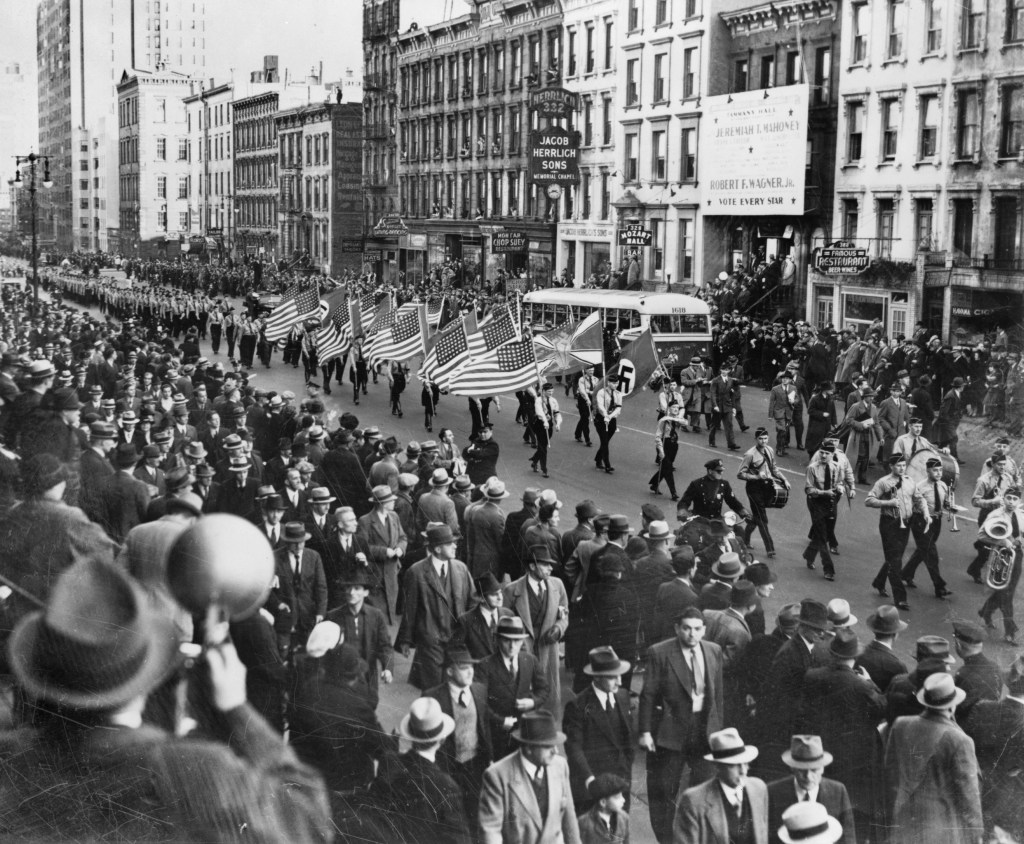
The German American Bund, which is very active on Long Island, has a parade on East 86th Street in Manhattan. The organization also goes by the name German American Federation (German: Amerikadeutscher Bund, also Amerikadeutscher Volksbund).
The Administration is preparing a new formula with which to deal with the readjustment of Latin-American debts as a basis for extension of credits to the republics, an official close to President Roosevelt declared today.
The Chrysler Corporation today put before the C.I.O. United Automobile Workers of America the draft of a proposed contract as a substitute for the union proposal on which negotiations have been proceeding for a week. After a brief examination of some of its provisions the union rejected it as “a declaration of war” and as an attempt by the corporation to destroy collective bargaining in its plants. Negotiations for a new contract in place of the one which expired on September 30 were resumed today, with James F. Dewey, United States Department of Labor conciliator, presiding. The conference will continue tomorrow.
John L. Lewis declared his opposition today to a conference of “progressives” of eleven States which he asserted two government officials were organizing with the “secret” purpose of promoting the candidacy of President Roosevelt for a third term.
The Marquess of Linlithgow, Viceroy of India, has invited Mohandas K. Gandhi, Rajendra Prasad, President of the Indian Congress, and M. A. Jinnah, President of the Muslim League, to meet him at New Delhi on Wednesday. It is understood that they are to have a joint discussion on the controversy over India’s future status. Both Mr. Gandhi and Mr. Prasad are leaving Wardha for New Delhi tomorrow.
A coal shortage threatened increased suffering in the Japanese-blockaded British and French Concessions today as hard-pressed occupants faced the season’s first wintry blasts. Foreign communities, under blockade since June 14, could look across the Hai River and see huge piles of fuel, but the Japanese refused to permit these stocks to reach them. Restrictions have not been eased, foreign residents stated, despite Japanese reports that “Kuomintang and Communist agents,” alleged object of the blockade, had left the area. American and other foreign exporters reported that they experienced great difficulties in obtaining merchandise through the barriers. Japanese sentries now are requiring all persons who pass through to have their legs and footwear sprayed with disinfectant, which foreign residents said damaged their clothing.
Japan denies a plan to talk to the United States. A spokesman repudiates the idea of parleys. It was officially declared today that the Japanese Government, for the moment, has no intention of opening negotiations with the United States or with Britain. Statements in the press to that effect were described today by Yakichiro Suma, Foreign Office spokesman, as “pure imagination.”
All that the spokesman left intact of the stories that leading newspapers have been featuring on their front pages was Foreign Minister Admiral Kichisaburo Nomura’s own announcement that he intended to see American Ambassador Joseph C. Grew soon. That interview will take place, but simply as a routine meeting of the new Foreign Minister with an Ambassador returning from a furlough. Some newspapers that have been confidently anticipating an early opening of negotiations manifested an adroit change of tone tonight. They now report that official circles are convinced that the utmost caution must be exercised before negotiating with the United States and Britain since great difficulties exist and optimism is premature.
Despite these official denials, however, some papers assert that the government is planning to open conversations with Mr. Grew shortly. From other quarters, moreover, this correspondent has learned that the government expects to open conversations with Mr. Grew, either before or immediately after the advent of a new Chinese Government. It has decided, however, that these will be conducted as informal routine conversations between the Foreign Minister and the Ambassador and not as formal negotiations on a set schedule, involving expert discussions.
Without speculating on why the press has changed its outlook, the facts on record are that predictions of early negotiations were widely published. Possible concessions, such as the reopening of the Yangtze River, were mentioned. Those anticipations, after running several days, are now officially repudiated. In the official view the Japanese press has simply been indulging in an orgy of wishful thinking, based on “pure imagination.” This is at least conclusive regarding the government’s immediate intentions.
Domei, Japanese news agency, said today in a dispatch from Sapporo that police disclosed the attempted assassination of General Kazushige Ugaki, former Minister of Foreign Affairs, while traveling there last June. The dispatch said that Masayushi Yabuchi, 20, entered General Ugaki’s railway compartment and unsuccessfully attacked him with a dagger. The attacker was quoted as saying that General Ugaki’s liberalism retarded Japan’s announced intention to set up a “new order” in East Asia.
Dow Jones Industrial Average: 153.21 (+0.09)
Born:
Grace Slick, singer (Jefferson Airplane- “White Rabbit”, “Somebody to Love”, Jefferson Starship), in Highland Park, Illinois.
Eddie Holland, American singer (“Jamie”), lyricist, vocal arranger, and producer (Holland–Dozier–Holland – “Heat Wave”; “Where Did Our Love Go”; “You Keep Me Hanging On”), and Rock and Roll Hall of Fame member, in Detroit, Michigan.
Norman West, American singer (The Soul Children – “Hearsay,”; “Give ’em Love”), in Lake Providence, Louisiana.
Emily Howell Warner, American pilot, first woman to captain a commercial American airline plane, in Denver, Colorado (d. 2020).
Leland H. Hartwell, biologist (Nobel laureate, 2001 – discoveries of protein molecules that control the division (duplication) of cells), in Los Angeles, California.
Bobby Lane, AFL linebacker (AFL Champions-Chargers, 1963; San Diego Chargers), in Wagoner, Oklahoma.
Naval Construction:
The Kriegsmarine (German Navy) Type VIIC U-boats U-409, U-410, U-411, and U-412 are ordered from Danziger Werft AG, Danzig (werk 110-113).
The Kriegsmarine (German Navy) Type VIIC U-boats U-451, U-452, U-453, and U-454 are ordered from Deutsche Werke AG, Kiel (werk 282-285).
The Royal Navy P 611-class HMS P 615 is laid down by Vickers Armstrong (Barrow-in-Furness, U.K.). Originally ordered by Turkey as Uluc Ali Reis.
The Royal Navy “U”-class (Second Group) submarines HMS Upholder (N 99), HMS Urge (N 17) and HMS Unique (N 95) are laid down by Vickers Armstrong (Barrow-in-Furness, U.K.).
The Royal Navy Flower-class corvettes HMS Arabis (K 73), HMS Calendula (K 28), HMS Clarkia (K 88), and HMS Periwinkle (K 55) are laid down by Harland & Wolff Ltd. (Belfast, Northern Ireland). Arabis, Calendula, and Periwinkle will later will be transferred to the U.S. Navy under Reverse Lend-Lease.
The Nihon Kaigun (Imperial Japanese Navy) river gunboat HIJMS Sumida (隅田) is launched by the Fujinagata Shipyards (Osaka, Japan).
The Royal Navy armed merchant cruiser HMS Cheshire (F 18) is commissioned. Her first commander is Captain (retired) Mountague Robert Bernard, RN.
The Вое́нно-морско́й флот СССР (ВМФ) (Soviet Navy) “S” (Stalinec)-class (2nd group, Type IX-modified) submarine S-4 is commissioned.
The Вое́нно-морско́й флот СССР (ВМФ) (Soviet Navy) “S” (Stalinec)-class (2nd group, Type IX-modified) submarine S-5 is commissioned.
The Вое́нно-морско́й флот СССР (ВМФ) (Soviet Navy) “S” (Stalinec)-class (2nd group, Type IX-modified) submarine S-6 is commissioned.
The Вое́нно-морско́й флот СССР (ВМФ) (Soviet Navy) Project 7-class (Gnevny-class) destroyer Steregushchy (Стерегущий, “Watchful”) is completed.

 History Diaries