Nguyễn Khánh resigned as Prime Minister of South Vietnam after less than two months, and was replaced by Trần Văn Hương. Hương, the Mayor of Saigon who was chosen today to be Premier of South Vietnam, is scheduled to appear tomorrow morning before the High National Council for confirmation of his appointment. Under the new Charter, Mr. Hương, who was selected by the chief of state, Phan Khắc Sửu, must outline his policies to the 17‐member council before it confirms his appointment. Though Mr. Hương is known as a self‐effacing man who is in failing health, he has joined in his country’s major revolutionary movements of the last 20 years. He fought the French colonialists, the pro‐Communist Việt Minh and the authoritarian Diệm regime. Together with Mr. Sửu and 16 other prominent citizens, he signed a manifesto on April 26, 1960, urging President Ngô Đình Diệm to reform his Administration. The late President Diệm was overthrown Nov. 1, 1963.
Mr. Hương, a 60‐year‐old former schoolteacher, was Mayor of Saigon briefly under President Diệm and again under the Government of Premier Nguyễn Khánh, said his Administration “would not indulge too much in politics but would aim at stabilizing the situation.” Mr. Hương’s civilian Government will succeed the military regime of General Khánh, which has served in a caretaker capacity since last summer. Military men have headed the Government since November, 1963, following the military coup against President Diệm. Buddhist and student groups demanded a return to civilian government during a series of riots last August. Premier Khánh bowed to these demands and the civilian High National Council was formed to draft a constitution and prepare the way for civilian administration. The council presented a new. Charter last week and, on October 24, named Mr. Sửu head of state.
American officials here welcomed the selection of Mr. Hương. In the text of an interview given four days ago and released tonight, the United States Ambassador, Maxwell D. Taylor was restrained but hopeful about the new civilian Government. Speaking to a reporter for the Columbia Broadcasting System, Mr. Taylor said: “We have a charter that shows in broad terms the kind of government desired. I think it meets all the tests for democratic government in time of war that one could look for.”
The Ambassador, who was Chairman of the Joint Chiefs of Staff before his diplomatic assignment, reiterated that operations against the Communist guerrillas had gone “surprisingly well” while power was being transferred from military junta to civilian leaders. “But nonetheless,” Mr. Taylor went on, “I can’t deny that there has been a deterioration and a loss of momentum in recent weeks.” Referring to the new Government, he said: “Now, of course, performance is “the test. Will the main officials — the Premier, the Minister of Defense, all these be strong, able men, be able to give this country the leadership it requires?” Mr. Hương pledged today that he would attempt to bring enough stability to the civilian population that the military could “devote itself entirely to the war effort.”
Earlier this week, Mr. Hương said that if named Premier he might complete his Cabinet selections‐by November 1. Because of a two‐day delay in announcing his appointment, while rumors circulated that a physician, Dr. Hồ Văn Nhựt, had been chosen instead, Mr. Hüong may not be able to meet that deadline. In interviews before his selection, Mr. Hương made it clear that he would be able to work with General Khánh if, as expected, he remained commander in chief of the armed forces.
A North Vietnamese newspaper warned today that the United States would meet a strong rebuff if it continued “aggression” against North Vietnam. Nhân Dân, official organ of the Communist Government, was commenting on the charge that United States ships and aircraft attacked North. Vietnamese territory October 28. The Foreign Ministry at Hanoi made the charge yesterday and demanded an “immediate end of such adventurous acts.” The United States has denied the allegation. Nhân Dân, which was quoted by Hsinhua, the Chinese Communist press agency, said the incident showed that the United States meant to “continue carrying on its provocation and war schemes against North Vietnam.”
Prince Norodom Sihanouk, the Cambodian chief of state. reversed his friendly attitude toward France today. He charged that France had “become the crafty partner of the Anglo‐Saxon imperialists.” In a speech in Kompong Cham Province on the Cambodian-South Vietnamese border, Prince Sihanouk said he had lost confidence in a French promise to seek a new sitting of the 1954 14‐nation Geneva meeting. That 1954 accord guaranteed the neutrality of the countries that made up French Indochina — Cambodia, Laos and North and South Vietnam. France has been Cambodia’s only free‐world ally since last year, when Prince Sihanouk denounced the United States and expelled the American aid mission here.
The Prince said he had become suspicious of French intentions when Paris allegedly recommended that Cambodia be patient and not carry out her threat to recognize the Communist regime in North Vietnam. Prince Sihanouk recently went to Paris for talks with President de Gaulle and French officials. When he returned, he said he had received substantial offers of military and economic aid. He made a similar trip to Communist China earlier this month and said he had received pledges of aid from Peking. Prince Sihanouk spoke today against the background of a week of clashes between Cambodian and American and South Vietnamese troops along the ill-defined border.
The United States has confirmed that Cambodian ground fire downed a United States C‐123 last Saturday over Cambodia, killing eight Americans. On Thursday, Prince Sihanouk said two — not one — American planes were shot down by Cambodian border guards at Mondolkiri. The Prince has threatened to throw in his lot with North Vietnam and the Communist guerrillas in South Vietnam. if the alleged American‐Vietnamese aggressions continue. Cambodia has accused American and South Vietnamese forces of repeated incursions upon her territory. She, in turn, has been accused of harboring Vietnamese Communist guerrillas.
The State Department charged today that Cambodia was not justified in taking “precipitate action” to shoot down an unarmed United States C‐123 transport plane that accidently strayed over Cambodian territory last Saturday. A statement issued by the department’s press officer, Robert J. McCloskey, also accused Cambodia of having failed to take into account the problem raised by the activities of Việt Cộng guerrillas on the Cambodian‐Vietnamese border. It was because or these border operations that three C‐123’s were flying in the vicinity of Cambodia on support missions for South Vietnamese troops, the United States contends.
The State Department stopped just short of blaming Cambodia for having tolerated the use of her territory by Việt Cộng guerrillas for incursions against South Vietnam, but officials here have few doubts that Prince Sihanouk is fully aware of these activities. The Prince threatened earlier this week to break diplomatic, relations with the United States and to grant recognition to North Vietnam and to the South Vietnamese Liberation Front, which is the political agency of the Việt Cộng guerrilla movement. Despite the rapid deterioration of its relations with Cambodia, the United States has tried to remain patient in its dealings with Prince Sihanouk. It has expressed regret for the straying of its planes over Cambodia and has waited almost a week before protesting the downing of the C‐123.
But today’s statement by Mr. McCloskey suggested that its patience was wearing thin. The statement said: “While we regret this border violation, the fact that these unarmed planes inadvertently crossed the Cambodian border on a mission in support of South Vietnam’s efforts to counter Communist Việt Cộng military actions in no way justified this precipitate action by Cambodian forces resulting in the loss of eight American lives.”
President de Gaulle welcomed tonight the idea of an international conference on nuclear disarmament as proposed by the Chinese Communists. In a message to Chou En-lai, the Chinese Premier, General de Gaulle said France was ready to participate “at any moment” in any “serious negotiations” among the world’s nuclear powers. The general called attention to France’s past efforts to obtain an agreement on eliminating vehicles capable of carrying nuclear weapons. The President’s statement was in reply to a letter from Premier Chou dated October 17, in which France and most other governments were officially informed of China’s first successful nuclear explosion, carried out the previous day. The letter contained China’s proposal for a conference on nuclear disarmament. President de Gaulle’s statement comes at a time when French‐Chinese relations have been stagnant. The French concede that they have gone nowhere in their attempts to lead the Chinese Government into serious political talks on the situation in Southeast Asia.
Nikita S. Khrushchev has lost the only two positions left to him in the Communist party and the Soviet Government. He was reliably reported today to have written letters to the Central Committee of the Communist party and to the Supreme Soviet (parliament) asking to be relieved of membership. It was not known whether he did so voluntarily. When he was driven from power 16 days ago, he ceased to be First Secretary of the Communist party and Premier. He also lost his membership in the Presidium of the party’s Central Committee. With the resignations, which became known today, his eclipse is complete, although he presumably is still a party member.
The East German Communists opened the Berlin wall today for the second time since it was built three years ago. More than 20,000 West Berliners moved across the border in a steady stream to visit relatives in East Berlin for a day. They traveled in elevated and subway trains, on foot, by car and, in the case of one old woman, in a wheelchair. As Berliners celebrated happy reunions, the United States mission in West Berlin disclosed that an American student was arrested in East Berlin three weeks ago, ostensibly because he was trying to help an East German to escape to the West. The student was identified as John Van Altina, 20 years old, of Milton Junction, Wisconsin. He was reported to have come to Berlin as a tourist early in October and was said to have been detained by the East Germans October 10.
The British Government will try to get West Germany’s co‐sponsorship of plans being worked out here for an allied nuclear force in which surface ships manned by international crews would be only one element. Under the still‐current United States project for a fleet of 25 mixed‐manned surface ships armed with Polaris missiles, the West Germans were to pay about 40 percent of the cost and presumably hold a corresponding share of command posts. In effect, the British will be asking the West Germans to, accept the idea of a much smaller role in whatever nuclear force is eventually agreed on. The West Germans have been given no official outline of British thinking, but they are aware of it from newspaper reports. What they have seen has not made them happy, according to reliable reports in London.
At New Delhi, India’s Prime Minister Lal Bahadur Shastri hosted Prime Minister Sirimavo Bandaranaike of Ceylon (now Sri Lanka) and the two leaders signed what has come to be known as the “Sirima–Shastri Pact”, though its official name was the “Agreement on Persons of Indian Origin in Ceylon”. Under the pact, Indian Tamils (those persons whose ancestry was from persons from the Tamil Nadu state of south India who had came to the island of Ceylon during British rule), were to be afforded the opportunity of repatriation from Ceylon to India, or Ceylonese citizenship. India agreed to accept up to 525,000 Tamil immigrants from Ceylon, while Ceylon agreed to offer citizenship to as many as 300,000 Tamils who wished to stay. The two nations agreed that the fate of another 150,000 of the 975,000 Indian Tamils in Ceylon would be decided later.
Malaysian security forces reported today that all but three of the 56 Indonesian-based guerrillas who landed on the west coast of Malaya had been caught. The three men still at large were believed to be trapped by Malaysian policemen surrounding the landing zones in a swampy area south of Malacca. The Malaysians said this was the third incursion by Indonesian‐based guerrillas in the last 10 weeks. Three groups were said to have landed from the sea on the south Malayan coast in August. Two others were reported to have been air-dropped in south‐central Malaya on September 2.
Bolivia was in a state of uneasy quiet today after outbursts of fighting yesterday in La Paz and at the mining city of Oruro. In La Paz the streets and public buildings were heavily guarded by brown‐uniformed carabineers. The workers’ militia, which President Victor Paz Estenssoro’s Government brought in yesterday to fight armed students at the university, were withdrawn from the streets. For four hours last night La Paz echoed to rifle and machine‐gun fire and occasional dynamite blasts. Students fired from the fourteen‐story university building at soldiers and militiamen. The Government forces returned the fire. As far as could be established, only two on the Government side were killed. There were unconfirmed reports that one student was also slain and that 30 combatants were injured on both sides.
The first reliable reports of the battle at Oruro, about 150 miles from La Paz, the capital, indicated that the fighting lacked the intensity that was originally reported. The fighting took place yesterday when the army and the militia moved against a roadblock set up by the leftist‐controlled tin miners at Sora‐Sora, a point outside Oruro. Only one confirmed death is now reported in contrast to the 30 claimed by miner‐held radio stations. However, there were a number of injured.
In a response to ongoing anti-government riots, Ibrahim Abboud, the President of the Sudan, resigned his post as the northeast African nation’s Prime Minister, and Sirr Al-Khatim Al-Khalifa formed a new government. A. coalition government was formed here today as a step toward elections and parliamentary rule. The establishment of a transitional government, intended to serve for four months, apparently ended a 10‐day crisis during which the police and the armed forces clashed with demonstrators, leaving 27 persons dead and more than 100 injured. Under an agreement between the army and the National Front, an opposition group, Sirr Al-Khatim Al‐Khalifa will serve as Premier of this northeast African country.
President Johnson is leading the presidential election race in 36 states, and the District of Columbia with 433 electoral votes and Senator Barry Goldwater is ahead in 10 states with 71 electoral votes, according to a United Press International survey. In doubt are four states with 34 electoral votes. These are Indiana, Florida, Vermont and North Dakota. This outlook for next Tuesday’s election is based on statewide polls, interviews with political leaders and the findings of U.P.I. correspondents throughout the nation.
President Johnson’s strength, according to the survey, extends into every section of the country with commanding leads in all of the big electoral‐vote states. Mr. Goldwater is making his strongest showing in the once traditionally Democratic South and has scattered support in the West, but is shut out in the East. The survey shows him leading in Alabama, Mississippi, Louisiana, South Carolina, Virginia, Arizona, Kansas, Nebraska, Idaho and Wyoming.
President Johnson solicited the votes of both big city Democrats and the nation’s Republicans today. He shook hands and talked his way through four major cities in an attempt to offset white backlash among ethnic groups. And in the Republican stronghold of Rockford, Illinois, he pictured himself as the kind of candidate who was more faithful to traditional Republican principles than was Senator, Barry Goldwater. In a campaign technique that was highly unusual for a Deemcrat, he even praised the “humane leadership” of the late Herbert Hoover.
The President began the day with a motorcade through Philadelphia. He also made an airport appearance in Detroit and toured the Polish area of Milwaukee before coming here for a torchlight parade and a speech at the Chicago Stadium. It was in Rockford that Mr. Johnson gave his most noteworthy speech. In it he appeared to be trying to kidnap a large part of the Republican party from its own conservative nominee. He said he was proud to be a Democrat. “But,” he went on, “I am proud that over a career of 30 years I have always been the kind of Democrat who could and would work together with my fellow Americans of the party of Lincoln and McKinley, Herbert Hoover and Dwight Eisenhower, Robert Taft and Everett Dirksen.”
President Johnson is coming to New York City. Democrats will return tomorrow evening to the scene of some of their party’s happiest moments to stage the climax of their 1964 election campaign. The event at Madison Square Garden will start at 6 PM. It will probably be the last campaign appearance for a President in the old Garden, as its replacement 16 blocks south is expected to be ready in 1967, before the next national election. The President, in a day of campaigning that took him from Philadelphia to Chicago, appealed yesterday for the votes of Republicans as well as Democrats. He toured two other major cities, Detroit and Milwaukee, and in the Republican stronghold of Rockford, Illinois, pictured himself as being more in the tradition of the Republicans than Senator Barry Goldwater, his opponent. Mr. Johnson will campaign through Nassau County, Queens the Bronx and Harlem today before getting to mid‐Manhattan for the party called, in his honor, “USA for LBJ.”
President Johnson said tonight that a survey showed there had been widespread compliance with the Civil Rights Act of 1964 and said that the prospects for solving the civil rights problem “have never been brighter.” In a statement, the President summarized the findings of a survey by former Florida Gov. LeRoy Collins, director of the Community Relations Service established by the 1964 act to assist localities in meeting problems of compliance.
The survey showed, according to Mr. Johnson, that in the 19 states, most of them Southern or border states, that had not had state public accommodations laws, hotels and restaurants were being desegregated rapidly. “What is most important,” said the President, “it shows the law is being obeyed in those areas where some had predicted there would be massive disobedience.” He said that Mr. Collins had informed him that there was “still considerable work to be done,” but the President said the “exceptions only serve to point up the basic fact that the general rule is compliance.”
Senator Barry Goldwater stumped the West today, concentrating his attack heavily on the Administration’s foreign policy. He charged that the United States might be in the beginning of World War III in South Vietnam. And he cited a lengthy catalogue of alleged Administration foreign policy failures to back up his assertion that President Johnson, running a “circus” campaign for “personal power,” had “turned his back on the pressing problems of foreign. policy.”
Mr. Goldwater will travel to Columbia, South Carolina, tomorrow for a 13‐state live television broadcast in a final effort to carry the South. On the way, he will stop at San Antonio, Texas. The rest of his campaign will be in California, a state whose 40 electoral votes he feels he must carry to win on Tuesday, and his own state of Arizona. Today Mr. Goldwater flew from Pittsburgh to Cheyenne, Wyoming, Las Vegas, Nevada, and Tucson, Arizona, for airport stops before continuing here for two rallies. One was for Mexican-Americans in Los Angeles and the other a Republican fundraiser at the sports arena. About 4,500 people met Mr. Goldwater at the Los Angeles Airport and about 10,000, according to police estimates, were at the open air rally, where Mr. Goldwater, speaking partly in Spanish, praised the contributions Mexican-Americans had made to the nation.
Barry Goldwater and many of his followers suffer from a “frantic impatience with the world as it is,” Senator Hubert H. Humphrey. told Far Western audiences today. “In his hot pursuit of the mirage of total victory, Senator Goldwater wishes to back the Soviet Union into a corner where its only alternatives would be surrender” or nuclear war,” the Democratic VicePresidential candidate said here. As the campaign enters its last few days, Senator Humphrey’s Strategy has become clear. In every speech his major stress is on the issue of peace and his major charge that Mr. Goldwater is not a man to occupy the Presidency in the nuclear age. Mr. Humphrey covers many other points; but in nearly every speech — including all the informal ones — his peroration is the peace issue.
As his campaign draws to an end, Representative William E. Miller has concluded that, both, from the standpoint of the candidates and the voters, Presidential campaigns should be shortened in the future. The Republican Vice‐Presidential candidate believes the, present nine‐week campaigns leaves the candidates exhausted physically and mentally and the voters bored. He thinks that the United States could well follow the British practice of restricting the campaign to about three weeks — but he does not know how to get the two American parties to agree.
At least five persons were arrested today at the beginning of a mock election in 69 Mississippi counties conducted by the predominantly Black Freedom Democratic party. The arrests came shortly after the group sent a plea to John M. Bailey, Democratic National Chairman, asking for an investigation into harassment of its workers. At Meridian, five volunteer campaign workers were arrested for distributing handbills without a permit. The Meridian police said the five, all out‐of‐state college students, were handing out literature urging persons to vote in the “freedom election,” a mock four‐day vote that began today.
Polling places were set up in cars, homes, cafes and barbershops for the freedom vote, designed to demonstrate potential Black voting strength and to pave the way to challenge the seating of the Mississippi Congressional delegation. The five persons arrested at Meridian were identified as Suzanne Gollob, 18 years old, of Wellesley, Massachusetts; Joseph Gross, 18, of New York City; Richard Lowenstein, 20, of Larchmont, New York: Jeremy Kammerer, 24, of Detroit, and Marjorie Henderson, 19, of Lansdowne, Pennsylvania.
Civil right leaders charged that policemen in Indianola, Mississippi, broke up a rally for the Johnson-Humphrey ticket here last night and arrested 13 Blacks and two whites. One of the speakers at the rally said that the policemen charged into the crowd of about 250, swinging clubs and pushing participants.
Federal District Judge Sidney C. Mize scheduled today a hearing on November 16 on a request for an injunction to stop state and county officers from interfering with Blacks attempting to register to vote. The application asks for an injunction against the Pike County sheriff, the McComb police chief and three of his policemen, and the state Public Safety Commissioner, T. B. Birdsong. The application was filed by 27 plaintiffs arrested last week in Pike County on charges of trespassing and refusing to obey an officer. They are workers for the Council of Federated Organizations or are associated with the, group. They were told by policemen that they could not register because the clerk was involved in the proceedings at a murder trial. The 27 defendants stayed outside the registrar’s office anyway.
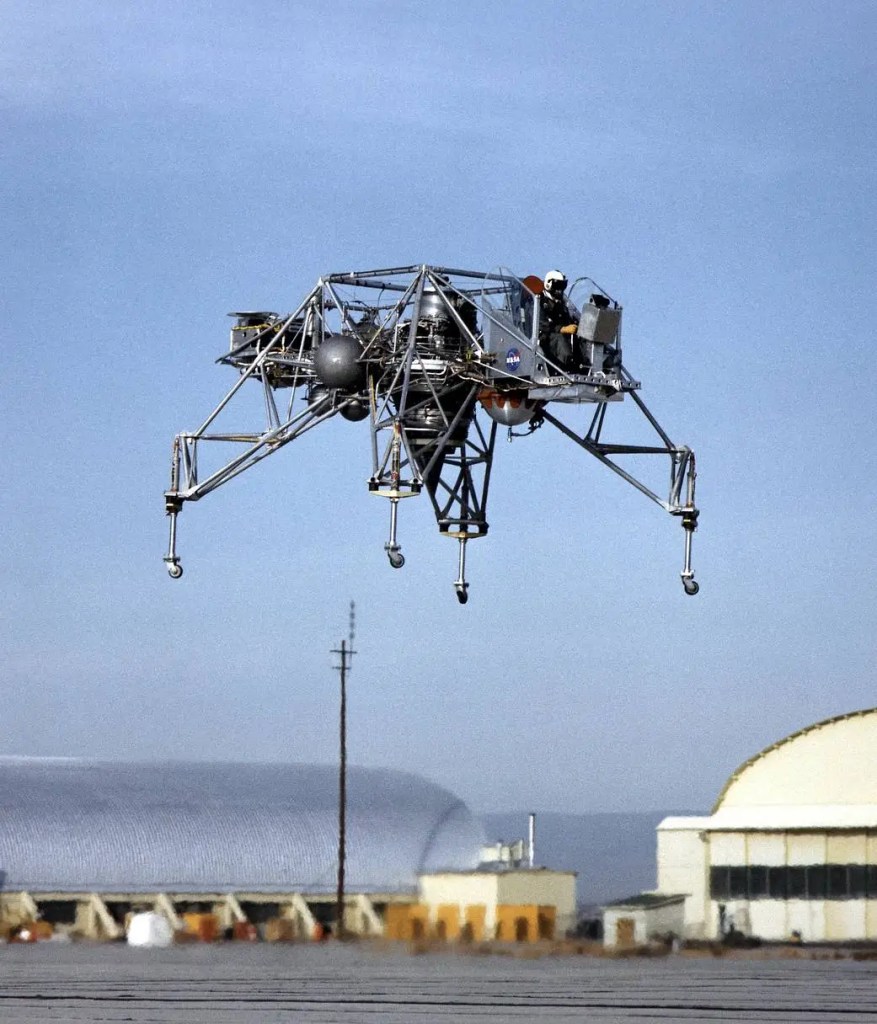
NASA’s Lunar Landing Research Vehicle, or LLRV, took to the skies for the first time. The LLRV was a bizarre, four-legged flying contraption commonly known as the “Flying Bedstead.” NASA used it to simulate moon landings and liftoffs on Earth to prepare for Apollo 11. The firast person to give it a whirl was the X-15 pilot Joe Walker. During this test flight, he reached an altitude of about 10 feet, and he hovered there for about a minute. He did this two more times that same day. In all, he completed more than 30 test flights with the LLRV. These test flights took place at NASA’s Dryden Flight Research Center in Edwards, California. That facility has since been renamed the Armstrong Flight Research Center after Neil Armstrong, who also piloted — and famously crashed — the “Flying Bedstead” before he went to the moon.
Buffalo wings, according to the more commonly accepted account, were first served at the Anchor Bar in Buffalo, New York, by Teressa Bellissimo, a story that has been cited more often in publications. However, another restaurateur, John Young, has also received recognition as having invented the appetizer in 1964 at his place of business, “Wings ‘n’ Things”.
Joe Stanka of the Nankai Hawks wins the Pacific League MVP award. With a season record of 26-7, Stanka pitched his team to 3 straight victories over the Yomiuri Giants to win the Japan Series. In his career with the Hawks (1960-65), and later with the Taiyo Whales (1966), he will win 100 games, the record for an American pitcher.
Dow Jones Industrial Average: 873.08 (+1.22)
Born:
Sandra Magnus, American engineer and NASA astronaut (NASA Group 16, 1996; STS-112, Atlantis, 2002; Expedition 18: STS-126, Endeavour/ISS/STS-119, Discovery, 2008-2009; STS-135, Atlantis, 2011), in Belleville, Illinois.
Rodney Carter, NFL running back (Pittsburgh Steelers), in Elizabeth, New Jersey.
Tom Copa, NBA center (San Antonio Spurs), in Robbinsdale, Minnesota.
Tabitha St. Germain, Canadian voice actress (“My Little Pony”, “Littlest Pet Shop”), in Boston, Massachusetts.
Howard Lederer, American poker player, in Concord, New Hampshire.




 History Diaries