OKH issues a revision to Fall Gelb (Operation Yellow) with the main thrust shifted slightly south and less strength being sent against Holland. There is an ongoing debate as to how it should be modified further. The OKH tinkers with its Fall Gelb plan. It aims the main thrust slightly south and weakens the right hook through Holland. The best brains in the Wehrmacht are working on this issue, which remains unresolved. This is an interim plan. General Gerd von Rundstedt, in particular, feels the plan is too obvious, and some more junior officers such as his deputy von Manstein are vocal about putting the main thrust to the south, through the Ardennes forest considered unsuitable for tanks. Hitler favors this view as well, but for a change, he is being diplomatic with his Generals and allowing the process to proceed without simply ordering the result that he prefers.
An eerie calm prevails in the west. Extreme quiet causes greater expectation of a German drive in the near future and Allies are still digging in. An official French communique reports all quiet generally during the day. An increasing number of British heavy artillery pieces are moved into position.
Hitler moves his command post to Godesberg.
The Kriegsmarine authorizes attacks on passenger ships in convoys. These liners have been, for the most part, converted to military purposes and are being used by the Allies as troop transports.
Heinrich Himmler takes over his duties as director of colonization in Poland.
The blockade will fail, the Berlin press tells the people of the Reich. The trade pact with Russia is cited to prove that Britain cannot starve Germany.
Important figures are jailed in Slovenia. The head of railways, party chiefs, and former ministers are said to be under arrest.
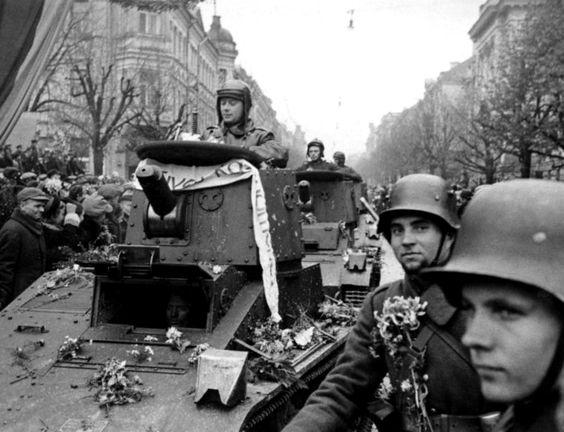
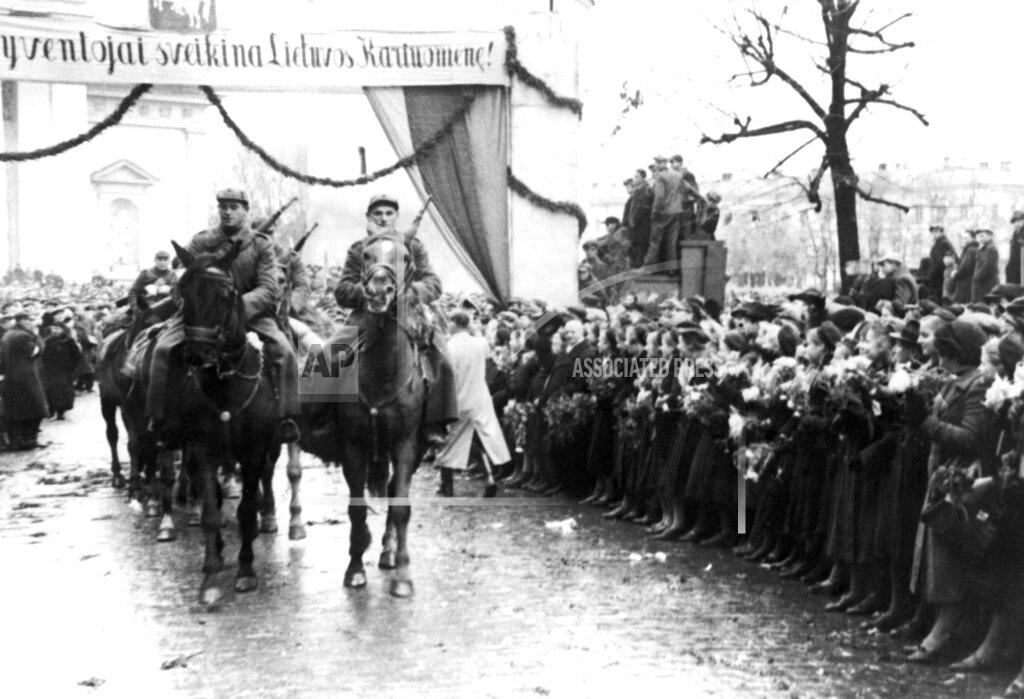
Lithuanian troops parade through newly reacquired Vilnius.
The first contingent of Soviet troops begin occupation of bases allotted by the Latvian-Soviet agreement.
The Ukrainian National Assembly asks the USSR to annex occupied Poland.
The new Italian city of Pomezia was inaugurated. It is on reclaimed land from the Pontine Marshes near Rome. Pomezia is populated by poor peasants of Romagna, Veneto, and Friuli.
The second annual rally of Nationalist Spain’s youth organizations was celebrated today in the presence of Generalissimo Francisco Franco and a crowd of 60,000. The football stadium was jammed for the exercises and thousands gathered on adjoining hills.
Federal elections were held in Switzerland, won by the Free Democratic Party.
The Moscow press condemns the United States. Washington takes the place of Berlin as the victim of attacks in leading journals.
The International Olympic Committee announced today that the 1940 Olympic Games would be held at Detroit if Finland renounced its right to stage the games at Helsinki.
[Ed: In the event, the games will not be held at all. The next Olympiad will not be held until 1948.]
In Iran, Reza Shah appoints Matin Daftari as Prime Minister. He presents his cabinet of ministers to the Iranian Parliament (Majlis). Daftari is a German sympathizer.
The first German aircraft to be shot down in Britain, a He 111 bomber, crashed near Haddington, East Lothian, Scotland, United Kingdom. The kill was claimed by No. 602 and No. 603 Squadrons RAF. Two members of the crew of four survived the crash and were captured.
A new type of German mine, set off by the noise of a ship is discovered near Porthcawl, Wales.
The German pocket battleship SMS Admiral Graf Spee rendezvoused with the German Tanker Altmark for refueling and the transfer of the prisoners of the 5 British ships that had recently been sunk by the Admiral Graf Spee. Captain Langsdorff conferred with Grand Admiral Erich Raeder in Berlin and concurred with the suggestion to proceed to the Indian Ocean. The Altmark would set sail for Germany with the prisoners from the British merchant ships Clement, Newton Beech, Ashlea, Huntsman, and Trevanion. The Altmark would be involved in an incident when the Royal Navy boarded her in neutral Norwegian waters on February 16, 1940.
Sailing with Convoy HX.5A, the British steam merchant Malabar was torpedoed and sunk by the U-34, commanded by Kapitänleutnant Wilhelm Rollmann, about 180 miles west of Lands End, England in the eastern Atlantic Ocean (49°57′N 7°37′W). Of the ship’s complement, 5 died and 70 survivors were picked up by the destroyer HMS Grafton. The 7,976-ton Malabar was carrying general cargo, including lumber and tobacco and was bound for Avonmouth, England.
The Norwegian cargo ship Varangmalm struck a mine and sank in the North Sea (53°50′N 0°17′E) with the loss of one crew member. Survivors were rescued by the British trawler Conida. The wreck was subsequently dispersed by explosives.
The body of U-12’s commanding officer, Kptlt Dietrich Von der Ropp, was washed ashore on the French coast near Dunkirk.
Convoy OA.27 departs from Scotland, OB.27 departs from Liverpool, and HG.5 departs from Gibraltar.
The War at Sea, Sunday, 29 October 1939 (naval-history.net)
Destroyers JERVIS, JANUS, JUNO, JERSEY, JUPITER, JACKAL departed the Humber on operation AG. They swept off the Dutch coast, but made no contact with enemy shipping, although JERSEY was near missed by German bombing. The ships arrived back in the Humber on the 30th.
Light cruiser SHEFFIELD arrived at Rosyth for refit, and departed on 9 November.
Light cruisers CARDIFF and CALEDON were on Northern Patrol duties between the Orkneys and the Faroes, light cruisers DRAGON, DIOMEDE, COLOMBO between the Faroes and Iceland, and light cruiser SOUTHAMPTON and armed merchant cruisers CHITRAL and AURANIA in the Denmark Strait.
Anti-aircraft cruiser CALCUTTA departed Grimsby on escort duties and arrived back later the same day.
The 22nd Destroyer Flotilla was formed at Harwich for East Coast Defence with destroyers EXMOUTH, KEITH and the Polish BURZA, GROM and BLYSKAWICA. On the 31st, destroyers ILEX, ISIS, IMPERIAL joined after completing repairs. The Flotilla was briefly composed of EXMOUTH as leader, ILEX, ISIS, IMPERIAL in the 43rd Division and KEITH and the three Polish ships in the 44th Division.
ILEX and ISIS were at Harwich at the end of the month and IMPERIAL at Plymouth preparing to depart. ILEX and ISIS departed Harwich on 2 November, arrived at Plymouth on the 3rd and departed the same day for Gibraltar to escort battleship WARSPITE. After this duty, they arrived at Scapa Flow on the 14th. Meanwhile IMPERIAL departed for Harwich on 1 November, but was ordered to Scapa Flow for duty with the Home Fleet, arriving on the 4th.
Captain R S Benson (D.12) in EXMOUTH was named Captain of the 22nd Flotilla on 2 November and continued in this capacity until the 11th, when he and EXMOUTH returned to Devonport.
Destroyer BOADICEA joined the 22nd Destroyer Flotilla on 5 November.
The three I’s of the 22th Destroyer Flotilla and all the destroyers, except BOADICEA, of the 23th Destroyer Flotilla were released on 5 November to return to their respective commands. The B’s returned to the 19th Destroyer Flotilla.
On 11 November, Captain G E Creasy in destroyer GRIFFIN was named D.22. On the same day, the 22nd Destroyer Flotilla was composed of GRIFFIN (D.22), GREYHOUND, GIPSY, GLOWWORM, KEITH, BOADICEA and Polish GROM, BURZA, BLYSKAWICA.
On the 22nd, GRAFTON and GALLANT replaced KEITH and BOADICEA in the 22nd Destroyer Flotilla.
On the 27th, D.22 transferred to submarine depot ship CYCLOPS, on 1 December, to BOADICEA, which had returned to the Flotilla, and on the 5th, to destroyer GRENVILLE, which completed repairs of her collision damage on the 7th.
Also, at Harwich, the 23rd Destroyer Flotilla was formed with CODRINGTON (Captain Simson, D.19) as leader, BOADICEA, ANTHONY, VANSITTART, VENOMOUS as the 45th Division, and BASILISK, BLANCHE, BEAGLE, BRAZEN as 46th Division.
In addition, destroyers BOREAS, which was repairing at Portsmouth until 13 November, and BRILLIANT were assigned to the 19th Destroyer Flotilla at Harwich.
Polish destroyer ORP BŁYSKAWICA attacked a submarine contact in 54 45N, 5 12W.
Convoy OA.27 of thirteen ships departed Southend escorted by destroyers WANDERER and WAKEFUL from the 29th to 31st.
Convoy OB.28 departed Liverpool escorted by destroyers VIMY and MACKAY to 1 November.
U-34 sank steamer MALABAR (7976grt, Commodore Rear Admiral G W Taylor (Rtd) aboard) from convoy HX.5A, 50 miles NW of the Scillies in 49 57N, 07 37W; five crew were lost. Destroyer GRAFTON rescued the survivors. U-34 attempted to sink another merchant ship of the convoy without success.
American steamer CRANFORD (6096grt) and Italian steamer MANZONI (3955grt) collided off Deal with light damage to CRANFORD and extensive damages to MANZONI .
Battleship WARSPITE departed Alexandria escorted by destroyers DAINTY and DIANA, and arrived at Malta on the 31st. After a brief docking, she left on 4 November with the same escort , which was relieved by destroyers ISIS and ILEX east of Gibraltar on the 6th and WARSPITE arrived at Gibraltar later that day.
Convoy HG.5 of 40 ships departed Gibraltar escorted by French destroyers FOUGUEUX and L’ADROIT, from 29 October until their arrival at Brest on 6 November, and British destroyers DOUGLAS and VORTIGERN. The convoy arrived at various English ports on the 6th.
Light cruiser DESPATCH departed Kingston.
Administration leaders, after a final reconnaissance, professed tonight to see no obstacle to final passage of the Neutrality Bill and adjournment of the special session of Congress by the end of this week. The accuracy of their appraisal of the situation was conceded in most official and unofficial circles, the prevailing opinion being that the only question would be the size of the majority by which the measure would pass the House, which is scheduled to begin discussion of it on Tuesday.
Isolationists, however, scoffed at the claims of Representative Bloom, chairman of the House Foreign Affairs Committee, that his side would be victorious by thirty votes. They said the margin would not be more than ten votes and that it might even be in their favor. Optimism of the leaders over the outcome of the neutrality fight extended also to the threat of House Republicans and some Democrats to keep Congress in session to consider other matters, although to pass the neutrality bill was the purpose for which the President convened the session. The demand that Congress stay on the job has come chiefly from Representative Martin, the Republican leader in the House, and his supporters. Similar sentiments, however, have been expressed by Senator Wheeler and a few others in the Senate.
Mr. Martin bases his argument on the assertion that a state of emergency has been proclaimed by President Roosevelt and that if an emergency exists passage of the neutrality bill will not end it. Therefore, he contends, Congress should remain in session, ready to act should the emergency require. Senator Wheeler, in advocating continuation of the session, stood on a different ground. He asserted that there were many pressing domestic questions, including railroad legislation, unemployment and farm relief, to which Congress could devote its attention during the next two months before the regular session convenes in January and thus avoid legislative jams likely to arise on the eve of the national political conventions in 1940.
Although the Administration forces are confident that they will have no difficulty in putting through a motion to adjourn when the neutrality bill is disposed of, it was pointed out that should the Senate and the House be unable to agree upon an adjournment date President Roosevelt has the Constitutional authority to set such a date if he so desires. The fact that even the Republican leaders hold divergent views to the advisability of continuing the session, Senator McNary, the Senate leader, being in favor of early adjournment, was pointed to as indicating that there was little likelihood of a situation arising wherein the President would be called upon to exercise this authority.
Senator Carter Glass said today that only one person could get the United States into the war — “this wretched creature,” Adolf Hitler. The elderly Virginia Democrat declared it was “the sheerest drivel” to say that the President could involve this country in a foreign conflict. Saying that only Congress has the power to declare war, he added:
“The only person who may drag this nation into war is Hitler. His pledged word is not worth a thrip. He is a fervent believer in the immoral Machiavellian doctrine of the end justifying the means, however vile the end may be. He has repeatedly lied as to his purposes since the deplorable Munich conference, and it may confidently be expected that under his wretched domination Germany still regards written treaties as mere scraps of paper.”
The U.S. War Department organizes the shape of the future Army, a peace force of 600,000 including the National Guard. The American Army of tomorrow is being organized, in accordance with revolutionary changes recently made and others still to be promulgated, on a four-army, nine-corps, twenty-seven-infantry-division framework, with a potential peace strength, including the National Guard, of from 600,000 to 700,000 men, and a war strength of 1,000,000.
The number of strikes in the United States more than doubled in the first three years of operation of the National Labor Relations Board, compared with the three years before the signing of the Wagner act, according to a survey made public yesterday by the Chamber of Commerce of the State of New York.
The American League for Peace and Democracy, ending its “national emergency conference” here today, made abolition of the Dies Committee its first big objective and laid plans for a membership and fund-raising campaign.
Droughts in the American west and southwest intensify.
The Golden Gate International Exposition on Treasure Island in San Francisco Bay closes for the year; it will reopen in Spring, 1940.
NHL Babe Seibert Memorial Game: All-Stars beat Montreal 5–3.
The U.S. military attaché reports that Chinese morale is low and that 100,000 Chinese are serving as Huang Hsieh Chun (Imperial Assisting Troops).
Chiang Kai-shek, meanwhile, opens a conference to plan a Chinese winter offensive.
Speculation concerning American-Japanese negotiations now forms the major morning item in Japanese newspapers. Today’s most noteworthy contribution is a frank account that Yomiuri publishes of the outrages and injuries from which Americans in China have suffered during the fighting.
The United States intends to demand, this newspaper says: first, an end to atrocities, orderly conduct of diplomatic relations and equal opportunity and the open door in China; and second, immediate cessation of bombing, murder, insult, and interference with American rights in China by Japan’s military forces, compensation for the past and guarantees for the future.
The United States is convinced, continues Yomiuri, that America’s historic rights and interests are being driven out of China in the name of the “New Order in East Asia.”. Such frankness before the recent speech of Ambassador Joseph C. Grew would have been impossible, and it is doubtful if any Japanese paper would have been allowed to use such words. But by placing them in the form of the expected United States demands Yomiuri allows its readers to know the gravity of the grievances, which heretofore have been lightly dismissed as accidental and incidental accessories to the hostilities.
The Japanese, according to Yomiuri, will reply that the United States, in filing its several hundred protests, does not take into account the existence of a state of war and irrationally treats the question as if the incidents had occurred in peace. For this reason it expects that Foreign Minister Kichisaburo Nomura will follow the same tactics as those used by Hachiro Arita during the Tientsin talks with British Ambassador Sir Robert Leslie Craigie and request the United States to recognize the actual state of affairs.
Born:
Pete Richert, MLB pitcher (All-Star, 1965, 1966; Los Angeles Dodgers, Washington Senators, Baltimore Orioles, St. Louis Cardinals, Philadelphia Philles), in Floral Park, New York.
Malay Roy Choudhury, poet and novelist, in Patna, Bihar, British India (d. 2023).
Died:
Dwight B. Waldo, 75, American educator and historian (first President of Western Michigan University).
Naval Construction:
The Royal Navy auxiliary anti-aircraft ship HMS Jeanie Deans (4.29) is commissioned. Her first commanding officer is Lieutenant Commander Leonard Cooper Windsor, RN.
The Kraljevska mornarica (Royal Yugoslav Navy) gunboat Beli Orao (“White Eagle”) is commissioned.

 History Diaries