Four convicts holding 16 hostages in the Scheveningen Prison chapel in the Netherlands demanded that a plane be made ready for them at Amsterdam airport and that a jailed Dutch Communist, Lucien van Hoesel, be allowed to inspect their escape route to the airport. There was no immediate response from Dutch authorities. The convicts, who took over the chapel last Saturday, include Palestinian guerrilla hijacker Adnan Ahmad Nuri. A second, later demand by the convicts, who include a Palestinian guerrilla, was that Sami Houssin Tamimah, another Palestinian prisoner, should join them. This caused a dilemma for Dutch officials since Mr. Tamimah said yesterday he did not want to join the escape attempt. Dutch officials have said they will not force him to do so. The convicts said that if if these conditions were met they would release three of the hostages, the two remaining women and an elderly man with a heart ailment. They have already freed four children, a woman and an elderly man.
Thieves broke into a Paris art gallery and stole Impressionist and modern paintings worth almost $500,000, police said. Taken were 10 paintings by Courbet, Renoir, Pissaro and lesser-known artists from the Galerie Urban in the fashionable Rue St. Honore, close to the Elysee Palace. The gallery owner said the thieves appeared to have entered through the back door, which was not connected to the burglar alarm system.
Italian Foreign Minister Aldo Moro has been named premier-designate with the task of trying to form a new coalition government. Undisputed leader of the left wing of the dominant Christian Democrats, Moro intends to form a minority Christian Democrat cabinet, according to informed sources. Such a government would be designed to last only two or three months, during which he would try to heal the rift with prospective coalition allies, the Socialists and the Social Democrats.
Police in Milan, Italy, reported payment of a ransom equal to $3.1 million for the 6-year-old son of a candy tycoon. The boy, Daniele Alemagna, was set free after six days in the hands of kidnappers. The amount would be the highest ever paid in a kidnapping in Italy. The previous record was $2.7 million paid to ransom oilman J. Paul Getty’s grandson last December.
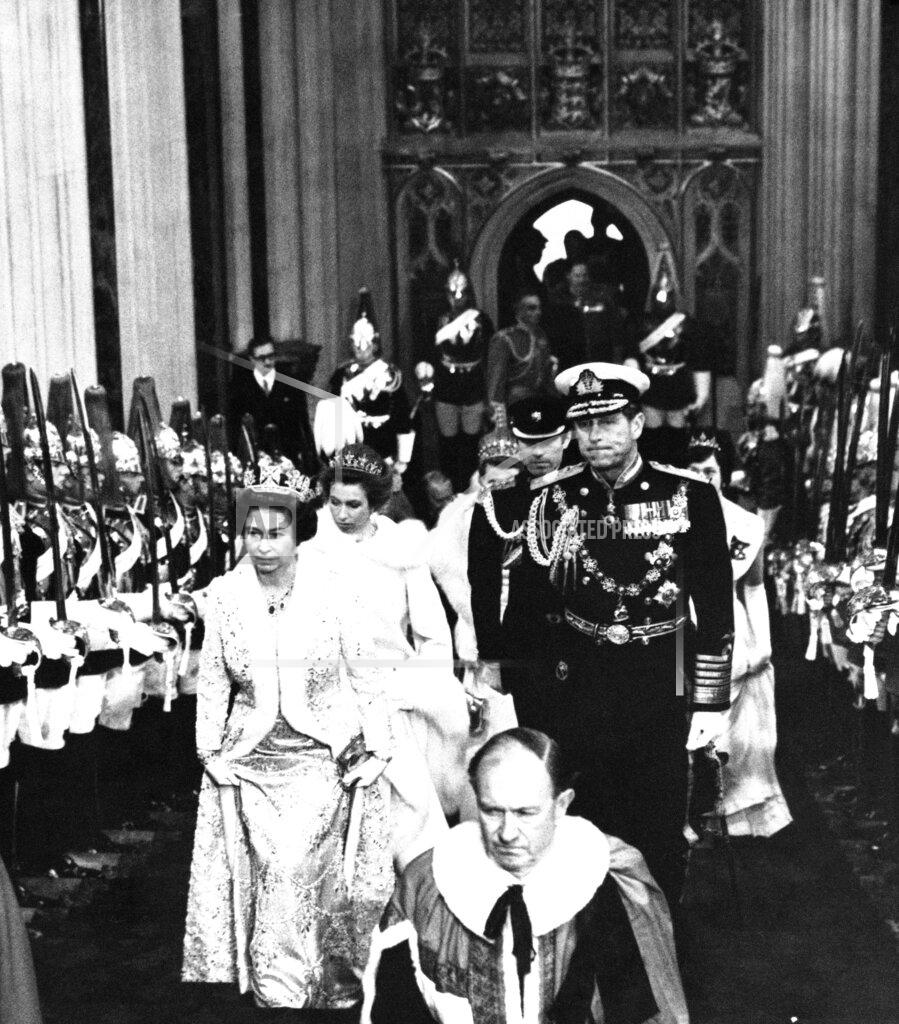
The Labor government of Britain announced its legislative plans for more nationalization in a speech read in Parliament by Queen Elizabeth II. Proposals include state ownership of the shipbuilding and aircraft industries and a new national oil corporation to control development and profits of North Sea oil. In the debate that followed the ceremony, Edward Heath of the opposition Conservatives called the program “totally irrelevant” to Britain’s problems.
Pio Cabanillas Gallas, the Minister of Information and Tourism, who had given the Spanish press its greatest freedom in 35 years, was dismissed today in a major concession to rightist forces. But the Government delayed formal announcement of the dismissal after it was reported to have created almost unprecedented strains on the fabric of Generalissimo Francisco Franco’s authoritarian regime.
Disagreement over Bonn’s relationship to West Berlin hampered progress in the second day of talks here between the Soviet leadership and Chancellor Helmut Schmidt of West Germany. Mr. Schmidt devoted about two‐thirds of a meeting this morning with Leonid I. Brezhnev, the party leader, and Premier Aleksei N. Kosygin to a discussion of the West Berlin issue before turning to the matter of economic cooperation, including long‐term projects. This afternoon, Mr. Schmidt held further economic discussions with Mr. Kosygin, but returned at 5 PM for a private meeting with Mr. Brezhnev, centering on the issue of West Berlin.
An earthquake near Tuzla, Yugoslavia (now in Bosnia and Herzegovina), left about 500 people homeless. The quake awakened many of Tuzla’s 70,000 residents and thousands of others in villages in this coal, and salt mining area. Seismologists said it measured 6 degrees on the 12‐degree international Mercalli scale. It registered about 5.0 on the Richter Scale.
The Arab summit meeting in Rabat agreed on a program of aid to countries and forces confronting Israel — $1 billion a year each to Egypt and Syria, $300,000 a year to Jordan and $50 million a year to the Palestine Liberation Organization, conference sources said. The Arab League will also make a single $150 million payment to Southern Yemen for the lease of the strategic Perim Island at the southern entrance to the Red Sea. The final communique marked the yielding of King Hussein of Jordan to the insistence of the others on recognition of the P.L.O. as sole representative of the Palestinian Arabs.
Kurdish military commanders said their guerrilla forces had relinquished strategic vantage points in the Kurdistan Mountains to the Iraqi army and had been pushed back toward the Iraq-Iran border. Baghdad has forecast that by winter its forces will have put down the revolt by the Kurds, who accuse the Iraqi government of not meeting terms of a truce guaranteeing them autonomy.
Secretary of State Kissinger discussed India’s food shortage in New Delhi with senior officials. Diplomats said the United States tentatively would supply 500,000 tons of food grain on concessional terms. A senior Indian official said past troubles had been removed and a “mature and friendly relationship” achieved. They said Prime Minister Indira Gandhi’s departure for Kashmir during the day was not a snub.
South Vietnam’s top labor leader joined in criticizing the government for the continuing war and restrictions on democratic liberties. Trần Quốc Bửu, president of the 500,000-strong Confederation of Labor, said the Saigon government was “indirectly continuing to maintain the war by allowing social injustices to increase daily at all levels of society.” Mr. Bửu and his union, which puts its membership at 300,000, have traditionally been close to the Government of President Nguyễn Văn Thiệu — a position that has earned them fairly generous treatment. Mr. Bửu, who has close ties to the American Labor movement, criticized the leaders of both North Vietnam and South Vietnam for preventing the return of peace to the Vietnamese nation. But his most pointed remarks were reserved for President Thieu’s Government. “The popular movements,” he said, referring to an emerging opposition coalition, “have reappeared at a time when the nation is becoming more and more upset by an inefficient and corrupt leadership.”
Mr. Bửu’s near‐defection from the Government camp marked a further erosion of Mr. Thiệu’s popular support. To date he has come under attack from leaders of South Vietnam’s Roman Catholic community, large sections of the press, lawyers’ and veterans’ organizations and outspoken Buddhist groups. So far Mr. Thiệu has responded to the criticisms in piecemeal fashion, bringing about the resignation of the unpopular Information Minister, Hoàng Đức Nhã, who happens to be his own cousin; sacking almost 400 field‐grade officers on charges of corruption and promising further reforms.
The leader of South Korea’s largest opposition party has expressed concern over what he sees as a possibility that President Ford’s visit to Seoul next month may have some unfavorable results. Implying that he was afraid Mr. Ford’s scheduled arrival in Seoul on November 22 might give the impression that the United States endorses a repressive government here, he said: “This visit should not result in acceleration of suppression of civil rights by the Park Government.” This statement was made yesterday by Kim Young Sam, the leader of the New Democratic party, in his office in the National Assembly building. He did not say, however, that he opposed Mr. Ford’s visit.
Police in Vancouver, British Columbia, launched a major crackdown on drug traffic and warrants were issued for 25 people, some of them believed to be major figures in the world narcotics trade, Royal Canadian Mounted Police officials announced in Ottawa.
Eleven Argentine celebrities, including world middleweight boxing champion Carlos Monzon, were assured their names were not on the Argentine Anti-Communist Alliance’s “death list.” The group, reported to have threatened to murder 22 celebrities unless they left the country within 72 hours, said the threats did not come from its organization. Eight opposition politicians received similar threats.
Members of the Security Council and other delegates were negotiating privately all day today in a search for transitional solution to the problem of South Africa that would avoid both expulsion of that country from the United Nations, and a big‐power veto to block an ouster. Britain, France and Austria — each a member of the Security Council — were particularly active in the talks behind the scenes. American officials said that the United States was participating in the informal “consultations” on South Africa. Washington, though expressing abhorrence for the policy of racial separation practiced by the South African Government, is known to oppose a drive led by African nations to expel South Africa from the world organization.
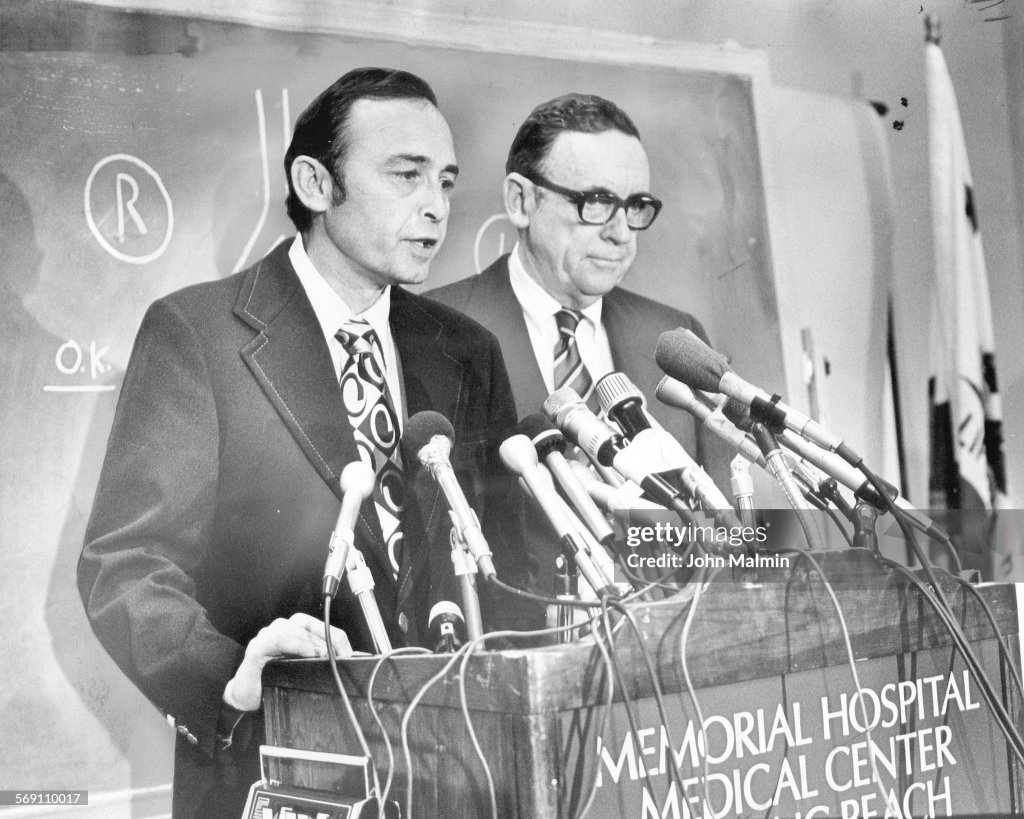
Former U.S. President Richard Nixon, who had resigned less than three months earlier following the Watergate scandal, was in critical condition after he went into vascular shock six hours after surgery to remove a blood clot from his leg. Former President Nixon was on the critical list in Memorial Hospital Medical Center in Long Beach, California Sudden intensive internal bleeding sent him into shock about six hours after surgeons completed an operation to combat a potentially lethal blood clot. A bulletin issued at 8:45 P.M. New York time said a stable vascular condition had been restored, indicating that his blood pressure at that time was back to normal or near-normal levels. Nixon remained in the intensive care unit at Long Beach Memorial Medical Center for one week and was released from the hospital on November 14.
The surgery was performed to a stop blood clot from breaking off and going to the former president’s heart; Nixon is in stable condition now, though his basic ailment, chronic phlebitis, may not be helped much by today’s surgery. Dr. William Wolff of the Beth Israel Medical Center in New York City discussed chronic phlebitis and stated that if special arrangements were made, Nixon could sustain a cross-country flight to testify at the Watergate cover-up trial.
Nixon’s attorneys requested that the White House immediately send tapes and documents which are needed for his testimony. A hearing regarding that request is set for tomorrow.
Testifying in the Watergate cover-up trial, Jeb Magruder, who was a deputy to one of the defendants, John Mitchell, at the Committee for the Re-election of the President, said Mr. Mitchell heard about — and did not object to — a plan to bug a hotel room that George McGovern was to occupy at the 1972 Democratic National Convention at Miami Beach.
During cross-examination at the Watergate cover-up trial, E. Howard Hunt admitted that his latest book on Watergate is filled with lies.
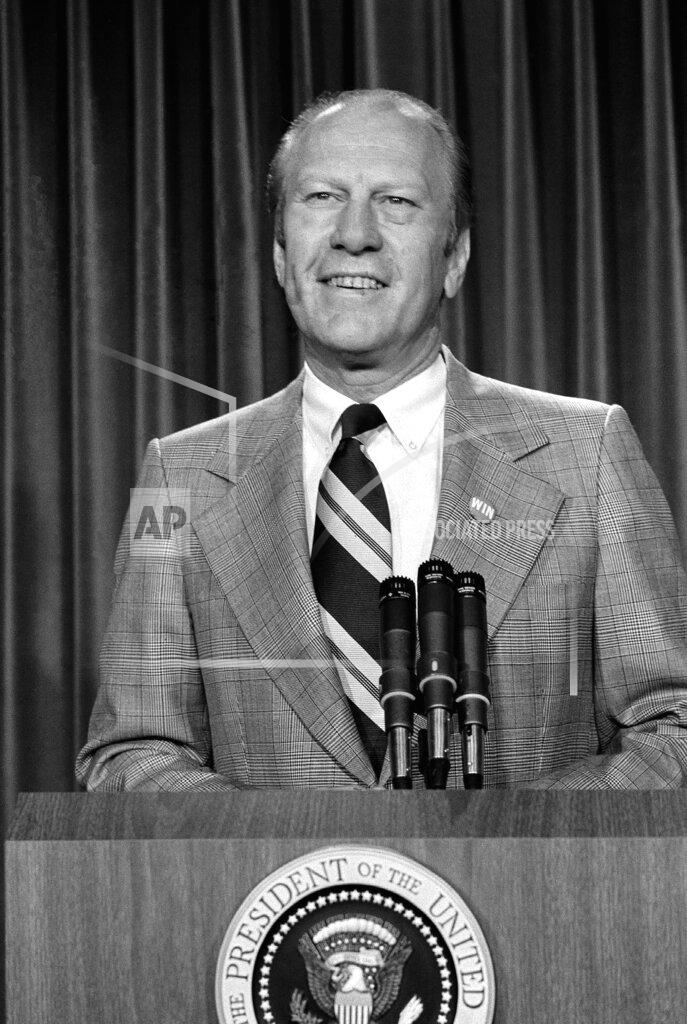
President Ford refused to sign two bills designed to help certain blind business operators and extend work protection benefits to migrant farm workers. He said he would not sign vocational rehabilitation legislation on grounds it transferred aid-to-the-handicapped from one part of the Department of Health, Education and Welfare to another “for no good reason-indeed, for very bad reasons” and would create an unnecessary new bureaucracy. He rejected the farm workers bill because it contained an unrelated rider, he said, reclassifying a group of Labor Department hearing officers as higher-salaried administrative law judges. He offered to sign the bill if that provision were removed.
At an impromptu news conference, President Ford announced the resignation of Federal Energy Administration director John Sawhill. Atomic Energy Commission chairman Dixy Lee Ray will move to the State Department. Ford introduced the new members of his staff and denied that his administration and Sawhill were at odds, but made it clear that chief energy adviser Rogers Morton wanted Sawhill out. In an interview, Sawhill discussed his removal from the FEA. Sawhill said that he’s not a politician, and perhaps his decisions weren’t politically popular moves. On a related topic, President Ford said that stiff new quotas on oil may be imposed if America’s dependence on oil can’t be reduced voluntarily.
The Federal Fire Prevention and Control Act of 1974 was signed into law by U.S. President Ford in order to provide federal funding for educating the general public about how to avoid fires. The legislation followed a report that 12,000 people were killed and 50,000 seriously injured every year by fires. The Act established the National Fire Prevention and Control Administration, the National Academy for Fire Prevention and Control, and a National Fire Data Center.
President Ford signed legislation authorizing nearly $15 million in water development projects in California, Oregon and Arizona. The new authorization includes a $10 million program for purchase of privately owned lands around the Lake Casitas reservoir in Ventura County, a $3 million recreational development at Lake Berryessa in Solano County and $1.1 million to be used for a study of water management for Solano County and a water supply system for Yuma, Arizona.
A new law bans discrimination of sex or marital status in credit applications. President Ford signed today legislation designed to force companies to correct billing errors when their customers demand it and to prohibit corporations from denying credit to women on the basis of sex.
The Supreme Court decided today to re‐examine the legality of capital punishment for the first time since a 5‐to‐4 majority ruled in 1972 that the death penalty, as then applied, was unconstitutional. The Justices agreed to hear an appeal by a convicted North Carolina murderer who was sentenced to death after the State Supreme Court interpreted a state capital punishment law as permitting such action, despite the high court’s ruling. In deciding the case, probably sometime next spring, the Court could issue a ruling of broad national impact if a majority decided to reverse the 1972 decision or took advantage of the North Carolina case to rule more clearly when the death penalty was unacceptable. But the Justices could also confine their decision to the validity of the State Supreme Court’s action, a move that would have life‐and‐death consequences for 31 convicts awaiting execution in North Carolina but would not necessarily affect the law elsewhere.
Three major tobacco companies announced increases in cigarette prices. A spokesman for wholesalers said it could mean they will cost a nickel more a pack by the time it gets to the smoker. R. J. Reynolds, which makes Winston, Salem, Camel, Doral and Vantage, raised wholesale prices 50 cents a thousand. Lorillard, which makes Kent, Old Gold, Newport and True, went up 70 cents and Phillip Morris, Inc., which makes Marlboro, Benson & Hedges, Virginia Slims and Parliament, jumped 70 cents.
Alfred Bello and Arthur Bradley, prosecution witnesses in the 1967 trial that convicted Rubin (Hurricane) Carter and John Artis of a triple murder, recanted their testimony in a Jersey City courtroom. They said they had lied under pressure from Passaic County detectives investigating the Paterson deaths.
Attorney General William Saxbe said the Justice Department is investigating whether price-fixing or other illegal behavior may have caused recent increases in sugar, beef, eggs, tuna and other basic items. He asked Congress to repeal the federal law that permits “fair trade” laws now on the books in 39 states prohibiting sale of certain items below fixed prices.
The index of economic indicators dropped 2.5% in September, the biggest drop in 23 years.
The son of the millionaire owner of the Castro Convertibles furniture chain was shot to death in his bedroom in Ft. Lauderdale, Florida. Police charged his wife with homicide. Julie Ann Castro, 24, was released on $20,000 bond in the shooting of Bernard Castro Jr., 26. Police said their investigation was “far from complete,” that Mrs. Castro had made no comment and no motive was known.
A woman accused of setting a September 9 nursing home fire in St. Joseph, Missouri, that killed seven persons was found hanged in the early morning in her jail cell. Sheriff Jack Fleck said Deborah Withrow, 22, hanged herself with a headband borrowed from another inmate. Miss Withrow was charged with first-degree murder in the flash fire at the Shildknecht Nursing Home, where she was an aide.
A third man was charged with burglary and larceny in the theft of $4.3 million from the Armored Express Corp. in Chicago, believed to be the largest cash haul in U.S. history. James Maniatis, 53, of Worth, Illinois, who already was sought by the police on charges not related to the Express case, was named by the FBI in a complaint alleging bank burglary, bank larceny and use of explosives. Maniatis had been indicted earlier on charges of trafficking in stolen watches worth $37,500. Others already accused in the October 20 theft of 800 pounds of small hard-to-trace bills were Ralph Marrera, the only guard on duty at the time, and Peter J. Gushi, 47.
New York City Fire Department firefighters Russell T. Linneball and Johnnie Williams were electrocuted when an aluminum ladder they were lowering after a warehouse fire in the Bronx came into contact with an 11,000-volt power line.
The Houston Astros deal Bob Gallagher to the New York Mets for infielder Ken Boswell. Gallagher bats .230 as a reserve outfielder for two years for the Mets. Boswell becomes a spot starter and pinch-hitter deluxe over the next three seasons.
Dow Jones Industrial Average: 659.34 (+25.50, +4.02%).
Born:
R. A. Dickey, MLB pitcher (MLB All-Star, NL Cy Young Award, NL strikeout leader 2012; Texas Rangers, Seattle Mariners, Minnesota Twins, New York Mets, Toronto Blue Jays, Atlanta Braves), in Nashville, Tennessee.
Rodney Heath, NFL cornerback (Cincinnati Bengals, Atlanta Falcons), in Cincinnati, Ohio.
Mike Crawford, NFL linebacker (Miami Dolphins), in Reno, Nevada.
Akashdeep Saigal, Indian television actor and model; in Bombay (now Mumbai), Maharashtra, India.
Yenny Wahid (born Zannuba Ariffah Chafsoh), Indonesian activist and politician; in Jombang Regency, East Java, Indonesia.
Died:
Harry Kalven, 60, American jurist and legal scholar, died of a heart attack.
Victor E. van Vriesland, 82, Dutch poet (Mirror of Dutch Poetry).


 History Diaries