Heinrich Himmler sets off a controversy when he issues an extraordinary “order” for the entire SS and police to father as many children as possible, even outside of marriage, to compensate for the German blood lost in the war. Himmler pledges to provide generous support for all such children, regardless of their parents’ marital status. Himmler issued a secret directive to the SS and police encouraging them to procreate with women of “good blood”, even outside of marriage, “to regenerate life for Germany”. The directive explained that the SS would support all mothers of children of good blood regardless of legitimacy, so no father would need to be concerned about creating a burden for them.
Starting with the town of Piotrkow, German authorities begin confining the Jews of Poland to a particular area (ghetto) of each city or town in which they live. Sometimes this area is the already prominently Jewish quarter, but often it is a poor or neglected part of the town, away from the center. Jews from the rest of the town are then forced to leave their homes, and to move into this, often much smaller area, in which even the basic amenities are unavailable. In each of these ghetto areas, food and medical supplies are restricted. Intense overcrowding, hunger and disease lead to widespread suffering and death.
On Czech Independence Day marking the 21st anniversary of the founding of Czechoslovakia, thousands of people, mostly students, protested at various locations throughout the region making up the former country. The Nazis retaliated by closing universities, executing student leaders and making many arrests. German police fire on student demonstrators in Prague marking the 20th anniversary of the former Czechoslovakian independence. Street fighting later breaks out in the city center with ethnic Germans clashing with Czech nationalists. One student is killed and a total of 16 casualties are reported. Some 3,500 people are arrested. Around 1,200 students were sent to Sachsenhausen Concentration Camp as punishment.
Nazis show anger at the U.S. Senate Neutrality vote. Spokesmen accept passage of the embargo repeal as reflecting sympathy for the Allies. The Nazis were obviously resentful and angered today by the United States Senate’s vote to repeal the arms embargo and hinted that final Congressional confirmation of repeal might lead to difficulties which the allied nations failed to anticipate.
The Foreign Office in London was embarrassed today by the British press, which hailed the vote in the United States Senate repealing the arms embargo as if it were the final word for sending thousands of planes over here to fight against Hitler.
Soviet troops began occupying bases in Latvia while preparing for war with Finland.
During the German planning for future invasion in Western Europe, the Netherlands was briefly dropped as a target.
Reports of massive German troop concentrations along the border are increasing.
The British Expeditionary Force is reported to have enough food to feed its nearly 200,000 troops for 46 days.
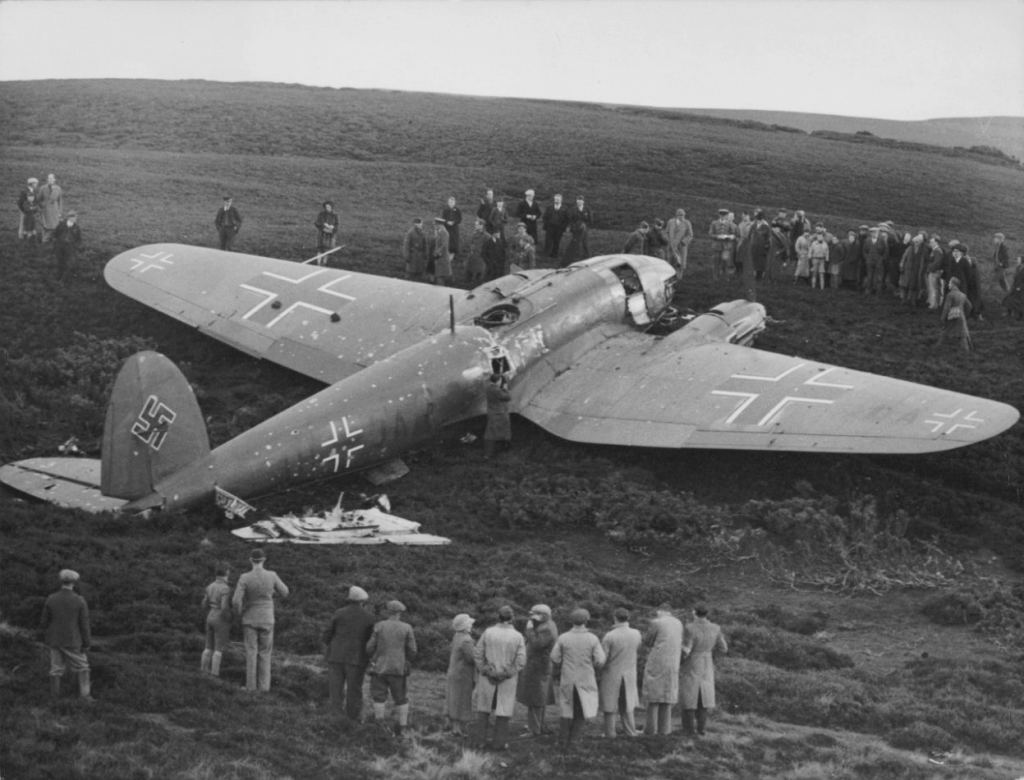
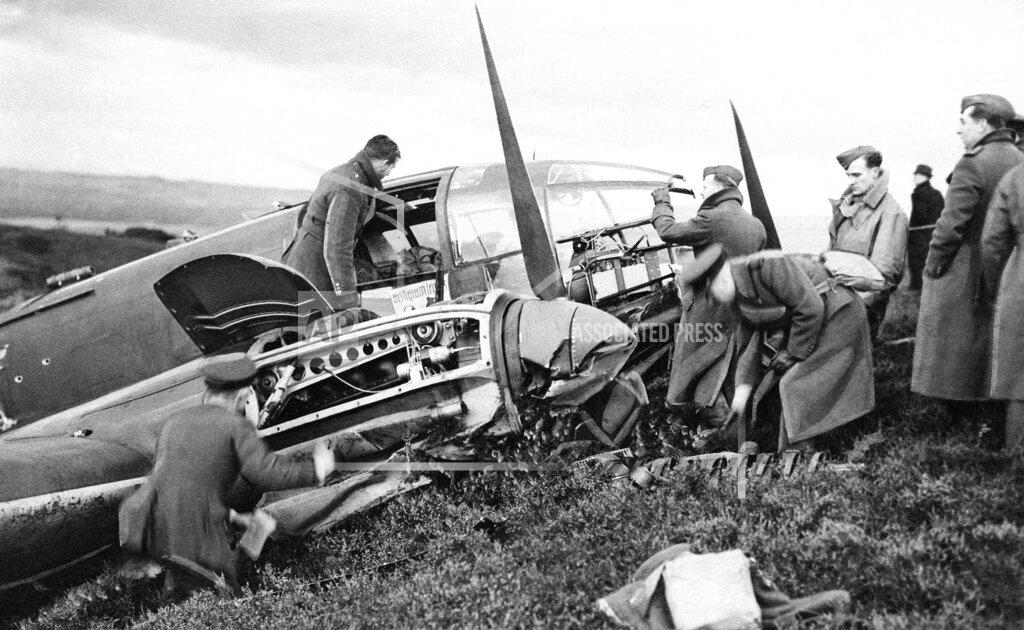
A German He 111 bomber was shot down by RAF fighters east of Dalkeith in southeastern Scotland — it is the first German airplane shot down over land in the British Isles during World War II. Two of the 4-man crew survived. Germany launches an air attack on Great Britain. The Luftwaffe raid is against Royal Navy ships anchored in the Firth of Forth. A Heinkel He 111 from Luftflotte 2 (northern Germany) is shot down near the Firth of Forth after a dramatic chase by the RAF in which the Luftwaffe plane landed and took off, was brought down and again tried to take off. The Heinkel finally winds up on the Lammermoor Hills near Humbie where it cannot taxi and try to take off any more. The two surviving crew are taken to Edinburgh. It becomes known as the “Humbie Heinkel” and is known as the first Luftwaffe aircraft brought down on British soil (there had been some shoot-downs during the First World War).
Spitfires from 602 and 603 squadrons, auxiliaries, and reservists, had met the Heinkels over the fields of East Lothian in Scotland. 25-year-old Flight lieutenant Archie McKellar was credited with the kill. He died at age 28 during the war and is known as “the Forgotten Ace.”
Night reconnaissance by the RAF over southern Germany despite bad weather.
Italy hears little of the Pope’s encyclical. Only a 1,000-word summary is issued, and commentary is forbidden.
The City of Flint left Murmansk under control of the German prize crew, intending to go to Germany.
Molotov — in a speech before the Supreme Soviet — asserts the that USSR has a right and duty to adopt strong measures to ensure security and publicly demands territorial concessions from Finland. The Soviets want:
- Territory north of Leningrad in the Karelian Isthmus;
- A base at the Finnish port of Hango for the Soviet Navy;
- Petsamo in the north of Finland, near Murmansk;
The Soviets offer to exchange some land along the wilderness of northern Finland for these strategic spots. The Finns immediately decide to reject the demand.
German armored ship Admiral Graf Spee makes rendezvous with tanker Altmark near Tristan de Cunha. The warship refuels from the auxiliary, and transfers prisoners from British freighter Trevanion’s crew to her.
U.S. freighter City of Flint, again under German control, sails from Murmansk for Norwegian waters. At no time during City of Flint’s enforced stay in the Soviet Union at Murmansk has the City of Flint’s American master, Captain Joseph A. Gainard (an inactive USNR officer) been allowed to communicate with the U.S. Embassy in Moscow.
The 250-ton British fishing steam trawler Lynx II was stopped by gunfire and after the crew abandoned ship was sunk by the U-59, commanded by Oberleutnant zur See Harald Jürst, north of Scotland (59°50′N 4°20′W). The crew was rescued by the British steam trawler Lady Hogarth.
The 565-ton British fishing steam trawler St. Nidan was stopped by gunfire and after the crew abandoned ship was sunk by the U-59 north of Scotland (59°50′N 4°20′W). The crew was rescued by the British steam trawler Lady Hogarth.
U.S. freighter Black Tern, detained at Weymouth, England, by British authorities since 11 October, is released.
The War at Sea, Saturday, 28 October 1939 (naval-history.net)
Two British cruisers were on Northern Patrol between the Orkneys and the Faroes, three cruisers on patrol between the Faroes and Iceland, and one cruiser and two armed merchant cruisers in the Denmark Strait.
A British submarine anti-invasion patrol off the Dogger Bank was in effect from 29 October to 6 November. L 26, STARFISH, SUNFISH and THISTLE, departed Rosyth on patrol on the 28th. There they were joined by CACHALOT and SEAL, which had already come directly from Portsmouth, also departing on the 28th, and by SEALION, SALMON and SHARK, again sailing from Portsmouth. UNDINE, which had left Rosyth on the 22nd, was ordered to reconnoiter north from Heligoland. Her patrol ended on 4 November.
Other submarines on patrol, all of which departed Rosyth on the dates given, were – L 27 on the 20th, off Utvaer; L.23 on the 21st, off the southwest coast of Norway; and SEAWOLF on the 26th and URSULA on the 28th, both in the Skagerrak. UNDINE assumed patrol off Horns Reef.
TRIAD, which had departed Rosyth on the 14th, returned to Blyth and SEAHORSE, also from Rosyth but on the 17th returned there on the 31st as this deployment began.
Destroyer FORESTER arrived in the Clyde for repairs which were completed on 23 November.
Convoy FS.28 departed Methil, escorted by destroyers MAORI, WHITEHALL and sloops GRIMSBY and WESTON, and arrived at Southend on the 30th. There was no convoy FN.28.
U-31 laid mines in Loch Ewe during the night of the 27th/28th, on which two auxiliary minesweepers were sunk and battleship NELSON badly damaged.
U-59 sank trawlers ST NIDAN (565grt) and LYNX II (250grt) northwest of the Orkneys in 59 50N, 04 20W; the entire crews of both trawlers being saved by trawler LADY HOGARTH (472grt). Destroyers ESKIMO, MATABELE and BEDOUIN were involved in searching for the submarine.
Destroyers ZULU and GURKHA attacked a submarine contact off St Abbs Head.
Polish destroyer ORP BŁYSKAWICA attacked a submarine contact off the Mull of Galloway in 54-45N, 5-12W.
Patrol sloop SHELDRAKE and aircraft were searching for a reported submarine off Oban, which was in fact British submarine TRIDENT.
Destroyers EXMOUTH and GREYHOUND were attempting to intercept a reported submarine in the Western Approaches.
German destroyers MAX SCHULTZ, FRIEDRICH IHN and ERICH STEINBRINCK of the 1st Destroyer Flotilla and BERND VON ARNIM, HANS LODY and KARL GALSTER of the 4th Destroyer Flotilla attempted a shipping sweep into the Skagerrak. However, they encountered heavy weather and were forced to abandon it. SCHULTZ was badly damaged by the weather and mechanical breakdown, lost power and IHN and STEINBRINCK unsuccessfully attempted to tow her. However, SCHULTZ was finally able to regain partial power and returned to Wilhelmshaven for repairs completed in late January 1940.
In operations in the Indian Ocean, a Swordfish of 825 Squadron from aircraft carrier GLORIOUS was lost in a forced landing at sea; the crew were rescued.
Light cruiser BIRMINGHAM departed Singapore for patrol in the Sunda Strait, was relieved by light cruiser DAUNTLESS on 4 November, and arrived back at Singapore on the 7th.
Light cruiser DANAE arrived at Simonstown, escorting troopship ATHLONE CASTLE (25564grt) from St Helena where they departed on the 22nd.
Light cruisers DAUNTLESS and DURBAN departed Colombo and arrived at Singapore on the 31st.
Australian light cruiser HMAS HOBART departed Singapore on patrol, and arrived back on 4 November.
The Roosevelt Administration’s proposal for revising the Neutrality Act, adopted last night by a two-to-one majority in the Senate, will pass the House by a margin of fifteen to fifty votes, according to its advocates, and will be defeated by ten votes, according to its opponents. The Rules Committee will report a rule on Monday permitting the House to take the Senate amendment to the original House resolution from the Speaker’s table and send it to conference, according to plans made today. Floor debate on the rule will start Tuesday. Leaders planned to let this debate run beyond the single hour which House rules permit.
Opponents of embargo repeal will have their opportunity when the Speaker recognizes, as he plans to do, a motion to instruct the House conferees to insist on retention of the Vorys amendment, which inserted in the original Bloom resolution last Spring a modified form of arms embargo. Such a motion will probably be offered by Representative Fish of New York, ranking minority member of the Foreign Affairs Committee and leader of the opposition to repeal of the arms embargo. Representative Martin of Massachusetts, minority floor leader, intends to take no active leadership in the debate, in the hope that the question will be considered in a nonpartisan atmosphere, he said today.
The whole fight in the House, according to present indications and by virtue of the parliamentary presentation of the issue, will hinge on the arms embargo, and the motion to instruct will give the opponents and proponents their first, and perhaps last, opportunity to record themselves. If the House should fail to instruct its conferees (which it would if the Fish motion should be lost), it is presumed that the conferees will quickly agree on substantially the version the Senate passed last night and that the House will approve their report.
If, on the other hand, the House conferees should be instructed (which they would be if the Fish motion should carry), they must persuade the Senate conferees to accept the Vorys amendment, in which case the Senate might reject the report, or bring back a report which the House might reject because it did not contain the Vorys amendment.
In attempting to restore some form of arms embargo, the opponents of complete repeal will, according to present indications, stress the fact that the Vorys amendment would only bar exports of “arms and ammunition,” omitting the words “and implements of war,” which are included in the present law. Representative Vorys of Ohio, Republican author of the amendment, stated, in offering it to the House last June, that it would not bar sales to belligerents of “commercial airplanes.” It was on this understanding that the whole debate proceeded in the House leading up to the adoption of the amendment. It was stated by advocates of the Vorys amendment that airplanes of any kind, provided they did not carry machine guns, bomb racks and sights, or other purely military equipment, could probably be exported as “commercial airplanes.”
In counting probable votes for and against the Administration’s proposal, leaders on both sides attached considerable importance to the overwhelming Senate vote as a psychological factor favoring its passage in the House. Representatives who are on the borderline, it is reasoned, will be influenced to go along with what appears to be the popular side, to judge from the Senate roll-calls. Mr. Fish opened the House campaign for retention of the arms embargo in a radio speech over the National Broadcasting Company’s red network tonight, addressing a special appeal to the citizens of New Jersey to ask their representatives to vote for the arms embargo “as they did last June,” indicating there might be defections among the New Jersey delegation.
“The arms embargo in itself may not be the decisive or compelling factor,” Mr. Fish said, “but it is the symbol as to whether we are to take sides and participate in the European war. I do not, from a careful study of the facts, believe that England and France want or need our arms and ammunition as they have huge factories employing scores of thousands of women making cannon and shells at much less cost than in America. They have built enormous airplane plants which in the next few months will be producing more than Germany. They do want the repeal of the arms embargo, as a symbol that we are ready to intervene on their side as the first step. They think, and possibly rightly, that the two next steps will follow logically — that of financing the war after we are sufficiently involved and, later on, sending our soldiers to the shambles of Europe.”
The U.S. lodges a protest with the Soviet government over the handling of the City of Flint, which already has left port. With the freighter City of Flint evidently having left Murmansk carrying her American crew on board under a German prize detail and with Laurence A. Steinhardt, the United States Ambassador to Russia, having been unable to communicate with Captain Joseph A. Gainard of the ship, the State Department tonight charged the Soviet Government with “withholding adequate cooperation.”
The charge, made in a formal statement, reflected the intense irritation felt in Washington over the cavalier fashion in which the diplomatic representative of this government in Moscow has been treated by the Soviet authorities. Officials expressed unconcealed anger over the failure to ascertain any definite facts officially regarding the vessel. State Department officials discussed the situation from every angle during the day. It was learned that staff conferences, headed by Secretary Cordell Hull, were held behind closed doors twice during the day. Officials, however, preserved an unusual reticence and nothing more than the formal statement was made public.
Grieved and pained, he said, by President Roosevelt’s criticism of, and “continued unfriendliness” toward, the House Committee on Un-American Activities, Chairman Dies declared tonight in a radio address that nothing would stop him from exposing to the public the presence of Communists in the Federal Government. Refusing to enter into a controversy with the President, Mr. Dies “served notice upon the country and the Administration” that should the investigation continue, he would not stop from investigating the “tax-supported officialdom of the nation’s capital.”
“If we are not free to reveal the identity of the parlor pets of Moscow who plot the overthrow of our government over their teacups, then we can have no investigation worthy of the name,” he asserted in his speech over the Columbia Broadcasting System. The chairman’s remarks were made as a reply to the accusation of “sordid procedure” with which President Roosevelt recently characterized the release by the committee of the list of members and mailing list of the American League for Peace and Democracy. That organization, Mr. Dies said tonight, had always served the interests of the Soviet regime.
National unemployment fell 6.7 percent last month, bringing the number of persons out of work to fewer than 9,000,000 for the first time since November, 1937, the National Industrial Conference Board reported yesterday. Since February, when the board estimated the number of unemployed at 10,694,000, there has been a decline of 1,896,000, or nearly 18 percent.
Palestine and the United States were put nearly on a par as countries receiving refugees from Greater Germany since the Nazi persecutions began in 1933, in estimates just made public by Sir Herbert Emerson of Great Britain, director of the Intergovernmental Committee on Political Refugees. They led all countries in the list of havens for refuge. Palestine in the period received 70,000 and the United States “nearly” 70,000, Sir Herbert said. This is more than half the total for all countries.
The people of the United States were urged yesterday by the National Catholic Alumni Federation to return to the religious principles on which their country was founded. A resolution was adopted condemning secularism.
The New York World Fair ends in two days, with more than 25,000,000 people visiting its exhibits.
Oklahoma extends its food stamp program to low-income families as well as those on relief.
Proposals to strengthen the U.S. Navy’s Atlantic Squadron and put it on a permanent basis were shaping today among members of the House Naval Committee.
The army’s new “streamlined” infantry division, basis of the extensive reorganization of the army now under way, appears to be weak in anti-tank and anti-aircraft defense in comparison with the divisions of foreign armies, an analysis of the new combat unit disclosed.
Helen Wills Moody, former world women’s singles tennis champion, and Aidan Roark, noted polo player, were married in Las Vegas today. It is the second marriage for both.
The 1939 Nebraska vs. Kansas State football game was the first college football homecoming game ever televised. Nebraska won 25–9.
Selected college football scores:
Alabama 7, Mississippi State 0
Army 46, Ursinus 13
Boston College 28, St Anselmo 0
Clemson 15, Navy 7
Columbia 26, VM I 7
Cornell 23, Ohio State14
Dartmouth 16, Harvard 0
Detroit 16, Tulsa 7
Duke 6, Wake Forest 0
Florida 14, Maryland 0
Fordham 27, Pittsburgh 13
Georgetown 7, George Washington 0
Georgia Tech 7, Auburn 6
Hofstra 7, Brooklyn
Holy Cross 27, Colgate 7
Iowa 19, Wisconsin 13
Lafayette 40, Gettysburg 0
Louisiana State 12, Vanderbilt 6
Lowell Text 7, CCNY 0
Michigan 27, Yale 7
Missouri 21, Iowa State 6
Nebraska 25, Kansas State 9
N.Y.U. 14, Georgia 13
North Carolina, 30 Penn 6
Northwestern 13, Illinois 0
Notre Dame 7, Carnegie Tech 6
Oklahoma 41, Oklahoma A&M 0
Oregon State 13, Washington State 0
Princeton 26, Brown 12
Rutgers 20, Lehigh 6
Santa Clara, 13 Purdue 6
Southern California 26, California 0
Syracuse 6, Penn State 6
Tennessee 17, Mercer 0
Texas 26, Rice 12
Texas A&M 20, Baylor 0
Tufts 14, Williams 12
Tulane 18, Mississippi 6
UCLA 16, Oregon 6
Villanova 7, Arkansas 0
Virginia 26, William and Mary 6
Washington 8, Stanford 5
Wesleyan 19, Amherst 14
In India, Mahatma Gandhi stresses his demands, questioning whether an India dominion will be independent.
Twenty thousand Chinese guerrillas under the control of the Communist-dominated New Fourth Army continue to maintain a constant harassing of Japanese districts immediately west of Shanghai, according to General Yeh Ting, commander of the New Fourth Army, who is now visiting Chungking.
General Yeh said that repeated Japanese clean-up drives, some with 4,000 or 5,000 troops participating, had failed to smash the influence of the guerrillas in the Shanghai area. In the Nanking-Wuhu area, General Yeh declared, the New Fourth’s activity is forcing the Japanese to keep 10,000 troops garrisoning points two or three miles apart in the vicinity of Nanking, Wuhu, and Chinkiang.
The general is in Chungking to obtain funds for food and clothing for his 40,000 men who operate in an extensive area in Kiangsu and Anhwei Provinces. He said there was not an acute need for arms. “We capture sufficient from the Japanese,” he declared.
First-hand news of the North China guerrilla areas was brought to Chungking today by Michael Lindsay, Professor of Economics in the American-supported Yenching University at Peiping. Professor Lindsay, a Briton, took three months to work his way through the Japanese-Chinese fighting zones in Hopeh and Shansi Provinces, and then to Chungking by way of Sian, in Shensi. He reported that the Japanese were making headway in their efforts to gain control of Hopeh, but he said the Shansi Chinese are still holding their own in a continuous bitter struggle.
Six armed Chinese fired today on Shanghai municipal police patrolling extraterritorial roads over which the International Settlement and the Japanese-sponsored Chinese municipal government claim jurisdiction. The incident broke a week of quiet that followed threats by Cornell S. Franklin, chairman of the Municipal Council, to demand that United States Marines be assigned to protect American lives and property.
Municipal police, who returned the fire of the terrorists, wounded and arrested one of their assailants. They said that questioning of the captive may establish definitely whether the Japanese-sponsored Chinese municipal government is behind acts of terrorism on the outside roads, which are in Chinese territory but which were built, maintained and policed by the International Settlement.
Optimism concerning the results of the United States-Japanese negotiations is expressed in Tokyo newspapers which significantly are not motivated by any urgent desire to remove American complaints but by the belief that a general clearing up of Japan’s relations with the democratic powers will powerfully accelerate a settlement in China.
It is expected that while the negotiations with the United States and Britain are kept separate they will proceed concurrently. Sotomatsu Kato, Vice Minister for Foreign Affairs, who will confer with Sir Robert Leslie Craigie, the British Ambassador, was ordered back to Tokyo while on his way to China. Only last Wednesday he had expected to return to China to remain indefinitely and his recall indicates that the government’s plans made rapid progress during the closing days of the week.
Dow Jones Industrial Average: 153.12 (-0.34)
Born:
Jane Alexander [née Quigley], actress (“The Great White Hope”, “All the President’s Men”, “Kramer vs Kramer”, “Testament”), chairwoman of the National Endowment for the Arts (1993–1997), in Boston, Massachusetts.
Andy Bey, American jazz singer and pianist (Horace Silver; Gary Bartz), in Newark, New Jersey.
Miroslav Cerar, Yugoslav gymnast (Olympics gold medal, 1964, 1968), in Ljubljana, Kingdom of Yugoslavia.
Died:
Alice Brady, 46, American silent and talkie film actress (“My Man Godfrey”; “The Gay Divorcee”; “Zenobia”), of cancer.
Naval Construction:
The Royal Fleet Auxiliary Ranger-class fleet support tanker RFA Brown Ranger (A 169) is laid down by Harland and Wolff (Govan, Scotland, U.K.).
The Regia Marina (Royal Italian Navy) Liuzzi-class submarine Alpino Bagnolini (Bl) is launched by Tosi (Taranto, Italy).
The Marinha do Brasil (Brazilian Navy) Carioca-class minelayer Camocim (C 3) is launched by Arsenal de Marinha do Rio de Janeiro (Ilha das Cobras, Rio de Janeiro, Brazil).
The Royal Navy armed merchant cruiser HMS Queen of Bermuda (F 73) is commissioned. Her first commander is Captain (retired) Miles Brock Birkett, DSO, RN.
The Royal Navy Kingfisher-class (Third group) patrol sloop (later rated corvette) HMS Guillemont (L 89, later K 89) is commissioned. Her first commander is Lieutenant Commander Henry Maxwell Darell-Brown, RN.




 History Diaries