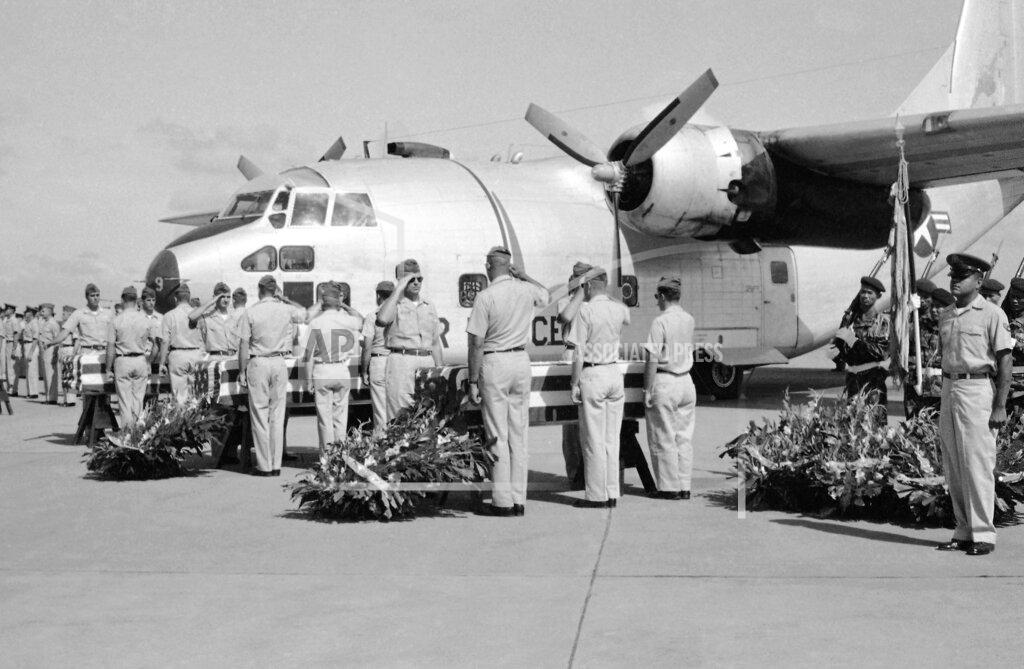
United States and Vietnamese spokesmen acknowledged today that American and South Vietnamese aircraft had fired on targets in Cambodia at least five times in the last week. They said the actions had been forced by increased Việt Cộng activity from bases in Cambodia. The official statements heightened the tension along the poorly marked frontier. Long‐standing border frictions have become critical in a series of incidents reflecting the intensity of the anti‐Communist struggle in South Vietnam. The United States spokesman, Barry Zorthian, confirmed that a United States Air Force C‐123 transport plane, which was shot down Saturday, was flying over Cambodia when it was hit. He said the fire came from heavy machine guns in Cambodian territory. Eight Americans were killed when the plane went down. Armed United States helicopters, circling over rescue operations around the wreckage on Sunday, returned fire that came from a Cambodian village and military camp, Mr. Zorthian said.
South Vietnam presented formal apologies for an incident on October 20, in which Vietnamese aircraft strafed a Cambodian village near the frontier. “The steps necessary to eliminate these regrettable incidents include the termination of hostile activity by the Việt Cộng in border areas,” Mr. Zorthian said. The root cause of the incidents, he said, is not a will to make war by either the Americans or the Vietnamese, but a situation in which the Việt Cộng are using the border to launch attacks and secure base facilities for troop movements across the entire Mekong delta.
Two difficulties, one of politics and one of geography, make the problem between Cambodia, South Vietnam and the United States particularly delicate. Geographically, the problem along most of the 575‐mile frontier is that it is not discernible either on the ground or from the air. It passes through desolate mountains and flooded delta land. This was the difficulty for the downed C‐123 transport, diplomatic and military spokesmen said. The pilot was not aware he had penetrated Cambodian airspace while preparing to land at an outpost in the mountains.
The political difficulty is that it is not, and perhaps cannot be, determined whether fire from Cambodian territory is coming from Cambodian forces or from Việt Cộng units using Cambodia as a sanctuary. Spokesman here are careful therefore not to accuse the Cambodian Government of having committed hostile acts against South Vietnamese or American forces. Many informed intelligence officials are willing to believe that the Cambodians are deliberately overlooking Việt Cộng operations that they have insufficient force to prevent, even if they wanted to.
The Cambodian Government in Phnom Penh categorically denied today that Cambodian forces were in any way responsible for the death of an American officer, Captain Herman Y. Towery, who was captured near the Cambodian-Vietnamese border last Thursday. United States military spokesmen said a Cambodian fort laid down covering fire while Captain Towery and three Vietnamese soldiers were taken, back toward Cambodia. His body and those of two of his companions were found later in Vietnamese territory.
U.S. T-28s, piloted by Thais, bomb and strafe North Vietnamese villages in the Mụ Giạ Pass area. The United States denies the public charge by North Vietnam, however, that any U.S. naval units participated in recent attacks on North Vietnam.
Władysław Gomułka, the Polish Communist leader, said today that there had been “justified grounds” for the ouster of Nikita S. Khrushchev. Mr. Gomułka, who recently conferred with the new Soviet leaders, disclosed that Mr. Khrushchev had presided at the Central Committee meeting that voted him out of office. He also called upon the Soviet Union and Communist China to settle their differences. The Polish leader left no doubt that he was satisfied with the Soviet explanation for the dismissal of Mr. Khrushchev as Premier and party leader.
Speaking at a Mongolian-Polish friendship rally in honor of Yumzhagiin Tsedenbal, First Secretary of the Mongolian Communist party, who is visiting Poland, Mr. Gomułka said that the Soviet Central Committee had respected Leninist principles of internal party democracy when it dropped Mr. Khrushchev. His recent talks with Mr. Khrushchev’s successors — Leonid I. Brezhnev as party secretary and Aleksei N. Kosygin as Premier — had confirmed “full unanimity” of views between the Polish and Soviet Governments and parties, he said.
Mr. Gomułka’s appeal to Moscow and Peking to take “diligent steps” to settle their controversy appeared to confirm that this issue had precipitated Mr. Khrushchev’s downfall: The former Premier had insisted on a conference of Communist parties on the dispute. The conference was widely opposed on the ground that it would further divide the Communist world. Mr. Gomułka is evidently hopeful that the new Soviet leaders will stand a better chance than Mr. Khrushchev of coming to terms with China. His prompt appeal. to both countries suggests that he may have been told that Moscow is already considering, some new initiative. The Poles had previously in. dicated their displeasure with Mr. Khrushchev’s handling of the Chinese issue. But they yielded to considerable pressure and reluctantly agreed to attend the conference, scheduled. for December 15.
Since Mr. Khrushchev’s dis‐missal nothing has been said about that meeting. While there is much talk about the need for a meeting of Communist parties, Moscow clearly has in mind a conference vastly different from the one that Mr. Khrushchev envisaged. There is discussion here of Communist leaders going to Moscow in November for the anniversary of the Bolshevik revolution. But such reports could not be confirmed. So far all official Polish comment on the changes in Moscow has been left to Mr. Gomułka, who has made two speeches with brief references to Mr. Khrushchev.
Premier Chou En‐lai of Communist China has expressed hope that relations between Peking and Moscow will improve following the downfall of Nikita S. Khrushchev. Mr. Chou said Mr. Khrushchev’s replacement as Premier and party leader was a “good thing.” The Chinese Premier’s comments were made in Peking October 24 in an interview of an hour and a half’s duration with four Filipino newsmen. He answered questions on a wide range of subjects.
The atomic bomb that China exploded on October 16 was bigger than those dropped on Hiroshima and Nagasaki by the United States in 1945, he said. He did not make the claim that the Chinese weapon was large by today’s standards. “Our atom bomb is small, but from the very first day of its birth it joined the struggle for peace,” he said. “Our purpose in acquiring atom bombs is not to threaten others,” he added. “We are not like the United States.” Peking’s relations with the United States do not seem likely to improve in the near future, the Chinese leader remarked.
He had this comment on the removal of Mr. Khrushchev: “In one word, it is a good thing.” Asked whether he believed relations between Peking and Moscow would improve as a result of Mr. Khrushchev’s downfall, he asserted: “That is our hope. You can see this from the congratulatory message our party and state leaders sent to the new leaders of the Soviet party and state.”
The United States joined Britain today in warning the Government of Rhodesia against proclaiming independence without the consent of the majority of the black population. The State Department said that the United States Government had “followed the course of events in Rhodesia with intense interest and mounting concern.” The statement, which was submitted later to the United Nations Special Committee on Colonialism, was made public by the department here apparently to call attention to Washington’s position on the latest African crisis. The State Department’s statement followed by a day a British warning to Rhodesia, which is governed by white settlers. Prime Minister Harold Wilson had said that a declaration of independence without the approval of the British Parliament would result in a series of political and economic reprisals, including the ending of Commonwealth ties.
The Malaysian Prime Minister, Prince Abdul Rahman, reported today that Indonesian guerrillas made a new landing on Malaysia’s southwest coast. Three of the invaders have been captured after a clash with Malaysian security troops. Prince Abdul Rahman said that the invaders crossed the narrow Strait of Malacca from Indonesian Sumatra in five boats. He declined to say how many men landed. But he said Malaysian troops and police were in action and the situation was under control. The Prime Minister said police received first word of the landing from members of the Vigilante corps patrolling the Malacca‐Johore State coastal border region. Official sources said the region has been placed under curfew from 11 AM to 11 PM.
President Ibrahim Abboud of the Sudan declared martial law and a state of emergency today, the Omdurman radio reported. He ordered striking Government employes to return to work immediately and threatened to use force against all demonstrators and rioters. The Sudan has been in a state of tension and violence for almost a week. The Omdurman radio announced the declaration of martial law after having been off the air for more than three hours. During the morning an announcer said the staff had decided to join the Sudanese people in their general strike and the radio station was being surrounded by troops. After the station came back on the air its broadcasts declared that demonstrations and riots had been renewed throughout the Sudan, leading to clashes with the police and warnings by President Abboud that force would be used as well as appeals to the people to “listen to reason.” Reports reaching Cairo said the Sudan was in complete upheaval and strikes were spreading.
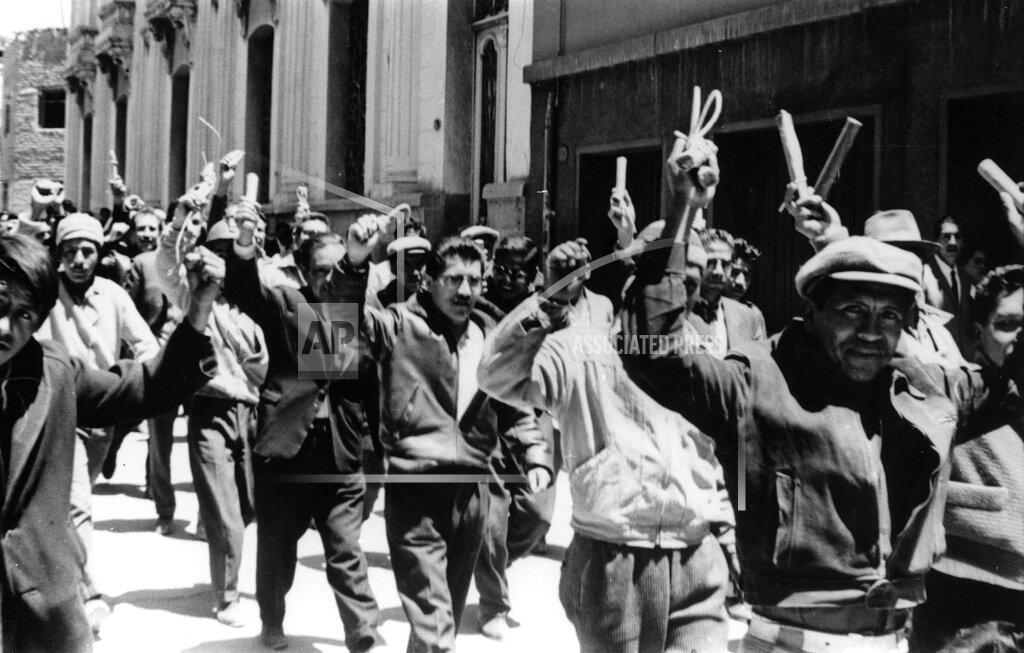
Demonstrations against the Bolivian Government of President Victor Paz Estenssoro flared again today and 10 persons were reported killed. The Government blamed Communists and leftists for the rioting in the tin mining center of Oruro, 143 miles south of La Paz. A communiqué said troops were on the way to the San Jose Mine near Oruro to free a group of militiamen seized by the miners as hostages. As the turmoil heightened the powerful Bolivian Miners Federation called a 24‐hour nationwide strike. The union accused the Paz Government of repression and the jailing of several labor leaders in the last few days. The Paz Government has been in difficulty since its announcement last month that an anti‐Government plot had been discovered. The Government imposed a state of siege, invoked press censorship and deported several leaders of the opposition.
The Stanleyville radio has disclosed that Dr. Paul Carlson, a 36‐year‐old American medical missionary, has been arrested for “spying” and brought to rebel headquarters for trial by a “military tribunal.” The broadcast, monitored here three days ago, was described as a communiqué issued by Christophe Gbenye, president of the Stanleyville Congolese People’s Republic.” The communiqué charged that, Dr. Carlson was a “United States major.” It said he was captured September 20 in the Yakoma fighting, was in good health, and was awaiting trial by a military tribunal as soon as it completed its study of the case.
The East German ship MV Magdeburg capsized after colliding with the Japanese ship MV Yamashiro Maru off Broadness Point in the United Kingdom, dumping its entire cargo of 42 British Leyland buses into the Thames river. The buses had been sold to Cuba in spite of American requests that Britain not trade with the regime of Fidel Castro.
The municipal government of the Indian city of Bangalore demolished a monument that had been built by the British to commemorate the British lives lost in the 1791 Siege of Bangalore. For 15 years, the city had resolved to get rid of the memorial as a symbol of the British conquest of India.
Canada’s Prime Minister Pearson announced that Mount Kobau near Penticton, British Columbia would be the site of the Queen Elizabeth II Observatory, with a 150-inch telescope that would be second only to the 200-inch Mount Palomar telescope in California. Cost overruns and “objections from university-based astronomers who wanted a better site” would lead to the cancellation of the project in 1968.
President Johnson believes that any increases in steel prices at this time would be extremely difficult to justify. Contracts between the United Steelworkers of America and the steel companies expire next June, and wage negotiations can begin January 1. These wage talks could have an important effect on prices, and the President is keeping close touch with all preliminary moves now in progress toward contract changes. There have been recent reports that a steel price increase is in prospect. Steel executives have been arguing that profits are inadequate and that a price rise is needed.
The President’s views on certain economic questions became known today from a qualified source as Mr. Johnson and his party campaigned in California. Mr. Johnson believes that the economy as a whole can sustain its present momentum at least until mid‐1965. His economic advisers, however, have indicated to him that some further action may be necessary by that time to stimulate the economy. Among the steps being considered are a revision of excise taxes, which are due to expire June 30.
The President believes there are two reasons that make any price increases in steel generally unjustifiable. The first, according to the source, is that profits for the first nine months of 1964 were up 29 per cent over profits for the same period of 1963. Secondly, imports have been rising to 5 million tons a year compared with the previous rate of 2 million. The source said the President believed that, if present conditions continued, imports might reach 7 million tons by 1965.
At the same time, President Johnson notes, steel exports have been declining. The net result of this decline has been a loss of about $1 billion in foreign exchange, a situation that has affected the balance of payments. The balance of payments is the measure of payments into and out of the country, by business, individuals and governments. It has been in deficit for many years.
Prices on the New York Stock Exchange dropped sharply in the final hour of trading Wednesday after President Johnson indicated disapproval of any further attempt by the steel industry to raise prices. Steel issues were weakest, with losses of 1 to 4 points.
Chief Justice Earl Warren refused today to delay the effect of a lower court order that would require Virginia to reapportion both its House of Delegates and State Senate by December 15 and to hold a special election in 1965. The Virginia case had been considered a key test of the Supreme Court’s willingness to “go slow” on reapportionment of state legislatures. Today’s action revealed no disposition by the Chief Justice to do so. However, Virginia’s Attorney General, Robert Y. Button, said denial of the stay would not affect his intention to petition the full Supreme Court for a review of the lower court’s decree. Mr. Button said he would do so promptly. He has less than seven weeks.
The issue of reapportionment was a principal cause of Congress’s delay in adjourning this year. Conservatives in both houses initiated a late drive either to curtail the Federal courts’ powers to review reapportionment in the states or, at the least, to express “the sense of Congress” that the courts should avoid hasty action. Both these moves failed in the closing days of the 88th Congress, which did not adjourn until October 3. But conservative candidates for elective office have continued to press the issue. The immediate impact of today’s decision, If it stands, will be in the Senate of the Virginia General Assembly. Justice Warren’s refusal to grant the state a stay means that the four-year terms of Virginia’s 40 State Senators, which normally would not have expired until January, 1968, would be cut to two years, ending in 1966.
The Supreme Court refused today to hear arguments on Senator Barry Goldwater’s demand for free, equal radio‐television time to answer President Johnson’s address of October 18 on world affairs. Indications were that the decision was 6 to 2, but this was not announced. The Court said only that Justices Hugo L. Black and Arthur S. Goldberg dissented and that Justice Byron R. White had taken no part. There was no comment from the majority, but Justice Goldberg and Justice Black wrote a three‐page opinion expressing their views.
Justice Goldberg said he considered the questions raised as “substantial” and he recited the law at some length. He and Justice Black said they thought it important that arguments on Mr. Goldwater’s plea be heard tomorrow, as the Republican Presidential nominee had requested, since the election is next Tuesday. The Court recessed last Monday until November 9, but the Justices could have ordered a special session if they had desired.
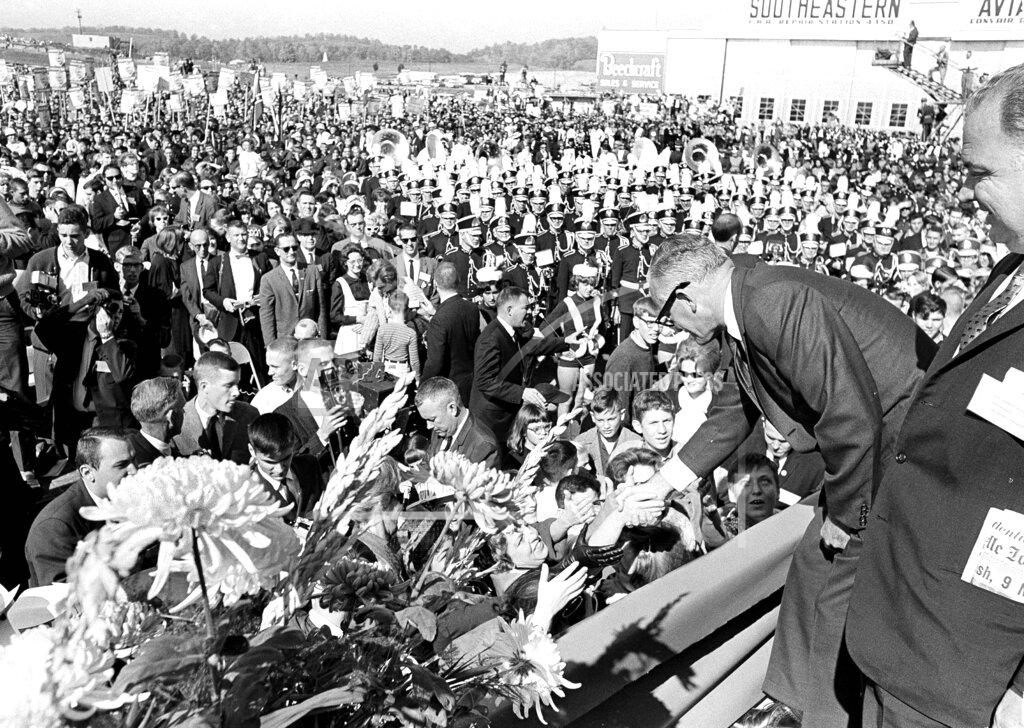
President Johnson, who has maintained a lead in the publicopinion polls, concentrated his campaign today on appeals for a large voter turnout next Tuesday. He told an audience at Albuquerque, New Mexico, this morning that he thought he would beat the Republican candidate, Senator Barry Goldwater of Arizona, but he added: “Anybody who counts those votes before they are in the ballot box is gambling with his life and with the future of this; nation. The risk is too great.”
Mr. Johnson continued to stress that the key issue in the election was “survival” in a nuclear age and to try to profit from the charge that Senator. Goldwater is impulsive. Stressing the need for restraint and responsibility in dealing with a Communist world armed with nuclear weapons, Mr. Johnson told a Los Angeles audience that “some people have more guts than brains.” He did not mention Mr. Goldwater, but there was little doubt about whom he was discussing. In his speech, Mr. Johnson said that it was not practicable to tell other nations to “go to hell — because they don’t want to go.”
Senator Barry Goldwater questioned today how the churches could be “concentrating on morality” when “clerical spokesmen” have become “loud advocates” of President Johnson. The Republican Presidential candidate injected this new note into his campaign in a speech at an intersection in downtown Cedar Rapids. The remark was not in his prepared text.
Mr. Goldwater led into the remark by saying that former President Herbert Hoover, whose burial at West Branch, Iowa, Mr. Goldwater attended Sunday, had once asked four questions, the answers to which determined whether the Government was “well and duly serving the nation.” Mr. Goldwater mentioned just two of them: “Is representative government in working order?” and “Are the doors of the schools and churches open?”
Representative government is not in working order, Mr. Gold, water said, “because of the insatiable desire of one man — the President — to have more and more and more power over your lives and businesses.” The schools are open, Mr. Goldwater said, “but how strongly can you create morality in the minds and hearts of young people when the Supreme Court has said you cannot pray in the schools?”
President Johnson, questioned tonight about the case of Walter W. Jenkins, said that “President Eisenhower had the same problem” with one of his aides. “The only difference is we Democrats felt sorry for Mr. Johnson said. “We thought it was a case of sickness and disease and didn’t capitalize on a man’s misfortune.” Mr. Jenkins resigned as a special assistant to the President after it became known he had been arrested twice on morals charges. There have long been stories in Washington that a candidate for an Eisenhower White House staff post was not appointed after a security check disclosed a homosexual background.
The Roman Catholic hierarchy of the United States asked today for a “forthright and unequivocal condemnation” by the Ecumenical Council of the “cancerous evil of racial injustice.” Speaking for the 175 United States bishops now attending the Council, the Most Rev. Patrick A. O’Boyle, Archbishop of Washington, asked that a special section dealing formally and explicitly with the race problem be added to the schema under debate on “The Church in the Modern World.” “Racism, which, in various forms and in varying degrees, is to be found in almost every region of the world, is not merely a social or cultural or political problem,” he told the Council. “It is, first and foremost, a moral and religious problem and one of staggering proportions.”
A tear‐gas bomb was tossed into a civil rights headquarters near Indianola, Mississippi early today and fire broke out a short time later in a nearby Freedom School. Nobody was seriously injured in either incident. A 14year‐old Black, Ernest Smith, who had been sleeping in the headquarters building, was slightly cut when he jumped through a window.
A three‐judge Federal panel declared unconstitutional today a Mississippi law requiring a receipt for “nonpayment of poll taxes.” The order directed the State Election Commission to “desist from application or use of the act in any way to deny any registered voter the right to vote.” A separate ballot for state and Federal offices is being used in the November 3 election. Only voters who have paid poll taxes will be allowed to vote on the state ballot. The law was said to have been designed to prevent voters who had not paid poll taxes from voting in state elections. Mrs. Victoria Jackson Gray and Cedia Wallace charged the law “was designed for the purpose of preventing persons who have registered without payment of a poll tax, most of whom are Negroes, from voting.”
Washington and Lee University, a 215‐year‐old private school where General Robert E. Lee is buried, has opened its doors to Black students. The announcement of the decision to drop racial barriers was made today by the university president, Dr. Fred C. Cole. The decision was made last summer by the school’s board of trustees. No applications from Blacks, however, are being considered at this time by the committee on admissions. So far none has completed an application for admission next term.
“The Wednesday Play,” a British anthology series, began the first of six seasons on the BBC1 network and, in its first two seasons “changed the face of television drama in Britain, introducing contemporary, social-issue drama”, and later “initiating a technological breakthrough by moving over to film and location shooting… out of the studio and into the real world.”
The Irish television police show, “Garda Patrol,” was broadcast for the first time, as a weekly show on the Raidió Teilifís Éireann (RTE) network. Sergeant Tommy Burns of Ireland’s national police agency, the Garda Síochána, would explain to viewers that the objectives of the program were “to offer advice on how to defeat the criminal and outsmart him in his efforts and secondly to seek your help in bringing offenders to justice.”
Dow Jones Industrial Average: 871.16 (-4.82)
Born:
Griffin O’Neal, American actor (“April Fools Day”, “Wraith”), son of Ryan O’Neal, brother of Tatum O’Neal, in Los Angeles, California.
Costantino Mastroprimiano, Italian classical pianist, educator, and musicologist, in Foggia, Italy.
Leonard Jones, NFL defensive back (Denver Broncos), in St. Louis, Missouri.
Died:
Harold H. Burton, 76, Associate Justice of the U.S. Supreme Court from 1945 to 1958, former U.S. Senator for Ohio and former Mayor of Cleveland.

 History Diaries